Showing posts with label Asian Art. Show all posts

Thursday, July 31, 2025

Art Eyewitness Close-up: Mahamayuri on Peacock, from The Met's "Recasting the Past" Exhibition


Mahamayuri on Peacock 


Recasting the Past: the Art of Chinese Bronzes Exhibition

The Metropolitan Museum of Art


Text by Ed Voves
Original photography by Anne Lloyd and Ed Voves

In an Art Eyewitness post earlier this year, I promised a return visit to Recasting the Past: the Art of Chinese Bronzes, 1100-1900, on view at The Met until September 28, 2025.

The Met's remarkable exhibition convincingly demonstrates that the casting of bronze works of art in China was much more than a long postscript to the glorious Shang bronzes created in China's distant antiquity. Amazingly, this belief was held by a number of reputable scholars.

Having more than proved its point that the long tradition of Chinese mastery in casting bronze and metal alloy works of art extended to modern times, Recasting the Past concludes on a surprising, almost unsettling note. 


   Anne Lloyd, Photo (2025)  Mahamayuri on Peacock,1426-35

The last work on display looks distinctly uncharacteristic of China's artistic conventions. It is a masterpiece so spectacular, so uniquely expressive that it seems more of a stand-alone display than the grand finale of an exhibition detailing the Chinese devotion to fugu, the "return to the past."


                      Ed Voves, Photo (2025)                                 
                    Gallery view of the Recasting the Past exhibition at The Met

This singular masterpiece is entitled Mahamayuri on Peacock. It dates to 1426-35, a cultural high point of the Ming Dynasty (1368-1644). One of the highlights of Berlin's Ethnologisches Museum, Mahamayuri is making a rare visit to the U.S. and its presence in The Met exhibit is deeply significant, as well as a wonder to behold.


The spiritual ideals which which led Chinese artisans of the Ming-era to create Mahamayuri on Peacock can be traced to three of Asia's great "awakenings." In this single work of art can be traced the birth of Buddhism in ancient India, its migration to the kingdoms of the Himalayan region and, finally, the integration of Buddhism within the traditions of Chinese culture.

Mahamayuri is a bodhisattva, a being striving toward enlightenment or Buddhahood.  An important aspect of this process of "becoming" is the bodhisattva's compassion for humanity and indeed all fellow creatures.

Mahamayuri is a Sanskrit name meaning "Great Peahen", in token of the reputation of these extraordinary birds for devouring snakes. One of the principal tasks of Mahamayuri is to safeguard people from poisonous snakes and to help cure those who fall victim to these dangerous reptiles.

Mahamayuri, it should be noted, is viewed as a protector against spiritual poisons, as well as snake venom. At some point in the journey of Buddhism from India to China and further into East Asia, Mahamayuri changed from peahen to peacock. But Mahamayuri remained a female wisdom figure.


Like the bodhisattva Avalokitesvara, who was renamed Guanyin upon reaching China, so Mahamayuri gained a new name in China, Kongque Mingwang (Peacock Wisdom King). And just as the beloved Guanyin was revered for her mercy and benevolence, so the Peacock Wisdom King was extolled as a protector against dangers and calamities, poisonous snakebites as noted above, but also natural disasters, floods and droughts.

According to the accompanying text provided by The Met curators:

 This esoteric Buddhist icon reflects an imaginative fusion of Chinese and Tibetan iconographies in the imperial Ming workshop. In the Chinese Buddhist tradition, the icon has only one face and four arms, while the icon in Tibetan Buddhism does not usually ride a peacock. This new representation of Mahamayuri continued into later centuries.

The Ming-era Mahamayuri/Kongque Mingwang on view in The Met exhibition is thus a synthesis of spiritual traditions from across Asia. 


The three faces, with their benevolent expressions, beam with the wisdom and compassion of a bodhisattva, so cherished by devout Buddhists and other spiritually-motivated people throughout the world.

In the six hands of the Peacock Wisdom King we see some of the symbolical instruments of her protective power - a sword, a scepter, a casket for holding jewels.


In the other hands, a lotus flower, a small piece of fruit, peacock feathers would also have been displayed. All speak of compassion for suffering humanity. All are symbols - and potent ones - for those who seek spiritual enlightenment.


This soul-nurturing work of art made a powerful impression on me on each of my two visits to Recasting the Past. It is the latest in a line of truly inspiring Asian exhibitions at The Met, beginning with the 2014 exhibitionLost KingdomsHindu-Buddhist Sculpture of Early Southeast Asia.

Part of the reason that Mahamayuri on Peacock registered so powerfully on me is its appeal on a first-time viewer. But I was no less enthralled the second time I beheld this wondrous work of art. If I'm fortunate to make a third visit, I think my reaction will be the same.

I could continue with personal reflections, but I will refrain. The most telling comment on the appeal and attraction of such an astonishing work of art comes from Andre Malroux's The Voices of Silence. And to this great French sage, we will now turn:

The supreme power of art, and of love, is that they urge us to exhaust in them the inexhaustible! The eagerness to enjoy art to the full is no new thing; what is new is that it is leading to the rediscoveries of works whose message fascinates us alike, whether their values seem friendly to us or hostile.

Hostility is not a word I would apply to Mahamayuri on Peacock. Exotic. Uncanny Extraordinary. Difficult to understand. Yes, all of these attributes are a factor, as I grapple with comprehending it.


Yet, when I stood before Mahamayuri on Peacock at The Met and, now, when i look-over the photos which Anne and I took, it is the "inexhaustible" power, warmth and empathy of this astonishing work of art which I feel. 

I want to go back to The Met and try to exhaust the Peacock Wisdom King's inexhaustible store of spiritual treasures ... which, of course, I will never succeed in doing. 

***
Text: Copyright of Ed Voves, all rights reserved                                                 
Original photography, copyright of Anne Lloyd and Ed Voves

 Introductory Image (and all subsequent photos by Anne Lloyd and Ed Voves):

Anne Lloyd, Photo (2025)  Mahamayuri on Peacock, Ming dynasty (1368–1644), Xuande mark and period (1426–35). Gilt copper alloy: H. 57 1/16 in. (145 cm); W. 47 1/4 in. (120 cm); D. 25 9/16 in. (65 cm); Wt. 196.4 lb (89.1 kg) Collection of Ethnologisches Museum, Staatliche Museen zu Berlin


c

Wednesday, August 30, 2023

Art Eyewitness Review: Tree & Serpent: Early Buddhist Art at the Metropolitan Museum of Art


Tree & Serpent: Early Buddhist Art in India, 200 BCE-400 CE

Metropolitan Museum of Art 

July 21 - November 13, 2023

Reviewed by Ed Voves

Original Photography by Anne Lloyd

There is often a very thin line dividing an art museum gallery from a place of religious worship. One might almost describe it as an "open border" between the realm of the spirit and the secular world of scholarship and art appreciation.

On a number of occasions, I have felt something akin to a religious experience while visiting an art museum. This has occurred several times at the Metropolitan Museum of Art, notably in the spring of 2014 when I attended the press preview of Lost Kingdoms: Hindu-Buddhist Sculpture of Early Southeast Asia. I had such a powerful sense of being on "holy ground" that I forgot, for a brief moment or two, that I was at The Met.

When I saw the announcement that John Guy, the Met's internationally-renowned curator of Asian art who organized Lost Kingdoms, was working on a new exhibition, I was thrilled at the news. Perhaps anticipating more than was reasonable to expect, I wondered if I would have a similar epiphany.

At the July 17, 2023 preview of Tree & Serpent: Early Buddhist Art in India, 200 BCE-400 CEI received a "yes and no" answer. 


Anne Lloyd, (Photo 2023)
     Gallery view of Tree & Serpent, showing a Dharmachakra, ca. 200
                                        
Yes, Tree & Serpent matches Lost Kingdoms in the number of stunning works of art on view. Many of these have never been presented outside of India and several are recent discoveries from the ongoing effort to uncover India's ancient past.


Anne Lloyd, (Photo 2023)
   Drum Panel with Veneration of Relics,        
from the Dupadu Great Stūpa, ca. 1st century

Yes, John Guy and the curatorial team of The Met have created a striking display setting for the exhibition, based on the dome-shaped Buddhist structure known as the stūpaAs noted in the excellent catalog of Tree & Serpent, the majority of "the works of art presented here once formed an integral part of the adornment of this pivotal Buddhist monument that emerged - lotus like - from the earthen funerary mound that was the stūpa's genesis." 


Anne Lloyd, (Photo 2023)
Gallery view of Tree & Serpent, showing a model of a stūpa built by the Irwin S. Chanin School of Architecture, Cooper Union 

I had to pinch myself a couple of time to recall that this same gallery at The Met, only a few months ago, was the site for the equally astonishing exhibition, Lives of the Gods: Divinity in Maya Art. An entirely new realm, the world of Buddhism in its earliest years in southern India, is now on view in Gallery 999 at The Met.


Anne Lloyd, (Photo 2023)
Prayer service at the press preview of Tree & Serpent
conducted by monks from the New York Buddhist Vihara 

Also of note, The Met sponsored a prayer ceremony at the press preview, led by Buddhist monks from the New York Buddhist Vihara Foundation. These devout monks, who reside in a monastery in Queens, New York City, chanted sutras, the spoken words of the Buddha as recorded in Sri Lankan Buddhist tradition. It was a moving and unforgettable experience.


It was not an an epiphany, however. I did not have a moment of revelation or a deep personal sense of the sacred during my attendance at the press preview of Tree & Serpent. No offense intended to the great folks at The Met, especially the monks of the New York Buddhist Vihara!


Anne Lloyd, (Photo 2023)
   Buddha Offering Protection, 5th century, (left) and
Buddha Granting Boons, 5th-6th century; both from Andhra Pradesh

One of the reasons why I did not experience a soul-stirring encounter with the Divine might have been due to the fact that the serene statues of the Buddha are grouped together in the final display area of Tree & Serpent, as shown above. By the time, I reached this impressive array of statuary, I was dealing with a case of sensory overload.

Images of the contemplative Buddha are what most non-specialist art lovers, like myself, associate with Buddhist art. However, many of the works on view in Tree & Serpent are narrative bas-reliefs, teeming with figures or drama. These were affixed to the pillars, railings and walls of the stūpa shrines, providing visual accounts of the life and teachings of the Buddha, much as stained glass windows in the Gothic Cathedrals of medieval Europe recounted the Gospel stories about Jesus.


Anne Lloyd, (Photo 2023)
   Drum Slab with Five Buddha Life Narratives (detail), 3rd century

Other statues on view depict deities only marginally related to the Buddha. These are nature spirits known as yakshas or yakshis or the goddess of abundance, Sri Lakshmi.


Anne Lloyd, (Photo 2023)
Gallery view of Tree & Serpent, showing a red sandstone statue 
of the Goddess of AbundanceSri Lakshmi, 2nd century  

And then there is one of my favorite works of art in the exhibition, shown below. It may not have promoted a moment of revelation, but Elephants Venerating the Ramagrama Stupa certainly brought a smile to my face.


Anne Lloyd, (Photo 2023)
   Pillar Abacus from Amaravati Great Stupa, showing
 Elephants Venerating the Ramagrama Stupa, 1st century

To be fair, museum exhibitions are not intended to create a spiritual state of mind or heart, though sometimes "spirit" does makes its presence felt. Instead, the task of curators is to reach back into time to present new insights about art, frequently with artifacts recently unearthed from archaeological sites, as is the case with Tree & Serpent. These are often unfamiliar to the general public, even unsettling on occasion. 


Anne Lloyd, (Photo 2023)
Gallery view of Tree & Serpent, showing a railing coping fragment with lotus bloom carving from the Barhut Great Stupa, 150-100 BCE

In such instances, it takes a considerable amount of effort to evaluate and  appreciate these ancient, yet newly discovered, works of art.

The past does not always give up its secrets easily. There are certainly a number of exhibition objects in Tree & Serpent which require intensive study to comprehend. Even then, with the guidance of brilliant scholars like John Guy, the meanings or significance of some of these may still be difficult to determine. 

By way of example, let us look at the railing cover or coping from the Great Stūpa at Madhya Pradesh. It was carved from sandstone, dating to 150 to 100 BCE, and shows two men scaling a mountain. 


Anne Lloyd, (Photo 2023)
   Railing Coping from Bharhut Great Stupa, showing
 Forest Dwellers Scaling or Quarrying a Rock Face (detail), 150-100 BCE

The two men are forest dwellers. They carry wicker baskets on their backs and are grasping pegs which have been inserted into a mountain side. Behind the pair and beneath their feet is a sacred plant, a wish-fulfilling lotus vine. 

Clearly, something of import is happening, but the exact meaning still eludes a definitive solution. Are the men scaling a mountain in search of treasure to bring back to deposit in honor of the Buddha in a stūpa? Or are they quarrying rock to construct a stūpa, durable stone being reserved for building sacred shrines?

This scene almost certainly illustrates a jataka tale, one of a vast corpus of stories and fables related to the Buddha. Many carved bas-relief narratives like this cannot be matched with texts of jataka tales. Other images brilliantly correspond to written jataka texts.


Anne Lloyd, (Photo 2023)
  Pillar Medallion from Bharhut Great Stupa, showing
 The Mugapakkha-jataka, 150-100 BCE

The Mugapakkha-jataka, depicted in the railing pillar medallion shown above, tells the story of a prince (the Buddha in disguise) who takes a vow of silence, due to his previous life transgressions. The prince's father, fearing disaster, orders the prince to be slain. But the royal chariot driver recognizes the prince as the future Buddha and spares his life. The prince's parents come to realize his divinity too and venerate him. 

This jataka scene, which dates to the same period as the mysterious tableau of the forest dwellers, is a masterpiece of story-telling, concise, coherent and beautifully carved. If it requires a bit of effort to comprehend, this version of the Mugapakkha-jataka is a tremendously appealing work of art and a treasure of spiritual awareness

The religious art of one culture often includes imagery which people of a different faith experience may find difficult to accept. Western people, raised in the Judeo-Christian tradition, and Buddhists view snakes from very different perspectives. The snake, seen as a treacherous deceiver in the Holy Bible's Book of Genesis, is viewed much more positively in Buddhism.

When we see the multi-headed cobra rearing-up on the carved railing pillar (below), we are witnessing a caring, nurturing deed rather than a dangerous reptile about to strike. The hooded-head of the snake acts like an umbrella shielding the Buddha from a dangerous storm.


Anne Lloyd, (Photo 2023)
   Railing Pillar with Naga Mucalinda protecting the Buddha
 (detail), 2nd-1st century, BC 

The protective cobra is known as the Naga Mucalinda. In these scenes, the Buddha often is not physically present, but is represented by a pair of footprints or by an empty throne, as shown above, encircled by the coils of the snake's body.

This Naga Mucalnda scene is one of the most ancient works of Buddhist art on view in Tree and Serpent. The early date is significant. So is the geographic locale of its creation: southern India, in the region known as the Deccan.

What we see on the walls and display cases of the Met's Gallery 999 is nothing less than the visual representation of the birth of Buddhism. In many of the works on view, we glimpse elements of earlier nature-based religious cults, including the worship of snake deities, which were incorporated into Buddhism as it developed in the Deccan, remote from cultural contact with outside civilizations. 


Anne Lloyd, (Photo 2023)
Gallery views of Tree & Serpent. The bottom photo shows Torana architraves, a lion in front, with an elephant behind, 3rd-4th century 

Later, as the exhibition shows, there was significant mercantile contact with the Roman Empire. But Tree & Serpent is essentially an epic exhibit about India. The generous participation of the Indian government and Indian museums in organizing Tree & Serpent deserves the highest praise and appreciation. 

Tree & Serpent is also the story of the birth or rebirth of art in India, since very few works of art survived the long centuries before the rise of Buddhism. As the devout disciples of the Buddha built stūpa shrines across vast stretches of the Deccan, they encircled these sacred buildings with carved depictions of the Buddha's life which have endured the test of time and - some of them - now hang on the walls of the Metropolitan Museum of Art.


Anne Lloyd, (Photo 2023)
   Drum Panel with Stupa Veneration and Seminal Buddh-life events        
from the Dupadu Great Stūpa, ca. 1st century

I intend to follow this review with a second essay focusing on the statues of the Buddha in the exhibition's concluding display. But for now, I want to reflect and meditate on all the wonderful treasures of art and spirituality I saw in Tree & Serpent. 

I have the feeling that I may experience an epiphany, after all. 

***

Text copyright of Ed Voves, all rights reserved.

Images copyright of Anne Lloyd, all rights reserved.

Introductory Image: Anne Lloyd, (Photo 2023) Railing Pillar with Naga Mucalinda Pillar Protecting the Buddhapada (detail), ca. 150-100 BCE. Sandstone: H. 64 15/16 in. (165 cm), W. 12 5/8 in. (32 cm), D. 15 3/4 in. (23 cm) Lent by Allahabad Museum, Prayagraj, Uttar Pradesh

Anne Lloyd, (Photo 2023) Gallery view of the Tree & Serpent exhibition, with Dharmachakra, ca. 200. copper-alloy:  H. 12 3/4 in. (32.4 cm.) W. 7 3/4 in. (19.7 cm.) Diam. 8 in. (20.3 cm). Lent by Bihar Museum, Patna, India

Anne Lloyd, (Photo 2023) Drum Panel with Veneration of Relics, ca. 1st century. Limestone: H. 67 5/16 in. (171 cm). W. 40 5/16 in. (104 cm). D. 6 11/16 in. (17 cm). Lent by Amaravati Heritage Center and Museum, Andhra  Pradesh.

Anne Lloyd, (Photo 2023) Gallery view of Tree & Serpentshowing a model of a stūpa built by the Irwin S. Chanin School of Architecture, Cooper Union

Anne Lloyd, (Photo 2023) Prayer ceremony at the press preview of Tree & Serpent, conducted by the monks from New York Buddhist Vihara Foundation.

Anne Lloyd, (Photo 2023) Buddha Offering Protection, 5th century, (left) Copper alloy: H. 16 in. (40.6 cm) W. 5 ¼ in. (13.3 cm) d. 4 ½ in. (11.4 cm) Metropolitan Museum collection; and Buddha Granting Boons, 5th-6th century. Copper alloy: H. 12 1/2 in. (41.7 cm) W. 3 15/16 in. (10 cm) d. 3 1/8 in. (8 cm) British Museum collection.

Anne Lloyd, (Photo 2023) Drum slab with Five Buddha-life Narratives (detail), 3rd century. Limestone: H. 78 3/8 in. (199 cm). W. 39 3/8 in. (100 cm). D. 8 1/4 in. (21 cm). Lent by Archaeological Museum, ASI, Nagarjunakonda, Andra Pradesh.

Anne Lloyd, (Photo 2023) Gallery view of Tree and Serpent, showing showing a red sandstone statue of the Goddess of AbundanceSri Lakshmi, 2nd century.  Lent by the National Museum, New Delhi.

Anne Lloyd, (Photo 2023) Elephants Venerating the Ramagrama Stupalate 1st  century. Limestone: H. 12 13/16 in. (32.5 cm) W. 25 3/4 in. (68 cm) d. 16 9/16 in. (42 cm) British Museum collection.

Anne Lloyd, (Photo 2023) Gallery view of Tree and Serpent, showing a railing coping fragment with lotus bloom carving from the Barhut Great Stupa, 150-100 BCE.  

Anne Lloyd, (Photo 2023) Railing Coping from Bharhut Great Stupa, showing Forest Dwellers Scaling or Quarrying a Rock Face (detail), 150-100 BCE. Sandstone: H. 13 3/4 in. (35 cm), W. 61 13/16 in. (157 cm), D. 10 1/4 in. (26 cm) Lent by National Museum, New Delhi.

Anne Lloyd, (Photo 2023) Railing Pillar Medallion with Mugapakkha-jataka, c. 150-100 BCE. Sandstone: H. 24 13/16 in. (63 cm). W. 22 1/16 in. (56 cm). D. 6 5/16 in. (16 cm). Lent by India Museum, Kolkata.

Anne Lloyd, (Photo 2023) Railing Pillar with Naga Mucalinda, 2nd-1st century, BC. Sandstone: : H. 43 5/16 in. (110 cm). W. 21 5/8 in. (55 cm). D. 19 1/2 in. (53 cm). Lent by National Museum, Delhi.

Anne Lloyd, (Photo 2023) Gallery views of Tree and Serpent. The bottom photo shows Torana Architraves, a lion in front, with an elephant behind, 3rd-4th century.  Lent by Department of Heritage, Telangana.

Anne Lloyd, (Photo 2023) Drum Panel with Stupa Veneration and Seminal Buddha-life events, 1st century. Limestone: H. 64 9/16 in. (164 cm). W. 45 ¼ in. (115 cm). D. 6 in. (22 cm). Lent by Amaravati Heritage Center & Museum, Andhra Pradesh.


Sunday, March 24, 2019

The Tale of Genji, A Japanese Classic Illuminated at the Metropolitan Museum of Art


The Tale of Genji, A Japanese Classic Illuminated


Metropolitan Museum of Art, New York City

March 5 - June 16, 2019


Reviewed by Ed Voves

In Western literary circles, The Tale of Genji has gained renown as the world's first novel. There is a degree of truth to bestowing this honor on the author, Lady Murasaki Shikibu. The prize, however, could just as legitimately be given to The Golden Ass by Apuleius, written almost a thousand years before.

First or not, The Tale of Genji is one of the world's great books. Written some years after 1000 AD, during the Heian period of Japanese history (794-1185 AD), The Tale of Genji or Genji Monogatari is worthy of many superlatives. It can be viewed as a magnificent novel, an anthology of inspired poetry, a guide to religious reflection and the foundation of Japan's indigenous literature and art.

The Tale of the Genji is the kind of cultural phenomenon that really needs to be studied in such a manner that all the various facets of its genius can be analyzed together. Not an easy task to be sure but one which is best approached by mounting an exhibition where word and image may be viewed together. In the case of Genji Monogatari, word and image need to be considered together.


Ed Voves, Photo (2019) Gallery view of The Tale of Genji exhibit, showing Tosa Mitsuoki's Portrait-Icon of Murasaki Shikibu, 17th century

Surprisingly, no Western museum has ever presented a major exhibition to achieve both a wide-angle and a detailed focus on this Japanese classic. Until now. Unsurprisingly, it is the Metropolitan Museum of Art in New York City which has boldly taken up the task.

Legend has it that 
Lady Murasaki traveled to the Buddhist temple of Ishiyamadera, about a day's journey from Kyoto, the capital of Japan. This temple, which still exists, overlooks Lake Biwa. There on the night of the full moon of August 1004, Lady Murasaki was moved to write about Hikaru Genji. Her novel recounted the loves and adventures of the "Shining Prince", deprived of his royal inheritance despite a Korean soothsayer's prediction of his coming greatness. 


Ed Voves, Photo (2019) Statue of the Dainichi Nyorai, Supreme Buddha of the Cosmos, on display in the Metropolitan Museum of Art's The Tale of Genji exhibition

The Metropolitan Museum curators have recreated the altar of the Ishiyamadera Temple with devotional works from this sacred site. The center piece of the altar is a  sculpture from the Met's own collection, dating to the twelfth century, not long after Lady Murasaki's lifetime. This is the Dainichi Nyorai or Supreme Buddha of the Cosmos.


Ed Voves, Photo (2019) Washio Ryūge of the Ishiyamadera Temple

The Met's curators also invited Washio Ryūge, daughter of the head priest of Ishiyamadera Temple and his designated successor, to come to New York. In a profoundly moving (though difficult to photograph) consecration ceremony, she and a group of monks from Ishiyamadera Temple opened the Met's exhibition, The Tale of Genji, A Japanese Classic Illuminated. 

Over the years, I have been privileged to witness several blessing ceremonies at Metropolitan Museum of Art exhibitions. The consecration for The Tale of Genji exhibition brought to mind the heartfelt prayers addressed to Wankan Tanka, the Great Spirit, at the opening of The Plains Indians, Artists of Earth and Sky exhibit, back in 2015. However different the theological precepts may be, the degree of devotion and the centrality of faith in a supreme being which is manifested at these ceremonies is truly inspiring.


Ed Voves, Photo (2019) Washio Ryūge leading the consecration ceremony
 at the Metropolitan Museum of Art's The Tale of Genji exhibition

The plot of Genji Monogatari is almost certainly based on a real event in Japanese history. Two centuries before Lady Murasaki picked up brush and ink to write the story of the "shining" prince, the Emperor Saga (786-842) demoted a number of his many children to the rank of commoner. Court expenditure was reduced and the line of succession simplified. 

Emperor Saga's son Minamoto no Toru (822-895) likely served as the inspiration for Murasaki's protagonist. Genji , as we noted, was also excluded from the Imperial succession. And thereby hangs a tale - in fiction and in fact!

A poet and statesman, Minamoto no Toru was awarded a high position in government but was later surpassed in rank by another aristocrat, Fujiwara no Motosune. Genji's estate, Rokujō, was modeled on Minamoto no Toru's lavish mansion and gardens. 

From the ranks of the descendants of Minamoto no Toru, a clan arose using his surname. The Minamoto were also known by their family symbol - similar in certain respects to the heraldic badges of the knights of medieval Europe. That clan symbol/name was Genji.


Circle of Tosa Mitsuyoshi, A Lovely Garland (Tamakazura), 17th century

The plot "thickens" because one of the leading characters in the story is named Murasaki, Genji's dearest lover. Murasaki was not the author's real surname. Scholars have identified a lady-in-waiting at the Imperial court, Fujiwara no Kaoruko, as her real identity. If true, this makes the author a member of the Fujiwara clan who had pushed Minamoto no Toru, the "real life" Genji, into early retirement.  

Was "Lady Murasaki" an honorary name bestowed on the author after the book was written?  Did readers recognize in her portrayal of the fictional Genji a sympathy for the Minamoto who had been excluded from power? Might it have been a recognition of the writer's political instincts? By the time "Lady Murasaki" wrote The Tale of Genji, the Minamoto (Genji) clan was again a power to be reckoned with. 

It is worth asking these questions - which really cannot be conclusively answered - because they underline the fact that the author of Genji Monogatari was an astute observer of the political scene in Japan. 

Lady Murasaki  was not merely a "women's writer." But a feminine sensibility definitely - and fortunately - is a prominent feature of the book. This is especially true of the nearly 800 waka poems that are an integral part of the story.

The Tale of Genji, as a literary masterpiece, helped to create the Japanese national identity. In the visual arts, the book’s impact was equally profound. The Metropolitan’s exhibition is devoted to tracing how the various incidents of Genji Monogatari inspired Japanese artists from the Heian period right up to today.

If I had to pick one of the art works on view in the Met’s exhibition to illustrate how The Tale of the Genji  shaped Japan’s sense of self it would be the six-panel screen painting, Kochō or Butterflies.


Tosa Mitsuyoshi, Kochō or Butterflies, late 16th-early 17th century

Tosa Mitsuyoshi (1539–1613) painted this during the last years of the 1500's or the early 1600’s. This was a very violent era in Japanese history, marked by the disastrous invasion of Korea by the Samurai armies of Toyotomi Hideyoshi in 1592. The aim was to conquer China by marching through Korea, an ironical objective considering the debts that Japanese culture owed  to both countries. Following Japan’s retreat from Korea and Hideyoshi’s death, Japan was convulsed by civil war. 

So whether this enchanting, ethereal work of art was painted during the futile Korean campaigns or later during the years of civil war, its dreamlike incidents contrasted starkly with the harsh reality of Japan’s political situation.

Not for the first time - or the last - a work of art extolling the sheer delight of living appeared in a time of strife. Tosa Mitsuyoshi's heaven-like setting was something few Japanese people of his era could experience, except through reading Genji Monogatari.


Tosa Mitsuyoshi, Kochō or Butterflies (detail), showing waterbird boat

Tosa Mitsuyoshi placed two related incidents from The Tale of Genji on the same "picture plain" to borrow a Western art concept. At the top portion of the painting, ladies-in-waiting from the Imperial court travel to visit Genji's Rokujō estate - the Empress being much-too exalted to come herself. These court ladies make the journey in a fantastical boat graced with the figurehead of waterbird. To return the favor, dancing girls are sent via a dragon boat to dance before the Empress who watches discretely from her pavilion.

The panel showing the page girls, dressed as butterflies and kalavinka birds and dancing beneath the cherry blossoms, is stunningly beautiful to behold. 


Tosa Mitsuyoshi, Kochō or Butterflies (detail), showing dancing girls, 
dressed as butterflies and kalavinka birds

Much more than earthly beauty is involved here. The singing of the kalavinka bird was so melodic that it was held to represent the voice of the Buddha. The event in Lady Murasaki's novel which these exquisite rituals celebrated was the official ceremony of reading Buddhist sutras, sponsored by the Empress.                                                                                         
Tosa Mitsuyoshi's painting is thus a multi-layered representation of Japan's past, present and future. Here we see the bygone Heian golden-era, the contemporary yearning for peace and beauty in time of war, and the vision of harmony-to-come.

Screens painted with episodes from The Tale of Genji were a prominent features of the long period of relative peace which followed the civil wars of the early 1600's. Actually, the Edo era (1603-1868) can more accurately be described as a time of the absence of war than a period of real peace. The regime founded by the first Shogun, Tokugawa Ieyasu (1542–1616), enforced law and order with the swords of loyal Samurai. The Shogunate also encouraged traditional Japanese art as a form of social control.

The Tale of Genji was the perfect vehicle to supply the approved themes for art of all types and genres. As visitors to The Tale of Genji, A Japanese Classic Illuminated exhibit will discover, the Genji Monogatari "brand" could be found on everything from embroidered Noh theater robes to clam shells used in a popular matching game!

The Tale of Genji, A Japanese Classic Illuminated is a brilliant exhibition in every respect. John Carpenter, the Met's chief curator of Japanese art, Melissa McCormick, a professor from Harvard who is a leading expert on Genji, and the other scholars involved on this project have worked a special kind of museum magic. 

The Met curators have assembled 135 artworks and artifacts to recreate the lost world of Lady Murasaki and to trace her influence on Japanese culture over the centuries that followed. Several of the most precious exhibit objects have been declared Japanese national treasures and have never been displayed outside of Japan. 


Ed Voves, Photo (2019) Gallery view of The Tale of Genji, A Japanese Classic Illuminated exhibit at the Metropolitan Museum of Art

In an especially effective display, the Metropolitan curators recreated a room in an aristocratic dwelling, complete with bamboo blinds to protect the women of the household from the gaze of passers-by. The objects from this ensemble date to much more recent times - the traditional silk robes of the nobleman were made between 1895 to 1900 - but this brilliant tableau creates a setting where Lady Murasaki would have felt right at home.

The majority of the art objects in The Tale of Genji, A Japanese Classic Illuminated are multi-panel screen paintings and scrolls of highly-esteemed calligraphy. Other artists, over the centuries, explored different media to produced exquisite works with Genji themes.


Ed Voves, Photo (2019) Robe with characters reading Wakamurasaki, 17th century

I was particularly impressed by the way that the art on costumes evoked major elements of the Genji story. This was especially true of a white satin robe, embroidered with silk, made in the late 1600's. It is directly related to a pivotal incident in Chapter 5, when Genji first meets the young girl who will be the true love of his life. Murasaki means purple in Japanese and thus we see two characters, one in light purple, which read wakamurasaki. Waka means young. The autumnal maple tree may refer to the season of the year when Genji first brings Murasaki to his estate.


Ed Voves, Photo (2019) Ogata Kenzan's Teabowl with Moonflower,18th century.

Another outstanding piece is a stoneware tea bowl made in the early eighteenth century by Ogata Kenzan, who excelled as a potter as well as a calligrapher. This striking cup refers to  Chapter 4 in which Genji meets Yugao, "the Lady of the Evening Faces." The words painted onto the cup are from a love poem written around 1500 but are very much in the romantic spirit of Murasaki's novel.

The Tale of Genji is a "woman's" novel in the emphasis it places on sexual attraction, seduction and ultimately love as plot devices. Genji is denied his heritage as a prince but he never responds with violence. He uses his intellect, charisma and male potency to restore his political fortune. 

It should be noted that Minamoto/Genji clan eventually did take up arms in a civil war, in 1185, well over a century after Lady Murasaki died. Genji Monogatari, a "battle of hearts and minds," continued to exercise a positive human sensitivity on Japanese society despite such lapses into bloodshed.


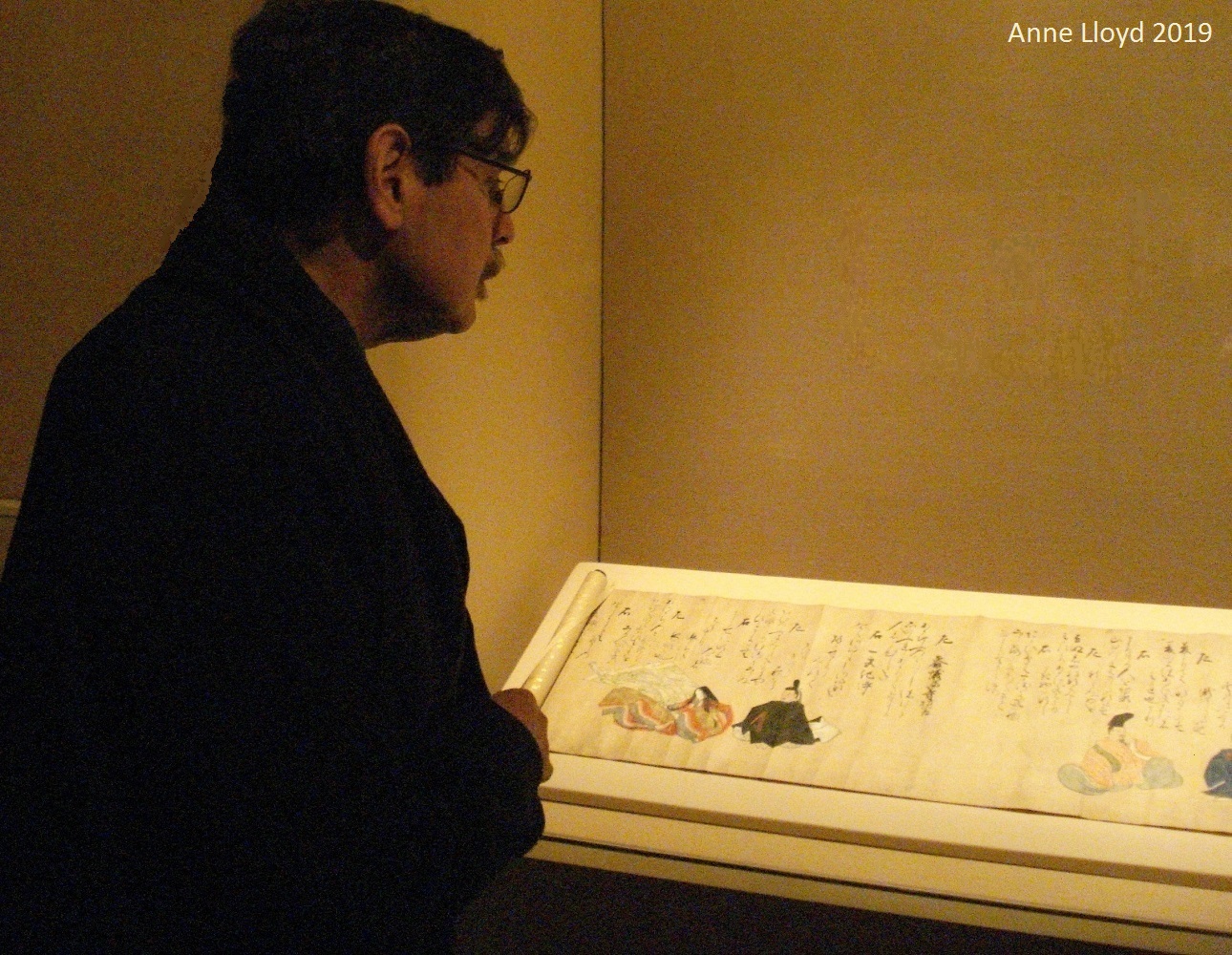
Anne Lloyd, Photo (2019)
 Gallery view of The Tale of Genji exhibit, showing a handscroll, c.1400, depicting an imaginary competition between Lady Murasaki and poet Ōshikōchi no Mitsune

The contrast between a male-female perspective on life and art was treated in a Japanese literary work from the fifteenth century. On display in the Met's exhibition is a stunning handscroll, created with ink, color pigments, gold and silver on paper. It surveys the competition between great Japanese poets and writers over the ages, much as Jonathan Swift satirized the "battle of ancients and moderns" in The Tale of a Tub,1704.

In this remarkable work of art, which dates to around 1400, Lady Murasaki "duels" with a challenger who had died long before she was born.This is the poet, Ōshikōchi no Mitsune (859–925). 

Mitsune had been one of the scholars who had compiled an earlier poetry anthology commissioned by the Japanese government, Collection of Poems Ancient and Modern, around 905. I was especially impressed with the inclusion of the Murasaki-Mitsune "point-counterpoint" because this work had enabled Lady Murasaki's poems to be included in a compendium of poetry. In most literary books, poems written for a novel, like those in Genji Monogatari, were excluded.

This luminous handscroll and its friendly rivalry of ancient and modern, male and female, was created in a time of relative peace for Japan. Later, during the 1500's and early 1600's, Japan was beset with strife and bloody civil wars. The code of the Samurai, exemplified by the revenge-theme saga of The Forty-seven Rōnindominated the cultural, as well as the political scene.

The Tale of Genji, however, is a classic example of the "pen" being mightier than the sword. It is a refreshing alternative to the cult of violence that has crowded out expressions of sensitive feeling and subtle reflection from so much of popular culture throughout the world of today. 

The M
et's Genji exhibition is helping to restore the balance. I felt a real charge of positive human energy, and a heightened  awareness of life's possibilities, upon leaving The Tale of Genji, A Japanese Classic Illuminated. 


Yamato Waki, The Death of Genji, from the manga series
 Tale of Genji: Dreams at Dawn, 1989

The Met's exhibit concludes with an appraisal of The Tale of Genji in the modern world. Genji was featured in ukiyo-e prints during the 1800's and now in manga. 

There was once a time when I would have shuddered at the thought of "comic" books being featured in art exhibitions. No longer. The artistry of Yamato Waki (born 1948) in her 1980's manga series, The Tale of Genji: Dreams at Dawn, created a superb fusion of ancient and modern. Examples of her work are on view in the Met's exhibition - where they belong.

A final point in understanding how Genji has been "illuminated" over a thousand years is that it was originally written in a language which Japanese male writers during the Heian period did not deign to use: their own.

While the noble (male) scholars continued to write in Chinese, women wrote in an early form of their native language called hiragana or "ordinary writing." It was also referred to as onna-de ("woman's hand"). Lady Murasaki was not the first to use "woman's hand" for important literary work. Yet,The Tale of Genji was such a major accomplishment, cherished throughout Japan, that hiragana was embraced for serious writing instead of Chinese.

At the risk of giving away the ending, Genji dies without ever gaining the throne of Japan. But he and Lady Murasaki achieved far more - cultural independence for Japan and immortality for themselves.

***
Text: Copyright of Ed Voves, all rights reserved
Images courtesy of the Metropolitan Museum of Art, New York City.

Introductory image:                                                                                                          Tosa Mitsuoki (Japanese, 1617–1691) Portrait-Icon of Murasaki Shikibu (Detail), 17th century.  Medium: Hanging scroll; ink and color on silk. Lent by Ishiyamadera Temple

Ed Voves, Photo (2019) Gallery view of The Tale of Genji exhibit, showing Tosa Mitsuoki's Portrait-Icon of Murasaki Shikibu, 17th century. Medium: Hanging scroll; ink and color on silk. Image: 35 5/8 × 20 3/4 in. (90.5 × 52.7 cm) Overall with mounting: 66 9/16 × 26 7/16 in. (169 × 67.1 cm). Lent by Ishiyamadera Temple

Ed Voves, Photo (2019) Photo of the Statue of Dainichi Nyorai, Supreme Buddha of the Cosmos, 12th century. Wood with gold leaf and lacquer decoration from the collection of Metropoltan Museum of Art. Accession Number: 26.118 

Ed Voves, Photo (2019) Washio Ryūge of the Ishiyamadera Temple at the Metropolitan Museum of Art, March 4, 2019.

Ed Voves, Photo (2019) Washio Ryūge leading the consecration ceremony at the Metropolitan Museum of Art's The Tale of Genji exhibition, March 4, 2019.

Circle of Tosa Mitsuyoshi (Japanese, 1539–1613) A Lovely Garland (Tamakazura), 17th century. Medium: Album leaves mounted as a pair of hanging scrolls; ink, gold, silver, and color on pape. Metropolitan Museum of Art. Accession Number: 2015.300.33a, b

Tosa Mitsuyoshi (Japanese, 1539–1613 ) Kochō or Butterflies, late 16th-early 17th century. Six-panel folding screen. Ink, color, gold, and gold leaf on paper: 65 in. × 12 ft. 3/4 in. (165.1 × 367.7 cm). Metropolitan Museum of Art. Mary Griggs Burke Collection, Gift of the Mary and Jackson Burke Foundation, 2015 Accession Number:2015.300.32

Ed Voves, Photo (2019) Gallery view of The Tale of Genji, A Japanese Classic Illuminated exhibit at the Metropolitan Museum of Art. Photo shows an ensemble of artifacts, evoking traditional Japanese culture created after 1895. Metropolitan Museum of Art collection.

Ed Voves, Photo (2019) Robe (Furisode) with Maple Tree, Bamboo Fence, and Characters from “Little Purple Gromwell” (Wakamurasaki), late 17th century. White silk satin with silk-thread embroidery and gold-thread couching. Lent by the Tokyo National Museum. 

Ed Voves, Photo (2019) Ogata Kenzan's Teabowl with Moonflower (Yūgao) and Poem, 18th century.  Stoneware with polychrome overglaze enamelsLent by Museum Yamato Bunkakan, Japan

Anne Lloyd, Photo (2019) Gallery view of The Tale of Genji exhibit, showing a 15th handscroll depicting the imaginary competition between Lafy Murasaki Shikibu and the poet Ōshikōchi no Mitsune. This handscroll is one of a pair, created with ink, color, gold, and silver on paper. It is on loan to the Metropolitan Museum of Art from the John C. Weber Collection. 

Yamato Waki, (Japanese, born 1948) The Death of Genji, the Empty Chapter in Murasaki’s Tale, from the manga series The Tale of Genji: Dreams at Dawn,1989. Matted painting; ink and color on paper: Overrall: 14 11/16 × 10 3/4 in. (37.3 × 27.3 cm) (Current mat window): 13 3/4 × 10 3/16 in. (34.9 × 25.9 cm). Credit Line:Lent by the Artist. Rights and Reproduction: Asaki Yumemishi © Yamato Waki