Showing posts with label William Hogarth. Show all posts

Thursday, March 24, 2022

Art Eyewitness Essay William Hogarth – The Printmaker’s Progress


William Hogarth - The Printmaker's Progress

An Art Eyewitness Essay

By Ed Voves

Original photos by Anne Lloyd

When the National Gallery in London was founded in 1824, its collection consisted of 38 paintings. These had been amassed by the financier, John Julius Angerstein, and then purchased by the British government when he died. Angerstein (1735–1823) had favored Old Master artists, Claude Lorrain, Anthony van Dyck, Rembrandt and Raphael. Hardly any works by British painters had graced the walls of his London town house.

There was only one British painter whom Angerstein esteemed on a par with Claude and van Dyck: William Hogarth.

Self-taught genius. Master printer and gifted painter. Chronicler of "modern moral subjects." Generous benefactor of noble causes, yet a man with no illusions. William Hogarth (1697-1764) was all of these. 

Hogarth was also a great "contrarian" and a rebel against the stranglehold of foreign Old Masters on British art. He famously denounced wealthy English visitors to Italy for purchasing "dead Christs, holy families, Madonnas, and other dismal dark objects."

Exhibitions of Hogarth's works are comparatively rare, especially in the United States I have only been to one, presented by the Morgan Library and Museum in 2019. Entitled Hogarth: Cruelty and Humor, the exhibition was based on the Morgan's trove of preparatory drawings of Hogarth's prints issued in 1751, Gin Lane and Beer Street, and The Four Stages of Cruelty.


The three stages of Gin Lane
Top: drawing with red chalk, over traces of black chalk, 1750-51; 
   Middle: copper plate, etched and engraved, 1751; 
Bottom: print of Gin Lane, third state , 1751

Although brilliantly curated, Hogarth: Cruelty and Humor was not an exhibit which induced me to linger in the gallery. Gin Lane and The Four Stages of Cruelty were unsparing critiques of the dark side of British society. Although Beer Street supplied a touch of humor, the emphasis on depravity was unsettling. Though motivated to correct glaring social vices, these prints reveal only one aspect of Hogarth's personality. As a result, I elected not to review this Morgan exhibit.

Hogarth embraced  life in all of its "humors." This we can see in his magnificent print, Southwark Fair (1733). 


                                     Anne Lloyd, Photo (2022)                                
 Detail of William Hogarth's Southwark Fair, 1733 

The whole human comedy/drama is represented here. Street brawlers and acrobats, a pickpocket next to a peep show, a beautiful young drummer girl attracting a bevy of admirers while a lonely, unappreciated bagpiper is about to be struck by actors tumbling down from a crashing stage.

Cruelty or humor?

How then to comprehend and appreciate William Hogarth? This little man (his height was just under five feet) was a towering figure during his lifetime and has grown in "stature" over time. This is especially true in the post-World War II era thanks to the devoted scholarship of Ronald Paulson. Several popular biographies have also served Hogarth well, including the recent Hogarth: Life in Progress by Jacqueline Riding (2021).

Despite the impressive quality of these modern-day resources, it was a unique opportunity to study the 1822 edition of Hogarth's collected prints, in the collection of the Free Library of Philadelphia, which enabled me to gain the measure of this amazing man and artist.

Thanks to Ms. Alina Josan, librarian for the Art Department of the Free Library,  I was able to closely study The Works of William Hogarth, reprinted from the original plates. The whole course of Hogarth's life and work was placed before us on the library table, enabling my wife Anne to take an array of close-up photos of these fantastic prints.


                                        Anne Lloyd, Photo (2022)                                      View of the Art Department of the Free Library of Philadelphia, Central Branch, showing The Works of William Hogarth, 1822.

It is a rare occasion to be granted hands-on access to a historic volume like this. An "elephant folio" in size, two centuries-old and, despite wear-and-tear on the covers, its pages are in magnificent condition. Anne and I were granted a time-travel ticket to Hogarth's world. Finally, I had the chance to grasp Hogarth's ideas and ideals, and to appreciate his skill as a media-savvy artist.

When Hogarth died in 1764, control of his prints and printer's plates went to his capable widow. Jane Hogarth eventually sold the plates to the prestigious printseller, John Boydell. In 1790, Boydell published The Original Work of William Hogarth. It was a magnificent endeavor, worthy of Hogarth himself.

Boydell was not content to merely reprint Hogarth's existing prints but also commissioned new engravings of several Hogarth works to present as complete a record of the revered artist's life as was possible. Detailed commentary on each of Hogarth's works in the book was provided by a noted art writer, John Nichols.

In 1818, the publisher Baldwin, Cradock and Joy purchased Hogarth's plates and had them restored by  the engraver James Heath. These were used to publish the 1822 edition which Ms. Josan “wrestled” from the storage vaults of the Free Library, so that I could appreciate Hogarth’s artistic achievement. 

The print quality of the 1822 edition is astonishing, permitting minute examination of Hogarth's technical skill in drawing and engraving. Hogarth was a master of the hatching process, by which black, white and gray "color" tones were imparted to his prints. He also had an incredible eye for the effect of light. His talent in both respects can be seen in his 1733 print, A Midnight Modern Conversation. 


                                      Anne Lloyd, Photo (2022)                                         Detail of William Hogarth's A Midnight Modern Conversation, 1733  

Notice the reflection of a window, lit by the light of dawn, on the brandy decanter in the hand of the befuddled drinker. On the table close by is an overturned candle stick.


         Detail of William Hogarth's A Midnight Modern Conversation 

With this small detail, Hogarth makes a telling point in this lampoon of tipsy gentlemen "deep in their cups." They have drunk the night away.

Over the course of the nineteenth century, the plates of the 1822 edition were used and reused until the print quality was negligible. This over-exposure, along with the bawdy details of many of Hogarth’s pictures, led to a partial eclipse of his reputation. A number of “eminent Victorians,” however, continued to uphold Hogarth’s creative genius. Charles Dickens was a huge admirer. The walls of his study were lined with Hogarth prints.

The best way to appreciate Hogarth’s place in the realm of art is to study his prints. Hogarth was first and foremost an engraver and a printmaker. He trained in this profession as a youth and worked his way from engraving business cards to creating original series of illustrated stories, such as A Harlot's Progress (1731-32), which gained him fame and fortune.


                                     Anne Lloyd, Photo (2022)                                  
 William Hogarth's A Harlot's Progress, I, 1731-32

Later in his career, Hogarth commissioned other artisans to do some of the labor involved in preparing the copper plates for his prints. This enabled Hogarth  to devote more time to painting  the original versions of new "progresses"  like the series, Marriage A-la-Mode, as well as portraits and large biblical scenes for charitable institutions like London's Foundling Hospital. Even so, Hogarth remained an engraver/printmaker at heart, reserving for his own hand the expressive facial features of the protagonists of his prints. 

Hogarth was extremely zealous in promoting and selling his prints and paintings. He endeavored to do so by his own efforts, rather than depend on agents or auction houses. Occasionally, he made a misstep in his marketing strategy. But the memory of the terrible poverty of his childhood and his father's imprisonment for debt drove him to rely on his own talents and to work without respite. 

One of the key details of Hogarth's prints is the statement "Published by Act of Parliament" which appears along the bottom of his prints beginning in 1735.


                                    Anne Lloyd, Photo (2022)                                   
Detail of Act of Parliament copyright, at bottom of a Hogarth print

Infuriated at the way that rival printers were pirating pictures like A Midnight Modern Conversation and his series, A Harlot's Progress. Hogarth petitioned Parliament to enact  legislation to protect his work and that of other legitimate artists. In 1735, Parliament passed the landmark bill, Engravers' Copyright Act (8 Geo.2 c.13). "Hogarth's Act" as it became universally known, remains the foundation of modern copyright protection law.

The opportunity to closely study the splendid 1822 edition of Hogarth's prints enabled me to ponder a question concerning Hogarth's painted and printed versions. When a painting or drawing is engraved and then printed, the result is a mirror image of the original.  Which is the stronger, more engaging version?

Several years ago, I had the chance to examine the Marriage A-la-Mode paintings at the National Gallery in London (Angerstein had bought the whole series).The arrangement and orientation of the printed versions, which I had seen seen in art books, seemed more effective than the painted originals. But given the reduced size of the book illustrations, it was difficult to reach a conclusion.


William Hogarth, Marriage A-la-Mode 2, After the Marriage, 1743


Anne Lloyd, Photo (2022) Print version of Marriage A-la-Mode 2

After studying the full-sized prints in the 1822 book, I think that Hogarth painted the originals with the "layout" of the intended print versions definitely in mind. Hogarth's paintings are superb works of art in their own right. That being said, when his paintings and prints are compared in terms of narrative movement, the verdict - in my estimation - is clear. The prints are stronger.

Earlier in his career, Hogarth created book illustrations which would have been viewed left-to-right, just as the text in books is "read." When painting the initial images of A Harlot's Progress, The Rake's Progress and Marriage A-la-Mode, Hogarth kept this matter of perception in mind. He generally configured the action in the paintings to insure that the printed versions would be viewed in the accustomed style, left-to-right. 

I closely studied numerous prints in the 1822 edition, cross-referencing them to illustrations of Hogarth's paintings. No matter how impressive the paintings are as independent works of art, the narrative flow of the prints is superior. Moreover, there is a real sense of a continuum in each print series. A story, a human drama, unfolds in each of these episodic "progresses," carrying us to the tragic, unforgettable denouement


                                   Anne Lloyd, Photo (2022)                                 
The print version of The Rake's Progress, 8, Bedlam, 1735

These reflections hold-true for Hogarth's one-off pictures, as well as the "progress" series.

A good example is the hugely comedic, Morning (1738).This was the first of a set of paintings called The Four Times of the Day. Hogarth created these for his friend, Jonathan Tyers, the impresario of the Vauxhall Gardens, London's premier resort. These paintings/prints depicted street scenes at different hours of the day and different seasons. The characters appear only once, unlike the protagonists of the "progresses."

In Morning, a prudish spinster, clad in a fashionable yellow dress is intent on "keeping-up-appearances." Despite the freezing cold and snow, she is marching-off to church, St. Paul's in Covent Garden, without a cape or coat.  Her shivering page boy trudges behind her, carrying her prayer book under his arm, his cold-numbed hands stuffed in his jacket and pocket. 


William Hogarth, 
 St. Paul's, Covent Garden, and part of the PiazzaMorning, 1738

The improbable pair is halted in their tracks by revelers carousing outside the door of an infamous dive, Tom King's Coffee House. These libertines are obviously not intent on keeping holy the sabbath and the look of consternation on the spinster's face is priceless.


                                    Anne Lloyd, Photo (2022)                                     
  The print version of Morning (detail), 1738

Once again, the printed version is more effective in conveying the sense of narrative flow, left-to-right. Hogarth, despite the pride he felt for his paintings, knew that many, many more people would see  - and buy - his prints. That is why he concentrated his prodigious creative energies, talent and insight on the design of the prints.

Hogarth demonstrated a virtuoso's skill in painting and printmaking. Yet his achievement does not stop there. It needs to be emphasized that Hogarth was creating a new form of visual story-telling, which in time would lead to cinema and graphic novels. 

The magnitude of Hogarth's innovations was grasped early on. William Hazlitt (1776-1830) considered Hogarth's compositions to be Epic Pictures. Hazlitt's commentary is worth quoting at some length.

His works represent the manners and humours of mankind in action, and their characters by varied expression. Everything in his pictures has life and motion in it. Not only does the business of the scene never stand still, but every feature and muscle is put into full play: the exact feeling of the moment is brought out, and carried to its utmost height, and then instantly seized and stamped on the canvas for ever.

Hogarth's achievements are all the more impressive when it is recalled how little he had to inform his efforts. There were no art museums in early 18th century London, just a few print shops selling Dutch genre scenes. We know that Hogarth studied the mural depictions of the life of St. Paul in London's new cathedral, but the primary sources of his unprecedented "progresses" were his own keen vision and retentive memory. 

Hogarth's drawing ability is evidenced by surviving sketches. He also created a system of mental note-taking and devised hieroglyph symbols, abstract combinations of lines and curls, to help jog his memory. Often, these were unneeded, as the power of his observation and ability to recall incidents of interest were phenomenal.

Hogarth was, undeniably, a genius. But there was another creative spark, outside the limited realm of the British art scene, which helped ignite his spectacular success.

On the night of January 29, 1728, John Gay's The Beggar's Opera debuted at the Lincoln's Inn Fields Theatre. This musical play struck British society like a double broadside of cannons of a ship-of-the-line. With the first volley, Gay aimed the guns of his satire at the conniving "screen master general, Prime Minister Robert Walpole. The second was directed at London's cultural savants who favored Italian opera companies at the expense of native English talent.

Hogarth was in the audience of The Beggar's Opera, as we know from a sketch of the climax of the play. This shows the two heroines, Lucy Lockit and Polly Peachum, begging for the highway robber hero, Captain Macheath, to be spared from the gallows.


William Hogarth, Sketch of a Scene in the Beggar's Opera, 1728-29

This sketch served as the template for Hogarth to attempt an ambitious effort in painting with oils, at which he was still inexperienced. (There are several drops of oil paint on the sketch.) Hogarth painted the celebrated scene from the play's third act several times, his skill in handling oil paint and pictorial composition gaining in strength with each effort.The version below, in the collection of the Yale Center for British Art, was painted in 1729.


William Hogarth, The Beggar's Opera, Version V, 1729

The Beggar's Opera struck a chord with Hogarth, whose political views were much like Gay's. Far more importantly, The Beggar's Opera phenomenon encouraged Hogarth to launch the first of his series, A Harlot's Progress. What Gay did with dialog and song, Hogarth would do with pictures.

Hogarth's The Beggar's Opera was his first major success as a painter. Yet, oddly, he did not make an engraving of this very impressive work. As a result, the British public remained unaware that Hogarth had painted the climax of Gay's play, an audience favorite for decades after its 1728 debut.

When Boydell started the process of publishing the huge folio edition of Hogarth's prints, he correctly saw the gap in the timeline of the artist's creative development. Boydell decided to commission an engraving after this vital work by Hogarth to include in The Original Work of William Hogarth. By what can only be described as an act of providential grace, Boydell assigned the job to another William, William Blake.


Anne Lloyd, Photo (2022) 
William Blake (after W. Hogarth) The Beggar's Opera, Act III, 1790

Blake's engraving of the Beggar's Opera climax is a sensational work of art, in its own right, as well as a mighty tribute to Hogarth. Art scholars regard it as a high point of Blakes's early career, along with his famous depiction of Chaucer's Canterbury Tales.


Anne Lloyd, Photo (2022) 
William Blake, The Beggar's Opera, (detail)

This print, however, marks a point of departure in Blake's style from Hogarth's. Boydell did not commission any further engravings after Hogarth from Blake,  who would soon devote his talents and energy to his own artistic vision utterly different from that of Hogarth.

Hogarth would, I think, have approved Blake's decision to follow his own muse, to blaze his own path through life and stick to it, regardless of the personal cost. 

In her superb new biography mentioned above, Hogarth: Life in Progress, Jacqueline Riding writes about Hogarth's approach to art and of life. For Hogarth this meant "life in the raw" rather than conforming to stale conventions of copying plaster casts and reworking allegorical motifs:

The combining of the elegant with the grotesque is precisely why Hogarth's work challenges, jars even ... and why he is so innovative and unusual. It is this combination that sets him and his paintings apart: a refusal to see  humour and the repugnant as separate from the great highs as well as the lows of human experience.

Perhaps the purest expression of Hogarth's celebration of the raucous London he loved is The Enraged Musician. This 1741 print was based on a monochrome oil sketch (as distinct from a full-color painting) and was a companion to another scene of life impinging on art, The Distressed Poet.

One may sympathize with the musician as he tries to practice. A squawking parrot, a barking dog, a bawling infant, a little drummer boy and an oboe-playing gypsy, a milkmaid singing her sales melody while a knife-sharpener grinds the blade of a meat cleaver. What is a man of culture to do?


Anne Lloyd, Photo (2022) 
William Hogarth, The Enraged Musician, 1741

There is no doubt what Hogarth would had advised the musician to do. Keep the window open and start playing. Add your tune to the music of the street, to the song of life. 

That is what Hogarth did with his paintings and engravings which, thanks to the magnificent 1822 volume in the Free Library collection, I was able to study and thoroughly enjoy. For a wonderful few hours, The Works of William Hogarth transported me back to London of long ago and to an exultation of life that can be embraced this very minute.

***

Text: Copyright of Ed Voves, all rights reserved. Original photos copyright of Anne Lloyd, all rights reserved. Permission to photograph images from the 1822 edition of William Hogarth's prints, courtesy of the  Art Department of the Free Library of Philadelphia

Introductory Image: Anne Lloyd, Photo (2022) Portrait of the Painter and his Pug, (painting by William Hogarth, 1745), engraved in 1795 by Benjamin Smith for John and Josiah Smith, publishers, London. From The Works of William Hogarth, 1822.

William Hogarth (British, 1697-1764) Gin Lane, 1750-51Drawing with red chalk, over traces of black chalk, on paper, incised with stylus, verso rubbed with red chalk: 15 1/2 inches x 12 1/8 inches (394 mm x 306 mm). Morgan Library and Museum.

William Hogarth (British, 1697-1764) Gin Lane, 1751. Copper plate (etched and engraved): 15 7/16 x 12 7/8 inches (39.2 x 32.7 cm). Metropolitan Museum of Art. Rogers Fund, 1921. #2155.3

William Hogarth (British, 1697-1764) Gin Lane, 1751. Etching and engraving, third state of three: 15 1/16 x 12 1/2 inches (38.3 x 31.7 cm). Metropolitan Museum of Art. Harris Brisbane Dick Fund, 1932. #32.35(124)

Anne Lloyd, Photo (2022) Detail of William Hogarth's Southwark Fair, 1733. Etching and engraving: 14 1/4 x 18 1/2 inches (36 x 47 cm). From The Works of William Hogarth, 1822. 

Anne Lloyd, Photo (2022) View of the Art Department of the Free Library of Philadelphia, Central Branch, showing the The Works of William Hogarth, 1822. 

Anne Lloyd, Photo (2022) Detail of William Hogarth's A Midnight Modern Conversation, 1733. Etching and engraving: 13 5/8 x 18 5/8 in. (34.6 x 47.3 cm )From The Works of William Hogarth, 1822.

Anne Lloyd, Photo (2022) William Hogarth's A Harlot's Progress, I, 1731-32. Etching and engraving: 12 3/8 x 15 1/8 inches (31.3 x 38.4 cm). From The Works of William Hogarth, 1822.

Anne Lloyd, Photo (2022) Detail of Act of Parliament copyright, at bottom of a Hogarth print. From The Works of William Hogarth, 1822.

William Hogarth, Marriage A-la-Mode: 2, The Tête à Tête, 1743. Oil on canvas: 27.5 x 35.7 inches (69.9 x 90.8 cm) National Gallery, London. #NG 114

Anne Lloyd, Photo (2022) Print version of Hogarth's Marriage A-la-Mode 2, 1745. Etched and engraved by Bernard Baron: 15 1/16 x 18 1/4 inches. From The Works of William Hogarth, 1822.

Anne Lloyd, Photo (2022) The print version of The Rake's Progress, 8, Bedlam, 1735. Etching and engraving: 12 1/16 x 16 1/8 in. (30.6 x 41 cm) From The Works of William Hogarth, 1822.

William Hogarth (British, 1697-1764) St. Paul's, Covent Garden, and part of the PiazzaMorning, 1738. Oil on canvas: 29 x 24 inches (737 x 610 mm) National Trust Collection, Upton House, Warwickshire. NT 446680. Image from Wikimedia Commons. 

Anne Lloyd, Photo (2022)The print version of Morning (detail), 1738. Engraving: 19 7/16 x 15 3/4  inches (49.3 x 40 cm.) From The Works of William Hogarth, 1822. From The Works of William Hogarth, 1822.
William Hogarth (British, 1697-1764) Sketch of a Scene in the Beggar's Opera, 1728-29. Black chalk with some white chalk on blue paper, some outlines pricked, splashed with oil paint: 37.3 x 49.2 cm (sheet of paper) Royal Collection Trust. #913487

William Hogarth (British, 1697-1764) The Beggar's Opera, version V, 1729. Oil on canvas: 23 1/4 x 30 inches (59.1 x 76.2 cm.) Yale Center for British Art.

Anne Lloyd, Photo (2022) William Blake (after W. Hogarth), The Beggar's Opera, Act III, 1790. Engraving: 17 15/16 x 23 1/16 in. (45.5 x 58.6 cm). From The Works of William Hogarth, 1822.

Anne Lloyd, Photo (2022) William Hogarth's The Enraged Musician, 1741. Etching and engraving: 14 3/16 x 14 3/16 in. (36 x 36 cm). From The Works of William Hogarth, 1822.


Wednesday, May 26, 2021

Art Eyewitness Review: 500 Years of British Art at Tate Britain


Five Hundred Years of British Art

By Kirsteen McSwein    

Tate Publishing, $40, 240 pages

Reviewed by Ed Voves

Henry Tate (1819–1899) was a public-spirited man who tried to keep his name out of the bright lights of celebrity. He failed dismally.

Tate rose from a thirteen-year old grocer's apprentice to become a fabulously wealthy sugar merchant and patron of worthy causes. Punch magazine called him "Potent Tate." 

For all of his business savvy, Tate was ill-at-ease with his position as an "Eminent Victorian." He tried to keep a low profile, rejecting several honors from the British government. Finally, in 1898, after an especially generous donation, Tate was informed that Queen Victoria would not be pleased if he again declined a knighthood.


Sir Hubert Von Herkomer, Sir Henry Tate, 1897

Sir Henry Tate's reward came after donating his collection of British paintings and £150,000 to build a museum for British art on the banks of the Thames River in the heart of London. Initially, the museum was called the National Gallery of British Art. Almost from its opening day on August 16, 1897, it was popularly referred to as the Tate Gallery. Museum officials eventually bowed to the inevitable and it was officially designated as the Tate Gallery in 1932. Today, it is known as Tate Britain, one of several "Tates," including the Tate Modern on the other side of the Thames.

However uncomfortable Sir Henry Tate would have been with all of the museums bearing his name, he would certainly be pleased with the new book, Five Hundred Years of British Art. Published by the Tate, this lavishly illustrated volume charts the course of British art in a way which reflects the unique way which Tate Britain displays much of its collection. 

Rather than organizing works of art by artist, theme or artistic movement, paintings and sculpture at Tate Britain are presented in a chronology-based scheme. This "Walk through British Art" (as it is called) gives a sense of the developing course of art, as it occurred. This enables visitors to Tate Britain to appreciate the radical differences in technique and artistic vision which frequently occurred during the same historical era. 

Comparison of three paintings from the 1850's provides insight into this curatorial decision. 


Sir John Everett Millais, Ophelia, 1851-2

One of the paintings Henry Tate donated to the museum soon to bear his name was Ophelia, painted in 1851-52 by John Everett Millais. The protagonist is the tragic Shakespearean heroine, driven to suicide by the melancholy, self-destructive Hamlet. The exhausting ordeal of creating Ophelia nearly cost Millais his sanity and almost claimed the life of his model, Lizzie Siddal. She caught a severe cold when Millais forgot to keep the heating lamps going underneath the water-filled bathtub where she was posing.

At the same time as Millais labored on Ophelia, John Martin was engaged on three epic paintings depicting the "end times." Martin's The Last Judgement is the center piece of the three pictures. On the left of the painting, the saved are gathered (George Washington and William Shakespeare can be identified among the elect), while at right, we see "how the mighty are fallen." 


John Martin, The Last Judgement, 1853

Nameless and Friendless 
is another 1850's work dealing with the theme of judgement. This time a young woman, clad in mourning attire, waits for the critical appraisal of an art dealer. If the dealer accepts her painting, she will have funds to buy food and lodging for herself and the young lad with her, likely her brother. If, as seems likely, the painting is rejected, she and the boy will have to resume their desperate quest elsewhere.


Emily Mary Osborn, Nameless and Friendless, 1857

Emily Mary Osborn, the creator of Nameless and Friendless, was an early Feminist. She joined the Society of Female Artists, which was established in 1857, the year she exhibited her painting. Nameless and Friendless dealt specifically with the plight of women, as Millais' Ophelia did indirectly. Osborn also sought to make a moral statement, as testified by the biblical subtitle of her painting: “The rich man’s wealth is his strong city, etc.” - Proverbs, x, 15. But her focus was on contemporary, Victorian, society not the world "hereafter" of Martin's Last Judgement

OpheliaThe Last Judgement and  Nameless and Friendless are very alike in one fundamental way. These three works of art probed sensitive social and ethical subjects. And by doing so, they undermined any sense of complacency or illusions of grandeur induced by the vast power of Britain's empire and industrial might.

This is a very significant point given the frequent controversies and culture "wars" that have marked British history. It is also a reminder that an independent spirit, often of a "contrarian" nature, has been the defining attribute of many British artists. Allegiance to a particular movement or "school" has counted for little or lasted but a short time.

A Walk through British Art navigates a path through thirteen galleries at Tate Britain. The journey begins during the 1540's. In many ways, this was the absolute nadir of the visual arts in England. Henry VIII's break with the Pope sparked widespread destruction of art associated with the Roman Catholic Church. Devotional paintings, stained glass windows, sacred manuscripts, alabaster religious sculptures - an English specialty - and embroidered priestly vestments were subjected to one of the most ruthless campaigns of iconoclasm in European history. 

As a result of this purge, there were few Englishmen who were able to paint or sculpt competently by the end of the 1500's. Foreign artists dominated the British art scene during the 1600's. Rubens, van Dyke and Lely gained the favor of the Stuart monarchs, who tried to repair the damage done during the Tudor era. 


Mary Beale, Portrait of a Young Girl, ca. 1681

One of the most intriguing paintings by a native English painter during the 1600's is Mary Beale's Portrait of a Young Girl, dating to around 1681. Beale (1633-1699) established a successful portrait studio, beating the incredible odds against women of talent during this period. Beale was highly regarded by rival painters, including Sir Peter Lely, the chief court painter for Charles II. If Beale's work lacks the polished sophistication of Lely's, it shows that, somehow, the artistic tradition in England had survived. 

Shortly after Beale died, she was praised in a literary work, An Essay towards an English-School. As the title implies, art in Great Britain at the beginning of the eighteenth century (England and Scotland having unified in 1707) still lacked a cohesive focus. What Britain needed was an artist of genius, who was able to ignite a nationwide enthusiasm for the visual arts similar to what had occurred in the Netherlands during the 1600's. 

As if on demand, this charismatic figure duly appeared. In 1710, a young goldsmith's apprentice began engraving drawings of his own design. By the time he died, William Hogarth (1697-1764) had raised the status and prospects of British art and artists to an unprecedented level. 


William Hogarth, The Painter and his Pug, 1745

This triumph, however, was anything but predestined. Like Charles Dickens - who revered his art works - Hogarth had to struggle to escape the poverty of his youth. Even when Hogarth achieved success with his early engravings, his work was so plagiarized that he realized little profit. He took legal action, reaching all the way to Parliament which passed the Copyright Act in 1735. A turning-point in Anglo-American history of immense significance, this legislation became known as Hogarth's Act.

Hogarth made his reputation - and fortune - with several series of paintings and related engravings. These were "moral subjects" which depicted in sequential progression the downward life spirals of scoundrels, harlots, playboys, lazy apprentices, cheating husbands and unfaithful wives. 

Since Five Hundred Years of British Art utilizes one iconic work of art to highlight each featured artist, Hogarth's format presents a problem. Which episode best represents the Rake's or the Harlot's step-by-step descent into oblivion?

The Tate editorial team brilliantly responded to this challenge by selecting a "one-off" work by Hogarth which displays most of the hallmarks of his celebrated series. 

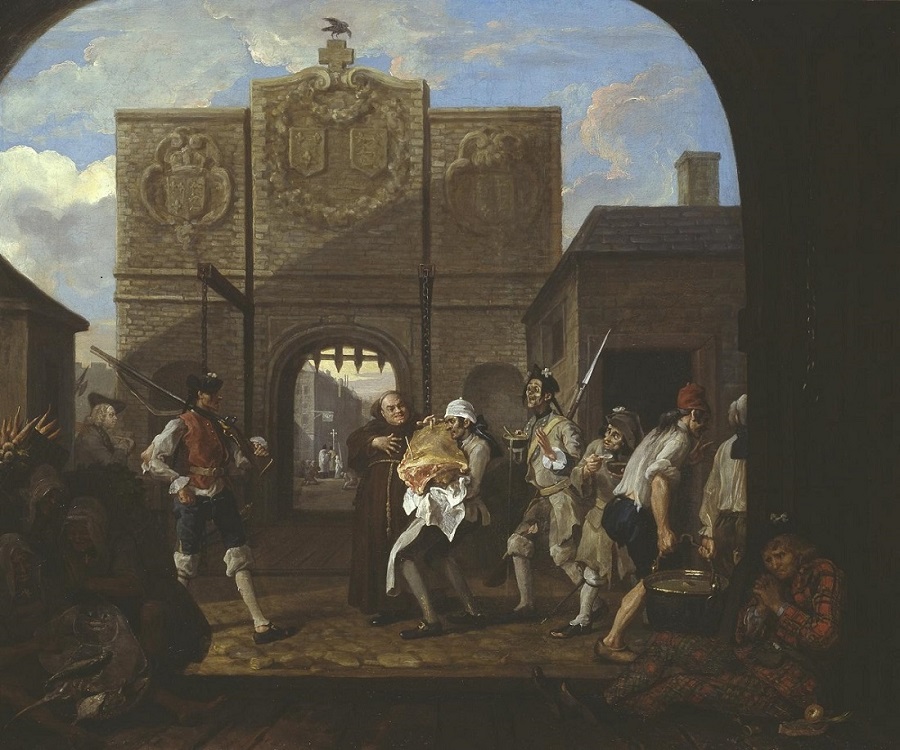
O the Roast Beef of Old England ("The Gate Of Calais") is based on a real incident in Hogarth's life. In 1748, after a treaty briefly ended hostilities between Britain and France, Hogarth crossed the English Channel. As recorded in the painting, Hogarth was arrested while sketching the battlements of the port city of Calais. The hand of a suspicious guardsman can be seen, about to lay hold of his shoulder.


             William Hogarth, O the Roast Beef of Old England , 1748 

Hogarth's arrest is really a minor detail of Roast Beef. Hogarth hardly needed a pretext for deploying the heavy artillery of his scathing humor on the French. The real action of this comic masterpiece centers on the facial expressions of emaciated French soldiers, in filthy, tattered uniforms, and a well-fed monk as they watch a joint of beef being carried to the inn where Hogarth and other English tourists are staying. 

Heavy-handed though the humor may seem now, Hogarth hit the mark with his salvos of sarcasm. Hogarth painted what he truly believed - that the life of an Englishman is superior to the French. The English eat roast beef, the French subsist on soup maigre. In England, Hogarth can draw and paint whatever he wants, protected by an Act of Parliament, while in France he was arrested for sketching an old drawbridge. 

With O the Roast Beef of Old England, Hogarth secured a niche for narration in the realm of British art. By depicting dramatic incidents, narrative paintings and prints acted as the visual counterparts of novels, which thanks to authors like Daniel Defoe and Henry Fielding were fast becoming the dominant genre of English literature. Narrative works of art by Hogarth and his successors told stories unifying the people of Britain in times of crisis or challenging social conventions leading to needed reform.

Narrative art can speak to generations unborn when a painting or print was first displayed. A superb example of art's ability to span the centuries can be found in the collection of Tate Britain. In 1890, Henry Tate commissioned a painting from Luke Fildes, a noted commercial illustrator. Fildes, whose grandmother was nearly killed in the Peterloo "Massacre" of 1819, was sensitive to issues of public welfare. Tate encouraged Fildes to select the subject of his painting and the artist responded with The Doctor.


Sir Luke Fildes, The Doctor, 1891

Fildes, reflecting on his own life experience, recalled the devoted care of Dr. Gustavus Murray for his one-year old son, desperately-ill with typhoid fever. Sadly, Philip Fildes died on Christmas morning, 1877. 

Fildes never forgot the heroic efforts to save the life of his son, but relocated the action to a working-class setting. Fildes, a stickler for authenticity, constructed a model of fisherman's cottage in his studio. He worked on the painting in the early hours around dawn each day, over the course of an extended period. In this way, he sought to capture the beam of misty light seeping through the widow on to the bowed shoulders of the child's despairing mother.

Is that beam of light a harbinger of hope or is it merely announcing a cheerless day? The answer is left to the viewer to decide. 

By placing us in the sick room, Fildes brilliantly highlighted the most important attribute of narrative art. It enables us, the viewers, to participate in the drama. It ennobles our hearts and souls, as we join in empathy with the protagonists of the painting.

Luke Fildes' The Doctor was created at the high "watermark" of representational art. Within a few years, painting and sculpture began to take radical new paths. The twentieth and twenty-first century art works selected by the editorial team of Five Hundred Years of British Art necessarily reflect this change. But it is worth a few more moments of reflection on The Doctor to emphasize the creative opportunities provided by narrative art.

Fildes' success as a graphic artist brought him to the attention of Charles Dickens. He was hired to illustrate The Mystery of Edwin Drood. Dickens died on June 9, 1870 before the novel was completed. Fildes visited Dickens' empty study and painted an homage to the great writer, The Empty Chair. This watercolor was later engraved and published in The Graphic magazine.

Vincent van Gogh was a devoted reader of The Graphic and a great admirer of Fildes. Later, he reworked Fildes' image of Dickens' empty chair into two immortal versions of his own, the chairs which he and Gauguin used at the Yellow House at Arles. Because Fildes had left plenty of room for the imagination of the viewers of The Empty Chair, van Gogh was enabled to participate in the dialog of that wonderful work of art and carry it forward with his paintings.


   Anne Lloyd, Photo (2014) 
Gallery view of A Walk through British Art at Tate Britain

The process of "cross-pollination" is one of the many virtues of narrative art. It is also one of the greatest blessings conferred on us by art museums where we can project ourselves emotionally and spiritually into the great works of art we behold before us.

I have been fortunate to take the Walk through British Art a couple of times at Tate Britain. I dearly hope to do so again, but in the meantime there is this wonderful companion volume to ramble through, in company with such kindred spirits as Mary Beale, William Hogarth, John Millais, Luke Fildes and, lest we forget, Sir Henry Tate.

***

Text: Copyright of Ed Voves. Original Photo: Anne Lloyd All rights reserved    Images of paintings from Tate Britain, courtesy of Tate Britain Museum 

Introductory Image: Five Hundred Years of British Art Book Cover: © Tate Publishing, Ltd. 2020

Sir Hubert Von Herkomer (British, 1849–1914) Sir Henry Tate, 1897. Oil paint on canvas: 1422 × 1118 mm. Tate Britain. Bequeathed by Amy, Lady Tate, 1920. # N03517

Sir John Everett Millais (British,1829–1896) Ophelia, 1851-52. Oil paint on canvas: 762 × 1118 mm. Tate Britain. Presented by Sir Henry Tate, 1894. N01506.

John Martin (British,1789–1854) The Last Judgement, 1853. Oil paint on canvas: 1968 × 3258 mm. Tate Britain. Bequeathed by Charlotte Frank in memory of her husband Robert Frank, 1974. #T01927

Emily Mary Osborn (British,1828–1925) Nameless and Friendless.“The rich man’s wealth is his strong city, etc.” - Proverbs, x, 15, 1857.  Oil paint on canvas: 825 × 1038 mm. Tate Britain.  Purchased with assistance from Tate Members, the Millwood Legacy and a private donor, 2009. # T12936

Mary Beale (1633-1699) Portrait of a Young Girl, ca. 1681. Oil paint on canvas: 535 x 460 mm. Tate Britain. Purchased 1992. # T06612

William Hogarth (British,1697–1764) The Painter and his Pug, 1745. Oil paint on canvas: 900 × 699 mm. Tate Britain. Purchased 1924. # N00112

William Hogarth (British,1697–1764) O the Roast Beef of Old England ("The Gate Of Calais"). Oil paint on canvas: 788 × 945 mm. Tate Britain. Presented by the Duke of Westminster, 1895. # N01464

Sir Luke Fildes (British, 1843–1927) The Doctor, exhibited 1891. Oil paint on canvas: 1664 × 2419 mm. Tate Britain. Presented by Sir Henry Tate, 1894. # N 01522.

Anne Lloyd, Photo (2014) Gallery view of A Walk through British Art at Tate Britain. # N00112