Showing posts with label Woodcuts. Show all posts

Friday, March 27, 2020

Art Eyewitness Book Review: Albrecht Dürer


Albrecht Dürer


 By Christof Metzger and Julia Zaunbauer
Prestel/488 pages/$75

Reviewed by Ed Voves

Rudolf II, Holy Roman Emperor and Europe's leading art collector, ordered his agents to purchase one of the greatest paintings in Italy, Feast of the Rose Garlands, and bring it to his palace in Prague. The large oil on wood painting, measuring 5.3 ft x 6.3 ft., was duly transported - at one point, hand-carried along a footpath across the Alps - to Prague Castle. 

The year was 1606. Rudolf's prize acquisition was not a contemporary work by Caravaggio nor a classic painting from the studio of a High Renaissance master like Raphael. Indeed, Feast of the Rose Garlands, had not been painted by an Italian at all. It was the masterpiece of the greatest of German artists, Albrecht Dürer.


Albrecht Dürer, The Feast of the Rose Garlands, 1506 

Rudolf was obsessed with Dürer's art. The emperor, who was slightly mad to begin with, spared no expense to purchase Dürer's works of art. In 1588, he had spent a princely sum to buy a large bound volume known as the Kunstbuch, which contained 100 original drawings and watercolors by Dürer. The nature study, The Great Piece of Turf (1503), was just one of the works of Dürer's genius which were carefully preserved in the Kunstbuch

No art book today - or ever - can match the Kunstbuch. However, Albrecht Dürer, the catalog of the recent exhibition at the Albertina Museum in Vienna, comes close. 


Published by Prestel, Albrecht Dürer surveys the Renaissance artist's entire career. The quality of the illustrations makes descriptive words like "lavish" or "magnificent" seem trite. The scholarship which informs the accompanying essays by Christof Metzger and Julia Zaunbauer is of the highest quality, as well. This, truly, is an outstanding book about one of the greatest artists in European - and world - history. 
                                  .
The Albrecht Dürer catalog essays, which include an excellent short biography, establish the salient features of Dürer the artist: "skill" and "versatility."  

Albrecht Dürer (1471-1528) succeeded not by virtue of raw talent - though he had plenty - but by study, experiment, application and discipline. His first work, a self-portrait drawn in silverpoint "when I was still a child" (as he noted on the sheet), was an audacious achievement. But the level of drawing testifies to the rigorous training he received from his father, a master goldsmith and a superb draftsman in his own right.


Albrecht Dürer, Self-Portrait at Thirteen, 1484

Dürer's skill extended to many artistic media: drawing, painting, etching and woodcarving. This last is a somewhat contentious point but important to consider from the standpoint of Dürer's versatility. Most of the woodcuts for Dürer's marvelous prints were created by master carvers based on his designs. But enough indications remain to show that Dürer was adept at this patient, meticulous form of artistry. 

Such mastery of woodcarving would have informed Dürer's relationship with the professional carvers he employed. When Dürer handed the design of a picture to a woodcarver or formschneider like Hieronymus Andreä, he could do so, secure in the knowledge that both he and Andreä were "on the same page" to use a modern expression.  

This ability to both delegate and to task-manage points to another of Dürer's great achievements. He succeeded brilliantly in organizing and operating a successful workshop. In this, he can be compared to Verrocchio, whose studio in Florence was the training ground for Leonardo, Ghirlandaio and, most likely, Botticelli. 

Dürer is often called the "Leonardo of the North" because he wrote major books on aesthetics later in life. Unlike, Leonardo, Dürer had the drive to see the job in hand through to completion. Dürer's output was staggering and there was little unfinished work in his studio when he died in 1528.


                                                       Albrecht Dürer,                                                       Detail of The Rape of Europa, Three Studies of a Lion's Head,
 Apollo and an Oriental Figure, 1494/1495

Dürer sketched and drew with relentless enthusiasm. A single page in the Kunstbuch preserved a mythological scene, with a typical south German town in the background,  figure studies of Apollo and a Hamlet-like philosopher and three views of a tired old lion, who would appear and reappear in Dürer's many depictions of St. Jerome and his faithful feline friend.


Albrecht Dürer, St. Jerome in His Study, 1514

The Prestel volume displays a generous selection of Dürer's drawings, ranging from delightful doodles on letters to friends and sketches for later reference to supremely finished works. These were often done on carefully prepared colored paper, executed with watercolor and body color and brilliant touches of white for contrast. The celebrated Praying Hands (1503), masterfully demonstrates Dürer's drawing technique.

It should be noted that Dürer "drew" with a paint brush, as well as charcoal, pen and ink, and the pointed stylus for silverpoint, one of the most exacting and unforgiving artistic techniques imaginable, as noted in the 2015 exhibition at the National Gallery in Washington D.C. Graphite pencils had not yet been invented.

In their most accomplished state, Dürer's drawings must be considered as Exempla. While such an expertly executed drawing might serve as part of the preparatory stage for a painting, it was also a work of art in its own right. On a higher, even more profound level, Dürer's exempla were a means of communicating ideas and ideals, the very essence of Renaissance humanism. 


                                                      Albrecht Dürer,                                                          A Pastoral Landscape with Shepherds Playing a Viola & Panpipes, 1496/1497

One of Dürer's greatest friends was Willibald Pirckheimer (1470-1530), a pioneer of the "New Learning" in Germany. Dürer created a special illustration for Pirckheimer's copy of the first print edition of the classical Greek philosopher, Theocritus. Executed in watercolor and gouache heightened with pen and ink and gold, Durer's image of musician-shepherds surrounds the opening page of Theocritus' IdyllsDürer drew this charming, one-of-a-kind illustration much as medieval artists created elaborate initials to mark the beginning of hand-copied prayer books and bibles. 

Although Pirckheimer's copy of Theocritus is a printed volume, its status is of supreme importance. It was printed in 1496 by Aldus Manutius in Venice. It was Manutius who established the first truly successful publishing company in Europe. The classical texts of the Aldine editions transformed scholarship because they were modestly priced and carefully edited. If one wanted to mark the moment when the Renaissance became a pan-European movement, Dürer's illustration for his friend's copy of Theocritus admirably performs that service.

Viewing Dürer's drawings as a totality, Cristof Metzger notes that Dürer's exempla "are ultimately conversation pieces, physical manifestations of the master's consummate artistic abilities whose purpose is to demonstrate this capacity to every visitor to the artists's workshop."

This is beautifully stated, but I would take it a stage-further. Dürer's drawings and prints are a means of dialogue between his time and our era - and those to come. And, when we look and reflect upon The Great Piece of Turf, we join with Dürer in a form of communication with the cosmic spirit, in short with God.


Albrecht Dürer, The Great Piece of Turf, 1503

Here, in this stunning depiction of a small plot of soil and plant life, we can feel and partake of the life force of the universe. A two-dimensional picture, 16 x 12 3/8 in., created half of millennium ago, takes us to dimensions of time and the spirit almost beyond our ability to grasp.

Dürer's drawings enable us to probe another realm of the infinite, namely the character of humanity. 


Albrecht Dürer, Head of an African, 1508

In a drawing dating to 1508, Dürer depicted the likeness of an African man of unknown origin. Dürer may have seen him in Venice during his recent trip or perhaps the man was a servant of an Imperial official visiting Nuremberg. We don't know the details, but we are given a higher degree of insight, straight into the heart and soul of this fellow human being, long dead and very much alive to us still.

Thanks to the exceptional quality of the illustrations of this Prestel book, viewing Dürer's art works on its pages is almost as rewarding as a visit to the Albertina Museum in Vienna!
If I have one criticism of this magnificent book, it is the abrupt, jarring manner in which the text comes to an abrupt halt. 

In the final section, "Dürer the Storyteller", Christof Metzger discusses a number of late works, pen and ink depictions of incidents in the life and death of Jesus. We read how these remarkable drawings were not "preliminary drawings for a specific work but rather experiments for the workshop stock."

We turn the page, expecting more, only to confront the book's section of notes. It struck me as quite a jolt to suddenly be deprived of Albrecht Dürer's company after page-upon-page of stunning illustrations and spirited, compelling commentary. This book is an exhibition catalog, rather than a formal biography, so this word of censure is undeserved.

All the same, it was with a real sense of loss, that I finished this wonderful book. Was this how Dürer's family, friends and colleagues felt when they received word that he had died on April 6, 1528? I suspect so.

Fortunately, a heartfelt valedictory of Dürer is available in Paul Johnson's Art: a New History (2003). Commenting on the large trove of Dürer's letters, travel diaries and other documents which have survived the centuries, Johnson notes how these personal writings:

 ... reveal the enthusiasm with which the boy, then the man, embraced a career in art; the assiduity with which he studied its techniques and absorbed any knowledge relevant to its practice; the humility with which, despite his obvious and overwhelming gifts, he approached art, and the generosity with which he helped others who shared his love of it.

"Dürer was the archetypal man of art," Johnson affirms. "He loved the world and nature, and sought to reduce it to orderly truth by his skill at putting real things and creatures in two dimensions."


Albrecht Dürer, Young Hare, 1502

In doing go, Dürer reached beyond tangible, visible reality to a higher level of creation. Here physical nature was infused with spirituality; transcendental themes took the shape of earthly creatures, birds, animals, human beings, which somehow - even now, five centuries after Dürer's death - do not seem out-of-place in heaven.

***
Text: Copyright of Ed Voves, all rights reserved                                                                                           
Images courtesy of the Albertina Museum, Vienna, Austria, and the National Gallery of Art, Washington D.C. Book cover ©  Prestel Publishing Company

Introductory Image:
Albrecht Dürer (German, 1471-1528) Praying Hands, 1508. Brush and gray wash heightened with white on blue prepared paper: 29.1 x 19.7 cm (11 1/2 x 7 3/4 in.), Albertina Museum, Vienna

Albrecht Dürer (German, 1471-1528) The Feast of the Rose Garlands (Rosenkranzfest), 1506. Oil on panel:162 x 194.5 cm (64 x 76.5 inches or 5.3 ft x 6.3 ft.) National Gallery in Prague, Prague, Czech Republic.

Albrecht Dürer (German, 1471-1528) Self-Portrait at Thirteen, 1484. Silverpoint on prepared paper, 27.3 x 19.5 cm (10 3/4 x 7 5/8 in.) Albertina Museum, Vienna 

Albrecht Dürer (German, 1471-1528) The Rape of Europa, Three Studies of a Lion's Head, Apollo and an Oriental Figure (detail), 1494/1495. Pen and brown and black/brown ink. Albertina Museum, Vienna 

Albrecht Dürer (German, 1471-1528)  St. Jerome in His Study, 1514. Engraving on laid paper: 25.4 x 19 cm (10 x 7 1/2 in.). National Gallery of Art, Washington D.C. Gift of R. Horace Gallatin. 1949.1.11

Albrecht Dürer (German, 1471-1528) A Pastoral Landscape with Shepherds Playing a Viola & Panpipes, 1496/1497. Watercolor and gouache heightened with pen and ink and gold, pasted back onto page 1 of Aldus Manutius' first edition of Theocritus' Idylls and other texts (Venice, 1496): page size: 31 x 20.3 cm (12 3/16 x 8 in.) National Gallery of Art, Washington D.C. Woodner Collection. 2005.1.1.a

Albrecht Dürer (German, 1471-1528) The Great Piece of Turf, 1503. Watercolor, pen and ink: 40.3 cm × 31.1 cm (​15 7⁄8 in × ​12 1⁄4 in). Albertina Museum, Vienna

Albrecht Dürer (German, 1471-1528) Head of an African, 1508. Black chalk: 31.8 x 21.7 cm (12 1/2 x 8 1/2 in.), Albertina Museum, Vienna 


Albrecht Dürer (German, 1471-1528) Young Hare, 1502. Watercolor and body color: 25.1 cm × 22.6 cm (9.9 in × 8.9 in). Albertina Museum, Vienna


Wednesday, July 19, 2017

The Urban Scene: 1920-1950 at the National Gallery of Art


The Urban Scene: 1920-1950


National Gallery of Art, Washington D.C.

February 26, 2017 - August 6, 2017

Reviewed by Ed Voves

Saturday's Child, according to Mother Goose, "works hard for a living." Martin Lewis, the great Australian-born artist, used this nursery tale as the title for one of his greatest works, Quarter of Nine - Saturday's Children. We will shortly look at this extraordinary drypoint etching.

Martin Lewis (1881-1962) was a master printmaker, as was Howard N. Cook, whose image of the surging tide of traffic, human and vehicular, in New York City, introduces this review.The art works of Lewis, Cook and other printmakers are currently on display in a small, but hugely important exhibit at the National Gallery of Art in Washington, D.C. The Urban Scene: 1920-1950 opened last February and runs until August 6, 2017.                  

The Urban Scene: 1920-1950 is the kind of exhibit that can easily be overlooked. Etchings and lithographs do not command the kind of attention that art exhibits about Monet or Matisse achieve. 

Also, the National Gallery of Art has been having a "career" year since the renovated East Wing reopened on September 27, 2016. One outstanding exhibit after another has been mounted:  Della Robbia's Renaissance sculptures, Frederic Bazille and the Birth of Impressionism, East of the Mississippi: 19th Century American Landscape Photography to name a few. It would be a great misfortune if The Urban Scene: 1920-1950 gets lost in the shuffle.

The Urban Scene has two great lessons to teach. First the artistic medium, in this case printmaking, does not need to be "cutting edge" to be effective. The second, even more significant, point is that the everyday life of "blue collar" America - gritty, unsentimental, raw-edged - is a fit subject for great art.

The first point, dealing with printmaking media is perhaps the most problematical. Why did Lewis and company choose drypoint etching, woodblock printing and lithography to create images that directly rivaled the path-breaking photographs of Bernice Abbott and Lewis Hine?


Louis Lozowick, Allen Street, 1929

When you compare Louis Lozowick's lithograph, Allen Street, 1929, with Under the El at the Battery by Berenice Abbott there seems little difference. Both print and photo brilliantly handle the dappled light shed by the metal superstructure of the elevated platform on the street below. Superficially, the same seems to be the case for Samuel Margolies' Men of Steel and the series of photos by Lewis Hine of the construction workers of the Empire State building.

At second glance, one realizes that there is a spiritual quality about the prints, an intimation of the "other reality" that lies all around us. There is no art term that defines this all-encompassing presence. "Numinous," a word borrowed from theology, perhaps comes closest to conveying this idea.

The men in Lozowick's Allen Street evoke an old term to describe people - "souls." The man striding through the shadow at center and those highlighted by the glaring sun evoke a sense of ethereal "being" that defines their humanity. However sketchy  or indistinct their bodies are depicted in the print, in this "other reality" they are souls.

"Numinous" is the most fitting word to describe the shafts of light beaming down on the Men of Steel by Samuel L. Margolies (1897-1974). Margolies, a native of New York City, was a printmaker for the W.P.A during the Depression. He was well-acquainted with how close to the margin of survival many people lived. His etching of a forlorn "Hooverville" shack, Beware of the Dog (not in the exhibit) testifies to his documentary ability. But mostly, Margolies created images of the "heroic" New York skyline or snow-clad country vistas. 

Men of Steel is much more than "heroic" New York. And it is very different from Lewis Hine's vertigo-inducing photos of men at work on the Empire State Building. I get queasy just looking at Hine's pictures of cloth-capped workers dangling from cables high above the streets of New York City.  

Margolies used the drypoint etching technique on Men of Steel. The etched lines, slanting down from the top right-hand corner were meticulously inscribed to achieve modulations of light and shade. These beams of light caress the buildings  below the construction workers, who are so intent in their work that they hardly notice.


Samuel L. Margolies, Men of Steel, c. 1939 

Margolies' level of skill is little short of miraculous. What we see here is an inverse of the expression, "There but for the grace of God go I." Such are our feelings when we look at Hine's photos. But Margolies "men of steel" are being safeguarded by the providential stream of grace, pouring down upon them, upon New York City and ultimately on all humankind.

It wasn't just these "men of steel" who were unaware of God's grace. People during  the 1930s often strained to see any evidence of divine intercession. The Depression-decade was a tough time to live. The more waspish Americans were likely to see the blackest of humor in the old saying that "God takes care of drunks, children and the United States," 

The grimness of life during the American 1930's is forcefully evoked in Clare Leighton's wood engraving, Breadline, New York, 1931 and Benton Murdoch Spruance's lithograph, The People Work - Evening, 1937. Both artists used time-worn techniques - in Leighton's case, almost anachronistic - to brilliant effect. What newspaper photos and newsreel footage showed, these two works "revealed." 


Clare Leighton, Breadline, New York, 1931

In these unsparing images, life is reduced to a rat race, to "brother can you spare a dime." Yet, even here, we detect a hint of spiritual presence at work. Like the fire warming the numbed fingers and hands of the down-and-out men in Breadline, a sense humanity will flare-up to unfreeze our calloused hearts. 

Look at the bottom right-hand corner of The People Work - Evening. There, squeezed against the edge of the picture, you will see the face of a smiling, older woman. It is the one and only clearly defined countenance in the entire scene.


Benton Spruance, The People Work - Evening, 1937

Benton Spruance (1904-1967) was one of the dominant figures of the Philadelphia art establishment during the 1930's and 40's. He often had a polemical slant to his work. But here, the elderly woman is finding inner peace amid all the hubbub. Or is she just amused by the madness of the human comedy taking place all around her?

Ambiguity too has a role to play in art. What better place for the "gray area" of life than a black and white print?

In Quarter of Nine - Saturday's Children, Martin Lewis raises questions and doubts about the meaning of modern urban life. The scene takes place with a medieval-looking edifice in the background. This is the now demolished 71st Regiment Armory on the southeast corner of 34th Street and Fourth Avenue in New York City. Lewis, whose studio was a couple blocks away at 145 East Thirty-Fourth Street, no doubt witnessed such a scene many times. 


Martin Lewis, Quarter of Nine - Saturday's Children, 1929

With a mastery rivaling Margolies, Lewis depicted streams of light pouring past the faux-towers and battlements of the armory.Trooping up Fourth Avenue (now Park Avenue) is a cavalcade of city dwellers, counterparts to Spruance's troll-like hoard. Who are these stylishly-dressed young women in tight-fitting flapper coats, bundled against the wind of a late winter morning in 1929?

The title of Lewis' print may provide the answer. Quarter of Nine most likely means that these urbanites are rushing to get to work on time.

In 1929, most Americans still worked a six-day or five-and-a half-day work week. The Ford Motor Company instituted a Monday to Friday schedule in 1926. But it was not until President Franklin Roosevelt signed the 1938 Fair Labor Standards Act that the two-day weekend was authorized by law.

Nobody likes working on a Saturday. The hustling pedestrians, straining to get to work by nine a.m., are no doubt thinking of what they will do with their truncated weekend. Most likely, they are thinking of home. Lewis was a master of night scenes. Nearly two decades after Quarter of Nine - Saturday’s Children, Martin Lewis created Yorkville Night in 1948, also in drypoint, showing homeward-bound New Yorkers. 

The superstructure of an elevated platform looms overhead, as in Louis Lozowick's Allen Street lithograph. It is the light coming from the under the awning of the corner produce market that dominates the scene. The glow speaks of the items being selected for dinner that will be enjoyed at home. This light silhouettes the two women walking away from the store with their purchases. 


Martin Lewis, Yorkville Night, 1948

Lewis was celebrated in his day for such nocturnes as Yorkville Night. His incredible skill with the technique of hatching and cross-hatching gained the attention of Edward Hopper. Lewis shared the secrets of his technique with Hopper, helping  the great painter become an accomplished printmaker as well.

A year before Lewis created Yorkville Night, Stow Wengenroth (1906-1978) evoked "night in the city" with his lithograph, Quiet Hour. In an exhibition where every work on display is a certified masterpiece, I must say that Quiet Hour takes the top prize. That is saying a lot because Quarter of Nine -Saturday's Children has been a personal favorite of mine - and still is. 


Stow Wengenroth, Quiet Hour, 1947

Quiet Hour
is suffused with the numinous feeling so evident in Men of Steel, but without the etched beams of light/grace. Instead, the feeling of spiritual presence suffuses the entire picture plane. This setting could be interpreted as a menacing or haunting scene,  a place of alienation or loss. Instead, Wengenroth counterbalances the empty streetscape with the beckoning glow of the house light pouring out a welcoming glow from the doorway.


"We'll leave a light on for you."

Is there a more comforting, reassuring sentence in any language than that? That's the feeling I get from viewing The Urban Scene: 1920-1950 at the National Galley, a truly wonderful exhibit.

I like to think that Wengenroth's Quiet Hour is scene that a returning World War II veteran would have appreciated. 

Here is the old neighborhood. There's our neighbor's car (a 1940 Studebaker Champion Coupe, if I'm not mistaken) reflecting the light of the street lamps on its hood and fenders. There's the tree I used to watch magically growing green in the spring, as it will do again in a couple of months. There's the light in the doorway of ...

Home.

***

Text: Copyright of Ed Voves, all rights reserved

Introductory image:
Howard Norton Cook (American, 1901-1980) Looking up Broadway, 1937 lithograph Image: 330 x 241 mm Sheet: 450 x 315 mm National Gallery of Art, Washington, Reba and Dave Williams Collection, Gift of Reba and Dave Williams


Louis Lozowick (American, born Ukraine,1898 -1973) Allen Street, 1929 lithograph in black on wove paper image: 19.1 x 28.5 cm (7 1/2 x 11 1/4 in.) sheet: 28.2 x 40 cm (11 1/8 x 15 3/4 in.) National Gallery of Art, Washington, Gift of Jacob Kainen

Samuel L. Margolies (American, 1897 -1974) Men of Steel, c. 1939 drypoint image: 378 x 300 mm, sheet: 476 x 381 mm National Gallery of Art, Washington, Reba and Dave Williams Collection, Gift of Reba and Dave Williams

Clare Leighton (American, born England,1898 -1989) Breadline, New York, 1931 wood engraving Image: 298 x 200 mm Sheet: 444 x 293 mm National Gallery of Art, Washington, Reba and Dave Williams Collection, Gift of Reba and Dave Williams
 

Benton Murdoch Spruance (American, 1904-1967) The People Work - Evening, 1937 lithograph in black image: 34.61 x 48.26 cm (13 5/8 x 19 in.) sheet: 40.64 x 58.1 cm (16 x 22 7/8 in.) National Gallery of Art, Washington, Rosenwald Collection

Martin Lewis (American, born Australia, 1881-1962) Quarter of Nine - Saturday's Children, 1929  drypoint on laid paper plate: 25.1 x 32.7 cm (9 7/8 x 12 7/8 in.) sheet: 34 x 45.7 cm (13 3/8 x 18 in.) National Gallery of Art, Washington, Gift of Addie Burr Clark

Martin Lewis (American, born Australia, 1881-1962) Yorkville Night, 1948 drypoint sheet: 10 7/8 x 14 3/4 in. (27.62 x 37.47 cm) image: 8 1/2 x 11 1/2 in. (21.59 x 29.21 cm)National Gallery of Art, Washington, Corcoran Collection (Bequest of Frank B. Bristow)

Stow Wengenroth (American, 1906-1978)  Quiet Hour, 1947 lithograph image: 8 3/4 x 15 in. (22.23 x 38.1 cm) sheet: 11 1/16 x 17 11/16 in. (28.1 x 44.93 cm) National Gallery of Art, Washington, Corcoran Collection (Bequest of Frank B. Bristow)

Sunday, March 2, 2014

Woodcut Revival at the Morgan Library & Museum


Medium as Muse: Woodcuts and the Modern Book

The Morgan Library & Museum,  New York City


 February 21–May 11, 2014


Reviewed by Ed Voves
 
A picture is no longer worth a thousand words.

We live in a world were a tidal wave of imagery threatens to swamp human consciousness. From Google Images and cell phone photography to the omnipresent screen presence of television, people in the twenty-first century glimpse more pictures in a week than a person in the not too distant past would have seen in a lifetime.

Throughout much of history, images were invested with power and sanctity. That is the true meaning of the word Icon. Now, the digital revolution is threatening the ideal of the uniqueness and spiritual force of images.

A new exhibit at the Morgan Museum and Library shows that similar concerns emerged during the age of the Industrial Revolution. Mechanized printing confronted people with a bewildering, disorienting mass of images. A counter movement arose, based upon the technique of carving pictures on wooden blocks to print illustrations in books or posters. This came to be called the Woodcut Revival.

The Woodcut Revival, as its name suggests, was the second great age of carving pictures and designs that could then be coated with ink to produce multiple copies of an image. The first had taken place during the 1500's when Albrecht Durer used the woodcut technique, originally developed in China nearly a thousand years before, to achieve astonishing levels of artistry. In time, Durer earned much more from the woodcut prints of his pictures than from the sale of individual paintings.

The heyday of the Woodcut Revival took place between 1890 and the outbreak of World War Two. But the artist who sparked this renaissance lived nearly a century before.

This was Thomas Bewick, a copper engraver and woodcutter from Newcastle in the north of England. Bewick (1753-1828) used his metal engraving tool, called a burin, to carve on wood. In doing so, Bewick followed French innovators earlier in the 18th century. These included Jean-Michel Papillon, who produced woodcut images for wallpaper. Bewick turned his attention to book illustrations. His woodcut pictures, which are properly called woodcut engravings, are among the most skillful ever created.

Bewick perfected the technique of cutting against the grain of hard, dense types of wood. This enabled him to create intricate patterns of white and black lines. These "hatchings" made his woodcut illustrations look more like drawings with subtle tones of shading than simple black and white prints.


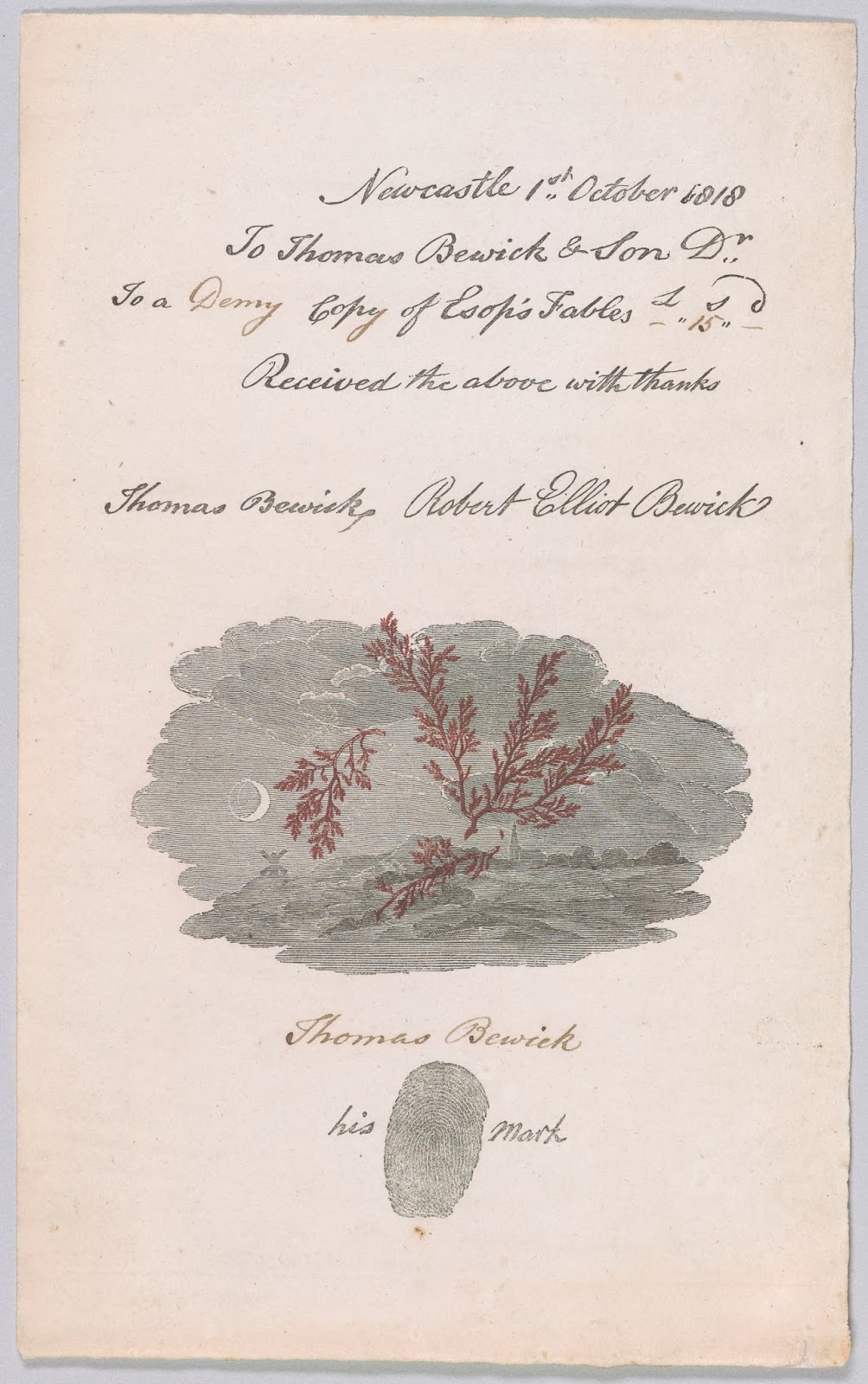
Thomas Bewick, Printed receipt for Fables of Aesop, 1818
  
Bewick was so successful with this technique that he began to issue copies of his woodcut-illustrated books with a thumbprint receipt to prove that the work was indisputably his. This example dates from 1818 for an edition of The Fables of Aesop.

 
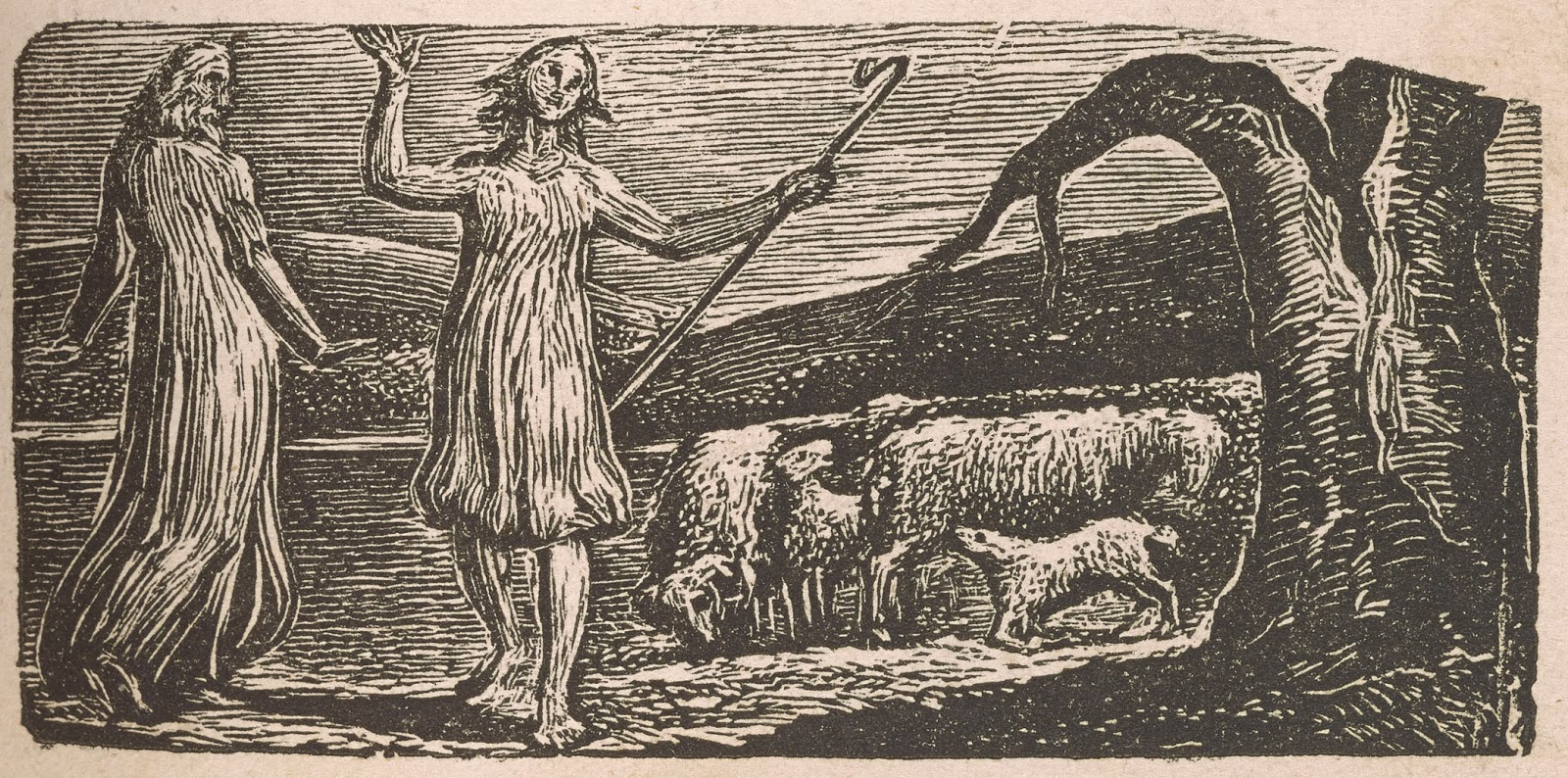
William Blake, The Pastorals of Virgil, 1821

By the end of his life, Bewick's method of "against the grain" engraving was emulated by many woodcut illustrators in Britain and Europe. But others, like the visionary poet and artist, William Blake, preferred the earlier style of Durer's era. This "primitive" style of woodcut carving became associated with counter-cultural and left-wing political movements. This is important to note because woodcut illustrations were often featured in expensive, limited-edition books favored by wealthy collectors.

During the nineteenth century, woodcuts appeared in two competing roles: the woodcut as talisman of the art of the common man or as aesthetic masterpiece affordable only in elite circles. Medium as Muse, as the Morgan Library exhibit is called. reveals that these two basic categories of woodcuts covered a very wide variety of illustrations. Over ninety woodcut prints, books illustrated with woodcuts, drawings and tools used to create woodcuts are on display in this much-needed exhibit at the Morgan Library. All are from the Morgan's collection.

Emile Bernard, the artist who mounted the first retrospective of the work of Vincent van Gogh, is a key figure in the duality of the Woodcut Revival. Bernard (1868 -1941) was a great admirer of Japanese woodcuts and of the popular prints made in the city of Épinal in northeast France. Yet he chose to illustrate with woodcuts one of the most controversial and "decadent" literary works of the era, Les fleurs du mal by Charles Baudelaire.


Émile Bernard, Les fleurs du mal, 1916

 
It took another Englishman, William Morris, to launch the Woodcut Revival in earnest. Morris (1834-1896) was one of the leaders of the Arts and Crafts movement. He had the private wealth to underwrite the operations of his design studio, which specialized in wallpaper, textiles and other furnishings for homes and churches. In January 1891, Morris founded the Kelmscott Press to produce limited editions of classic or inspirational works. The production of these books incorporated all the traditional, artisan techniques that Morris struggled to preserve in an age of increasing automation.


The Works of Geoffrey Chaucer
Designed by William Morris, 1896

Morris and his long-time colleague and friend, Edward Burne-Jones, worked together on a lavishly illustrated edition of the works of Geoffrey Chaucer. Five years of planning, two years to produce, 438 copies in total, the Kelmscott Chaucer was illustrated with eighty-seven woodcuts by Burne-Jones. These are among the last art works in the Pre-Raphaelite tradition. Morris died in October 1896, as his edition of Chaucer came clanking from the hand press. Burne-Jones died less than two years later, in June 1898. It was the end of an era - and the beginning of another.

The Kelmscott Press gained widespread fame for its stunning, handcrafted books. Lucien Pissarro (1863-1944), son of the Impressionist Camille Pissarro and a notable artist himself, established the Eragny Press with the help of his wife, Esther. Pissarro was a great admirer of Japanese prints like his friend, Vincent van Gogh, and he incorporated color woodcut engravings in many of his works. But Pissarro lacked the independent wealth of Morris and he suffered a stroke which limited the number of publishing projects that he could undertake. Never-the-less, the Eragny Press woodcuts made a deep impression on book collectors on the European continent.

The Kelmscott Chaucer and the Eragny Press books were feasts for the eye but not intended for reading. Morris described his edition of Chaucer as "essentially a work of art." But the sheer number of woodcut illustrations in these beautiful books enabled viewers to construct a visual narrative without grappling with the dense, crowded typography.


Félix Vallotton, Le dejeuner en plein air (or, Cinq heures), 1900

Picking up on this, the Swiss-born artist, Felix Vallotton (1865- 1925), produced several series of woodcuts without accompanying text. These presented episodes or scenes whose meanings were easy to grasp. Vallotton's woodcuts totally dispensed with hatchings and simulated gray tones. His woodcuts were small universes of black and white.

Frans Masereel (1889–1972), born in Belgium but active in France, created "wordless novels" with woodcuts unsupported by text. His masterpiece was Mon livre d'heures or Passionate Journey, the story of a twentieth century everyman first published in 1919. A popular Chinese edition appeared in 1933.

Masereel was a hard-working, prolific artist, a painter as well as woodcut specialist. Only a year after Passionate Journey, he published L'Idée or The Idea. In this symbolical work, a naked woman representing free-thinking ideals, is hunted down by the Capitalist "powers that be."


Frans Masereel, Die Idee: 83 Holzschnitte, 1927

A 1932 animated film, L'Idée, inspired by Masereel's wordless novel, was made by Berthold Bartosch, a Hungarian filmmaker, and can be seen at the Morgan exhibit.

Masereel made a lasting impact with his wordless novels, his influence extending to Art Spiegelman's controversial Holocaust graphic novel, Maus, completed in 1991. But it is inconceivable to consider the role of woodcuts in twentieth century American art without studying the career of Lynd Ward.

Lynd Ward (1905-1985) is represented in the Morgan exhibition by a short film documenting his carving technique. Ward was fortunate that woodcuts enjoyed a vogue in advertising circles during the 1930's and 1940's. He was at the peak of his energy and talent, both of which were epic in scope. Ward produced woodcut engravings for such corporate giants as U.S. Cast Iron Pipe & Foundry. Ward's woodcuts gave a populist appeal to the marketing strategy of a company which produced seventy-percent of the metal pipes in the United States.


Lynd Ward, Wild Pilgrimage: A Novel in Woodcuts, 1932

While Ward "paid the bills" with ads for U.S. Cast Iron Pipe & Foundry, he created "wordless novels" which were anything but supportive of the corporate economy. Ward's tales of workers struggling to find their identity in Depression-era America were passionate, almost anarchistic, in tone. Ward's Wild Pilgrimage also probed the psychological state of his protagonist, shifting to reddish brown color to denote a shift from reality to the embattled hero's inner world.

Ward's Wild Pilgrimage shows an obvious debt to the wordless novels of Masereel. Ward had closely studied Masereel’s work while a student in Leipzig during the 1920's. The effect of silent film on the woodcut revival ought to be considered too. But it is fascinating to consider this connection from the reverse angle - the influence of the wordless novel with its woodcut engravings on modern film.

Wordless novels plot the course of narratives exactly as storyboards are used in the motion picture industry. Webb Smith, an animator for the Walt Disney Studio, is credited with pioneering storyboards to plot the sequential development of Disney cartoons such as The Three Little Pigs in 1933. It was not long before feature films were using the technique of plotting, scene by scene, the development of the narrative with storyboards. David O. Selznick hired William Cameron Menzies, who had studied at the Art Students League of New York, to storyboard Gone with the Wind. Alfred Hitchcock was legendary for the use of storyboards in his films of the 1940's and 1950's.


Typee: Wood-Engravings by Robert Gibbings, Penguin Illustrated Classics, 1938

Woodcut engravings, either directly or at second-hand, contributed to some of the most dynamic media of the twentieth century. The Morgan exhibition displays several of the early Penguin Press paperback books which were illustrated with woodcut engravings. It was a long way from the Kelmscott Chaucer, but Morris would certainly have approved.

Woodcuts retain an arcane, time-honored appeal. This is inevitable, no doubt, given the Janus-like nature of the Woodcut Revival. The signature illustration of the Morgan exhibit, Vanessa Bell's woodcut for the story, Monday or Tuesday, by her sister Virginia Woolf, is a case in point. Bell's woodcut appeared in an edition printed on the hand-operated printing press of the Hogarth Press, owned by Virginia Woolf and her husband, Leonard.

But the Morgan exhibit shows that the incredible diversity of woodcut illustration absolutely defies easy categorization. The exhibit is very aptly named, Medium as Muse. There is an almost magical power at work in woodcuts. The act of carving these wondrous illustrations insures the unique, indelible individuality of the artists who create them - and fosters that of the art lovers who behold them.

 *** 

 
Text: Copyright of Ed Voves, all rights reserved

Images Courtesy of Morgan Library and Museum, New York City

Introductory Image:
Vanessa Bell (1879-1961)
Monday or Tuesday
By Virginia Woolf (1882-1941)
Richmond: The Hogarth Press, 1921
Bequest of Gordon N. Ray, 1987
The Morgan Library & Museum
© Estate of Vanessa Bell, courtesy Henrietta Garnett
Photograph: Graham S. Haber

Thomas Bewick (1753-1828)
Printed receipt, signed Newcastle 1st October 1818
From a subscriber’s copy of Bewick’s Fables of Aesop
Gift of Dr. Charles Ryskamp, 1981
The Morgan Library & Museum
Photograph: Graham S. Haber

William Blake (1757-1827)
The Pastorals of Virgil
London: F.C. & J. Rivingtons et al., 1821
Bequest of Gordon N. Ray, 1987
The Morgan Library & Museum
Photograph: Graham S. Haber

Émile Bernard (1868-1941)
Les fleurs du mal
By Charles Baudelaire (1821-1867)
Paris: Ambroise Vollard, 1916
Bequest of Gordon N. Ray, 1987
The Morgan Library & Museum
Photograph: Graham S. Haber

The Works of Geoffrey Chaucer
Designed by William Morris (1834-1896)
Wood engravings after Edward Coley Burne-Jones (1833-
1898)
Hammersmith: The Kelmscott Press, 8 May 1896
Purchased by J. P. Morgan, Jr., ca. 1921
The Morgan Library & Museum
Photograph: Graham S. Haber

Félix Vallotton (1865-1925)
Le dejeuner en plein air (or, Cinq heures), 1900
Preparatory drawing for wood engraving
Pen and black ink, over black chalk, on wove paper
Thaw Collection
The Morgan Library & Museum
Photography: Graham S. Haber

Frans Masereel (1889-1972)
Die Idee: 83 Holzschnitte
Munich: Kurt Wolff, 1927
Purchased on the Gordon N. Ray Fund, 2012
The Morgan Library & Museum
© 2014 Artists Rights Society (ARS), New York / VG Bild-
Kunst, Bonn
Photography: Graham S. Haber

Lynd Ward (1905-1985)
Wild Pilgrimage: A Novel in Woodcuts
New York: Harrison Smith & Robert Haas, 1932
Collection of Robert Dance
© Estate of Lynd Ward
Photography: Graham S. Haber
Herman Melville (1819-1891)

Typee: Wood-Engravings by Robert Gibbings (1889-1959)
Penguin Illustrated Classics
Harmondsworth: Penguin Books Ltd., 1938
Bequest of Gordon N. Ray, 1987
The Morgan Library & Museum
Photography: Graham S. Haber
© 2014 Artists Rights Society (ARS), New York / ADAGP, Paris