Showing posts with label Carmen Bambach. Show all posts

Sunday, June 28, 2026

Art Eyewitness Essay: The Raphael and Michelangelo Exhibits at the Met


Art Eyewitness Essay:

Raphael & Michelangelo at the Met 


Text by Ed Voves
Original Photography by Anne Lloyd

There really is no time like the present. For art lovers, this undeniable fact has ominous implications when museum bulletins announce the closing date of special exhibits.

When the exhibition in question is Raphael: Sublime Poetry at the Metropolitan Museum of Art, the alarm and sense of impending "gloom" is all the greater. 


Ed Voves, Photo (2026)
Gallery view of Raphael: Sublime Poetry at The Met

Raphael: Sublime Poetry at the Met is truly a once-in-a-lifetime experience - not a figure of speech. The Met is the only venue for this exhibition, the first complete career survey of the amazing Rafaello di Giovanni Santi (1483-1520) ever presented in the U.S.

The exhibit closes at the Met on June 28. 

On June 19th, with the clock ticking, I made my second trek to Raphael: Sublime Poetry. I arrived at the Met, on the dot, as the doors opened. A lot of people had the same idea.


A mass of humanity, indeed, crowded into Gallery 899. By the time I elbowed my way out, there was a waiting line to get in, winding its way through the second-floor corridors past the Rodin statues and Symbolist paintings and on and on ...

I can recall quite a few densely-packed Met exhibitions but very few which drew the multitudes waiting to glimpse Raphael: Sublime Poetry. The 2005 Van Gogh Drawings was one. The other was Michelangelo: Divine Draftsman and Designer, 2017-18.


Anne Lloyd, Photo (2026)
 Gallery view of Raphael: Sublime Poetry


Anne Lloyd, Photo (2017)
 Gallery view of Michelangelo: Divine Draftsman & Designer

Neither Raphael nor Michelangelo would likely have been pleased by the comparison. But that is exactly what art lovers have been doing since the two artists worked for the same employers - Pope Julius II and Pope Leo X - during the early years of the sixteenth century. 

The marked difference in personal demeanor and working methods between the two artists almost assured their "rivalry" in the public eye - and in the annals of art history. Famous incidents like Michelangelo's rebuke to Raphael for traveling through the streets of Rome with a entourage worthy of a prince - and Raphael's quick-riposte that Michelangelo comported himself like a hangman   - make it seem that they detested each other.

However, the Raphael exhibition at the Met presents far more evidence for an affinity between Raphael and Michelangelo than an antipathy. The great - if unacknowledged - bond between the two Renaissance masters was their mutual devotion to drawing. 

One of the great surprises of Raphael: Sublime Poetry is the outstanding quality and quantity of Raphael's drawings. Of the 170 works of art by Raphael on view, 145 drawings were selected for the exhibition.

By comparison, the 2017 Met exhibit, Michelangelo: Divine Draftsman & Designer, presented 133 drawings by the Florentine master. This sensational display of art was organized by Dr. Carmen Bambach, who curated Raphael: Sublime Poetry, as well.

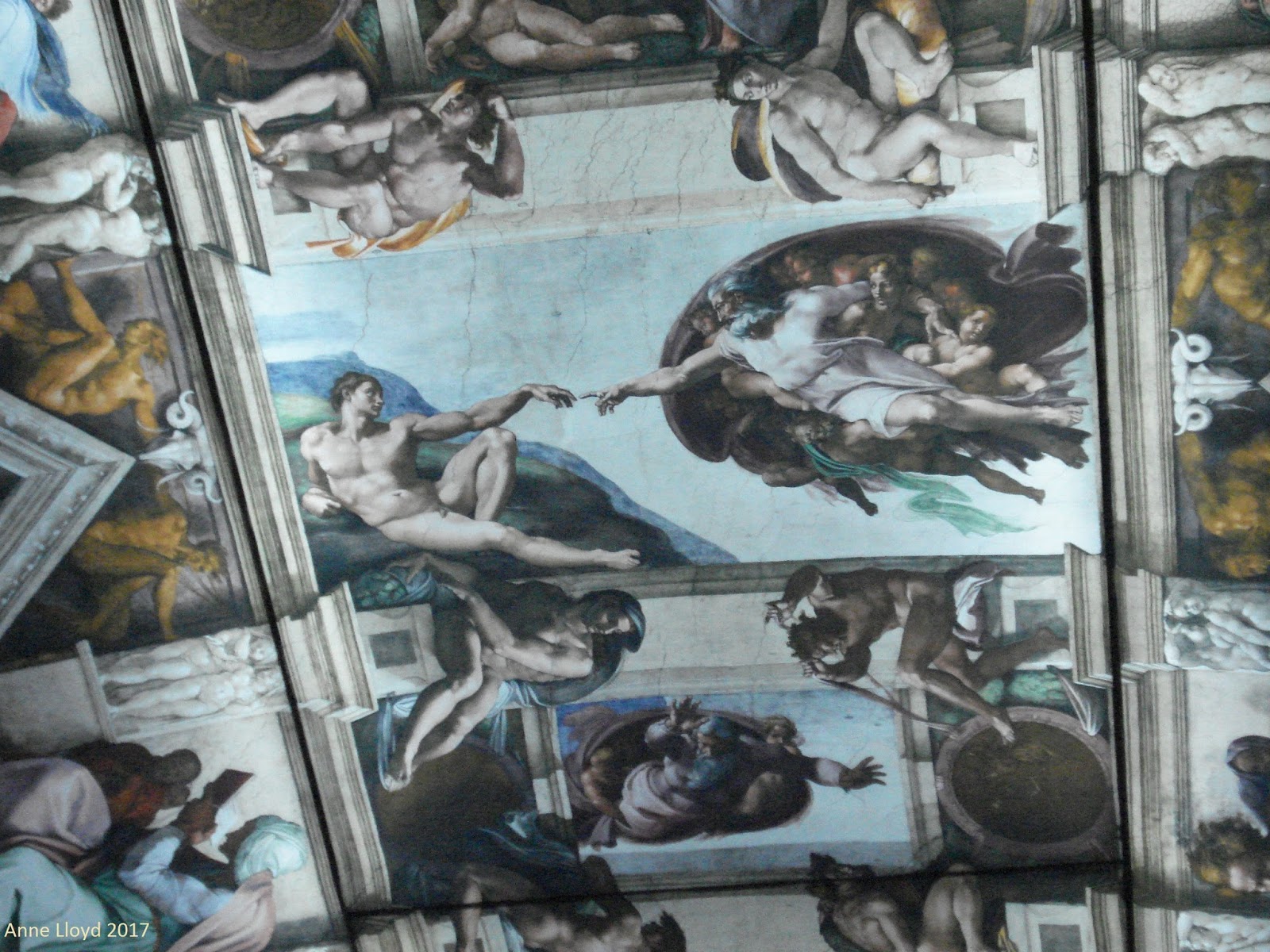
The most memorable feature of Michelangelo: Divine Draftsman & Designer was the installation of a lighted photo version of the Sistine Chapel ceiling frescoes. 


Though reduced in scale from the original, the Met's "Sistine ceiling" was an awesome demonstration of curatorial genius. In my review of the 2017 exhibition, I wrote:

With skill and audacity to match Michelangelo, the Metropolitan has replicated the fabled Sistine Chapel ceiling ... The effect of being able to study Michelangelo's studies for the figures of the Sistine ceiling and then look above at the wondrous copy is enlightening in a way that no close study of the many fine books dealing with the Sistine frescoes can ever be.

Dr. Bambach and the Raphael design team made impressive efforts similar to the 2017 Michelangelo show. I will briefly comment later in this essay. Ultimately, it was the judicious selection of drawings by the two Renaissance masters which was the greatest achievement of both exhibits. 


Anne Lloyd, Photo (2026)
Raphael's The Head of the Muse Polyhymnia, 1511-12

We should not be amazed by Raphael's skill as a draftsman. Yet, it is undeniable that Raphael's reputation as a painter, especially of Madonna and Child portraits, has deflected acclaim away from his drawings. 


Anne Lloyd, Photo (2026)
Raphael's Madonna of the Candelabra, 1514-16

Likewise, the critical attention devoted to Raphael's "debts' to Leonardo and Michelangelo place him in position where his unique merits can be difficult to assess.

During his sojourns in Florence, 1504-08, the young Raphael certainly studied the work of Leonardo and Michelangelo. The influence of Fra Bartolommeo, according to the noted art scholar, Paul Joannides, was also profound. 

Joannides, in his biography of Raphael, makes an important point in comparing him to the Florentine artists of his generation, who were also scrutinizing Leonardo and Michelangelo. The two titans were engaged in painting frescoes celebrating military victories. Everyone in Florence's art community was watching, but the outsider from Urbino was the most perceptive. Joannides writes:

Raphael acquired a great deal in Florence and, in his understanding of the artistic possibilities that the city had to offer, he far outdistanced native Florentines. Put simply, his intelligence, technical ability, capacity for assimilation and ambition were infinitely greater than theirs.

Raphael came to Florence ready, indeed determined, to observe. The key word in the quotation from Joannides is "assimilation." Raphael was already a proficient, largely self-taught, artist by the time he first visited Florence. The portrait sketch (below), dating to 1500 when he was barely 17 years old, clearly shows his immense ability and devotion to drawing.


Anne Lloyd, Photo (2026)
Raphael's Composition Study for the
Coronation of St. Nicholas of Tolentino, ca. 1500

What Raphael sought in coming to Florence was insight into the latest innovations in the world of art. Talent and a command of fundamental techniques he already had.

Of the Florentine masters, Fra Bartollomeo and Leonardo, were the more obliging in affording Raphael opportunities to observe and experiment. Raphael may indeed have worked in Leonardo's studio. If so, Raphael would have directly witnessed the dramatic scene of cavalry combat which Leonardo was painting, in competition with Michelangelo's battle scene. 


Anne Lloyd, Photo (2026)
Detail of Leonardo da Vinci's Studies for the Battle of Anghiari
 and the Proportions of the Head, ca. 1490-95; 1503-05.

Sadly,The Battle of Anghiari, like so much of Leonardo's work, would never be finished. A drawing made by Leonardo for his battle scene and a striking figure study reveal the revolutionary experiments in art which were taking place in Leonardo's studio - and inside his head.

While Leonardo tried to capture the frantic nature of a cavalry skirmish, Michelangelo sought to depict a group of soldiers, caught by surprise attack as they bathed in a stream. Michelangelo's handling of nude male figures in action astonished onlookers, though his painting, The Battle of Cascina, likewise, was never completed.

Raphael was deeply impressed from studying the cartoon of The Battle of Cascina and is known to have copied at least two of Michelangelo's nude soldiers struggling to don their uniforms and armor to join in the battle. The influence of The Battle of Cascina soldiers would reappear frequently in Raphael's own narrative depictions.


Anne Lloyd, Photo (2017), Detail of Michelangelo's Male Back with a Flag, c. 1504, created for The Battle of Cascina; Raphael's Studies of Two Male Nudes for the Naval Battle of Ostia, 1515, Albertina Museum, Vienna

Yet, Raphael had to be more circumspect when he studied Michelangelo's oeuvre than that of Leonardo. The careful process by which Raphael followed  Michelangelo's example can be traced in a revelatory sketch by Raphael in the Met exhibition.

While in Florence, Raphael received an important commission to paint an altarpiece for a noblewoman from Perugia, Atalanta Baglioni. Her son had been killed in a brawl, much like the violence depicted in Romeo and Juliet. An early "prep" drawing for the altarpiece closely follows Michelangelo's already famous Pieta.

Raphael may have been wary of being accused of plagiarizing the Pieta. He looked to an ancient tomb sculpture for an alternative pose, while keeping Michelangelo's example at the ready. Raphael took the format of the dying Greek hero, Meleager, and re-purposed it to show the body of Jesus being carried to the tomb from which he will arise on Easter.


Anne Lloyd, Photo (2026)
Marble sarcophagus fragment, showing the dying Meleager, 2nd century


Anne Lloyd, Photo (2026)
Raphael's The Entombment
 (Composition Study for the Baglioni Altarpiece), ca. 1507

The finished work of art, entitled The Entombment, is now in the collection of the Galleria Borghese in Rome. Raphael followed the "Meleager" format discussed above. The body of Jesus, however, was painted with a profound regard for Michelangelo's Pieta, so much so that Joannides surmises that Raphael traveled to Rome to examine the statue at first hand.


Detail of The Baglioni Entombment, painted by Raphael, 1507
                                                                             
Other protagonists in the Baglioni Entombment (which was not on view in the Met exhibit) are based on sculpted figures by Michelangelo. The bearded man in green and gold bears a striking resemblance to an unfinished statue of St. Matthew by Michelangelo. Indeed, Raphael drew a copy of this statue on the back of the sketch shown above!

For all of these "borrowings", it must be emphasized that Raphael was internalizing - not plagiarizing - the great innovations of Leonardo and Michelangelo. A comparison of his preparatory sketch for the Alba Madonna with the finished painting, clearly shows the intelligent study by Raphael of Leonardo and Michelangelo, leading to stylistic improvements uniquely his own.


Anne Lloyd & Ed Voves, Photos (2026)
Raphael's Alba Madonna, ca. 1509, & related Composition Study

At some point in 1508, Raphael was summoned to Rome to join the team of talented architects and artists charged with building, sculpting and painting the New Rome envisioned by Pope Julius. 

Raphael's first commission, painting the frescoes of the Stanza della Segnatura, notably The School of Athens, was a triumphant success. An escalating list of commissions and duties, including the position of chief architect for the Basilica of St. Peter's, followed.

The Met's Raphael design team attempted to replicate the experience of the simulated Sistine Chapel ceiling frescoes from Michelangelo: Divine Draftsman & Designer. In a bold, perhaps over bold plan, they chose to feature all four of the fresco series designed by Raphael in a digital video loop progression. Focusing exclusively on the Stanza della Segnatura, which Raphael directly painted himself, would have been more effective given the complexity of these works of art.


Ed Voves, Photo (2026)
View of the Digital Video Projection Gallery of Raphael: Sublime Poetry 

By showing the four "stanzas" in rapid succession, the Met curators did make one telling point. Raphael, who seemingly could not say no to a commission, took on staggering burdens of work, more akin to the labors of Hercules than the tasks of a mere mortal.


Anne Lloyd, Photo (2026)
 Raphael's Study of Two Nude Seated Male Figures for the Transfiguration (St. Andrew and Another Apostle) ca. 1518–19

Raphael wore himself out through overwork and died, aged 37, in 1520.

While Raphael's death was a tragic loss, it should be noted that he was spared the horror of the 1527 Sack of Rome. That year, troops of the Holy Roman Empire, Catholics and Protestants, attacked the Eternal City and massacred over 20,000 people. One soldier scratched the name of Martin Luther into Raphael's fresco, The Disputa, with his pike.

Raphael's "rival" Michelangelo survived much longer, dying at 88 years in 1564. Michelangelo lived through terrible decades of religious strife and much of this turmoil is reflected in his later art, The Last Judgement and the unfinished Rondanini Pieta.

Both of these Renaissance Men, however, cannot be defined by the political or social events of their era - or by revisionist criticism of later ages. Both Raphael and Michelangelo lived to use their God-given talents to create art which is worthy of God.


Anne Lloyd, Photo (2026)
Detail of The Miraculous Draft of Fishes, designed by Raphael, 1515-16; tapestry woven by Jan van Tiegman & Frans Gheteels, late 1540s

,

Anne Lloyd, Photo (2017)
 The Metropolitan Museum's "Sistine Chapel ceiling", from the Michelangelo: Divine Draftsman & Designer exhibit

Both Raphael and Michelangelo engaged in their shared passion - drawing - almost to their dying breaths.

That is why their works of art, so splendidly presented at the Met, are immortal.

***

Text: Copyright of Ed Voves, all rights reserved                                  

Original photography, copyright of Anne Lloyd and Ed Voves

Introductory Image: Anne Lloyd, Photo (2026) Gallery view of the Raphael: Sublime Poetry exhibition at the Metropolitan Museum of Art .


Anne Lloyd, Photos (2017 & 2026); Ed Voves, Photos (2026) Gallery views of Michelangelo: Divine Draftsman & Designer (2017) and Raphael: Sublime Poetry (2026) at the Metropolitan Museum of Art, N.Y.C.

Anne Lloyd, Photo (2026) Raphael's The Head of the Muse Polyhymnia (“Auxiliary Cartoon” for the Parnassus, Stanza della Segnatura), 1511-12. Black chalk drawn freehand over pounce marks (spolvero underdrawing), traces of stylus underdrawing, and partly unrelated design in pounce marks (spolvero):Sheet: 12 × 8 3/4 in. (30.5 × 22.2 cm) Private Collection.

Anne Lloyd, Photo (2026) Raphael's The Virgin and Child with Angels (The Madonna of the Candelabra), 1514-16. Oil on poplar wood (two members; thickness reduced, panel cradled, size cut down): Framed: 47 1/16 × 49 1/2 × 8 1/4 in. (119.6 × 125.7 × 21 cm) Walters Art Museum, Baltimore

Anne Lloyd, Photo (2026) Raphael's Composition Study for the Coronation of St. Nicholas of Tolentino (The Baronci Altarpiece), ca. 1500. Black chalk, over preliminary stylus underdrawing, with a construction of numerous overlapping circles incised with the compass, squared (recto), black chalk, over preliminary stylus underdrawing (verso), on paper: 15 1/2 × 10 3/8 in. (39.4 × 26.3 cm)  Palais des Beaux-Arts, Lille, France.

Anne Lloyd, Photo (2026) Detail of Leonardo da Vinci's Studies for the Battle of Anghiari and the Proportions of the Head, ca. 1490-95; 1503-05. Pen and two hues of brown ink (that of lighter color later reworked with black-brown ink), over traces of preliminary stylus work, soft black chalk, red chalk :11 × 8 13/16 in. (28 × 22.4 cm) Gallerie dell’Accademia, Gabinetto dei Disegni e Stampe, Venice

Anne Lloyd, Photo (2017), Detail of Michelangelo's Male Back with a Flag, c. 1504, created for The Battle of Cascina. Chalk on paper: 7.7 x 11 in. 19.6 x27 cm) Albertina Museum, Vienna.

Raphael (Italian, 1483-1520) Studies of Two Male Nudes for the Naval Battle of Ostia, 1515.  Red chalk over preliminary stylus underdrawing, on paper:15 7/8 × 11 1/8 in. (40.3 × 28.3 cm) Albertina Museum, Vienna.

Anne Lloyd, Photo (2026) Marble sarcophagus fragment, showing the dying Meleager, 2nd century, Roman Empire. Marble: 38 1/8 in. × 8 3/4 in. × 46 7/8 in. (96.8 × 22.2 × 119.1 cm) Metropolitan Museum of Art.

Anne Lloyd, Photo (2026) Raphael's The Entombment (Composition Study for the Baglioni Altarpiece), ca. 1507. Pen and brown ink over black chalk and preliminary stylus underdrawing (recto), pen and brown ink (verso), on paper:9 × 12 1/2 in. (22.9 × 31.8 cm) British Museum.

Raphael (Italian, 1483-1520) Detail of The Baglioni Entombment, 1507. Oil on wood: 72 1/2 × 69 3/8 in. (184 × 176 cm) Galleria Borghese, Rome.

Anne Lloyd & Ed Voves, Photos (2026) The Virgin and Child with the Infant Saint John the Baptist in a Landscape (The Alba Madonna) ca. 1509-11: Oil on canvas, transferred from wood: 55 1/4 in. × 6 1/4 in. (140.3 × 15.9 cm) National Gallery of Art, Washington, D.C; related composition study for the Alba Madonna, 1509, from the Palais des Beaux-Arts, Lille, France.

Anne Lloyd, Photo (2026) Raphael's Study of Two Nude Seated Male Figures for the Transfiguration (St. Andrew and Another Apostle) ca. 1518–19. Red chalk over preliminary stylus underdrawing: 12 15/16 × 9 1/8 in. (32.8 × 23.2 cm) The Devonshire Collections, Chatsworth, England.

 Anne Lloyd, Photo (2026) Detail of The Miraculous Draft of Fishes, designed by Raphael, 1515-16; tapestry woven by Jan van Tiegman & Frans Gheteels, late 1540s. Warp: wool, 7-8 per cm; weft: wool and silk, lined on the reverse, 34-38 per cm.: 15 ft. 11 3/4 in. × 19 ft. 5 1/16 in. (487 × 592 cm) Patrimonio Nacional, Colecciones Reales, Madrid, Spain

Anne Lloyd, Photo (2017) The Metropolitan Museum's "Sistine Chapel ceiling", from the Michelangelo: Divine Draftsman & Designer exhibition.


Sunday, November 19, 2017

Michelangelo: Divine Draftsman and Designer at the Metropolitan Museum of Art


Michelangelo: Divine Draftsman and Designer


Metropolitan Museum of Art
November 13, 2017–February 12, 2018


Reviewed by Ed Voves

Michelangelo: Divine Draftsman and Designer joins a long list of landmark exhibitions at Metropolitan Museum of Art. These exhibits do far more than just present great works of art for us to enjoy.  New insights, sometimes revolutionary in their implications, emerge from the Met exhibitions.

Many of these exhibits, like Michelangelo: Divine Draftsman and Designer, appeared in the Tisch Galleries on the second floor of the Met. I have been privileged to see quite of few of them over the years and to review the more recent ones in Art Eyewitness.

To name but a few: Byzantium: Faith and Power (2004), Impressionism, Fashion, and Modernity (2013) and Ancient Egypt Transformed: The MIddle Kingdom (2015). These brilliant exhibits transformed the Tisch Galleries into portals to the past and to the living essence of art. 

Michelangelo: Divine Draftsman and Designer does no less.  However, the exhibit curator, Dr. Carmen Bambach, faced a seemingly impossible obstacle which her colleagues generally do not encounter. Michelangelo's greatest masterpieces do not travel.

David, "Il Gigante," cannot be loaned to museums like the Metropolitan. Nor can The Pieta - though it was sent over from the Vatican for the 1964 New York World's Fair.To view the statue, art lovers stood on a conveyor-belt like the moving walkway between the East and West buildings of the National Gallery in Washington, D.C. That permitted about a 45 second look at The Pieta.

With Michelangelo's "greatest hits" off-limits, Dr. Bambach focused on what was available. In an epic eight year quest, she secured the loan of several smaller sculptures, a very good copy of The Last Judgement, much reduced in scale, a splendid selection of Michelangelo's drawings and a number of contrasting art works by other Renaissance artists.Two hundred pieces of art are on view, the greatest number of works by Michelangelo ever presented in a single exhibition.


Michelangelo, Three Labours of Hercules, 1530–33
Royal Collection Trust © Her Majesty Queen Elizabeth II, 2017

With these drawings - and a "special effects" masterstroke - Dr. Bambach has curated a comprehensive and readily comprehensible introduction to the life of Michelangelo Buonarroti (1475-1564).

Michelangelo is known to have burned many of his drawings toward the end of his life and was only prevented from destroying more by the art historian, Giorgio Vasari. But the great Florentine would have approved of an exhibition which emphasizes the importance of disegno or drawing. Disegno was the foundation of Michelangelo's art and life.

“Draw Antonio," Michelangelo wrote to his studio assistant, Antonia Mini. "Draw and don't waste time.” 

Mini did not waste any time selling the trove of drawings that Michelangelo had given him to inspire his practice of disegno. Deeply in debt, Mini sold the drawings, ironically insuring that they would survive to bear witness to Michelangelo's rise to greatness.

Michelangelo learned the basics of art in the workshop of Domenico Ghirlandaio (1448/49–1494). Several of Ghirlandaio's sketches are on view in the opening gallery, along with early efforts by Michelangelo. Ghirlandaio was a master of the fresco technique in painting and the main thrust of his desegno was to prepare the images to be painted in his frescoes.

Michelangelo must have profited by working with Ghirlandaio but he claimed to have taught himself art.There is some truth to that claim as Michelangelo's drawings have a sustained power and insight that Ghirlandaio's seldom match. 


Michelangelo, Portrait of Andrea Quaratesi, 1532

Michelangelo's Portrait of Andrea Quaratesi, created in black chalk in 1532, is one of the finest Renaissance character studies, matching the best of Hans Holbein's similar works. 

After a bit more than a year,1488-89, Michelangelo left Ghirlandaio's studio to survey the art collection of Lorenzo da Medici. Il Magnifico had created a sculpture garden at the Medici palace in Florence. Michelangelo was permitted to sketch the antiquities and then try his hand at sculpture.
  
In a famous encounter, Lorenzo da Medici commented favorably on the small sculpture of an aged satyr that Michelangelo had made. He noted, with wry humor, that the mythological creature would not likely have had a full set of teeth, as Michelangelo had depicted. The thirteen-year-old artist took a file and chipped away one of the satyr's teeth. Il Magnifico was so impressed that he invited Michelangelo to join his court.

Michelangelo's apprenticeship was over.


Anne Lloyd, Photo (2017) Michelangelo’s Study of Adam & Eve after Masaccio

The young Michelangelo also spent a lot of time in the Brancacci Chapel in Florence, sketching the frescoes created by the tragically short-lived Masaccio (1401-1428). Michelangelo's copy in red chalk of Masaccio's Expulsion from the Garden of Eden adheres closely to Masaccio but we can glimpse the beginnings of his version of this fabled event, immortalized on the ceiling of the Sistine Chapel.

Lorenzo da Medici died in 1492 and within a few, short years, the searing drama of Masaccio's fresco was repeated in the lives of countless people in Italy, including Michelangelo. The French invasion of 1494 and the wave of puritanical religious fervor under Savanorola led to the fall of the Medici. The fragile political framework of the Italian city-states, especially Florence, never recovered, though the cultural awakening of the  Renaissance continued. 

Michelangelo found himself without a patron, a refugee from the lost Medici paradise. He  sought work first in Bologna and then in Rome under the revived power of the Papacy. 
Michelangelo  took with him an impressive portfolio of artistic skills. But his years with the Medici gifted him with a philosophical treasure of equal value: the Neo-Platonic philosophy of Pico della Mirandola (1463-1494). 

Pico's teaching emphasized human dignity, the ability of individuals to shape their own destiny and the ideal of perfection as goal. Human beings could thus worship their Divine Creator with deeds, as well as prayers.


Michelangelo, Il Sogno (The Dream), 1530's

Michelangelo's The Dreamfrom the collection of the Courtauld Gallery in London, illustrates Pico's philosophy in action. A young man, perfect in bodily form, listens to the word of God, transmitted by an angelic trumpeter. The young man grasps the globe, while behind him rages scenes of cruelty, violence, lust and greed.

The symbolism in The Dream invites speculation and interpretation. Some commentators believe that the idealized youth is grappling with melancholy, as well as resisting temptation. The drawing was created in the early 1530's, following the terrible Sack of Rome in 1527 by the mercenary troops of Emperor Charles V.  It was certainly a depressing period in Italian history.


The Dream was probably part of a group of presentation drawings which Michelangelo made as gifts for Tommaso de’ Cavalieri. A young Roman nobleman, Tommaso de’ Cavalieri was also the recipient of Michelangelo's passionate friendship. Quaratesi likely was, as well. 

Michelangelo's homoerotic yearnings for these young nobles is quite evident. Yet the degree to which this passion was physically pursued will never be known. Michelangelo's private life, extremely limited by his obsessive work ethic, left him little time for self-indulgence. 

Michelangelo was a devout Christian and during his later years was a member of the religious circle inspired by the reform-minded poet, Vittoria Collona. Michelangelo was a close friend of Collona, for whom he created a powerful depiction of the Pieta, very different from the famous statue he had carved decades before.


Anne Lloyd, Photo (2017), Michelangelo's Pieta, ca. 1540 

Throughout his life, Michelangelo labored to create visual images testifying to the glory of God. This was done  chiefly through depictions of the male nude, including those of the dead Christ in his mother's arms. For Michelangelo, the youthful male body represented the epitome of God's creative handiwork.

This was such a far-reaching ideal that Michelangelo extended it to the way he portrayed women. A number of cultural historians, including Camille Paglia in her book, Sexual Personae, maintain that Michelangelo used male models for female characters in his paintings. Looking on his painted panel of the Holy Family called the Doni Tondo, the lithe, athletic body of the Virgin Mary certainly lends weight to that argument.

The Doni Tondo is not in the Metropolitan Museum exhibition but confirmation of this theory can be found in one of the the Met's own treasures, Michelangelo's Studies for the Libyan Sibyl which he painted on the Sistine Ceiling. The rippling arm muscles, the broad shoulders and ramrod straight spinal column are matched by the strength of character of the Libyan Sibyl's face. 


Michelangelo, Studies for the Libyan Sibyl, c.1510–11

It should not it be forgotten that the finished version of the Libyan Sibyl is holding a massive volume, a Wisdom Book. The Libyan Sibyl represents the incarnation of mind/body perfection possible to a person, male or female, who is devoted to God's truth.

The incomparable physique of the Libyan Sibyl sketch is also evident in a preparatory study made around 1504 for the famous, now lost, cartoon for the Battle of Cascina fresco. Looking at Male Back with a Flag, one is struck by the obvious fact that Michelangelo retained much of his sculptor's technique even when he sketched and painted.


 Anne Lloyd, Photo (2017), Detail of Michelangelo's Male Back with a Flag, c. 1504. 

That was especially true of the Sistine Chapel frescoes. Unlike the Battle of Cascina, the cosmic drama of the Book of Genesis was carried through to completion. With skill and audacity to match Michelangelo, the Metropolitan has replicated the fabled Sistine Chapel ceiling with a lighted photo version above the Tisch galleries. The scale, though reduced, approximates the experience of looking at the original in Rome.


Anne Lloyd, Photo (2017) Gallery view of Michelangelo: Divine Draftsman & Designer

The effect of being able to study Michelangelo's studies for the figures of the Sistine ceiling and then to look above you at the wondrous copy is enlightening in a way that no close study of the many fine books dealing with the Sistine frescoes can ever be. 

The sheer brilliance of the Metropolitan exhibit enables you to look at the original study for the Cumaean Sybyl, check it against the dazzling overhead display and thus progressively see how the image was incorporated into the whole design of the Sistine Chapel fresco.


Anne Lloyd, Photo (2017) Detail of Michelangelo' s Study of the Cumaean Sibyl (top),
followed by details of Metropolitan Museum reproductions of the Cumaean Sibyl


Even straining your neck to look at the original in the Vatican does not allow you to do that. My wife, Anne, an accomplished artist herself, described the effect. 

"I finally get the Sistine Chapel," Anne said. 

The sensational impact of the re-imagined Sistine Chapel is reinforced by the presence of a sculpture group in the very next gallery. To see a Michelangelo statute in the United States is a rare treat. There are two in this group, along with contrasting portrait busts, one from ancient Rome and another of Julius Caesar by Andrea Ferrucci (1465-1526). 


.Anne Lloyd, Photo (2017) Gallery view of the Michelangelo: Divine Draftsman and Designer exhibit, Michelangelo's David/Apollo at left.

The standing sculpture, David/Apollo, begun around 1530, was never completed by the overworked Michelangelo. As a result, this non-finito work is impossible to identify as either David or Apollo. 


Anne Lloyd, Photo (2017) Gallery view of the Michelangelo: Divine Draftsman and Designer exhibit, Michelangelo's Brutus at center.

That's not case with the bust of Brutus. Sculpted in 1539, Brutus exerts a living presence. Here unquestionably is the portrait of a noble Roman. This forceful evocation of Caesar's assassin also points to the power-politics of Michelangelo's era.

Michelangelo was a supporter of the Republic of Florence, which had been suppressed by one of the Medici successors to Lorenzo the Magnificent. This was the brutal Duke Alessandro, assassinated in 1537 by his cousin, Lorenzino da Medici. Lorenzino was motivated by Republican sentiments similar to Michelangelo's. Alessandro's death, alas, did not lead to the restoration of the Florentine Republic. Michelangelo may have left his bust of Brutus unfinished in silent protest to the passing of Florence's republican tradition.

It is incredible to think that when Michelangelo stopped working on Brutus in 1539, he had a quarter of a century of life before him. Could he not have finished the bust of Brutus?

The obvious answer to this question is provided by the Metropolitan exhibit which cogently outlines his later epic works: the Last Judgment fresco and the architectural design of the basilica of St. Peter's. Michelangelo might cease working on a statue like Brutus but he never stopped working.

There is another reason, I believe, that many of the statues from his later years remained non-finito. Michelangelo was motivated by spiritual impulses that compelled him to work to the point that Spirit, God's spirit, was satisfied and then to move on. It was a case of God's will be done rather than Michelangelo's.

Michelangelo composed a beautiful poem, a madrigal, around 1534. These verses, translated by the great Renaissance scholar, Creighton Gilbert, confirm that Michelangelo certainly believed that he was obeying God's will.

Beautiful things are the longing of my eyes,                                                              
 Just as it is my soul’s to be secure,                                                                                 
 But they’ve no other power                                                                                              
That lifts to Heaven, but staring at all those.                                                                    
A shining glory falls                                                                                                          
From furthest stars above,         
Toward them our wish it pulls,                                                                                       
 And here we call it love.                                                                                                
Kind heart can never have,                                                                                                
To enamor and fire it, and to counsel,                                                                            
More than a face with eyes that they resemble.

If my interpretation of this madrigal is correct, Michelangelo believed that God's face, with eyes that resemble stars, watched over his creative achievements. It was not Michelangelo's "kind heart" but heavenly inspiration that impelled him to attempt and to achieve the impossible.


Anne Lloyd, Photo (2017) The Metropolitan Museum reproduction of the Sistine Chapel ceiling, with Michelangelo's Creation of Adam at center. 

Any person fortunate to visit Michelangelo: Divine Draftsman and Designer at the Metropolitan is likely come to the same conclusion. The evidence is overwhelming.

***
Text: Copyright of Ed Voves, all rights reserved    

Madrigal by Michelangelo Buonarroti, c.1534. Translated by Creighton Gilbert in Complete Poems and Selected Letters of Michelangelo, Princeton University Press, 1980, first edition published by Random House, 1963.

Images courtesy of the Metropolitan Museum of Art and Anne Lloyd

Introductory Image:
Anne Lloyd, Photo (2017) Daniele da Volterra's Portrait of Michelangelo Buonarroti, ca. 1544, oil on wood, 34 3/4 x 25 1/4 in. (88.3 x 64.1 cm) Metropolitan Museum of Art

Michelangelo Buonarroti (Italian, 1475–1564) Three Labours of Hercules, 1530–33. Drawing, red chalk; 10 11/16 x 16 5/8 in. (27.2 x 42.2 cm) ROYAL COLLECTION TRUST / © HER MAJESTY QUEEN ELIZABETH II 2017, www.royalcollection.org.uk.


Michelangelo Buonarroti (Italian, 1475–1564) Portrait of Andrea Quaratesi, 1532.
Drawing, black chalk; 16 3/16 x 11 ½ in. (41.1 x 29.2 cm) The British Museum, London

Anne Lloyd, Photo (2017) Photo of Michelangelo’s Study of Adam and Eve after The Expulsion from Paradise fresco by Masaccio, c. 1503-04. Red chalk. Musée du Louvre, Department des arts Graphiques, Paris (3897 recto)

Michelangelo Buonarroti (Italian, 1475–1564) Il Sogno (The Dream), 1530's. Black chalk. Sheet: 15 5/16 × 10 15/16 in. (38.9 × 27.8 cm) Sheet: 15 5/16 × 10 15/16 in. (38.9 × 27.8 cm) London, Courtauld Gallery, Prince Gate Bequest (1978) inv. D 1978.PG.424

Anne Lloyd, Photo (2017) Michelangelo's Pieta, ca. 1540, Black chalk,  28.9 x 18.9 cm (11 3/8 x 7 7/16 in. Isabella Stewart Gardner Museum. 1.2.o.16


Michelangelo Buonarroti (Italian,1475–1564) Studies for the Libyan Sibyl (recto), Ca. 1510–11. Red chalk, with small accents of white chalk. Sheet: 11 3/8 x 8 7/16 in. (28.9 x 21.4 cm) The Metropolitan Museum of Art, Purchase, Joseph Pulitzer Bequest, 1924. 24.197.2


Anne Lloyd, Photo (2017), Detail of Michelangelo's Male Back with a Flag, c. 1504.  Albertina, Vienna.123v

Anne Lloyd, Photo (2017) Gallery view of Michelangelo: Divine Draftsman & Designer.

Anne Lloyd, Photo (2017) Detail of Michelangelo' s Study of the Cumaean Sibyl and the Metropolitan Museum of Art's reproductions of the Cumaean Sibyl on the Sistine Chapel ceiling at the Michelangelo: Divine Draftsman and Designer exhibit.

Anne Lloyd, Photo (2017) Gallery view of the Michelangelo: Divine Draftsman and Designer exhibit at the Metropolitan Museum of Art, showing Michelangelo's David/Apollo (C. 1530) and Brutus (1539), Marble Portrait of Emperor of Caracalla, Third Century A.D., and Andrea Ferrucci's Julius Caesar (c.1512-14) 

Anne Lloyd, Photo (2017) Gallery view of the Michelangelo: Divine Draftsman and Designer exhibit at the Metropolitan Museum of Art, Michelangelo's Brutus, center.

Anne Lloyd, Photo (2017) Gallery view of Michelangelo: Divine Draftsman and Designer, showing the Metropolitan Museum reproduction of the Sistine Chapel ceiling, with Michelanglo's Creation of Adam at center.