
Michelangelo: Divine Draftsman and Designer
Metropolitan Museum of Art
November 13, 2017–February 12, 2018
Reviewed by Ed Voves
Michelangelo: Divine Draftsman and Designer joins a long list of landmark exhibitions at Metropolitan Museum of Art. These exhibits do far more than just present great works of art for us to enjoy. New insights, sometimes revolutionary in their implications, emerge from the Met exhibitions.
Many of these exhibits, like Michelangelo: Divine Draftsman and Designer, appeared in the Tisch Galleries on the second floor of the Met. I have been privileged to see quite of few of them over the years and to review the more recent ones in Art Eyewitness.
To name but a few: Byzantium: Faith and Power (2004), Impressionism, Fashion, and Modernity (2013) and Ancient Egypt Transformed: The MIddle Kingdom (2015). These brilliant exhibits transformed the Tisch Galleries into portals to the past and to the living essence of art.
Michelangelo: Divine Draftsman and Designer does no less. However, the exhibit curator, Dr. Carmen Bambach, faced a seemingly impossible obstacle which her colleagues generally do not encounter. Michelangelo's greatest masterpieces do not travel.
David, "Il Gigante," cannot be loaned to museums like the Metropolitan. Nor can The Pieta - though it was sent over from the Vatican for the 1964 New York World's Fair.To view the statue, art lovers stood on a conveyor-belt like the moving walkway between the East and West buildings of the National Gallery in Washington, D.C. That permitted about a 45 second look at The Pieta.
With Michelangelo's "greatest hits" off-limits, Dr. Bambach focused on what was available. In an epic eight year quest, she secured the loan of several smaller sculptures, a very good copy of The Last Judgement, much reduced in scale, a splendid selection of Michelangelo's drawings and a number of contrasting art works by other Renaissance artists.Two hundred pieces of art are on view, the greatest number of works by Michelangelo ever presented in a single exhibition.

Michelangelo, Three Labours of Hercules, 1530–33
Royal Collection Trust © Her Majesty Queen Elizabeth II, 2017
With these drawings - and a "special effects" masterstroke - Dr. Bambach has curated a comprehensive and readily comprehensible introduction to the life of Michelangelo Buonarroti (1475-1564).
Michelangelo is known to have burned many of his drawings toward the end of his life and was only prevented from destroying more by the art historian, Giorgio Vasari. But the great Florentine would have approved of an exhibition which emphasizes the importance of disegno or drawing. Disegno was the foundation of Michelangelo's art and life.
“Draw Antonio," Michelangelo wrote to his studio assistant, Antonia Mini. "Draw and don't waste time.”
Mini did not waste any time selling the trove of drawings that Michelangelo had given him to inspire his practice of disegno. Deeply in debt, Mini sold the drawings, ironically insuring that they would survive to bear witness to Michelangelo's rise to greatness.
Michelangelo learned the basics of art in the workshop of Domenico Ghirlandaio (1448/49–1494). Several of Ghirlandaio's sketches are on view in the opening gallery, along with early efforts by Michelangelo. Ghirlandaio was a master of the fresco technique in painting and the main thrust of his desegno was to prepare the images to be painted in his frescoes.
Michelangelo must have profited by working with Ghirlandaio but he claimed to have taught himself art.There is some truth to that claim as Michelangelo's drawings have a sustained power and insight that Ghirlandaio's seldom match.

Michelangelo, Portrait of Andrea Quaratesi, 1532
Michelangelo's Portrait of Andrea Quaratesi, created in black chalk in 1532, is one of the finest Renaissance character studies, matching the best of Hans Holbein's similar works.
After a bit more than a year,1488-89, Michelangelo left Ghirlandaio's studio to survey the art collection of Lorenzo da Medici. Il Magnifico had created a sculpture garden at the Medici palace in Florence. Michelangelo was permitted to sketch the antiquities and then try his hand at sculpture.
In a famous encounter, Lorenzo da Medici commented favorably on the small sculpture of an aged satyr that Michelangelo had made. He noted, with wry humor, that the mythological creature would not likely have had a full set of teeth, as Michelangelo had depicted. The thirteen-year-old artist took a file and chipped away one of the satyr's teeth. Il Magnifico was so impressed that he invited Michelangelo to join his court.
Michelangelo's apprenticeship was over.

Anne Lloyd, Photo (2017) Michelangelo’s Study of Adam & Eve after Masaccio
The young Michelangelo also spent a lot of time in the Brancacci Chapel in Florence, sketching the frescoes created by the tragically short-lived Masaccio (1401-1428). Michelangelo's copy in red chalk of Masaccio's Expulsion from the Garden of Eden adheres closely to Masaccio but we can glimpse the beginnings of his version of this fabled event, immortalized on the ceiling of the Sistine Chapel.
Lorenzo da Medici died in 1492 and within a few, short years, the searing drama of Masaccio's fresco was repeated in the lives of countless people in Italy, including Michelangelo. The French invasion of 1494 and the wave of puritanical religious fervor under Savanorola led to the fall of the Medici. The fragile political framework of the Italian city-states, especially Florence, never recovered, though the cultural awakening of the Renaissance continued.
Michelangelo found himself without a patron, a refugee from the lost Medici paradise. He sought work first in Bologna and then in Rome under the revived power of the Papacy.
Michelangelo took with him an impressive portfolio of artistic skills. But his years with the Medici gifted him with a philosophical treasure of equal value: the Neo-Platonic philosophy of Pico della Mirandola (1463-1494).
Pico's teaching emphasized human dignity, the ability of individuals to shape their own destiny and the ideal of perfection as goal. Human beings could thus worship their Divine Creator with deeds, as well as prayers.

Michelangelo, Il Sogno (The Dream), 1530's
Michelangelo's The Dream, from the collection of the Courtauld Gallery in London, illustrates Pico's philosophy in action. A young man, perfect in bodily form, listens to the word of God, transmitted by an angelic trumpeter. The young man grasps the globe, while behind him rages scenes of cruelty, violence, lust and greed.
The symbolism in The Dream invites speculation and interpretation. Some commentators believe that the idealized youth is grappling with melancholy, as well as resisting temptation. The drawing was created in the early 1530's, following the terrible Sack of Rome in 1527 by the mercenary troops of Emperor Charles V. It was certainly a depressing period in Italian history.
Michelangelo's homoerotic yearnings for these young nobles is quite evident. Yet the degree to which this passion was physically pursued will never be known. Michelangelo's private life, extremely limited by his obsessive work ethic, left him little time for self-indulgence.
Michelangelo was a devout Christian and during his later years was a member of the religious circle inspired by the reform-minded poet, Vittoria Collona. Michelangelo was a close friend of Collona, for whom he created a powerful depiction of the Pieta, very different from the famous statue he had carved decades before.

Anne Lloyd, Photo (2017), Michelangelo's Pieta, ca. 1540
Throughout his life, Michelangelo labored to create visual images testifying to the glory of God. This was done chiefly through depictions of the male nude, including those of the dead Christ in his mother's arms. For Michelangelo, the youthful male body represented the epitome of God's creative handiwork.
This was such a far-reaching ideal that Michelangelo extended it to the way he portrayed women. A number of cultural historians, including Camille Paglia in her book, Sexual Personae, maintain that Michelangelo used male models for female characters in his paintings. Looking on his painted panel of the Holy Family called the Doni Tondo, the lithe, athletic body of the Virgin Mary certainly lends weight to that argument.
The Doni Tondo is not in the Metropolitan Museum exhibition but confirmation of this theory can be found in one of the the Met's own treasures, Michelangelo's Studies for the Libyan Sibyl which he painted on the Sistine Ceiling. The rippling arm muscles, the broad shoulders and ramrod straight spinal column are matched by the strength of character of the Libyan Sibyl's face.

Michelangelo, Studies for the Libyan Sibyl, c.1510–11
It should not it be forgotten that the finished version of the Libyan Sibyl is holding a massive volume, a Wisdom Book. The Libyan Sibyl represents the incarnation of mind/body perfection possible to a person, male or female, who is devoted to God's truth.
The incomparable physique of the Libyan Sibyl sketch is also evident in a preparatory study made around 1504 for the famous, now lost, cartoon for the Battle of Cascina fresco. Looking at Male Back with a Flag, one is struck by the obvious fact that Michelangelo retained much of his sculptor's technique even when he sketched and painted.

Anne Lloyd, Photo (2017), Detail of Michelangelo's Male Back with a Flag, c. 1504.
That was especially true of the Sistine Chapel frescoes. Unlike the Battle of Cascina, the cosmic drama of the Book of Genesis was carried through to completion. With skill and audacity to match Michelangelo, the Metropolitan has replicated the fabled Sistine Chapel ceiling with a lighted photo version above the Tisch galleries. The scale, though reduced, approximates the experience of looking at the original in Rome.

Anne Lloyd, Photo (2017) Gallery view of Michelangelo: Divine Draftsman & Designer
The sheer brilliance of the Metropolitan exhibit enables you to look at the original study for the Cumaean Sybyl, check it against the dazzling overhead display and thus progressively see how the image was incorporated into the whole design of the Sistine Chapel fresco.


Anne Lloyd, Photo (2017) Detail of Michelangelo' s Study of the Cumaean Sibyl (top),
followed by details of Metropolitan Museum reproductions of the Cumaean Sibyl
Even straining your neck to look at the original in the Vatican does not allow you to do that. My wife, Anne, an accomplished artist herself, described the effect.
"I finally get the Sistine Chapel," Anne said.
The sensational impact of the re-imagined Sistine Chapel is reinforced by the presence of a sculpture group in the very next gallery. To see a Michelangelo statute in the United States is a rare treat. There are two in this group, along with contrasting portrait busts, one from ancient Rome and another of Julius Caesar by Andrea Ferrucci (1465-1526).

.Anne Lloyd, Photo (2017) Gallery view of the Michelangelo: Divine Draftsman and Designer exhibit, Michelangelo's David/Apollo at left.

Anne Lloyd, Photo (2017) Gallery view of the Michelangelo: Divine Draftsman and Designer exhibit, Michelangelo's Brutus at center.
That's not case with the bust of Brutus. Sculpted in 1539, Brutus exerts a living presence. Here unquestionably is the portrait of a noble Roman. This forceful evocation of Caesar's assassin also points to the power-politics of Michelangelo's era.
Michelangelo was a supporter of the Republic of Florence, which had been suppressed by one of the Medici successors to Lorenzo the Magnificent. This was the brutal Duke Alessandro, assassinated in 1537 by his cousin, Lorenzino da Medici. Lorenzino was motivated by Republican sentiments similar to Michelangelo's. Alessandro's death, alas, did not lead to the restoration of the Florentine Republic. Michelangelo may have left his bust of Brutus unfinished in silent protest to the passing of Florence's republican tradition.
It is incredible to think that when Michelangelo stopped working on Brutus in 1539, he had a quarter of a century of life before him. Could he not have finished the bust of Brutus?
The obvious answer to this question is provided by the Metropolitan exhibit which cogently outlines his later epic works: the Last Judgment fresco and the architectural design of the basilica of St. Peter's. Michelangelo might cease working on a statue like Brutus but he never stopped working.
There is another reason, I believe, that many of the statues from his later years remained non-finito. Michelangelo was motivated by spiritual impulses that compelled him to work to the point that Spirit, God's spirit, was satisfied and then to move on. It was a case of God's will be done rather than Michelangelo's.
Michelangelo composed a beautiful poem, a madrigal, around 1534. These verses, translated by the great Renaissance scholar, Creighton Gilbert, confirm that Michelangelo certainly believed that he was obeying God's will.
Beautiful things are the longing of my eyes,
Just as it is my soul’s to be secure,
But they’ve no other power
That lifts to Heaven, but staring at all those.
A shining glory falls
From furthest stars above,
Toward them our wish it pulls,
And here we call it love.
Kind heart can never have,
To enamor and fire it, and to counsel,
More than a face with eyes that they resemble.
If my interpretation of this madrigal is correct, Michelangelo believed that God's face, with eyes that resemble stars, watched over his creative achievements. It was not Michelangelo's "kind heart" but heavenly inspiration that impelled him to attempt and to achieve the impossible.
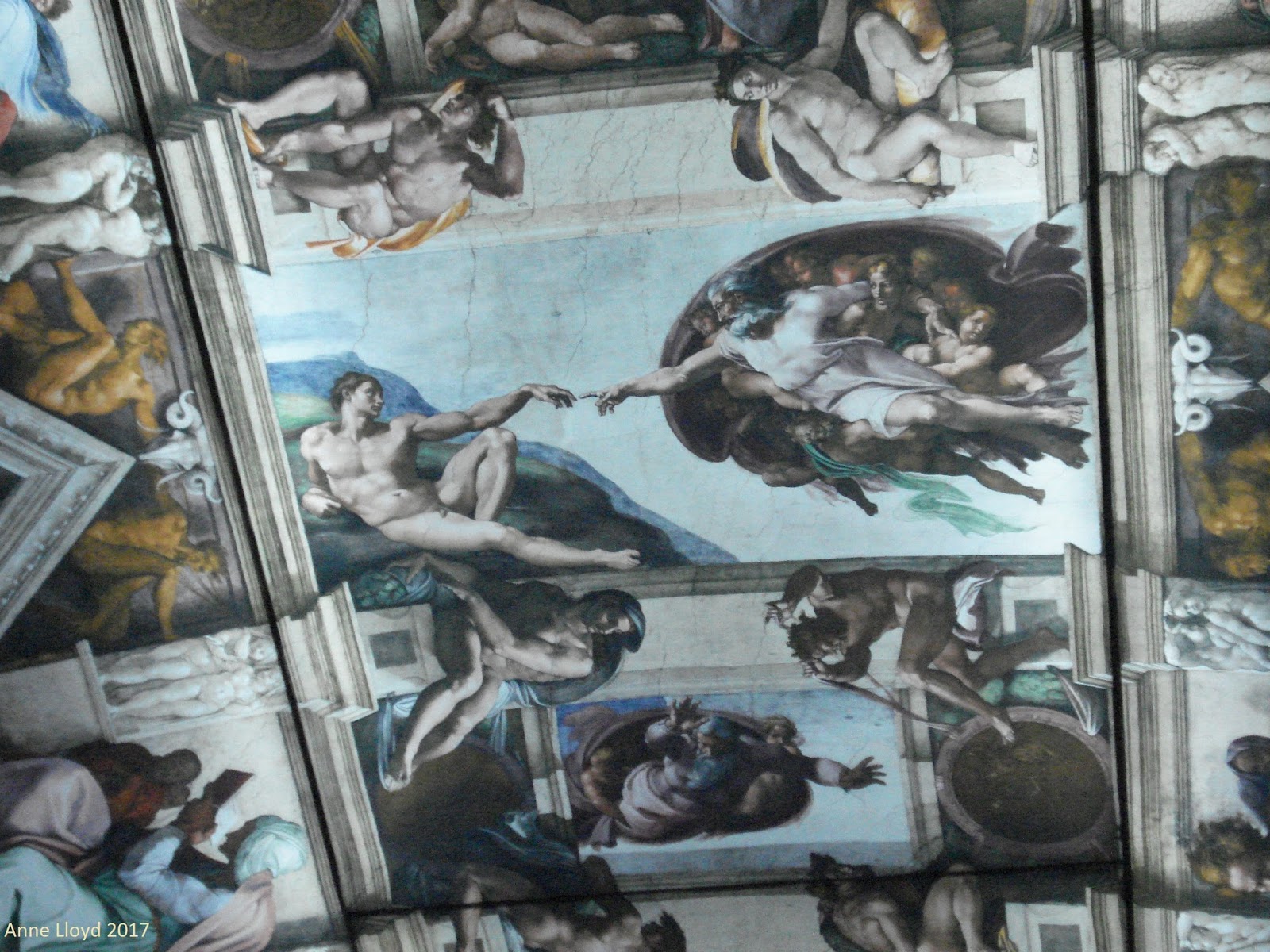
Anne Lloyd, Photo (2017) The Metropolitan Museum reproduction of the Sistine Chapel ceiling, with Michelangelo's Creation of Adam at center.
Any person fortunate to visit Michelangelo: Divine Draftsman and Designer at the Metropolitan is likely come to the same conclusion. The evidence is overwhelming.
***
Text: Copyright of Ed Voves, all rights reserved
Madrigal by Michelangelo Buonarroti, c.1534. Translated by Creighton Gilbert in Complete Poems and Selected Letters of Michelangelo, Princeton University Press, 1980, first edition published by Random House, 1963.
Images courtesy of the Metropolitan Museum of Art and Anne Lloyd
Introductory Image:
Anne Lloyd, Photo (2017) Daniele da Volterra's Portrait of Michelangelo Buonarroti, ca. 1544, oil on wood, 34 3/4 x 25 1/4 in. (88.3 x 64.1 cm) Metropolitan Museum of Art
Michelangelo Buonarroti (Italian, 1475–1564) Three Labours of Hercules, 1530–33. Drawing, red chalk; 10 11/16 x 16 5/8 in. (27.2 x 42.2 cm) ROYAL COLLECTION TRUST / © HER MAJESTY QUEEN ELIZABETH II 2017, www.royalcollection.org.uk.
Michelangelo Buonarroti (Italian, 1475–1564) Portrait of Andrea Quaratesi, 1532.
Drawing, black chalk; 16 3/16 x 11 ½ in. (41.1 x 29.2 cm) The British Museum, London
Michelangelo Buonarroti (Italian, 1475–1564) Il Sogno (The Dream), 1530's. Black chalk. Sheet: 15 5/16 × 10 15/16 in. (38.9 × 27.8 cm) Sheet: 15 5/16 × 10 15/16 in. (38.9 × 27.8 cm) London, Courtauld Gallery, Prince Gate Bequest (1978) inv. D 1978.PG.424
Anne Lloyd, Photo (2017) Michelangelo's Pieta, ca. 1540, Black chalk, 28.9 x 18.9 cm (11 3/8 x 7 7/16 in. Isabella Stewart Gardner Museum. 1.2.o.16
Michelangelo Buonarroti (Italian,1475–1564) Studies for the Libyan Sibyl (recto), Ca. 1510–11. Red chalk, with small accents of white chalk. Sheet: 11 3/8 x 8 7/16 in. (28.9 x 21.4 cm) The Metropolitan Museum of Art, Purchase, Joseph Pulitzer Bequest, 1924. 24.197.2
Anne Lloyd, Photo (2017), Detail of Michelangelo's Male Back with a Flag, c. 1504. Albertina, Vienna.123v
Anne Lloyd, Photo (2017) Gallery view of Michelangelo: Divine Draftsman & Designer.
Anne Lloyd, Photo (2017) Detail of Michelangelo' s Study of the Cumaean Sibyl and the Metropolitan Museum of Art's reproductions of the Cumaean Sibyl on the Sistine Chapel ceiling at the Michelangelo: Divine Draftsman and Designer exhibit.
Anne Lloyd, Photo (2017) Gallery view of the Michelangelo: Divine Draftsman and Designer exhibit at the Metropolitan Museum of Art, showing Michelangelo's David/Apollo (C. 1530) and Brutus (1539), Marble Portrait of Emperor of Caracalla, Third Century A.D., and Andrea Ferrucci's Julius Caesar (c.1512-14)
Anne Lloyd, Photo (2017) Gallery view of the Michelangelo: Divine Draftsman and Designer exhibit at the Metropolitan Museum of Art, Michelangelo's Brutus, center.
Anne Lloyd, Photo (2017) Gallery view of Michelangelo: Divine Draftsman and Designer, showing the Metropolitan Museum reproduction of the Sistine Chapel ceiling, with Michelanglo's Creation of Adam at center.


