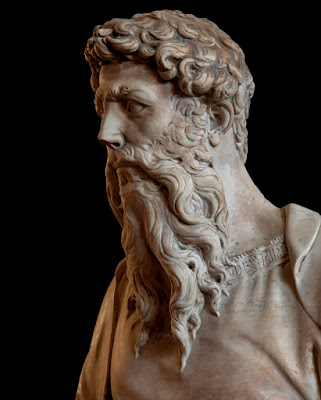
Showing posts with label Donatello. Show all posts

Friday, November 29, 2019

Verrocchio Exhibition at the National Gallery, Washington D.C.


Verrocchio: Sculptor and Painter of Renaissance Florence


National Gallery of Art, Washington D.C.
September 15, 2019 - January 12, 2019

Reviewed by Ed Voves
Original Phoitography by Anne Lloyd

What do you see when you examine a work of art by Leonardo da Vinci?

Is it a masterpiece by an "Artist as Hero"? This was the memorable description of Leonardo - and of Raphael and Michelangelo - by Kenneth Clark in the classic television series, Civilization.

Perhaps, wearied by all the current media-hype over the five hundred year anniversary of Leonardo's death in 1519, you are counting the days to 2020. 

If you have the opportunity to view Leonardo's early masterpiece Ginevra de' Benci  (1474/1478) in its current setting at the National Gallery of Art, Washington D.C., you may change your opinions about Leonardo and Renaissance art.


Ed Voves, Photo (2019)
Gallery view of the Verrocchio exhibition, showing
Leonardo da Vinci's Ginevra de' Benci

The current setting for Ginevra de' Benci is a place of honor in an exhibition devoted to a different artist of Renaissance Italy. This not a 'back-handed" compliment to Leonardo since the protagonist of the National Gallery exhibit is Andrea del Verrocchio.

Verrocchio was the master of the studio in Florence where the young Leonardo was sent by his father, Ser Piero da Vinci, to learn the craft of art. Verrocchio, as the National Gallery exhibition shows, was a supremely gifted artist and a very efficient businessman. Leonardo worked in Verrocchio's study from 1466 to 1476. Indeed, he thrived to such an extent that the older artist's reputation withered under the shadow of Leonardo's legend.

Verrocchio: Sculptor and Painter of Renaissance Florence restores a sense of balance to the lives and creative works of Verrocchio and Leonardo. It shows that Verrocchio is such a major Renaissance artist that his career does not need - or deserve - to be appraised in terms of Leonardo's. A very good exhibit, last year at Yale, did exactly that.

Verrocchio at the National Gallery in Washington D.C. tells the whole story and it confirms that this neglected artist was one of the greatest Renaissance masters. Painting, sculpting, drawing and teaching - Verrocchio excelled in all of these pursuits. He was the best of all teachers for Leonardo - and other major Renaissance artists.


Anne Lloyd, Photo (2019) Gallery view of the Verrocchio exhibit showing
Verrocchio’s Putto with a Dolphin, c.1465/1480

Andrea del Verrocchio (1435-1488) was born in Florence just as the Renaissance gained impetus as a defining force in European affairs. Like many great artists, he trained as a goldsmith, then launched himself into painting and sculpting with impressive skill. 

Verrocchio, however, was very much a figure of the "springtime of the Renaissance." He was ready and able to work as a collaborative artist. The government and mercantile patrons of Florence during the early decades of the Renaissance expected the works of art they commissioned to be of the highest quality and delivered on time and within the budget. 

The best method for satisfying such patrons was an efficient workshop rather than the work ethic of a solitary "hero." That is exactly the kind of establishment which Verrocchio set up when he had gained sufficient means and reputation to do so.


Andrea del Verrocchio & assistants (Leonardo da Vinci & Pietro Perugino)
Madonna and Child with Two Angels, c.1470/1474

In the paintings produced by Verrocchio's workshop, the division of labor is often very clear. The hands of Verrocchio's assistants, Leonardo and Pietro Perugino, are detected in Madonna and Christ with Two Angels (c.1470-1474) on loan from the National Gallery  in London. After close inspection and repeated changes in opinion, the lily-holding angel on the left is attributed to Leonardo, while Perugino, the teacher of Raphael, is credited with the angel on the right.

Exactly what year Verrocchio founded his studio has not been established. Very little is known about Verrocchio's youth. Most of his early oeuvre, in metal work especially, has not survived. However, a small covered vase, likely used to hold saintly relics, is of interest in regard to his rise in the Florentine art community. Though attributed to Verrocchio later in his career, it is likely to be the kind of exquisite object d'art that would have caught the eye of would-be patrons as he made a name for himself as a professional artist.


Andrea del Verrocchio (attributed) Small Vase with Cover, c. 1480/1485

The delicate silver-gilt settings on this agate vase are worked with motifs  that can securely be traced to Verrocchio. Curator Andrew Butterfield is confident that this is a work by him. Butterfield also notes that the vase is inscribed "LAV. R. MED." This means that it was owned by Lorenzo de' Medici, "Il Magnifico."


Ed Voves, Photo (2019)
Portrait Bust of Lorenzo de' Medici, ca.1513/1520,

Lorenzo the Magnificent (1444-1492) thought so highly of Verrocchio's skill that he commissioned numerous works. This grim-faced portrait, however, had different patrons and an unusual history, brilliantly investigated by Andrew Butterfield, the chief curator of the National Gallery exhibition. 

In 1478, Medici supporters commissioned a wax statue of Lorenzo, celebrating his survival in the assassination attempt known as the Pazzi Conspiracy. Butterfield maintains that Verrocchio made or assisted with the wax statue, now lost. This work later served as the source for an extremely lifelike terracotta bust of Lorenzo, made about 1513.

Verroccio sculpted another statue of a Medici-family member which has survived: a terracotta portrait of Lorenzo's brother, Guiliano, the "golden youth" of Florence. 


Ed Voves, Photo (2019) 
                   Andrea del Verrocchio’s Giuliano de' Medici, c. 1475/1478

Wearing lavishly-decorated jousting armor, Guiliano beams a victorious smile. In 1475, he wore this or similar armor in a tournament which he won. Three years later, he was murdered, stabbed nineteen times while attending Sunday religious services. The Pazzi conspirators, who tried and failed to kill Lorenzo, were the perpetrators and they paid a fearful price for their deed.

The portrait busts of Lorenzo and Guiliano share an exhibition gallery with with one of Verrocchio's greatest works, the bronze statue, David with the Head of Goliath, dating to around 1465. Verrocchio's David, along with the more famous statues of the Old Testament hero by Donatello and Michelangelo, testifies to the always-tense political situation in Florence. 


Ed Voves, Photo (2019) Gallery view of the Verrocchio exhibit
showing Verrocchio’s  David with the Head of Goliath, c. 1465

An independent city-state and a republic, Florence was surrounded by powerful enemies, Milan, Urbino and the Papacy. Strong leadership, by the Medici, was needed to oppose these external foes, but political factions in Florence feared that this powerful family would erode the democratic constitution, as eventually happened.     

The image of the young, heroic, giant-killing David was selected by the Florentines as the perfect symbol of their small, dynamic state. Three statues of David were commissioned by Donatello, Verrocchio and Michelangelo. Each represented a pivotal moment in the development of  sculpture in Florence. Donatello's David, dating to the 1440's, is an enigmatic figure, relaxed and arrogant, posing in a homoerotic stance. Michelangelo's David (1501-1504) is likewise nude, but stands tense and belligerent.

Verrocchio's David with the Head of Goliath, created around 1465, is one of his earliest works that can be dated. His David is clothed, wearing a kilt and a form-fitting tunic or jerkin. He is confident, but ready for action, just in case the Philistines try to avenge their fallen champion. 


Ed Voves, Photo (2019) Andrea del Verrocchio’s Head of Goliath, c. 1465

Lying at David's feet is the head of Goliath. It is a detail which Verrocchio's youthful hero shares with Donatello's. There the comparison ends. 

Goliath's decapitated head is treated by Donatello's David with smirking contempt. Verrocchio presents him with compassion, indeed empathy. At one point, when the body of Verrocchio's David and the head of Goliath were still separate, the latter was assumed by visitors to Verrocchio's studio to be the head for a statue of St. John the Baptist. There could be no higher, if unintended, praise for Verrocchio since John the Baptist was the patron saint of Florence.

How and why did this emotional transformation occur? So little is known of Verrocchio's life that we can only ponder debatable theories for his sympathetic depiction of the fallen Goliath. 

Perhaps the best explanation lies with the rise of Humanism as the dominant philosophical school of thought in Italy during the 1400's, notably in Florence. Based on dedicated study of classical texts, many newly translated from Greek, Humanism stimulated an awareness of the psychological complexity of people, ancient and modern.


Ed Voves, Photo (2019) Gallery view of the Verrocchio exhibit
showing Verrocchio’s  David with the Head of Goliath, c. 1465

Verrocchio's David perfectly matched the mood and mission of Florence at the moment when the freedom-loving Tuscan city, Humanist scholarship and the "new art" of fifteenth century painting and sculpture were coming into a full-flowering.


Ed Voves, Photo (2019) 
Andrea del Verrocchio’s Bust of Christ, c.1470/1483

The humanity with which Verrocchio depicted David and Goliath appears in work after work in the National Gallery exhibition. Especially notable is the Bust of Christ which Verrocchio originally modeled for one of his major full-bodied works, a statue of Christ and St. Thomas. This portrait of Jesus, renowned in its day as "the most beautiful head of Christ ever made," was then reworked as a terracotta bust. The version of this bust on view at the National Gallery, was likely a collaborative effort, with the head sculpted by Verrocchio and the torso handled by an assistant.

Later, with the tilt of the head changed left to right, this 'fully human, fully divine" Jesus would anchor a scene of bustling human activity in a famous painting: Leonardo's The Last Supper.

Verrocchio, I believe, should be regarded as a Humanist in the visual arts. Verrocchio's "close study" of the human body paralleled the diligent efforts, in translating ancient texts and writing learned commentaries, that transmitted this knowledge to an eager audience of young scholars throughout Italy and then in all the major nations of Europe.

Verrocchio's students, along with Leonardo and Perugino, likely included Domenico Ghirlandaio, in whose studio the young Michelangelo briefly worked.  Thus, we can trace a pedigree of creative genius from the workshop/studio of Verrocchio to the "artist as hero" of the High Renaissance.

In the case of Verrocchio's "passing the baton" to Leonardo, signature works by each artist reveal the way that this was accomplished.


Ed Voves, Photo (2019)
Andrea del Verrocchio’s Lady with Flowers, c. 1475/1480

Verrocchio sculpted his half-length marble, Lady with Flowers, during the years, 1475 to 1480. At the same time, the young Leonardo painted Ginevra de' Benci, but not as the head-and-shoulders portrait as it now is. The curators of the Verrocchio exhibit make a very cogent case that Ginevra de' Benci was originally a half-length portrait before being cut-down at a later date. Viewed in this way, Leonardo's Ginevera strikes a similar pose to Verrocchio's Lady, which likely influenced Leonardo's painting.


Anne Lloyd, Photo (2019) 
Copy of exhibition wall illustration, contrasting a hypothetical version of       Leonardo’s Ginevra de' Benci with Verrocchio’s Lady with Flowers

For all of Verrocchio's success as a sculptor, it was his great ability in drawing that proved key in the dissemination of art innovation and techniques to the next generation of Florentine masters. Of all the many achievements of the National Gallery exhibition, the insights into Verrocchio  as draftsman are perhaps the most crucial to a re-assessment of his art.


Andrea del Verrocchio, Head of a Woman with Braided Hair, late 1470s

I was prepared to be impressed by Verrocchio's statues and sculpture. The gallery display of his drawings was a complete, if pleasurable, shock. The magnificent drawing from the British Museum collection, Head of a Woman with Braided Hair literally stopped me in my tracks each time I visited the Verrocchio exhibition - and I have been there three times! 

So masterful is the gradation of shading around the eye lids, that you half-expect them to open and Woman with Braided Hair to return your gaze.

This is double-sided work, with a finished drawing  on one side. An equally impressive preparatory sketch on the reverse, Head of a Woman Leaning on Her Right Hand. The identity of Woman with Braided Hair is a matter of speculation, with some scholars believing it to be a portrait of Simonetta Vespucci, the most beautiful woman of Florence. If so, it might have been a presentation piece for Guiliano de' Medici, who regarded her with courtly affection. Alas, Simonetta Vespucci died from tuberculosis, aged twenty-two, shortly before Guiliano was cut down by the Pazzi assassins.


Ed Voves, Photo (2019)
 Gallery view of the Verrocchio exhibit at the National Gallery, Washington D.C., showing Verrocchio’s  Head of a Woman Leaning on Her Right Hand

Head of a Woman with Braided Hair and her compatriot provide the central, focusing point of this gallery of Verrocchio's drawings. These are all superlative works of art, worthy of comparison to Michelangelo's drawings. There are only twenty-five known drawings by Verrocchio, so to be able study this selection at the National Gallery is an experience not likely to be repeated for many, many years to come.
  

Ed Voves, Photo (2019) 
Andrew Butterfield, Curator of the Verrocchio exhibit at the National Gallery

Andrew Butterfield, the eminent authority  on Verrocchio's sculptures, has done the art world an enormous service for the outstanding job of curating this magnificent exhibition. Similar accolades are due to him as editor and principle author of the exhibit catalog, truly a Renaissance masterpiece in its own right. I plan to review the catalog in order to more fully explore Verrocchio's art, especially his drawings. 

The greatest praise - and thoroughly deserved - that can be paid to Verrocchio: Sculptor and Painter of Renaissance Florence is to affirm that the study of Renaissance art will never be the same. The vital role of the workshop/studio system and of collaborative effort are themes which the exhibition underscores, in addition to documenting Verrocchio's individual contributions.

And what of the Renaissance "Artist as Hero" school of thought? Well, Leonardo, Raphael and Michelangelo are still there. Donatello and Masaccio, too. They will just have to squeeze a little closer, to make room on the pediment frieze for Andrea del Verrocchio.  

***
Text: Copyright of Ed Voves. Original Photos: Anne Lloyd. All rights reserved                                                                                           
Images courtesy of the National Gallery of Art, Washington D.C.

Introductory Image:
Ed Voves, Photo (2019)  Andrea del Verrocchio’s Putto with a Dolphin (Detail), c. 1465/1480. Bronze: overall: 73.03 cm (28 3/4 in.); base: 125 cm (49 3/16 in.) Museo di Palazzo Vecchio, Florence, Italy.

Ed Voves, Photo (2019) Gallery view of the Verrocchio exhibit at the National Gallery, Washington D.C., showing Leonardo da Vinci’s Ginevra de' Benci.

Anne Lloyd, Photo (2019) Gallery view of the Verrocchio exhibit at the National Gallery, Washington D.C., showing Verrocchio’s Putto with a Dolphin, c. 1465/1480

Andrea del Verrocchio & assistants (Leonardo da Vinci & Pietro Perugino) Madonna and Child with Two Angels, c.1470/1474. Tempera on panel: overall: 97 x 71 cm (38 3/16 x 27 15/16 in.) The National Gallery, London, Bought, 1857

Andrea del Verrocchio (Attributed) Small Vase with Cover, c. 1480/1485. Sardonyx with silver-gilt mountings: height: 16 cm (6 5/16 in.); diameter: 9 cm (3 9/16 in.); diameter: 5 cm (1 15/16 in.) Gallerie degli Uffizi, Tesoro dei Granduchi, Florence.

Ed Voves, Photo (2019) Portrait Bust of Lorenzo de' Medici, ca.1513/1520, probably after a model by Andrea del Verrocchio and Orsino Benintendi, ca/ 1478. Polychrome terracotta: overall: 65.8 x 59.1 x 32.7 cm (25 7/8 x 23 1/4 x 12 7/8 in.)
National Gallery of Art, Washington, Samuel H. Kress Collection

Ed Voves, Photo (2019)  Andrea del Verrocchio’s Giuliano de' Medici, c. 1475/1478. Terracotta with traces of polychromy: overall: 61 x 66 x 28.3 cm (24 x 26 x 11 1/8 in.) National Gallery of Art, Washington, Andrew W. Mellon Collection

Ed Voves, Photo (2019) Gallery view of the Verrocchio exhibit at the National Gallery, Washington D.C., showing Verrocchio’s David with the Head of Goliath, c. 1465. Bronze with traces of gilding: overall: 120 cm (47 1/4 in.) Museo Nazionale del Bargello, Florence, Italy.

Ed Voves, Photo (2019)  Andrea del Verrocchio’s Head of Goliath, c.1465. Bronze with traces of gilding: overall: 120 cm (47 1/4 in.) Museo Nazionale del Bargello, Florence, Italy.

Ed Voves, Photo (2019) Gallery view of the Verrocchio exhibit at the National Gallery, Washington D.C., showing Verrocchio’s David with the Head of Goliath, c.1465.

Ed Voves, Photo (2019)  Andrea del Verrocchio’s Bust of Christ (Detail), c. 1470/1483. Polychrome terracotta: overall: 68 x 71.2 x 40.6 cm (26 3/4 x 28 1/16 x 16 in.) Private collection. Photo: Yale University Art Gallery.

Ed Voves, Photo (2019) Andrea del Verrocchio's Lady with Flowers, c. 1475/1480. Marble: overall: 60 x 48 x 25 cm (23 5/8 x 18 7/8 x 9 13/16 in.) Museo Nazionale del Bargello, Florence.
Anne Lloyd, Photo (2019) Copy of exhibition wall illustration, contrasting a hypothetical version of Leonardo’s Ginevra de' Benci with Verrocchio’s Lady with Flowers.

Andrea del Verrocchio. Head of a Woman with Braided Hair (recto); Head of a Woman Leaning on Her Right Hand (verso),late 1470s. Recto: black chalk or charcoal, lead white gouache, pen and brown ink, reworked with oil charcoal on cream prepared paper; verso: charcoal on white paper: overall: 32.4 x 27.3 cm (12 3/4 x 10 3/4 in.) On loan from the Trustees of the British Museum, London.

Ed Voves, Photo (2019)  Gallery view of the Verrocchio exhibit at the National Gallery, Washington D.C., showing Verrocchio’s Head of a Woman Leaning on Her Right Hand.

Ed Voves, Photo (2019) Andrew Butterfield, Curator of the Verrocchio exhibit at the National Gallery of Art, Washington D.C.   
                                                                                                                                           

Wednesday, September 16, 2015

Art Eyewitness Review: The New Art of the Fifteenth Century by Shirley Neilsen Blum


The New Art of the Fifteenth Century:Faith and Art in Florence and the Netherlands


By Shirley Neilsen Blum 
Abbeville Press/314 pages/$85

Reviewed by Ed Voves

The fifteen century was a revolutionary age, matching the many changes and discoveries of the twentieth.  From Gutenberg's invention of the printing press  to the "discovery" of the Americas, the 1400's reshaped the world into a form we can now recognize.

In an authoritative new book, The New Art of the Fifteenth Century. Shirley Neilsen Blum, explores the art of Europe during the 1400's. This momentous era witnessed the introduction of oil painting, the invention of linear perspective and a revival of life-like portraiture - after an intermission of nearly one thousand years.

Blum builds a case that these new techniques originated in two small, but dynamic, cultural centers: the Republic of Florence and in Flanders, ruled by the dukes of Burgundy.

There was one major difference in the art revolution of the 1400's from the one the took place during the early 1900's. People in Western Europe embraced and applauded the innovations of great artists like Donatello, van Eyck and Masaccio without the consternation that greeted the early works of Matisse, Braque and Picasso. 

There was no "shock of the new" during the Quattrocento, as Italians call the 1400's.


Robert Campin, Mérode Altarpiece, c. 1427–1432 

As Blum cogently shows, paintings like Robert Campin's Mérode Altarpiece depicted hallowed Christian themes while introducing Europe to a new naturalism in the visual arts. Both the Florentine and Netherlandish schools aimed to make "seeing into believing."

Art in the fifteenth century was notable for great painting, especially for the way that the rules of perspective were applied to create the appearance of  three dimensions in a two-dimensional format. Blum however begins her study with works of sculpture.

Blum contrasts the sculptural group of Old Testament prophets called the Well of Moses with statues of New Testament saints by Donatello. The Well of Moses, located in a monastery in Dijon, France, was created by Claus Sluter for the dukes of Burgundy. Sluter carved six incredibly lifelike (and life-sized) statues of biblical prophets including Moses, Jeremiah and King David. These surrounded a monumental crucifixion scene which was smashed by French revolutionaries in 1791.

Sluter's Well of Moses was made to inspire monastic rather than public devotion. Given the urban orientation of religion during the 1400's, it may be questioned if this is indeed a Renaissance art work. 

Such a question could never be asked about the sculptures of Donatello (c.1386-1466). Along with Lorenzo Ghiberti's "Doors of Paradise" on the Baptistry of Florence, Donatello's marble saints and apostles are the signature works of the birth of the Renaissance in Italy.

I had the opportunity recently to see several  of these inspiring works in the Sculpture in the Age of Donatello exhibit at the Museum of Biblical History (MOBIA) in New York City. This rare display of Renaissance art in the United States was a perfect complement to Blum's book. Sadly, MOBIA closed its doors in in June, reducing the venues for such outstanding exhibits in the future.


Donatello, St. John the Evangelist, 1408–15

Even in the MOBIA exhibit setting, Donatello's first great statue, Saint John the Evangelist (1409-1411), exerted a powerful, almost living,  presence.  When it is remembered that Saint John the Evangelist once filled a niche on the facade of Florence' s Duomo, you realize that Donatello  was not creating a symbolical work for a monastery cloister or aristocratic patrons. Rather, his sculptures made a bold statement of public virtue. 

Donatello's statues were paid for by the guilds of Florence. The Wool Guild (the Arte della Lana) oversaw fund-raising for the completion of the Duomo. A select group, guild officials and clergy ,called the Opera del Duomo, hired Donatello and others to sculpt statues for the facade of the cathedral and its bell tower. It was on this latter building that Donatello's masterpiece, Prophet Habbakuk, called "Zuccone" or"Pumpkinhead," was displayed.

Saint John the Evangelist is an imposing, almost regal, portrait of saintliness while Habbakuk is a masterpiece of introspective soul-searing. Both were created to be constant examples of righteous living for the citizens of Florence. In this way, the mystical, devotional element of Medieval art was preserved and channeled into the urban life of the Renaissance.

Strange as this sounds, the acute naturalism of Donatello's sculptures aimed to draw viewers away from "this" world, into a union with God. The great French scholar of the early Renaissance, Jean Gerson (1363-1429) wrote, "We ought to learn to transcend with our minds from these visible things to the invisible, from the corporeal to the spiritual. For this is the purpose of the image."

While Donatello was creating sculptures to achieve this delicate balance of private piety with public expression of faith, Jan van Eyck in Flanders was preoccupied with the same task through painting with oils.

Jan van Eyck's Adoration of the Mystic Lamb, better known as the Ghent Altarpiece, was painted in collaboration with his brother, Hubert, and completed in 1432. It ranks among the  greatest and most complex paintings in the whole of Christian art. 


Jan van Eyck & Hubert van Eyck, Ghent Altarpiece - Adoration of the Mystic Lamb, 1432

The exact meaning of the Ghent Altarpiece now eludes us in the twenty-first century. Blum is very perceptive in pointing out that nobody in the fifteenth century complained that it was enigmatic or indecipherable. It was intended for the instruction of the Christian faithful. Its now arcane symbolism, such as the central panel which shows a bleeding lamb representing Christ's sacrificial death, was readily comprehensible to all who crowded into St. Bavo's Cathedral, Ghent, to see it.

The Ghent Altarpiece was commissioned by a wealthy civic leader of Ghent, Joos Vijd. He and his wife appear as worshipers on facing panels on the altarpiece. 


Jan van Eyck, Rolin Madonna, 1436

So too, did Nicolas Rolin commission a devotional work by van Eyck. Rolin was a self-made man who became chancellor to Philip the Good, Duke of Burgundy. Rolin, rather arrogantly, had van Eyck place him in the same room as the infant Jesus and the radiantly beautiful Virgin Mary. Yet, with Jesus blessing the kneeling Rolin the message could not be clearer: even the most powerful men in Christendom must bend their knees to God.

Van Eyck and other Netherlandish artists who painted with oils made a huge and almost immediately-felt impact on European art. Their work was highly esteemed in Italy, though few Florentine artists utilized oil paints, at least during this early stage of the Renaissance.

A highly influential Flemish work showing rugged, weather-beaten shepherds worshiping the new-born Jesus was brought to Florence by banker Tommaso Portinari in 1483. Painted by Hugo van der Goes, the Portinari Altarpiece directly influenced a similar work by Domenico del Ghirlandaio (1449-1494) for Francesco Sassetti, director of the Medici Bank.

One of the student assistants in Ghirlandaio's studio was the young Michelangelo. He evidently was more impressed with the work of an earlier Florentine painter, Masaccio. Michelangelo is known to have spent long periods in Florence's Brancacci Chapel. There he studied the cycle of paintings of the life of St.Peter left unfinished by Masaccio when he died, aged 27 in 1428. The frescoes were completed by Masaccio's colleague, Masolino.


Masaccio, Tribute Money (detail), c. 1425

Masaccio painted biblical themes, like the story of the Tribute Money from Matthew 17:23-26, with amazing vigor. In his tragically short life, Masaccio created "new and dynamic" versions of age-old Christian images "much more closely related to the world of the viewer."

Of Masaccio, Blum writes: 

Masaccio's people, saints and sinners alike, are rooted in the earth.Their forms are solid, often ungainly, revealed rather than flattered by light... Masaccio's figures are separated from the viewer only by their historical relation to Christ. Very like Donatello's saints, they dwell in a world possible of imitation and thereby humanly attainable. The promise has been given not just by an unknowable God, but through his human agents.The highest of which man is  capable may indeed win him a place next to the disciples, now so very much like him.  


Masaccio, Tribute Money (detail), c. 1425

Masaccio, of course, was in good company, with Sluter, Donatello and van Eyck. He found a kindred spirit in Robert Campin (c.1375–1444), as well. 


Robert Campin, Mérode Altarpiece (detail), c. 1427–1432

Campin's Mérode Altarpiece has a side panel showing a devout couple looking on the central scene of the Annunciation. They are neither aristocrats nor clergy - nor directors of the Medici bank. Campin's onlookers are simply God-fearing townsfolk, people of deep and abiding faith.  

In her concluding remarks, Blum writes movingly of the way that the artists of the 1400's in Flanders and Florence drew beholders of all social strata "ever closer to the divine object of their devotion," in short to God.

"Christian art," Blum affirms, "had never dared so much nor rendered earth more sacred."


***
Text: Copyright of Ed Voves, all rights reserved 

Images Courtesy of Abbeville Press, the Metropolitan  Museum of Art, www.christusrex.org and and the Museum of Biblical History (MOBIA) in conjunction with the Sculpture in the Age of Donatello exhibit

Introductory Image: 
Cover Image Courtesy of Abbeville Press

Robert Campin (ca. 1375–1444) and Workshop, Annunciation Triptych (Merode Altarpiece), ca. 1427–1432 Oil paint on oak; Central panel 25 1/4 x 24 7/8 in. (64.1 x 63.2 cm); each wing 25 3/8 x 10 3/4 in. (64.5 x 27.3 cm)The Cloisters Collection, 1956 (56.70) © Metropolitan Museum of Art


Donatello (c.1386-1466), St. John the Evangelist, 1408–15, Marble, 212 × 91 × 62 cm (83½ × 35¾ × 24½ in.) Opera di Santa Maria del Fiore, inv. no 2005/113 © Opera di Santa Maria del Fiore / Antonio Quattrone -  in conjunction with the Sculpture in the Age of Donatello exhibit at the Museum of Biblical History

Hubert van Eyck (c.1370-1426) and Jan van Eyck (c.1390-1441) Ghent Altarpiece, 1426 - 1432) Oil on panel: 11 ft x 15 ft (3.35 x 4.6 m) open. Adoration of the Mystic Lamb (Central panel, bottom ) 95.39 inches wide x 54.21 inch high. Cathedral of Saint Bavo, Ghent, Belgium


Jan van Eyck (c.1390-95-1441)  Rolin Madonna, 1436 Oil on panel: 25 7/8  x  34 3/8 inches H. 0.66 m; W. 0.62 m Removed from Notre-Dame-du Châtel in Autun and sent to the Louvre, 1800, INV. 1271, Musee du Louvre

Masaccio  (1401-1428) The Trubute Money, 1425 Fresco 247 cm × 597 cm (97.2 in × 235 in) Santa Maria del Carmine - Brancacci Chapel 
http://www.christusrex.org/www2/art/tributo.htm
http://www.christusrex.org/www2/art/images/masacc01a.jpg   http://www.christusrex.org/www2/art/images/masacc23.jpg

Robert Campin Annunciation Triptych (Merode Altarpiece), ca. 1427–1432 (Detail - Left Panell) The Cloisters Collection, 1956 (56.70) © Metropolitan Museum of Art

Friday, June 19, 2015

Farewell to the Museum of Biblical Art (MOBIA)


Sculpture in the Age of Donatello:

Renaissance Masterpieces from Florence Cathedral

February 20, 2015 to June 14, 2015 


Reviewed by Ed Voves

There is always a touch of wistfulness lurking in my emotions when I leave an art exhibition. Outstanding works of art, many of which have not been displayed together in centuries, are joined in unforgettable configurations of genius. After a few months, the exhibit closes. The masterworks are packed in crates and sent back to the museums and collections from which they came.

The magic moment is over.

In the case of Sculpture in the Age of Donatello at the Museum of Biblical Art in New York City, actual sorrow mixed with my feelings of awe at seeing these wonders of Renaissance art. Not only the exhibition, but the museum itself was scheduled to close in a few days. The iron grip of financial "reality" was about to claim another venue of artistic expression.

The Museum of Biblical Art in New York City (MOBIA) opened in 1997, under the direction of the American Bible Society. In 2005, MOBIA became an independent museum, albeit one without a permanent collection of its own. MOBIA paid the American Bible Society $1 per year to rent the second floor of its Columbus Circle area headquarters. It was a beautiful arrangement, allowing MOBIA to mount high caliber exhibitions of religious art.


Gallery view of the Museum of Biblical Art during the Sculpture in the Age of Donatello exhibit

Organizing Sculpture in the Age of Donatello: Renaissance Masterpieces from Florence Cathedral was MOBIA's most brilliant success. But in 2014, the American Bible Society decided to move to Philadelphia and sold its building. As record numbers of patrons visited Sculpture in the Age of Donatello, MOBIA scrambled to raise the funding to rent a new site. With only a few months to do so, MOBIA faced an impossible task.

This depressing scenario is also rich in irony. The final exhibit at MOBIA brought treasures from the Opera di Santa Maria del Fiore, the museum attached to the cathedral of Florence. Santa Maria del Fiore is better known as the Duomo or House of God. The Duomo, as is well-known, was the creative - and spiritual - heart of Florence during the Renaissance.

The works of art in the MOBIA exhibit virtually define Western conceptions of religious faith and devotion. Sculptures by Donatello (1386-1466) and by his colleague and rival, Nanni di Banco (c. 1384 – 1421) were the centerpieces of the show. 


Luca della Robbia & Antonio di Salvi Salvucci, Processional Cross, 15th century

An exquisite processional cross created by Luca della Robbia (1400-1482) was another highlight, along with a series of series of hexagonal panels celebrating the intellectual pursuits of Florence. One of these showed a grammar teacher instructing his students, a perfect illustration of Renaissance learning in action.


Luca della Robbia, The Art of Grammar, 1437-39

How could MOBIA go from organizing and mounting such an impressive exhibition to closing its doors forever? A comparison of Florence's S. Maria del Fiore Cathedral with MOBIA provides telling insight into the comparative expressions of religion and culture in Renaissance Italy and modern-day America.

Construction of the Duomo took place over 165 years. The keystone of S. Maria del Fiore was laid on September 8, 1296. The cathedral's stunning dome, designed by Filippo Brunelleschi in 1418 and completed in 1436, was represented in the MOBIA exhibit by the actual working model of this astonishing edifice. The crowning touch, the Lantern of the Cupola, was set high atop the dome, in 1461.


Filippo Brunelleschi, Model for the Dome of Santa Maria del Fiore, ca. 1420–52

Taking American history as a comparison, these 165 years match the long course of American democracy, from 1776 to the U.S. entry into the Second World War in 1941. That is a long time to build a church. The Duomo, however, is not just any church. The Florentines knew that and the sculptures from S. Maria del Fiore that MOBIA displayed proved that they knew it.

Two statues were given pride of place, side-by-side in the MOBIA exhibit, St. Luke the Evangelist and St. John the Evangelist. These impressive works of art asserted the piety and self-confidence of Florence during the 1400’s in a way that is almost impossible to conceive today. Renaissance Florence managed to combine mercantile skill, political pragmatism and fidelity to the Christian faith with cultural awareness of Greek and Roman antiquity. These traits are well-attested to in the marble men of God sculpted to adorn the Duomo.


Nanni di Banco, St. Luke the Evangelist, 1408–13

St. Luke the Evangelist, sculpted by Nanni di Banco around 1408–13, embodies the intellectual mindset known as Humanism. This innovation of the Renaissance made the role of individual scholars, rather than scholastic theory, the keystone of intellectual inquiry. The keen-eyed Apostle Luke appraises passers-by and the world at large from his niche on the wall of the Duomo.

Nanni di Banco's St. Luke resembles the Roman emperor Hadrian, an indication of the zeal of Renaissance humanists for studying the surviving art works of antiquity. By contrast, Donatello's St. John the Evangelist played an important role in how the image of God came to be presented in Western art.


Donatello, St. John the Evangelist, 1408–15

During the Middle Ages, God the Father was almost never depicted, save as a disembodied arm sending the Holy Spirit winging down to earth.  In a daring stroke, Lorenzo Ghiberti showed the torso, head and outstretched arms of God the Father in the Annunciation panel of his North Doors for the Florence Baptistery, created between 1403-24. God's face, however, is largely obscured.

When Ghiberti created his second set of doors for the Baptistery, the famed "Doors of Paradise," God was shown as a long-bearded sage not unlike Michelangelo's Supreme Being on the Sistine Chapel Ceiling. More to the point, Ghiberti's God the Father looked like Donatello's St. John, completed a few years earlier in 1415.

Did Donatello influence Ghiberti or was it the other way around? Donatello assisted Ghiberti with the North Door panels during the early years of the project, before he started sculpting St. John in 1408. Donatello was almost certainly influenced by Ghiberti's depiction of the long-bearded Abraham poised to sacrifice Isaac in the competition piece that enabled him to best his rival Brunelleschi to gain the commission for the Baptistery doors.

The answer to this question lies in the creative rivalries and relationships in the small, brilliant circle of the Florentine art world during the early 1400's. Donatello, Ghiberti, Brunelleschi and the rest mutually influenced the techniques and achievements of each other - and succeeding generations of artists. When we look at the powerful, visionary countenance of Donatello's St. John the Evangelist we are looking at the face of Western art from the Renaissance onward to Rodin in the nineteenth century.


Donatello, St. John the Evangelist (Detail), 1408–15

The great artistic drama in Florence during the 1400's centered on the sculptural decoration of the Duomo and other places of worship like the Church of Santa Croce. It was a wise decision by the curators of the MOBIA exhibit to extend the range of artists to include ones of lesser talent than Donatello because virtually every Florentine artist of note was involved in the sustained programs of ecclesiastical art.


Attributed to Giovanni d’Ambrogio, Archangel Gabriel and the Virgin Mary

The two-figure ensemble of the Archangel Gabriel of the Annunciation and the Virgin Mary of the Annunciation, attributed to Giovanni d'Ambrogio during the late 1300's, is a case in point. Etched into the faces of Gabriel and Mary are intense emotions which in turn reveal the deep psychological roots of the Renaissance in Italy. This great artistic revolution was not the product of two or three isolated "genius" figures. The spirit of that remarkable age encompassed the many not the few.

Donatello - Donato di Niccolò di Betto Bardi - was a genius and a long-lived one at that. By the time he died in 1466, aged 80, his vast, innovative and varied body of work encompassed the entire epoch of the early Renaissance. Several of the disturbing works of his later career, such as the Penitent Magdalene, which he carved in wood around 1455, pointed to the political and religious discord that marked the later stages of the Renaissance.

Indeed, it is not an exaggeration to see social stress fractures beginning to appear in a relatively early work and one that Donatello was reputed to have spoken to as if it were alive. This statue, created around 1435, is believed to depict the Old Testament prophet, Habakkuk. 


Donatello, Prophet (possibly Habbakuk), 1435–36

With a typical Italian blend of affection and irreverence, the statue of Habakkuk has long been called lo Zuccone or "Squash Head." When viewing this mighty work in person, the wittiness of its nickname can become rather annoying. The mind behind the tormented face of Habakkuk has other ideas. Lips parted as if to speak, Habakkuk scores a direct hit on the complacency and self-satisfaction of the viewer - without saying a word.                              

As the excellent essay in the companion volume to the exhibit notes, the Prophet Habakkuk proclaimed in the Old Testament that "... the just shall live by his faith."


Donatello, Prophet (possibly Habbakuk), (detail), 1435–36

Any society which devotes so many resources, so much talent and zeal to church building as the Florentines did during the 1300's and 1400's is obviously a faith community. But Donatello's Habakkuk is speaking to a primal level of religious belief for those times when our lives and souls are not protected by the walls of the Duomo.  Faith at this level is an act of courage, physical and moral, when menaced by tyranny and death. It is a voice saying yes to God when the rest of the world says no.

Donatello's Habakkuk speaks of values that an institution like MOBIA is best equipped to present. No art museum is - or should be - a surrogate church. MOBIA was designed to present religious art in a sensitive, non-sectarian manner. By doing so, MOBIA allowed the moral values of the works on view to be evoked without endorsing them. This unique and dearly-needed artistic environment is very rare, apart from the Metropolitan Museum's Cloisters and a few other venues.

When MOBIA closed its doors on June 14, 2015, a major loss to American culture took place. How sad that an American foundation could not have stepped forward to assist MOBIA to find a new home. The guilds of Florence played a direct role in funding the Duomo and the incomparable art created by Donatello and Ghiberti.

MOBIA's closing raises real questions about the values of the present-day.  Are we a society that stamps "In God We Trust" on the coin of the realm but fails to support a museum dedicated to the study of the Bible upon which the values of the West are ultimately founded?

The answer to that question may be more important than we realize.

***
Text: Copyright of Ed Voves, all rights reserved 

Images courtesy of the Museum of Biblical Art (MOBIA), New York City

Introductory Image:    
Installation view of Sculpture in the Age of Donatello: Renaissance Masterpieces from Florence Cathedral at the Museum of Biblical Art, 2015. Photo by Eduard Hueber. The exhibition is organized by Opera di Santa Maria del Fiore, Florence, and the Museum of Biblical Art, New York

Installation view (Interior) of Sculpture in the Age of Donatello: Renaissance Masterpieces from Florence Cathedral at the Museum of Biblical Art, 2015. Photo by Eduard Hueber. The exhibition is organized by Opera di Santa Maria del Fiore, Florence, and the Museum of Biblical Art, New York

Luca della Robbia and Antonio di Salvi Salvucci, Processional Cross: Christ Crucified, the Evangelists, Allegory of the Sun, 15th century (after 1460, before 1475), Gilded copper (repoussé and chased), gilded bronze, and enamel, 76 × 57 cm (total height with staff: 160 cm) (30 × 22½ in.) (total height with staff: 63 in.) Opera di Santa Maria del Fiore, inv. no. 2005/347 © Opera di Santa Maria del Fiore / Antonio Quattrone

Luca della Robbia, The Art of Grammar (Aelius Donatus or Priscian instructing students?), 1437-39, Marble, 81.5 × 68.5 × 13 cm (32 × 27 × 5 in.) Opera di Santa Maria del Fiore, inv. no. 2005/436 © Opera di Santa Maria del Fiore / Antonio Quattrone

Attributed to Filippo Brunelleschi, Model for the Dome of Santa Maria del Fiore, ca. 1420–52, Wood, dome: 100 × 70 cm (393⁄8 × 27½ in.); apses: 55 × 63 × 35 cm each (215⁄8 × 24¾ × 13¾ in. each) Opera di Santa Maria del Fiore, inv. no. 2005/493 © Opera di Santa Maria del Fiore / Antonio Quattrone

Nanni di Banco, St. Luke the Evangelist, 1408–13, Marble, 207 × 91 × 63 cm (81½ × 357⁄8 × 247⁄8 in.) Opera di Santa Maria del Fiore, inv. no 2005/112 © Opera di Santa Maria del Fiore / Antonio Quattrone

Donatello, St. John the Evangelist, 1408–15, Marble, 212 × 91 × 62 cm (83½ × 35¾ × 24½ in.) Opera di Santa Maria del Fiore, inv. no 2005/113 © Opera di Santa Maria del Fiore / Antonio Quattrone

Attributed to Giovanni d’Ambrogio, Archangel Gabriel of the Annunciation, late 14th century, Marble, 144 × 44 × 30 cm (56¾ × 17¼ × 117⁄8 in.) Opera di Santa Maria del Fiore, inv. no. 2005/276 © Opera di Santa Maria del Fiore / Antonio Quattrone

Attributed to Giovanni d’Ambrogio, Virgin Mary of the Annunciation, late 14th century, Marble, 144 × 44 × 30 cm (56¾ × 17¼ × 117⁄8 in.) Opera di Santa Maria del Fiore, inv. No 2005/277 © Opera di Santa Maria del Fiore / Antonio Quattrone

Donatello, Prophet (possibly Habbakuk), known as the Zuccone, 1435–36, Marble, 195 × 54 × 38 cm (763⁄4 × 211⁄4 × 15 in.) Opera di Santa Maria del Fiore, inv. no. 2005/374 © Opera di Santa Maria del Fiore / Antonio Quattrone