Showing posts with label Lewis Hine. Show all posts

Wednesday, July 8, 2026

Art Eyewitness Essay: American Visions, 1776-2026


 American Visions, 1776-2026 

Reflections on the 250th Anniversary 

of the U.S. Declaration of Independence


Commentary by Ed Voves

Original Photography by Anne Lloyd and Ed Voves

The 250th anniversary of the Declaration of Independence of the United States is at hand. Or to give the occasion its full, official title, the Semiquincentennial.

In the mind of most Americans, Independence Day - July 4th - is America's birthday. Other dates figure prominently in the story of the Declaration of Independence. I will have a few comments on these events later in this essay.

What Semiquincentennial really means is a lot of candles on the U.S.A.'s birthday cake!!

I wish to extend to America - and to my fellow Americans - many "regards of the day." By way of a present, I have made a small selection of works of art which I believe can be cherished by all on this 250th anniversary of the birth of modern democracy in 1776.

What kind of works of art or actual examples should I place in my gift box for the Semiquincentennial?

Traditionally, a patriotic painting like Emmanuel Leutze's Washington Crossing the Delaware would have an honored place inside. I highly esteem this iconic work. So, it would seem, do a lot of art fans visiting the Metropolitan Museum of Art. I have never seen the gallery featuring Washington Crossing the Delaware without enthusiastic admirers gathered around it.


Ed Voves, Photo (2022) 
A gallery view of the Metropolitan Museum of Artshowing
 Emanuel Leutze's Washington Crossing the Delaware, 1850

Leutze's Washington Crossing the Delaware, however, is as much a European work of art as an American one. Leutze (1816-68) was born in Germany, came to the U.S. as a child and then returned to Europe for a number of years. An ardent believer in democracy, Leutze painted this stirring, if inaccurate, depiction of the American Revolution to show his support for the abortive 1848 Liberal uprisings in Europe.

Mythic history, however impressively handled, is not what I have in mind. Instead, I found my first choice a couple of galleries from where Leutze's mighty narrative is displayed in the American wing of the Met. 

By comparison with Washington's patriot band, Jerome B. Thompson's The Belated Party on Mansfield Mountain hardly qualify as "pioneer stock." But for insight into the American identity, this genre painting has a great deal to say.


Ed Voves, Photo (2022) 
Jerome Thompson's The Belated Party on Mansfield Mountain,1858

Thompson specialized in creating depictions of pleasant outdoor occasions, especially those going by the title of "pic nic." Sure enough, these intrepid members of "Young America" have scaled the highest mountain of Vermont, Mount Mansfield, with a wicker basket full of provisions.


Having made it to the mountain top, the protagonists of Thompson's painting can now look out in the favorite direction of nineteenth century America - to the west.  Flowing across this impressive oil on canvas is a thin silvery, gold line, the shimmering waters of Lake Champlain. Beyond, in the far, far distance, is the real frontier. Trouble is brewing there - "Bleeding" Kansas. 


Ed Voves, Photo (2022) 
Detail of Thompson's The Belated Party on Mansfield Mountain,1858

The year is 1858. But these appealing young people need not be concerned - yet. 

What I find fascinating about this painting is the time of year in which it is set. It certainly is not late winter or fall - no sign of autumn foliage down below. Nor is it the spring. May and June are the Black Fly months in Vermont when hordes of these pestiferous insects invade the North Woods. By the look of the early evening sky, the Summer Solstice is past, but recently so. The month, according to my observations, is July.

Looking at The Belated Party on Mansfield Mountain, I believe these good folks with the picnic basket have scaled Mount Mansfield to celebrate the Fourth of July. There, they can bask in the glory of God's creation, reflect on the freedoms won by America's 1776 Revolution and hope for the best.


The clock, however, is ticking. One of their party holds-up his pocket watch to remind his friends that light is fading and they still have to climb down Mount Mansfield to get home safely. Most likely, Thompson included the detail of the pocket watch as a moral lesson - tempus fugit, time passes. 

There is a possibility that Thompson was warning Americans that they were living on borrowed time. The next year, 1859, time ran out and the once-United States began to unravel. John Brown's "raid" on Harpers Ferry was followed a year later by the secession of the Southern states, then Fort Sumter and on and on...

The "belated party" who journeyed to the top of Mount Mansfield were fated to experience the horrors of the American Civil War. When - if - they survived, an invaluable treasure was there to help them rebuild their country and their lives.

This was the Declaration of Independence. The Declaration was a shared, sacred legacy, an article of near-religious faith and a living, active force in achieving the "new birth of freedom" proclaimed by Lincoln at Gettysburg.

For many Americans today, the Declaration of Independence is still "all of the above."


The Declaration of Independence, 1776
The Dunlap Broadside

Divided into two sections, the immortal words of the preamble and the long list of grievances justifying independence from the British Crown, the Declaration may seem to suffer from a "split" personality. The Declaration of Independence is undeniably a masterpiece of political expression. But can it be esteemed as a work of art? Is it an act of creative genius?

Yes to both questions, as I hope to show.


The Declaration of Independence
Comparison of the title and preamble in the Dunlap Broadside (top)
and the William Stone engraving (1823) of the Engrossed Copy

The Declaration of Independence exists in four basic formats:
  • The Dunlap Broadside. As soon as the final, edited Declaration of Independence was ratified on the morning of July 4, 1776, the text was taken to the Philadelphia print shop of John Dunlap. There it was typeset into a proclamation or broadside. Next morning, couriers were sent riding to carry 200 printed copies to the state legislatures, to Washington's army and to supporting Patriot organizations. On July 8, the first public reading was held in Philadelphia and, next day, Washington had the text proclaimed to his troops, positioned to defend New York.
  • The Engrossed (handwritten) Copy of the Declaration of Independence was commissioned by Charles Thomson, Secretary of the Second Continental Congress on July 19, 1776. The text was transcribed onto parchment with superb penmanship by Timothy Matlack and signed by most members of Congress on August 2, 1776. The Engrossed Copy was not originally intended for public display, the signers' names (except for John Hancock) remaining anonymous.
  • The Goddard Broadside is the rarest version of the Declaration of Independence, only nine copies remain. After Washington's victories at Trenton and Princeton, Congress ordered authenticated printed copies of the Declaration with the signers' names included. A woman printer active in the Patriot cause, Mary Katherine Goddard of Baltimore, was tasked with the job. In an act of defiance to British authority, she printed her own name at the bottom.
  • The final version of the Declaration of Independence, printed nearly a half century after the events of 1776, is, in its way, the most remarkable. After decades of constant exposure, the Engrossed Copy, penned by Timothy Matlack, was fading away. In 1820, John Quincy Adams, the U.S. Secretary of State, commissioned an engraver, William Stone, to try and make a facsimile. Working quietly for three years, Stone produced a copper plate engraving whose fidelity to the original was astonishing. No one has ever figured out the transfer technique used by Stone to achieve such accuracy. 


The Declaration of Independence, 1776
The Engrossed Copy, handwritten by Timothy Matlack


The Declaration of Independence
The William Stone engraving (1823) of the Engrossed Copy

From these brief summaries, it is clear that the Declaration of Independence was never a "one and done" event, signed, sealed and delivered on July 4th. It was a dramatic train of decisions, actions and results, occurring over an extended period. The courier carrying the Dunlap Broadside did not reach Charleston, South Carolina until August 2, 1776. That was the day when most of the delegates of the Continental Congress actually signed the Engrossed Copy of the Declaration in Philadelphia.

The drama of the Declaration of Independence continues to this day. Safeguarding life and liberty require constant vigilance. 

Significantly, there are no ironclad guarantees of happiness in the Declaration.
Nor can we evoke or depict the "pursuit of happiness" in a single, July 4th image. 

However, after the Civil War, the idea and ideals of happy American childhood took hold. This was the age of Mark Twain's Adventures of Tom Sawyer, Louisa May Alcott's Little Women and the barefoot boys and apple-cheeked girls in Winslow Homer's 1870's paintings.


Anne Lloyd, Photo (2022) 
Winslow Homer's Snap the Whip, 1872

Originally, I intended to place Homer's Snap the Whip in my Semiquincentennial gift box. It seemed a fitting choice and a perfect illustration of happiness, however elusive it may be. Instead I chose a picture of another barefoot youngster, a 12-year old girl from Vermont. Taken by Lewis Hine in August 1910, this photo would seem to have nothing to do with happiness. 


Lewis Hine, Addie Card, 1910

Lewis Hine, the courageous sociologist who used his photographic skill to document the dangerous conditions related to child labor, took approximately 5,000 such photos. The terse documentation which Hine included with each photo often sounds perfunctory, almost dismissive.

Anaemic little spinner in North Pownal cotton mill. see photo No. 1056. Location Vermont.

Hine initially did not include the girl's name in his notes. He frequently worked in threatening conditions, menaced by angry factory managers and security guards. But an assistant did secure details of her identity: Addie Card, aged 12. She had begun working in the cotton mill at the age of 8, during the summer vacation, and now was employed full-time.


Lewis Hine, Addie Card (detail), 1910

As Hine's photos and reports began to be released - along with those of other like-minded reformers - a remarkable social shift in America occurred. And this is where the "pursuit of happiness" clause made its presence felt, once again. 

Young children had worked under brutal conditions since the dawn of time. In the bondage of slavery and serfdom, in the grinding conditions of chimney sweeps and match girls, children had suffered and often died. But in the U.S. there were words proclaiming the right to "pursue" happiness. It was deemed an essential part of life, especially in the lives of children.

Hine's Anaemic little spinner became a revelatory image for the social reform movement in the United States. Hine's photos contributed mightily to the passing by Congress of the Fair Labor Standards Act of 1938. 

In 1998, the U.S. Postal Service issued a series of commemorative stamps documenting twentieth century America. Hine's photo of the Anaemic little spinner was one of the images used. 


Researchers, with much effort, traced Addie Card's life history. She had changed her name to Pat (disliking Adeline) and lived to 1993. "Grandma Pat", her descendants said, was completely unaware of the photo which had so benefited the lives of America's children.

The lives of all Americans changed to an incredible degree from the summer evening when the Belated Party relaxed at the summit of Mount Mansfield to when Addie Card had her photo taken in 1910. 

A great urban revolution occurred, eclipsing Thomas Jefferson's vision of America as a nation of self-sufficient farm families. In 1860, less than twenty percent of U.S. citizens lived in cities. By 1910, the figure had more than doubled. Today, the urban population of the U.S. is approximately eighty-three percent. 

How can one illustrate such a transformation with a single image? The closest one can come, I think, is Berenice Abbott's photograph, New York at Night, 1932.

Abbott set to work on the shortest day of the year when darkness comes early to Manhattan. She positioned her camera in an upper-floor room of the Empire State Building and set the film exposure for fifteen minutes. That way the lens could adjust to the darkness, enabling Abbott to take the picture before the office lights were turned-off.

For a brief quarter of an hour, the world stood still. Abbott waited and then she recorded the indelible image of New York City, of the modern day American city.


Anne Lloyd, Photo (2022) 
Berenice Abbott's New York at Night, 1932

In terms of photographic technique, I don't have much to add. Abbott's genius speaks for itself.  

Yet, this photo exerts such magnetic power that I want to keep looking into it. Down and down, further and further, focusing my eyes until I am able to peer into the windows and behold the people therein.


Anne Lloyd, Photo (2022) 
Berenice Abbott's New York at Night (detail), 1932

There is a spiritual essence to this photo, as well. To my eyes, each of those lights represents a human soul, the soul of a citizen of the U.S.A. and a citizen of the Planet Earth.

Each of these souls is "endowed by their Creator with unalienable rights, that among these are Life, Liberty and the pursuit of Happiness."

Today is July 8, 2026. Two hundred fifty years ago, on July 8, 1776, Col. John Nixon of the Pennsylvania Militia proclaimed the words of the Declaration of Independence for the first time. Nixon spoke to a throng of anxious citizens gathered before the building now called Independence Hall.

It would not be long before the audience listening to the words of the Declaration of Independence would be all of humankind.


William Anders, Earthrise-Apollo 8 - Dec. 24, 1968

May these words continue to be proclaimed and practiced, for as long as the World shall live.

***

Introductory Image. Ed Voves, Photo (2022)  Jerome B. Thompson's The Belated Party on Mansfield Mountain, 1858. (Detail, full citation below)

Ed Voves, Photo (2022)  Gallery view of the Metropolitan Museum of Art, showing Emmanuel Leutze’s Washington Crossing the Delaware, 1850.

Ed Voves, Photo (2022)  Jerome B. Thompson's The Belated Party on Mansfield Mountain, 1858. Oil on canvas: 38 x 63 1/8 in. (96.5 x 160.3 cm.) Metropolitan Museum of Art.

The Declaration of Independence, The Dunlap Broadside. United States. In Congress, July 4, 1776. A declaration by the representatives of the United States of America: in general Congress assembled. Philadelphia: Printed by John Dunlap, 1776. The Morgan Library and Museum. PML 77518

The Declaration of Independence, The Engrossed (handwritten) Copy. Copied by Timothy Matlack. Manuscript on parchment page. Original resource at: U.S. National Archives and Records Administration. Digital image downloaded from Library of Congress website. Library of Congress control # 2021667571

The Declaration of Independence, The William J. Stone engraving (1823) of the Engrossed Copy. Third printing from the William Stone copperplate engraving of the Declaration of Independence that was carried out by the Bureau of Engraving and Printing in 1976. Digital image downloaded from National Archives website. National Archives control # 1656604


Anne Lloyd, Photo (2022) Winslow Homer's Snap the Whip, 1872. Oil on canvas: 12 × 20 in. (30.5 × 50.8 cm) Metropolitan Museum of Art.

Lewis W. Hine (American, 1874-1940) Addie Card (Anaemic little spinner in North Pownal cotton mill. see photo No. 1056. Location Vermont.) Photographic print from glass negative: 4 x 5 inches. National Child Labor Committee collection, Library of Congress: LC-H51- 1056

U.S. Postal Service. Celebrate the Century: Child Labor Reform - 1910s, 1998. (Image of Addie Card by Lewis W. Hine)

Anne Lloyd, Photo (2022) Berenice Abbott's New York at Night, 1932. Gelatin Silver Print: Image and sheet. 13 3/8 x 10 5/8 in. (34 x 27 cm.) Philadelphia Museum of Art.

William Anders, Earthrise-Apollo 8 - Dec. 24, 1968. Photo ID:68-HC-870. Image credit: NASA.


Sunday, June 28, 2015

American Moments Photo Exhibit at the Phillips Collection


American Moments: Photographs from The Phillips Collection


June 6, 2015 -  September 13,2015


Reviewed by Ed Voves

“Let America be America Again” proclaimed Langston Hughes in his 1935 poem. With searing, unflinching verse, Hughes condemned the social ills of the United States during the Great Depression, “the rack and ruin of our gangster death.” And yet, he held firmly to “the dream that’s almost dead today.”

O, let America be America again--                                                                                     The land that never has been yet--                                                                                   And yet must be--the land where every man is free.                                                           The land that's mine--the poor man's, Indian's, Negro's, ME--                                               Who made America…

These are bold, unforgettable words that stick in the mind. They are also words that are very difficult to express in visual terms. How can an artist depict a “land that never has been yet--and yet must be” with paint or sculptor’s clay?

The Phillips Collection in Washington D.C. has managed to evoke the “mighty dream” of Langston Hughes with a powerful exhibition of twentieth century photographs. American Moments: Photographs from The Phillips Collection embraces both the vision of the people of the United States and the reality of their lives. While Hughes is not directly mentioned in the exhibition wall texts, seldom has there been a better visual articulation of the American dream, "a dream so strong, so brave, so true,That even yet its mighty daring sings..."

American Moments is also a testament to the vision of Duncan Phillips, founder of the Phillips Collection. During the same period of Hughes' literary activism, Phillips (1886-1966) and his wife, Marjorie (1894-1985), created America's first museum of "modern" art. In a bold mission statement, Phillips in 1926 declared that the new venue would be an "intimate museum combined with an experiment station."

The Phillips "experiment station" joined forces in 1941 with the Museum of Modern Art to collect and promote Jacob Lawrence's Migration Series, the epic cycle of tempera paintings celebrating African-American history. Phillips supported many struggling American artists, buying paintings directly from them or from the New York galleries of Alfred Stieglitz, the Intimate Gallery and its successor, An American Place.

Anyone in the American art world during the first decades of the twentieth century could expect to hear from Alfred Stieglitz (1864-1946) on the subject of photography. Duncan Phillips entered into a lively dialog with Stieglitz and began to selectively collect work by noted American photographers, including cloud studies by Stieglitz himself. From time-to-time, the Phillips Collection mounted photo exhibits but never devoted the resources to build an in-depth  photo archive of its own.


Alfred Stieglitz, Equivalent, 1926.

In 2006, the Phillips received a major gift of 152 photos by Brett Weston, a great photographer and the son of one of America's most legendary photo artists, Edward Weston. This marked the "takeoff" of the Phillips photo collection with acquisitions, predominantly donations, raising the photo holdings to 1,000 pictures. In 2014 alone, nearly 300 photographs were donated. These included works by major figures like Bruce Davidson. a personal favorite of mine and a living link to the hard-hitting photojournalism of mid-twentieth century America.

Davidson, born in 1933, draws on the street photography of Louis Faure (1916-2001). In his 1950 picture,Times Square, N.Y. (Home of the Brave), Faurer took a rather routine situation, investing it with magical ambiance and an ingenious subtext. Home of the Brave was one of the first major films to deal with a Civil Rights theme.Yet to look at the neon lights, you could easily jump to the conclusion that it was a big screen adventure flick starring Clark Gable or Tyrone Power. 


Louis Faurer, Times Square, N.Y. (Home of the Brave), 1950

Looks are deceiving.

Davidson documented some of the most dramatic moments of the Civil Rights movement. He also  captured prosaic, matter-of-fact images of that remarkable era as well: stressed-out Freedom Riders, an impassive Martin Luther King, besieged with questions at a press conference. 


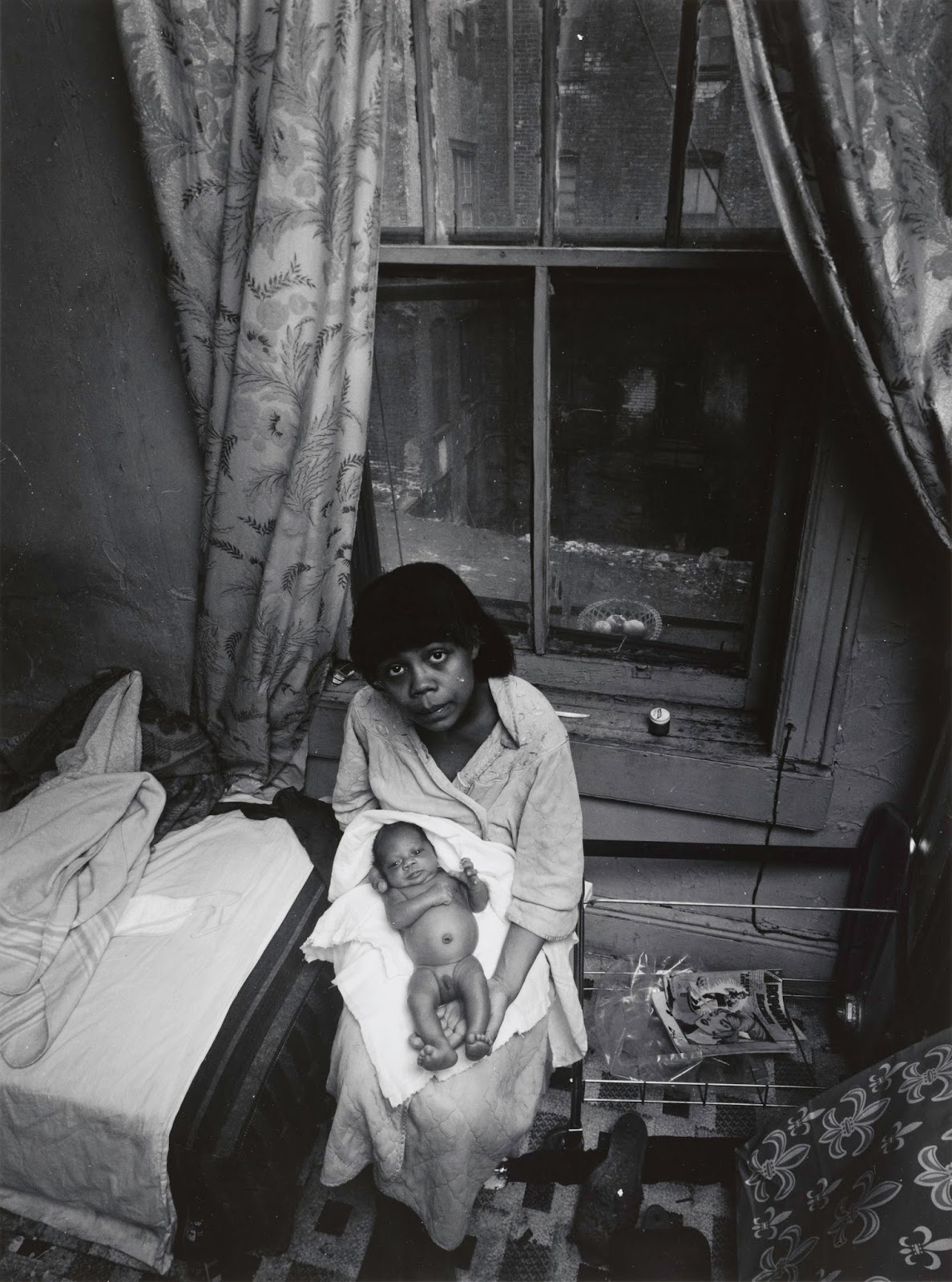
Bruce Davidson, Woman with Newborn on Lap (East 100th Street series), 1966 - 1968


Here, Davidson's  Woman with Newborn on Lap, (East 100th Street series), taken between 1966 and 1968, could represent either an icon-like representation of motherhood or a devastating critique of the African-American experience of urban poverty in a time of plenty.

The same dilemma arises when we study another Davidson photo from the mid-1960's, Girl Waving with Sign on Road, (Los Angeles series). To go from Woman with Newborn on Lap to this picture may be a "from the sublime to the ridiculous" transition. The multiple meanings that can be imparted to Girl Waving with Sign, however, testifies to the oracle status of great photography. 


Bruce Davidson, Girl Waving with Sign on Road (Los Angeles series), 1964

Which answer would you pick:
  1. Mid-century Modern life-style      
  2. "Sex-sells" dehumanization of womanhood
  3. Corporate promotion leading to global warming
  4. All of the above
The "correct" answer is there for the choosing. But we have to decipher its meaning, as with the oracles of ancient times. 

Values, insights - meaning in art - often change with time. When Davidson photographed Girl Waving with Sign in 1964, most people would have classified it as a delightful example of Americana. Their values would have been shaped by popular television shows like Petticoat Junction or That Girl and by Coca Cola ads - "The Pause that  Refreshes" - with pretty young ladies in polka dot blouses.

With the polar ice caps melting from overuse of fossil fuels, we are confronted with a different scenario. The "meaning" of this photo changes too. Girl Waving with Sign in 2015 is a modern day Siren, beckoning us to our doom as her ancient counterparts tried to do to Odysseus on his voyage home from the Trojan War.

We can subjectively interpret the photos in American Moments with some confidence because the exhibit itself is thematically arranged. This comes as a slight surprise. American Moments is the first exhibition of photos from the Phillips Collection, 130 photos by thirty-three artists. The exhibit might well have been arranged to illustrate the evolution of the photo archive at the Phillips. Marjorie and Duncan Phillips, however, frequently chose to explore the meaning of their paintings in special exhibits. American Moments keeps to this great, open-minded tradition.

An early favorite of Duncan Phillips was Clarence John Laughlin (1905-1985). In 1943, the Phillips Collection presented a solo-exhibit of Laughlin's photos. The Louisiana-born photographer certainly gave his viewers a lot to ponder.

Laughlin grew-up in an atmosphere of genteel poverty. With the relics of the Old South all around him, he became the visual artist of "Southern Gothic." What Carson McCullers and Walker Percy explored  in words, Laughlin presented with imagery. 


Clarence John Laughlin, Grandeur and Decay No. 1, 1944

Laughlin frequently used photo montage to created some of the most surrealist photographs in American history.However, Grandeur and Decay No. 1, 1944 did not require any "special effects" to present an indelible symbol of the collapse of the grandiose, slavery-based, culture of the American South.

Grandeur and Decay No. 1, 1944  depicts  the passing of a "heroic" age while Lewis Hine's Empire State Building, 1931, shows a new era on the rise. Certainly there was incredible courage, tenacity and skill involved in the construction of the skyscrapers of Gotham City. Hines's photographs of the Empire State Building, however, were utilized to create a "myth" of progress for New York City that was as problematical as the sense of decline and fall in Laughlin's Grandeur and Decay.


Lewis Hine, Empire State Building, 1931


The Empire State Building opened in 1931, shortly after Hine (1874-1940) took this vertigo-inducing photo. But the "Empty State Building" (as New Yorkers referred to it) was a financial black hole for most of its early years. Floor after floor of vacant office suites echoed like a tomb. For much of the period, the management of the Empire State Building relied on the fees paid by tourists to use the observation deck to keep the towering edifice standing. 

What both Laughlin's Grandeur and Decay and Hine's Empire State Building show is the incredible harshness of American life during much of the twentieth century. We can see this too in the incredible array of portraits and group shots of America's people during an era of economic turmoil and of total war. Look at the faces on the gallery walls of the Phillips Collection and you will see people, in Langston Hughes' words, "battered through the years."


Alfred Eisenstaedt, Sunday afternoon crowd of passengers waiting for trains in Union Station, Washington, DC, 1943


It is particularly jarring to note the grim expressions of wartime service men and women in 1943 at Washington's Union Station. Their home leaves are over and they are headed back to war. Alfred Eisenstaedt (1898-1995) captured an image of foreboding that can still be felt all these decades later. I was struck by the slightly-out-of-focus soldier in the center. A year later, he could have been the central figure in Robert Capa's blurry, over-exposed photo of a GI Joe struggling in the surf to reach Omaha Beach on D-Day.

So too might Jack Delano's protagonist in Untitled (Railroad Man), the introductory photo of this review. Put a combat helmet on the head of this hunched, weary man and he might just as well be standing behind a parapet of sandbags at Tarawa or Anzio as at a railroad depot.

The real standout for me among the American Moments photographers was Esther Bubley (1921-1998). A photographer for the Office of War Information under the dynamic Roy Stryker, Bubley documented the American home front during World War II in a number of photographic series. These photo series may sound a bit dull and of little importance today - people in line waiting for war-rationed shoes or riding a bus to Pittsburgh, PA-  but Bubley created a time-machine portrait of the lives of America's people that borders on the definitive.


Esther Bubley, A Child Whose Home Is an Alley Dwelling near the Capitol, 1943


Amid the hundreds and hundreds of photographs taken by Bubley, a number are truly iconic. One of them is displayed in American Moments, A Child Whose Home Is an Alley Dwelling near the Capitol, 1943. This was part of a series aimed at depicting the appalling living conditions of African-Americans in Washington D.C. only a few blocks from the White House. Bubley's photos were quite effective in meeting the goals of her assignment but this picture is a symbolic masterpiece of inspiring merit.

The shadow cast by the length of wood held by the little boy transfixes his body. His right eye peers through the shadow making it seem like the disembodied eye of an alien being rather than one of a pair of eyes belonging to a scrawny, underfed, apprehensive little chap, trying to keep out of trouble. That eye in turn transfixes the viewer, forcing him or her to recognize the humanity of this child and the inhumanity of the "Jim Crow" racial oppression that blights his life.

With this photo, Bubley truly captured what Henri Cartier-Bresson called the "decisive moment." It was a transforming moment, as more and more Americans came to realize -sometimes unwillingly - that the racial segregation that had arisen following the Civil War could no longer be tolerated now that America was the leader of the Free World.

America did change following World War II and change for the better. The American Moments exhibit is a brilliant evocation of these social changes.

It is important to note that this wonderful exhibition at the Phillips Collection also documents the joys and  pleasures, the "pursuit of happiness" that figure in the American story along with sorrows and challenges.


Louis Faurer, Broadway, New York, N.Y., between 1949 -1950

Louis Faurer's Broadway, New York, N.Y., shows a group of laughing friends in a snappy sports car with the bright lights of the city reflected on its polished, gleaming surface. Faurer's astonishing picture was taken between 1949 and 1950 - or was it just last night? 

If there's a better illustration of American joie de vivre, I've never seen it. And when joy of life is shared by all our citizens, then Langston Hughes' dream will come true at last and America will be America again.

***
Text: Copyright of Ed Voves, all rights reserved 
Images courtesy of Phillips Collection, Washington D.C.                                                                                                                                                                                          
Introductory Image:                                                                                                                                               
Jack Delano, Untitled (Railroad Man), 1940s/printed later. Gelatin silver print, 11 x 14 in. Gift from the Collection of Michael and Joyce Axelrod, Mill Valley, California, 2013. The Phillips Collection, Washington, DC

Alfred Stieglitz, Equivalent, 1926. Gelatin silver print, 3 5/8 x 4 3/4 in. The Alfred Stieglitz Collection, gift of Georgia O'Keeffe, 1949. The Phillips Collection, Washington, DC

Louis Faurer, Times Square, N.Y. (Home of the Brave), 1950, printed 1981. Gelatin silver print, 11 x 14 in. Gift of Steve LaMantia, 2013. The Phillips Collection, Washington, DC

Bruce Davidson, Woman with Newborn on Lap (East 100th Street series), between 1966 and 1968. Gelatin silver print, 14 x 11 in. Gift of Saul E. Levi, 2013. The Phillips Collection, Washington, DC

Bruce Davidson, Girl Waving with Sign on Road (Los Angeles series), 1964. Gelatin silver print, 7 15/16  x 11 15/16 in. Gift of Lisa Finn, 2013. The Phillips Collection, Washington, DC


Clarence John Laughlin, Grandeur and Decay No. 1, 1944. Gelatin silver print, 13 3/8 x 10 5/8 in. Acquired from the artist, 1945. The Phillips Collection, Washington, DC 


Lewis Hine, Empire State Building, 1931. Gelatin silver print, 10 1/4 x 13 1/4 in. Gift of the Phillips Contemporaries, 1997. The Phillips Collection, Washington, DC

Alfred Eisenstaedt, Sunday afternoon crowd of passengers waiting for trains in Union Station, Washington, DC, 1943. Vintage gelatin silver print, 10 5/8 x 13 1/14 in. Gift of Cam and Wanda Garner, 2014. The Phillips Collection, Washington, DC

Esther Bubley, A Child Whose Home Is an Alley Dwelling near the Capitol, 1943. Gelatin silver print, 10 7/8 x 10 1/8 in. Gift of Cam and Wanda Garner, 2012. The Phillips Collection, Washington, DC


Louis Faurer, Broadway, New York, N.Y., between 1949 and 1950, printed later. Gelatin silver print, 11 x 14 in. Gift of Jerri Mattare, 2013. The Phillips Collection, Washington, DC


Tuesday, June 3, 2014

Picasso Prints and Flash Photography Exhibit at the Philadelphia Museum of Art


Philadelphia Museum of Art

Picasso Prints: Myths, Minotaurs and Muses

Artificial Light: Flash Photography in the Twentieth Century

May 24- August 3, 2014

 
Reviewed by Ed Voves
Great art always speaks for itself. A notable work of art - whatever the medium - is a unique and timeless assertion of each artist's creative insight.

 Art exhibitions showcase the individual contributions of artists. Exhibits also show trace common themes and the ways that innovative or over-looked forms of creative expression are utilized by artists to "speak" for art in new ways.

Two thoughtful and eclectic exhibits at the Philadelphia Museum of Art address the process whereby an artistic medium, unappreciated or seldom studied by art scholars, can reveal profound truths and unforgettable imagery. Artificial Light: Flash Photography in the Twentieth Century and Picasso Prints: Myths, Minotaurs and Muses also complement each other by drawing attention to a human value often undervalued today: compassion.

Why compassion? Flash photography often has an opposite effect, of invading someone's life in a sudden assault of paralyzing, probing light. Some of the photos in the exhibit, like Harold Edgerton’s Tumblers (1942), evoke a clinical, dispassionate perspective, namely that of science.  Ovid’s Metamorphosis, which inspired many of Picasso's prints, is not a notably compassionate work.  Pablo Picasso, himself, was more known for his personal passions than concern for those around him.

Yet many of the art works in Artificial Light and Picasso Prints powerfully evoke the need for human empathy.

A photo by Mark Cohen, on display in Artificial Light, is a good starting point. Now based in Philadelphia after many years in Wilkes-Barre, PA, Cohen specializes in what he describes as "intrusive" street-photography.


Mark Cohen, Untitled (Girls' Faces Flashed in Bus Window)
In Cohen's 1973 photo, Untitled (Girls' Faces Flashed in Bus Window), we see exactly what the title says - and something more. The reflection of Cohen's flash replicates the effect of human breath on a window, in this case of the smiling, vivacious young woman beaming at us from inside the bus. This effect makes the young woman the active party in the photo. She is the beholder, her breath marking her presence as she reaches out to us, with an open-handed act of friendship.

Of course, this startling detail is just a trick of the camera and the young woman's waved hand little more than a spontaneous gesture. But in that fleeting moment, her eyes meet ours and the artificial barriers between human beings melt away.

Lewis Hine (1874-1940) aimed to bridge the dividing gulf between people too, but his photo process was a bit more deliberate.

Hine, the great Progressive-era photographer, documented the plight of child workers, immigrants and hard-luck outcasts with a large format camera. Hine's night-time photography carried on the work of an earlier social activist, Jacob Riis, one of the first to experiment with flash photography. Hine's Midnight at the Bowery Mission Breadline, 1909, on display in the exhibit, is a superb example of the psychological awareness that he brought to his work.

Hine was a master of giving artful form to awful reality. Many of his famous photos of immigrant mothers and children directly borrowed poses from Raphael's Renaissance Madonnas. When he photographed a young, barefoot factory girl from Vermont, Addie Card, in front of the cotton-spinning loom of the North Pownal Cotton Mill, Hine was surely aware of the country lasses painted over a century earlier by Thomas Gainsborough.

With aesthetically acceptable photos like these, Hine was able to deliver a shocking glimpse of the harshness of life in a format that would not cause the viewer to immediately wince and look away. In his nighttime pictures, however, Hine had to use the flash to illuminate the scene, a dangerous and unforgiving technique at that time. Hine ignited magnesium powder to light the scene. This gave little or no opportunity to arrange the subjects to conform to preconceived notions of fine art. The flash photo would have to stand or fall on whether it caught and held this specific moment of time.

 
Lewis W. Hine, Midnight at the Bowery Mission Breadline
 
Midnight at the Bowery Mission Breadline certainly succeeded in capturing the raw, social-Darwinian brutalities of pre-World War I America. This group portrait is all the more powerful for the wide range of ages of the picture's subjects, with a touch of intriguing mystery. Who are these men trying to hold hunger at bay with a free cup of coffee and a slice of bread? Hobos? Laid-off factory workers? Immigrants just arrived from Ellis Island?

Hine's Breadline protagonists have the defeated faces of wartime POWs. Their varying expressions recall Winslow Homer's Prisoners from the Front. But these hungry men are not defeated "enemy" soldiers. They are fellow-Americans. They stare at us through the lens of Hine's camera. And since their clothes are so non-descript, so lacking in period details - except for the rounded derby hat of the second man from the left - these men might well be from the "brother can you spare a dime" 1930's or from our own time. They could be us, just as the beaming, smiling Girls' Faces Flashed in a Bus Window could be ours too, on a better, happier day.

These two pictures are indicative of the way that flash photos help us to reach beyond the "us vs. them" divide that separates human beings. We can embrace the "other" in other people more readily because of the enhanced spontaneity of the photograph taken with a flash camera. And in doing so, we can get in touch with the "other" in ourselves.

Nicholas Nixon's West Springfield, Massachusetts extends this embrace to other species, indeed to all of nature. Nixon is one of the most sensitive photographers of the contemporary era. His photos of AIDS patients and dying elderly people are haunting portraits, entirely free of cloying sentimentality.

Here, an affectionate hand is extended to a sleeping calf. Nixon captured an endearing image of innocent new life - and of human empathy. The calf, however, is not pet, not a puppy or kitten who will be showered with affection and treats. The calf, when it matures, is fated to serve the material needs of people, producing milk or meat for the dinner table. It is unsettling to look at this photo, taken in 1978, and reflect that this beautiful animal is long since dead, unremembered but for this memorable image.


Nicholas Nixon, West Springfield, Massachusetts
mages of cattle are comparatively rare in art, but in the ancient Mediterranean world religious cults flourished where bulls were worshipped or ritually slaughtered. We see echoes of these practices in the second of the Philadelphia Museum of Art exhibits, Picasso Prints: Myths, Minotaurs and Muses.

Pablo Picasso (1881-1973), who created mythology-themed prints during the first half of the 1930's, focused on the legend of the Minotaur. This became a dominant motif in Picasso's art, partly in response to his own tumultuous life, but also expressing his anguish over the Spanish Civil War which began in 1936.

Picasso's creative genius was so caught-up in the revolutionary atmosphere of pre-World War I Paris that his imagination remained little affected by ancient art until a 1917 visit to Italy. The "return to order" urged by Jean Cocteau a year later further directed him toward classical antiquity. When the great art dealer, Ambrose Vollard, commissioned Picasso to illustrate the mythological stories in Ovid’s Metamorphoses, it appeared to be a perfect match of artist and subject.

A different destiny awaited the Vollard Suite and the great etching and engraving, Minotauromachy, created in 1935. These classically-inspired works mirror Picasso's bitter disputes at that time with his wife, Olga Khokhlova and his young mistress and model, Marie-Thérèse Walter. The violence in many of these prints also reflects the savage Spanish Civil War, which began in 1936.

Marie-Thérèse Walter, idolized by Picasso for her classical beauty, appears in most of these prints. We see her Grecian profile as she gazes down at Picasso's alter ego, the Minotaur. Picasso identified with this bull-headed "monster" and later, toward the end of his life, he declared, "If all the ways I have been along were marked on a map and joined up with a line, it might represent a Minotaur."


Pablo Picasso, Sleeping Minotaur Watched by a Woman
In a 1933 print, Sleeping Minotaur Watched by a Woman, Picasso presents the Minotaur as a weary, exhausted creature rather than a dangerous predator. Indeed, the face of the sleeping Minotaur, behind the delicate curtain, is surprisingly like that of the calf in West Springfield, Massachusetts!

A year later, Picasso shows a young girl with the facial features of Marie-Thérèse guiding a blinded, suffering Minotaur.  The print is filled with dense, cryptic images, the tortured Minotaur reflecting his own inner turmoil.

These images climax with the 1935 print, Minotauromachy or "Minotaur fight." All of the elements here relate to Picasso's explosive conflict with his wife and Marie-Thérèse.  Olga Khokhlova discovered the relationship between Picasso and Marie-Thérèse, who was pregnant with his child. Picasso's handling of the situation was notably insensitive to both wife and mistress and a short time later he commenced a new liaison, with Dora Marr.

 
Pablo Picasso,  Minotauromachy
The elements of Minotauromachy, however, shortly reappeared in another work that would yield a great deal of credit to Picasso. The face of Marie-Thérèse with outstretched hand holding a light, the anguished rearing horse, the great bull's head, the crumpled, dying figure holding a sword - all would emerge again in Guernica!

Minotauromachy and the prints of the Vollard Suite, by the strange alchemy that is art, paved the way to Picasso's greatest painting. It is a process that we can see at work in the flash photos and classically inspired prints of these fine exhibits at the Philadelphia Museum of Art: the dross of daily life transformed into the gold of compassionate creativity.

***
Text: Copyright of Ed Voves, all rights reserved

Images Courtesy of the Philadelphia Museum of Art

Blind Minotaur Guided by a Girl at Night, 1934. Pablo Ruiz y Picasso, Spanish, 1881 - 1973. Aquatint, scraper, and drypoint, Plate: 9 11/16 x 13 11/16 inches (24.6 x 34.8 cm), Sheet: 13 x 15 15/16 inches (33 x 40.5 cm). Philadelphia Museum of Art, © Estate of Pablo Picasso / Artists Rights Society (ARS), New York

 Untitled (Girls' Faces Flashed in Bus Window), 1973. Mark Cohen, American, born 1943. Gelatin silver print, Image: 11 13/16 x 17 5/8 inches (30 x 44.8 cm), Sheet: 15 7/8 x 19 13/16 inches (40.3 x 50.3 cm). Philadelphia Museum of Art

 Midnight at the Bowery Mission Breadline, 1909. Lewis W. Hine, American, 1874   1940. Gelatin silver print, Sheet: 4 9/16 x 5 7/8 inches (116 x 149 mm) Mount: 11 15/16 x 9 13/16 inches (30.3 x 24.9 cm). Philadelphia Museum of Art, From the Collection of Dorothy Norman, 1997.

 West Springfield, Massachusetts, 1978. Nicholas Nixon, American, born 1947. Gelatin silver print, Image: 7 11/16 x 9 11/16 inches (19.5 x 24.6 cm) Sheet: 8 x 9 15/16 inches (20.3 x 25.2 cm). Philadelphia Museum of Art, Gift of Charles Isaacs and Carol Nigro.

 Sleeping Minotaur Watched by a Woman, 1933. Pablo Ruiz y Picasso, Spanish, 1881 - 1973. Etching, Plate: 7 9/16 x 10 9/16 inches (19.2 x 26.8 cm), Sheet: 12 1/8 x 17 1/16 inches (30.8 x 43.3 cm). Philadelphia Museum of Art, © Estate of Pablo Picasso / Artists Rights Society (ARS), New York

 Minotauromachy, 1935. Pablo Ruiz y Picasso, Spanish, 1881 - 1973. Etching and engraving (seventh state of seven), Plate: 19 9/16 x 27 3/8 inches (49.7 x 69.5 cm), Sheet: 22 5/16 x 30 3/8 inches (56.7 x 77.2 cm). Philadelphia Museum of Art, © Estate of Pablo Picasso / Artists Rights Society (ARS), New York