Showing posts with label Duncan Phillips. Show all posts

Sunday, October 8, 2017

Renoir and Friends at the Phillips Collection, Washington D.C.


Renoir and Friends: Luncheon of the Boating Party


Phillips Collection, Washington D.C.

October 7, 2017 to January 7, 2018


Reviewed by Ed Voves

Impressionism derived a great deal of inspiration from Charles Baudelaire’s ideal of the "Heroism of Modern Life.”  In his review of the Salon of 1846, Baudelaire declared that "our age," the nineteenth century, "is no less rich than ancient times in sublime themes." Baudelaire went on to  assert "that since every age and every people have their own form of beauty, we inevitably have ours."

The heroes and heroines who created these new forms of beauty were men like Pierre-Auguste Renoir (1841-1919), his friend and fellow painter, Gustave Caillebotte, actresses Ellen Andrée and Jeanne Samary, journalist Adrien Maggiolo and the top-hatted patron of the arts, Charles Ephrussi. 

Portrayed in a legendary painting by Renoir, Luncheon of the Boating Party, these kindred souls are re-united in an outstanding exhibit at the Phillips Collection in Washington D.C.

Renoir and Friends at the Phillips displays over forty Impressionist paintings, a rare bronze sculpture by Renoir and vintage photos from the late 1870's and 1880's. These works are grouped around Renoir's Luncheon of the Boating Party to document a key moment in the story of Impressionism.

"Heroism" is not too strong a word for the cultural achievements of Renoir and his talented friends. And like Hercules, these heroes of "everyday life" had occasionally to rest from their labors. 


Ed Voves, Photo (2017), Renoir's Luncheon of the Boating Party (detail), 1880–81.

When they took a break, the Impressionists and their colleagues went to the Maisson Fournaise. This suburban restaurant became a legendary "hangout" like the Café Guerbois, in the heart of Paris, had been during the early days of  Impressionism.

The Maisson Fournaise was located in Chatou, about fourteen kilometers to the west of Paris. The restaurant overlooked the River Seine. For rowing and sailing enthusiasts like Gustave Caillebotte (1848-1894), it was the perfect spot to dock the boat for lunch, a round of drinks and the latest gossip. 


Gustave Caillebotte, A Man Docking His Skiff, 1878

Renoir favored the Maisson Fournaise, too, so much so that he painted the convivial meals he enjoyed there with his friends. His picture, Luncheon of the Boating Party, is among  the greatest of all Impressionist works of art.

Painted over an extended period of time, 1880 to 1881, Luncheon is not an "all in one-sitting" Impressionist work. It is a masterpiece in the Old Master sense, recalling art by Rubens and Watteau. It is a labor of love, created at the high point of the Impressionist movement, which in five years would cease to be a united front as the member artists went their separate ways.

Luncheon of the Boating Party was recognized as a masterpiece right from the start. Its first owner was Paul Durand-Ruel (1831-1922), the principal art dealer for the Impressionists. It was only sold after Durand-Ruel's death. Luncheon entered the collection of Duncan Phillips (1886-1966), the art enthusiast who opened America's first museum of modern art, the Phillips Collection in Washington D.C.


Pierre-Auguste Renoir, Luncheon of the Boating Party, 1880–81

Phillips first saw Luncheon of the Boating Party in 1911 in Durand-Ruel's gallery. He was so moved that he wrote an essay praising the way that Renoir had conveyed "life's vivacity" in this memorable painting. When the opportunity appeared to purchase Renoir's magnum opus, Phillips paid Durand-Ruel's heirs the astronomical sum of $125,000. 

That was in 1923. Eighteen months earlier, in 1921, Duncan Phillips had opened a small museum at his home, in Washington D.C. Phillips' museum was created to honor his beloved father and brother who had died during the Spanish Influenza epidemic of 1918.

Phillips' museum was a "heroic" endeavor worthy of Baudelaire's theme. Phillips aimed to create a collection representing the best in modern art. Of the 237 paintings at the museum's founding, 87 were works by masters of American impressionism, including Childe Hassam, John Henry Twatchman and Julian Alden Weir. 

Acquiring Luncheon of the Boating Party was quite a coup by Phillips, enabling art lovers in the U.S. to contrast the works of American Impressionism with one of the signature paintings of the great Renoir.

For all his enthusiasm for Luncheon of the Boating Party, Duncan Phillips did not amass a collection favoring Impressionism, as did his rival, Dr. Albert Barnes. Phillips, in fact, ceased purchasing Impressionist works, except occasionally. After he bought Luncheon of the Boating Party in 1923. Phillips emphasized works by contemporary artists, especially Americans like Arthur Dove, John Marin and Georgia O'Keeffe.

Renoir and Friends at the Phillips is thus a perfect opportunity to investigate the birth of Impressionism in contrast with the subsequent development of Modernism. Almost all of the works in the exhibit (other than Luncheon) come from other museums, including the Musée d'Orsay and the Art Institute of Chicago, and private collections. One has only to move to nearby galleries at the Phillips to trace the cultural impact of Impressionism.


 Pierre-Auguste Renoir, The Seine at Argenteuil, 1874

The Renoir and Friends exhibition is arranged with displays highlighting life and leisure along the Seine river. The Impressionists had long favored France's great river in their works. Monet along with Renoir had painted many scenes at Argenteuil early in the 1870's. Like Chatou, Argenteuil was a short train ride from Paris. Active, hardworking people from Paris came for a day in the country, through there are plenty of signs of industrialism and urban sprawl in the paintings of the Impressionists.

Other galleries in the exhibit are devoted to the women and the men we see relaxing in Luncheon of the Boating Party. Some of the greatest contemporary actresses of the period are depicted in Luncheon. These actresses are familiar faces as they often modeled for their painter friends. Ellen Andrée, who is draining a glass of wine in Luncheon, was the downcast protagonist in L'Absinthe by Edgar Degas. She certainly seems to be enjoying herself more in Renoir's painting.

I was especially pleased to see Renoir's A Girl with a Fan from the Clark Art Institute in  Williamstown, Massachusetts. I stumbled on the Clark many years ago during a New England vacation. A Girl with a Fan lodged in my memory with its blending of Impressionist technique and Old Mastery sensibility. Seeing this splendid work of art after all these years was like meeting an old friend.


Ed Voves, Photo (2017), A Girl with a Fan by Pierre-Auguste Renoir, 1879-1880 

A Girl with a Fan is likely an idealized portrait of Jeanne Samary (1857-1890), one of the leading players of the Comédie-Française. The exhibit displays several photos of Jeanne Samary, who had a much fuller face than the young woman depicted in the painting. In one of the photos, the actress looks at the viewer with a big, friendly grin quite different from the demure smile of A Girl with a Fan.

In Luncheon of the Boating Party, Jeanne Samary is believed to be the woman holding her ears. Around the time that Renoir was painting Luncheon, Samary's name was frequently mentioned in the tattle columns of Paris newspapers. Her plans to marry the wealthy aristocrat, Paul Legard, had aroused the bitter opposition of his parents, The hands over her ears likely denote Samary's dismay about being the "talk of the town."


Ed Voves, Photo (2017), Renoir's Luncheon of the Boating Party (detail), 1880–81

Frequent use of "believed to be" or "likely" may lead to the conclusion that sloppy guesswork was involved in trying to establish the respective identities of the "Boating Party." Instead, an incredible amount of scholarship, beginning with the efforts of the German art historian, Julius Meier-Graefe (1867-1935), has been devoted to the study of Luncheon of the Boating Party.


Ed Voves, Photo (2017), Placement Chart for Renoir's Luncheon of the Boating Party

An elaborate chart of Luncheon is on view in the exhibition. Each of the identities or presumed identities of the protagonists is marked by number. The seated male character (number 8 on the right) looking out toward the river is certainly Gustave Caillebotte, yearning to get back to his boat. 


Ed Voves, Photo (2017), Renoir's Luncheon of the Boating Party (detail), 1880–81

The young woman (number 2) playing with the little dog is Renoir's girl friend and soon-to-be wife, Aline Charigot. Just twenty years old in 1879, Charigot was a seamstress and thus came from a working-class background like Renoir. 


Ed Voves, Photo (2017), Portrait of Madame Renoir by Pierre-Auguste Renoir, c.1885

Once again, this is a somewhat idealized likeness. The wonderful portrait from the Philadelphia Museum of Art collection, painted around 1885, is much more accurate. The sitter was Madame Renoir by then and Renoir was clearly in love with the "unidealized" woman he married.

Why did Renoir include so many "somewhat idealized" portraits in Luncheon of the Boating Party? Renoir was the greatest portrait painter among the Impressionists. It was not for lack of talent, but rather, I think, because he was aiming to depict a "universal" moment, a meeting of minds, hearts and souls that would stand the test of time.

Renoir certainly devoted a great deal of effort to achieve this goal. The final gallery of the exhibit analyses the careful configuration of the protagonists which Renoir devoted to Luncheon of the Boating Party. 


Detail comparison of Luncheon of the Boating Party, infrared photo at right.

An infrared photo of Luncheon, shows that Renoir changed the angle of the head of Charles Ephrussi (1849-1905), wearing a top hat in the background. At first, Renoir had Ephrussi looking toward the river, as he did with Caillebotte. But then he shifted Ephrussi's gaze toward his companion, believed to be Jules Laforgue. Ephrussi was the editor of the influential Gazette des Beaux-Arts and Laforgue was his personal secretary. Business, as well as pleasure, was the subject of conversation at the Maisson Fournaise.

Renoir's Luncheon of the Boating Party recorded a special moment in French history as well as representing universal human qualities and aspirations. When displayed at the Seventh Impressionist Exhibition in 1882, Renoir's painting was the hit of the exhibit.  

The 1880's, however, were a tense period in French history. The decade was marked by bank failures, the Boulanger Affair which nearly toppled the Third Republic, the rise of anti-Semitism soon to ignite the Dreyfus Affair. Renoir, by most accounts a splendid man, succumbed to anti-Jewish feeling and turned on Charles Ephrussi, who came from a distinguished Jewish banking family.

Happiness, alas, never lasts for long. Perhaps that is why Luncheon of the Boating Party strikes such a chord with so many people. 

What we see happening at the Maisson Fournaise in 1879 is a moment in Paradise Lost. Brief, transitory, heart-warming and heart-breaking. Such moments are short-lived, except in our memories and in the paintings of Pierre-Auguste Renoir.

***
Text: Copyright of Ed Voves, all rights reserved 


Introductory Image:                                                                                                          Ed Voves, Photo (2017), Detail of Pierre-Auguste Renoir's Luncheon of the Boating Party, 1880–81. Oil on canvas, 51 1/4 x 69 1/8 in. The Phillips Collection, Washington, DC, Acquired 1923

Ed Voves, Photo (2017), Detail of Pierre-Auguste Renoir's Luncheon of the Boating Party, 1880–81. Oil on canvas, 51 1/4 x 69 1/8 in. The Phillips Collection, Washington, DC, Acquired 1923

Gustave Caillebotte, A Man Docking His Skiff, 1878. Oil on canvas, 29 x 36 1/2 in. Virginia Museum of Fine Arts, Richmond, Collection of Mr. and Mrs. Paul Mellon. Photo: Katherine Wetzel © Virginia Museum of Fine Arts

Pierre-Auguste Renoir, Luncheon of the Boating Party, 1880–81. Oil on canvas, 51 1/4 x 69 1/8 in. The Phillips Collection, Washington, DC, Acquired 1923

Pierre-Auguste Renoir, The Seine at Argenteuil,1874. Oil on canvas, 19 3/4 x 25 3/4 in. Portland Art Museum, Oregon, Bequest of Winslow B. Ayer

Ed Voves, Photo (2017), A Girl with a Fan by Pierre-Auguste Renoir. Oil on canvas, 65,4 x 54 cm c. 1879- 1880, Sterling and Francine Clark Art Institute, Williamstown, Massachusetts 

Ed Voves, Photo (2017), Detail of Pierre-Auguste Renoir's Luncheon of the Boating Party, 1880–81. Oil on canvas, 51 1/4 x 69 1/8 in. The Phillips Collection, Washington, DC, Acquired 1923

Ed Voves, Photo (2017), Placement Chart for Renoir's Luncheon of the Boating Party, exhibited at the Phillips Collection, Washington D.C.

Ed Voves, Photo (2017), Detail of Pierre-Auguste Renoir's Luncheon of the Boating Party, 1880–81. Oil on canvas, 51 1/4 x 69 1/8 in. The Phillips Collection, Washington, DC, Acquired 1923

Ed Voves, Photo (2017), Portrait of Madam Renoir by Pierre-Auguste Renoir. Oil on canvas, Framed: 36 × 30 1/2 × 5 inches (91.4 × 77.5 × 12.7 cm) Philadelphia Museum of Art, W1957-1-1, Purchased with the W. P. Wilstach Fund, 1957

Detail comparison of Luncheon of the Boating Party, exhibited at the Phillips Collection, Washington D.C.


Wednesday, December 16, 2015

Gauguin to Picasso: Masterworks from Switzerland at the Phillips Collection


Gauguin to Picasso: Masterworks from Switzerland


The Staechelin and Im Obersteg Collections


October 10, 2015 to January 10, 2016

Reviewed by Ed Voves

No one knows for certain what was the last painting created by Vincent van Gogh. That sad honor may well belong to a work currently on view in a special exhibit at the Phillips Collection in Washington D.C. Van Gogh's The Garden of Daubigny, painted during the early summer of 1890, is one of the remarkable works appearing in Gauguin to Picasso: Masterworks from Switzerland - the Staechelin and Im Obersteg Collections.

The selected works from the two Swiss collections at the Phillips Collection include other masterpieces of early Modernism. But it is appropriate to begin this review with The Garden of Daubigny. For one thing, this poignant work was the first painting to greet my eyes in the exhibit. It was the work of art that I most wanted to see - and it did not disappoint.
        
             
Vincent van Gogh, The Garden of Daubigny, 1890

There is a wistful note to the presence of The Garden of Daubigny in the exhibit at the Phillips. This "double-square" sized painting was purchased by the Swiss businessman, Rudolf Staechelin, during World War I. Staechelin was a far-sighted collector. Van Gogh was still a controversial figure to many in the art establishment nearly three decades afer his death. One can only wonder what the course of van Gogh's life - and of Modern art  - might have been had there been a figure like Staechelin or the other Swiss patron of art, Karl Im Obersteg, willing to purchase works by the tortured Dutch artist while he lived.

If one is looking for a significant "message" in Gauguin to Picasso at the Phillips Collection it is the vital role of the patron in the nurturing of art. Rudolf Staechelin, Karl Im Obersteg and their American contemporary, Duncan Phillips, founder of the Phillips Collection, played a vital role in the story of Modern art. Without such patrons - willing to take a risk to their bank accounts and their reputations - many of the artists  whose works appear in the exhibition and in the galleries of the Phillips would have starved or faded into oblivion.

If one is looking for a note of controversy in the exhibit, Paul Gauguin’s NAFEA faaipoipo (When Will You Marry?) will provide it. This painting, removed from the Swiss museum where it was long displayed, was sold by Staechelin's descendants for a record-smashing $300 million. This has raised serious questions about the viability of the public display of privately-owned art works.


Paul Gauguin, NAFEA faaipoipo (When Will You Marry?), 1892

Rudolf Staechelin bought NAFEA faaipoipo (When Will You Marry?) during a brief but brilliant collecting campaign as war raged throughout Europe. His collection has been on extended loan to the Kunstmuseum Basel for much of the period since his death in 1946. 

When the Kunstmuseum Basel closed recently for renovations, the Staechelin Family Trust planned a travelling exhibition. The Kunstmuseum Basel, unwisely, balked at the idea. The contract was cancelled by the Staechelin Family Trust and 18 paintings, including NAFEA faaipoipo (When Will You Marry?), were withdrawn from the museum.

The Staechelin Family Trust stated that their action was based on opposition to a legal sanction known as the Undroit Convention. This was originally established to prevent the export of stolen works of art. But the ambiguous phrasing of the document has led to protests by other art groups and institutions besides the Staechelin Family Trust. 

The sale of NAFEA faaipoipo (When Will You Marry?) hardly seems in keeping with opposition to "red tape" and  bureaucracy. With much of their family assets tied up in these masterpieces, no doubt the Staechelin Family Trust felt that one of these works needed to be sold to generate some revenue.

Everyone has bills to pay.

This episode, in turn, underlines the importance of private institutions like the Phillips Collection.  Duncan Phillips established his museum during the 1920's to afford a lasting venue for the care, study and display of great works of art. That is the reason why the Phillips Collection is the perfect site to to consider the role of the patrons of Modernism.

Duncan Phillips (1886–1966) was an almost exact contemporary of Rudolf Staechelin (1881-1946) and Karl Im Obersteg (1883-1969). Staechelin relied on art agents like Bernheim-Jeune from whom he puchased The Garden of Daubigny for 35,000 Swiss francs in February 1918.  


Pablo Picasso, Harlequin with Black Mask, 1918

Staechelin excelled at making a quick strike based on agents' reports. He purchased Picasso's Harlequin with Black Mask, 1918, soon after it was painted. This was just as the rappel à l'ordre (call to order) was being proclaimed by Jean Cocteau, who called for a revived classicism in art.

Phillips bought works from art agents too, notably Renoir's Luncheon of the Boating Party, which he purchased in 1923 from the firm of Durand-Ruel. More importantly, Phillips supported living artists, some yet to make their mark. Others like Arthur Dove were established figures, but struggling in the Depression decade of 1930's.There is a gallery adjacent to the Gauguin to Picasso exhibit where the philosophy in action of Duncan Phillips is brilliantly illustrated.

This nurturing approach to art was shared by the second of the Swiss collectors, Karl Im Obersteg. Given the masterpiece status of many of Staechelin's paintings, it is easy to glide by the works by Alexej von Jawlensky (1864-1941). This Russian-born painter had been a member of the Blue Rider group, organized by Wassily Kandinsky and Franz Marc. Jawlensky fled to Switzerland at the outbreak of World War I. Im Obersteg was a loyal patron, amassing a major collection of Jawlensky's works, which are comparatively rare in American museums and collections.


Alexej von Jawlensky, Abstract Head: Mysterium, 1925

Diversity of theme and style characterizes Jawlensky's work. Many of his paintings, like Abstract Head: Mysterium, painted in 1925, possess a symbolical or mystical nuance. This was also true of the paintings of Georges Rouault, another painter favored by Karl Im Obersteg.


Georges Rouault, Landscape with Red Sail, 1939

If Jawlensky and Rouault lack name recognition in the U.S., that does not mean that Karl Im Obersteg only specialized in lesser known painters. He too purchased  works by Picasso like the remarkable The Absinthe Drinker. This work was created in 1901, on one side of a double-sided canvas, with Woman at the Theater on the other. Im Obersteg also bought a fine portrait by Amedeo Modigliani, Portrait of Mrs. Dorival, painted around 1916.


Amedeo Modigliani, Portrait of Mrs. Dorival, c.1916

These signature works may establish the range of Im Obersteg's taste as a collector. But Marc Chagall's three rabbi paintings from 1914 evoke an almost prophetic stature for both the painter and the patron. Whether you focus on each individual painting, as in Jew in Black and White, or study all three together, they form a triptych-like presentation of living faith. 


Marc Chagall, Jew in Black and White, 1914

In many ways, these outstanding works by Chagall form the heart of the Gauguin to Picasso exhibition, rendering all the attention to NAFEA faaipoipo (When Will You Marry?) a bit wide of the mark.

As you make your way through the exhibit, you may be struck by the "safeness" of much of the art bought by Rudolf Staechelin and Karl Im Obersteg. 

It needs to be kept in mind, however, that the first purchase of a Cezanne for an American art museum only occurred in 1913. This was Cezanne's View of the Domaine Saint-Joseph, painted around 1888  and bought by the Metropolitan Museum of Art at the New York Armory Show. 
  

Paul Cézanne, Glass and Apples, 1879–1882

If not radicals or revolutionaries, Rudolf Staechelin and Karl Im Obersteg were patrons of vision whose astute purchases of Modern art helped establish the great artists of Modernism. Staechelin and Im Obersteg  were members of a generation of collectors of genius which included Samuel Courtauld in Great Britain, Dr. Albert Barnes and Duncan Phillips in the United States.
   
All of these men attempted to find ways of sharing their treasured works of art with the public. And for decades their various methods of collection display, either at public museums like Kunstmuseum Basel or at independent facilities which they created, like the Barnes Foundation or the Phillips Collection, seemed to work.   

Then the BIG MONEY hit the art world during the 1980's. Noblesse oblige was no longer enough to raise the funds to purchase (or in some cases protect) notable works of art. 

This is the "way of the world" of the art world these days. We need to carefully consider this disturbing trend. Not only does it apply to "pros and cons" related to the sale of NAFEA faaipoipo (When Will You Marry?). The viability of museum trusteeship of great art is at risk. 

The role of patrons in supporting creative artists and of public museums to conserve and display their work cannot be dismissed as relics of a bygone era. Whatever the next phase in the world of art, anyone involved in the decision-making behind endowments and museum policy would be well to reflect on these wise words by Duncan Phillips:
   
The really good things of all ages and all periods can be brought together in one room with such delightful result that we recognize the universality of art and the special affinities of artists.                                                                                                                                                                                     
***
Text: Copyright of Ed Voves, all rights reserved 

Images Courtesy of the Phillips Collection, Washington D.C.

Introductory Image: 
Pablo Picasso, The Absinthe Drinker [verso:Woman at the Theater], 1901. Oil on canvas, 31 7/8 x 23 5/8 in. Im Obersteg Foundation,  permanent loan to the Kunstmuseum Basel
© 2015 Estate of Pablo Picasso / Artists Rights Society (ARS), New York

Vincent van Gogh, The Garden of Daubigny, 1890. Oil on canvas, 22 x 40 in. The Rudolf Staechelin Collection © Kunstmuseum Basel, Martin P. Bühler

Paul Gauguin, NAFEA faaipoipo (When Will You Marry?), 1892. Oil on canvas, 40 x 30 1/2 in. The Rudolf Staechelin Collection © Kunstmuseum Basel, Martin P. Bühler

Pablo Picasso, Harlequin with Black Mask, 1918. Oil on wood, 45 5/8 x 35 in. The Rudolf Staechelin Collection © 2015 Estate of Pablo Picasso / Artists Rights Society (ARS), New York

Alexej von Jawlensky, Abstract Head: Mysterium, 1925. Oil on linen-finish paper laid down on cardboard, 16 3/4 x 12 3/4 in. Im Obersteg Foundation, permanent loan to the Kunstmuseum Basel © 2015 Artists Rights Society (ARS), New York

Georges Rouault, Landscape with Red Sail, 1939. Oil on paper laid down on gauze, 19 3/4 x 33 in. Im Obersteg Foundation, permanent loan to the Kunstmuseum Basel. Photo © Mark Gisler, Müllheim. Image © 2015 Artists Rights Society (ARS), New York / ADAGP, Paris


Amedeo Modigliani, Portrait of Mrs. Dorival, c.1916. Oil on canvas, 24 x 15 in. Im Obersteg Foundation, permanent loan to the Kunstmuseum Basel © Mark Gisler, Müllheim

Marc Chagall, Jew in Black and White, 1914. Oil on cardboard laid down on canvas, 39 3/4 x 31 1/2 in. Im Obersteg Foundation, permanent loan to the Kunstmuseum Basel © 2015 Artists Rights Society (ARS), New York / ADAGP, Paris

Paul Cézanne, Glass and Apples, 1879–1882. Oil on canvas, 12 3/8 x 15 3/4 in. The Rudolf Staechelin Collection © Kunstmuseum Basel, Martin P. Bühler


Sunday, June 28, 2015

American Moments Photo Exhibit at the Phillips Collection


American Moments: Photographs from The Phillips Collection


June 6, 2015 -  September 13,2015


Reviewed by Ed Voves

“Let America be America Again” proclaimed Langston Hughes in his 1935 poem. With searing, unflinching verse, Hughes condemned the social ills of the United States during the Great Depression, “the rack and ruin of our gangster death.” And yet, he held firmly to “the dream that’s almost dead today.”

O, let America be America again--                                                                                     The land that never has been yet--                                                                                   And yet must be--the land where every man is free.                                                           The land that's mine--the poor man's, Indian's, Negro's, ME--                                               Who made America…

These are bold, unforgettable words that stick in the mind. They are also words that are very difficult to express in visual terms. How can an artist depict a “land that never has been yet--and yet must be” with paint or sculptor’s clay?

The Phillips Collection in Washington D.C. has managed to evoke the “mighty dream” of Langston Hughes with a powerful exhibition of twentieth century photographs. American Moments: Photographs from The Phillips Collection embraces both the vision of the people of the United States and the reality of their lives. While Hughes is not directly mentioned in the exhibition wall texts, seldom has there been a better visual articulation of the American dream, "a dream so strong, so brave, so true,That even yet its mighty daring sings..."

American Moments is also a testament to the vision of Duncan Phillips, founder of the Phillips Collection. During the same period of Hughes' literary activism, Phillips (1886-1966) and his wife, Marjorie (1894-1985), created America's first museum of "modern" art. In a bold mission statement, Phillips in 1926 declared that the new venue would be an "intimate museum combined with an experiment station."

The Phillips "experiment station" joined forces in 1941 with the Museum of Modern Art to collect and promote Jacob Lawrence's Migration Series, the epic cycle of tempera paintings celebrating African-American history. Phillips supported many struggling American artists, buying paintings directly from them or from the New York galleries of Alfred Stieglitz, the Intimate Gallery and its successor, An American Place.

Anyone in the American art world during the first decades of the twentieth century could expect to hear from Alfred Stieglitz (1864-1946) on the subject of photography. Duncan Phillips entered into a lively dialog with Stieglitz and began to selectively collect work by noted American photographers, including cloud studies by Stieglitz himself. From time-to-time, the Phillips Collection mounted photo exhibits but never devoted the resources to build an in-depth  photo archive of its own.


Alfred Stieglitz, Equivalent, 1926.

In 2006, the Phillips received a major gift of 152 photos by Brett Weston, a great photographer and the son of one of America's most legendary photo artists, Edward Weston. This marked the "takeoff" of the Phillips photo collection with acquisitions, predominantly donations, raising the photo holdings to 1,000 pictures. In 2014 alone, nearly 300 photographs were donated. These included works by major figures like Bruce Davidson. a personal favorite of mine and a living link to the hard-hitting photojournalism of mid-twentieth century America.

Davidson, born in 1933, draws on the street photography of Louis Faure (1916-2001). In his 1950 picture,Times Square, N.Y. (Home of the Brave), Faurer took a rather routine situation, investing it with magical ambiance and an ingenious subtext. Home of the Brave was one of the first major films to deal with a Civil Rights theme.Yet to look at the neon lights, you could easily jump to the conclusion that it was a big screen adventure flick starring Clark Gable or Tyrone Power. 


Louis Faurer, Times Square, N.Y. (Home of the Brave), 1950

Looks are deceiving.

Davidson documented some of the most dramatic moments of the Civil Rights movement. He also  captured prosaic, matter-of-fact images of that remarkable era as well: stressed-out Freedom Riders, an impassive Martin Luther King, besieged with questions at a press conference. 


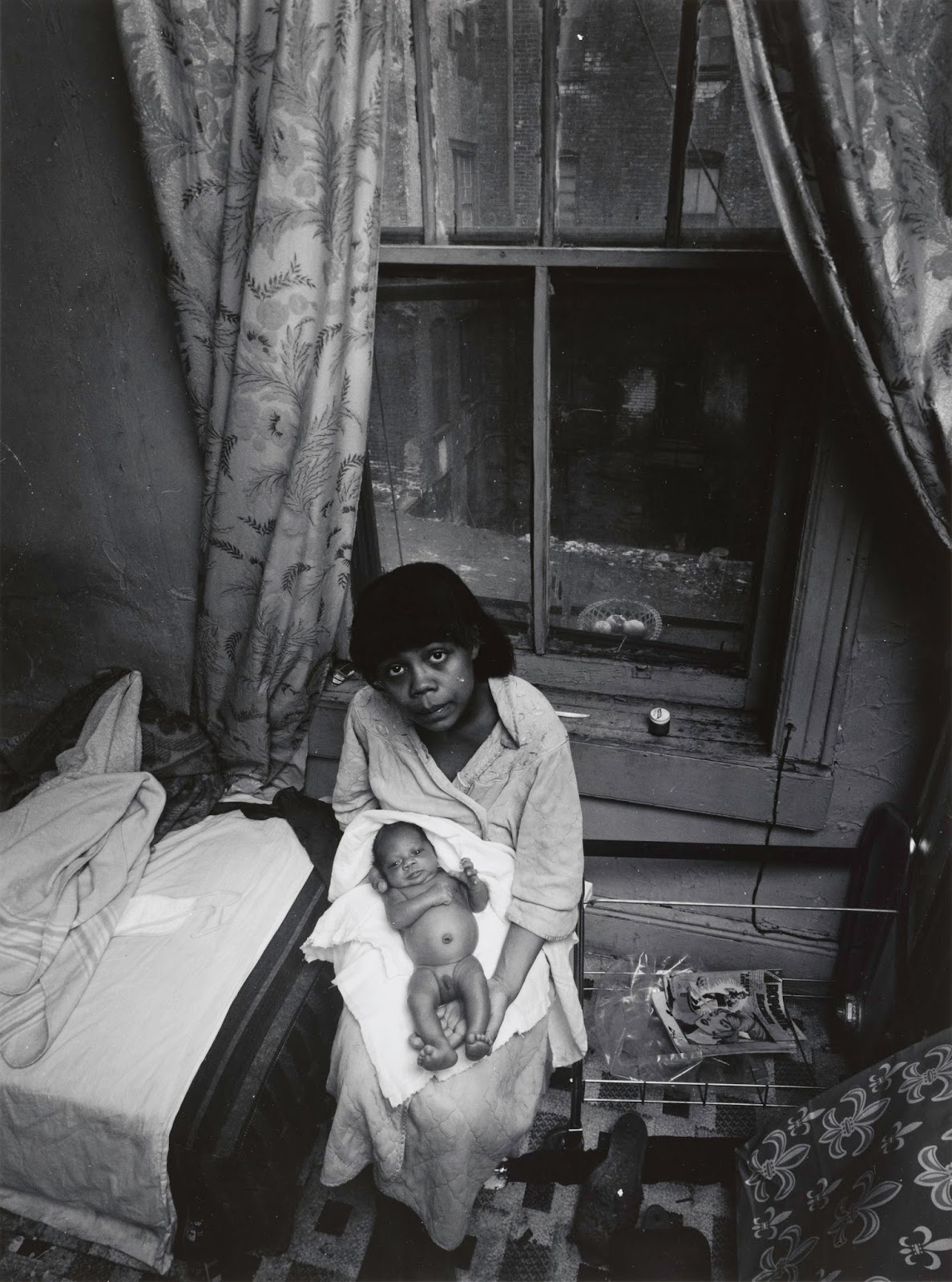
Bruce Davidson, Woman with Newborn on Lap (East 100th Street series), 1966 - 1968


Here, Davidson's  Woman with Newborn on Lap, (East 100th Street series), taken between 1966 and 1968, could represent either an icon-like representation of motherhood or a devastating critique of the African-American experience of urban poverty in a time of plenty.

The same dilemma arises when we study another Davidson photo from the mid-1960's, Girl Waving with Sign on Road, (Los Angeles series). To go from Woman with Newborn on Lap to this picture may be a "from the sublime to the ridiculous" transition. The multiple meanings that can be imparted to Girl Waving with Sign, however, testifies to the oracle status of great photography. 


Bruce Davidson, Girl Waving with Sign on Road (Los Angeles series), 1964

Which answer would you pick:
  1. Mid-century Modern life-style      
  2. "Sex-sells" dehumanization of womanhood
  3. Corporate promotion leading to global warming
  4. All of the above
The "correct" answer is there for the choosing. But we have to decipher its meaning, as with the oracles of ancient times. 

Values, insights - meaning in art - often change with time. When Davidson photographed Girl Waving with Sign in 1964, most people would have classified it as a delightful example of Americana. Their values would have been shaped by popular television shows like Petticoat Junction or That Girl and by Coca Cola ads - "The Pause that  Refreshes" - with pretty young ladies in polka dot blouses.

With the polar ice caps melting from overuse of fossil fuels, we are confronted with a different scenario. The "meaning" of this photo changes too. Girl Waving with Sign in 2015 is a modern day Siren, beckoning us to our doom as her ancient counterparts tried to do to Odysseus on his voyage home from the Trojan War.

We can subjectively interpret the photos in American Moments with some confidence because the exhibit itself is thematically arranged. This comes as a slight surprise. American Moments is the first exhibition of photos from the Phillips Collection, 130 photos by thirty-three artists. The exhibit might well have been arranged to illustrate the evolution of the photo archive at the Phillips. Marjorie and Duncan Phillips, however, frequently chose to explore the meaning of their paintings in special exhibits. American Moments keeps to this great, open-minded tradition.

An early favorite of Duncan Phillips was Clarence John Laughlin (1905-1985). In 1943, the Phillips Collection presented a solo-exhibit of Laughlin's photos. The Louisiana-born photographer certainly gave his viewers a lot to ponder.

Laughlin grew-up in an atmosphere of genteel poverty. With the relics of the Old South all around him, he became the visual artist of "Southern Gothic." What Carson McCullers and Walker Percy explored  in words, Laughlin presented with imagery. 


Clarence John Laughlin, Grandeur and Decay No. 1, 1944

Laughlin frequently used photo montage to created some of the most surrealist photographs in American history.However, Grandeur and Decay No. 1, 1944 did not require any "special effects" to present an indelible symbol of the collapse of the grandiose, slavery-based, culture of the American South.

Grandeur and Decay No. 1, 1944  depicts  the passing of a "heroic" age while Lewis Hine's Empire State Building, 1931, shows a new era on the rise. Certainly there was incredible courage, tenacity and skill involved in the construction of the skyscrapers of Gotham City. Hines's photographs of the Empire State Building, however, were utilized to create a "myth" of progress for New York City that was as problematical as the sense of decline and fall in Laughlin's Grandeur and Decay.


Lewis Hine, Empire State Building, 1931


The Empire State Building opened in 1931, shortly after Hine (1874-1940) took this vertigo-inducing photo. But the "Empty State Building" (as New Yorkers referred to it) was a financial black hole for most of its early years. Floor after floor of vacant office suites echoed like a tomb. For much of the period, the management of the Empire State Building relied on the fees paid by tourists to use the observation deck to keep the towering edifice standing. 

What both Laughlin's Grandeur and Decay and Hine's Empire State Building show is the incredible harshness of American life during much of the twentieth century. We can see this too in the incredible array of portraits and group shots of America's people during an era of economic turmoil and of total war. Look at the faces on the gallery walls of the Phillips Collection and you will see people, in Langston Hughes' words, "battered through the years."


Alfred Eisenstaedt, Sunday afternoon crowd of passengers waiting for trains in Union Station, Washington, DC, 1943


It is particularly jarring to note the grim expressions of wartime service men and women in 1943 at Washington's Union Station. Their home leaves are over and they are headed back to war. Alfred Eisenstaedt (1898-1995) captured an image of foreboding that can still be felt all these decades later. I was struck by the slightly-out-of-focus soldier in the center. A year later, he could have been the central figure in Robert Capa's blurry, over-exposed photo of a GI Joe struggling in the surf to reach Omaha Beach on D-Day.

So too might Jack Delano's protagonist in Untitled (Railroad Man), the introductory photo of this review. Put a combat helmet on the head of this hunched, weary man and he might just as well be standing behind a parapet of sandbags at Tarawa or Anzio as at a railroad depot.

The real standout for me among the American Moments photographers was Esther Bubley (1921-1998). A photographer for the Office of War Information under the dynamic Roy Stryker, Bubley documented the American home front during World War II in a number of photographic series. These photo series may sound a bit dull and of little importance today - people in line waiting for war-rationed shoes or riding a bus to Pittsburgh, PA-  but Bubley created a time-machine portrait of the lives of America's people that borders on the definitive.


Esther Bubley, A Child Whose Home Is an Alley Dwelling near the Capitol, 1943


Amid the hundreds and hundreds of photographs taken by Bubley, a number are truly iconic. One of them is displayed in American Moments, A Child Whose Home Is an Alley Dwelling near the Capitol, 1943. This was part of a series aimed at depicting the appalling living conditions of African-Americans in Washington D.C. only a few blocks from the White House. Bubley's photos were quite effective in meeting the goals of her assignment but this picture is a symbolic masterpiece of inspiring merit.

The shadow cast by the length of wood held by the little boy transfixes his body. His right eye peers through the shadow making it seem like the disembodied eye of an alien being rather than one of a pair of eyes belonging to a scrawny, underfed, apprehensive little chap, trying to keep out of trouble. That eye in turn transfixes the viewer, forcing him or her to recognize the humanity of this child and the inhumanity of the "Jim Crow" racial oppression that blights his life.

With this photo, Bubley truly captured what Henri Cartier-Bresson called the "decisive moment." It was a transforming moment, as more and more Americans came to realize -sometimes unwillingly - that the racial segregation that had arisen following the Civil War could no longer be tolerated now that America was the leader of the Free World.

America did change following World War II and change for the better. The American Moments exhibit is a brilliant evocation of these social changes.

It is important to note that this wonderful exhibition at the Phillips Collection also documents the joys and  pleasures, the "pursuit of happiness" that figure in the American story along with sorrows and challenges.


Louis Faurer, Broadway, New York, N.Y., between 1949 -1950

Louis Faurer's Broadway, New York, N.Y., shows a group of laughing friends in a snappy sports car with the bright lights of the city reflected on its polished, gleaming surface. Faurer's astonishing picture was taken between 1949 and 1950 - or was it just last night? 

If there's a better illustration of American joie de vivre, I've never seen it. And when joy of life is shared by all our citizens, then Langston Hughes' dream will come true at last and America will be America again.

***
Text: Copyright of Ed Voves, all rights reserved 
Images courtesy of Phillips Collection, Washington D.C.                                                                                                                                                                                          
Introductory Image:                                                                                                                                               
Jack Delano, Untitled (Railroad Man), 1940s/printed later. Gelatin silver print, 11 x 14 in. Gift from the Collection of Michael and Joyce Axelrod, Mill Valley, California, 2013. The Phillips Collection, Washington, DC

Alfred Stieglitz, Equivalent, 1926. Gelatin silver print, 3 5/8 x 4 3/4 in. The Alfred Stieglitz Collection, gift of Georgia O'Keeffe, 1949. The Phillips Collection, Washington, DC

Louis Faurer, Times Square, N.Y. (Home of the Brave), 1950, printed 1981. Gelatin silver print, 11 x 14 in. Gift of Steve LaMantia, 2013. The Phillips Collection, Washington, DC

Bruce Davidson, Woman with Newborn on Lap (East 100th Street series), between 1966 and 1968. Gelatin silver print, 14 x 11 in. Gift of Saul E. Levi, 2013. The Phillips Collection, Washington, DC

Bruce Davidson, Girl Waving with Sign on Road (Los Angeles series), 1964. Gelatin silver print, 7 15/16  x 11 15/16 in. Gift of Lisa Finn, 2013. The Phillips Collection, Washington, DC


Clarence John Laughlin, Grandeur and Decay No. 1, 1944. Gelatin silver print, 13 3/8 x 10 5/8 in. Acquired from the artist, 1945. The Phillips Collection, Washington, DC 


Lewis Hine, Empire State Building, 1931. Gelatin silver print, 10 1/4 x 13 1/4 in. Gift of the Phillips Contemporaries, 1997. The Phillips Collection, Washington, DC

Alfred Eisenstaedt, Sunday afternoon crowd of passengers waiting for trains in Union Station, Washington, DC, 1943. Vintage gelatin silver print, 10 5/8 x 13 1/14 in. Gift of Cam and Wanda Garner, 2014. The Phillips Collection, Washington, DC

Esther Bubley, A Child Whose Home Is an Alley Dwelling near the Capitol, 1943. Gelatin silver print, 10 7/8 x 10 1/8 in. Gift of Cam and Wanda Garner, 2012. The Phillips Collection, Washington, DC


Louis Faurer, Broadway, New York, N.Y., between 1949 and 1950, printed later. Gelatin silver print, 11 x 14 in. Gift of Jerri Mattare, 2013. The Phillips Collection, Washington, DC