Showing posts with label Mexico. Show all posts

Saturday, March 25, 2023

Art Eyewitness Review: Lives of the Gods: Divinity in Maya Art


Lives of the Gods: Divinity in Maya Art

Metropolitan Museum of Art, Nov. 2022 - April 2, 2023

Kimbell Art Museum, Fort Worth TX, May 7 - Sept. 3, 2023

Reviewed by Ed Voves

Original photography by Anne Lloyd

To compare ancient peoples, separated by thousands of miles and hundreds of years, is always problematical. The danger of emphasizing superficial resemblances between two cultures can easily lead to dubious or untenable conclusions.

Despite this risk, I think that the astonishing Mayan kingdoms of southern Mexico and Central America rank with the ancient Greeks as the most dynamic cultures of their respective regions. What the Greeks were to the lands bordering the Mediterranean Sea, the Maya equaled in their influence on the Mesoamerican world.

After visiting the Lives of the Gods: Divinity in Maya Art exhibition, now in its final weeks at the Metropolitan Museum, one is struck by the singular nature of Mayan civilization. The parallels with Greece, however, are certainly interesting. The small Mayan kingdoms, like the Greek city-states, never formed a united coalition or empire. But that can be said of other native peoples of the Americas as well, like the Moche of Peru.


Anne Lloyd, Photo (2022)
 Gallery view of the Lives of the Gods Art exhibit,
 showing Column, from Campeche, Mexico, c. 800-900

The fundamental influence of religion on both the Maya and the Greeks is what really counts in comparing the two cultures. As the subtitle of the Met's exhibition, Divinity in Maya Art, affirms, religion was fundamental to the Mayan peoples.

Lives of the Gods: Divinity in Maya Art is a superb exhibition, very much in the grand tradition of the Met. Inevitably, it will be compared with the 2018 Golden Kingdoms exhibit which presented 200 treasures, notably exquisite gold jewelry, of the Aztecs, Incas and Mayas. There is little glitter in the 100 works of art on view in Lives of the Gods, but visitors should not be disappointed. The Maya regarded jade as far more valuable than gold and they honored their gods with a another precious substance which cannot be put on view in a modern art museum: blood.


Anne Lloyd, Photo (2022)
 Maya jade pendants, 7th-9th century

Mayan gods were powerful, capricious beings, willful and cruel like Zeus and company. But they were different, too. Mayan gods, especially the youthful and much-loved Maize God, could perish and be reborn. 


Anne Lloyd, Photo (2022 )
 Gallery view of Lives of the Gods, showing Maize God, from Copan, 715

The gallery devoted to images of the Maize God is centered on a sensational limestone carving from Copan in Honduras. The exhibition text, expressed in almost poetical terms, deserves quotation here because it demonstrates the emotional appeal of certain aspects of Mayan religion:

The Maize God is an eternally youthful being who endures trials and overcomes the forces of death. Maya artists portrayed him as a graceful young man with glossy skin and a sloping forehead, his elongated head resembling a maize cob crowned with silky, long locks of hair... Formally appealing and conceptually rich, the Maize God’s transit through death and his subsequent rebirth were metaphors for regeneration and resilience.

Not all of Mayan cosmology touched the hearts of the people with the reassuring symbolism of the Maize God. Religion for the Maya was an awe-inspiring, often terrifying system of belief.


Anne Lloyd, Photo (2022)
 Censer Stand, from Palenque, Mexico, c. 690–720
 
Among the first images to greet visitors to Lives of the Gods are fearsome-looking censer stands, on the top of which were placed vessels of smoldering incense. Often these censers bore the image of jaguar gods, incarnations of nocturnal menace. Jaguars, stealthy predators lurking in the jungles surrounding the Mayan cities, were an obvious choice to symbolize divine wrath.


Anne Lloyd, Photo (2022)
 Jaguar God Censer Stand, from Palenque, 7th–8th century

The terrifying aspect of statues and paintings of the Mayan gods was emulated by the kings or ajaws of Mayan states like Palenque or Tikal. This wasn't just "dress-up" on the part of Mayan rulers like the formidable King Jaguar Bird Tapir of Tonina in southern Mexico. The rulers of Mayan kingdoms assumed the personality of gods for important ceremonial and religious functions.


Anne Lloyd, Photo (2022)
 King Jaguar Bird Tapir, from Tonina, Mexico, early 7th century
 
For all of the "divine-right" authority with which Jaguar Bird Tapir and his peers were invested, being a Mayan monarch was no easy task. And of all the royal burdens of state, none was more significant than keeping the gods "happy."

Due to the challenging natural environment of the Mayan world, which the Met exhibition evokes with brilliant video and sound clips, the gods of the Maya needed to be constantly placated.


Anne Lloyd, Photo (2022)
 Gallery view of the Lives of the Gods exhibit,
 showing video of Tikal and El Mirador, filmed by Ricky Lopez Bruni

The Mayas - like their northern rivals in the great city of Teotihuacan in central Mexico, lived in danger of frequent droughts, the annual hurricane season, periodic earthquakes and the occasional volcanic eruption. These disasters involved the anger of deities like Chahk, the god of rain and storms, or K’awiil, the celestial lord of lightning. These heavenly overlords lashed out when provoked by human failure to pay them due homage.

To keep the gods pleased required rich gifts, chiefly of human blood. This sacrificial bloodletting is not pleasant to consider but it is necessary given the role it played in Mayan religion.

Blood sacrifice among the Maya came in two forms. The first involved the ritual execution of captives, an almost universal practice by the peoples of Mesoamerica. We will address this briefly later in the essay.

The other form involved shedding one's own blood, an act largely reserved for the Mayan kings, queens and nobility at moments of high importance, such as transition points on the calendar cycle or the opening of a military campaign. This act of personal mutilation was known as ch'ahb' meaning "penance" and was often inflicted by stabbing with a stingray spine.


Anne Lloyd, Photo (2022) 
Lady K'abal Xook Conjuring a Supernatural Warrior, Yaxchilan, Mexico, 725

One of the key works of art in the exhibition is a carved limestone lintel which depicts such an act of blood sacrifice. It is entitled Lady K'abal Xook Conjuring the Spirit of a Warrior. Lady K’abal Xook, was the wife of Shield Jaguar III, king of Yaxchilan, located on the border of Chiapas, southern Mexico, and Guatemala.


In this work from the British Museum collection, Lady K'abal Xook has pieced her tongue and is bleeding into a bowl containing pieces of cloth. These, most likely made of cotton fabric, will absorb the blood and then be burned as an offering. Weakened by bleeding and related rituals such as fasting, Lady K’abal Xook will be enabled to enter into a trance state and commune with the other world.


This is exactly what is depicted in the detail above. A spirit warrior, armed with shield and spear, emerges from a giant serpent's mouth, in order to converse with Lady K'abal Xook. The scene most likely refers to preparations for war, as her husband's kingdom, Yaxchilan, was one of the most aggressive Mayan states.

The impressive carving of Lady K'abal Xook and the spirit warrior bears a few faint traces of the vivid colors with which it was painted when created around the year 725. Whatever guidance she received in her vision ultimately failed to help Lady K'abal Xook's homeland. The population of Yaxchilan, worn-down by constant warfare and drought, abandoned the city a century later, during the widespread collapse of the Classical Mayan kingdoms.


Anne Lloyd, Photo (2022) 
Gallery view of the Lives of the Gods exhibit,
 showing Throne Back, from Mexico or Guatemala, 7th-9th century

A very different visit by a celestial being was carved into the upright back panel of a throne  (above). It was discovered in Guatemala, at a site on the Usumacinta River not far from Yaxchilan. The date of its creation is unknown, but is projected as occurring between the seventh and ninth centuries. I don't profess to being an expert in Mayan art, but I suspect that this wondrous work of art (my favorite in the exhibition) was created in the earlier range of these dates.

This carved backrest to a throne shows a Mayan king (at right) conversing with a small, supernatural visitor (center). This unearthly creature has the face of a jaguar deity and wings. His upward gaze meets that of the Mayan ajaw. It is truly a meeting of two worlds.
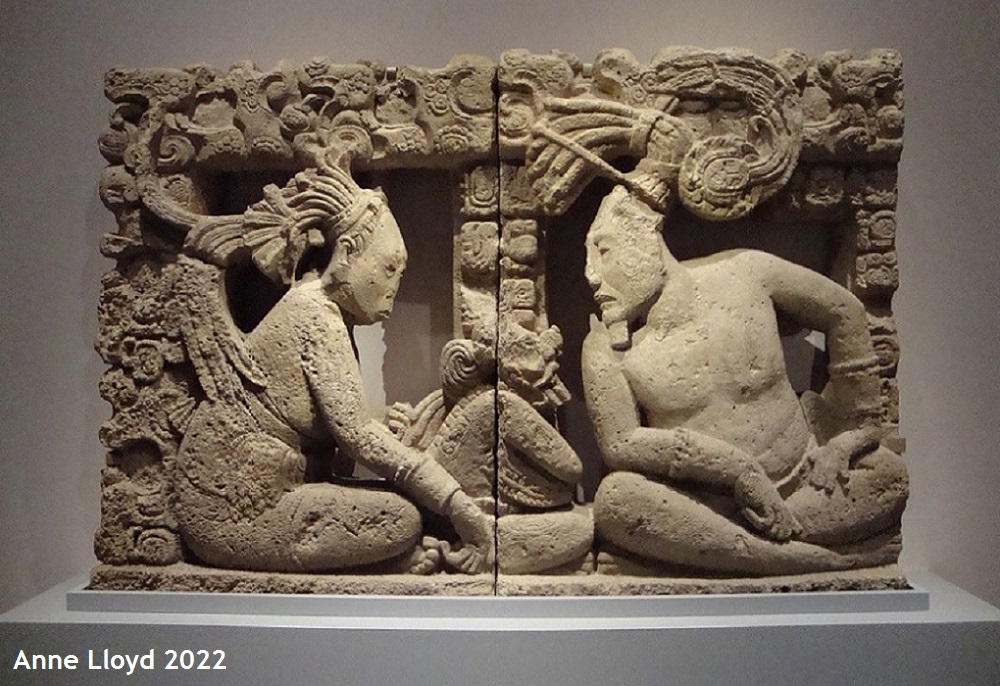
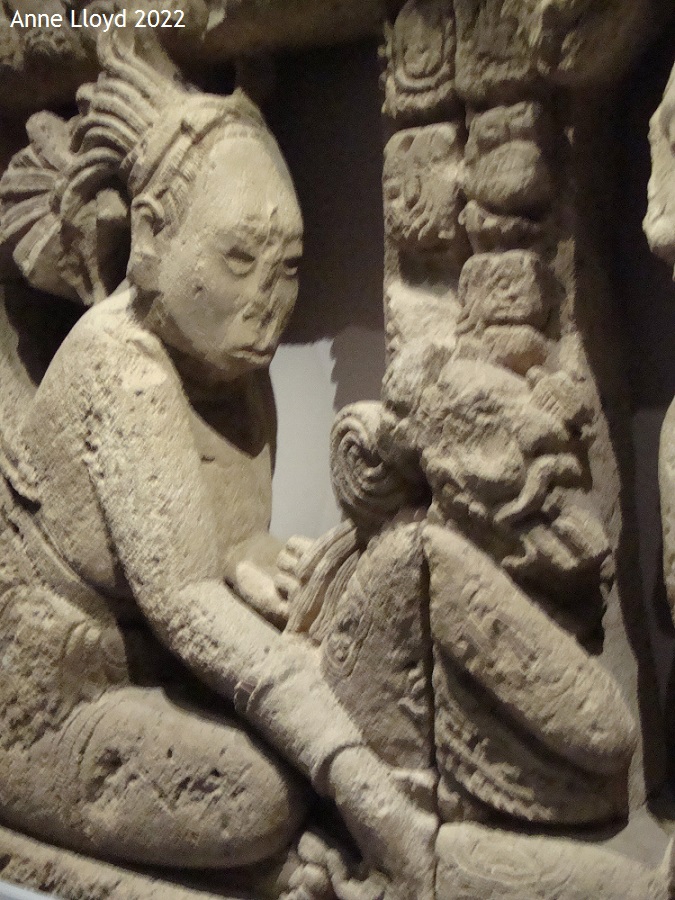


Details of Throne Back, 7th-9th century

Oddly enough, the face of the jaguar deity resembles that of a shipwrecked Spanish sailor, though centuries before Columbus. Behind him, a royal attendant takes in the interview, perhaps mystified, as we are, at what is going on.

What message does the jaguar deity impart to the intently-listening king? Of course, we cannot know. But experts in Mayan art and religion locate the scene to a cave, sacred places to the Maya. Whatever communication is being given, it is certainly of importance. 

What impresses me with this magnificent carving is the tone of a style and presentation. It is free of the frightful imagery which we see on carvings from the eighth and ninth centuries when the Mayan kingdoms were in their death spiral. That is why I surmise that it should be dated earlier, before the fatal steps to the dissolution of the Classical Mayan age had been taken.

Indeed, Mayan art of the earlier periods, (proto-Classical and early Classical, third-fifth centuries) often demonstrates humane values and a sense of humor. There are quite a few examples of early Mayan art on view in Lives of the Gods, making this part of the exhibition a very enjoyable and compelling trip back in time.


Anne Lloyd, Photo (2022) Whistling Vessel, 5th century

Displayed close to the Throne Back carving is a whistling device showing another mythical scene. Activated by being filled with water, the ceramic vessel mounts a vignette showing  a trickster tale. A fearsome bird deity confronts a kneeling human being, unaware of a cat climbing-up the side of the vessel, ready to pounce.

Other ceramic masterworks on view comprise a group of lidded vessels for feast days, topped with animal knobs or handles. Howler monkeys, a peccary and a turtle with a grinning man's head emerging from its mouth attest to the Maya kinship with the animal realm and a generous helping of fun. It's hard to resist a smile when looking at these wonderful examples of Mayan pottery.


Anne Lloyd, Photo (2022) Lidded vessel with Peccary Handle, 4th century


Anne Lloyd, Photo (2022)
 Lidded Vessel with Mythological Turtle, 4th century

As the timeline of Lives of the Gods reaches the eighth and ninth centuries, the  Mayan success story began to turn to ashes. The complex turn of event, drought, soaring population, hardening class distinctions are still being studied by historians. One thing can be certain, during the 700's, the time of Lady K’abal Xook's vision quest, warfare in the Mayan world escalated from low-intensity raids to secure a few captives for sacrifice to rampaging campaigns of wholesale destruction.


Anne Lloyd, Photo (2022)
 Gallery view of Lives of the Gods, showing statues of captive warriors

The terrible eclipse of Classical Mayan civilization is evoked in the carved images of bound prisoners awaiting execution. As part of his humiliation, a captive warrior named Yak Ahk' has been dressed as a jaguar deity, who had been tortured and killed in a tale from Mayan myth. 


Anne Lloyd, Photo (2023)  
Yak Ahk' as Captive, Impersonating a Jaguar Deity, c. 700

The precise chronology of the Maya wars is still incomplete and likely to remain so. Looking at this one carving is quite sufficient, however, to illustrate the suicide of the Classical Maya kingdoms. The image of Yak Ahk's suffering recalls the haunting 1971 photo of a young Vietnamese girl, Phan Thi Kim Phuc, set aflame by napalm. One picture tells us all we need to know.

The Mayan people proved able to survive the apocalypse of the Classical kingdoms. After the great cities were abandoned, by the year 900, Mayan life reconfigured on a localized, village basis. This decentralized community structure produced less in the way of great art, but enabled the Maya to survive the Spanish invasions of the 1500's and the epidemic diseases which followed in the footsteps of the Conquistadors.

The Met exhibit pays tribute to contemporary Maya life with a colorful video clip of a modern day festival. Dance of the Macaws in the Santa Cruz Verapaz, Guatemala, was filmed by Ricky Lopez Bruni. Dance of the Macaws exudes the life and spirit of the Maya, filling the exhibition gallery with incandescent light - and a palpable feeling of life!


Anne Lloyd, Photo (2022) 
Gallery View of the Lives of the Gods exhibit, showing
 Dance of the Macaws, filmed by Ricky Lopez Bruni

The survival of the Maya over the ages and their still-flourishing folk-culture is as remarkable a phenomenon as the pyramids, statues and paintings their ancestors created over twelve hundred years ago.

Happily, Lives of the Gods: Divinity in Mayan Art will be traveling to the Kimbell Art Museum, Fort Worth, Texas,  after it closes at The Met. This year marks the 50th anniversary of the Kimbell Museum and I can't conceive of better company for this celebration than the Maya, ancient and modern.

 ***

Text: Copyright of Ed Voves, all rights reserved                                                      

Original photography, copyright of Anne Lloyd

Introductory Image: Anne Lloyd, Photo (2022) Maize God, 715, from the British Museum. Details below.

Anne Lloyd, Photo (2022) Gallery view of the Lives of the Gods: Divinity in Maya Art exhibit, showing Column, from Campeche, Mexico, c. 800-900. Limestone: H. 68 3/4 x 29 in. Metropolitan Museum of Art. 

Anne Lloyd, Photo (2022) Gallery view of the Lives of the Gods exhibit, showing Maya jade pendants, 7th-9th century. Collection of the Metropolitan Museum of Art. 

Anne Lloyd, Photo (2022 ) Gallery view of the Lives of the Gods exhibit, showing Maize God, from Copan, Honduras, 715. Limestone: H. 35 1/16 x W. 22 1/4 in. x D. 11 13/16 in. 264.6  lbs. British Museum.

Anne Lloyd, Photo (2022 ) Censer Stand, from Palenque, Mexico, c. 690–720. Ceramic, traces of pigments: H. 44 × W. 22 × D. 12 1/4 in.,103 lb. (111.8 × 55.9 × 31.1 cm, 46.7 kg) Kimbell Art Museum, Fort Worth, TX

Anne Lloyd, Photo (2022 ) Jaguar God Censer Stand, from Palenque, Mexico, 7th–8th century. Ceramic: H. 26 × W. 14 9/16 × D. 6 5/16 in., 132.3 lb. (66 × 37 × 16 cm, 60 kg) Museo de Sitio de Palenque Alberto Ruz

Anne Lloyd, Photo (2022 ) King Jaguar Bird Tapir, from Tonina in Chiapas, Mexico, early 7th century. Limestone: 8 ft 5 9/16 in. x 28 3/4 in. x 20 1/16 in. 881.8 lb. Museo de Sitio de Tonina, Mexico.

Anne Lloyd, Photo (2022 ) Gallery view of the Lives of the Gods exhibit, showing video of Tikal and El Mirador, Guatemala, filmed by Ricky Lopez Bruni.

Anne Lloyd, Photo (2022) Lady K'abal Xook Conjuring a Supernatural Warrior, Yaxchilan, Mexico, 725. Limestone: H. 47 5/8 × W. 33 11/16 × D. 5 5/16 in., 509.3 lb. (121 × 85.5 × 13.5 cm, 231 kg) British Museum.

Anne Lloyd, Photo (2022) Detail views of Lady K'abal Xook Conjuring a Supernatural Warrior.

Anne Lloyd, Photo (2022) Gallery view of the Lives of the Gods exhibit, showing Throne Back, from Mexico or Guatemala, 7th-9th century. Limestone: H. 43 11/16 x W. 65 3/8 x D. 9 1/4 in. 937 lb. Museo Amparo Collection, Puebla, Mexico

Anne Lloyd, Photo (2022) Detail views of Throne Back (See above). 

Anne Lloyd, Photo (2022) Whistling Vessel, from Guatemala or Mexico, 5th century. Ceramic: H. 11 7/8 x W.  7 3/4 x D. 5 1/4 in. Metropolitan Museum of Art

Anne Lloyd, Photo (2022) Lidded vessel with Peccary Handle, from Guatemala, 4th century. Ceramic: H. 10 5/8 x Diam. 12 5/8 inches. Museo de Nacional Arqueologia & Ethologia, Guatemala.

Anne Lloyd, Photo (2022) Lidded Vessel with Mythological Turtle, 4th century. Ceramic: H. 9 5/8 x Diam. 10 7/16 inches. Museo de Nacional Arqueologia & Ethnologia, Guatemala.                                                                                                                                                                                                             Anne Lloyd, Photo (2022) Gallery view of the Lives of the Gods exhibit, showing statues of captive warriors, Yak Ahk' (left) and Muwaan Bahlam,     

Anne Lloyd, Photo (2023)  Yak Ahk' as Captive, Impersonating a Jaguar Deity, c. 700. Sandstone: H. 22 7/16 x W. 18 1/8 x D. 4 5/16 in. 176.4 lb. Museo de Sitio de Tonina, Mexico.

Anne Lloyd, Photo (2022) Gallery view of the Lives of the Gods exhibit, showing video clip of Dance of the Macaws. Filmed by Ricky Lopez Bruni. 


Friday, October 28, 2016

Paint the Revolution: Mexican Modernism at the Philadelphia Museum of Art


Paint the Revolution: Mexican Modernism, 1910–1950


Philadelphia Museum of Art, October 25, 2016 – January 8, 2017 

Museo del Palacio de Bellas Artes, Mexico City, February 3 – April 30, 2017


Reviewed by Ed Voves

Paint the Revolution: Mexican Modernism, 1910–1950, is a tale of two struggles. The new exhibition at the Philadelphia Museum of Art presents a definitive retelling of the story of the Mexican Revolution and its brilliant artistic aftermath.

On December 1, 1920, a one-armed general named Álvaro Obregón  was elected President of Mexico. Obregón was a chickpea farmer turned military tactician. In 1915, his astute generalship won the bloody battle of Celaya, turning point of the Mexican Revolution. 

Obregón was also the "last man standing." He had survived the slaughter that had claimed the lives of over one million Mexicans, including more famous rivals like Emiliano Zapata.

Obregón's election brought the military phase of Mexico's revolutionary conflict to a close. A second, cultural revolution began as soon as the gunfire ceased. The time had arrived, as a perceptive U.S. journalist, John Dos Passos, observed, to "paint the Revolution."          

The Mexican Revolution was a vast, sprawling event, of "Russian novel" dimensions and a bewildering cast of protagonists. The second phase was no different. The sheer number of major artists of the Mexican Renaissance, as it is often called, is staggering: José Clemente Orozco, David Alfaro Siqueiros, Diego Rivera, Frida Kahlo,Tina Modotti, Manuel Álvarez Bravo and many more.

Paint the Revolution at the Philadelphia Museum of Art somehow encompasses this vast cast, giving due recognition to all. This is a major, insight-packed reappraisal of a hugely significant event.


Digital version of Ballad of the Proletarian Revolution (detail) by Diego River,1928-29

This brilliant exhibit also manages the seemingly impossible task of recreating the vast public murals that figured so prominently during Mexico's revolutionary era.Three major mural cycles are depicted using digital technology in a way that enables the scale and scope of these mighty works of art to be grasped.

The Mexican Revolution began in November 1910. Simmering rage over the expropriation of communal land erupted into revolt. The long-time dictator, Porfirio Diaz, was swiftly toppled from power. A succession of leaders beginning with Francisco I. Madero, however, failed to create a stable and equitable new government. Madero's assassination in 1913 detonated a brutal civil war.

A number of works of art are displayed that show the efforts to create a heroic myth for the Mexican Revolution. These are "after-the-fact" images, much like nineteenth century representations of the American Revolution. These present history as contending political factions wished it had happened - not necessarily as it did occur. 

David Alfaro Siqueiros (1896-1974) was an avowed Marxist, co-founder of El Machete, the newspaper that became the mouthpiece of the Mexican Communist Party. Siqueiros depicts Emiliano Zapata as a Proletarian hero in two works displayed in the exhibit. Zapata was indeed a champion for land reforms for Mexico's peasant class. But close scrutiny of these two works by Siqueiros raises red flags of a different sort.


David Alfaro Siqueiros, Zapata, 1931

This 1931 lithograph of Zapata presents him as a hard-riding guerrilla leader. It is the very image of a commander during the Mexican Revolution. Look closer at Zapata's features - and even more so at the portrait painted the same year, part of the Hirshorn Museum collection - and we see a different character altogether. Here is a Stalinist reworking of Zapata's image by Siqueiros. Apart from the carefully-groomed mustache (Zapata was rather vain about his mostacho), the resemblance is far closer to Stalin than to Zapata.                                                                                  
Siqueiros was such a staunch supporter of Stalin that he helped plan a botched-assassination of Leon Trotsky who had fled to Mexico to escape Stalin's agents. The eventual murder of Trotsky in 1940 was carried out by a professional Communist hit man. Siqueiros was a far better artist than an assassin.

A much more  convincing work of art related to the Mexican Revolution is Diego Rivera's searing depiction of the rescue of a peasant who had been brutally lashed and left to die in the desert. Revolutionary troops, having set fire to a rural estate, are tending to the wounds of their tortured compadre.


Diego Rivera, Liberation of the Peon, 1931

Diego Rivera (1886-1957) painted this "portable" mural in 1931, using the fresco technique popular during the Italian Renaissance. This profoundly moving work is in many ways a worthy successor to Renaissance painting. It conveys the same compassion and empathy expressed in Giotto's Lamentation. The horses in Liberation of the Peon express the almost surreal intensity of the war horses in the Battle of San Romano by Paolo Uccello.


Anne Lloyd, detail of Liberation of the Peon, 1931, by Diego Rivera

Rivera's Liberation of the Peon is a link between the Italian Renaissance and the Mexican Renaissance. However, the version of Rivera's Liberation of the Peon on view in the Philadelphia exhibit is an extremely significant work in its own right. Rivera painted it in 1931 in New York City, for the exhibition of his work organised by the Museum of Modern Art. The exhibit - and Liberation of the Peon  -  later traveled to the Philadelphia Museum of Art. 

Liberation of the Peon and its companion piece, Sugarcane, remained unsold after the MOMA show. When the Philadelphia Museum of Art sponsored a major exhibition, Mexican Art Today, in 1943, Liberation of the Peon and Sugarcane played a starring role and were purchased for the Philadelphia Museum of Art's permanent collection.

Rivera's Liberation of the Peon is based upon a much larger fresco, approx. 14' 4 3/8" x 11' 5", which he painted in the courtyard of the Education ministry in Mexico City. This brings us to one of the central protagonists of the Mexican cultural revolution, José Vasconcelos, appointed by President Obregón to head the Secretaría de Educación Pública.

In a bold move, Vasconcelos encouraged Rivera to return from Europe, where he had spent most of the years of the Mexican Revolution. Vasconcelos pressured Rivera and other artists awarded government contracts to paint in a style reflecting the lives and aspirations of Mexico's long-suffering peasants and growing urban work force.

Rivera responded with murals that obeyed Vasconcelos' guiding principle, "Action surpasses destiny. Conquer!" Like the stained glass depictions of religious scenes in Medieval cathedrals, Rivera's epic works were readily understandable to Mexicans of all social classes. 

Along with the digitized versions of classic murals by Rivera, Siqueiros  and Orozco, an actual mural, painted by Manuel Rodriguez Lozano, is displayed in the exhibit.


Anne Lloyd, gallery view of Pieta in the Desert by Manuel Rodriguez Lozano

Pieta in the Desert was originally painted on a prison wall, while Lozano was incarcerated in 1942. The mural  was later removed by the rather alarming technique called strappo. The mural is covered with resin, glue, fabric and tape and then pounded with a jackhammer which cracks the concrete on which it is painted enabling the mural to be lifted clear of the debris and remounted.

The Tres Grandes - Rivera, Orozco and Siqueiros - went on to produce mural cycles in  the United States which influenced public art in New Deal America during the Great Depression. They also created controversy, Rivera's ill-fated mural in Rockefeller Center being the most notorious example, and confusion.

Almost all of the great themes of Mexican art during this revolutionary era were first exhibited in traditional easel paintings. The wonderful Futurist Portrait of Nahui Olin, by Gerardo Murillo, (1875–1964) who styled himself as Dr. Atl, was painted in 1921.


Anne Lloyd, gallery view of Futurist Portrait of Nahui Olin (1921) by Dr. Atl

Incredibly, easel paintings like this were dismissed by a radical 1924 manifesto as lacking in heroic vision. Easel paintings, the most easily transported art form, were declared to be unsuited to instruct the Mexican masses. 

However, government-sponsored mural projects paid poorly. Rich foreign patrons bought smaller scale works that supplied infusions of cash. Rivera and others painted "unheroic" easel paintings for sale to the "bourgeois individualists" they denounced.

It was Rivera's wife, the now celebrated Frida Kahlo, who would "square the circle" and use easel painting to create socially conscious works of art. Undeniable "heroism" was in her shattered, suffering body and soul. This courage she painted on easel-sized canvases.

There are five works by Kahlo in Paint the Revolution. The exhibition curators chose wisely, selecting paintings that exemplify Kahlo's focus on  social issues and Mexico's problematic relationship with the United States. 


Frida Kahlo, Self-Portrait on the Border Line Between Mexico and the U.S.,1932

Self-Portrait on the Border Line Between Mexico and the United States, painted in 1932, brilliantly juxtaposes the industrial pipelines and electric wires of the smog-shrouded United States with symbols of "eternal" Mexico, rooted in the natural world.

The career of Maria Izquierdo (1902-1955) reveals the mural-easel, male-female fault lines running through Mexican Modernism. Izquierdo seemed an almost unstoppable artistic force during the late 1920's and 1930's. In 1930, Izquierdo had the first solo exhibit of a Mexican woman artist in the U.S. 

Izquierdo's work, combining religious and folk art themes was praised by the Surrealists and during the early 1940's she exerted a powerful presence throughout Latin America. However, her design submissions for a major mural commission which she received in 1944 were rejected. Rivera and Siqueiros, often at odds, united to sabotage Izquierdo's attempt to achieve the ultimate level of recognition in Mexican art, mural painting. 

When Izquierdo tried to regain the commission, the male-dominated art establishment thwarted her efforts. Her career and health went into a downward spiral. 


María Izquierdo, Our Lady of Sorrows, 1943 

Izquierdo bitterly declared that "it is a crime to be born a woman and have talent."

The same could be said for the brilliant photographic work of Tina Modotti - though she would not have said so herself. 

The Italian-born Modotti came to Mexico with the noted American photographer, Edward Weston, who was for a time her lover and teacher. Modotti revealed superlative gifts in photography, documenting the lives of Mexico's peoples with incredible artistic vision.

Modotti's career took a radical slant when she joined the Mexican Communist Party in 1927. She became entangled in the violent internal struggles of Leftist groups in Mexico and she was a prime-suspect in the murder of her new lover, the Cuban-born radical, Julio Antonio Mella, in 1929. Though cleared of the charges, Modotti left Mexico under clouds of suspicion. 


Tina Modotti, Woman of Tehuantepec, c. 1929

Modotti's subsequent fate was tragic. All her talents became subsumed in Marxist politics, especially related to the Spanish Civil War. She gave up photography in 1931 and her amazing body of work was only rediscovered in the late 1970's with the dawn of the Feminist movement.

The political radicalization of Modotti and almost all of the leading Mexican artists is symbolized by the wood engraving, Proletarian Hand, by Leopoldo Méndez. The finger bones are hanged prisoners and the wrist bomes are portraits of political martyrs, including Mella. It is a brilliant, unforgettable work, evoking the  great nineteenth century printmaker, José Guadalupe Posada (1852 – 1913), whose prints of demonic skeletons helped bring down Porfirio Diaz.


Leopoldo Méndez, Proletarian Hand, 1932

Proletarian Hand is very much  a work of the 1930's. It ignores the sacrifices and suffering of women. Likewise, it focuses on the international scene at the expense of Mexico. Two of the "martyrs" named in the print were Sacco and Vanzetti, the Italian anarchists who were executed for murder in the U.S. in 1927. While the artistic elite of Mexico may have been radicalized by such political imagery, the impact on Mexico's workers was negligible. 

Mexican Modernism grew increasingly remote from the realities of Mexican life. The economy of Mexico strengthened, especially as Mexico's oil industry was needed by the Allied war effort in World War II. Many Mexicans, loyal to conservative traditions and the Catholic religion, deeply resented the Marxist ethos of the "Modernists."

There was also the inconvenient fact that many Mexican artists, including strident Marxists, depended on sales and commissions from "El Norte." Frida Kahlo's first big success was a sale of four paintings to the American actor, Edward G. Robinson, in 1938.

By 1950, the two-fold Mexican Revolution and Mexican Renaissance had run their course. But these events had entered into the heart and soul of the Mexican people. It is no surprise that whenever social ferment arises in Mexico, the vivid images displayed in Paint the Revolution are revived, coaxed back to life and action like the beaten prisoner in Liberation of the Peon. 

***
Text: Copyright of Ed Voves, all rights reserved 
Images courtesy of the  Philadelphia Museum of Art

Introductory Image:                                                                                                         Anne Lloyd, Detail of Liberation of the Peon, 1931, by Diego Rivera (Philadelphia Museum of Art: Gift of Mr. and Mrs. Herbert Cameron Morris, 1943-46-1) © Banco de México Diego Rivera Frida Kahlo Museums Trust, Mexico, D.F./Artists Rights Society (ARS), New York

Anne Lloyd (2016), Detail of the digital version of Ballad of the Proletarian Revolution by Diego River, 1928-29, mural painted at the Ministry of Public Education, Mexico City. 

David Alfaro Siqueiros (1896-1974) Zapata, 1931, Philadelphia Museum of Art: Purchased with the Lola Downin Peck Fund from the Carl and Laura Zigrosser Collection, 1976-97-122) © Artists Rights Society (ARS), New York/SOMAAP, Mexico City

Diego Rivera (Mexican, 1886-1957) Liberation of the Peon, 1931. Fresco on reinforced cement in a galvanized steel framework, 73 x 94 1/4 inches (185.4 x 239.4 cm) (Philadelphia Museum of Art: Gift of Mr. and Mrs. Herbert Cameron Morris, 1943-46-1) © Banco de México Diego Rivera Frida Kahlo Museums Trust, Mexico, D.F./Artists Rights Society (ARS), New York

Anne Lloyd (2016), Gallery view of Pieta in the Desert by Manuel Rodriguez Lozano. Fresco (removed by strappo from Lecumberri Prison) 6 ' 6 3/8" x 7'  9/16" (2.6 x 2.3 m) Museo del Palacio de Bellas Artes, INBA, Mexico City

Anne Lloyd (2016), Gallery view of Futurist Portrait of Nahui Olin (1921) by Dr. Atl. Oil and Atl color on cardboard, 39 3/8 x 55 7/8 inches (100 x 142 cm) collection of Maria and Manuel Reyero.

Frida Kahlo, Self-Portrait on the Border Line Between Mexico and the United States, 1932. (Colección Maria y Manuel Reyero, New York) © Banco de México Diego Rivera Frida Kahlo Museums Trust, Mexico, D.F./Artists Rights Society (ARS), New York

María Izquierdo (Mexican,1902 -1955) Our Lady of Sorrows, 1943. Oil on board, 23 1/4  x 19 5/8 inches  (59.1 x 49.8 cm ) Private collection

Tina Modotti (Italian, 1896–1942) Woman of Tehuantepec, c. 1929, (Philadelphia Museum of Art: Gift of Mr. and Mrs. Carl Zigrosser

Leopoldo Méndez (Mexican,1902–1969) Proletarian Hand, 1932, Philadelphia Museum of Art: Gift of Anne d’Harnoncourt in memory of Sarah Carr d'Harnoncourt), ©Leopoldo Mendez/Artists Rights Society (ARS), New York/SOMAAP, Mexico City