
The Oxford Illustrated History of the World
Edited by Felipe Fernández-Armesto
Oxford University Press/$60/481 pages
Edited by Felipe Fernández-Armesto
Oxford University Press/$60/481 pages
Reviewed by Ed Voves
Readers of the Christian New Testament (Hebrews 4:12) will be
familiar with the image of a "two edged sword." This weapon is
used as metaphor for the living word of God which can pierce "unto the
division of the soul and the spirit, of the joints also and the marrow, and is
a discerner of the thoughts and intents of the heart."
On a more earthly plain, two edged swords certainly have stabbed
and sliced "of the joints and the marrow" of countless human beings. Two
edged swords cut both ways. The weapon you use to kill an enemy can kill you.
Sometimes this occurs by accident rather than design -"friendly
fire" is a current way of describing it. Two edged swords have also
been used in acts of suicidal despair, as King Saul, forsaken by God and
defeated by the Philistines, fell upon his sword.
As I read the brilliant and provocative new book, The Oxford
Illustrated History of the World, the image of the two edged sword kept
appearing and reappearing in my mind. Civilization is a two edged sword.
And not just swords. The biblical passage of swords being hammered
into plowshares is worthy of note. Plowshares, the subject of much
discussion in the Oxford book, are "two edged" too. Cutting through
turf, plowshares create this year's topsoil which wind and rain turn into
next year's dust and mud.

A plough pulled by oxen, from the Luttrell Psalter, c.1325 (British Library)
In just under five hundred pages, the authors of The Oxford Illustrated History of the World have achieved a near impossible feat of scholarship. They trace the rise of Homo Sapiens as the dominant living species on Planet Earth. The momentous journey from the cradle of human life in prehistoric Africa to the present phase of the "Great Acceleration" is presented in a judicious blend of sweeping narrative and lucid commentary.
Drawing upon the latest research in earth science, biology and climatology, the Oxford volume closely links the dominant status of Homo Sapiens to the ability to adapt to challenging living conditions on all continents except Antarctica.The book's first chapter (written by Clive Gamble) presents informed and intriguing speculation that the replacement of Neanderthals by humans in Europe occurred 40,000 years ago following a huge volcanic eruption. As Neanderthals were "as large brained as their human contemporaries," the change was not due to lack of intelligence. Humans likely gained predominance by their enhanced ability to respond to challenges, acquired during the migrations from East Africa.

The skull of Homo Sapiens (left) compared to a Neanderthal skull
Clive Gamble writes:
We became the lonely, global species as a result of imagination, supported by advanced cognitive skills, which gave us myths, afterlives, ancestors, gods, and history - the cultural dreams of a clever, versatile biped...This imagination, validated by society and culture, saw benefit in going beyond, taking the risk, moving out of the long-inhabited hominin comfort zone...
The editor of The Oxford Illustrated History of the World, Felipe Fernández-Armesto, is the perfect leader of the team of scholars responsible for this splendid book. A brilliant and unorthodox historian,
Other notable historians follow Fernández-Armesto's example and Gamble's superb opening chapter. The combined scholarship of this Oxford illustrated history balances wide-ranging appraisal with tightly-focused scrutiny on significant factors. The text is brilliantly complemented by pictures of extraordinary works of art and readily understandable maps and charts.

Buddhist Expansion in Asia to about 1300 CE
A good example of the book's balance of far-sighted perception and incisive example occurs in the chapter on life during late antiquity and the Middle Ages. John Brooke notes that changed climate conditions in the thirteenth and fourteenth centuries brought significant rainfall to the Eurasian steppe. Grassland grew in what had been a vast stretch of near desert. Mongol raiders under Genghis Khan thus had a ready supply of forage, enabling them to create a land empire from the Volga and Dnieper rivers in Russia to Korea and China. Along with the marauding armies of the Mongols traveled the Yersinia pestis bacillus, the plague microbe responsible for the Black Death.
Natural calamities of the magnitude of the Black Death or the Spanish Influenza pandemic of 1918-19 are comparatively rare. On the other hand, the frequency of societal smash-ups is almost predictable in its wheel-of-misfortune regularity.
Fernández-Armesto and his fellow scholars view the development of human societies from a broad continuum. As a result, traditional textbook dates for "smash-ups" like the fall of the Roman Empire in the West, 476 AD, sometimes appear in the middle of chapters, rather than more definitive places on history's timeline.
John Brooke's "Material Life: Bronze Age Crisis to the Black Death," is one of three chapters spanning the long period from the collapse of Bronze Age city-states and kingdoms around the presumed date for the Trojan War (1200 BC) to the Renaissance in Europe. Brooke, David Northrup and Ian Morris examine how humanity in this long phase of history developed complex societies and religious/philosophical foundations to sustain them.
Often the most creative ideas and innovations occurred during the "dark ages" which punctuated this millennium and a half. Homer's Iliad was composed during a truly dark time, a least in terms of written records, following the collapse of the Mycenaean civilization in Greece (1100-750 BC). It was only written down after the Greeks had adapted the alphabet of the seafaring Phoenicians for their own use. Not long after this, the Hebrew Bible began to be organized in written form by Jews who had been forced to migrate to Babylon after Judea was conquered and incorporated into the Babylonian Empire.
Frequently, human beings cannot resist drawing the sword and using force to defend themselves. Civilized states have suffered much from the attacks of wandering, pillaging nomads - Goths, Huns, Vikings and Mongols. Small kingdoms and states must also resist being swallowed up by bigger states. One of the more successful political entities to do so was ancient Assyria's New Empire, 912-612 BC.
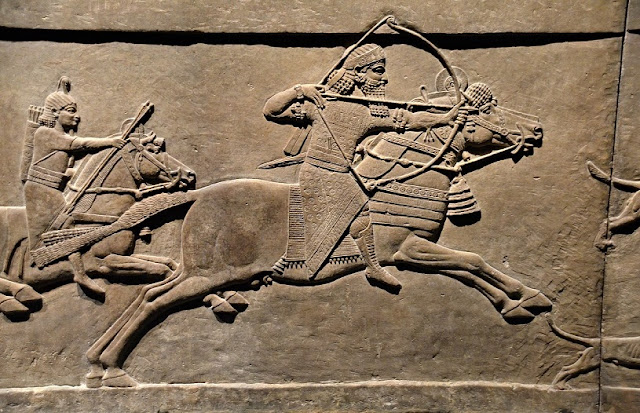
Assyrian cavalry relief, c. 700 BCE (British Museum)
Early Assyria had been an unremarkable Middle Eastern kingdom, often under the sway of Babylon. "New" Assyria built a powerful military establishment, developing horse cavalry units rather than relying on cumbersome chariots. This enabled Assyria to survive the tsunami of steppe raiders and "sea peoples" which wiped-out Mycenaean Greece, the Hittites in modern-day Turkey and nearly swamped once-mighty Egypt. According to Brooke, cooler temperatures and more rainfall favored the horse raiders and the likely spread of plague vectors similar to what occurred with the Mongols later during the Middle Ages. Assyria countered this grave threat and won.
Does this mean that we should extend a degree of sympathy to the New Assyrian Empire, given the narrow margin of survival which they faced? Ultimately no, for militarized Assyria became one of the most ruthless and blood-thirsty political states in history - and one of the least innovative once the nomad invaders had been driven off. In my 2014 Art Eyewitness review of the "Assyria to Iberia" exhibit at the Metropolitan Museum of Art, I compared the sterile culture of the Assyrians with the immense creative achievements of the Phoenician city-states during the same period.
In the case of the war-loving Assyrians, the image of the '''two edged sword" is literally true. But the law of unintended effect is equally appropriate to creative pursuits like the visual arts.
Fernández-Armesto writes movingly of the birth of art during the Paleolithic era. He notes that art painted or carved on the walls of cave shrines served a ritual purpose or as a record of hunting techniques. Much, indeed the majority, of art created around the time of the celebrated Chauvet Cave paintings, thirty thousand years ago, was religious in its intention, as human beings conceived and interpreted notions of divine powers and eternal life.
Not all prehistoric art was spiritually-motivated. Fernández-Armesto writes:
One of the reasons why humans make images of the objects they see is in an effort to understand them: understanding is inescapably prior to control. Like modern 'abstract' artists today, Ice Age predecessors tried to capture the key properties and patterns of the nature they observed, not to reproduce its exact appearance.
Note the words "understanding is inescapably prior to control." Humans created art to help them understand and control their natural environment and to conceptualize the unseen, but intuited, realm of divine beings. From there, it was but a step to using art as a means of understanding society, "prior to control" by some human beings over other, less favored men and women.

The skull of Homo Sapiens (left) compared to a Neanderthal skull
Clive Gamble writes:
We became the lonely, global species as a result of imagination, supported by advanced cognitive skills, which gave us myths, afterlives, ancestors, gods, and history - the cultural dreams of a clever, versatile biped...This imagination, validated by society and culture, saw benefit in going beyond, taking the risk, moving out of the long-inhabited hominin comfort zone...
The editor of The Oxford Illustrated History of the World, Felipe Fernández-Armesto, is the perfect leader of the team of scholars responsible for this splendid book. A brilliant and unorthodox historian,
Other notable historians follow Fernández-Armesto's example and Gamble's superb opening chapter. The combined scholarship of this Oxford illustrated history balances wide-ranging appraisal with tightly-focused scrutiny on significant factors. The text is brilliantly complemented by pictures of extraordinary works of art and readily understandable maps and charts.

Buddhist Expansion in Asia to about 1300 CE
A good example of the book's balance of far-sighted perception and incisive example occurs in the chapter on life during late antiquity and the Middle Ages. John Brooke notes that changed climate conditions in the thirteenth and fourteenth centuries brought significant rainfall to the Eurasian steppe. Grassland grew in what had been a vast stretch of near desert. Mongol raiders under Genghis Khan thus had a ready supply of forage, enabling them to create a land empire from the Volga and Dnieper rivers in Russia to Korea and China. Along with the marauding armies of the Mongols traveled the Yersinia pestis bacillus, the plague microbe responsible for the Black Death.
Natural calamities of the magnitude of the Black Death or the Spanish Influenza pandemic of 1918-19 are comparatively rare. On the other hand, the frequency of societal smash-ups is almost predictable in its wheel-of-misfortune regularity.
Fernández-Armesto and his fellow scholars view the development of human societies from a broad continuum. As a result, traditional textbook dates for "smash-ups" like the fall of the Roman Empire in the West, 476 AD, sometimes appear in the middle of chapters, rather than more definitive places on history's timeline.
John Brooke's "Material Life: Bronze Age Crisis to the Black Death," is one of three chapters spanning the long period from the collapse of Bronze Age city-states and kingdoms around the presumed date for the Trojan War (1200 BC) to the Renaissance in Europe. Brooke, David Northrup and Ian Morris examine how humanity in this long phase of history developed complex societies and religious/philosophical foundations to sustain them.
Often the most creative ideas and innovations occurred during the "dark ages" which punctuated this millennium and a half. Homer's Iliad was composed during a truly dark time, a least in terms of written records, following the collapse of the Mycenaean civilization in Greece (1100-750 BC). It was only written down after the Greeks had adapted the alphabet of the seafaring Phoenicians for their own use. Not long after this, the Hebrew Bible began to be organized in written form by Jews who had been forced to migrate to Babylon after Judea was conquered and incorporated into the Babylonian Empire.
Frequently, human beings cannot resist drawing the sword and using force to defend themselves. Civilized states have suffered much from the attacks of wandering, pillaging nomads - Goths, Huns, Vikings and Mongols. Small kingdoms and states must also resist being swallowed up by bigger states. One of the more successful political entities to do so was ancient Assyria's New Empire, 912-612 BC.

Assyrian cavalry relief, c. 700 BCE (British Museum)
Early Assyria had been an unremarkable Middle Eastern kingdom, often under the sway of Babylon. "New" Assyria built a powerful military establishment, developing horse cavalry units rather than relying on cumbersome chariots. This enabled Assyria to survive the tsunami of steppe raiders and "sea peoples" which wiped-out Mycenaean Greece, the Hittites in modern-day Turkey and nearly swamped once-mighty Egypt. According to Brooke, cooler temperatures and more rainfall favored the horse raiders and the likely spread of plague vectors similar to what occurred with the Mongols later during the Middle Ages. Assyria countered this grave threat and won.
Does this mean that we should extend a degree of sympathy to the New Assyrian Empire, given the narrow margin of survival which they faced? Ultimately no, for militarized Assyria became one of the most ruthless and blood-thirsty political states in history - and one of the least innovative once the nomad invaders had been driven off. In my 2014 Art Eyewitness review of the "Assyria to Iberia" exhibit at the Metropolitan Museum of Art, I compared the sterile culture of the Assyrians with the immense creative achievements of the Phoenician city-states during the same period.
In the case of the war-loving Assyrians, the image of the '''two edged sword" is literally true. But the law of unintended effect is equally appropriate to creative pursuits like the visual arts.
Fernández-Armesto writes movingly of the birth of art during the Paleolithic era. He notes that art painted or carved on the walls of cave shrines served a ritual purpose or as a record of hunting techniques. Much, indeed the majority, of art created around the time of the celebrated Chauvet Cave paintings, thirty thousand years ago, was religious in its intention, as human beings conceived and interpreted notions of divine powers and eternal life.
Not all prehistoric art was spiritually-motivated. Fernández-Armesto writes:
One of the reasons why humans make images of the objects they see is in an effort to understand them: understanding is inescapably prior to control. Like modern 'abstract' artists today, Ice Age predecessors tried to capture the key properties and patterns of the nature they observed, not to reproduce its exact appearance.

A richly bejewelled burial at Sunghir in Russia, dated to 28,000 years ago
Fernández-Armesto pauses in his survey of Paleolithic society to focus on an elite burial ground at Sunghir, near Moscow. The cemetery was found to contain the remains of an older man (shown above) and two children, dated to 28,000 years ago. The grave goods were staggering in their profusion and sophistication. Thousands of beads made from mammoth ivory,a necklace made of fox fangs and fur garments with fox teeth buttons were uncovered. One of the children, a boy of ten to twelve years, was buried with a spear or wand made from mammoth ivory.
Like the Egyptians, thousands of years later, these early "Russians" were well-equipped for the afterlife. But the spiritual connotation of these grave goods must also be interpreted from a political or societal perspective. These were privileged people, probably a clan or tribe leader and his children. Whoever they were, Fernández-Armesto is surely correct to identify them as members of an "Ice Age power class."
From that point, 28,000 years ago, the mutually reinforcing relationship of religion, politics and art shaped and determined the whole course of human existence. The discovery of the Sunghir grave goods in 1970 provided the earliest examples of the "trappings" of power.
In a later chapter of the Oxford book, dealing with the rise and crisis of modern culture, Paolo Luca Bernardini affirms that "the presence or absence of God is a key element in all spiritual, intellectual, and artistic work." Throughout history, Bernardini notes:
The arts constantly gave their account of the clash between mutability and eternity as they relate to the human world and the eternal God: through these representations, they justify their practice and express their deepest meaning. These conditions of mutability and visions of the world in which the sacred space plays a fundamental role plead in favor of the divine dimension of art. They suggest 'divine inspiration', as a human response to the same mystery of existence.

Japanese export pottery with VOC (Dutch East India Company) symbol
With brilliant (and disturbing) insight, Bernardini shows how a strain of atheism promulgated by radicals of the French Revolution spread throughout European cultural circles despite the eventual defeat suffered by the French Republic and its successor, Napoleon's empire. Later embraced in various forms by intellectuals all over the world, the belief that "God is Dead" has had staggering implications for humanity's creative impulses and emotional health.
A secularized perspective is now the dominant mode of thought and action in today's world, even in societies which profess strong belief in religious creeds. The critical turning point may have been earlier than the French Revolution of 1789. The chapter in the Oxford book dealing with the spread of global commerce following the voyages of "discovery" by Columbus, Vasco da Gama and others provides fascinating evidence for this crucial development.
"Exhibit A" is a porcelain plate made in Japan around 1660 for export to the Netherlands. Prominently placed in the center is the symbol of the Dutch East India Company. "VOC" stands for Vereenigde Oostindische Compagnie. Although the Dutch were still a very pious people, by the 1660's many were equipping or decorating their homes with nonreligious-themed products or pictures. Rembrandt's career took a fatal downturn around this time as his biblical paintings remained unsold.
A century before this, very few persons in Europe of any social standing, Protestant or Catholic, would have displayed a work of art or costly artifacts which lacked some reference to religion. Even the Medici of Florence were careful to have themselves portrayed on the edges of paintings devoutly worshiping the Christ child in the manger.
"Envy is a weed," Cosimo de Medici (1389-1464) declared, "which should never be watered."
As long as human beings feared - or more importantly, believed in - God's judgment, then art and religion provided the inspiring belief systems which motivated the rise of Homo Sapiens to unprecedented achievements. Once corporate "brands" like "VOC" began to replace religious symbolism and spiritual ideals, humanity entered a new phase of existence.

Earth Lights, 1994, illustrated by Craig Mayhew and Robert Simmon, NASA
We now live in a "new world" of instant communication and individual gratification. The NASA illustration, Earth Lights, shows how widespread is the present state of the globalism, the latest man-made Utopia. Created in 1994 using data from the Defense Meteorological Satellite Program (DMSP) and Operational Linescan System (OLS), the illustration shows "twinkling lights" which actually are "the locations of permanent lights on the Earth’s surface."
The dark spaces of Earth Lights also show how circumscribed is globalism. This is not a matter of civilization vs. barbarism, First World vs. Third World, but signifies instead how standards of certain regions cannot and should not be the measure for the whole planet.
The final chapters of The Oxford Illustrated History of the World have much to say - cogent and based upon the latest research - about the troubled condition of humanity. The epilogue of this magnificent book also reminds us that it is "the function of a prophet to be wrong..."
Homo Sapiens, in the journey from Africa, survived by adapting not predicting, by problem-solving rather than pontificating. Felipe Fernández-Armesto and his team of all-star historians take the same measured approach.
"The search for an ideal society," Fernández-Armesto counsels,"is like the pursuit of happiness: it is better to travel hopefully, because arrival breeds disillusionment."
***
Text: Copyright of Ed Voves, all rights reserved
Images courtesy of Oxford University Press, the British Museum (via Wikipedia) and the British Library. The New Testament quote (Hebrews 4:12) is from the Douay–Rheims Bible 1899 American Version of the Holy Bible.
Introductory Image:
Book Cover. Courtesy of Oxford University Press,
A plough pulled by oxen from the Luttrell Psalter, c.1325-35. Plowing scene, r, f.170r, from the digitized manuscript of the Luttrell Psalter on the British Library website: (https://www.bl.uk/manuscripts/Viewer.aspx?ref=add_ms_42130_fs001ar
The skull of Homo Sapiens (left) compared to a Neanderthal skull. hairymuseummatt (original photo), Dr Mike Baxter (derivative work) / Wikimedia Commons / CC BY-SA 2.0 Courtesy of Oxford University Press
Buddhist Expansion to about 1300 CE. Gunawan Kartapranata / Wikimedia Commons / CC BY-SA 3.0 Courtesy of Oxford University Press
Assyrian cavalry relief,c. 700 BCE. Gypsum wall panel relief showing King Ashurbanipal and attendants hunting. From the Assyrian galleries of the British Museum. https://upload.wikimedia.org/wikipedia/commons/thumb/9/93/Exhibition_I_am_Ashurbanipal_king_of_the_world%2C_king_of_Assyria%2C_British_Museum_%2831033563287%29.jpg/1280px-Exhibition_I_am_Ashurbanipal_king_of_the_world%2C_king_of_Assyria%2C_British_Museum_%2831033563287%29.jpg
A richly bejewelled burial at Sunghir in Russia, dated to 28,000 years ago.
José-Manuel Benito Álvarez / Wikimedia Commons Courtesy of Oxford University Press
The Earth at night, 1994, as illustrated by NASA scientists Craig Mayhew and Robert Simmon Data courtesy Marc Imhoff of NASA GSFC and Christopher Elvidge of NOAA NGDC. Image by Craig Mayhew and Robert Simmon, NASA GSFC Courtesy of Oxford University Press


.jpg)

