%20lead.jpg)
Recasting the Past: the Art of Chinese Bronzes
1100-1900
Metropolitan Museum of Art
February 28 - September 28, 2025
Reviewed by Ed Voves
The Metropolitan Museum of Art is currently re-evaluating Chinese civilization from the vantage point of works of art which have not been viewed in particularly high esteem. The objects on display date from the high Middle Ages (by Western date conventions) to the dawn of the twentieth century.
Ed Voves, Photo (2025 )
Tripod Incense Burner, Qing Dynasty, created 1736-95
These bronze cast sculptures, along with works in other media, were held to be derivative exercises in scholarly nostalgia rather than bold statements of cultural vitality, such as those The Met featured in the spectacular Art of Empires exhibit in 2017.
Recasting the Past: the Art of Chinese Bronzes, 1100-1900, is sure to lead to a more positive assessment of these striking works of art. But, as with most generalizations, there are elements of fact which, if viewed out of context, can lead to a distorted appraisal.
Ed Voves, Photo (2025 )
Ritual Ox Tripod (niuding), used as a cauldron at
the Imperial Ancestral Temple, Northern Song Dynasty, 1114
Two hundred works of art (half from The Met's incomparable collection) are displayed in the exhibition. Though some of these are not bronzes, all exemplify a major feature of Chinese civilization, called fugu or the "return to the past."
The historical era which these precious objects celebrated was the very distant past: the Shang dynasty (1600-1046 B.C.) and the two successor Zhou dynasties (1046-256 B.C.) This was China's bronze age, which was revered as a "golden" age.
Shang bronzes are among the most notable works of art produced in Asia. These bronze-cast objects were intended to be functional, not merely ornamental. Most importantly, Shang bronzes were foundational to the cultural expression of the subsequent dynasties which followed over the long course of China's history. The Met has several outstanding examples of Shang bronzes on view in nearby galleries.
Wine pouring Vessel (Gong), Shang Dynasty, 13th-11th century B.C.
Collection of the Metropolitan Museum of Art
If displayed in a direct "face-off" with the works of art on view in Recasting the Past, the Shang bronzes would "win" by almost all standards of aesthetic judgement. Fugu bronzes and works of jade were made, for the most part, for display or contemplation, unlike Shang bronzes. As a consequence, the scales of judgment seem even more tilted against these later works.
Yet, when viewed from the overarching context of Chinese history, Recasting the Past enables us to value the very impressive levels of technical skill devoted to these later works. These were intended to foster appreciation of China's ancient heritage and to revive the craft methods of bronze casting.
Most importantly, the fugu concept enabled China's cultural elite to withstand the depredations of waves of invaders and thus preserve the core values of their remarkable civilization.
Vase with Archiastic Design, Yuan Dynasty, 14th century
Collection of the Metropolitan Museum of Art
In addressing these criteria, the Recasting the Past artifacts deserve our consideration as high caliber works of art, indeed.
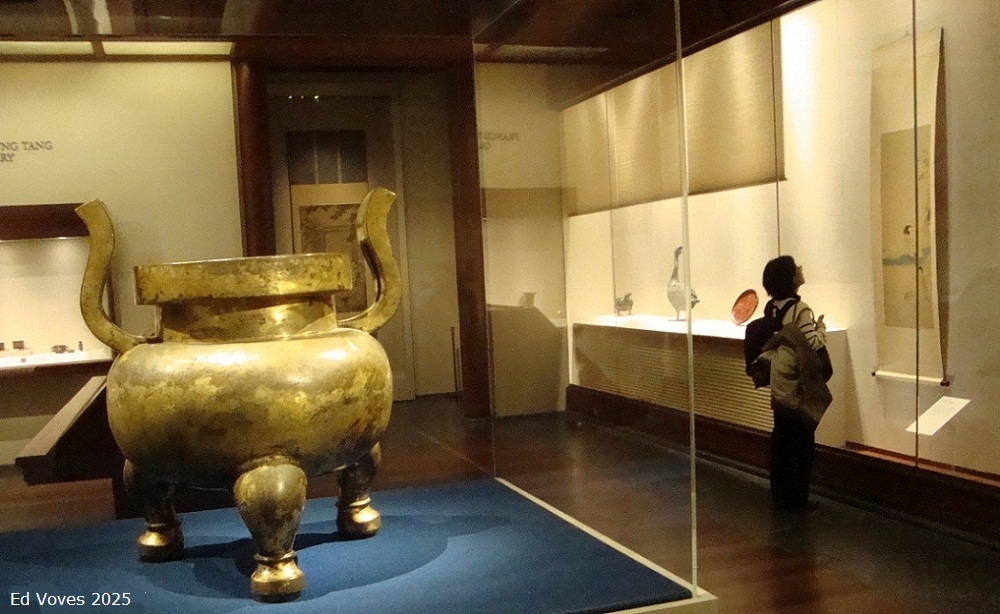
Ed Voves, Photo (2025 )
Gallery view of Recasting the Past: the Art of Chinese Bronzes.
At left, is a Tripod Incense Burner, c. 1403-24
"Location, location" is the mantra of real estate agents. "Context, context" is the similar refrain for art historians and curators. Recasting the Past provides both for the study of these masterworks of Chinese civilization.
First, let's examine the location of the exhibition.
Ed Voves, Photo (2025 )
The Astor Chinese Garden Court at the Metropolitan Museum of Art
The galleries of Recasting the Past are located adjacent to the Astor Chinese Garden Court. Built by expert Chinese craftsman who used traditional techniques and authentic materials, the Astor Court recreates the courtyard of a scholar-official of the Ming Dynasty, 1368-1644 . It was in such settings that the bronze, jade and ceramic works of art on display in Recasting the Past were first collected by gentleman-savants and used in small group discussions.
The Met has a wonderful depiction of such an event, with the engaging title, Elegant Gathering in the Apricot Garden, ca. 1437. It is an elaborate hand scroll showing the Ming Dynasty statesman, Yan Rong, engaged in cultured activities with several other scholar-officials. One of the scenes shows tables set with painting and calligraphy materials and bronze vessels similar to those on view in the exhibition.
Xie Huan, Elegant Gathering in the Apricot Garden (detail), c. 1437
Such "elegant gatherings" must have been idyllic occasions, especially during the early decades of the Ming Dynasty. The Ming Dynasty was comparable both in its begin/end dates and in its influence on Chinese civilization to the role of the Renaissance in Europe.
Ed Voves, Photo (2025 )
Gallery view of Recasting the Past: the Art of Chinese Bronzes
at the Metropolitan Museum of Art
The bronze and jade favored by scholar-officials like Yan Rong tended to be moderate in size, rather than monumental, and very much in the spirit of fugu. Why would the ideal of a "return to the past" find favor in a dynamic state like the Ming Dynasty?
For that we need historical context.
Ed Voves, Photo (2025 )
Ceremonial Bell with Imperial Procession, Landscape, and
Mythical Creatures in Waves, Northern Song Dynasty, 12th century
The lead work of art in the exhibition is the Ceremonial Bell with Imperial
Procession, Landscape, and Mythical Creatures in Waves. This huge - and hugely impressive - bronze bell dates to the early 12th century, the era of the Northern Song Dynasty (960-1127).
This mighty bell was meant to be functional, sounded by being struck on its surface with mallets. The mythological dragons at its top and the bas-relief depictions of an Imperial procession, replete with elephants and flag bearers, deliberately evoke the artistic motifs and the spirit of the "golden age" Shang Dynasty.
Ed Voves, Photo (2025 )
Details of Ceremonial Bell with Imperial Procession, Landscape,
and Mythical Creatures in Waves
The Song Dynasty, in its two manifestations was ruled by a native Chinese family of Han ancestry. It was a powerful and culturally-dynamic regime. During the 1100's, this political climate changed drastically, as raiders from what is now Manchuria began to assail China. Under pressure, the Song Dynasty regrouped to a new, more defensible capital city, Lin'an, south of the Yangtze River. Then, in 1205, scattered attacks from Mongolia escalated into a full-scale catastrophe.
By 1279, the unthinkable had occurred. The Mongols under Kublai Khan had invaded all of China. For the first time ever, the entire Middle Kingdom was controlled by a non-Chinese dynasty.
Historians are divided in their judgments on the Mongol impact on China. The Mongols bestowed high rank on certain elite groups, especially engineers and skilled technicians. Chinese merchants found expanded opportunities in the Mongol dominions which stretched from the Volga River and the Crimea to the shores of the Pacific Ocean.
The Mongols, however, regarded China's scholar-officials, the traditional governing class of the Middle Kingdom, as a subversive threat to their hegemony over the conquered empire.
The Mongols sharply diminished the access of the scholar-officials to government posts. In a cunning move, the Mongol khans curtailed the elaborate examination process which had long sustained the career track of these scholarly gentlemen in their service to the ruling dynasties of China.
Denied their long-standing position in Chinese society, the scholar-officials retreated to their country homes. In the seclusion of their libraries and gardens, they engaged in fugu connoisseurship.
Ed Voves, Photo (2025 )
Fugu artifacts, Yuan Dynasty era, 14th century. From left:
Incense Burner in the Shape of a Lion; Brush Rest in the Shape of Twin Dragons; Tripod Vase; Paperweights in the Shape of Crabs
The reduction in political status was reflected in the modest scale of the works of art which the scholar-officials treasured. Exquisitely crafted, fugu artifacts were certainly ingenious and conveyed more than a touch of whimsy. Most had at least a nominal use like the intertwined dragons (second from left, above) which functioned as a brush rest and the wrestling crabs which served as a paper weight.
Ed Voves, Photo (2025 )
Incense Burner in the Shape of a Goose, 14th century
Larger in size, but from the same time period (14th century) was the Incense Burner in the Shape of a Goose. It is a singular creature, with extremely naturalistic detail in its anatomy and plumage, yet with dragon-like eyes. When the incense smoke came wafting out of its beak, the copper-alloy goose must have been an alarming sight to those who had never beheld such a creature before.
These wonderful objects d' art were chiefly meant to please the eyes and console the minds of the Chinese intelligentsia after their demotion in rank. And none better expresses the poignant devotion to China's past by the scholar-officials than a tabletop tableau which evokes the serene atmosphere of the Astor Court.
Rock
Landscape with Rectangular Planter "Floating Bridge of Dreams". Yuan dynasty era, 14th century. Tokugawa Art
Museum.
The Rock Landscape with Rectangular Planter dates to the Mongol-dominated 1300's. With a miniature landscape such as this, a scholar-official could find solace and enlightenment, despite being an "exile" in his native land. And that was especially true for those who lacked the financial resources to maintain an estate like the Astor Chinese Garden Court.
Not just the Chinese were inspired by this small wonder. It is reputed to have been a personal favorite of the Japanese emperor, Go-Daigo, who reigned, 1318-39. The title "Floating Bridge of Dreams", from the last chapter of The Tale of Genji, was bestowed on this marvelous art work, showing that the concept of fugu could be embraced with reverence and enthusiasm in a non-Chinese social setting.
The Mongol Empire took the name of the Yuan Dynasty and assumed many of the traditional features of Chinese civilization. Eventually, they even revived the examination process for government positions.
However, when factional infighting in the Yuan court occurred during the mid-1300's, the Mongol grip on power weakened. A series of populist uprisings throughout China led to the establishment of the native Ming Dynasty in 1366.
The Ming triumph revived some of the authority and influence of the scholar-officials who had languished under Mongol disfavor for most of the Yuan era. They celebrated their return to high status by commissioning works of art, very much in the fugu spirit, modestly-proportioned and exquisite in detail. Many of these were created in the workshop of an accomplished father-son team, Hu Wenming and Hu Guangyu.
Hu Wenming, Incense Burner with Flowers,
Ming Dynasty, late 16th-17th century.
As might be expected, the revival of traditional ideals of Chinese religious and social mores did occasion the creation of works of art of a size suited to public display. The early Ming emperors sponsored the renovation of Daoist religious shrines, with particular veneration shown to the deity Zhenwu, who was regarded as as a national protector. Several Ming emperors were also devoted to Buddhism and commissioned sculpture portraits of the Buddha and bodhisattvas like Mahamayuri, the Peacock Wisdom King.
Ed Voves, Photo (2025 )
Laozi Riding an Ox, created by Xue Mingyang,
Ming Dynasty, 1569 or 1629
Among the Ming Dynasty works devoted to Daoism, a copper alloy ensemble of Laozi Riding an Ox is particularly striking. Eighteen inches in height, the venerable sage, Laozi, and his ox-steed are depicted headed westward on a journey of enlightenment.
Ed Voves, Photo (2025)
Statue of Sudhana (Shancai Tongz), 1641
Another wanderer in search of enlightenment is Sudhana or Shancai Tongzi. A Buddhist pilgrim, Sudhana is usually shown worshiping Guanyin, the bodhisattva of compassion. This magnificent work of gilded copper alloy, standing 43 inches tall, was made in the Imperial Workshops and is believed have been one of a multi-figure group. If so, it was surely part of one of the greatest of all Ming-era works of art.
Laozi on his ox and the beaming Sudhana are likely to have been favored subjects for Ming patronage because they evoked the chain of events which resulted in the triumph of the Ming Dynasty. The founder of the dynasty had started life as a Buddhist monk. He was named Zhu Yuanshang (1328-1398). In an incredible tale of courage and resourcefulness, Zhu Yuanshang joined a group of peasant rebels known as the Red Turbans and then formed his own resistance force which eventually drove the Mongols out of China. Defeating rival warlords, he took the title of Hongwu Emperor.
Despite his ecstatic expression, Sudhana is actually an isolated, lonely figure in the exhibit gallery. This somber atmosphere is matched by the historical record. In 1644, only three years after this statue - and its likely companions - had been completed, the Ming Dynasty collapsed.
History had repeated itself. A rebellion of peasants, impoverished and starving, overwhelmed the Ming government. Northern "barbarians" from Manchuria smashed the weakened frontier defenses and seized Beijing.
How could such a capable regime like the Ming Dynasty succumb to a revolt much like the one which had enabled them to seize power? The chain of disaster was long, but the primary cause was the impact of the Little Ice Age of the 1600s. A sequence of short, cold planting seasons and failed harvests undermined the Ming Dynasty.
Once the Manchu invaders had crushed or marginalized the last Ming loyalists, a depressing revival of Mongol tactics on China's culture ensued ... but its duration was not as long nor as destructive.
Ed Voves, Photo (2025)
Qing Dynasty Ritual Artifacts. At left is a Ritual Bell, 1715;
at right is a Ritual Vessel (xizun), created between 1736-95
Within a few years, the emperors of the Qing Dynasty, as the Manchurian ruling elite stylized themselves, were enthusiastically engaged in collecting and commissioning fugu works of art. Such was the irresistible power of China's traditional culture.
Recasting the Past: the Art of Chinese Bronzes thus concludes on a high note. In fact, the finale of this "only the Metropolitan Museum can do" exhibition is so fantastic that I spent almost as much time examining it, as I did the rest of the exhibited works of art.
Ed Voves, Photo (2025 )
Gallery view of Recasting the Past: the Art of Chinese Bronzes,
showing Mahamayuri on Peacock, 1426-35
I was not alone. Many visitors to the exhibition halted in their tracks to gaze in wonder at Mahamayuri
on Peacock. Dating from 1426 to 1435, the apogee of the Ming Dynasty renaissance, this astonishing talisman of Asian spirituality deserves a review just for itself.
And so, we will cease our contemplation of these precious relics of old China. We close our review of this "once in a lifetime" exhibit at The Met with the promise to "return to the past" with a future Art Eyewitness review devoted to Mahamayuri on Peacock.
***
Text: Copyright of Ed Voves, all rights reserved
Introductory Image: Statue of Sudhana (Shancai
Tongz)(detail), 1641.
Ed Voves, Photo (2025) Tripod
Incense Burner, Qing Dynasty, created 1736-95. Cloisonne enamel, gilt copper alloy: H. 15 3/8 in. (39.1 cm) x W. 8 5/8
in. (21.9); Diam. of rim 8 in. (11.1 cm) Metropolitan Museum of Art.
Ed Voves, Photo (2025) Ritual Ox Tripod (niuding) Northern
Song Dynasty, 1114. Copper
alloy: H. 19 11/16 in. (50 cm); W. 24 7/8 in. (63.2 cm); Diam. 20 3/4 in.
(52. 7 cm); Wt. 75 lb. (34 kg) Lent by Hebei Provincial Museum
Wine pouring Vessel (Gong), Shang Dynasty, 13th-11th
century B.C. Bronze: H. 8 ½ in. (21.6 cm. Metropolitan Museum of Art
Vase with Archiastic Design, Yuan Dynasty, 14th century. Bronze:
H. 15 1/2 in. (39.4 cm); Diam. 8 in. (20.3 cm); Diam. of rim 4 3/8 in.
(11.1 cm); Diam. of foot 5 5/8 in. (14.3 cm) Purchase, Brooke Russell Astor
Bequest, 20142014.449 Metropolitan Museum of Art
Ed Voves, Photo (2025) Gallery
view of Recasting the Past: the Art of Chinese Bronzes. At left, Tripod Incense Burner, c. 1403-24. Gilt copper alloy: H.
25 7/8 in. (65.7) x W. 25 3/16 in. (64 cm) Diameter: 20 in. (50.8 cm.) Lent by
Qinghai Provincial Museum.
Ed Voves, Photo (2025) The Astor Chinese
Garden Court at the Metropolitan Museum of Art. Ming dynasty (1368–1644), 17th century style. Taihu rocks, granite terrace,
ceramic tile flooring, roof tiles, and door frames, various woods (nan wood
columns, pine beams, gingko latticework), brass fittings. Metropolitan Museum
of Art, Purchase, The Vincent Astor Foundation Gift, 1981
Xie Huan, Elegant Gathering in the Apricot
Garden, c. 1437. Handscroll;
ink and color on silk: 14 ¾ in. x 95 ¾ in. ( 37.1 x 243.2 cm) Metropolitan
Museum of Art
Ed Voves, Photo (2025) Gallery
view of Recasting the Past: the Art of Chinese Bronzes at the Metropolitan Museum of Art.
Ed Voves, Photo (2025) Ceremonial Bell with Imperial Procession, Landscape, and Mythical
Creatures in Waves, Northern Song Dynasty, 12th century.) Copper alloy cast: H. 70 7/8 in. (180 cm), Diam.
32 in. (81.3 cm); Wt. 1554.2 lb. (705 kg) Lent by Liaoning Provincial Museum,
Shenyang, China.
Ed Voves, Photo (2025) Fugu artifacts,
Yuan Dynasty era, 14th century. From left: Incense Burner in the
Shape of a Lion; Brush Rest in the Shape of Twin
Dragons; Tripod Vase; Paperweights in the Shape of Crabs. All objects are on loan from the Fujian Provincial Museum, China.
Ed Voves, Photo (2025) Incense
Burner in the Shape of a Goose, 14th century.Copper alloy: H. 26 3/8 in. (67
cm); W. 15 in. (38.1 cm); D. 8 1/2 in. (21.6 cm); Wt. 15.5 lb. (7 kg) Private
collection on loan to the exhibition at The Met.
Rock Landscape with Rectangular
Planter "Floating Bridge of Dreams". Yuan dynasty era, 14th century: 14th century Bronze, rock Rock: H. 1 3/4 in. (4.4cm); L. 11 7/16 in.
(29.1 cm)Planter: H. 3 1/8 in. (7.9 cm); W. 4 5/16 in. (11 cm); L. 14 5/16
in.(36.4cm) Courtesy of Tokugawa Art Museum
Hu Wenming, Incense Burner with Flowers, Ming Dynasty, late 16th-17th
century. Copper alloy, parcel gilding, silver inlay: H. 3 ¼ in. (8.3 cm);
Diam. of rim 4 in. (10.2 cm) Metroppolitan Museum of Art.
Ed Voves, Photo (2025) Laozi Riding an
Ox, created by Xue Mingyang, Ming Dynasty, 1569 or 1629. Copper alloy, pigments:H. 18 in. (45.7 cm); W. 13 7/8
in. (35.2 cm); D. 5 1/2 in. (14 cm) Promised Gift of Julia and John
Curtis, in celebration of the Metropolitan Museum’s 150th Anniversary
Ed Voves,
Photo (2025) Statue of Sudhana (Shancai Tongz), 1641. Gilt
copper alloy: H.
43 in. (109,2.7 cm); W. 21 in. (53.3 cm); D. 20 in. (50.8 cm) Art Properties, Avery Architectural
& Fine Arts Library, Columbia University
Ed Voves, Photo (2025) Qing Dynasty Ritual
Artifacts. Ritual Bell, 1715; Ritual Vessel (xizun), created
between 1736-95. Bell: Gilt copper
alloy: H. 12 ¾ in. (32.4 cm); W. 8 ¾ in. (22.2 cm) Metropolitan Museum
Collection. Vessel: Copper alloy: H. 15
3/16 in. (38.6 cm); Diam. 4 5/16 in. (11 cm); Wt. 36.4 lb (16.5 kg) Lent by The
Palace Museum.
Ed Voves, Photo (2025) Gallery
view of Recasting the Past: the Art of Chinese Bronzes, showing Mahamayuri
on Peacock, 1426-35
%20lead.jpg)




%20text.jpg)


