The
Sassoons
Jewish
Museum, New York
March
3- August 13, 2023
Reviewed
by Ed Voves
The
Jewish Museum of New York has a well-deserved reputation for
presenting unusual exhibitions which provide expansive, yet
incisive, views of complex subjects. The current exhibit, The
Sassoons, certainly deserves such accolades.
From
the Ottoman Empire to the British Raj to the splendor of Edwardian
Britain and the subsequent horrors of World War I, The Sassoons
tells the story of a Jewish dynasty which gained (and lost) huge
fortunes and bequeathed a rich legacy in art and philanthropy.
And
what a story! Normally, such a saga, spanning several generations, would feature in a multi-episode television series rather than on the
gallery walls of a New York City museum.
Ed Voves, Photo (2023)
Gallery view of The Sassoons exhibit at the Jewish Museum,
showing a photo montage of members of the Sassoon family
Escapes from danger,
breathtaking risks in the world of high finance, battlefield
exploits, bitter family feuds and savvy, strong-willed heroines, it's
all here in The Sassoons.
The
Jewish Museum exhibition highlights this stirring drama with a fascinating
display of sacred religious artifacts of Judaism which the Sassoon family
commissioned or helped to preserve. Among the many examples of Judaica on view is the Sassoon Haggadah, an exquisite illuminated manuscript containing the service read during the Passover Seder. It dates from the early fourteenth century and was most likely created in Spain or perhaps the south of France.
JM Nahson, Photo (2022)
The Sassoon Haggadah, Spain or Southern France, c. 1320
Now in the collection of the Israel Museum, the Sassoon Haggadah had special relevance for the Sassoons, who were driven from their home in Baghdad during a campaign of persecution, just as the Sephardic Jews of Spain had earlier suffered in 1492. This splendid hand-written and decorated book is a testament to the enduring faith of devout Jews like the Sassoons across the centuries.
The Sassoons also devoted much effort and discernment to collecting works of Old Master art and rare books, especially after numerous family members relocated to England in the late 1800's. And being “eminent” Victorians and Edwardians, these later Sassoons could not resist having their noble faces preserved for posterity by the finest portrait painter of their age: John Singer Sargent.
Ed Voves, Photo (2023)
Gallery view of The Sassoons exhibit, showing portraits
of the Sassoon family painted by John Singer Sargent
The
Sassoons begins in the Middle East during the
rule of the Ottoman Turkish Empire. Skilled
in military matters, the Turks delegated much of the administration
of their domains to Jewish or Christian subjects. Sheikh
Sassoon Ben Saleh Sassoon (1750-1830) was the finance minister for
the Turkish Pashas of Baghdad, Iraq, a post he held with honor for many
years.
During
the 1820’s, a ruthless Pasha, Dawud, began harassing Baghdadi Jews in order to curb their influence – and to enrich
himself. Sheikh Sassoon’s eldest son, David, was taken hostage in
1828 and placed under guard until a hefty ransom could be paid to the
Pasha. David managed to escape and the family, including the aged
Sheikh Sassoon, made a daring bid for freedom. Eluding Dawud’s
troops, some of whom had been paid a hefty “bakhshesh” or bribe
to look the other way, the Sassoons fled Baghdad. They made their way
to Iran, where Sheikh Sassoon died in 1830.
David
Sassoon (1792-1864) was now the patriarch of the Sassoon clan. This
resourceful, clear-sighted business man carefully studied the
international scene and decided to secure his family’s fortune with
the British Raj in India. The British were notably indifferent to
matters of religion. Loyalty to the British Empire and skill in trade
and finance were what mattered to the British “sahibs.” David
Sassoon and his sons and heirs were ready to oblige.
Ed Voves, Photo (2023)
Portrait of David Sassoon, attributed to William Melville, mid-1800's
David
Sassoon was a skilled linguist, fluent in most of the languages of
the Middle East and India (though he never mastered English) and a
skilled investor. He established the Sassoon fortune, initially in
the lucrative cotton and silk trades. He dispatched his numerous sons
to important trading cities in Asia, including China. In a relatively
short span of time, the wealth and political influence of the Sassoon
family was secured.
In
1857, the time for loyalty to the Raj became a paramount concern.
Triggered by fears of modernization to the traditional society of
India and by the arrogant and insensitive behavior of their British
officers, many of the regiments of the Indian Army rose in revolt.
The Sassoons supported the embattled Raj with all the resources at their
disposal.
When the Great Mutiny was defeated and British rule
reasserted, the “sahibs” were very grateful to the Sassoons for
their timely support. In 1863, David Sassoon was awarded a British coat of arms. The armorial emblem depicts symbols with biblical references and the Hebrew motto, Emet ve-emunah (Truth and Faith).
The
early years of the Sassoon saga are brilliantly illustrated in the
exhibition by a number of works of art including a portrait of David
Sassoon (shown above). The portrait is attributed to William
Melville, a British merchant who took up painting while in India.
Although not a major figure in British art, Melville certainly
captured the intelligence and quiet tenacity of David Sassoon.
Ed Voves, Photo (2023)
Gallery view of The Sassoons exhibit, showing
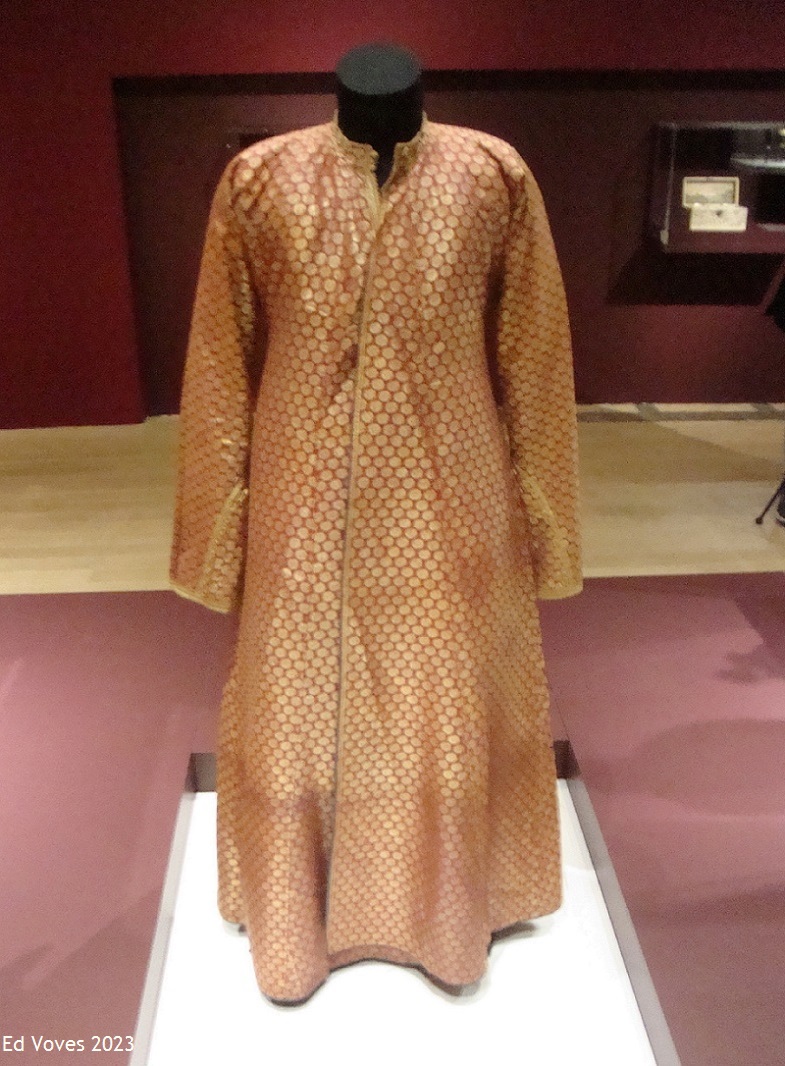
the Wedding Robe of Ezekial Gubbay, c. 1852
The
“star” of this part of the exhibition, however, is the
Wedding Robe
of Ezekiel Gubbay.
Made of silk, gold metallic thread and cotton around 1852, it was
worn by Ezekial Gubbay when he married Aziza Sassoon, the
granddaughter of David. Like the Sassoons, Gubbay was a refugee from
the Ottoman Empire, though his base of commercial operations for many
years was China not India.
This
magnificent robe is fascinating on many counts. It reminds us of the
Asian roots of the Sassoons and of the adaptability of Jews and Judaism
to whatever geographic region they find themselves.
The
design of the Wedding Robe of Ezekiel Gubbay is Iraqi. While
in India and China, the early Sassoons and Gubbay dressed in the
fashion of their native land (at least for special occasions) even
after they had to flee for their lives. Like many refugees, they
still preserved a heart-felt affinity for the place of their birth.
Ed Voves, Photo (2023)
The Wedding Robe of Ezekial Gubbay, c. 1852
Another
interesting point about Ezekial Gubbay and his wedding robe is that he
frequently loaned it to grooms who could not afford such splendid
attire for their marriage celebrations. Generous and thoughtful,
Gubbay was a deeply religious man. His daughter, Flora, as we will
see, became a brilliant scholar of Jewish theology and culture.
David
Sassoon died in 1864, bequeathing a huge fortune worth over £4
million, an impressive
network of charitable institutions throughout Asia - and a
complicated family situation. By his first marriage, he had fathered
two sons and two daughters; by his second marriage, six sons and
three daughters. With trading bases throughout Asia, these eight sons
had provided David Sassoon with reliable representatives for his
business transactions. But after his death, the House of Sassoon
became a house divided. Beginning in 1867, two bitterly hostile
companies, David
Sassoon and Co. and ED Sassoon and Company, competed with each other
for the lion's share of the wealth of Asia.
An
important part of the Sassoon's profits came from Indian cotton,
especially when the American Civil War interrupted the flow of cotton
from the American South to British factories. After 1865, American
cotton flooded the market and the Sassoons invested in another
lucrative product of Indian agriculture, opium.
The
exhibition curators are quite candid about the controversial nature
of the opium trade. In a very effective wall-text, they detail the resistance of the Chinese
government to the ruthless efforts of European powers, especially the British, to export the addictive drug to China. When China banned opium, the British responded with a military campaign, the First Opium War, in 1842. The British incursion forced the Chinese to open "treaty ports" to merchant trade, including opium.
Ed Voves, Photo (2023)
Ivory Casket from China, with a painting of Bocca Tigris,
a strait of the Pearl River Delta, early 1800's
The Sassoons entered the opium trade after these strongarm tactics had taken effect. Moreover, it is worth noting, the Sassoons were not operating as an illegal drug cartel similar to the dangerous
global narcotic dealers of today. Opium was legal worldwide and
indeed could be purchased without a doctor's prescription in the U.S.
until 1914 and in Britain until 1916. Still, it is rather disturbing
to note that by the 1870's, David
Sassoon and Co. controlled 70% of the Indian opium production.
By now, it should be obvious that the full story of the Sassoon family is way beyond the scope of a online journal like Art Eyewitness. Suffice it to say that when David Sassoon and Co.moved its corporate headquarters from Bombay to London in 1872, the narrative shifts from Asian affairs and empire-building to a more cultural focus. This will allow us to concentrate on the art collecting activities of the "English" Sassoons.
The late Victorian and Edwardian eras were a golden age for amassing art collections. Among wealthy art lovers, the art of the eighteenth century and medieval manuscripts were favored genres. The Sassoons subscribed to these trends and their collections were well-stocked with portraits of Age of Enlightenment celebrities like the sculptor Jean-Jacques Caffieri by Adolf Ulric Wertmuller (1784) and Thomas Gainsborough's Major John Dade of Tannington, Suffolk (c.1755).
Ed Voves, Photo (2023)
Adolf Ulric Wertmuller, Jean-Jacques Caffieri, 1784
Ed Voves, Photo (2023)
Thomas Gainsborough, Maj. John Dade of Tannington, Suffolk, c. 1755
The medieval manuscripts collected by Sassoon family members is one of the most fascinating displays of the exhibition. On view are outstanding examples with a direct relevance to Judaism, like the Sassoon Haggadah (shown above), and illuminated books from the Christian and secular spheres like the Astronomical Anthology from Catalonia, created around the same time as the Haggadah.
Ed Voves, Photo (2023)
Astronomical Antholgogy, from Catalonia, c. 1361
Given the importance of Asian trade to the Sassoons, it should come as no surprise that Chinese art featured in their collections. Astonishing examples of Qing Dynasty ivory sculpture, carved from single pieces of ivory, are on view in the gallery devoted to Asian art.
Ed Voves, Photo (2023)
China, Qing Dynasty, Ivory Carving
From left, Miniature Mountain, 19th century, & Table Screen, 1775
Pride of place among the Sassoon collectors ought to go to the remarkable Flora Sassoon (1859-1936). Born as Farha Gubbay (daughter of Ezekial), Flora married Solomon David Sassoon (the son of patriarch David, from his second marriage). When her husband died in 1894, Flora Sassoon took over the management of David Sassoon and Co. She was so successful that her jealous male relatives reorganized the company structure to oust her!
Flora Sassoon, 1900
Instead of founding a third Sassoon company to rival the others, Flora moved to Britain with her invalid daughter, Mozelle, and directed her formidable intellect and generous spirit to theological scholarship, philanthropy and patronage of the arts. She became so famous and beloved that letters were simply addressed to her, "Flora Sassoon, England."
Flora Sassoon was so devoted to the correct observance of Jewish religious law that she traveled with a minyan, a quorum of ten Jewish men needed for a public prayer service, and her own shohet or ritual butcher, so that she could always eat kosher.
JM Nahson, Photo (2022)
Torah and haftarah scrolls in cases,
commissioned by Flora Sassoon, 1888-93
The exhibition showcases Torah and haftarah scrolls, protected in gilt silver and enamel cases, which were commissioned by Flora Sassoon. These beautiful examples of Judaica are now in a private collection, making the Jewish Museum exhibit a rare opportunity to admire both the tremendous workmanship of the craftsmen who made these precious works of devotional art and the religious convictions of the remarkable woman who sponsored them.
Ed Voves, Photo (2023)
Gallery view of The Sassoons with Torah and haftarah scrolls
in cases commissioned by Flora Sassoon
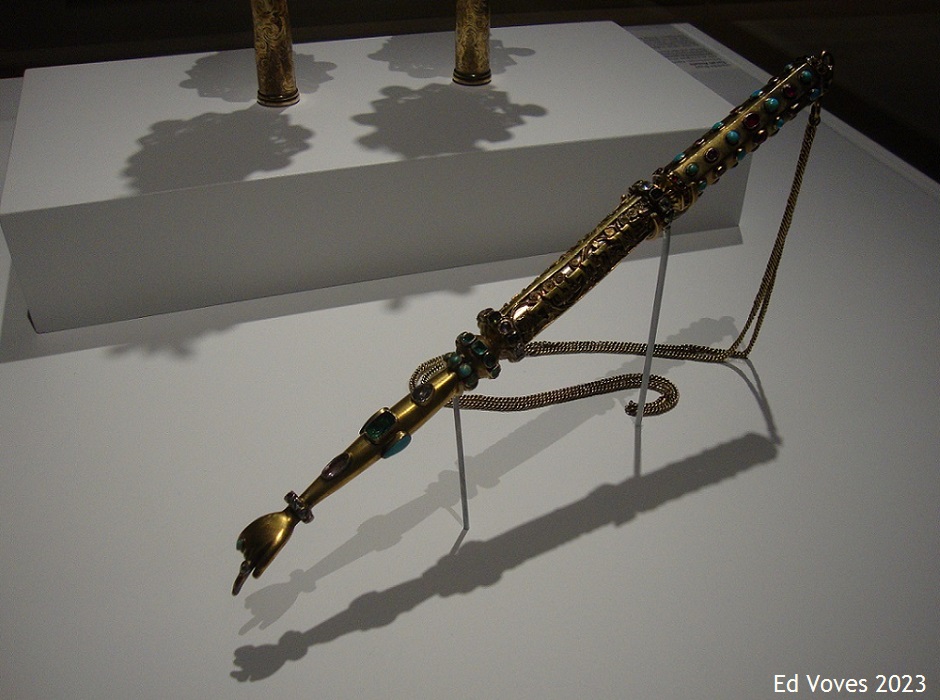
Another sacred artifact owned by Flora Sassoon is a gilt silver Torah pointer, made in the Netherlands during the mid-nineteenth century. It is inscribed with the words "(For) the honor of God and His Torah." A Torah pointer, also called a "YAD" from the word for hand, is used during readings of the Torah in order to keep track of the text without physically touching the sacred scroll. Of all the wonderful works of art on view in The Sassoons, this was my favorite!
Ed Voves, Photo (2023)
Torah pointer, c. 1840-1853, from Flora Sassoon's collection
The narrative of The Sassoons turns from displays of Old Master paintings, Chinese carvings and precious examples of Judaica to a moving consideration of World War I. On view are a number of oil paintings by John Singer Sargent, created during his 1918 tour of the Western Front which would lead to the monumental painting, Gassed, arguably the most searing depiction of war by a major artist.
Fourteen members of the Sassoon family served in the British military, 1914-1918. But the exhibit focuses - wisely - on two of these "Lost Generation" soldiers. Sir Philip Sassoon (1888-1939) and Siegfried Sassoon (1886-1967) both served with distinction in the war, but their experiences were markedly different. Their portraits are placed side-by-side in the exhibition, yet they seem like strangers from different realms of experience rather than second-cousins and comrades-in-arms.
Ed Voves, Photo (2023)
World War I portraits, Sir Phillip Sassoon (at left) & Siegfried Sassoon
Philip Sassoon (1888-1939) served as a staff-officer, private secretary to the British commander-in-chief, Sir Douglas Haig. Charming yet diligent, he was fluent in French, an important skill since the British and French fought side-by-side at the Battle of the Somme, 1916. He was also a close friend of Sargent and helped facilitate his painting expedition to the front.
Siegfried Sassoon, by contrast, was a front-line infantry officer, wounded in action, awarded the Military Cross for valor. He was nicknamed "Mad-Jack" for his almost suicidal gallantry. The very passion which fueled his courage on the Somme and at Arras also triggered his anger at the futile frontal attacks which squandered thousands of lives and the political duplicity on the Home Front.

Ed Voves, Photo (2023)
World War I-era journals of Siegfried Sassoon
Appearing at left is the April-June 1917 journal containing the draft of Sassoon's "Statement against the Conduct of the War"
For a sensational display, the Jewish Museum curators were able to secure a trove of Siegfried Sassoon's notebooks and journals. These include the draft copy of his "Statement against the Conduct of the War" which was quoted in a speech in Parliament. This might have led to a court martial -and possibly a firing squad for Sassoon. Instead, he was sent to a hospital for the "shell shocked" and then released to fight again and be wounded again on the unquiet Western Front.The Sassoons goes on to look at the family's post-World War I experiences. Attempts to revive the economic fortunes of the family by major investment in China, especially the booming real estate market in Shanghai in the 1920's and early 1930's, promised success. But the coming of a second "Great War" and the Communist take-over of China devastated the hopes and the finances of the Sassoons.
As the sun set on the British Empire, so too did it fade upon the Sassoon family.
Ed Voves, Photo (2023)
Claudia Nahson (left) and Esther da Costa Meyer, curators of
The Sassoons exhibit at the Jewish Museum
The Sassoons at the Jewish Museum is a wonder of an exhibition. There are almost too many themes, too many characters, too much geography to cover - and yet it succeeds memorably in bringing this vital story to life. For that triumph, we have the exhibition curators, Claudia Nahson and Esther da Costa Meyer, to thank. The Sassoons is a fascinating, thoughtful investigation of an incredible family, flesh-and-blood human beings who never - or almost never - forgot the God of Israel.
In a final testament to the Sassoons, let us end with the exhibit display which shows the heart-shaped inscription
from a Torah ark curtain donated by Rachel Sassoon (1857-1911) in memory of her only child and an embossed silver plaque from another Torah ark curtain, this time dedicated to Hannah Khatun Sassoon, who died in 1895. Let the words of the final invocation on the plaque speak for all the Sassoons - and hopefully for us too!
Ed Voves, Photo (2023)
Torah ark curtain memorials for Sassoon family members, late 1800's
This Torah Curtain is consecrated upon the passing of the noble, modest, elder Lady Hannah Khatun bat No'am, may she abide in Eden, wife of Sir Abdullah David Sassoon, may God protect and keep him, to the Yagel Yaakov Synagogue in the Holy City of Jerusalem, may it be rebuilt and reestablished quickly in our days, amen. She passed away in Bombay on Wednesday, 13 Tevet 5655 (January 9, 1895). May her soul be bound up in the Bond of Life.
***
Text: Copyright of Ed Voves, all rights reserved. Original Photography by Ed Voves, all rights reserved.
Exhibition images courtesy of the Jewish Museum, New York
Introductory
image: Ed Voves, Photo (2023) Gallery view of The Sassoons exhibit,
showing a photo montage of members of the Sassoon family.
Ed
Voves, Photo (2023) Gallery view of The Sassoons exhibit, showing a
photo montage of members of the Sassoon family.
JM
Nahson, Photo (2022) The Sassoon Haggadah, Spain or Southern
France, c. 1320. Ink,
tempera, and gold and silver leaf on parchment 8 5/16 × 6 ½ in. (21
×16.5 cm) Israel Museum, Jerusalem, purchased by the State of Israel
through an anonymous donor, London, L-B75.0583, formerly in the David
Solomon Sassoon Collection.
Ed
Voves, Photo (2023) Gallery view of The Sassoons exhibit, showing
portraits of members of the Sassoon family, painted by John Singer
Sargent.
Ed
Voves, Photo (2023) Portrait of David Sassoon, attributed to William
Melville, mid-1800's. Oil on canvas: 41 ½ × 33 in. (105.4 × 83.8
cm) Private Collection
Ed
Voves, Photo (2023) Gallery view of The Sassoons exhibit, showing The
Wedding Gown of Ezekial Gubbay, c. 1852.
Ed
Voves, Photo (2023) The Wedding Gown of Ezekial Gubbay, c. 1852.
Silk, gold metallic thread, and cotton: L 54in (137.2
cm) Private Collection, New York.
Ed
Voves, Photo (2023) Ivory Casket from China, with a painting of Bocca
Tigris, a strait of the Pearl River Delta, early 1800's. Ivory:
4 9/16 × 9 7/8 × 4 11/16 in. (11.5 × 25 × 11.8 cm) Collection of
the British Museum.
Ed
Voves, Photo (2023) Adolf Ulric Wertmuller's Jean-Jacques
Caffieri, 1784. Oil on
canvas: 50 3/4 x 37 3/4 in. (128.9 x 95.9 cm) Collection of the
Museum of Fine Arts, Boston.
Ed
Voves, Photo (2023) Thomas Gainsborough's Major John Dade of
Tannington, Suffolk, c. 1755. Oil
on canvas: 30 × 25 1/2 inches (76.2 × 64.8 cm) Collection of the
Yale Center for British Art.
Ed
Voves, Photo (2023) Astronomical Anthology, from Catalonia, c. 1361.
Ink
and paint on parchment 11 3/8 × 8 13/16 in. (28.8 × 22.4 cm)
Lawrence J. Schoenberg Collection, Kislak Center for Special
Collections, Rare Books and Manuscripts, University of Pennsylvania.
Ed Voves, Photo (2023) China, Qing Dynasty, Ivory Carving. Miniature Mountain, 12 1/4 x 4 9/16 in. (31 x 13.5 cm) 19th century (left) and Table Screen, 11 7/16 x 3 15/16 in. (29 x 10 cm), 1775. Both from collection of the British Museum.
JM
Nahson, Photo (2022) Copy of a Portrait Photo of Flora Sassoon, 1900.
JM
Nahson, Photo (2022) Torah and haftarah scrolls in cases,
commissioned by Flora Sassoon, China and Iraq, 1888–93. Cases: gilt
silver and enamel; scrolls: ink on parchment Heights 37 3/8 in. (95
cm); 30 in. (76.2 cm) Private collection.
Ed
Voves, Photo (2023) Gallery view of The Sassoons exhibit, with Torah
and haftarah scrolls in cases, commissioned by Flora Sassoon,
1888-93.
Ed
Voves, Photo (2023) Torah
pointer, c. 1840-1853, from Flora Sassoon's collection. Made
in the Netherlands by Hedde Buys. Gilt silver with precious and
semiprecious stones (possibly later additions): L 13 1/2 in. (34.4
cm) Weitzman Family Collection.
Ed
Voves, Photo (2023) World War I portraits, from left, Sir Philip
Sassoon by Philip Alexius De Laszlo, 1915, collection of Houghton
Hall, U.K.,and Siegfried Sassoon by Glyn Warren Philpot, 1917,
collection of the Fitzwilliam Museum, Cambridge University.
Ed
Voves, Photo (2023) World War I-era journals of Siegfried Sassoon,
with (at left) the the April 11 -June 2, 1917 journal containing the
draft of Sassoon's "Statement against the Conduct of the War".
Ink
on paper; leather binding: 5 x 3 in (12.7 x 7.6 cm) Cambridge
University Library, United Kingdom.
Ed
Voves, Photo (2023) Claudia Nahson (left) and Esther da Costa Meyer,
curators of The
Sassoons exhibit
at the Jewish Museum.
Ed
Voves, Photo (2023) Inscription from Torah ark curtain donated by
Rachel Sassoon (1857-1911) to Shalom Shabazi Synagogue, Jerusalem.
Probably made in Mumbai (Bombay), c. 1886. Velvet embroidered with
metallic thread: 15 x 11 in (38.1 x 27.9 cm) and Plaque
from a Torah ark curtain in memory of Hannah Khatun Sassoon,
dedicated to Yagel Yaakov Synagogue, Jerusalem Probably Mumbai, 1895
Embossed silver Diam. 6 1/8 in. (15.6cm) Both
works in the collection of the Jewish Museum, New York.


.jpg)


.jpg)




.jpg)
.jpg)