Sunday, July 5, 2015

Discovering Impressionism: Paul Durand-Ruel and the New Painting at the Philadelphia Museum of Art


Discovering Impressionism: Paul Durand-Ruel and the New Painting

Philadelphia Museum of Art 

June 24 to September 13, 2015


Reviewed by Ed Voves

In 1910, Pierre-Auguste Renoir created his last, truly great picture. Suffering terribly from  rheumatoid arthritis, Renoir drew upon a life-time of artistic skill and fortitude to paint Portrait of Paul Durand-Ruel. The subject of this tremendous painting was the visionary art dealer who had supported the Impressionists when few people believed in their work and even fewer purchased it.

Paul Durand-Ruel (1831-1922) is the protagonist in a major international art exhibition, currently on display at the Philadelphia Museum of Art. This is the third and final showing of this insightful exhibit, which was shown previously at the Musée du Luxembourg in Paris and at the National Gallery in London.  Discovering Impressionism: Paul Durand-Ruel and the New Painting is on view in Philadelphia, June 24 to September 13, 2015.

The first thing about Portrait of Paul Durand-Ruel that strikes one is the uncompromising way that Renoir evoked the "ravages of age." This is a portrait of an elderly man who has suffered his share of life's vicussitudes - and perhaps more than his share.

The second feature of  this remarkable work complements - and confounds - the previous impression. Look closely at the eyes. Renoir places a small dot of white on each of Durand-Ruel's dark eyes. These specks of gleaming light reveal the extraordinary life force lurking behind the shadows and creases of this weary man's face. Like lasers, Durand-Ruel's eyes fix upon us, appraising and taking our measure. There is no deceiving these eyes that have seen so much already.

Portrait of Paul Durand-Ruel is a depiction of an old campaigner who still has plenty of fight left. But for the demands of his family's business, Durand-Ruel might indeed have had an impressive career in the French Army. Instead, he used his capacity for strategic planning to lead the Impressionist artists to success on the field of artistic battle.  


Claude MonetThe Artist's Garden in Argenteuil, 1873

Discovering Impressionism has been advertised as the "untold story" of Impressionism. This certainly seems incredible when you consider the number of exhibits that have previously dealt with the "New Painting," as Impressionism was initially called. For once, this claim is no exaggeration. Durand-Ruel's role in the Impressionist saga, though examined in the specialist literature, is here documented for the first time in a major exhibition.

Durand-Ruel's entry into the art world came at the entreaty of his father. In 1851, Durand-Ruel was accepted as a cadet in the French military academy, St. Cyr. But his father's declining health forced him to resign and he devoted himself to helping manage the family's Paris-based firm. This was a company specializing in the sale of paper, with a sideline trade in selling or renting art works. These included works by the leading lights of French Romanticism such as Théodore Géricault and Eugene Delacroix, unexpected choices for a solidly bourgeois family.

In 1855, Durand-Ruel visited the Universal Exhibition, the first French "world's fair." Durand-Ruel's appreciation of art was deepened by what he saw, especially Delacroix's later works and the landscapes of the Barbazon painters. What had begun as a filial duty now became a passion.

Durand-Ruel embraced  avant-garde art before the age of Impressionism had even begun. These Barbizon artists are sometimes called  the School of 1830, a revolutionary year which saw the reactionary French monarch, Charles X, toppled from his throne. Trend-setting artists, like Camille Corot, Charles-François Daubigny, Théodore Rousseau and Gustave Courbet are highlighted in the early galleries of  Discovering Impressionism and the point is well-taken. 

Rousseau's  View of Mont Blanc, painted shortly before he died in 1867, is hyper-realistic, rather than impressionistic.  Yet, it is as revolutionary as Daubigny's landscapes which clearly point to the dawn of Impressionism.  Gustave Courbet's Woman in the Waves shows far less of the female body than Alexandre Cabanel's classical nude, The Birth of Venus, which had been the sensation of the 1863 Salon. There is absolutely nothing mythological about Courbet's naked lady. That is what made the work so shocking in the 1860's and still a bit unsettling today.


 Gustave Courbet, The Woman in the Waves, 1868

These works in the early exhibit galleries raise the question why Durand-Ruel favored avant-garde artists like the the School of 1830 - and later the Impressionists.  Everything about Durand-Ruel's personal life clashed with the kind of art he sold in his galleries. He was politically conservative, a practicing Roman Catholic, a devoted husband and family man and, after his beloved young wife died in 1871, a widower who never remarried. Perhaps the answer lies in the way that he combined a pragmatic approach in selling art with missionary zeal as the advocate of painters whom the haughty, elitist Salon routinely rejected. 

Durand-Ruel's complex character did not include risking everything for  the sake of bold, useless gestures. In 1870, France under Napoleon III lurched into a hopeless war with a well-prepared Germany led by Otto von Bismarck. Durand-Ruel took his family and business to safety in  England. He opened a London gallery at a sales facility at 168 New Bond Street, ironically known as the German Gallery. There he settled down to wait-out events. But "events" came looking for him.

Charles-François Daubigny (1817-1878) also sought shelter in England and introduced another artist refugee, Claude Monet (1840-1926), to Durand-Ruel. “This artist will surpass us all,” Daubigny declared.  

Durand-Ruel was greatly impressed with Monet's work and also with that of Camille Pissarro (1830-1903), who had escaped the disasterous war as well. Sadly, Monet's devoted - and financially generous - friend and fellow artist, Frédéric Bazille, would never meet Durand-Ruel. Bazille volunteered for military service and was killed in action in one of the final, futile battles of a war that Émile Zola would later describe as La Débâcle.

Following France's humiliating defeat, Durand-Ruel returned to Paris, determined to advance the careers of Monet and Pissarro. Their paintings evoked a sense of modernity and naturalism that was a refreshing contrast with the superficial values of the fallen Second Empire.

“Please be so kind as to send me others as soon as you are able to,” Durand-Ruel wrote to Pissarro when the latter sent him a painting to inspect. 

This was a key element of Durand-Ruel's marketing strategy. Buying en bloc enabled Durand-Ruel to showcase the oeuvre of his favored artists, as opposed to individual works, and to corner the market when their fame and prices rose. 

When we look at some of the early works by Monet and Pissarro on display in the Philadelphia exhibition, it quickly becomes apparent how vital Durand-Ruel's policy was.


Camille Pissarro,The Lock at Pontoise, 1872


Claude Monet, Railroad Bridge, Argenteuil, 1874

The Lock at Pontoise by Pissarro and Monet's Railroad Bridge, Argenteuil deal with similar themes and settings. But each artist, with the financial backing of Durand-Ruel, was free to explore and depict the the world in his own inimitable style.

Durand-Ruel extended his support to like-minded artists, Alfred Sisley (1839-1899), Edgar Degas (1834-1917) and Monet's boon companion from the glorious Grenouillère painting sessions, Pierre-Auguste Renoir (1841-1919). 


 Edgar Degas, The Dance Foyer at the Opera on the rue Le Peletier, 1872

In 1872, Durand-Ruel purchased twenty-six paintings from Édouard Manet the notorious creator of Olympia. In a single visit to Manet's studio, Durand-Ruel bought twenty-three of these works for 35,000 francs ($175,000).This heady sum, as the exhibit text declares, was forty times the average French worker’s salary. 

This was not just a daring financial move, but a direct challenge to the Salon who had earlier scorned Manet's work. Even though Manet pointedly evoked Old Masters  like Velazquez in his Boy with a Sword, he continued to be regarded as an enfant terrible by the French art establishment.


 Édouard Manet, Boy with a Sword, 1861

With his declaration of support for Manet, Durand-Ruel challenged the Salon, until now the official arbiter of French culture. With Durand-Ruel on the scene, the Salon was no longer "the only game in town."

Durand-Ruel plotted his moves with the bold tactics of a battle-tested military commander. But, unlike his counterparts in the French Army who subscribed to the headless policy of attaque à outrance, he knew when to retreat as well as to advance. In 1873, a world-wide economic crisis halted France's post-war recovery.  Durand-Ruel slowed the rate of his purchases and after disappointing sales at the first two Impressionist exhibitions in 1874 and 1875, he ceased buying new works altogether for nearly five years.

Was Durand-Ruel more of an opportunist than a crusading advocate of Impressionism? Sisley, who later broke-off with him, declared that Durand-Ruel, “acts as a modern speculator, with angelic sweetness.” 

Durand-Ruel was indeed a "modern speculator." He had very limited financial resources of his own and often borrowed heavily to fund his purchases and the exhibitions he mounted to showcase these works. In one particularly desperate situation, he negotiated a loan based on the value of the picture frames in his gallery. The price of his stock of Monets and Renoirs was so low as to be virtually worthless in the eyes of his creditors.

When the French economy started to show signs of reviving, Durand-Ruel began to purchase paintings from the financially-besieged Impressionists. In 1881, he bought forty-nine canvases from Renoir, followed by more in succeeding years. Three of these works form a breathtaking array of beauty at the heart of the Discovering Impressionism exhibit.


Pierre-Auguste Renoir, Dance at Bougival, 1883

Dance at Bougival, perhaps the most beloved work in the collection of Boston's Museum of Fine Arts, hangs with City Dance and Country Dance from the Musee d'Orsay to from a joy-giving triptych. Renoir's bon vivant friend, Paul Lhôte, sweeps Aline Charigot, later Renoir's wife, off her feet in Country Dance. His dance partner in the other two pictures is the redoubtable Suzanne Valadon, ex-trapeze performer and later a notable post-Impressionist painter.


Exhibition view of Discovering Impressionism  Photo: Anne Lloyd

Taken together, these three wondrous paintings are a major testament to the joys of being human, of being alive. Jaded museum goers need to forget how many times they have seen these in art books. Look at the charred matches and the bunch of crumpled violets at the feet of Suzanne Valadon and the sweetness of her smile in Dance at Bougival. Look at the unabashed happiness on the face of Aline Charigot. Life is short, but a moment of joy can last forever.

Economic upswings do not last forever. In 1882, the collapse of the Union Générale, a fraudulent investment bank, almost caused the closing of the French stock market. Durand-Ruel, who had been purchasing works based on loans, faced the most serious crisis of his career. But fortunately, his good deeds went unpunished.

Among his many virtues, Durand-Ruel was very enlightened in his support of women in the arts. The careers of Berthe Morisot (1841 -1895) and Mary Cassatt (1844 -1926) both benefited from his support. 


Mary Cassatt, The Child's Bath, 1893

Cassatt, who came from a well-to-do American family, offered loans to help Durand-Ruel ride out the storm. It was Cassatt's connections with America's Gilded Age aristocracy, however, that proved most helpful to him. Cassatt's brother, Alexander, the President of the Pennsylvania Railroad, bought pictures and so did her influential New York friends, Henry and Louisine Havemeyer. The word started to spread throughout the United States about the exciting new paintings from France.

In 1886, James Sutton and the American Art Association invited Durand-Ruel to organize an exhibition of the Impressionist painters in New York City. Like the gifted strategist he was, Durand-Ruel knew that it was time to throw in all his reserves. He traveled to New York with his son Charles and  forty-three cases of artwork.  The ensuing exhibit, along with one at the National Academy of Design, brought $40,000 in sales to Durand-Ruel and total vindication for Impressionism.

Works in Oil and Pastel by the Impressionists of Paris, Durand-Ruel's New York exhibit, is one of the key events in art history. It also represents a significant moment in American history.The 1886 Impressionist sale marked the beginning of the shift of cultural leadership from Europe to the United States that climaxed with the triumph of the New York School in 1945.

Discovering Impressionism: Paul Durand-Ruel and the New Painting is a triumph for the Philadelphia Museum of Art, as well. This exhibition is intelligently curated, with "special effects" kept to a  merciful minimum. The art works themselves, each of which passed through the doors of Durand-Ruel & Cie., are allowed to tell the story of Impressionism's travail and triumph.  

And like all really good stories, Discovering Impressionism leaves a tantalizing mystery or two for us to reflect upon. 


Dornac, Photograph of Paul Durand-Ruel in His Gallery, about 1910


Even after taking in this wonderful exhibit, I still wonder what  motivated Paul Durand-Ruel, a man of tradition, to risk so much for pictures of transitory light effects. What really drove Durand-Ruel, who slept with a crucifix above his bed, to tempt fate for the sake of paintings like The Artist's Garden in Argenteuil or Poplars on the Bank of the Epte River?

***
Text: Copyright of Ed Voves, all rights reserved 

Photos courtesy of the Philadelphia  Museum of Art

Introductory Image: 
Pierre-Auguste Renoir (French, 1841–1919) Portrait of Paul Durand-Ruel, Oil on Canvas,  25.6 × 21.7 inches (65 × 55 cm), 1910. Private collection. Image © Archives Durand-Ruel © Durand-Ruel & Cie

Claude Monet (French, 1840 -1926) The Artist's Garden in Argenteuil, Oil on Canvas, overall: 61 x 82.5 cm (24 x 32 1/2 in.) 1873. National Gallery of Art, Washington D.C.: Gift of Janice H. Levin, in Honor of the 50th Anniversary of the National Gallery of Art

Gustave Courbet (French, 1819 -1877) The Woman in the WavesOil on Canvas, 25 3/4 x 21 1/4 in. (65.4 x 54 cm),  1868. Metropolitan Museum of Art, H.O Havemeyer Collection, Bequest of Mrs. H. O. Havemeyer, 1929 (29.100.62)

Camille Pissarro(French, 1830 -1903) The Lock at Pontoise, Oil on Fabric, 20 13/16 x 32 5/8 inches ( 53  x 83 cm), 1872. Cleveland Museum of Art, Leonard C. Hanna Fund, 1990.7

Claude Monet (French, 1840 -1926) Railroad Bridge, Argenteuil, Oil on Canvas, Oil on Canvas, 21 3/8 x 28 7/8 inches ( 54.3  x 73.3 cm), Philadelphia Museum of Art, John G. Johnson Collection, 1917, cat. 1050

Edgar Degas (French, 1834 -1917) The Dance Foyer at the Opera on the rue Le Peletier Oil on Canvas, 12 3/5 x 18 1/10 in. (32 x 46 cm),  1872. Musee d'Orsay, Paris: Bequest of count Isaac de Camondo, 1911

Édouard Manet  (French, 1832 -1883)Boy with a Sword, Oil on Canvas, 51 5/8 x 36 3/4 in. (131.1 x 93.4 cm), 1861. Metropolitan Museum of Art, Gift of Erwin Davis, 1889 (89.21.2)

Pierre-Auguste Renoir (French, 1841–1919) Dance at Bougival, Oil on canvas,  71 5/8 x 38 5/8 in. (181.9 x 98.1 cm), 1883. Boston Museum of Fine Arts, Picture Fund purchase,(37.375 )Image: © The Boston Museum of Fine Arts  

Mary Cassatt (American, 1844 -1926, The Child's Bath, Oil on Canvas, Oil on canvas,  100.3  x 66.1 cm. (39 1/2 x 26 inches), 1893. Art Institute of Chicago, Robert A. Waller Fund, 1910. 2

Exhibition view of Discovering Impressionism  Photo: Anne Lloyd

Dornac (Paul François Arnold Cardon) (French,1859-1941) Photograph of Paul Durand-Ruel in His Gallery, about 1910. Archives Durand-Ruel. Image © Archives Durand-Ruel © Durand-Ruel & Cie
1

Sunday, June 28, 2015

American Moments Photo Exhibit at the Phillips Collection


American Moments: Photographs from The Phillips Collection


June 6, 2015 -  September 13,2015


Reviewed by Ed Voves

“Let America be America Again” proclaimed Langston Hughes in his 1935 poem. With searing, unflinching verse, Hughes condemned the social ills of the United States during the Great Depression, “the rack and ruin of our gangster death.” And yet, he held firmly to “the dream that’s almost dead today.”

O, let America be America again--                                                                                     The land that never has been yet--                                                                                   And yet must be--the land where every man is free.                                                           The land that's mine--the poor man's, Indian's, Negro's, ME--                                               Who made America…

These are bold, unforgettable words that stick in the mind. They are also words that are very difficult to express in visual terms. How can an artist depict a “land that never has been yet--and yet must be” with paint or sculptor’s clay?

The Phillips Collection in Washington D.C. has managed to evoke the “mighty dream” of Langston Hughes with a powerful exhibition of twentieth century photographs. American Moments: Photographs from The Phillips Collection embraces both the vision of the people of the United States and the reality of their lives. While Hughes is not directly mentioned in the exhibition wall texts, seldom has there been a better visual articulation of the American dream, "a dream so strong, so brave, so true,That even yet its mighty daring sings..."

American Moments is also a testament to the vision of Duncan Phillips, founder of the Phillips Collection. During the same period of Hughes' literary activism, Phillips (1886-1966) and his wife, Marjorie (1894-1985), created America's first museum of "modern" art. In a bold mission statement, Phillips in 1926 declared that the new venue would be an "intimate museum combined with an experiment station."

The Phillips "experiment station" joined forces in 1941 with the Museum of Modern Art to collect and promote Jacob Lawrence's Migration Series, the epic cycle of tempera paintings celebrating African-American history. Phillips supported many struggling American artists, buying paintings directly from them or from the New York galleries of Alfred Stieglitz, the Intimate Gallery and its successor, An American Place.

Anyone in the American art world during the first decades of the twentieth century could expect to hear from Alfred Stieglitz (1864-1946) on the subject of photography. Duncan Phillips entered into a lively dialog with Stieglitz and began to selectively collect work by noted American photographers, including cloud studies by Stieglitz himself. From time-to-time, the Phillips Collection mounted photo exhibits but never devoted the resources to build an in-depth  photo archive of its own.


Alfred Stieglitz, Equivalent, 1926.

In 2006, the Phillips received a major gift of 152 photos by Brett Weston, a great photographer and the son of one of America's most legendary photo artists, Edward Weston. This marked the "takeoff" of the Phillips photo collection with acquisitions, predominantly donations, raising the photo holdings to 1,000 pictures. In 2014 alone, nearly 300 photographs were donated. These included works by major figures like Bruce Davidson. a personal favorite of mine and a living link to the hard-hitting photojournalism of mid-twentieth century America.

Davidson, born in 1933, draws on the street photography of Louis Faure (1916-2001). In his 1950 picture,Times Square, N.Y. (Home of the Brave), Faurer took a rather routine situation, investing it with magical ambiance and an ingenious subtext. Home of the Brave was one of the first major films to deal with a Civil Rights theme.Yet to look at the neon lights, you could easily jump to the conclusion that it was a big screen adventure flick starring Clark Gable or Tyrone Power. 


Louis Faurer, Times Square, N.Y. (Home of the Brave), 1950

Looks are deceiving.

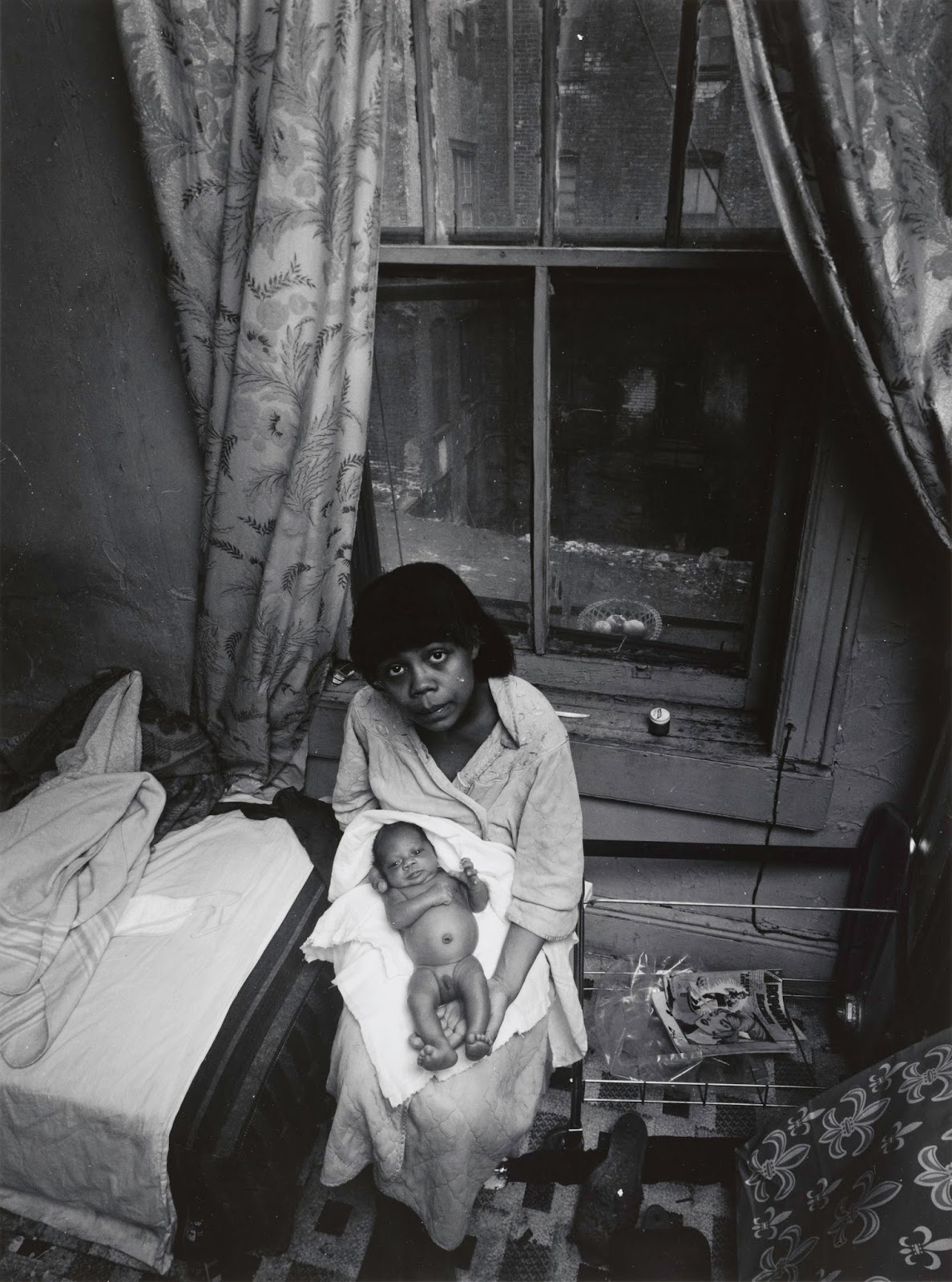
Davidson documented some of the most dramatic moments of the Civil Rights movement. He also  captured prosaic, matter-of-fact images of that remarkable era as well: stressed-out Freedom Riders, an impassive Martin Luther King, besieged with questions at a press conference. 


Bruce Davidson, Woman with Newborn on Lap (East 100th Street series), 1966 - 1968


Here, Davidson's  Woman with Newborn on Lap, (East 100th Street series), taken between 1966 and 1968, could represent either an icon-like representation of motherhood or a devastating critique of the African-American experience of urban poverty in a time of plenty.

The same dilemma arises when we study another Davidson photo from the mid-1960's, Girl Waving with Sign on Road, (Los Angeles series). To go from Woman with Newborn on Lap to this picture may be a "from the sublime to the ridiculous" transition. The multiple meanings that can be imparted to Girl Waving with Sign, however, testifies to the oracle status of great photography. 


Bruce Davidson, Girl Waving with Sign on Road (Los Angeles series), 1964

Which answer would you pick:
  1. Mid-century Modern life-style      
  2. "Sex-sells" dehumanization of womanhood
  3. Corporate promotion leading to global warming
  4. All of the above
The "correct" answer is there for the choosing. But we have to decipher its meaning, as with the oracles of ancient times. 

Values, insights - meaning in art - often change with time. When Davidson photographed Girl Waving with Sign in 1964, most people would have classified it as a delightful example of Americana. Their values would have been shaped by popular television shows like Petticoat Junction or That Girl and by Coca Cola ads - "The Pause that  Refreshes" - with pretty young ladies in polka dot blouses.

With the polar ice caps melting from overuse of fossil fuels, we are confronted with a different scenario. The "meaning" of this photo changes too. Girl Waving with Sign in 2015 is a modern day Siren, beckoning us to our doom as her ancient counterparts tried to do to Odysseus on his voyage home from the Trojan War.

We can subjectively interpret the photos in American Moments with some confidence because the exhibit itself is thematically arranged. This comes as a slight surprise. American Moments is the first exhibition of photos from the Phillips Collection, 130 photos by thirty-three artists. The exhibit might well have been arranged to illustrate the evolution of the photo archive at the Phillips. Marjorie and Duncan Phillips, however, frequently chose to explore the meaning of their paintings in special exhibits. American Moments keeps to this great, open-minded tradition.

An early favorite of Duncan Phillips was Clarence John Laughlin (1905-1985). In 1943, the Phillips Collection presented a solo-exhibit of Laughlin's photos. The Louisiana-born photographer certainly gave his viewers a lot to ponder.

Laughlin grew-up in an atmosphere of genteel poverty. With the relics of the Old South all around him, he became the visual artist of "Southern Gothic." What Carson McCullers and Walker Percy explored  in words, Laughlin presented with imagery. 


Clarence John Laughlin, Grandeur and Decay No. 1, 1944

Laughlin frequently used photo montage to created some of the most surrealist photographs in American history.However, Grandeur and Decay No. 1, 1944 did not require any "special effects" to present an indelible symbol of the collapse of the grandiose, slavery-based, culture of the American South.

Grandeur and Decay No. 1, 1944  depicts  the passing of a "heroic" age while Lewis Hine's Empire State Building, 1931, shows a new era on the rise. Certainly there was incredible courage, tenacity and skill involved in the construction of the skyscrapers of Gotham City. Hines's photographs of the Empire State Building, however, were utilized to create a "myth" of progress for New York City that was as problematical as the sense of decline and fall in Laughlin's Grandeur and Decay.


Lewis Hine, Empire State Building, 1931


The Empire State Building opened in 1931, shortly after Hine (1874-1940) took this vertigo-inducing photo. But the "Empty State Building" (as New Yorkers referred to it) was a financial black hole for most of its early years. Floor after floor of vacant office suites echoed like a tomb. For much of the period, the management of the Empire State Building relied on the fees paid by tourists to use the observation deck to keep the towering edifice standing. 

What both Laughlin's Grandeur and Decay and Hine's Empire State Building show is the incredible harshness of American life during much of the twentieth century. We can see this too in the incredible array of portraits and group shots of America's people during an era of economic turmoil and of total war. Look at the faces on the gallery walls of the Phillips Collection and you will see people, in Langston Hughes' words, "battered through the years."


Alfred Eisenstaedt, Sunday afternoon crowd of passengers waiting for trains in Union Station, Washington, DC, 1943


It is particularly jarring to note the grim expressions of wartime service men and women in 1943 at Washington's Union Station. Their home leaves are over and they are headed back to war. Alfred Eisenstaedt (1898-1995) captured an image of foreboding that can still be felt all these decades later. I was struck by the slightly-out-of-focus soldier in the center. A year later, he could have been the central figure in Robert Capa's blurry, over-exposed photo of a GI Joe struggling in the surf to reach Omaha Beach on D-Day.

So too might Jack Delano's protagonist in Untitled (Railroad Man), the introductory photo of this review. Put a combat helmet on the head of this hunched, weary man and he might just as well be standing behind a parapet of sandbags at Tarawa or Anzio as at a railroad depot.

The real standout for me among the American Moments photographers was Esther Bubley (1921-1998). A photographer for the Office of War Information under the dynamic Roy Stryker, Bubley documented the American home front during World War II in a number of photographic series. These photo series may sound a bit dull and of little importance today - people in line waiting for war-rationed shoes or riding a bus to Pittsburgh, PA-  but Bubley created a time-machine portrait of the lives of America's people that borders on the definitive.


Esther Bubley, A Child Whose Home Is an Alley Dwelling near the Capitol, 1943


Amid the hundreds and hundreds of photographs taken by Bubley, a number are truly iconic. One of them is displayed in American Moments, A Child Whose Home Is an Alley Dwelling near the Capitol, 1943. This was part of a series aimed at depicting the appalling living conditions of African-Americans in Washington D.C. only a few blocks from the White House. Bubley's photos were quite effective in meeting the goals of her assignment but this picture is a symbolic masterpiece of inspiring merit.

The shadow cast by the length of wood held by the little boy transfixes his body. His right eye peers through the shadow making it seem like the disembodied eye of an alien being rather than one of a pair of eyes belonging to a scrawny, underfed, apprehensive little chap, trying to keep out of trouble. That eye in turn transfixes the viewer, forcing him or her to recognize the humanity of this child and the inhumanity of the "Jim Crow" racial oppression that blights his life.

With this photo, Bubley truly captured what Henri Cartier-Bresson called the "decisive moment." It was a transforming moment, as more and more Americans came to realize -sometimes unwillingly - that the racial segregation that had arisen following the Civil War could no longer be tolerated now that America was the leader of the Free World.

America did change following World War II and change for the better. The American Moments exhibit is a brilliant evocation of these social changes.

It is important to note that this wonderful exhibition at the Phillips Collection also documents the joys and  pleasures, the "pursuit of happiness" that figure in the American story along with sorrows and challenges.


Louis Faurer, Broadway, New York, N.Y., between 1949 -1950

Louis Faurer's Broadway, New York, N.Y., shows a group of laughing friends in a snappy sports car with the bright lights of the city reflected on its polished, gleaming surface. Faurer's astonishing picture was taken between 1949 and 1950 - or was it just last night? 

If there's a better illustration of American joie de vivre, I've never seen it. And when joy of life is shared by all our citizens, then Langston Hughes' dream will come true at last and America will be America again.

***
Text: Copyright of Ed Voves, all rights reserved 
Images courtesy of Phillips Collection, Washington D.C.                                                                                                                                                                                          
Introductory Image:                                                                                                                                               
Jack Delano, Untitled (Railroad Man), 1940s/printed later. Gelatin silver print, 11 x 14 in. Gift from the Collection of Michael and Joyce Axelrod, Mill Valley, California, 2013. The Phillips Collection, Washington, DC

Alfred Stieglitz, Equivalent, 1926. Gelatin silver print, 3 5/8 x 4 3/4 in. The Alfred Stieglitz Collection, gift of Georgia O'Keeffe, 1949. The Phillips Collection, Washington, DC

Louis Faurer, Times Square, N.Y. (Home of the Brave), 1950, printed 1981. Gelatin silver print, 11 x 14 in. Gift of Steve LaMantia, 2013. The Phillips Collection, Washington, DC

Bruce Davidson, Woman with Newborn on Lap (East 100th Street series), between 1966 and 1968. Gelatin silver print, 14 x 11 in. Gift of Saul E. Levi, 2013. The Phillips Collection, Washington, DC

Bruce Davidson, Girl Waving with Sign on Road (Los Angeles series), 1964. Gelatin silver print, 7 15/16  x 11 15/16 in. Gift of Lisa Finn, 2013. The Phillips Collection, Washington, DC


Clarence John Laughlin, Grandeur and Decay No. 1, 1944. Gelatin silver print, 13 3/8 x 10 5/8 in. Acquired from the artist, 1945. The Phillips Collection, Washington, DC 


Lewis Hine, Empire State Building, 1931. Gelatin silver print, 10 1/4 x 13 1/4 in. Gift of the Phillips Contemporaries, 1997. The Phillips Collection, Washington, DC

Alfred Eisenstaedt, Sunday afternoon crowd of passengers waiting for trains in Union Station, Washington, DC, 1943. Vintage gelatin silver print, 10 5/8 x 13 1/14 in. Gift of Cam and Wanda Garner, 2014. The Phillips Collection, Washington, DC

Esther Bubley, A Child Whose Home Is an Alley Dwelling near the Capitol, 1943. Gelatin silver print, 10 7/8 x 10 1/8 in. Gift of Cam and Wanda Garner, 2012. The Phillips Collection, Washington, DC


Louis Faurer, Broadway, New York, N.Y., between 1949 and 1950, printed later. Gelatin silver print, 11 x 14 in. Gift of Jerri Mattare, 2013. The Phillips Collection, Washington, DC


Friday, June 19, 2015

Farewell to the Museum of Biblical Art (MOBIA)


Sculpture in the Age of Donatello:

Renaissance Masterpieces from Florence Cathedral

February 20, 2015 to June 14, 2015 


Reviewed by Ed Voves

There is always a touch of wistfulness lurking in my emotions when I leave an art exhibition. Outstanding works of art, many of which have not been displayed together in centuries, are joined in unforgettable configurations of genius. After a few months, the exhibit closes. The masterworks are packed in crates and sent back to the museums and collections from which they came.

The magic moment is over.

In the case of Sculpture in the Age of Donatello at the Museum of Biblical Art in New York City, actual sorrow mixed with my feelings of awe at seeing these wonders of Renaissance art. Not only the exhibition, but the museum itself was scheduled to close in a few days. The iron grip of financial "reality" was about to claim another venue of artistic expression.

The Museum of Biblical Art in New York City (MOBIA) opened in 1997, under the direction of the American Bible Society. In 2005, MOBIA became an independent museum, albeit one without a permanent collection of its own. MOBIA paid the American Bible Society $1 per year to rent the second floor of its Columbus Circle area headquarters. It was a beautiful arrangement, allowing MOBIA to mount high caliber exhibitions of religious art.


Gallery view of the Museum of Biblical Art during the Sculpture in the Age of Donatello exhibit

Organizing Sculpture in the Age of Donatello: Renaissance Masterpieces from Florence Cathedral was MOBIA's most brilliant success. But in 2014, the American Bible Society decided to move to Philadelphia and sold its building. As record numbers of patrons visited Sculpture in the Age of Donatello, MOBIA scrambled to raise the funding to rent a new site. With only a few months to do so, MOBIA faced an impossible task.

This depressing scenario is also rich in irony. The final exhibit at MOBIA brought treasures from the Opera di Santa Maria del Fiore, the museum attached to the cathedral of Florence. Santa Maria del Fiore is better known as the Duomo or House of God. The Duomo, as is well-known, was the creative - and spiritual - heart of Florence during the Renaissance.

The works of art in the MOBIA exhibit virtually define Western conceptions of religious faith and devotion. Sculptures by Donatello (1386-1466) and by his colleague and rival, Nanni di Banco (c. 1384 – 1421) were the centerpieces of the show. 


Luca della Robbia & Antonio di Salvi Salvucci, Processional Cross, 15th century

An exquisite processional cross created by Luca della Robbia (1400-1482) was another highlight, along with a series of series of hexagonal panels celebrating the intellectual pursuits of Florence. One of these showed a grammar teacher instructing his students, a perfect illustration of Renaissance learning in action.


Luca della Robbia, The Art of Grammar, 1437-39

How could MOBIA go from organizing and mounting such an impressive exhibition to closing its doors forever? A comparison of Florence's S. Maria del Fiore Cathedral with MOBIA provides telling insight into the comparative expressions of religion and culture in Renaissance Italy and modern-day America.

Construction of the Duomo took place over 165 years. The keystone of S. Maria del Fiore was laid on September 8, 1296. The cathedral's stunning dome, designed by Filippo Brunelleschi in 1418 and completed in 1436, was represented in the MOBIA exhibit by the actual working model of this astonishing edifice. The crowning touch, the Lantern of the Cupola, was set high atop the dome, in 1461.


Filippo Brunelleschi, Model for the Dome of Santa Maria del Fiore, ca. 1420–52

Taking American history as a comparison, these 165 years match the long course of American democracy, from 1776 to the U.S. entry into the Second World War in 1941. That is a long time to build a church. The Duomo, however, is not just any church. The Florentines knew that and the sculptures from S. Maria del Fiore that MOBIA displayed proved that they knew it.

Two statues were given pride of place, side-by-side in the MOBIA exhibit, St. Luke the Evangelist and St. John the Evangelist. These impressive works of art asserted the piety and self-confidence of Florence during the 1400’s in a way that is almost impossible to conceive today. Renaissance Florence managed to combine mercantile skill, political pragmatism and fidelity to the Christian faith with cultural awareness of Greek and Roman antiquity. These traits are well-attested to in the marble men of God sculpted to adorn the Duomo.


Nanni di Banco, St. Luke the Evangelist, 1408–13

St. Luke the Evangelist, sculpted by Nanni di Banco around 1408–13, embodies the intellectual mindset known as Humanism. This innovation of the Renaissance made the role of individual scholars, rather than scholastic theory, the keystone of intellectual inquiry. The keen-eyed Apostle Luke appraises passers-by and the world at large from his niche on the wall of the Duomo.

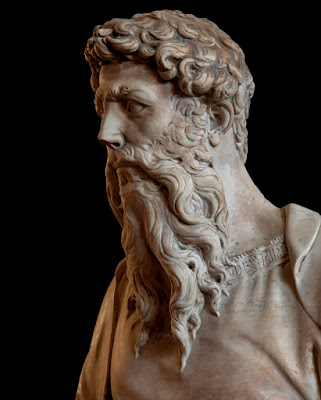
Nanni di Banco's St. Luke resembles the Roman emperor Hadrian, an indication of the zeal of Renaissance humanists for studying the surviving art works of antiquity. By contrast, Donatello's St. John the Evangelist played an important role in how the image of God came to be presented in Western art.


Donatello, St. John the Evangelist, 1408–15

During the Middle Ages, God the Father was almost never depicted, save as a disembodied arm sending the Holy Spirit winging down to earth.  In a daring stroke, Lorenzo Ghiberti showed the torso, head and outstretched arms of God the Father in the Annunciation panel of his North Doors for the Florence Baptistery, created between 1403-24. God's face, however, is largely obscured.

When Ghiberti created his second set of doors for the Baptistery, the famed "Doors of Paradise," God was shown as a long-bearded sage not unlike Michelangelo's Supreme Being on the Sistine Chapel Ceiling. More to the point, Ghiberti's God the Father looked like Donatello's St. John, completed a few years earlier in 1415.

Did Donatello influence Ghiberti or was it the other way around? Donatello assisted Ghiberti with the North Door panels during the early years of the project, before he started sculpting St. John in 1408. Donatello was almost certainly influenced by Ghiberti's depiction of the long-bearded Abraham poised to sacrifice Isaac in the competition piece that enabled him to best his rival Brunelleschi to gain the commission for the Baptistery doors.

The answer to this question lies in the creative rivalries and relationships in the small, brilliant circle of the Florentine art world during the early 1400's. Donatello, Ghiberti, Brunelleschi and the rest mutually influenced the techniques and achievements of each other - and succeeding generations of artists. When we look at the powerful, visionary countenance of Donatello's St. John the Evangelist we are looking at the face of Western art from the Renaissance onward to Rodin in the nineteenth century.


Donatello, St. John the Evangelist (Detail), 1408–15

The great artistic drama in Florence during the 1400's centered on the sculptural decoration of the Duomo and other places of worship like the Church of Santa Croce. It was a wise decision by the curators of the MOBIA exhibit to extend the range of artists to include ones of lesser talent than Donatello because virtually every Florentine artist of note was involved in the sustained programs of ecclesiastical art.


Attributed to Giovanni d’Ambrogio, Archangel Gabriel and the Virgin Mary

The two-figure ensemble of the Archangel Gabriel of the Annunciation and the Virgin Mary of the Annunciation, attributed to Giovanni d'Ambrogio during the late 1300's, is a case in point. Etched into the faces of Gabriel and Mary are intense emotions which in turn reveal the deep psychological roots of the Renaissance in Italy. This great artistic revolution was not the product of two or three isolated "genius" figures. The spirit of that remarkable age encompassed the many not the few.

Donatello - Donato di Niccolò di Betto Bardi - was a genius and a long-lived one at that. By the time he died in 1466, aged 80, his vast, innovative and varied body of work encompassed the entire epoch of the early Renaissance. Several of the disturbing works of his later career, such as the Penitent Magdalene, which he carved in wood around 1455, pointed to the political and religious discord that marked the later stages of the Renaissance.

Indeed, it is not an exaggeration to see social stress fractures beginning to appear in a relatively early work and one that Donatello was reputed to have spoken to as if it were alive. This statue, created around 1435, is believed to depict the Old Testament prophet, Habakkuk. 


Donatello, Prophet (possibly Habbakuk), 1435–36

With a typical Italian blend of affection and irreverence, the statue of Habakkuk has long been called lo Zuccone or "Squash Head." When viewing this mighty work in person, the wittiness of its nickname can become rather annoying. The mind behind the tormented face of Habakkuk has other ideas. Lips parted as if to speak, Habakkuk scores a direct hit on the complacency and self-satisfaction of the viewer - without saying a word.                              

As the excellent essay in the companion volume to the exhibit notes, the Prophet Habakkuk proclaimed in the Old Testament that "... the just shall live by his faith."


Donatello, Prophet (possibly Habbakuk), (detail), 1435–36

Any society which devotes so many resources, so much talent and zeal to church building as the Florentines did during the 1300's and 1400's is obviously a faith community. But Donatello's Habakkuk is speaking to a primal level of religious belief for those times when our lives and souls are not protected by the walls of the Duomo.  Faith at this level is an act of courage, physical and moral, when menaced by tyranny and death. It is a voice saying yes to God when the rest of the world says no.

Donatello's Habakkuk speaks of values that an institution like MOBIA is best equipped to present. No art museum is - or should be - a surrogate church. MOBIA was designed to present religious art in a sensitive, non-sectarian manner. By doing so, MOBIA allowed the moral values of the works on view to be evoked without endorsing them. This unique and dearly-needed artistic environment is very rare, apart from the Metropolitan Museum's Cloisters and a few other venues.

When MOBIA closed its doors on June 14, 2015, a major loss to American culture took place. How sad that an American foundation could not have stepped forward to assist MOBIA to find a new home. The guilds of Florence played a direct role in funding the Duomo and the incomparable art created by Donatello and Ghiberti.

MOBIA's closing raises real questions about the values of the present-day.  Are we a society that stamps "In God We Trust" on the coin of the realm but fails to support a museum dedicated to the study of the Bible upon which the values of the West are ultimately founded?

The answer to that question may be more important than we realize.

***
Text: Copyright of Ed Voves, all rights reserved 

Images courtesy of the Museum of Biblical Art (MOBIA), New York City

Introductory Image:    
Installation view of Sculpture in the Age of Donatello: Renaissance Masterpieces from Florence Cathedral at the Museum of Biblical Art, 2015. Photo by Eduard Hueber. The exhibition is organized by Opera di Santa Maria del Fiore, Florence, and the Museum of Biblical Art, New York

Installation view (Interior) of Sculpture in the Age of Donatello: Renaissance Masterpieces from Florence Cathedral at the Museum of Biblical Art, 2015. Photo by Eduard Hueber. The exhibition is organized by Opera di Santa Maria del Fiore, Florence, and the Museum of Biblical Art, New York

Luca della Robbia and Antonio di Salvi Salvucci, Processional Cross: Christ Crucified, the Evangelists, Allegory of the Sun, 15th century (after 1460, before 1475), Gilded copper (repoussé and chased), gilded bronze, and enamel, 76 × 57 cm (total height with staff: 160 cm) (30 × 22½ in.) (total height with staff: 63 in.) Opera di Santa Maria del Fiore, inv. no. 2005/347 © Opera di Santa Maria del Fiore / Antonio Quattrone

Luca della Robbia, The Art of Grammar (Aelius Donatus or Priscian instructing students?), 1437-39, Marble, 81.5 × 68.5 × 13 cm (32 × 27 × 5 in.) Opera di Santa Maria del Fiore, inv. no. 2005/436 © Opera di Santa Maria del Fiore / Antonio Quattrone

Attributed to Filippo Brunelleschi, Model for the Dome of Santa Maria del Fiore, ca. 1420–52, Wood, dome: 100 × 70 cm (393⁄8 × 27½ in.); apses: 55 × 63 × 35 cm each (215⁄8 × 24¾ × 13¾ in. each) Opera di Santa Maria del Fiore, inv. no. 2005/493 © Opera di Santa Maria del Fiore / Antonio Quattrone

Nanni di Banco, St. Luke the Evangelist, 1408–13, Marble, 207 × 91 × 63 cm (81½ × 357⁄8 × 247⁄8 in.) Opera di Santa Maria del Fiore, inv. no 2005/112 © Opera di Santa Maria del Fiore / Antonio Quattrone

Donatello, St. John the Evangelist, 1408–15, Marble, 212 × 91 × 62 cm (83½ × 35¾ × 24½ in.) Opera di Santa Maria del Fiore, inv. no 2005/113 © Opera di Santa Maria del Fiore / Antonio Quattrone

Attributed to Giovanni d’Ambrogio, Archangel Gabriel of the Annunciation, late 14th century, Marble, 144 × 44 × 30 cm (56¾ × 17¼ × 117⁄8 in.) Opera di Santa Maria del Fiore, inv. no. 2005/276 © Opera di Santa Maria del Fiore / Antonio Quattrone

Attributed to Giovanni d’Ambrogio, Virgin Mary of the Annunciation, late 14th century, Marble, 144 × 44 × 30 cm (56¾ × 17¼ × 117⁄8 in.) Opera di Santa Maria del Fiore, inv. No 2005/277 © Opera di Santa Maria del Fiore / Antonio Quattrone

Donatello, Prophet (possibly Habbakuk), known as the Zuccone, 1435–36, Marble, 195 × 54 × 38 cm (763⁄4 × 211⁄4 × 15 in.) Opera di Santa Maria del Fiore, inv. no. 2005/374 © Opera di Santa Maria del Fiore / Antonio Quattrone