Showing posts with label Anthony van Dyck. Show all posts

Wednesday, May 8, 2019

Gainsborough's Family Album at the Princeton Museum of Art


Gainsborough's Family Album


Princeton University Art Museum
February 23 - June 9, 2019

Reviewed by Ed Voves

In June of 1787, the British painter Thomas Gainsborough was staggered by the death of Carl Friedrich Abel. A noted composer and master player of the viola da gamba, Abel had been one on the music-loving painter's greatest friends. In a letter to Rev. Henry Bate-Dudley, Gainsborough wrote:

We love a genius for what he leaves and we mourn him for what he takes away... For my part I shall never cease looking up to heaven - the little while I have to stay behind - in hopes of getting one more glance of the man I loved from the moment I heard him touch the string. 

Visitors to the superb exhibition, Gainsborough's Family Album, now at the Princeton University Museum of Art, will likely extend these moving words to Gainsborough himself.

Gainsborough's Family Album presents forty-four works by Gainsborough - all dealing with the subject of family: Gainsborough's family. The theme is hugely significant because Gainsborough painted his wife and daughters, siblings, niece, nephew and in-laws at exactly the moment when the concept of the modern family was taking shape. 

Earlier in history, family units were more extended and communal in nature. That of course is a broad generalization but the eighteenth century definitely saw a shift to more focused units of familial affection. Thomas Gainsborough's family, as the Princeton exhibition shows, was at the epicenter of this development, Great Britain during the reign of a noted family man, King George III. 

The facts of Gainsborough's life are essential to understanding the Princeton Museum exhibition and the greater story it tells.


Thomas Gainsborough,Self-portrait, mid-1770's, 
completed by Gainsborough Dupont, 1790

Thomas Gainsborough (1727-1788) was a native of Suffolk in the eastern part of England, directly across the North Sea from the Netherlands. John Constable (1776-1837) was born in that region too and both artists looked to the great Flemish and Dutch art traditions which had begun to depict family life as an important theme a century before. 

Gainsborough's family were devout Christians, but not of the established Church of England. They were "independents," outsiders who could not hold government jobs or commissions in Britain's armed forces. Excluded from positions of power, many Independents found scope for their talents in the mines, factories and iron foundries of the rising Industrial Revolution. A Baptist preacher, Thomas Newcomen, invented the first effective steam engine in 1712.


Thomas Gainsborough, 
Humphrey Gainsborough, the Artist's Brother, early 1770s

Gainsborough's brother, Humphrey, followed a similar path. Humphrey was the minister of the Independent congregation of Henley-on-Thames on Sunday. During the workweek, he was an engineer, who is credited with a number of inventions, including improvements to Newcomen's engine.

Very much an "independent" himself, Thomas Gainsborough directed his creative talents in a different direction - the field of art.

Another vital factor about Gainsborough was  his personality. A charismatic and contradictory man, Gainsborough's personality was cut from the "whole cloth" of human nature.

A portrait painter by necessity, Gainsborough devoted himself to painting "landskips" of the English countryside - which seldom sold. He cared little for reading but was a skillful amateur musician. Generous to his friends, Gainsborough was thin-skinned and combative in his relationship with the art establishment, often at odds with Sir Joshua Reynolds, the president of the Royal Academy. 

And then there was his family. Gainsborough was a loving, doting father to his two daughters, Mary and Margaret. He was dutiful to his wife, Margaret, respecting her good sense and financial management skills. Gainsborough, however succumbed to the sexual temptations of the "rakehell" 1700's. He nearly died in 1763 of a fever likely caused by a "dangerous liaison."

Gainsborough's infidelity was especially hurtful as Margaret was the illegitimate daughter of the third Duke of Beaufort. She received a hefty annuity from the Duke's estate which bankrolled Gainsborough's artistic career, especially during his early struggles. Thus, Gainsborough's unfaithfulness was truly a "blow upon a bruise."

By way of recognition of his wife's many virtues, Gainsborough painted a number of portraits of her later in life. This 1777 likeness of Margaret Gainsborough is surely one of the greatest portraits of a wife ever painted by a husband.  


Thomas Gainsborough, Margaret Gainsborough, the Artist's Wife, 1777

For all the excesses and contradiction in his life, Gainsborough was shrewd and perceptive in the way he portrayed his family. He both loved his family as individuals and grasped their strengths and weaknesses. In doing so, Gainsborough had to have reflected on his own character and character faults. Only a person with strong self-awareness could have painted the incredible portraits which we see in the special exhibition gallery at Princeton. 
  

Thomas Gainsborough, 
The Artist' with his Wife Margaret and Eldest Daughter Mary, 1748

One of the first paintings on view in Gainsborough's Family Album is a very early work, painted in 1748. It shows a dapper Gainsborough and his wife, Margret, wearing a billowing, blue silk dress. Gainsborough's family was engaged in the clothing trade and he was extremely skillful in depicting a variety of textiles. This is a very fashionable painting, a conversation piece in the style of Gainsborough's teacher, Francis Hayman.

The Artist with his Wife, Margaret and Eldest Daughter Mary is also a somber, sorrowful work. The little child died before it was finished and the expressions of her parents reflect their emotions. Gainsborough had been attempting to establish his painting business in London at this time. In order to protect his wife and future children, he made the courageous and risky move to leave London for the more healthy environment of Sudbury in Suffolk and then the spa resort of Bath.

Gainsborough and his wife were blessed with two surviving daughters. The eldest was also named Mary, born in 1750, with Margaret following a year later. Gainsborough called them "Molly" and "the Captain."


Anne Lloyd, Photo (2019)
 View of the entrance to the Gainsborough's Family Album exhibit

While the girls were still very young, Gainsborough painted them chasing a butterfly, one of the great treasures of British art. This enchanting work appeared in the first presentation of Gainsborough's Family Album at the National Portrait Gallery in London. It is not on view in the Princeton show but a spectacular, over-sized copy welcomes visitors at the entrance to the exhibition gallery.

In 1760-61, Gainsborough painted a pair of double-portraits of his daughters which pose a number of questions. Gainsborough devoted exceptional skill to the faces of Mary and Margaret, yet both pictures of the adolescent girls remained unfinished. The most likely answer is that these were experimental paintings, tests of Gainsborough's ever-developing technique.


Thomas Gainsborough, Mary and Margaret Gainsborough,
 the Artist's Daughters, c. 1760–1 

The portrait of Mary reaching out to Margaret was originally painted on a single canvas, with Mary positioned slightly above Margaret. Later, the painting was cut into two separate portraits. Restorers, at some point in more recent times, reunited and touched-up the two parts, albeit in a way that was never intended. Had this been a finished painting, none of this would likely have occurred.


The unfinished nature of the double portrait of Molly and The Captain which introduces this review provides more insight into Gainsborough's technique. The cat they are playing with is barely sketched-in. Even more startling is the minimal attention given to the texture of the girls' dresses. For an artist who devoted enormous effort to getting the sheen and crinkle of silk and satin "just right," Gainsborough seems almost negligent in the way he painted his daughter's clothing. He just gives the impression in both of these portraits of everything but the faces of Mary and Margaret.

The word Impression is key to understanding Gainsborough. In many ways, he was the first "impressionist" though Velazquez could claim that honor too. It was not an accident either. Gainsborough often tied his painting brush to a long stick and painted at a considerable distance from his canvas. The effect was what you would expect in a Renoir or Van Gogh.

Sir Joshua Reynolds, speaking of Gainsborough after his death in 1788, directed the attention of his audience to how "all those odd scratches and marks… this chaos, this uncouth and shapeless appearance, by a kind of magick at a certain distance assumes form."

This "kind of magick" is less noticeable in Gainsborough's grand manor portraits - though it is certainly there. British artists - and more to the point, their aristocratic patrons - were enamored of the magnificent portraits of Charles I and his court painted by Anthony van Dyck. Every rich detail - exactly true to life. That was expected of Gainsborough and he complied, as can be seen in several formal likenesses he painted of his daughters as they matured into young ladies.


Thomas Gainsborough, Mary and Margaret Gainsborough,
the Artist's Daughters at their Drawing, C. 1763

The 1763 oil on canvas, subtitled The Artist's Daughter, at their Drawing is especially evocative of Van Dyck's influence. Looking at this marvelous work helps us understand why Gainsborough spoke of the Flemish master with his dying words, "Van Dyck was right."

Gainsborough looked at much more than surface details as we see in the portrait he painted of his sister Sarah, around 1777-79. Sarah Dupont (1715-1795) was well into her "sixties" by the time her brother painted her. The bloom had long faded from her looks, but perceptive intelligence, dignity and integrity beam from her eyes.


Thomas Gainsborough, Sarah Dupont, the Artist's Sister, c. 1777–9

All these traits in combination make for a lively and aware person - a person of inner beauty. This is the person Thomas Gainsborough saw and painted nearly two and a half centuries ago.

What he saw in his sister, Sarah, Gainsborough saw and painted in his other family members. Their portraits, on display at the Princeton University Museum of Art, speak to human values which may be glimpsed on the faces of those we know and love, if - like Thomas Gainsborough - we look hard enough to see.

***
Text: Copyright of Ed Voves, all rights reserved
Original photo by Anne Lloyd, all rights reserved
Images courtesy of the Princeton University Art Museum, the Art Institue of Chicago and the Yale Center for British Art

Introductory Image: Thomas Gainsborough( British, 1727-1788) The Painter’s Daughters, Playing with a Cat, 1760-61. Oil on canvas: 75.6  x 62.9cm. (29 3/4 × 24 3/4 in.) National Gallery, London. Accession Number: NG3812

Thomas Gainsborough (English, 1727–1788), completed by Gainsborough Dupont, (British, 1754–1797) Self -portrait, mid-1770s and 1790. Oil on canvas: 76.6 × 63.5 cm (30 3/16 × 25 in.) The Samuel Courtland Trust. The Courtauld Gallery, London

Thomas Gainsborough (English, 1727–1788) Humphrey Gainsborough, the Artist's Brother, early 1770s. Oil on canvas: 59.7 × 49.5 cm (23 1/2 × 19 1/2 in.) Yale Center for British Art, Paul Mellon Collection

Thomas Gainsborough (English, 1727–1788) Margaret Gainsborough, the Artist’s Wife, ca. 1777. Oil on canvas: 76.6 × 63.8 cm (30 3/16 × 25  1/8 in.) The Samuel Courtauld Trust. The Courtauld Gallery, London

Thomas Gainsborough( English, 1727–1788) The Artist with his Wife Margaret and Eldest Daughter Mary, 1748? Oil on canvas: 92.1 × 70.5 cm (36 1/4 × 27 3/4 in.) The National Gallery, London. Acquired under the acceptance-in-lieu scheme at the wish of Sybil, Marchioness of Cholmondeley, in memory of her brother, Sir Philip Sassoon, 1994

Anne Lloyd, Photo (2019) View of the entrance to the Gainsborough's Family Album exhibition,  Princeton University Museum of Art, 2019.

Thomas Gainsborough (English, 1727–1788) Mary and Margaret Gainsborough, the Artist's Daughters, c. 1760–1. Oil on canvas: 40.6 × 58.4 cm (16 × 23 in.) Victoria and Albert Museum, London. Bequeathed by John Forster

Thomas Gainsborough (English, 1727–1788) Mary and Margaret Gainsborough, the Artist's Daughters, at their Drawing, c. 1763–4. Oil on canvas: 127.3 × 101.7 cm (50 1/8 × 40 1/16 in.) Worcester Art Museum, Worcester, Massachusetts, USA. Museum purchase, 1917.181


Thomas Gainsborough (English, 1727–1788) Sarah Dupont, the Artist's Sister, c. 1777–9 Oil on canvas: 77.2 × 64.5 cm (30 3/8 × 25 3/8 in.) The Art Institute of Chicago, Charles H. and Mary F. S. Worcester Collection; through prior gifts of Mr. and Mrs. Denison B. Hull, Mr. and Mrs. William Kimball, and Mrs. Charles McCulloch, 1987.13


Friday, April 29, 2016

Van Dyck: The Anatomy of Portraiture at The Frick Collection


Van Dyck: The Anatomy of Portraiture 


The Frick Collection, New York City

March 2, 2016, through June 5, 2016 

Reviewed by Ed Voves

The list of foreign artists who have found fame and fortune in Great Britain - or refuge, at the very least - is a long one. Hans Holbein, Claude Monet and John Singer Sargent are just a few who achieved success or gained inspiration on British soil.

One artist who "crossed the Channel" made such a mark that it seems incredible that he was not British-born.  Anthony van Dyck (1599-1641) influenced the visual culture of Britain so profoundly that Thomas Gainsborough (1727-1788) invoked his name from his deathbed almost a century and a half later.

"We are all going to heaven," gasped Gainsborough with his dying words, "and van Dyck is of the Company."

Van Dyck: The Anatomy of Portraiture, now on display at the Frick Collection in New York City, demonstrates the exceptional skill and versatility that earned van Dyck this singular acclaim. 

It is highly appropriate that this exhibition is being mounted by the Frick Collection, for it has one of the finest collections of van Dyck's works in the world. 

By a great stroke of fortune - in more ways than one - Henry Frick was able to buy a matched pair of van Dyck portraits, of the painter Frans Snyders and his wife, Margareta de Vos. Unlike so many husband-wife matched portraits from the Old Master era, these two were not separated.  They can be regularly seen together at the Frick and they anchor this special exhibit of van Dyck portraits.

Van Dyck: The Anatomy of Portraiture enables us to see beyond specific masterpieces in order to gain an appreciation of the entire oeuvre of van Dyck's portrait painting. The exhibit cogently integrates van Dyck's preparatory works with his celebrated portraits in oil and less famous etchings. 


Anthony van Dyck, Frans Snyders & Margareta de Vos, ca.1620

The portraits of Frans Snyders and Margareta de Vos testify to van Dyck's well-earned place in the grand tradition of Flemish painting.  But the great age of Flanders was nearing its end by the time that van Dyck painted Frans Snyders and Margareta de Vos. It was in the wider arena of Europe that van Dyck made his mark, in Great Britain most of all. 

A youthful Anthony van Dyck first visited Britain for about six months, October 1620 to March 1621. Returning a decade later, he was appointed "principal painter in ordinary to their Majesties" and was knighted by Charles I. 


Anthony van Dyck, Self-Portrait, ca. 1620-21

Accounts of his lifestyle made "Vandyke" - as he anglicized his name - seem more of a nobleman than some of the "milords" he painted. As his numerous self-portraits reveal, van Dyck possessed a highly-developed self-regard.

Van Dyck's rapid rise was founded upon his consummate skill. He masterfully captured the character and individuality of the members of Britain's ruling class and of the Italian nobility during his sojourn there, 1621-1627. 

The salient traits of a van Dyck portrait are not the arrogance or conceit that one might expect of seventeenth century aristocrats. Certainly, there are some portraits proclaiming the inflated dignity of van Dyck's protagonists. But elitism was largely a defense mechanism as royal and aristocratic privilege were threatened on many fronts.

When viewing a van Dyck portrait from his 1630's classic decade, what we see most often is fear, melancholy or blank inscrutability spread across these handsome English and Scottish faces. This was the generation who had been admonished in 1624 by John Donne, "never send to know for whom the bells tolls; it tolls for thee."

Van Dyck, naturally, aspired to a very different tone for his art. He wanted to be the "prince of painters and the painter of princes" as his mentor, Peter Paul Rubens (1577-1640), had been. For a brief few years, during the the 1630's, van Dyck seemingly had achieved his goal at the court of Charles I. 

At first glance, the monumental portrait of Queen Henrietta Maria, the French-born wife of Charles I, overwhelms us with a sense of majesty. Van Dyck lavished a huge amount of time and talent on the preparatory sketch, done with chalk on blue paper.


Anthony van Dyck, chalk sketch for Queen Henrietta Maria with Jeffery Hudson, 1633

The fabrics in the sketch glisten and evoke a tactile feel in the same way, if not to the same degree, of the finished work. This is a masterpiece of draftmanship and it is no wonder that this sketch is a prized work in the collection of the École Nationale Supérieure des Beaux-Arts, Paris.

The most telling element of this sketch, however, is the faint, almost invisible, trace of Henrietta Maria's head. Forsaking preparatory drawings, van Dyck reserved the special magic of his painterly technique to achieve a likeness of the queen.

Van Dyck learned his trade from Rubens but the methods they employed in portraiture were vastly different. Rubens made exquisite preliminary sketches, which the Metropolitan Museum displayed in a memorable exhibit during the winter of 2005. Van Dyck, on the other hand, depicted the features of those he painted by intensive scrutiny during sittings. He methodically creating a "living" image through layer after layer of carefully applied color.

The special achievement of the Henrietta Maria portrait is the way it evokes the queen's outward reserve. This magnificent painting does not portray hauteur or conceit. Rather, it is a masterpiece of not showing any emotion. It is a portrait as a mask of concealment. 


Anthony van Dyck, detail of Queen Henrietta Maria with Jeffery Hudson, 1633

Queen Henrietta Maria, as a French woman and a devout Roman Catholic, was placed in an impossible situation following her marriage to Charles I in 1625. She was never actually crowned Queen of England because of her staunch Catholicism. In militantly Protestant England, Henrietta Maria had to watch her every move and work behind the scenes. This she did, using her influence to aid Catholics in Britain. This only inflamed her Protestant opponents all the more.

Van Dyck was also a devoted Roman Catholic, living and working in what was essentially "enemy" territory. While he was in Italy during the 1620's, however, van Dyck may have felt more secure or perhaps his Italian patrons were less threatened by religious conflict. The portraits that van Dyck painted in Italy are generally less marked by the Hamlet-like introspection that is a notable feature of those he did in Britain.

There is one magnificent exception among van Dyck’s Italian portraits that defies easy categorization.  Shortly after arriving in Italy, van Dyck painted the portrait of the Roman Catholic prelate, Cardinal Guido Bentivoglio. For me, this is the most arresting and unforgettable work in the exhibition. 


Anthony van Dyck, Cardinal Guido Bentivoglio, 1623 

I had never seen van Dyck's Cardinal Guido Bentivoglio before. Yet, there is an ineffable "something" in Bentivoglio's expression. If you examined this masterpiece year-after-year, you would be no closer in getting to the emotional core of Cardinal Bentivoglio than after a fleeting glance.

Bentivoglio was a man of contradiction. He was a brilliant scholar and an able diplomat for the Papacy. However, his face as depicted by van Dyck is that of a mystic, not a man of learning or of worldly affairs. 

Although Bentivoglio was one of the last in a long line of Renaissance humanists, he voted against Galileo at his trial. Bentivoglio was a patron of Claude Lorraine and of Girolamo Frescobaldi, one of the most influential musicians and composers of the seventeenth century. Yet, there is not one visual reference to art or to music in this painting.

For all the intricate detail involved in painting Bentivoglio's white linen surplice, I suspect that van Dyck was not much concerned with the external trappings of the Cardinal's life. Rather, he depicted the enigma at the heart of this "prince of the church" - and of all mortal men and women.

There is  perhaps no more intriguing aspect of human existence than the way that children grow into adulthood. Significantly, portraying children was another point at which van Dyck excelled. As Paul Johnson comments in his great study, Art: a New History, "No one ever painted childhood and youth better than this sensitive and engaging Fleming."


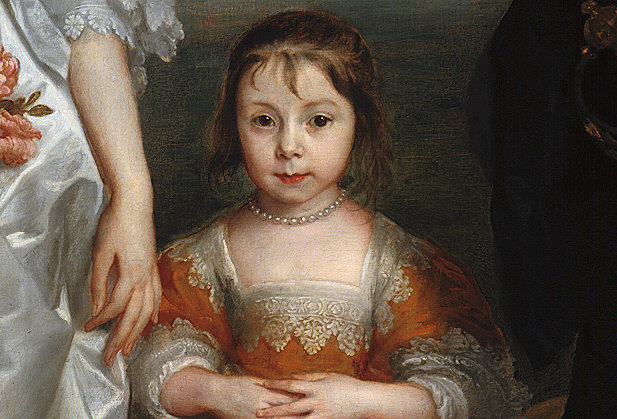
Anthony van Dyck, detail of James Stanley, Lord Strange, Later Seventh Earl of Derby, with His Wife, Charlotte, and Their Daughter, ca. 1636

"Sensitive and engaging" are the words to describe the portrait of the daughter of Lord Strange, Earl of Derby. The young girl was most likely Henrietta Stanley (1630-1685). Posing between her parents, she was painted by van Dyck with an astute grasp of character. Looking at her, we realize that van Dyck was well aware that children are not merely adults in embryo but are unique individuals at every stage of their lives. 

This insight into human nature and development is readily apparent in one of van Dyck's supreme achievements, The Five Eldest Children of Charles I, 1637. 

Van Dyke's group portrait is not among the works at the Frick exhibit but rather exerts a virtual presence. This famous work hung above the breakfast table of Charles I at Whitehall and remains one of the most renowned paintings in the Royal Collection. It is chiefly known by the image of the future Charles II resting his arm on the head of a huge mastiff. To the right of the young Charles are two princesses, Elizabeth and Anne. 

On exhibition at the Frick is an oil study of Princess Elizabeth and Princess Anne used by van Dyck to complete The Five Eldest Children of Charles I. Working with very young children, he elected to follow Rubens' example and do preparatory sketches of the facial features of his subjects.


Anthony van Dyck, The Princesses Elizabeth and Anne, Daughters of Charles I, 1637

This is a tremendously compelling work. Tragically, baby Anne died from tuberculosis in 1640. Elizabeth, at age fifteen, succumbed to the same disease ten years later. Queen Henrietta Maria maintained that she died from a broken heart after hearing of the execution of her father on orders of Parliament. 

By the time Charles I was executed in 1649, van Dyck had been dead for almost a decade. Worn out by his staggering work load, the "sensitive and engaging" painter from Flanders died on December 9, 1640. His "grand manner" world was crashing down around him, with the Thirty Years War devastating Europe and civil war erupting in Britain.

Among the unfinished works in van Dyck's studio was an oil painting of a woman whose identity has not come down to us. 


Anthony van Dyck, Portrait of a Woman, c 1640

Once a great beauty, she appears just past her "prime" in this magnificent portrait. Everything about her is starting to diminish or decline. Her hand claws at her heart. The look of wry self-knowledge in her eyes speaks volumes for her, for van Dyck and to us.

In probing the ultimate mystery and majesty of life, van Dyck had no peers and few equals. All the kings and queens, dukes and duchesses, whose portraits grace the galleries of the Frick are long since passed away. But the human soul is immortal. This is what Anthony van Dyck painted to perfection - or as close to it as any artist can go.

***

Text: copyright of Ed Voves, all rights reserved

Images Courtesy of the Frick Collection, New York City

Introductory image:
Anthony van Dyck (1599–1641) Queen Henrietta Maria with Jeffery Hudson, 1633. Oil on canvas, 219.1 x 134.8 cm (86 1/4 x 53 1/16 in.). National Gallery of Art, Washington; Samuel H. Kress Collection, 1952.5.39. 

Anthony van Dyck (1599–1641), Frans Snyders, ca. 1620. Oil on canvas, 56 1/8 x 41 1/2 in. (142.6 x 105.4 cm) Henry Clay Frick Bequest  Accession #: 1909.1.39 Frick Collection.

Anthony van Dyck (1599–1641), Margareta de Vos, ca.1620. Oil on canvas 51 1/2 x 39 1/8 in. (130.8 x 99.4 cm) Henry Clay Frick Bequest  Accession #: 1909.1.42 Frick Collection.

Anthony van Dyck (1599–1641) Self-Portrait, ca. 1620–21. Oil on canvas, 47 1/8 x 34 5/8 in. (119.7 x 87.9 cm) The Metropolitan Museum of Art, New York; The Jules Bache Collection, 1949 49.7.25

Anthony van Dyck (1599–1641) Queen Henrietta Maria with Jeffery Hudson, 1633. Black chalk, red and yellow (fabricated?) chalks, heightened with white chalk, on blue paper,
16 1/2 × 10 1/8 in. (41.9 × 25.5 cm) Ã‰cole Nationale Supérieure des Beaux-Arts, Paris

Anthony van Dyck (1599–1641)  Detail of Queen Henrietta Maria with Jeffery Hudson, 1633. Oil on Canvas. National Gallery of Art, Washington (see above).

Anthony van Dyck (1599–1641), Cardinal Guido Bentivoglio, 1623. Oil on canvas, 76 3/4 × 57 7/8 in. (195 × 147 cm) Galleria Palatina, Palazzo Pitti, Florence 

Anthony van Dyck (1599–1641) Detail of James Stanley, Lord Strange, Later Seventh Earl of Derby, with His Wife, Charlotte, and Their Daughter, ca. 1636. Oil on canvas,
97 x 84 1/8 in. (246.4 x 213.7 cm) Henry Clay Frick Bequest Accession #: 1913.1.40 Frick Collection.

Anthony van Dyck (1599–1641) The Princesses Elizabeth and Anne, Daughters of Charles I, Oil on canvas, 11 3/4 × 16 1/2 in. (29.8 × 41.8 cm) Scottish National Portrait Gallery, Edinburgh; purchased with the aid of the Heritage Lottery Fund, the Scottish Office and the Art Fund 1996

Anthony van Dyck (1599–1641) Portrait of a Woman, c 1640. Oil on canvas, 29 7/8 × 23 1/4 in. (75.9 × 59.1 cm) Speed Art Museum, Louisville; Museum Purchase, Preston Pope Satterwhite Fund 


Monday, November 16, 2015

Class Distinctions: Dutch Painting in the Age of Rembrandt and Vermeer at Boston's Museum of Fine Arts


Class Distinctions:
Dutch Painting in the Age of Rembrandt and Vermeer

Museum of Fine Arts, Boston 

October 11, 2015 - January 18, 2016

Reviewed by Ed Voves

Occasionally, when I walk into the galleries of an art museum, I get the sensation that I've stepped onto the pages of an art history book. That feeling often strikes me in MOMA where so many of the great works of early Modernism are displayed in close proximity.

A recent visit to Boston's Museum of Fine Arts (MFA) provided a similar feeling of crossing a portal of time. The pages I walked onto, however, dealt more with the realm of history than of art. A consciousness of past time occupied the foreground here, matters of foreshortening and brush stroke being pushed a bit  to the side.

That is not to say that the superlative exhibition at the MFA, Class Distinctions: Dutch Painting in the Age of Rembrandt and Vermeer lacks masterpieces of art. Of these, there are plenty. The Astronomer by Johannes Vermeer, on loan from the Louvre, is but one of the celebrated Old Master icons on view.


Johannes Vermeer, The Astronomer, 1668

The theme of Class Distinctions, however, takes a different path than most other treatments of the Dutch Golden Age. Previous exhibits have often stressed the innovations and individualism of the great Dutch artists.

Class Distinctions examines how the revolution in art in the Netherlands provides insight into the social make-up of  the United Provinces during the seventeenth century. The Netherlands, like all of Europe in the 1600's, was divided into tightly circumscribed classes. Significantly, the MFA exhibit brilliantly reveals that interaction, not exclusiveness, was the keynote of Dutch society during that troubled century.

The exhibit also testifies to the connection between the growing tolerance and prosperity of Dutch society and the receptiveness of its citizens  to the arts. To the amazement and incredulity of the envious English, art works were purchased and cherished by all but the poorest Dutch citizens.

"God created the world," as the old proverb states, "but the Dutch made Holland."

And the same was true of the art of the Dutch Golden Age.

Interaction and cooperation enabled the Dutch, beginning in the early Middle Ages, to dredge marshland, build flood barriers and convert marginal land into pasture and farmland. In short, to "make" Holland. These same principles of conduct are apparent throughout the exhibition. Although the first three galleries are devoted to separate classes, the works of art reflect the binding ties of obligation and service which held the United Provinces together.

The first  exhibition gallery is devoted to the upper classes. Despite being surrounded by  other magnificent art works, Frans Hals' dynamic group-portrait, Regents of the St. Elisabeth Hospital of Haarlem, exerts an almost magnetic force.


Frans Hals, Regents of the St. Elisabeth Hospital of Haarlem, 1641

Hals painted Regents in 1641, a year before Rembrandt's fabled Militia Company of Captain Frans Banninck Cocq, misnamed the Nightwatch. Like Rembrandt, Hals shows an animated scene of upper class officials performing their civic duty. Unpaid - except in honor and prestige -these Regents undertook vital tasks, insuring that the poor received effective aid and that the lid on dissent was kept securely fastened.

Group portraits were a major artistic innovation of the Dutch Golden Age. Portraits of regents boards were a major sub-genre. According to art scholar Eric Ketelaar, no less than 33 group portraits of regents boards were painted in Amsterdam alone during the peak years of the Golden Age, 1617 - 1686. 

The St. Elisabeth Hospital was in Haarlem, Holland's brewery capital. Most of the Regents of St. Elisabeth Hospital were wealthy brewers and therefore initally of the middle class. Administering to the poor provided them with the credentials to move up in rank, joining the ruling elite of the United Provinces.

Hals painted group portraits of female regents, as did his rival, Johannes Verspronck. It is a pity that one of these portraits of regentessen could not have been included in Class Distinctions. It is virtually the only significant omission in this brilliantly curated exhibit.

Another outstanding work in the first gallery highlights the military  and diplomatic effort needed to protect Dutch society during the Golden Age. Frederik Hendrik, Prince of Orange, painted by Anthony van Dyck, about 1631–32, shows the Stadholder or chief executive of the United Provinces.

The title of Stadholder was a vestige of Hapsburg rule of the Netherlands, similar in rank to the viceroy who ruled Mexico for the Spanish crown. When the Netherlands revolted against the Spanish Hapsburgs in 1568, the position of Stadholder was maintained. 

With self-rule as the motivating force of the Dutch resistance to Spain, the power of the Stadholder might well have been reduced to ceremonial insignificance. The opposite was true. As Stadholder, Frederik Hendrik was the supreme military leader or kapitein-generaal but answerable to the Dutch legislature, the Estates General.


Anthony van Dyck, Frederik Hendrik, Prince of Orange, c.1631

The careworn face of Frederik Hendrik (1584-1647) reflects his difficult position. As Prince of Orange, he was a hereditary nobleman but also the leader of a republic battling for its freedom against mighty Spain. Frederik Hendrik spent his whole career fighting - and beating - the Spanish. He never wore fancy armor in combat as he does in van Dyck's portrait but this battle gear symbolizes his life of service to his county men.

The second - and the central - gallery of the exhibit deals with the broad social category that made the Dutch independence movement a viable enterprise. Ship builders and shop keepers, clergyman and tavern owners, lens makers and artists - all combined and cooperated to form the first recognizable middle class in a modern sense of the term.

With roots stretching back to the 1300's, the Dutch middle class had a degree of influence during the Golden Age that was unmatched by any other nation in Europe. As with the upper class regents and regentessen, the role of women in the contributions of the middle class is readily apparent as well.

Rembrandt's The Shipbuilder and his Wife depicts the interaction of Jan Rijcksen (1560/2-1637) with his wife, Griet Jans. They were a Roman Catholic couple and loyal citizens of the Dutch Republic. Rijcksen was the master ship builder of the Dutch East India Company. Rembrandt's painting, one of his early masterpieces, shows a preoccupied Rijcksen being handed a note by Griet Jans. 


Rembrandt van Rijn, Jan Rijcksen and His Wife, Griet Jans, 1633

In Rembrandt's unforgettable work, Rijcksen looks up, perplexed and startled like an absent-minded professor who has just been reminded that his lecture began fifteen minutes ago. Griet Jans, by comparison, is a model of calm and efficiency.

It was a typical situation. Dutch men engaged in politics, war, commerce and science. Dutch women were left to run the homes and very often the family business affairs, thus keeping  the whole enterprise from crashing into ruin. 


Gerrit Dou, Grocery Shop, 1647

Gerrit Dou's Grocery Shop, dated to 1647,  and Adriaen van Ostade's The Fishwife (displayed in the gallery devoted to the Dutch lower class) likewise show the vital role of women in the day-to-day management of Dutch economic life. But women had an inspirational role as well, serving as guardians of what Simon Schama calls  "the moral geography" of the Dutch Republic.

Faced by the awesome, if brittle, power of Spain, followed later by French invasions under Louis XIV, the Dutch could not afford the luxury of always keeping their women at home. Yet the family hearth was of transcendent importance to a people fighting for their independence. Pieter de Hooch evoked the quiet, clean, peaceful atmosphere of the Dutch home in a series of memorable paintings like Interior with Women beside a Linen Cupboard, painted in 1663.

In de Hooch's painting, a mother and her elder daughter fold and store the family linen. A younger daughter pauses from playing with her hockey stick to watch. The wider world beckons beyond the vestibule or vorhuis of the home but the little girl is learning how the "moral geography" of the Dutch home - and the Dutch Republic - is maintained: by unremitting work and obsessive attention to detail. 

De Hooch's painting testifies to the personal toll that it took to "keep the home fires burning." This particular work is one of the last great family-themed works that he did. After 1663, de Hooch stopped painting scenes with children. Two of his own children died around that time, followed by his wife in 1667. Financial woe added to his anxiety, the art market all but collapsing during the 1660's. De Hooch began painting scenes of elegant ladies and dashing gentlemen, perhaps to entice wealthy clients. De Hooch's muse soon abandoned him and he died in an insane asylum in 1684.


Pieter de Hooch, Interior with Women beside a Linen Cupboard, 1663

Standing over the door frame in de Hooch's Interior with Women beside a Linen Cupboard is a curious figure. In his book, The Embarrassment of Riches, Schama identifies the peculiar statue as Mercury, god of commerce. Mercury is holding a bag of coins. Was this an admission by de Hooch of the financial pressures that menaced the "moral geography" of the Dutch home?

Whatever the relation of de Hooch's personal circumstances to the composition of his painting, the use of doorways and the vorhuis as a stage for pictorial drama appeared in other Dutch paintings as well. Jacob Ochtervelt used the door frame and vorhuis as a motif in a number of his paintings. It is the point where the lives of the well-to-do and laboring poor intersect.

Standing on the other side of the doorway in his painting (the introductory image of this review), Ochtervelt shows itinerant musicians. They are performing an impromptu concert for a middle class child and her nurse, with a reward in hand from the lady of the house. 


The charm of this wonderful painting should not obscure its serious theme. In this moment of shared humanity, we can see how the Dutch class system preserved both the lines of demarcation and communication between rich and poor. In this genre scene, we are made aware of how the United Provinces remained united.


Jan van Bijlert, Portraits of the Men from the St. Job Inn in Utrecht Collecting Alms, c.1630

The third and fourth galleries of Class Distinctions display numerous works that depict the lives of the poor or the ways that the social classes mingled, associated and worked together. Portraits of the Men from the St. Job Inn in Utrecht Collecting Alms by Jan van Bijlert is particularly noteworthy.

The fourth gallery has a surprise in store, even for art lovers like me who expected great things from Class Distinctions. Ronni Baer, the MFA curator who planned the exhibition, prepared a stunning mini-exhibit of three tables, each set with the dinnerware and table accouterments of the three Dutch classes during the 1600's. The pieces were meticulously selected from art collections from the Netherlands and the United States. 


I was transfixed by this ingenious and moving display of artifacts from the everyday lives of the Dutch people. It was like a door had been opened to the Golden Age and I was permitted to stand in the vorhuis to get a glimpse.


A contrast of the Upper & Lower Class table settings in the Class Distinctions Exhibit.

Ann and Graham Gund Gallery *Photograph © Museum of Fine Arts, Boston


It is impossible to give a true sense of this insightful display in an online review like this. By grouping photos of the upper and lower class table settings, I hope to enable the brilliantly orchestrated sense of contrast to be apparent. 


The Middle Class table setting in the Class Distinctions Exhibit.
Ann and Graham Gund Gallery *Photograph © Museum of Fine Arts, Boston


With a more detailed view of the middle class setting, hopefully the feeling of kindred experience that this tableau engenders can be grasped as well.

This year has been extraordinarily rich in wonderful art exhibitions. I will not be so foolhardy as to pick an Academy Award-style "best exhibit" for 2015.  However, Class Distinctions: Dutch Painting in the Age of Rembrandt and Vermeer does deserve an extra word of praise.

Like Job Berckheyde's Baker, announcing that his baked goods are ready and waiting for rich and poor alike, the MFA exhibit sounds the trumpet of our common humanity. 


Job Berckheyde, The Baker, about 1681


Whether we wear an elegant lace ruff or a woolen scarf about our necks, we are all children of God. And like the Dutch folk of the Golden Age, we are all fed with the bread of life from God's table.

***
Text: Copyright of Ed Voves, all rights reserved 

Images courtesy of the Museum of Fine Arts, Boston

Introductory Image:     
Jacob Ochtervelt (Dutch, 1634–1682), Street Musicians at the Door, 1665 Oil on canvas, 68.6 x 57.2 cm (27 x 22 1/2 in.) (Saint Louis Art Museum, Gift of Mrs. Eugene A. Perry in Memory of her mother, Mrs. Claude Kilpatrick 

Johannes Vermeer (Dutch, 1632–1675), The Astronomer, 1668, Oil on canvas, 51.5 x 45.5 cm (20 1/4 x 18 in.)Paris, Musée du Louvre, Département des Peintures 

Frans Hals (Dutch, 1581 to 1585-1666), Regents of the St. Elisabeth Hospital in Haarlem, 1641, Oil on canvas, 153 × 252 cm (60 1/4 × 99 1/4 in.) Frans Hals Museum, Haarlem 

Anthony van Dyck (Flemish, 1599–1641), Frederik Hendrik, Prince of Orange, about 1631–32, Oil on canvas, 114.3 × 96.5 cm (45 × 38 in.) The Baltimore Museum of Art: The Mary Frick Jacobs Collection 

Rembrandt van Rijn (Dutch, 1606–1669), Jan Rijcksen and His Wife, Griet Jans, known as "The Shipbuilder and His Wife", 1633, Oil on canvas, 113.8 x 169.8 cm (44 5/8 × 66 3/4 in.) British Royal Collection 

Gerrit Dou (Dutch, 1613–1675), Grocery Shop, 1647, Oil on panel, 38.5  x 29 cm (15 1/8 × 11 1/2 in.) Paris, Musée du Louvre, Département des Peintures 

Pieter de Hooch (Dutch, 1629–after 1684), Interior with Women beside a Linen Cupboard,1663, Oil on canvas, 70 x 75.5 cm (27 5/8 x 29 3/4 in.) Rijksmuseum, Amsterdam. On loan from the City of Amsterdam 


Jan van Bijlert (Dutch, 1597–1671), Portraits of the Men from the St. Job Inn in Utrecht Collecting Alms, about 1630–1635, Oil on canvas, 76.3 x 115.3 cm (30 1/8 x 45 3/8 in.)  Centraal Museum


Job Berckheyde (Dutch, 1630–1693), The Baker, about 1681, Oil on canvas, 63.3  x 53 cm (25 × 20 7/8 in.) Worcester Art Museum, Gift of Mr. and Mrs. Milton P. Higgins 

Photos of the Class Distinctions table displays at the Ann and Graham Gund Gallery © Museum of Fine Arts, Boston