Showing posts with label Frans Hals. Show all posts

Thursday, September 21, 2017

Art Eyewitness Essay: Toys R Art


Toys R Art

Some Thoughts on the Role of Toys in the Art World


Text by Ed Voves  

Photo Essay by Anne Lloyd

Sometimes a visit to the art museum presents a difficult choice. Should I go see the exhibit or check out the gift shop first. The temptation to follow the latter course is often irresistible.

The recent Wild: Michael Nichols exhibit at the Philadelphia Museum of Art is a case in point. The inventory of the gift shop reflected Nichols' status as one of the world's greatest nature photographers.  A vast herd of animal-themed toys thronged the shelves and display racks. Floor to ceiling, lions, tigers, bears and a stray elephant or two were everywhere. 


Anne Lloyd (Photo 2017), Philadelphia Museum shop for Wild: Michael Nichols 

These Wild toys reinforced a growing interest in toys since I reviewed the Embracing the Contemporary exhibit at the Philadelphia Museum of Art. This exhibition of modern art, collected by Keith and Katherine Sachs, included a tiny wooden toy box filled with miniature toys. This small wonder was crafted by Charles LeDray in 2005-06. I had a much bigger version of such a toy box as a child, long gone - but not forgotten.


Anne Lloyd (Photo 2016), Toy Chest, 2005–6, by Charles LeDray

In my 2016 review of Embracing the Contemporary, I wrote:

Looking at LeDray's wondrous work of art, I was stuck by the thought that we begin to collect memories as children and continue to do so throughout our lives. This in turn leads to a point when we are moved to share our emotional riches with others.

Lately, my wife Anne has been going on photo "safaris," chiefly of the many remarkable gardens of our Philadelphia neighborhood. Anne stopped in to the local Salvation Army store during one of her expeditions. A creative moment, relating to my toy box meditations, ensued.



Anne Lloyd (Photo 2017), Salvation Army Store, Philadelphia PA

When you go into the Salvation Army store, you are confronted by row upon row of cleaned, if slightly time-worn, clothing. On top of some of the metal shelves are trays of cast-off stuffed animals. Once these were treasured companions of a little Jane or Johnny. Kids grow-up and outgrow their playthings. Computer games take the place of plush animals. Time marches on.

Anne started snapping photos and then began rearranging the stuffed animals into little "photo-op" scenes. Evidently, someone else had a similar idea earlier. Anne found a lion and a lamb sharing a shelf. With a little propping-up, predator and prey were reconciled and ready to pose again for a new incarnation of the Peaceable Kingdom.  


Anne Lloyd (Photo 2017), Peaceable Kingdom at the Salvation Army Store

These discarded toys are especially affecting and poignant because they were once loved by children. Some resonance of this love clings to them still. I sensed that when I saw the first batch of photos that Anne took. When I went with Anne for a return visit, I was amazed to see the transformation for myself. 

Anne's careful groupings of these toys seemed to bring them to life. Something struck a chord or touched a nerve in me. Those inanimate objects really appeared to be awakening to the kind of life they once enjoyed in the company of young children. 

Toys play a really important part in children's lives. I'm not referring here to toys that have a clearly "educational" role - which most kids instinctively reject. 


Anne Lloyd (Photo 2017), Monkey Friend at the Salvation Army Store

A smiling monkey doll, like this one, is more life affirming. It helps a young child adjust to the world, to identify, appreciate and respond to kindness and love in the immediate family circle. 

Then comes the next import step, to appreciate and love beyond the family unit.

The big, beaming smile that spreads across this monkey's silly mug also appears on the face of Frans Hals' Fisher Boy with a Basket. Why did the cash-strapped Hals paint a picture of an impoverished working-class kid with a toothy smile?  He cannot have made much money selling this or the other versions of street urchins that he did.


Frans Hals, Fisher Boy with Basket, ca. 1630

I believe that Frans Hals and his compatriots in Golden Age Holland could appreciate a smile on a poor boy's face because their society invested so much in the well-being of children.  This regard for others which Dutch children learned early in their lives was a social "glue" which helped the United Provinces survive repeated invasions and internal stresses that would have wrecked less well-adjusted societies during the 1600's.


Artists and writers have been imparting human attributes to animals since Aesop.That's certainly a comforting thought. Perhaps my reflections on stuffed animals and art are not quite so “off-beat” after all!

On second thought, the ridiculous elements in life need to be cherished in art along with the sublime. Take a look at these Salvation Army recruits and try and keep a straight face. The kooky clown in his fright wig and the teddy bear and panda posing for a selfie. Just fun! Purely, simply fun!


Anne Lloyd (Photo 2017),  Candid Photography at the Salvation Army Store! 

I've come to believe that a totally serious approach to art isn't always necessary - or even wise all the time. Not that I'm in favor of drawing a mustache on the Mona Lisa, either.



Anne Lloyd (Photo 2017), "Photo-Op" at the Salvation Army Store

Here is a demonstration of what I mean. Anne arranged a troop of the Salvation Army critters for a group portrait. The cartoon expressions of these beasties range from befuddlement and alarm to kindly acceptance. It is truly a very funny tableau.

Where have we seen such a range of emotion in the art world?


Rembrandt, The Syndics of the Clothmakers Guild, 1662

Rembrandt's Syndics of the Clothmakers Guild? Surely I jest! 

Yes, but Syndics of the Clothmakers Guild is based on an underlying strata of humor. According to the most accepted interpretation of Syndics, Rembrandt depicted these officials responding to a challenging question during a policy-making meeting. It records a rather uncomfortable moment.

Syndics is unquestionably a masterpiece. But it is also a warm, funny evocation of the human comedy. From the suspicion and startled dignity of several of the syndics to the bemused look of the secretary behind them, we glimpse faces of men who have let the mask of officialdom slip down. For once, we see them, not as a group of "stuffed shirts," but as decent, if fallible, mortals like ourselves.

I suspect that there is a cartoon character or two in all of us. We don't need to arrange stuffed animals and find parallels with masterpieces like Rembrandt's Syndics to put a smile on our faces. Sometimes, a great painting will produce that effect without the need for props.

Titian was not especially well known for his sense of humor. Yet, in his Supper at Emmaus, Titian included a confrontation between a snappy, combative little dog and a gray tabby cat, poking its head under the table cloth.


Titian, The Supper at Emmaus,  ca. 1530

The Supper at Emmaus is one of the key events of Christian history. Following Jesus' crucifixion, two disciples met a stranger on the road to the village of Emmaus, a day's journey from Jerusalem. This of course was Jesus, risen from the dead. The disciples only recognized him when he blessed the bread for dinner. The story appears in the Gospel of St. Luke.


Titian, The Supper at Emmaus (Detail)

Nowhere does St. Luke mention a dog and a cat at the table at Emmaus. Other artists, Caravaggio and Rembrandt, painted this scene without any animal intervention. Why did Titian do so?

The first owners of this painting were the Maffei family from Verona, rather than a Catholic religious order. Perhaps, Titian wanted to include a homey detail or to show that the trifling details of life do not stop even when the Divine Presence is being manifested. 

Whatever the case, Titian demonstrated that humor has a secure place in great art.

Anne and I spent a delightful half-hour arranging the Salvation Army animals for their "photo shoots."  One of the plush animals, a sweet, demure mouse, called to mind the subject of one of Renoir's greatest portraits. Renoir painted Adelphine Legrand in 1875, the year after the First Impressionist Salon and its dissappointing sales.


Pierre-Auguste Renoir, Portrait of Mademoiselle Legrand, 1875

Adelphine Legrand was eight years old when Renoir painted her. This sweet, demure girl was just at the point in her life when she would no longer be a child but rather be Mademoiselle Legrand.

Adelphine's dolls and toys, counterparts of this little mouse, would have had to be set on the shelf or given away. This is part of the price of growing up and I could not help but reflect that this particular toy mouse surely had been loved and cherished by a modern-day Adelphine only a short time ago.


Anne Lloyd (Photo 2017), Mouse Friend at the Salvation Army Store

Life passes swiftly. Pleasant interludes such as Anne and I spent at the Salvation Army store come to an end almost as soon as they begin. 

Yet occasions for humor, joy and inspiration should be cherished, however brief and wherever these take place. A museum gallery or an aisle in a Salvation Army store. You never know when or where an "art moment" may occur.


***

Text: Copyright of Ed Voves, all rights reserved. Images courtesy of the National Gallery of Ireland, Rijksmuseum, the Louvre and the Philadelphia Museum of Art, via Creative Commons. Gallery and  Salvation Army Store images courtesy of Anne Lloyd.

Introductory Image:
Anne Lloyd (Photo 2017), Second-hand Toys at the Salvation Army Store, Philadelphia PA, September 2017.
Anne Lloyd (Photo 2017),  Museum shop for the Wild: Michael Nichols exhibit, Philadelphia Museum of Art, June 2017.  
Anne Lloyd (Photo 2017), Toy Chest, 2005–6, by Charles LeDray. Mixed-media object from the Keith and Katherine Sachs Collection. Promised gift to the Philadelphia Museum of Art.
Anne Lloyd (Photo 2017), Salvation Army Store, Philadelphia PA , September 2017.   
Anne Lloyd (Photo 2017), Peaceable Kingdom at the Salvation Army Store, Philadelphia PA , September 2017.    
Anne Lloyd (Photo 2017), Monkey Toy at the Salvation Army Store , Philadelphia PA, September 2017.                     
Frans Hals, (Dutch, 1581-1666) Fisher Boy with Basket, ca. 1630. Oil on canvas, 72 cm × 58 cm (28 in × 23 in). National Gallery of Ireland, Dublin. Purchased in 1881. NGI.193.
Anne Lloyd (Photo 2017), Second-hand Toys at the Salvation Army Store, Philadelphia PA . Three photos taken during September 2017.
Rembrandt van Rijn (Dutch, 1606–1669) The Syndics of the Cloth Makers Guild, about 1662 Oil on canvas,191.5 x 279 cm. © Rijksmuseum, Amsterdam (SK-C-6).
Titian (Italian, 1490–1576) The Supper at Emmaus,  ca. 1530. Oil on canvas. 169 cm (66.5 in). Width: 244 cm (96.1 in). Louvre, Paris. Inventory # 746.
Pierre-Auguste Renoir (French, 1841–1919) Portrait of Mademoiselle Legrand, 1872, Oil on canvas, 32 x 23 1/2 inches, 81.3 x 59.7 cm. Philadelphia Museum of Art, The Henry P. McIlhenny Collection in memory of Frances P. McIlhenny, 1986, (1986-26-28)  Image: © The Philadelphia Museum of Art.
Anne Lloyd (Photo 2017), Mouse Toy at the Salvation Army Store , Philadelphia PA, September 2017.                     


Monday, December 26, 2016

Art Eyewitness Book Review: Art in Detail: 100 Masterpieces by Susie Hodge


Art in Detail: 100 Masterpieces


By Susie Hodge
Thames & Hudson/$39.95/432 pages

Reviewed by Ed Voves

Art in Detail: 100 Masterpieces is an acutely perceptive survey of some of the greatest paintings and sculptures of the Western world. Written by the noted scholar, Susie Hodge, it is truly an "eye-opening" look at art.

In reviewing a wide-ranging book like Art in Detail, the first task is to find  a common theme uniting all of the disparate parts. That is easy enough with Hodge's book. Every one of the one hundred works she examines, like Georges De La Tour's astonishing contrast of light and shadow, is indeed a "masterpiece."


Georges De La Tour, St Joseph the Carpenter, c. 1642

One might argue that Hodge should have selected several different choices for analysis. Leonardo da Vinci's The Virgin and Child with St. Anne would have made for intriguing study rather than another look at the relentlessly examined Mona Lisa. Yet - overwhelmingly - Art in Detail delivers what it promises: fascinating insights into one hundred of the supreme treasures of Western art.

Lurking just below the surface is another theme that is not so readily apparent. Each of these works of art was painted or sculpted by a recognizable artist. Each can be documented. We know who created it, when, where and what materials the artist used. 

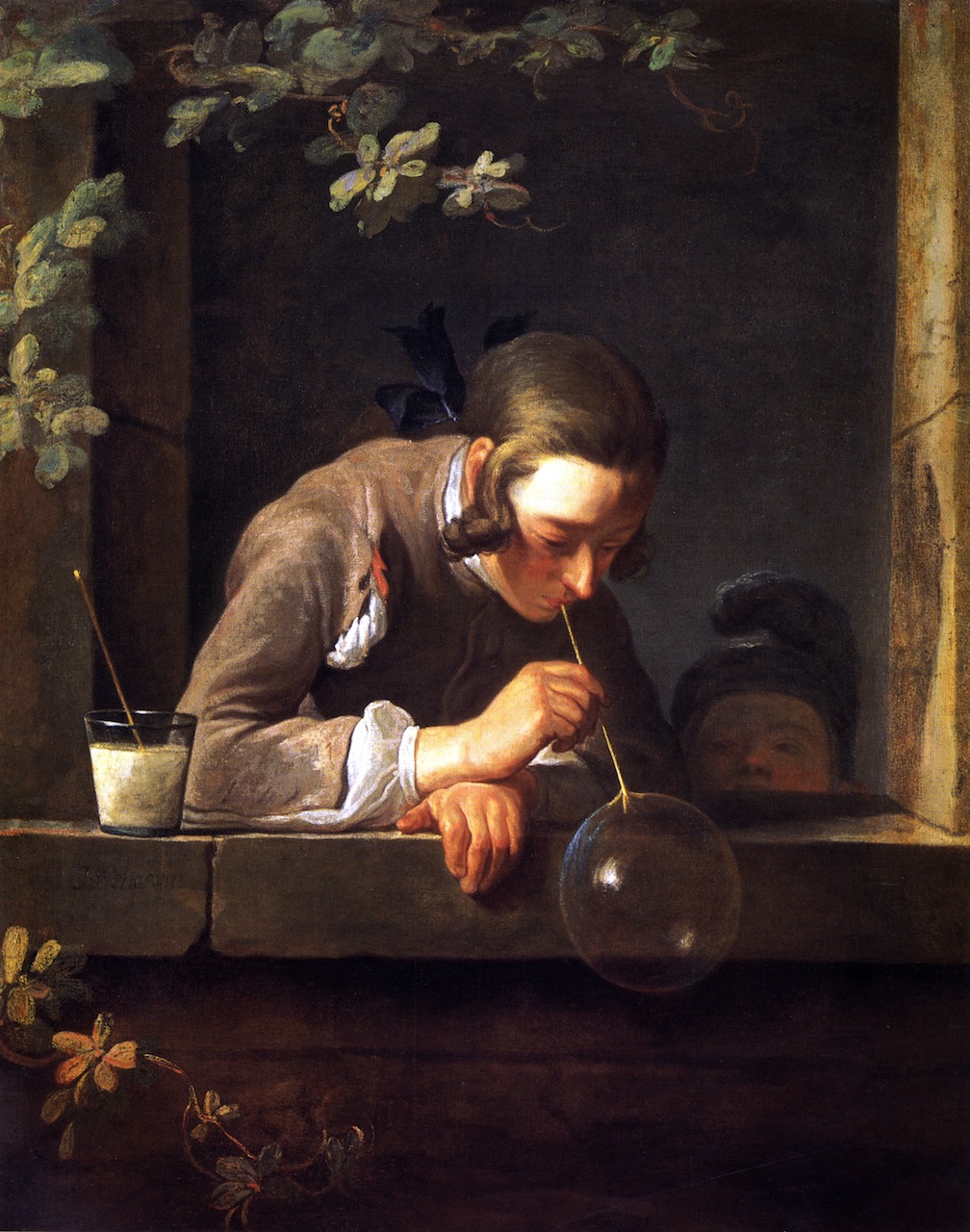
Beginning with Giotto in 1305 and extending to a 2014 painting by Paula Rego, Art in Detail charts the rise of artists as creative individualists. Hans Holbein's The Ambassadors (1533), with its trove of cryptic details, and Jean-Baptiste-Siméon Chardin's Soap Bubbles, painted exactly two centuries later, treat the subject of human mortality in totally unique and absolutely dissimilar ways.


Hans Holbein The Younger, The Ambassadors, 1533


Jean-Baptiste-Siméon Chardin, Soap Bubbles, c. 1733-34

Over the vast expanse of human history, almost all artists were anonymous creators of       religious images or monuments to kings and rulers. Occasionally, a master from antiquity like Apelles achieved lasting renown but nothing of his actual oeuvre has survived. Several indisputable masterpieces like the Riace bronzes have been recovered but we do not know the identity of their creator.

That changed at the dawn of the Renaissance with Giotto and the painting of the Arena Chapel frescoes. Giotto was credited by Giorgio Vasari as having initiated 'the great art of painting as we know it today, introducing the techniques of drawing from life ..."

Hodge studies Giotto's Adoration of the Magi from the Arena Chapel frescoes, noting for instance that the Star of Bethlehem was painted to resemble Halley's Comet which had appeared in 1301. 

Significantly, the resounding success of the Arena Chapel frescoes did not lead to carbon copy imitations all over Italy. Every major artist who followed Giotto - even Lorenzo Monaco whose narrative sense was much the same - always left a different "finger print" in style and technique.


Lorenzo Monaco, The Adoration of the Magi, 1420-22

This is the central paradox of Western art. The Classical tradition was relentlessly extolled by high-brow theorists. Generation after generation of students were indoctrinated to paint or sculpt like the Old Masters. Yet, nobody taught Rembrandt van Rijn to paint like Rembrandt.

No one taught Frans Hals to paint in his unique manner either. Hodge has selected Hals'     The Laughing Cavalier for analysis and it is a brilliant choice. Painted in 1624, this work has many of the elements of Hals' signature style. But it also has a high degree of detail and "finish" not found in his later portraits.

Early in his career, the Flemish-born Hals used a color-drenched palette and an exacting eye for detail to impress his aristocratic patrons. We don't know the identity of the Cavalier (who really isn't laughing) but he would surely have been pleased with the embroidered lovers' knots, Mercury's staff and other motifs on his sleeves.


Frans Hals, The Laughing Cavalier, 1624

During the 1630's and 1640's, the Dutch middle-class gained social status to match their growing economic power. Hals found a ready market for portraits or character studies, the now famous tronies which American collectors have long favored.

Since many of these middle-class patrons dressed in black, Hals experimented with a bold, loose brushstroke to evoke the folds and sheen of the dark cloth. We can see an early example of this in the Cavalier's black cloak. Focusing closely on Hals' technique, Hodge provides illuminating commentary on this important detail. The following quote is characteristic of the power of perception which she devotes to all one hundred of the art works she studies:

At a time when brushstrokes were meant to be invisible, Hals made his obvious, from fine blended marks in the face to longer marks in the clothing, which create a sense of spontaneity. This freely handled application was unusual then, but in the 19th century was seen as a precursor to Realism and Impressionism.

Hodge has created a very effective technique of analyzing the details of these masterpieces. She divides each work under discussion into tightly-cropped frames. This enables her to focus on technical matters, for instance, the "wet-in-wet" method which Hals often used, "layering wet paint, rather than waiting for previous layers to dry."

This method of analysis also provides insight on thematic factors as well. The exceptional attention that Hals paid to the lace and embroidered sleeve enables Hodge to make the educated guess that the "Laughing Cavalier" was likely a cloth merchant as silk, lace and damask weaving had become major industries in Haarlem, the city in Holland where Hals worked.

Hodge's technique succeeds both for unfamiliar works or art and for paintings we've seen so often that we roll our eyes at the mention of their title. There is always something of value to discover in Art in Detail.


Jacques-Louis David,The Oath of the Horatii, 1784

Jacques-Louis David's The Oath of the Horatii, painted in 1784, has appeared in countless art history books. Kenneth Clark discussed it in the Civilization documentary series as a revolt against the status quo of Europe's Age of Enlightenment. Clark likened The Oath of the Horatii to Picasso's Guernica (which Hodge also discusses), calling it "the supreme picture of revolutionary action..."

The Oath of the Horatii is also the "supreme picture" of Neoclassical art. As such it can be readily contrasted with the "supreme picture" of Romanticism, Goya's The Third of May, 1808, which also is studied in Hodge's book.  But I was very stuck by a lesser known Romantic painting, which movingly demolishes all the male vanity and "call of duty" propaganda evoked by The Oath of the Horatii.

Eugéne Delacroix's Entry of the Crusaders Into Constantinople depicts a harrowing moment in one of the most disgraceful episodes of Western history. Crusading knights marching (ostensibly) to liberate Jerusalem from the Saracens in 1204 conspired with the Venetians to attack and despoil the Christian city of Constantinople instead.


Eugéne Delacroix, Entry of the Crusaders Into Constantinople,1840

The treachery of this incident needs no further comment here. But it is worth noting that Delacroix painted this compelling work of art while memories of the horror of the Napoleonic Wars still lingered in the European mind. These bloody, ruinous wars were founded upon the heartless sentiments of David's The Oath of the Horatii.

Delacroix saw war a bit differently from David. In Entry of the Crusaders Into Constantinople, the outstretched arm of the old man is a plea for the right to life rather than an invocation of the cold steel of revenge and slaughter.

When viewed in this light, Delacroix's Entry of the Crusaders Into Constantinople is not a "history" painting but a testament to humanity. The same can be said, to a greater or lesser degree, for all one hundred masterpieces in Hodge's book.

Art in Detail provides more than a mass of technical detail involved in creating a painting or a sculpture. Here, in this very fine book, is a wealth of information that will draw us back for many a return visit. Here we can explore how great artists have sought to find insights into the dilemmas of human existence and the mysteries of creative expression.

Genius is in the details, as Hodge certainly shows. Yet, the scope of skill in the visual arts is far wider than mastery of technique. Ever since cave walls served as the "picture plane," artists have been searching for ways to express the greater truths of earthly life. It's a messy, often chaotic process, but one that is directly related to human self-realization.

To her credit, Hodge finds room for such visionary matters. In an engaging discussion of Helen Frankenthaler's early experimentation with Color Field painting, Hodge quotes Frankenthaler's reaction to her efforts. Standing on a ladder to survey her work, Frankenthaler declared that she was "sort of amazed and surprised and interested."

No better description could possibly be given for the electric moment when a work of art becomes a masterpiece.

***
Text: Copyright of Ed Voves, all rights reserved 

Images Courtesy of Thames & Hudson 

Introductory Image: Art in Detail: 100 Masterpieces, 2016 (cover) Image credit: Thames & Hudson 

Georges De La Tour (French, 1593-1652) St Joseph the Carpenter, c. 1642. Oil on canvas. 137 x 102 cm (54 x 40 in.)  Louvre, Paris, France © ACTIVE MUSEUM/Alamy Stock Photo),  

Hans Holbein The Younger (German, 1497-1543) The Ambassadors, 1533. Oil on oak panel. 207 x 209.5 cm (81 1/2 x 82 1/2 in.) National Gallery, London, UK © Peter Barritt/Alamy Stock Photo

Jean-Baptiste-Siméon Chardin (French, 1699-1779) Soap Bubbles, c. 1733-34.  Oil on canvas. 93 x 74.5 cm (36 5/8 x 29 3/8 in.) National Gallery of Art, Washington, DC, USA     classicpaintings/Alamy Stock Photo        

Lorenzo Monaco (Italian, c.1370-c.1425) The Adoration of the Magi, 1420-22. Tempera on panel, 115 x 183 cm (45 x 72 in.) Uffizi, Florence, Italy The Art Archive/Alamy Stock Photo       

Frans Hals (Dutch, 1582-1666) The Laughing Cavalier, 1624. Oil on canvas. 83 x 67.5 cm (32 5/8 x 26 1/2 in.) Wallace Collection, London, UK © SuperStock/Alamy Stock Photo

Jacques-Louis David (French, 1748-1825) The Oath of the Horatii, 1784. Oil on canvas. 330 x 425 cm (129 7/8 x 167 3/8 in.) Louvre, Paris, France © Heritage Image Partnership Ltd/Alamy Stock Photo

Eugéne Delacroix (French, 1798-1863) Entry of the Crusaders Into Constantinople,1840. Oil on canvas. 410 x 498 cm (161 1/2 x 196 in.) Louvre, Paris, France © Heritage Image Partnership Ltd/Alamy Stock Photo        


Monday, November 16, 2015

Class Distinctions: Dutch Painting in the Age of Rembrandt and Vermeer at Boston's Museum of Fine Arts


Class Distinctions:
Dutch Painting in the Age of Rembrandt and Vermeer

Museum of Fine Arts, Boston 

October 11, 2015 - January 18, 2016

Reviewed by Ed Voves

Occasionally, when I walk into the galleries of an art museum, I get the sensation that I've stepped onto the pages of an art history book. That feeling often strikes me in MOMA where so many of the great works of early Modernism are displayed in close proximity.

A recent visit to Boston's Museum of Fine Arts (MFA) provided a similar feeling of crossing a portal of time. The pages I walked onto, however, dealt more with the realm of history than of art. A consciousness of past time occupied the foreground here, matters of foreshortening and brush stroke being pushed a bit  to the side.

That is not to say that the superlative exhibition at the MFA, Class Distinctions: Dutch Painting in the Age of Rembrandt and Vermeer lacks masterpieces of art. Of these, there are plenty. The Astronomer by Johannes Vermeer, on loan from the Louvre, is but one of the celebrated Old Master icons on view.


Johannes Vermeer, The Astronomer, 1668

The theme of Class Distinctions, however, takes a different path than most other treatments of the Dutch Golden Age. Previous exhibits have often stressed the innovations and individualism of the great Dutch artists.

Class Distinctions examines how the revolution in art in the Netherlands provides insight into the social make-up of  the United Provinces during the seventeenth century. The Netherlands, like all of Europe in the 1600's, was divided into tightly circumscribed classes. Significantly, the MFA exhibit brilliantly reveals that interaction, not exclusiveness, was the keynote of Dutch society during that troubled century.

The exhibit also testifies to the connection between the growing tolerance and prosperity of Dutch society and the receptiveness of its citizens  to the arts. To the amazement and incredulity of the envious English, art works were purchased and cherished by all but the poorest Dutch citizens.

"God created the world," as the old proverb states, "but the Dutch made Holland."

And the same was true of the art of the Dutch Golden Age.

Interaction and cooperation enabled the Dutch, beginning in the early Middle Ages, to dredge marshland, build flood barriers and convert marginal land into pasture and farmland. In short, to "make" Holland. These same principles of conduct are apparent throughout the exhibition. Although the first three galleries are devoted to separate classes, the works of art reflect the binding ties of obligation and service which held the United Provinces together.

The first  exhibition gallery is devoted to the upper classes. Despite being surrounded by  other magnificent art works, Frans Hals' dynamic group-portrait, Regents of the St. Elisabeth Hospital of Haarlem, exerts an almost magnetic force.


Frans Hals, Regents of the St. Elisabeth Hospital of Haarlem, 1641

Hals painted Regents in 1641, a year before Rembrandt's fabled Militia Company of Captain Frans Banninck Cocq, misnamed the Nightwatch. Like Rembrandt, Hals shows an animated scene of upper class officials performing their civic duty. Unpaid - except in honor and prestige -these Regents undertook vital tasks, insuring that the poor received effective aid and that the lid on dissent was kept securely fastened.

Group portraits were a major artistic innovation of the Dutch Golden Age. Portraits of regents boards were a major sub-genre. According to art scholar Eric Ketelaar, no less than 33 group portraits of regents boards were painted in Amsterdam alone during the peak years of the Golden Age, 1617 - 1686. 

The St. Elisabeth Hospital was in Haarlem, Holland's brewery capital. Most of the Regents of St. Elisabeth Hospital were wealthy brewers and therefore initally of the middle class. Administering to the poor provided them with the credentials to move up in rank, joining the ruling elite of the United Provinces.

Hals painted group portraits of female regents, as did his rival, Johannes Verspronck. It is a pity that one of these portraits of regentessen could not have been included in Class Distinctions. It is virtually the only significant omission in this brilliantly curated exhibit.

Another outstanding work in the first gallery highlights the military  and diplomatic effort needed to protect Dutch society during the Golden Age. Frederik Hendrik, Prince of Orange, painted by Anthony van Dyck, about 1631–32, shows the Stadholder or chief executive of the United Provinces.

The title of Stadholder was a vestige of Hapsburg rule of the Netherlands, similar in rank to the viceroy who ruled Mexico for the Spanish crown. When the Netherlands revolted against the Spanish Hapsburgs in 1568, the position of Stadholder was maintained. 

With self-rule as the motivating force of the Dutch resistance to Spain, the power of the Stadholder might well have been reduced to ceremonial insignificance. The opposite was true. As Stadholder, Frederik Hendrik was the supreme military leader or kapitein-generaal but answerable to the Dutch legislature, the Estates General.


Anthony van Dyck, Frederik Hendrik, Prince of Orange, c.1631

The careworn face of Frederik Hendrik (1584-1647) reflects his difficult position. As Prince of Orange, he was a hereditary nobleman but also the leader of a republic battling for its freedom against mighty Spain. Frederik Hendrik spent his whole career fighting - and beating - the Spanish. He never wore fancy armor in combat as he does in van Dyck's portrait but this battle gear symbolizes his life of service to his county men.

The second - and the central - gallery of the exhibit deals with the broad social category that made the Dutch independence movement a viable enterprise. Ship builders and shop keepers, clergyman and tavern owners, lens makers and artists - all combined and cooperated to form the first recognizable middle class in a modern sense of the term.

With roots stretching back to the 1300's, the Dutch middle class had a degree of influence during the Golden Age that was unmatched by any other nation in Europe. As with the upper class regents and regentessen, the role of women in the contributions of the middle class is readily apparent as well.

Rembrandt's The Shipbuilder and his Wife depicts the interaction of Jan Rijcksen (1560/2-1637) with his wife, Griet Jans. They were a Roman Catholic couple and loyal citizens of the Dutch Republic. Rijcksen was the master ship builder of the Dutch East India Company. Rembrandt's painting, one of his early masterpieces, shows a preoccupied Rijcksen being handed a note by Griet Jans. 


Rembrandt van Rijn, Jan Rijcksen and His Wife, Griet Jans, 1633

In Rembrandt's unforgettable work, Rijcksen looks up, perplexed and startled like an absent-minded professor who has just been reminded that his lecture began fifteen minutes ago. Griet Jans, by comparison, is a model of calm and efficiency.

It was a typical situation. Dutch men engaged in politics, war, commerce and science. Dutch women were left to run the homes and very often the family business affairs, thus keeping  the whole enterprise from crashing into ruin. 


Gerrit Dou, Grocery Shop, 1647

Gerrit Dou's Grocery Shop, dated to 1647,  and Adriaen van Ostade's The Fishwife (displayed in the gallery devoted to the Dutch lower class) likewise show the vital role of women in the day-to-day management of Dutch economic life. But women had an inspirational role as well, serving as guardians of what Simon Schama calls  "the moral geography" of the Dutch Republic.

Faced by the awesome, if brittle, power of Spain, followed later by French invasions under Louis XIV, the Dutch could not afford the luxury of always keeping their women at home. Yet the family hearth was of transcendent importance to a people fighting for their independence. Pieter de Hooch evoked the quiet, clean, peaceful atmosphere of the Dutch home in a series of memorable paintings like Interior with Women beside a Linen Cupboard, painted in 1663.

In de Hooch's painting, a mother and her elder daughter fold and store the family linen. A younger daughter pauses from playing with her hockey stick to watch. The wider world beckons beyond the vestibule or vorhuis of the home but the little girl is learning how the "moral geography" of the Dutch home - and the Dutch Republic - is maintained: by unremitting work and obsessive attention to detail. 

De Hooch's painting testifies to the personal toll that it took to "keep the home fires burning." This particular work is one of the last great family-themed works that he did. After 1663, de Hooch stopped painting scenes with children. Two of his own children died around that time, followed by his wife in 1667. Financial woe added to his anxiety, the art market all but collapsing during the 1660's. De Hooch began painting scenes of elegant ladies and dashing gentlemen, perhaps to entice wealthy clients. De Hooch's muse soon abandoned him and he died in an insane asylum in 1684.


Pieter de Hooch, Interior with Women beside a Linen Cupboard, 1663

Standing over the door frame in de Hooch's Interior with Women beside a Linen Cupboard is a curious figure. In his book, The Embarrassment of Riches, Schama identifies the peculiar statue as Mercury, god of commerce. Mercury is holding a bag of coins. Was this an admission by de Hooch of the financial pressures that menaced the "moral geography" of the Dutch home?

Whatever the relation of de Hooch's personal circumstances to the composition of his painting, the use of doorways and the vorhuis as a stage for pictorial drama appeared in other Dutch paintings as well. Jacob Ochtervelt used the door frame and vorhuis as a motif in a number of his paintings. It is the point where the lives of the well-to-do and laboring poor intersect.

Standing on the other side of the doorway in his painting (the introductory image of this review), Ochtervelt shows itinerant musicians. They are performing an impromptu concert for a middle class child and her nurse, with a reward in hand from the lady of the house. 


The charm of this wonderful painting should not obscure its serious theme. In this moment of shared humanity, we can see how the Dutch class system preserved both the lines of demarcation and communication between rich and poor. In this genre scene, we are made aware of how the United Provinces remained united.


Jan van Bijlert, Portraits of the Men from the St. Job Inn in Utrecht Collecting Alms, c.1630

The third and fourth galleries of Class Distinctions display numerous works that depict the lives of the poor or the ways that the social classes mingled, associated and worked together. Portraits of the Men from the St. Job Inn in Utrecht Collecting Alms by Jan van Bijlert is particularly noteworthy.

The fourth gallery has a surprise in store, even for art lovers like me who expected great things from Class Distinctions. Ronni Baer, the MFA curator who planned the exhibition, prepared a stunning mini-exhibit of three tables, each set with the dinnerware and table accouterments of the three Dutch classes during the 1600's. The pieces were meticulously selected from art collections from the Netherlands and the United States. 


I was transfixed by this ingenious and moving display of artifacts from the everyday lives of the Dutch people. It was like a door had been opened to the Golden Age and I was permitted to stand in the vorhuis to get a glimpse.


A contrast of the Upper & Lower Class table settings in the Class Distinctions Exhibit.

Ann and Graham Gund Gallery *Photograph © Museum of Fine Arts, Boston


It is impossible to give a true sense of this insightful display in an online review like this. By grouping photos of the upper and lower class table settings, I hope to enable the brilliantly orchestrated sense of contrast to be apparent. 


The Middle Class table setting in the Class Distinctions Exhibit.
Ann and Graham Gund Gallery *Photograph © Museum of Fine Arts, Boston


With a more detailed view of the middle class setting, hopefully the feeling of kindred experience that this tableau engenders can be grasped as well.

This year has been extraordinarily rich in wonderful art exhibitions. I will not be so foolhardy as to pick an Academy Award-style "best exhibit" for 2015.  However, Class Distinctions: Dutch Painting in the Age of Rembrandt and Vermeer does deserve an extra word of praise.

Like Job Berckheyde's Baker, announcing that his baked goods are ready and waiting for rich and poor alike, the MFA exhibit sounds the trumpet of our common humanity. 


Job Berckheyde, The Baker, about 1681


Whether we wear an elegant lace ruff or a woolen scarf about our necks, we are all children of God. And like the Dutch folk of the Golden Age, we are all fed with the bread of life from God's table.

***
Text: Copyright of Ed Voves, all rights reserved 

Images courtesy of the Museum of Fine Arts, Boston

Introductory Image:     
Jacob Ochtervelt (Dutch, 1634–1682), Street Musicians at the Door, 1665 Oil on canvas, 68.6 x 57.2 cm (27 x 22 1/2 in.) (Saint Louis Art Museum, Gift of Mrs. Eugene A. Perry in Memory of her mother, Mrs. Claude Kilpatrick 

Johannes Vermeer (Dutch, 1632–1675), The Astronomer, 1668, Oil on canvas, 51.5 x 45.5 cm (20 1/4 x 18 in.)Paris, Musée du Louvre, Département des Peintures 

Frans Hals (Dutch, 1581 to 1585-1666), Regents of the St. Elisabeth Hospital in Haarlem, 1641, Oil on canvas, 153 × 252 cm (60 1/4 × 99 1/4 in.) Frans Hals Museum, Haarlem 

Anthony van Dyck (Flemish, 1599–1641), Frederik Hendrik, Prince of Orange, about 1631–32, Oil on canvas, 114.3 × 96.5 cm (45 × 38 in.) The Baltimore Museum of Art: The Mary Frick Jacobs Collection 

Rembrandt van Rijn (Dutch, 1606–1669), Jan Rijcksen and His Wife, Griet Jans, known as "The Shipbuilder and His Wife", 1633, Oil on canvas, 113.8 x 169.8 cm (44 5/8 × 66 3/4 in.) British Royal Collection 

Gerrit Dou (Dutch, 1613–1675), Grocery Shop, 1647, Oil on panel, 38.5  x 29 cm (15 1/8 × 11 1/2 in.) Paris, Musée du Louvre, Département des Peintures 

Pieter de Hooch (Dutch, 1629–after 1684), Interior with Women beside a Linen Cupboard,1663, Oil on canvas, 70 x 75.5 cm (27 5/8 x 29 3/4 in.) Rijksmuseum, Amsterdam. On loan from the City of Amsterdam 


Jan van Bijlert (Dutch, 1597–1671), Portraits of the Men from the St. Job Inn in Utrecht Collecting Alms, about 1630–1635, Oil on canvas, 76.3 x 115.3 cm (30 1/8 x 45 3/8 in.)  Centraal Museum


Job Berckheyde (Dutch, 1630–1693), The Baker, about 1681, Oil on canvas, 63.3  x 53 cm (25 × 20 7/8 in.) Worcester Art Museum, Gift of Mr. and Mrs. Milton P. Higgins 

Photos of the Class Distinctions table displays at the Ann and Graham Gund Gallery © Museum of Fine Arts, Boston