Showing posts with label Rembrandt van Rijn. Show all posts

Tuesday, November 30, 2021

Art Eyewitness Book Review: Rembrandt in Amsterdam

 Rembrandt in Amsterdam

Edited by Stephanie S. Dickey & Jochen Sander 

Yale University Press//384 pages

Städel Museum, Frankfurt, October 6, 2021- January 30, 2022

Reviewed by Ed Voves

Every time I visit the Frick Collection in New York City, I make a point to "check-in" with Nicolaes Ruts (1573-1638). This somber-faced merchant lived in Amsterdam, with trading contacts extending all the way to Russia via the North Sea, around the Arctic coast of northern Norway and then down to the ice-free port of Archangel. The letter in his hand might bring news of a safely-landed cargo of precious furs from Siberia or a ship lost in the storm-tossed seas.


Rembrandt van Rijn, Nicolaes Ruts, 1631

The magnificent likeness of Nicolaes Ruts which we see at the Frick was the first significant portrait painted by Rembrandt van Rijn. The year of its creation was 1631. 

So successful was Rembrandt's image of Ruts, and other portraits executed soon after, that the trajectory of the young painter's life changed forever. Rembrandt had just purchased a sizable plot of ground, with garden, in his home town of Leiden. But commissions to paint wealthy merchants like Ruts were glittering opportunities which could not be forsaken. Rembrandt relocated his studio - and his life - to Amsterdam.

Rembrandt in Amsterdam: Creativity and Competition tells the story of how Rembrandt ventured to the rising center of trade and commerce of the Netherlands during the mid-1600's. The exhibition is currently on view at the Städel Museum in Frankfurt am Main, Germany. Earlier, it appeared in a Covid-19 interrupted presentation at the National Gallery of Canada, Ottawa.

The superbly illustrated catalog to Rembrandt in Amsterdam was edited by the curators of the exhibition, Stephanie S. Dickey & Jochen Sander, with contributions by a team of scholars. Dickey wrote the opening, biographical essay and several studies on important aspects of Rembrandt's oeuvre, including the way he treated the life of Jesus in several powerful works. Sander focused on how Rembrandt created his own distinctive style or "brand" according to twenty-first century usage.


Gallery view of the Rembrandt in Amsterdam exhibition at the 
Städel Museum, Frankfurt am Main, Germany

Rembrandt's life is a three-part drama, of rise, triumph and tragedy. This brilliant exhibition deals with the second chapter, Rembrandt's golden hour of fame and fortune. It ably complements Rembrandt: the Late Works at the National Gallery in London (2014), thus providing a wide-ranging reappraisal of the Dutch master's life and career.

However, Rembrandt in Amsterdam is not a story exclusively dealing with Rembrandt. Paintings by other notable Dutch "Golden Age" artists are also presented, making for a "crowded canvas" in the exhibition galleries and the pages of the accompanying catalog.

Gerard van Honthorst, Govert Flinck, Ferdinand Bol, Carel Fabritius and Jacob Backer are some of painters who share the stage in Rembrandt in Amsterdam. They proved to be worthy competitors, especially in the portrait trade. 

From the 1640's, these rivals gained lucrative commissions, many of which would otherwise have gone to Rembrandt. In some respects, this was a case of being victimized by his own success. Rembrandt had trained a number of these artists, including Flinck, Bol and Fabritius, in his own studio. 

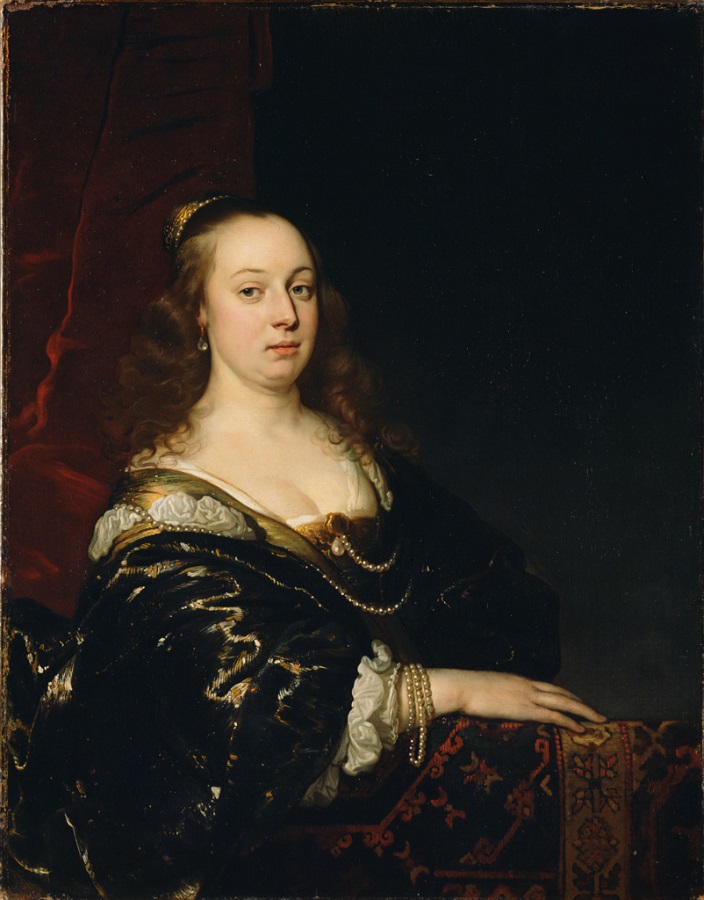
These younger artists benefited mightily from Rembrandt's teaching and example. They kept an eye on changes in taste among the art-buying public, as can be seen in Jacob Backer's elegant, bejeweled Portrait of a Woman, painted around 1647.


Jacob Backer, Portrait of a Woman, ca. 1647

This shift to an easier-on-the-eye mode of painting became known as the "bright style." Flinck, as noted in the exhibition catalog, was a pioneer of the lighter tones and close attention to surface detail which soon "supplanted Rembrandt's earthy palette and rough brushwork as the choice of a newly sophisticated clientele."

Rembrandt ignored these fickle alterations of taste. He took his teaching duties seriously, working so closely with his students that it is often difficult to ascertain who was the primary painter of some of the most celebrated works attributed to him. One of the "icons" of the National Gallery of Art in Washington D.C., A Girl with a Broom, was almost certainly completed by Carel Fabritius around 1651. 


           Rembrandt van Rijn, A Girl with a Broom, ca. 1646/1648;        
  completed 1651, possibly by Carel Fabritius

Rembrandt's willful, heedless character also played a significant part in his undoing.  Boldly signing his canvases with his first name only, Rembrandt claimed a place at the pinnacle of the Dutch cultural elite. It was a rarefied, vulnerable position for a miller's son, with a steep drop and no safety net should he fail and fall.

One of the principal themes of Rembrandt in Amsterdam is the process by which Rembrandt established his "brand" to use modern terminology. His successful transition to Amsterdam was based on his evolution from being primarily a "history" painter to embracing "the ideal of the universal master, proficient in all aspects of his craft."

Though a recognizable brand, a Rembrandt painting was never a standardized, "pre-fab" production. As Stephanie Dickey notes, Rembrandt's "approach was disruptively fluid: group portraits became action scenes, lofty historical figures were brought down to earth and the flat Dutch landscape gained a numinous mystery through nuanced effects of light."


Rembrandt van Rijn, Landscape with Stone Bridge, 1638

Rembrandt's life-sized portrait of Andries de Graeff (1611-1677) is a notable example of his "disruptively fluid" approach to painting. What appears to be a forthright likeness of an imperious, worldly gentleman is loaded with complex, contrarian details. 


Rembrandt van Rijn, 
Portrait of a Standing Man (Andries de Graef), 1639

De Graef came from a very prominent, powerful family. His austere black garments proclaim his wealth, as the color black was difficult and expensive to dye on to cloth. His simple, linen collar (as opposed to an elaborate neck "ruff") shows de Graef's allegiance to the populist political faction who were opposed to granting too much power to the central government led by the Stadtholder.

Likewise, de Graef's glove, fallen to the ground, might represent a nonchalant disregard for formality. Or, it might suggest a gauntlet thrown down as a challenge. De Graef, who rose to be finance minister of Holland, 1652-57 and mayor of Amsterdam, 1657-1672, was certainly a man to be reckoned with. Rembrandt's bravura portrait clearly asserts this, even as he leaves us to ponder  some of the puzzling details of the painting and its protagonist.

The exploration of character, of the man or woman behind the mask of facial features, is the supreme attribute of Rembrandt's portraits. The work from Rembrandt's early career which best exemplifies this is Portrait of a Man Holding a Black Hat (1637). 


Rembrandt van Rijn, Portrait of a Man Holding a Black Hat, 1637 

The skillful interplay of light and shadow on the garments of this unknown man is matched by the duality of Rembrandt's handling of his face. The competing aspects of human character, of our capacity for good or evil, are here delineated in portrait painting at the very summit of artistic skill.

Rembrandt's productivity as a portrait painter began to lapse in the 1640's. Instead, he continued with character explorations, increasingly of family members or of himself. These now rank among the greatest glories of world art.


Rembrandt van Rijn, Portrait of Hendrickje Stoffels, ca. 1654-56

However, portraits of his wife, Saskia, or later of his mistress, Hendrickje Stoffels, were not commercially viable works of art. This was especially true of paintings of Hendrickje, by then Rembrandt's common-law wife, who was denounced in 1654 by Dutch Reformed Church officials for living as a "whore."

As Rembrandt rose in the world, so did his taste for the finer things of life and for the money to pay for them. This led him to make a serious miscalculation, centered on one of the major works on view in Rembrandt in Amsterdam.

In January 1639, Rembrandt wrote to Constantijn Huygens (1596-1687), the secretary to the Statholder, Frederik Hendrik, announcing that he had finished an official commission of two paintings depicting the death and resurrection of Jesus. Huygens had been an early admirer of Rembrandt and had done much to advance his career. In the letter, Rembrandt mentioned that he was sending a major work of art by way of thanking Huygens for his patronage.


Gallery view of Rembrandt in Amsterdam,
showing The Blinding of Samson (left) and Venus and Cupid Lamenting the Dead Adonis by Cornelis Holsteyn, 1655    

The gratis painting was The Blinding of Samson, created in 1636. It is a spectacular work of art, as can be seen in the exhibition gallery at the Städel Museum. It is also a singularly unpleasant painting, graphically depicting one of the most notorious acts of betrayal and cruelty in the Bible. 


Rembrandt van Rijn, The Blinding of Samson, 1636

Although technically brilliant, The Blinding of Samson is so repellent that Rembrandt's reason for selecting it as a gift to Huygens needs to be questioned. 

Was Rembrandt's motive in sending the painting really a demonstration of gratitude? Or was he aiming to add Huygens to the list of influential patrons with a "Rembrandt" in their collection? Rembrandt actually had the temerity to advise Huygens how to hang The Blinding of Samson on the walls of his home. Once installed, bragging-rights and enhanced sales would be insured.

Huygens, in fact, declined the gift, most likely because it could be interpreted as a bribe. Yet Rembrandt insisted that he accept the painting. It is not certain that Huygens did so, though Christopher White, one of Rembrandt's most knowledgeable biographers, believes he did. If so, it was a costly victory for, as White notes, Huygens completely ignored Rembrandt "for the last thirty years of his life."

This unfortunate incident occurred in the same year that Rembrandt purchased a palatial house in Amsterdam. To do so, Rembrandt secured the first of many loans to pay the 13,000 guiders needed to buy his new home. If Rembrandt considered the idea that he should trim his personal expense account or paint more portraits to stay out of debt, he soon brushed the thought aside.

Rembrandt clearly was tempting fate by offending Huygens and by living  beyond his means. But such foolhardy conduct needs to be considered in light of his incredible artistic output and the awesome level of achievement which occurred as he began edging toward financial and personal disaster in the years before his 1656 bankruptcy.

Although his portrait production diminished over the course of the 1640's, Rembrandt created some of the most awesome paintings of his career during this decade, including The Night Watch (1642) and Christ and the Woman Taken in Adultery (1644). The magnitude of these works need to be considered alongside Rembrandt's investment of time, talent and effort in the wide-ranging sketching and printmaking of these years.

Not since Albrecht Dürer had any artist attempted to create prints of such profound beauty and technical sophistication.  No artist, since Rembrandt, has even come close to the measure of the Dutch master's success in works on paper. 

It is one of the many virtues of the exhibition catalog, published to the highest production values by Yale University Press, that Rembrandt's drawings and etchings are given equal prominence to his paintings. The selection of these works on paper and the detail and clarity on the pages of the catalog is superlative.


Rembrandt  van Rijn, The Three Trees, 1643

The Three Trees, 1643, deserves special consideration, as it unites several strands of thought and study regarding Rembrandt as his troubles continued to mount. It is an elaborate work, an etching with drypoint and engraving on laid paper. Does it represent an actual location visited and sketched by Rembrandt?

Rembrandt is known to have gone on walking/sketching rambles but the hundreds of drawings he made as strolled along the streets of Amsterdam or hiked about its suburbs rarely served as direct sources for commercial works like his etchings. The thatched cottages is this pen and brown ink drawing, now in the Getty Museum collection, almost certainly were on-the-spot depictions of humble dwellings.


Rembrandt  van Rijn,
Two Thatched Cottages with Figures at a Window, ca. 1640. 

Rembrandt most likely did see and sketch a copse of trees, similar to these cottages. These drawings were stored in binders - and in his memory - for future reference. But Rembrandt's landscapes, whether The Three Trees or the earlier oil painting, Landscape with Stone Bridge, are imagined spaces, typical rather than topographically accurate landscapes.

As Rembrandt sketched from nature, he likely communed with the spirit of his beloved Saskia, or at least brooded on her passing in 1642. The catalog includes a very poignant drawing of Saskia Asleep in Bed, dating to the time of her last illness. It may, indeed, show Saskia on her deathbed.

The Three Trees is an "imagined" landscape, a place of emotional solace as Rembrandt grappled with Saskia's death and his other woes. 


Rembrandt  van RijnThe Three Trees, 1643
 (detail from the Metropolitan Museum of Art version of the etching)

With this incomparable etching, Rembrandt attempted to depict an ideal setting, where earth and sky join "hands" and thoughts on human mortality could be seen from a more enduring perspective. The Three Trees, perhaps, represents a vision of paradise transplanted to a field on the outskirts of Amsterdam.

God made the world, as the old proverb proclaims, but the dike-building, marsh-draining Dutch created Holland. Reflecting on The Three Trees, its hard to resist the conclusion that Rembrandt was trying to lend a hand to God and the Dutch in both endeavors.

***

Text: Copyright of Ed Voves, all rights reserved

Introductory image: Rembrandt van Rijn (Dutch, 1606-1669) Self-portrait in a Velvet Beret,1634. Oil on oak panel:  58.3 cm (22.9 in) x  47.4 cm (18.6 in). Staatliche Museum zu Berlin, Gemäldegalerie #810.

Rembrandt van Rijn (Dutch, 1606–1669) Nicolaes Ruts, 1631. Oil on panel: 46 x 34 3/8 in. (116.8 x 87.3 cm). Purchased by The Frick Collection, 1943. #1943.1.150

Gallery view of the Rembrandt in Amsterdam exhibition at the Städel Museum, Frankfurt am Main, Germany. Photo courtesy of the Städel Museum.

Jacob Backer (Dutch, 1608-1651) Portrait of a Woman, ca. 1647. Oil on canvas: 95.3 × 74.9 cm (37 1/2 × 29 1/2 in.) Getty Museum. Gift of J. Paul Getty. #71.PA.18

Rembrandt van Rijn (Dutch, 1606-1669)  A Girl with a Broom, probably begun 1646/1648 and completed 1651, possibly by Carel Fabritius. Oil on canvas: 107.3 x 91.4 cm (42 1/4 x 36 in.)  National Gallery of Art. Andrew W. Mellon Collection.  Accession Number 1937.1.74

Rembrandt van Rijn (Dutch, 1606-1669) Landscape with Stone Bridge, 1638. Oil on panel: 29.5 cm × width 42.5 cm × depth 5.5 cm. Rijksmuseum, Amsterdam. Purchased 1900 SK-A-1935

Rembrandt van Rijn (Dutch, 1606-1669) Portrait of a Standing Man (Andries de Graef), 1639. Oil on canvas: 200 cm (78.7 in) x 124.2 cm (48.8 in). Hessen Kassel Gemaldegalerie Alte Meister. #GK 239.

Rembrandt van Rijn (Dutch, 1606-1669) Portrait of a Man Holding a Black Hat, 1637. Oil on panel: 31 5/16 x 27 5/16 in. (79.5 x 69.4 cm). The Armand Hammer Collection, Gift of the Armand Hammer Foundation. Hammer Museum, Los Angeles, AH.90.59

Rembrandt van Rijn (Dutch, 1606-1669) Portrait of Hendrickje Stoffels, ca. 1654-56. Oil on canvas: 101.9 x 83.7 cm. National Gallery, London. Bought with a contribution from the Art Fund, 1976. Inventory number NG6432

Gallery view of Rembrandt in Amsterdam, showing The Blinding of Samson (left) and Venus and Cupid Lamenting the Dead Adonis by Cornelis Holsteyn, 1655. Photo courtesy of the Städel Museum.

Rembrandt van Rijn (Dutch, 1606-1669) The Blinding of Samson, 1636. Oil on canvas:  219.3 x 305 cm. Städel Museum, Frankfurt am Main. Inventory #  1383.

Rembrandt van Rijn (Dutch, 1606-1669) The Three Trees, 1643. Etching with drypoint and engraving on laid paper: 21.8 x 28.7 cm; plate: 20.8 x 28 cm. National Gallery of Canada, Ottawa, purchased 1939.

Rembrandt van Rijn (Dutch, 1606-1669) Two Thatched Cottages with Figures at a Window, ca. 1640. Pen and brown ink, corrected with white gouache: 13.3 × 20.2 cm (5 1/4 × 7 15/16 in.). Getty Museum. Object # 85.GA.93.

Rembrandt van Rijn (Dutch, 1606-1669) The Three Trees, 1643. (Detail from the version of the etching in the collection of the Metropolitan Museum of Art, NYC.

Saturday, July 28, 2018

A World of Art: Art Eyewitness Fifth Anniversary


A World of Art 

Art Eyewitness Fifth Anniversary

2013-2018


By Ed Voves
Photos by Anne Lloyd

Why do people create? Why do people "do" art? After five years of working on Art Eyewitness, I'm no closer to understanding the wellspring of creativity than when I started this blog in 2013.

Five years, on a human timeline, is both a short interval and a sizable chunk of life. It seems appropriate to reflect upon what have I seen and shared about art in these five years. But in taking stock of how much more I "know" about creativity, then I'm forced to confess to being "five years older and not a bit wiser." 


I am not alone when it comes to being mystified about creativity and the arts. Leonard Bernstein, whose centennial is being celebrated with a wonderful exhibit at the National Jewish Museum in Philadelphia, reflected upon the spark of creativity and declared:


That, thank Heaven, is still a glorious mystery; and it is a mystery that enshrouds every good artist I know, rich or poor, successful or not, old or young. They write, they paint, they perform, produce, whatever, because life to them is inconceivable without doing so.


Bernstein went on to plead with God to " leave us this one mystery, unsolved: why man creates."


The great maestro's prayers have so far been answered. The mystery of human creativity still eludes us, as it did during Rembrandt's final, tragic decade. 


Rembrandt, The Jewish Bride, 1665

Why did Rembrandt continue to paint, as his world crashed down about him during the 1660's? Bankrupt, his style no longer popular with middle class patrons, haunted by the death of his son,Titus, the chain of disaster was only broken by his death in 1669. Yet, during this time of woe, Rembrandt created the supreme masterpieces that were displayed in the 2014 exhibit at London's National Gallery. 

How Rembrandt painted such works is no mystery. Why he did it, is.

I couldn't agree more with the sentiments of Bernstein's plea that the question of creativity remain unresolved. Art Eyewitness is an attempt to understand how people create in the realm of the visual arts rather than why they do so.

Yet, the voice of why keeps trying to make itself heard.

Bernstein's comment that "life to them (artists) is inconceivable" without art is absolutely true. I would add that art is also a way for human beings to make death conceivable.


        Anne Lloyd, Photo (2016) Gallery view of the Metropolitan Museum of Art        (Center) Fragmentary Colossal Marble Head of a Youth, 2nd century B.C.

So much of the art that I have studied and written about over the past five years can be traced to the effort to comprehend the mysteries of life and death - and life hereafter.  The ancient Greek quest to "know thyself" constantly encounters the even more ancient Egyptian concern to secure the eternal well-being of the soul, the ka.

Transience or transcendence. We see these epic themes on display in great art museums and their wonderful special exhibits. We see these themes at work in our daily lives and in the special challenges that life sends our way. To properly understand art, you need to see works of art in person and in the company of other people, who are grappling with their own daily dose of "outrageous fortune."


    Anne Lloyd, Photo (2018)
   Gallery view of the Greek & Roman Galleries at the Metropolitan Museum of Art           
A quiet moment at the Metropolitan Museum a few months ago reinforced how vital is the companionship of other museum patrons to appreciating art. Here in the Greek and Roman galleries, some students were sketching a statue of Hercules. Here, I could see the Greek and Egyptian quests for self-awareness and spiritual transcendence taking place. Art was happening.

Down the hall, curators at the Metropolitan were at work setting mannequins in place for the Heavenly Bodies: Fashion and the Catholic Imagination exhibit. I was struck by the subversive thought that the draped mannequins had a tale of their own to tell before being adorned in high style for the exhibit.


Anne Lloyd, Photo (2018) Gallery view of preparations for the Heavenly Bodies Exhibit

The sight of those mannequins, "blithe spirits" hovering in the Met gallery, made me think of all the generations of patrons and art lovers who have climbed the steps and thronged the galleries of the Met, of the Philadelphia Museum of Art, of your favorite art museum wherever it may be. 


Anne Lloyd, Photo (2018)
Modern Times: American Art, 1910-1950, Phila. Museum of Art

Patrons come to art museums to sketch or to paint, to commune with the higher spirits, to know themselves, to write a school term paper, to record their experience with digital photos, to have fun.

All of these activities are part of the process of sharing in art. I plan to do an essay at some point about the role of the art patron, but for now I can't think of a better work of art to symbolize the paramount importance of the art lover/patron than Woman Viewed from Behind (Visit to a Museum) by Edgar Degas. 


Edgar Degas, Woman Viewed from Behind (Visit to a Museum), c. 1879-1885

In true Impressionist style, Degas gives a only suggestive hint of the paintings on the gallery wall. Here - and always - it is the interaction of the art lover with the work of art that really matters. Art appreciation is how a patron experiences art.

It is a rich and rewarding experience to be able to view, study and reflect upon a work of art and then come back for another look. I always pay a visit to Jules Bastien-Lepage's Joan of Arc.


Jules Bastien-Lepage, Joan of Arc, 1879

Painted in 1879, this image of the Maid of Orleans and her heavenly visitors is one of the oldest works of art in the collection of the Metropolitan Museum of Art. It was a favorite of my mother's and I always experience something new or meaningful about life when I see it.

The "experience" of art in special exhibitions is even more compelling and immediate because there will never again be an exhibit quite like the one you are seeing right now. This moment.

Special exhibitions at art museums take years to plan and organize. In the case of the fantastic 2017 Michelangelo exhibit at the Metropolitan Museum, the curator, Dr. Carmen Bambach, worked for eight years to secure the nearly two hundred works of art which appeared in the exhibit. Never before had so many of Michelangelo's drawings and smaller sculptures appeared in one exhibition. Never have the ceiling frescoes of the Sistine Chapel been so convincingly evoked than by the lighted scale model on view in the Met's exhibition galleries.


Anne Lloyd, Photo (2017) Gallery view of Michelangelo: Divine Draftsman and Designer

"This moment" for Michelangelo: Divine Draftsman and Designer lasted three months. It is safe to say that there will not be such a vast and brilliantly curated exhibit devoted to the work of Michelangelo for many years, perhaps decades. Eight years work for a three month display is a sobering thought.

That's where Art Eyewitness comes in. The aim of this blog is to spread the word about great exhibitions like Michelangelo: Divine Draftsman and Designer. We encourage art lovers to make the pilgrimage to see for themselves. Just as importantly, Art Eyewitness aims to make available a "virtual visit" to these exhibits for those unable to make the trip.

It has been - and continues to be - a great experience to recreate the sights and spirit of these magnificent evocations of human genius and creativity. Beginning with a visit in July 2013 to Diaghilev and the Ballets Russes, 1909–1929 at the National Galley in Washington D.C., Art Eyewitness aims to share the appreciation of art from all cultures and historical epochs.


Valentin Serov, Ballet Russes poster showing Anna Pavlova from Les Sylphides, 1909

It is rather ironic that the first review of Art Eyewitness dealt with Serge Diaghilev (1872-1929). Before he became the impresario of the ballet world, Diaghilev co-founded the art magazine, Mir iskusstva in 1899. Diaghilev's endeavor included mounting art exhibitions and lectures in order to promote liberal cultural values in Russia and ultimately throughout the world.

Mir iskusstva  translates as "World of Art." What Diaghilev and his colleagues, the miriskusniki, endeavored  to achieve, the curators and exhibit design teams of our great museums are doing now. These visionary and incredibly accomplished people open up the World of Art to us.

Trying to pick "stand-out" exhibitions from the crowded canvas of Art Eyewitness reviews is a foolhardy enterprise. I won't try to do so. Instead, I will highlight three: Lost Kingdoms: Hindu-Buddhist Sculptures of Early Southeast Asia, 5th to 8th Century at the Metropolitan Museum of Art (2014), Power and Pathos: Bronze Sculpture of the Hellenistic World at the National Gallery of Art in Washington D.C. (2015) and Charlotte Brontë: an Independent Will at the Morgan Library and Museum (2016).


Buddha Offering Protection, Pre-Angkor period, 6th century

These exhibitions opened a portal to the respective historical periods being surveyed. I knew little about the art of the bygone realms of ancient Asia when I walked into the astonishing Lost Kingdoms exhibit gallery at the Met. When I left, I felt as if I had been transported to these Hindu and Buddhist kingdoms and I wanted to learn more.


Anne Lloyd, Photo (2016) Gallery view of Charlotte Brontë: an Independent Will

Though I am more familiar with Victorian England and a huge fan of the Brontës, my mental and spiritual universe was expanded by the sensational Morgan exhibit celebrating the two hundred year anniversary of the birth of Charlotte Brontë. That might sound like extravagant praise but in the case of Charlotte Brontë: an Independent Will it was thoroughly deserved.

There was a powerful religious element to Lost Kingdoms. Likewise, Charlotte Brontë was not just a strong-willed woman, an early feminist according to current views. She was a devout Christian. Divinity and the human craving for transcendence cannot be ignored. 

This phenomenon accounts for the rejection of classical art forms during the later stages of the Roman empire. Depictions of the Greek ideal of the "body beautiful" were discarded for a less sophisticated, yet intensely devotional art. 


Unknown Artist, Portrait Statue of an Aristocratic Boy, 27 BC-AD 14

For over a thousand years, religious icons and images were the supreme statements of Western art. This was a theme I addressed in several Art Eyewitness posts, notably Power and PathosBronze Sculpture of the Hellenistic World.


Crucifixion, Panel of the Maskell Passion Ivories, C. 420-430 AD

To offer a "virtual visit" to these great exhibits, as I mentioned earlier, would be an empty gesture were it not for the phenomenal photos which my wife, Anne Lloyd, has been taking for Art Eyewitness since the summer of 2014. 


Anne Lloyd, Photo (2018) Gallery view of the Philadelphia Museum of Art
Rodin's Thought is in the foreground, Renoir's Portrait of Madam Renoir behind

Anne is an accomplished artist in several media. Thanks to her skill with a camera and her artist's eye, Anne has raised the level of visual reportage of Art Eyewitness to a superlative degree.

It was thanks to Anne's ability and determination that Art Eyewitness achieved what I (humbly) claim is a "show-stopper" caliber photo of the great David Hockney. The legendary Yorkshire painter appeared, unannounced, at the press preview of the Metropolitan Museum's Hockney retrospective in November 2017. Hockney was an illusive subject but Anne was not to be denied. 


Anne Lloyd, Photo (2017) David Hockney at the Metropolitan Museum, Nov. 20, 2017

"Astound me!" That quote from Serge Diaghilev to the set designers of the Ballet Russes were the opening words of my first review for Art Eyewitness five years ago.

Astound me!

Well, I have been astounded and inspired many times in the last five years. I hope for more such moments to come. It may, however, be outrageous to say in this blog devoted to art exhibitions, that you don't need to go to museums to be astounded by beauty. Just look out your front door.


Anne Lloyd, Photo (2017) Butterfly Garden, 2017
***

Text: Copyright of Ed Voves, all rights reserved                                                              Photos courtesy of Anne Lloyd, the Metropolitan Museum of Art, New York City, and the National Gallery of Art, Washington D.C.

Introductory Image
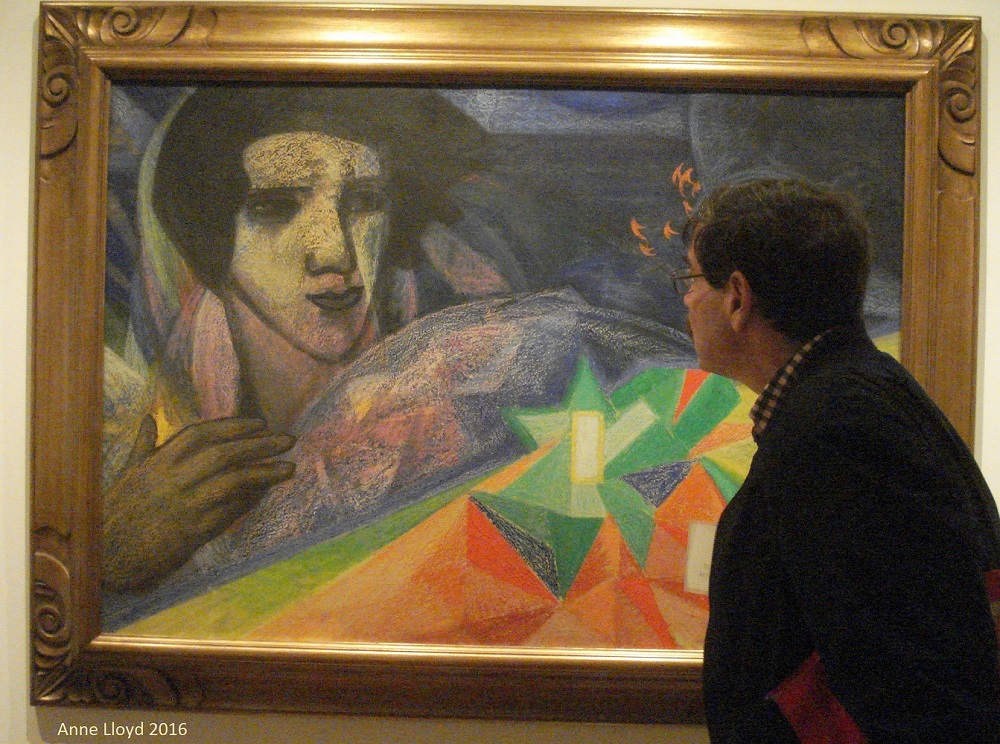
Anne Lloyd (2016), Gallery view of Paint the Revolution: Mexican Modernism, 1910–1950 at the Philadelphia Museum of Art, 2016. Painting shown is Pieta in the Desert by Manuel Rodriguez Lozano. Fresco (removed by strappo from Lecumberri Prison) 6 ' 6 3/8" x 7'  9/16" (2.6 x 2.3 m) Museo del Palacio de Bellas Artes, INBA, Mexico City

Rembrandt van Rijn (Dutch, 1604-1669) Portrait of a Couple as Isaac and Rebecca, known as ‘The Jewish Bride’, about 1665 Oil on canvas 121.5 x 166.5 cm Rijksmuseum, on loan from the City of Amsterdam (A. van der Hoop Bequest) © Rijksmuseum, Amsterdam. 

Anne Lloyd, Photo (2016), Gallery View of the Metropolitan Museum of Art, New York City, showing Fragmentary Colossal Marble Head of a Youth, Greek, Hellenistic period, 2nd century B.C. Discovered at Pergamon, on upper terrace of gymnasium, 1879. On loan from the Antikensammlung, Staatliche Museen zu Berlin (AvP VII 283) Cat. 58

Anne Lloyd, Photo (2018), Gallery View of the Greek and Roman Galleries at the Metropolitan Museum of Art, New York City.

Anne Lloyd, Photo (2018), Gallery View of Preparations for the Heavenly Bodies: Fashion and the Catholic Imagination exhibit at the Metropolitan Museum of Art, New York City.

Anne Lloyd, Photo (2018) Gallery view of the Modern Times: American Art 1910–1950 exhibit at the Philadelphia Museum of Arts.

Edgar Degas (French,1834 1917) Woman Viewed from Behind (Visit to a Museum), c. 1879-1885) Oil on canvas, 81.3 x 75.6 cm (32 x 29 3/4 in.) National Gallery of Art, Washington D.C. Collection of Mr. and Mrs. Paul Mellon, # 1985.64.11

Jules Bastien-Lepage (French, 1848–1884) Joan of Arc, 1879. Oil on canvas, 100 x 110 in. (254 x 279.4 cm) The Metropolitan Museum of Art, New York, Gift of Erwin Davis, 1989 (89.21.1 ). Image © The Metropolitan Museum of Art

Anne Lloyd, Photo (2017) Gallery view of Michelangelo: Divine Draftsman & Designer exhibition at the Metroplitan Museum of Art, New York City.

Valentin Serov (Russian, 1865-1911) Anna Pavlova from Les Sylphides, poster for the first Russian season, 1909. Color lithograph framed:  256.2 x 201.5 cm (100 7/8 x 79 5/16 in.)  V&A, London. Displayed at the Diaghilev and the Ballet Russes, 1909-1929 exhibit at the National Gallery of Art, Washington D.C., 2013)

Buddha Offering Protection, Southern Cambodia, Pre-Angkor period, second half of the 6th century. Sandstone with traces of lacquer and gilding. Lent by the National Museum of Cambodia, Phnom Penh, to the Metropolitan Museum of Art for the 2014 exhibit, Lost Kingdoms: Hindu-Buddhist Sculptures of Early Southeast Asia, 5th to 8th Century

Anne Lloyd, Photo (2016) Gallery view of Charlotte Brontë: An Independent Will (the "Thackeray dress") at the Morgan Library and Museum, New York City. 2016.

Unknown Artist, (Hellenistic Bronze), Portrait Statue of an Aristocratic Boy, 27 BC-AD 14, Bronze, H 132.4 cm; W 50.8 cm D 41.9 cm Lent by The Metropolitan Museum of Art, inv. no 14.130.1

Unknown Artist, Crucifixion, Panel of Maskell Passion Ivories, Circa 420-430 AD, Carved Ivory, H: 75 mm W: 98 mm W: 106 grams, British Museum, 1856,0623.5

Anne Lloyd, Photo (2018) Gallery view of the Philadelphia Museum of Art

Anne Lloyd, Photo (2017) David Hockney at the Metropolitan Museum, Nov. 20, 2017

Anne Lloyd, Photo (2017) Butterfly Garden, 2017.


Thursday, September 21, 2017

Art Eyewitness Essay: Toys R Art


Toys R Art

Some Thoughts on the Role of Toys in the Art World


Text by Ed Voves  

Photo Essay by Anne Lloyd

Sometimes a visit to the art museum presents a difficult choice. Should I go see the exhibit or check out the gift shop first. The temptation to follow the latter course is often irresistible.

The recent Wild: Michael Nichols exhibit at the Philadelphia Museum of Art is a case in point. The inventory of the gift shop reflected Nichols' status as one of the world's greatest nature photographers.  A vast herd of animal-themed toys thronged the shelves and display racks. Floor to ceiling, lions, tigers, bears and a stray elephant or two were everywhere. 


Anne Lloyd (Photo 2017), Philadelphia Museum shop for Wild: Michael Nichols 

These Wild toys reinforced a growing interest in toys since I reviewed the Embracing the Contemporary exhibit at the Philadelphia Museum of Art. This exhibition of modern art, collected by Keith and Katherine Sachs, included a tiny wooden toy box filled with miniature toys. This small wonder was crafted by Charles LeDray in 2005-06. I had a much bigger version of such a toy box as a child, long gone - but not forgotten.


Anne Lloyd (Photo 2016), Toy Chest, 2005–6, by Charles LeDray

In my 2016 review of Embracing the Contemporary, I wrote:

Looking at LeDray's wondrous work of art, I was stuck by the thought that we begin to collect memories as children and continue to do so throughout our lives. This in turn leads to a point when we are moved to share our emotional riches with others.

Lately, my wife Anne has been going on photo "safaris," chiefly of the many remarkable gardens of our Philadelphia neighborhood. Anne stopped in to the local Salvation Army store during one of her expeditions. A creative moment, relating to my toy box meditations, ensued.


Anne Lloyd (Photo 2017), Salvation Army Store, Philadelphia PA

When you go into the Salvation Army store, you are confronted by row upon row of cleaned, if slightly time-worn, clothing. On top of some of the metal shelves are trays of cast-off stuffed animals. Once these were treasured companions of a little Jane or Johnny. Kids grow-up and outgrow their playthings. Computer games take the place of plush animals. Time marches on.

Anne started snapping photos and then began rearranging the stuffed animals into little "photo-op" scenes. Evidently, someone else had a similar idea earlier. Anne found a lion and a lamb sharing a shelf. With a little propping-up, predator and prey were reconciled and ready to pose again for a new incarnation of the Peaceable Kingdom.  


Anne Lloyd (Photo 2017), Peaceable Kingdom at the Salvation Army Store

These discarded toys are especially affecting and poignant because they were once loved by children. Some resonance of this love clings to them still. I sensed that when I saw the first batch of photos that Anne took. When I went with Anne for a return visit, I was amazed to see the transformation for myself. 

Anne's careful groupings of these toys seemed to bring them to life. Something struck a chord or touched a nerve in me. Those inanimate objects really appeared to be awakening to the kind of life they once enjoyed in the company of young children. 

Toys play a really important part in children's lives. I'm not referring here to toys that have a clearly "educational" role - which most kids instinctively reject. 


Anne Lloyd (Photo 2017), Monkey Friend at the Salvation Army Store

A smiling monkey doll, like this one, is more life affirming. It helps a young child adjust to the world, to identify, appreciate and respond to kindness and love in the immediate family circle. 

Then comes the next import step, to appreciate and love beyond the family unit.

The big, beaming smile that spreads across this monkey's silly mug also appears on the face of Frans Hals' Fisher Boy with a Basket. Why did the cash-strapped Hals paint a picture of an impoverished working-class kid with a toothy smile?  He cannot have made much money selling this or the other versions of street urchins that he did.


Frans Hals, Fisher Boy with Basket, ca. 1630

I believe that Frans Hals and his compatriots in Golden Age Holland could appreciate a smile on a poor boy's face because their society invested so much in the well-being of children.  This regard for others which Dutch children learned early in their lives was a social "glue" which helped the United Provinces survive repeated invasions and internal stresses that would have wrecked less well-adjusted societies during the 1600's.


Artists and writers have been imparting human attributes to animals since Aesop.That's certainly a comforting thought. Perhaps my reflections on stuffed animals and art are not quite so “off-beat” after all!

On second thought, the ridiculous elements in life need to be cherished in art along with the sublime. Take a look at these Salvation Army recruits and try and keep a straight face. The kooky clown in his fright wig and the teddy bear and panda posing for a selfie. Just fun! Purely, simply fun!


Anne Lloyd (Photo 2017),  Candid Photography at the Salvation Army Store! 

I've come to believe that a totally serious approach to art isn't always necessary - or even wise all the time. Not that I'm in favor of drawing a mustache on the Mona Lisa, either.


Anne Lloyd (Photo 2017), "Photo-Op" at the Salvation Army Store

Here is a demonstration of what I mean. Anne arranged a troop of the Salvation Army critters for a group portrait. The cartoon expressions of these beasties range from befuddlement and alarm to kindly acceptance. It is truly a very funny tableau.

Where have we seen such a range of emotion in the art world?


Rembrandt, The Syndics of the Clothmakers Guild, 1662

Rembrandt's Syndics of the Clothmakers Guild? Surely I jest! 

Yes, but Syndics of the Clothmakers Guild is based on an underlying strata of humor. According to the most accepted interpretation of Syndics, Rembrandt depicted these officials responding to a challenging question during a policy-making meeting. It records a rather uncomfortable moment.

Syndics is unquestionably a masterpiece. But it is also a warm, funny evocation of the human comedy. From the suspicion and startled dignity of several of the syndics to the bemused look of the secretary behind them, we glimpse faces of men who have let the mask of officialdom slip down. For once, we see them, not as a group of "stuffed shirts," but as decent, if fallible, mortals like ourselves.

I suspect that there is a cartoon character or two in all of us. We don't need to arrange stuffed animals and find parallels with masterpieces like Rembrandt's Syndics to put a smile on our faces. Sometimes, a great painting will produce that effect without the need for props.

Titian was not especially well known for his sense of humor. Yet, in his Supper at Emmaus, Titian included a confrontation between a snappy, combative little dog and a gray tabby cat, poking its head under the table cloth.


Titian, The Supper at Emmaus,  ca. 1530

The Supper at Emmaus is one of the key events of Christian history. Following Jesus' crucifixion, two disciples met a stranger on the road to the village of Emmaus, a day's journey from Jerusalem. This of course was Jesus, risen from the dead. The disciples only recognized him when he blessed the bread for dinner. The story appears in the Gospel of St. Luke.


Titian, The Supper at Emmaus (Detail)

Nowhere does St. Luke mention a dog and a cat at the table at Emmaus. Other artists, Caravaggio and Rembrandt, painted this scene without any animal intervention. Why did Titian do so?

The first owners of this painting were the Maffei family from Verona, rather than a Catholic religious order. Perhaps, Titian wanted to include a homey detail or to show that the trifling details of life do not stop even when the Divine Presence is being manifested. 

Whatever the case, Titian demonstrated that humor has a secure place in great art.

Anne and I spent a delightful half-hour arranging the Salvation Army animals for their "photo shoots."  One of the plush animals, a sweet, demure mouse, called to mind the subject of one of Renoir's greatest portraits. Renoir painted Adelphine Legrand in 1875, the year after the First Impressionist Salon and its dissappointing sales.


Pierre-Auguste Renoir, Portrait of Mademoiselle Legrand, 1875

Adelphine Legrand was eight years old when Renoir painted her. This sweet, demure girl was just at the point in her life when she would no longer be a child but rather be Mademoiselle Legrand.

Adelphine's dolls and toys, counterparts of this little mouse, would have had to be set on the shelf or given away. This is part of the price of growing up and I could not help but reflect that this particular toy mouse surely had been loved and cherished by a modern-day Adelphine only a short time ago.


Anne Lloyd (Photo 2017), Mouse Friend at the Salvation Army Store

Life passes swiftly. Pleasant interludes such as Anne and I spent at the Salvation Army store come to an end almost as soon as they begin. 

Yet occasions for humor, joy and inspiration should be cherished, however brief and wherever these take place. A museum gallery or an aisle in a Salvation Army store. You never know when or where an "art moment" may occur.


***

Text: Copyright of Ed Voves, all rights reserved. Images courtesy of the National Gallery of Ireland, Rijksmuseum, the Louvre and the Philadelphia Museum of Art, via Creative Commons. Gallery and  Salvation Army Store images courtesy of Anne Lloyd.

Introductory Image:
Anne Lloyd (Photo 2017), Second-hand Toys at the Salvation Army Store, Philadelphia PA, September 2017.
Anne Lloyd (Photo 2017),  Museum shop for the Wild: Michael Nichols exhibit, Philadelphia Museum of Art, June 2017.  
Anne Lloyd (Photo 2017), Toy Chest, 2005–6, by Charles LeDray. Mixed-media object from the Keith and Katherine Sachs Collection. Promised gift to the Philadelphia Museum of Art.
Anne Lloyd (Photo 2017), Salvation Army Store, Philadelphia PA , September 2017.   
Anne Lloyd (Photo 2017), Peaceable Kingdom at the Salvation Army Store, Philadelphia PA , September 2017.    
Anne Lloyd (Photo 2017), Monkey Toy at the Salvation Army Store , Philadelphia PA, September 2017.                     
Frans Hals, (Dutch, 1581-1666) Fisher Boy with Basket, ca. 1630. Oil on canvas, 72 cm × 58 cm (28 in × 23 in). National Gallery of Ireland, Dublin. Purchased in 1881. NGI.193.
Anne Lloyd (Photo 2017), Second-hand Toys at the Salvation Army Store, Philadelphia PA . Three photos taken during September 2017.
Rembrandt van Rijn (Dutch, 1606–1669) The Syndics of the Cloth Makers Guild, about 1662 Oil on canvas,191.5 x 279 cm. © Rijksmuseum, Amsterdam (SK-C-6).
Titian (Italian, 1490–1576) The Supper at Emmaus,  ca. 1530. Oil on canvas. 169 cm (66.5 in). Width: 244 cm (96.1 in). Louvre, Paris. Inventory # 746.
Pierre-Auguste Renoir (French, 1841–1919) Portrait of Mademoiselle Legrand, 1872, Oil on canvas, 32 x 23 1/2 inches, 81.3 x 59.7 cm. Philadelphia Museum of Art, The Henry P. McIlhenny Collection in memory of Frances P. McIlhenny, 1986, (1986-26-28)  Image: © The Philadelphia Museum of Art.
Anne Lloyd (Photo 2017), Mouse Toy at the Salvation Army Store , Philadelphia PA, September 2017.