Showing posts with label Impressionism. Show all posts

Monday, September 16, 2024

Art Eyewitness Review: Paris 1874, the Impressionist Moment


Paris 1874, the Impressionist Moment

 National Gallery of Art, Washington, D.C.

September 8, 2024–January 19, 2025

Reviewed by Ed Voves

 Visitors to the Paris 1874 exhibition at the National Gallery of Art in Washington D.C., no sooner walk through the entrance to the galleries than they are greeted by two of the greatest paintings of the nineteenth century. Both were contemporary works of art and were first exhibited the same year, one hundred and fifty years ago. The sesquicentennial observance of the First Impressionist Exposition, which opened on April 15, 1874, serves as the inspiration for this outstanding exhibition.

Paris 1874, the Impressionist Moment is a collaborative effort of the National Gallery and the Musee d’Orsay, Paris. A dazzling array of 125 works of art, predominantly paintings and a selection of sculptures, from the rich collections of both museums is complemented by significant loans from other institutions. The lenders include the Museum of Fine Arts, Boston, the Musée Marmottan in Paris and the Stadel Museum of Frankfurt, Germany.


Ed Voves, Photo (2024)
 Gallery view of the Paris 1874: the Impressionist Moment exhibition 

This is a beautifully mounted exhibition which devotes equal attention to the Paris Salon of 1874 and the first Impressionist exhibit. The curators wisely chose to integrate Salon and Impressionist artworks in thematic arrangements. Rather than confining works of art from the 1874 Salon and from the rival Impressionist presentation in separate galleries, the curators have evoked the cultural setting of 1870's France in which both of these legendary displays were held.


Ed Voves, Photo (2024) 
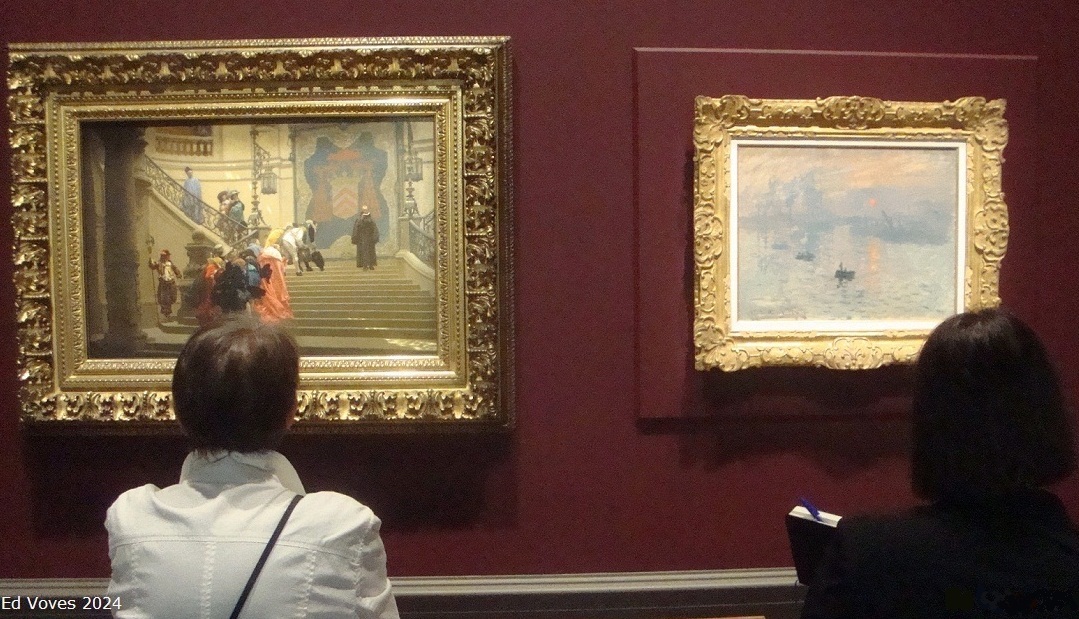
Gallery view of Paris 1874: the Impressionist Moment, showing Jean-Léon Gérôme’s L'Éminence Grise & Claude Monet’s Impression, Sunrise

The two paintings which introduce Paris 1874 - Jean-Léon Gérôme’s L'Éminence Grise (1873) and Claude Monet’s Impression, Sunrise (1872) were not on the best of terms one hundred-fifty years ago. 


Jean-Léon Gérôme, L'Éminence Grise, 1873


Claude Monet, Impression, Sunrise, 1872

Each of the paintings was displayed at a rival venue, one being the official Paris Salon, where Gérôme’s history painting was unveiled to popular acclaim. 

The other exhibition was presented by an artist cooperative known as the Société anonyme des artistes peintres, sculpteurs, graveurs, etc. The location of the exposition was the vacant studio of the photographer, Nadar, who had just moved to a new site. Nadar had earlier paid the rent for his old studio for the month of April 1874. Monet, Renoir, Degas, Pissarro, Cezanne and twenty-six other artists, most of them "refused" by the Salon, were thus enabled to mount their own exhibit.

It should be noted that one of the participating artists in the group presentation in Nadar's old studio was a young woman. Associating "with madmen ... at some peril" (as her art teacher wrote with horror) was Berthe Morisot. Her exquisite The Cradle, painted in 1872, was a highlight of the 1874 Impressionist exhibit. One of the treasures of the Musee d’Orsay, it is now on view in the National Gallery show.


Ed Voves, Photo (2024)
 Berthe Morisot’s The Cradle, 1872

Radically different, too, were the effects of the two exhibitions, immediate and long-term. Gérôme's L'Éminence Grise won the Salon's medal of honor. Monet's masterpiece earned a derisive sobriquet which was soon applied to the paintings of his colleagues, as well: Impressionist.

At the National Gallery, today, this contentious stand-off continues in the opening display of paintings.

Gérôme’s L'Éminence Grise and Monet’s Impression, Sunrise confront each other like two opposing duelists.


Ed Voves, Photo (2024) 
Gallery view of the Paris 1874 exhibit, showing Jean-Léon Gérôme’s L'Éminence Grise & Claude Monet’s Impression, Sunrise

Viewing L'Éminence Grise and Impression, Sunrise, one feels like a “second” at the duel. The paintings hang, not together on the gallery wall, but “back-to-back” in the manner of gentlemen defending their honor. They appear poised to walk the requisite ten paces, pistols in hand, turn and at the command -

Fire! 

As contrived, even absurd, as this may sound, the actual events surrounding the advent of Impressionism were even more contentious – and confused - than this imagined scenario conveys.

Jean-Leon Gérôme (1824-1904) was the greatest of French academic painters, whose meticulous scenes of history and oriental sensuality commanded huge prices. L'Éminence Grise accurately and evocatively recreates a famous story from French history. It is a brilliant example of the works of art which made Gérôme such a formidable figure in the nineteenth century art world.

Gérôme detested the “New Painting” innovations of the likes of Edouard Manet whom he scorned as “the apostle of decadent fashion, the art of the fragment..." Gérôme remained the implacable foe of Impressionism until the day he died.

Claude Monet (1840-1926) responded to Gérôme's traditionalism by a change of focus. He chose for his subjects nature at close hand and life in the modern metropolis. His urban paintings were immortalized by his sweeping vista of the Boulevard des Capucines, painted in late 1873. Monet's observation point for this truly-impressionistic work was the window of Nadar's studio where the first Impressionist exhibition was to be held a few months later.


Ed Voves, Photo (2024) 
Claude Monet’s Boulevard des Capucines,1873–1874

Monet and the Impressionists would eventually win the duel. But the struggle was not settled by a single "shot" or a pair of contrasting paintings.

One of the reasons for the rancorous rivalry between academic painters like Gérôme and Monet’s Anonymous Society of Painters, Sculptors, and Engravers, etc., was the legacy of actual warfare. The artistic events of 1874 occurred while the debris of the Franco-Prussian War and the radical uprising known as the Paris Commune was still being cleared from battlefields and barricades.

In 1870-71, France suffered shattering, unexpected defeat at the hands of Prussia/Germany. The experience of the Commune was, in many ways, even worse. Deep fissures had been revealed in French society. After the brutal execution of the archbishop of Paris, held hostage by the Communards, and the savage reprisals of the French army, these divisions could no longer be concealed.


Ed Voves, Photo (2024)
 Auguste Lancon’s Dead in Line, 1873

Nor do the curators of the National Gallery exhibit attempt to gloss over the effects of the 1870-71 disaster. A powerful painting of French war casualties entitled Dead in Line is presented not far from L'Éminence Grise and Impression, Sunrise. This work, by an artist named Auguste Lancon, has the searing effect of battlefield photos from the American Civil War.

The detail of the corpse of a French soldier in the foreground of Lancon's painting (below) reminds us of the death of Frederic Bazille in one of the final battles of the 1870-1871 war. A friend of Monet and Renoir and a fellow-painter, Bazille had been the first to propose a joint exhibition of the type eventually presented in April 1874.


In response to the horrors of the “terrible year”, traditionalists like 
Gérôme emphasized the need for depicting episodes from France's glorious past. Like the trumpet call of the medieval knight, Roland, heroic art works would summon Frenchmen to defend la patrie.

Monet and his compatriots took a more low-key approach. They favored scenes of “the heroism of everyday life.”

These remarks on the opposing ideals of Gérôme and his supporters (he was the son-in-law of the major art dealer, Goupil) and those of Monet and the Anonymous Society need some clarification.

 Disagreement there certainly was but the French art world was not divided into rigid, warring camps. Some of the works of art on view in the 1874 Salon shared artistic affinities with the paintings displayed on the walls of Nadar's ex-studio.


                                Ed Voves, Photo (2024)                                  
Charles Francois Daubigny’s The Fields in June, 1874


A good example of the "dialog" between the artists in the 1874 Salon and the Boulevard des Capucines "outsiders" is a sprawling landscape painted by Charles-Francois Daubigny (above). Entitled The Fields in June, Daubigny's painting is described by the exhibit wall text as an "expansive landscape" characterized by "loose brushwork, a bright palette and sense of immediacy."

In short, The Fields in June has all the hallmarks which we now ascribe to signature Impressionist landscapes by Monet, Sisley and Pissarro. Yet, Daubigny's vast painting was accepted for the 1874 Salon. Was exception made for him because he was a close friend of Corot, now a revered figure in France, or by virtue of his own age and long years of devotion to art?

There were so many exceptions and inconsistent decisions related to acceptance or rejection by the annual Salon committees that it is a good question if there were actual standards by which works of art were judged. 


Ed Voves, Photo (2024 ) 
Detail of Camille Cabaillot-Lassalle’s The Salon of 1874, 1874

Whatever the criterion for Salon decision-making in 1874, it is perplexing to consider Manet's unconventional (dare we say impressionistic) The Railroad (1873). This startling work, certainly to 1870's sensibilities, was accepted for display in the 1874 Salon. 

Manet submitted another painting to the1874 Salon. Masked Ball at the Opera conformed much more closely to the customary standards of pictorial composition. Yet, it was denied inclusion in the 1874 Salon.


Ed Voves, Photo (2024) 
Édouard Manet’s The Railway, 1873

The same fate befell Manet's pupil, Eva Gonzalez. The 1874 Salon accepted a clearly inferior work, The Pink Morning Gown, while rejecting the vastly superior, opera-themed A Box at the Theatre des Italiens. 


Ed Voves, Photo (2024)
 Eva Gonzalez’ A Box at the Theatre des Italiens, c.1874

Gonzalez might have considered offering this "refused" masterpiece for display in the exhibition at Nadar's old studio. But Manet, who had advised Morisot not to join forces with Monet, Renoir and Degas, likely urged Gonzalez to refrain from doing so. If so, Gonzalez listened to Manet's advice, unlike Morisot who - fortunately - did not.

Of course, Manet could have displayed Masked Ball at the Opera with Monet, Degas and his other friends at Nadar's studio, while exhibiting The Railroad at the Salon. Monet and Degas were anxious for Manet's participation. There was no "either/or" stipulation in this first Impressionist public display, as there was in the later exhibitions. But Manet kept his sights on the annual Paris Salons and would never exhibit with the Impressionists.

Giuseppe De Nittis, the Italian-born landscape painter befriended by Degas, did take advantage of the ability to show works at both venues. The Salon exhibited his brilliant study in color-contrasts, In the Wheat Field, while rejecting another fine work, Avenue du Bois de Boulogne (1873). Five other paintings by De Nittis went on view at the Société anonyme show.


Ed Voves, Photo (2024)
 Giuseppe De Nittis’ In the Wheat Field, 1873 

Exhibiting with the soon-to-be Impressionists proved to be a mixed blessing for De Nittis. He felt that his paintings had been poorly hung, evidence of resentment by Monet and Renoir at allowing foreign artists into the ranks of the Société anonyme. De Nittis remained a close friend of Degas but did not participate in the later Impressionist exhibitions.

If, as noted above, it is hard to understand the acceptance/rejection standards of the Salon, no such problems existed for admission to the Société anonyme (apart from the prejudicial attitude of Monet and Renoir). The cash-strapped members of this "co-op" welcomed recruits, including print makers who traditionally had been viewed as artisans rather than artists.

Felix Bracquemond (1833-1914), who played a key role in the revival of etching in France, joined the group, displaying an ensemble of etched prints based on Old Master favorites and an intriguing drypoint print of J.M.W. Turner's now-iconic painting Rain, Steam and Speed.


Ed Voves, Photo (2024) 
Felix Bracquemond's The Locomotive (After J.M.W. Turner), 1873

Generally, the Société anonyme members introduced recent works of art at the exhibition, created within a year or two of the April 15th opening day. Most of the group we now consider "Impressionists" were making major strides in the "New Painting" during the months before the debut of the exhibition.The combined efforts  of the National Gallery and the Musee d’Orsay have succeeded in presenting an array of early Impressionist masterpieces which we are unlikely to see again for some time to come.

Of particular note, visitors to the National Gallery will be able to study the transformative moment when Paul Cezanne "discovered" landscape painting. This occurred during  the joint painting expeditions of Camille Pissarro and Cezanne to the French countryside around Pontoise and Auver. The Paris 1874 exhibit devotes major attention to the landscapes which this unlikely pair created. As these were of such seminal importance in Cezanne's maturation as an artist, I plan a follow-up essay in Art Eyewitness. 


Ed Voves, Photo (2024) 
Gallery view of Paris 1874: the Impressionist Moment, showing landscapes by Camille Pissarro & Paul Cezanne during the 1870’s


Paul Cézanne, The House of the Hanged Man, Auvers-sur-Oise, c. 1873

It can scarcely be wondered why  visitors to the Société anonyme exhibit were shocked upon seeing Monet's Impression, Sunrise or Cezanne's The House of the Hanged Man. Never had so many "en plein air" landscapes, works painted with "broken" brush stokes or portraits influenced by Japanese-style picture cropping appeared together en masse.

Monet, however, used the exhibition to display a huge painting created in the realist style of his early career. The story of how this "dated" masterpiece came to be included needs to be briefly recounted.


Ed Voves, Photo (2024) Claude Monet’s The Luncheon, 1868

In 1868, Monet, enjoying a very brief respite from financial woes, painted an endearing portrait of his mistress, later first wife, Camille Doncieux and their son, Jean. An enigmatic, black-clad guest (also posed by Camille) is about to join them for lunch. Monet painted this scene of domestic harmony on a heroic scale (91 1/8 x 59 5/8 inches) usually reserved for a Napoleonic hussar or a captain of industry. Any hopes that this depiction of a secularized "madonna and child" would find favor - and a buyer - were dashed when the 1870 Salon rejected it.

Monet dusted The Luncheon off and exhibited it at the Société anonyme exposition. He had to wait until 1910 for the painting of his long-dead first wife to sell, when the Stadel Museum purchased it from Monet's dealer, Paul Durand-Ruel.


Ed Voves, Photo (2024)
 Gallery view of Paris 1874: the Impressionist Moment, showing
 Claude Monet’s The Luncheon, 1868

Today, on loan from the Stadel, The Luncheon towers over the Impressionist and 1874 Salon paintings sharing gallery space with this once-spurned masterpiece. Its presence in Paris 1874 reminds us of the revolutionary change in style which Monet made between 1870 and 1874.

Yes, a revolution had occurred, the artistic upheaval which we now call Impressionism. Not many people noticed in 1874.

Only 3,500 attended this "First Impressionist Exposition" as opposed to nearly 500,000 patrons at the 1874 Salon. Sales were few and the reviews were mixed. The negative, derisory comments of the art critics were the ones that most people recalled.

The remarks of Ernest Chesneau, writing in the Paris-Journal, were the words that deserved to be remembered. Focusing on Monet's Boulevard des Capucines, Chesneau took note of the lack of finish of early Impressionism, "the art of the fragment." He also caught sight of its future promise.


      Ed Voves, Photo (2024) Monet’s Boulevard des Capucines 

Chesneau wrote: "At a distance,, one hails a masterpiece in the stream of life ... But come closer and it all vanishes. There remains only an indecipherable chaos of palette scrapings. Obviously, this is not the last word in art, nor even of this art."


Ed Voves, Photo (2024) 
Detail of Claude Monet’s Boulevard des Capucines, 1873

Chesneau concluded his remarks with a judicious assessment, composed in equal measures of practical insight and prophetic foresight.

"It s necessary to go and transform this sketch into a finished work. But what a bugle call for those who listen carefully, how it resounds into the future."

***

Text: Copyright of Ed Voves, all rights reserved                                                 

Original photography, copyright of Ed Voves

Introductory Image:

Ed Voves, Photo (2024) Gallery view of Paris 1874: the Impressionist Moment, showing Claude Monet’s Impression, Sunrise.

Ed Voves, Photo (2024) Gallery view of the Paris 1874: the Impressionist Moment exhibition at the National Gallery of Art, Washington, D.C

Ed Voves, Photo (2024) Gallery view of Paris 1874: the Impressionist Moment, showing Jean-Léon Gérôme’s L'Éminence Grise, and Claude Monet’s Impression, Sunrise.

Jean-Léon Gérôme (French, 1824-1904) L'Éminence Grise, 1873. Oil on canvas overall: 68.6 x 101 cm (27 x 39 3/4 in.) framed: 111.1 x 142.9 x 12.1 cm (43 3/4 x 56 1/4 x 4 3/4 in.) Museum of Fine Arts, Boston, Bequest of Susan Cornelia Warren, 1903 Photograph © Museum of Fine Arts, Boston

Claude Monet (French, 1840-1926) Impression, Sunrise, 1872. Oil on canvas framed: 75 x 91 x 10 cm (29 1/2 x 35 13/16 x 3 15/16 in.) original canvas: 50 x 65 cm (19 11/16 x 25 9/16 in.) Musée Marmottan Monet, Paris, gift of Eugène and Victorine Donop de Monchy, 1940. Inv. 4014 Photo: © Musee Marmottan Monet, Paris / Studio Christian Baraja SLB

Ed Voves, Photo (2024) Berthe Morisot’s The Cradle, 1872. Oil on canvas framed: 80 x 71 cm (31 1/2 x 27 15/16 in.) unframed: 56 x 46.5 cm (22 1/16 x 18 5/16 in.) Musée d’Orsay, Paris, purchased 1930.

Ed Voves, Photo (2024) Gallery view of Paris 1874: the Impressionist Moment, showing Jean-Léon Gérôme’s L'Éminence Grise, and Claude Monet’s Impression, Sunrise.

Ed Voves, Photo (2024) Claude Monet’s Boulevard des Capucines,1873–1874. Oil on canvas framed: 110.2 x 92 x 10.2 cm (43 3/8 x 36 1/4 x 4 in.) unframed: 80.3 x 60.3 cm (31 5/8 x 23 3/4 in.) The Nelson-Atkins Museum of Art, Kansas City, Missouri 

Ed Voves, Photo (2024) Auguste Lancon’s Dead in Line, 1873. Oil on canvas: 160 x 210 cm (63 x 82 11/16 in.) Musée de la Princerie de Verdun # 81.1.401

Ed Voves, Photo (2024) Charles Francois Daubigny’s The Fields in June, 1874. Oil on canvas: 54 x 86 inches. Herbert F. Johnson Museum of Art, Ithica NY.

 Ed Voves, Photo (2024 ) Detail of Camille Cabaillot-Lassalle’s The Salon of 1874, 1874. Oil on canvas: 100 x 81.5 cm (39 3/8 x 32 1/16 in.) Musee d’Orsay, Paris, gift of Galerie Ary Jan and Segoura Fine Art, 2023

Ed Voves, Photo (2024) Édouard Manet’s The Railway, 1873. Oil on canvas: 93.3 x 111.5 cm (36 3/4 x 43 7/8 in.) framed: 113 x 132.7 x 5.4 cm (44 1/2 x 52 1/4 x 2 1/8 in.) National Gallery of Art, Gift of Horace Havemeyer in memory of his mother, Louisine W. Havemeyer

Ed Voves, Photo (2024) Eva Gonzalez’ A Box at the Theatre des Italiens, c.1874. Oil on canvas  38 1/2 x 51 1/8 inches.  Musee d’Orsay, Paris.

Ed Voves, Photo (2024) Giuseppe De Nittis’ In the Wheat Field, 1873. Oil on panel 13 x 9 7/8 in. Private collection.

Ed Voves, Photo (2024) Felix Bracquemond's The Locomotive (After J.M.W. Turner), 1873. Etching and drypoint, 2nd state of 2:  Lent by The Metropolitan Museum of Art. #1990.1119

Ed Voves, Photo (2024) Gallery view of Paris 1874: the Impressionist Moment, showing landscapes painted by Camille Pissarro and Paul Cezanne during the 1870’s.

Paul Cézanne (French,1839 -1906) The House of the Hanged Man, Auvers-sur-Oise, c.1873. Oil on canvas:: 55.5 x 66.3 cm (21 7/8 x 26 1/8 in.) Musée d’Orsay, Paris, bequest of Count Isaac de Camondo, 1911. Photo: © Musée d’Orsay, Dist. RMN-Grand Palais / Patrice Schmidt

Ed Voves, Photo (2024) Claude Monet’s The Luncheon, 1868. Oil on canvas: 231.5 x 151 cm. Stadel Museum, Frankfurt am Main. 

Ed Voves, Photo (2024) Gallery view of Paris 1874: the Impressionist Moment, showing Claude Monet’s The Luncheon, 1868. 

Ed Voves, Photo (2024) Gallery view of Paris 1874: the Impressionist Moment, showing Claude Monet’s Boulevard des Capucines, 1873.

Ed Voves, Photo (2024) Detail of Claude Monet’s Boulevard des Capucines, 1873.


Wednesday, August 7, 2024

Art Eyewitness Essay: Lydia Cassatt, Model and Muse


Art Eyewitness Essay

Lydia Cassatt: Model and Muse

By Ed Voves

Original Photography by Anne Lloyd

It is a mark of a great exhibition when our expectations have been met (or exceeded), some of our preconceptions have been confounded and our vision of art and awareness of life have been expanded.

Mary Cassatt at Work, on view at the Philadelphia Museum of Art until September 8, 2024, succeeds on all three counts. 

In the case of expanding vision and awareness, the Cassatt exhibition focused my reflections on Cassatt's life in a way which was a considerable departure from the theme of the exhibition. I certainly had not begun to think along such a different, if not divergent, train of thought when I first visited the exhibition galleries back in May.


Anne Lloyd, Photo (2024)
  Entrance to the Mary Cassatt at Work exhibition

Mary Cassatt at Work is an ambitious endeavor, brilliantly analyzing the career goals, technical skills and working methodologies of Cassatt as a mature artist. Yet, at some point during several visits to the exhibition, Mary Cassatt's sister, Lydia, emerged as a major protagonist in the course of Cassatt's rise to greatness.

I had expected Lydia Cassatt to make her presence felt in the exhibition. She was the model for one of the premiere paintings in the collection of the Philadelphia Museum of Art (PMA) dating to the late 1870's. Now entitled Woman in a Loge, this painting, set in one of the exclusive, mirror-backed compartments at the Paris Opera, used to be called LydIa in a Loge.


   Anne Lloyd, Photo (2024)
  Mary Cassatt's Woman in a Loge,1879

A brilliant and complex work, Woman in a Loge was Cassatt's breakout painting at the 1879 Impressionist salon, the first in which she participated. Normally, Woman in a Loge is displayed in the main gallery devoted to Impressionism at the Philadelphia Museum of Art. Other works by Cassatt are hung in the museum's American art wing, an issue which we will consider later in this essay. 

In the setting of the Impressionist gallery, Woman in a Loge, reigns like a queen on her throne.


Anne Lloyd, Photo (2023)
View of Gallery 252 at the Philadelphia Museum of Art, showing
 the usual placement of Mary Cassatt's Woman in a Loge  

 As can be seen in the photo above, Woman in a Loge, is normally displayed in an ornate, golden frame. But that is not how the curators of Mary Cassatt at Work present the painting. Instead, we see it in an austere frame, painted in a light olive hue. Surprisingly, since the the late 1870's were the height of the "gilded age," this modest frame was the type and color which Cassatt chose for the painting back in 1879.


Anne Lloyd, Photo (2024)
   Mary Cassatt's Woman in a Loge, displayed as it was in 1879

it was difficult to adjust to Woman in a Loge in her new/old frame. The modern-looking lines and olive green color of the frame were not the only issue. The walls of the opening galleries of Mary Cassatt at Work are painted a very dark shade of gray. The overhead lights are kept low, with Cassatt's paintings and prints illuminated from strategically-placed lighting fixtures.


Anne Lloyd, Photo (2024)
  Gallery view of the Mary Cassatt at Work exhibition

The effect is very dramatic and, initially, disorienting. i was not the only person at the press preview to comment on this unexpected treatment of one of the "star" paintings of the PMA's collection. But it was not long before considerations about the frame and lighting seemed beside the point. It was the woman in Woman in a Loge who mattered.

Lydia Cassatt was the elder sister of Mary. She was born in 1837, the year that Queen Victoria's reign began. While Mary, nicknamed "Mame", boldly launched her career in the arts, Lydia remained at home. Unmarried and untrained for any vocation outside of the family circle, Lydia seemed fated for the women's role much praised in a popular poem of the time, "the angel in the house."

In 1874, Mary made the audacious decision to settle and work in France - without financial support from her family. In a quiet act of rebellion, Lydia decided to follow in her younger sister's footsteps. In what was most likely posed as the role of chaperone, Lydia joined Mary in Paris in 1875.

The Cassatt sister's independence lasted two years. Lydia's health became a concern and their parents decided to join them.


Edgar Degas, 
Mary Cassatt at the Louvre: the Etruscan Gallery, 1879–80

Before her health declined, Lydia joined Mary in sampling the cultural delights of France. Edgar Degas recorded the sisters' visit to the Louvre.

When not sightseeing in Paris, Lydia managed their modest household, while Mary painted. Lydia also posed for "Mame" whose oeuvre remained oriented to portraits and genre studies rather than landscapes. Models cost money and the Cassatt sisters had precious little to spend with Mary's professional reputation yet to be made.

If, as seems very likely, Lydia posed for Woman in a Loge, the fidelity of the facial features of the beautiful and vivacious young woman in the painting to those of Lydia in real life needs to be addressed.

It's not an easy matter to resolve, as no portrait photos of Lydia have apparently survived.


In 1878-79, when Mary was working on Woman in a Loge, Lydia was aged 41. She was no longer a young woman by Victorian standards. Moreover, Lydia had recently been diagnosed as suffering from a serious kidney disorder known as Bright's Disease. 

Is Lydia the Woman in a Loge? If so - and I believe it is her -then Woman in a Loge is an idealized portrait. It is also an "in-denial" portrait of a seriously-ill woman.

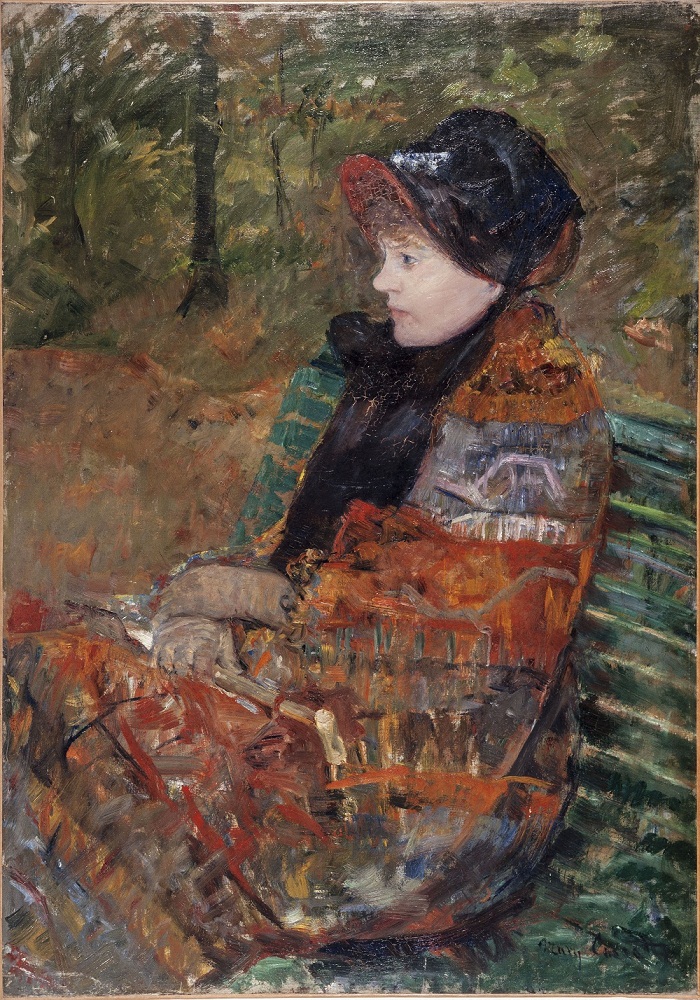
Another, very different, portrait of Lydia, dating to 1880, reveals a shocking physical decline from Woman in a Loge. 


Mary Cassatt, Autumn, 1880

Entitled Autumn, this powerful and poignant work is in the collection of the Musee de Petit Palais, Paris. Given the personal/family relevance of Autumn, it is surprising that Mary Cassatt selected Autumn to feature among her contributions to the 1881 Impressionist salon. Yet, she did.

Autumn is not on view in Mary Cassatt at Work. But the exhibition does display numerous works depicting Lydia between 1878 and the year of her death, 1882. From these, it is clear that Mary Cassatt was grappling with a subject seldom addressed by the Impressionists in their paintings - human mortality.


Anne Lloyd, Photo (2024)
  
Gallery view of Mary Cassatt at Work, showing paintings
 of Lydia Cassatt, dating to 1878-1880

These paintings of Lydia had an unsettling effect on me. Were these merely depictions of an upper class woman keeping busy with needle work and embroidery? My wife, Anne, picked-up the tenor of these paintings.

"It looks like Mary Cassatt was painting her sister's passing," Anne said, and she is undoubtedly correct.

In terms of chronology, the series of depictions of Lydia begins with a small work from a private collection, Lydia Seated in the Garden with a Dog on her Lap. Painted with a bold Impressionist verve that rivals Monet, it dates to around the same time as Cassatt was working on Woman in a Loge. It is hard to conceive of two pictures of the same person being so different.


Mary Cassatt, Lydia Seated in the Garden with a Dog on Her Lap, 1878–79

The colorful and historic setting of this painting was Marly-le-Roi, the site of a grand chateau of Louis XIV destroyed during the French Revolution. Despite the verdant background and the engaging dog on Lydia's lap, there is an ominous note to this work. Significantly, Lydia is portrayed from the back. In coming upon her from behind, we are not being shut-off from this paradise-like locale, but rather excluded from her thoughts.

In the paintings which enable us to study Lydia's face, it is once again apparent that Mary Cassatt was well aware of what was happening to her sister, physically and emotionally.


Anne Lloyd, Photo (2024)
  Mary Cassatt's
Lydia at a Tapestry Frame, 1880-81


Anne Lloyd, Photo (2024)
  Mary Cassatt's Lydia Crocheting in the Garden at Marley, 1880

If you look closely at Lydia's face in these paintings, there is battle of emotions taking place in her countenance.  A deep note of sadness, as her life force drains way, is countered  by a stoic courage to keep-up the appearances of normalcy, to keep working no matter how mundane or trivial the task may seem.  Lydia is dying and, yet, bravely struggling to live.


Another of Mary Cassatt's paintings of Lydia is on view in the exhibition. It is a very familiar and much loved work from the PMA's collection. Driving (sometimes referred to as A Woman and a Child Driving) dates to 1881. It shows a healthy, confident Lydia holding the reigns of a carriage. Edgar Degas' young niece is beside her and a groom sitting behind, ready to manage the horse and carriage when they have reached their destination.


Anne Lloyd, Photo (2024)
  Mary Cassatt's Driving, 1881

This is customarily viewed as a "Youth and Experience" painting. As its regular placement is in the American art galleries at the PMA, a contrast with Woman in a Loge is not the easiest. Driving is presented in a different gallery in the exhibition, but it was still fresh in my mind when I gazed at Lydia Crocheting in the Garden at Marly (1880).


Lydia Crocheting looks ill. A year later, Lydia in A Woman and Child Driving appears to have recovered her health. Sadly, this painting, like Woman in a Loge, is an idealized portrait.

Lydia Cassatt died on November 7, 1882, at the age of 45. Her passing was an excruciating ordeal, described by her father as "many years of ill-health and 84 days of deathbed agony." 

Mary Cassatt was devastated by Lydia's death. She was unable to resume painting and printmaking for several months after losing her sister.

Lydia's illness and death may be interpreted in a number of ways. Death is the common lot of all humankind. Yet, Lydia's "deathbed agony" was a true example of the religious concept of redemptive suffering.

During the course of my research for this essay, I chanced upon a superb scholarly article entitled "Mary Cassatt's portraits of her sister, Lydia: Tracing signifers of disease and impending death."

The 2022 article, written by Lini Radhakrishnan of Rutgers University, closely studies Cassatt's paintings of Lydia. This article is available by open access on the Internet at the following link. It is a "must-read" for anyone interested in Mary Cassatt's life and art.

Radhakrishnan's analysis brilliantly details the close correspondence of Cassatt's depiction of the facial features, skin tone and other physical attributes of Lydia's tormented body with the actual "signifers" or manifestations of kidney disease.

Rather than try and paraphrase the clinical analysis of all the paintings Radhakrishnan surveys, I will quote a brief passage from the treatment devoted to Lydia at a Tapestry Frame.


Anne Lloyd, Photo (2024)
  Detail of Mary Cassatt's
 Lydia at a Tapestry Frame, 1880-81

Radhakrishnan writes:

As the title indicates Lydia is depicted at a tapestry frame, but this time the hands at work are neither gloved nor elegant. The left hand seen under the frame has become misshapen and the bluish gray tinge seen on the contorted digits denote poor oxygenation, a distinct sign of diminishing kidney function. There is a similar discoloration on her facial skin and signs of edema or swelling around the eyes and under the chin. Edema was a condition linked to Bright’s disease and referred to the puffiness caused by excess fluid trapped in the body’s tissues.

Lydia's travail, physical and emotional, was not in vain. Earlier I described Lydia as an exemplar of redemptive suffering. For many, the idea that one person''s acceptance of pain or privation may benefit others is a difficult concept to grasp. Yet, Lydia Cassatt's suffering would have a transforming effect on her sister's outlook on life and art

Many Cassatt scholars view Lydia's death as a major turning point in Mary's artistic career. Before Lydia became ill, there were no indications that Mary would become a "painter of mothers and infants."  Cassatt did not display one of her signature "mother and infant"" paintings until the 1881 Impressionist exhibition. As noted earlier, the 1881 show was the venue for Autumn, a meditation on Lydia's imminent death.


Anne Lloyd, Photo (2024)
  Mary Cassatt's Mother and Child (Maternal Kiss), 1896

The Mary Cassatt whose art we know and love dates from the shocking loss of her sister. Inspired by Lydia's courage in the face of death, Mary chose life.as the theme of her art. As Radhakrishnan writes, Mary's paintings of the ailing, suffering Lydia were "foundational of the next chapter of her work."

Though she never married or had children of her own, Mary Cassatt created a special universe in her art where infants are nurtured by the strong and tender love of their mothers. 


Anne Lloyd, Photo (2024)
  Gallery view of Mary Cassatt at Work, 
with display of Cassatt's Baby Joan Nursing, 1908

Many children are not so blessed - or not to the same degree - as a "Mary Cassatt mother and child." 

How wonderful it is, then, to behold such a pair in real life, walking down the street, in the playground or gazing at a Mary Cassatt painting in the local museum of art.

***

Text: Copyright of Ed Voves, all rights reserved. Photos by Anne Lloyd, all rights reserved                                                                                          

 Introductory Image:

Anne Lloyd, Photo (2024) Gallery view of Mary Cassatt at Work showing Cassatt’s Lydia at a Tapestry Frame, 1880-81.

Anne Lloyd, Photo (2024) View of the entrance to the Mary Cassatt at Work exhibition, Philadelphia Museum of Art.

Anne Lloyd, Photo (2024) Mary Cassatt’s Woman in a Loge, 1879.

Anne Lloyd, Photo (2024) View of Gallery 252 at the Philadelphia Museum of Art, showing the usual placement of Mary Cassatt’s Woman in a Loge.

Anne Lloyd, Photo (2024) Mary Cassatt’s Woman in a Loge as it was displayed in 1879.

Anne Lloyd, Photo (2024) Gallery view of the Mary Cassatt at Work exhibition.

Edgar Degas, (French, 18-1917) Mary Cassatt at the Louvre: the Etruscan Gallery, 1870-1880.

Mary Stevenson Cassatt (American, 1844-1926) Autumn, 1880. Oil on Canvas: 93 x 65 cm. Musee du Petit Palais, Paris.

Anne Lloyd, Photo (2024) Gallery view of Mary Cassatt at Work, showing paintings of Lydia Cassatt, dating to 1878-1880.

Mary Stevenson Cassatt (American, 1844-1926) Lydia Seated in the Garden with a Dog on Her Lap, 1878–79. Oil on canvas, 10 3/4 × 16 in. (27.3 × 40.6 cm). Cathy Lasry, New York.

Anne Lloyd, Photo (2024) Mary Cassatt’s Lydia at a Tapestry Frame, 1880-81. Oil on Canvas: 65.5 x 92 cm. Flint Institute of Arts, Michigan.

Anne Lloyd, Photo (2024) Mary Cassatt’s Lydia Crocheting in the Garden at Marly, 1880. Oil on canvas: 25 13/16 x 36 7/16 in. (65.6 x 92.6 cm) Metropolitan Museum of Art. #65-124

Mary Stevenson Cassatt (American, 1844-1926) Driving, 1881. Oil on canvas, 35 5/16 × 51 3/8 in. (89.7 × 130.5 cm). Philadelphia Museum of Art, W1921-1-1

Anne Lloyd, Photo (2024) Detail of Mary Cassatt’s Lydia at a Tapestry Frame, 1880-81.

Anne Lloyd, Photo (2024) Detail of Mary Cassatt’s Mother and Child (Maternal Kiss), 1896.

Anne Lloyd, Photo (2024) Gallery view of Mary Cassatt at Work, showing Cassatt’s Baby Joan Nursing, 1908.