Showing posts with label Mary Cassatt. Show all posts

Wednesday, August 7, 2024

Art Eyewitness Essay: Lydia Cassatt, Model and Muse


Art Eyewitness Essay

Lydia Cassatt: Model and Muse

By Ed Voves

Original Photography by Anne Lloyd

It is a mark of a great exhibition when our expectations have been met (or exceeded), some of our preconceptions have been confounded and our vision of art and awareness of life have been expanded.

Mary Cassatt at Work, on view at the Philadelphia Museum of Art until September 8, 2024, succeeds on all three counts. 

In the case of expanding vision and awareness, the Cassatt exhibition focused my reflections on Cassatt's life in a way which was a considerable departure from the theme of the exhibition. I certainly had not begun to think along such a different, if not divergent, train of thought when I first visited the exhibition galleries back in May.


Anne Lloyd, Photo (2024)
  Entrance to the Mary Cassatt at Work exhibition

Mary Cassatt at Work is an ambitious endeavor, brilliantly analyzing the career goals, technical skills and working methodologies of Cassatt as a mature artist. Yet, at some point during several visits to the exhibition, Mary Cassatt's sister, Lydia, emerged as a major protagonist in the course of Cassatt's rise to greatness.

I had expected Lydia Cassatt to make her presence felt in the exhibition. She was the model for one of the premiere paintings in the collection of the Philadelphia Museum of Art (PMA) dating to the late 1870's. Now entitled Woman in a Loge, this painting, set in one of the exclusive, mirror-backed compartments at the Paris Opera, used to be called LydIa in a Loge.


   Anne Lloyd, Photo (2024)
  Mary Cassatt's Woman in a Loge,1879

A brilliant and complex work, Woman in a Loge was Cassatt's breakout painting at the 1879 Impressionist salon, the first in which she participated. Normally, Woman in a Loge is displayed in the main gallery devoted to Impressionism at the Philadelphia Museum of Art. Other works by Cassatt are hung in the museum's American art wing, an issue which we will consider later in this essay. 

In the setting of the Impressionist gallery, Woman in a Loge, reigns like a queen on her throne.


Anne Lloyd, Photo (2023)
View of Gallery 252 at the Philadelphia Museum of Art, showing
 the usual placement of Mary Cassatt's Woman in a Loge  

 As can be seen in the photo above, Woman in a Loge, is normally displayed in an ornate, golden frame. But that is not how the curators of Mary Cassatt at Work present the painting. Instead, we see it in an austere frame, painted in a light olive hue. Surprisingly, since the the late 1870's were the height of the "gilded age," this modest frame was the type and color which Cassatt chose for the painting back in 1879.


Anne Lloyd, Photo (2024)
   Mary Cassatt's Woman in a Loge, displayed as it was in 1879

it was difficult to adjust to Woman in a Loge in her new/old frame. The modern-looking lines and olive green color of the frame were not the only issue. The walls of the opening galleries of Mary Cassatt at Work are painted a very dark shade of gray. The overhead lights are kept low, with Cassatt's paintings and prints illuminated from strategically-placed lighting fixtures.


Anne Lloyd, Photo (2024)
  Gallery view of the Mary Cassatt at Work exhibition

The effect is very dramatic and, initially, disorienting. i was not the only person at the press preview to comment on this unexpected treatment of one of the "star" paintings of the PMA's collection. But it was not long before considerations about the frame and lighting seemed beside the point. It was the woman in Woman in a Loge who mattered.

Lydia Cassatt was the elder sister of Mary. She was born in 1837, the year that Queen Victoria's reign began. While Mary, nicknamed "Mame", boldly launched her career in the arts, Lydia remained at home. Unmarried and untrained for any vocation outside of the family circle, Lydia seemed fated for the women's role much praised in a popular poem of the time, "the angel in the house."

In 1874, Mary made the audacious decision to settle and work in France - without financial support from her family. In a quiet act of rebellion, Lydia decided to follow in her younger sister's footsteps. In what was most likely posed as the role of chaperone, Lydia joined Mary in Paris in 1875.

The Cassatt sister's independence lasted two years. Lydia's health became a concern and their parents decided to join them.


Edgar Degas, 
Mary Cassatt at the Louvre: the Etruscan Gallery, 1879–80

Before her health declined, Lydia joined Mary in sampling the cultural delights of France. Edgar Degas recorded the sisters' visit to the Louvre.

When not sightseeing in Paris, Lydia managed their modest household, while Mary painted. Lydia also posed for "Mame" whose oeuvre remained oriented to portraits and genre studies rather than landscapes. Models cost money and the Cassatt sisters had precious little to spend with Mary's professional reputation yet to be made.

If, as seems very likely, Lydia posed for Woman in a Loge, the fidelity of the facial features of the beautiful and vivacious young woman in the painting to those of Lydia in real life needs to be addressed.

It's not an easy matter to resolve, as no portrait photos of Lydia have apparently survived.


In 1878-79, when Mary was working on Woman in a Loge, Lydia was aged 41. She was no longer a young woman by Victorian standards. Moreover, Lydia had recently been diagnosed as suffering from a serious kidney disorder known as Bright's Disease. 

Is Lydia the Woman in a Loge? If so - and I believe it is her -then Woman in a Loge is an idealized portrait. It is also an "in-denial" portrait of a seriously-ill woman.

Another, very different, portrait of Lydia, dating to 1880, reveals a shocking physical decline from Woman in a Loge. 
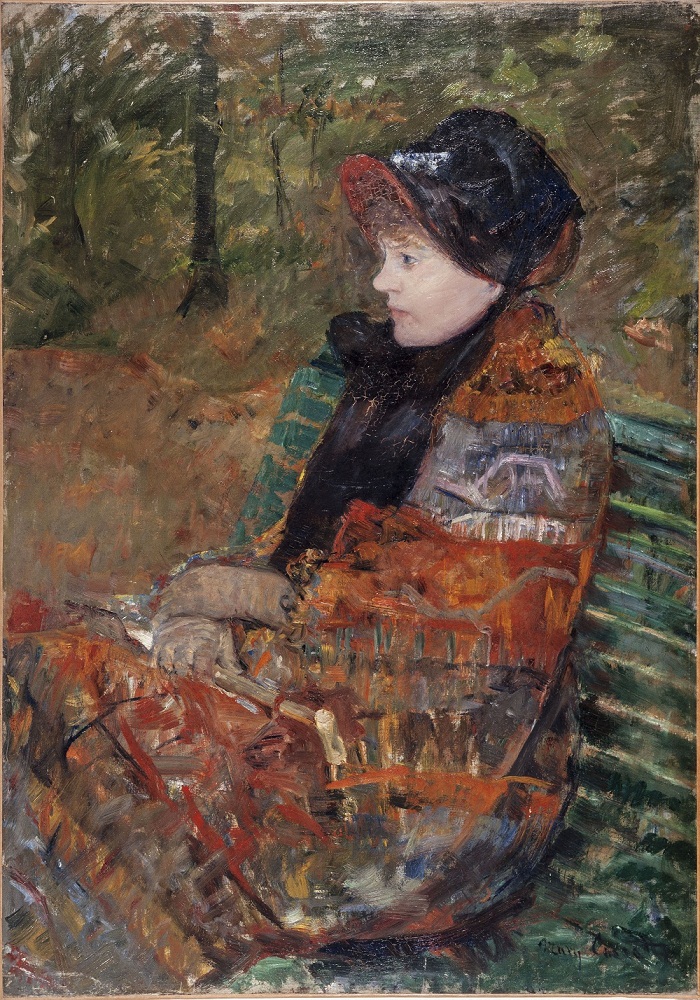


Mary Cassatt, Autumn, 1880

Entitled Autumn, this powerful and poignant work is in the collection of the Musee de Petit Palais, Paris. Given the personal/family relevance of Autumn, it is surprising that Mary Cassatt selected Autumn to feature among her contributions to the 1881 Impressionist salon. Yet, she did.

Autumn is not on view in Mary Cassatt at Work. But the exhibition does display numerous works depicting Lydia between 1878 and the year of her death, 1882. From these, it is clear that Mary Cassatt was grappling with a subject seldom addressed by the Impressionists in their paintings - human mortality.


Anne Lloyd, Photo (2024)
  
Gallery view of Mary Cassatt at Work, showing paintings
 of Lydia Cassatt, dating to 1878-1880

These paintings of Lydia had an unsettling effect on me. Were these merely depictions of an upper class woman keeping busy with needle work and embroidery? My wife, Anne, picked-up the tenor of these paintings.

"It looks like Mary Cassatt was painting her sister's passing," Anne said, and she is undoubtedly correct.

In terms of chronology, the series of depictions of Lydia begins with a small work from a private collection, Lydia Seated in the Garden with a Dog on her Lap. Painted with a bold Impressionist verve that rivals Monet, it dates to around the same time as Cassatt was working on Woman in a Loge. It is hard to conceive of two pictures of the same person being so different.


Mary Cassatt, Lydia Seated in the Garden with a Dog on Her Lap, 1878–79

The colorful and historic setting of this painting was Marly-le-Roi, the site of a grand chateau of Louis XIV destroyed during the French Revolution. Despite the verdant background and the engaging dog on Lydia's lap, there is an ominous note to this work. Significantly, Lydia is portrayed from the back. In coming upon her from behind, we are not being shut-off from this paradise-like locale, but rather excluded from her thoughts.

In the paintings which enable us to study Lydia's face, it is once again apparent that Mary Cassatt was well aware of what was happening to her sister, physically and emotionally.


Anne Lloyd, Photo (2024)
  Mary Cassatt's
Lydia at a Tapestry Frame, 1880-81


Anne Lloyd, Photo (2024)
  Mary Cassatt's Lydia Crocheting in the Garden at Marley, 1880

If you look closely at Lydia's face in these paintings, there is battle of emotions taking place in her countenance.  A deep note of sadness, as her life force drains way, is countered  by a stoic courage to keep-up the appearances of normalcy, to keep working no matter how mundane or trivial the task may seem.  Lydia is dying and, yet, bravely struggling to live.


Another of Mary Cassatt's paintings of Lydia is on view in the exhibition. It is a very familiar and much loved work from the PMA's collection. Driving (sometimes referred to as A Woman and a Child Driving) dates to 1881. It shows a healthy, confident Lydia holding the reigns of a carriage. Edgar Degas' young niece is beside her and a groom sitting behind, ready to manage the horse and carriage when they have reached their destination.


Anne Lloyd, Photo (2024)
  Mary Cassatt's Driving, 1881

This is customarily viewed as a "Youth and Experience" painting. As its regular placement is in the American art galleries at the PMA, a contrast with Woman in a Loge is not the easiest. Driving is presented in a different gallery in the exhibition, but it was still fresh in my mind when I gazed at Lydia Crocheting in the Garden at Marly (1880).


Lydia Crocheting looks ill. A year later, Lydia in A Woman and Child Driving appears to have recovered her health. Sadly, this painting, like Woman in a Loge, is an idealized portrait.

Lydia Cassatt died on November 7, 1882, at the age of 45. Her passing was an excruciating ordeal, described by her father as "many years of ill-health and 84 days of deathbed agony." 

Mary Cassatt was devastated by Lydia's death. She was unable to resume painting and printmaking for several months after losing her sister.

Lydia's illness and death may be interpreted in a number of ways. Death is the common lot of all humankind. Yet, Lydia's "deathbed agony" was a true example of the religious concept of redemptive suffering.

During the course of my research for this essay, I chanced upon a superb scholarly article entitled "Mary Cassatt's portraits of her sister, Lydia: Tracing signifers of disease and impending death."

The 2022 article, written by Lini Radhakrishnan of Rutgers University, closely studies Cassatt's paintings of Lydia. This article is available by open access on the Internet at the following link. It is a "must-read" for anyone interested in Mary Cassatt's life and art.

Radhakrishnan's analysis brilliantly details the close correspondence of Cassatt's depiction of the facial features, skin tone and other physical attributes of Lydia's tormented body with the actual "signifers" or manifestations of kidney disease.

Rather than try and paraphrase the clinical analysis of all the paintings Radhakrishnan surveys, I will quote a brief passage from the treatment devoted to Lydia at a Tapestry Frame.


Anne Lloyd, Photo (2024)
  Detail of Mary Cassatt's
 Lydia at a Tapestry Frame, 1880-81

Radhakrishnan writes:

As the title indicates Lydia is depicted at a tapestry frame, but this time the hands at work are neither gloved nor elegant. The left hand seen under the frame has become misshapen and the bluish gray tinge seen on the contorted digits denote poor oxygenation, a distinct sign of diminishing kidney function. There is a similar discoloration on her facial skin and signs of edema or swelling around the eyes and under the chin. Edema was a condition linked to Bright’s disease and referred to the puffiness caused by excess fluid trapped in the body’s tissues.

Lydia's travail, physical and emotional, was not in vain. Earlier I described Lydia as an exemplar of redemptive suffering. For many, the idea that one person''s acceptance of pain or privation may benefit others is a difficult concept to grasp. Yet, Lydia Cassatt's suffering would have a transforming effect on her sister's outlook on life and art

Many Cassatt scholars view Lydia's death as a major turning point in Mary's artistic career. Before Lydia became ill, there were no indications that Mary would become a "painter of mothers and infants."  Cassatt did not display one of her signature "mother and infant"" paintings until the 1881 Impressionist exhibition. As noted earlier, the 1881 show was the venue for Autumn, a meditation on Lydia's imminent death.


Anne Lloyd, Photo (2024)
  Mary Cassatt's Mother and Child (Maternal Kiss), 1896

The Mary Cassatt whose art we know and love dates from the shocking loss of her sister. Inspired by Lydia's courage in the face of death, Mary chose life.as the theme of her art. As Radhakrishnan writes, Mary's paintings of the ailing, suffering Lydia were "foundational of the next chapter of her work."

Though she never married or had children of her own, Mary Cassatt created a special universe in her art where infants are nurtured by the strong and tender love of their mothers. 


Anne Lloyd, Photo (2024)
  Gallery view of Mary Cassatt at Work, 
with display of Cassatt's Baby Joan Nursing, 1908

Many children are not so blessed - or not to the same degree - as a "Mary Cassatt mother and child." 

How wonderful it is, then, to behold such a pair in real life, walking down the street, in the playground or gazing at a Mary Cassatt painting in the local museum of art.

***

Text: Copyright of Ed Voves, all rights reserved. Photos by Anne Lloyd, all rights reserved                                                                                          

 Introductory Image:

Anne Lloyd, Photo (2024) Gallery view of Mary Cassatt at Work showing Cassatt’s Lydia at a Tapestry Frame, 1880-81.

Anne Lloyd, Photo (2024) View of the entrance to the Mary Cassatt at Work exhibition, Philadelphia Museum of Art.

Anne Lloyd, Photo (2024) Mary Cassatt’s Woman in a Loge, 1879.

Anne Lloyd, Photo (2024) View of Gallery 252 at the Philadelphia Museum of Art, showing the usual placement of Mary Cassatt’s Woman in a Loge.

Anne Lloyd, Photo (2024) Mary Cassatt’s Woman in a Loge as it was displayed in 1879.

Anne Lloyd, Photo (2024) Gallery view of the Mary Cassatt at Work exhibition.

Edgar Degas, (French, 18-1917) Mary Cassatt at the Louvre: the Etruscan Gallery, 1870-1880.

Mary Stevenson Cassatt (American, 1844-1926) Autumn, 1880. Oil on Canvas: 93 x 65 cm. Musee du Petit Palais, Paris.

Anne Lloyd, Photo (2024) Gallery view of Mary Cassatt at Work, showing paintings of Lydia Cassatt, dating to 1878-1880.

Mary Stevenson Cassatt (American, 1844-1926) Lydia Seated in the Garden with a Dog on Her Lap, 1878–79. Oil on canvas, 10 3/4 × 16 in. (27.3 × 40.6 cm). Cathy Lasry, New York.

Anne Lloyd, Photo (2024) Mary Cassatt’s Lydia at a Tapestry Frame, 1880-81. Oil on Canvas: 65.5 x 92 cm. Flint Institute of Arts, Michigan.

Anne Lloyd, Photo (2024) Mary Cassatt’s Lydia Crocheting in the Garden at Marly, 1880. Oil on canvas: 25 13/16 x 36 7/16 in. (65.6 x 92.6 cm) Metropolitan Museum of Art. #65-124

Mary Stevenson Cassatt (American, 1844-1926) Driving, 1881. Oil on canvas, 35 5/16 × 51 3/8 in. (89.7 × 130.5 cm). Philadelphia Museum of Art, W1921-1-1

Anne Lloyd, Photo (2024) Detail of Mary Cassatt’s Lydia at a Tapestry Frame, 1880-81.

Anne Lloyd, Photo (2024) Detail of Mary Cassatt’s Mother and Child (Maternal Kiss), 1896.

Anne Lloyd, Photo (2024) Gallery view of Mary Cassatt at Work, showing Cassatt’s Baby Joan Nursing, 1908. 


Friday, May 31, 2024

Art Eyewitness Review: Mary Cassatt at the Philadelphia Museum of Art


Mary Cassatt at Work


Philadelphia Museum of Art

May 18 -  September 8, 2024


Reviewed by Ed Voves
Original Photography by Anne Lloyd 

Beginning on April 19, 1879, the Fourth Impressionist exhibition opened its doors to a much more appreciative audience than had attended the first showing by the group back in April 1874. For the price of 1 franc, art enthusiasts could study - and hopefully buy - the latest work by Claude Monet, Edgar Degas and fourteen other artists. Renoir was a no-show that year, but an American-born recruit, invited to join by Degas, displayed 12 striking works of art.

It proved to be a dazzling debut. The dozen exhibited works included three superb pastels. But the standouts were two magnificent oil paintings - a beautiful portrait of a young woman at the Paris Opera and an unforgettable depiction of a bored, mischievous child sprawled on a blue-upholstered arm chair.


Anne Lloyd, Photo (2024) Mary Cassatt’s Woman in a Loge, 1879


Anne Lloyd, Photo (2024)
 Mary Cassatt’s Little Girl in a Blue Armchair, 1877-78

With these now-iconic paintings, the newest, and the only American-born, member of the Impressionists claimed her place in the ranks of the Independents (as the group was still officially known). By the time the Fourth Impressionist exhibition ended in May 1879 and 15,000 patrons had paid their 1 franc entrance fee, Mary Stevenson Cassatt had made her mark in the world of art.


Anne Lloyd, Photo (2024)
 Signature of Mary Cassatt on Bathing the Young Heir, 1890-91

Today, Woman in a Loge and Little Girl on a Blue Arm Chair are reunited in another special exhibition. This time, Cassatt’s works are on view in the Philadelphia Museum of Art's Dorrance Galleries. Entitled Mary Cassatt at Work, this exhibition is an insight-packed examination of Cassatt's methodology, bound to heighten her status in art history as one of the major artists of her era.


Anne Lloyd, Photo (2024)
 View of the East Entrance of the Philadelphia Museum of Art,
 showing banners advertising the Mary Cassatt at Work exhibit

Mary Cassatt at Work will surely delight art lovers who make the pilgrimage to Philadelphia to see it. With 130 works of art on view - oil paintings, works in pastel and prints - the exhibition curators at the Philadelphia Museum of Art (PMA) needed every square inch of gleaming, glistening gallery space to do justice to Cassatt's achievements.


Anne Lloyd, Photo (2024)
 Gallery view of Mary Cassatt at Work, Philadelphia Museum of Art

It's high time to celebrate Cassatt's amazing artistic career. Mary Cassatt at Work is the first major exhibition of the great American Impressionist to be held by a U.S. museum in a quarter of a century. Back in 1998-99, the Art Institute of Chicago, the National Gallery of Art in Washington D.C. and the Museum of Fine Arts in Boston presented Mary Cassatt: Modern Woman. Despite the rousing success of this exhibition, Cassatt retrospectives remain surprisingly rare.

To focus on Cassatt’s “modernity” is to risk forgetting that she was a Victorian, a Victorian radical, certainly, but still a person of her era.

During the Victorian age, the “gospel of work” was a favorite theme of social commentators. The virtues of labor and industry were usually ascribed to the formidable, bewhiskered gentleman of the era. 

Given Cassatt’s frequent choice of scenes of family life and leisure as her chosen subject, one could be excused for thinking that she somehow found a way to ignore or evade the moralizing sermons of men like John Ruskin, who called for an embrace of “the pleasure and arduousness of useful, physical labor.”


Anne Lloyd, Photo (2024)
 Mary Cassatt’s Maternal Caress, 1896

I don’t think that Cassatt and Ruskin would have agreed on much else, but on the importance of work, these two “eminent” Victorians were in complete accord.

Two years of intensive study of the 84 works of art by Cassatt in the PMA collection enabled curators, Jennifer A. Thompson and Laurel Garber, to grasp the importance of work for Cassatt. Toil and fortitude, exacting attention to technique and a proud sense of professionalism were revealed as key determinants of Cassatt's character.


Anne Lloyd, Photo (2024)
 Copy of a photo of Mary Cassatt, Paris, c. 1867

Mary Stevenson Cassatt (1844-1926) came from a wealthy American family, though not extravagantly so by the Robber Baron standards of the post-Civil War era. Cassatt’s parents – who were otherwise devoted to her - refused to subsidize her career in the hope that she would resume a more ladylike attitude toward life and art: get married and paint for pleasure.

Cassatt was not content with painting as a gentile, feminine accomplishment. She was driven to succeed commercially, desiring pay for her efforts rather than faint praise. The foundation of Cassatt’s success as a professional artist, first noticed at the 1879 Impressionist exhibition, can be summed up in that one word: work.

Work. Diligent, dedicated effort, characterized by the courage to try, fail and try again. 

Cassatt’s determination to create great works of art led her to express her attitude toward labor in remarks that now seem deliberately composed for inclusion in Bartlett’s Familiar Quotations:

“I work & that is the whole secret of anything like conten(ment) with life.”

“I am independent! I can live alone & I love my work.”

“What one would like to leave behind is superior art and a hidden personality.”                                                    

For Cassatt, these assertions expressed the simple, unvarnished truth of her life. For historians and students of art, Cassatt ‘s “hidden personality” is a call to action.

Cassatt’s genius can be observed in the details of her paintings, pastels and prints. In the introduction to the exhibition catalog, Thompson and Garber direct our attention to the hands of the women Cassatt painted or, in the case of The Banjo Lesson, depicted with pastel.


Anne Lloyd, Photo (2024) 
Detail of Mary Cassatt’s The Banjo Lesson, 1894

Thompson and Garber perceptively comment on the never "idle" hands of Cassatt's protagonists.

Despite the spontaneity of her style, Cassatt’s attentive depictions of hands, whether at rest or in motion – wetting a towel, plucking a banjo or holding a book, balancing horse reins or cradling a nursing child – demonstrate that she was very much in control. These details challenge the idea that her oeuvre focuses solely on moments of leisure.

In fact, close study of Cassatt’s work reveals that she excluded everything except serious, purposeful activity by her female protagonists. No lawn tennis playing or bicycle riding, very popular activities for spirited American girls of her era. No amateur dabbling with sketch books or water colors!

This view of Cassatt as a thorough professional - rather than a gentile painter of mothers and infants - may come as a jolt. Mary Cassatt at Work has quite a number of surprises in store. Be prepared to entertain new interpretations of Cassatt and her oeuvre!

The first “concern” to be addressed is the absence of several of the greatest and most beloved paintings by Cassatt. Every special exhibition presents challenges about which signature works of art “must” be included and those that, for one reason or another, elude the curators' grasp.


Anne Lloyd, Photo (2024)
 Gallery view of the Mary Cassatt at Work exhibition,
 showing Mary Cassatt’s Lydia at a Tapestry Frame, 1880

It was a real privilege to be able to see Lydia at a Tapestry Frame (1880) from the Flint Institute of Art. This was surely an essential Cassatt painting for a “Work” themed exhibition. The Metropolitan Museum of Art’s Young Mother Sewing (1900) also addresses this topic, but is not on view. The Met loaned other important works, notably Lydia Crocheting in the Garden at Marly (1880) which I will discuss in a follow-up essay.

More serious are the omission of key Cassatt paintings from the National Gallery in Washington, like The Boating Party. But this is due to the stipulation of the Chester Dale Collection at the National Galley that its paintings may not travel to other museums. The National Gallery did send Little Girl in a Blue Arm Chair, a truly sensational work of art, which benefited from Degas' assistance soon after he met Cassatt in 1877.


Anne Lloyd, Photo (2024)
 Detail of Mary Cassatt’s Little Girl in a Blue Armchair, 1877-78

The real “surprise” of Mary Cassatt at Work is the premier status accorded to Cassatt’s prints in the over-all plan of the exhibition.


Anne Lloyd, Photo (2024 ) 
Gallery view of the Mary Cassatt at Work,
 showing three states of Mary Cassatt’s print, The Fitting, 1890-1891

Cassatt's introduction to printmaking came from the same source as her invitation to join the Impressionists, Edgar Degas. Cassatt had studied traditional engraving techniques under an Italian master, Carlo Raimundi, in 1872. But it was the daring, unconventional nature of Degas' art, beginning with some of his pastels which Cassatt saw in a dealer's window in Paris, which "changed my life. I saw art then as I wanted to see it."

After viewing prints by Cassatt, Degas recruited her to join with him, Camille Pissarro and Felix Bracquemond to produce a journal of engravings to be entitled Le Jour et la nuit. This was to be a new version of "impressionism" - images pressed onto paper, a visionary, modernist approach to a time-honored medium.

Unfortunately, Le Jour et la nuit never progressed beyond the planning stages. Cassatt was deeply disappointed. But preoccupied with exhibiting at the   Impressionist exhibitions of the 1880's and caring for her elderly parents who had come to live with her in France, Cassatt had little time for printmaking initiatives on her own.

In 1890, this frustrating situation changed radically. A vast exhibition of Japanese woodblock prints, held at the Ecole des Beaux Arts, seized hold of Cassatt's imagination after she visited the show with Degas. 

"You who want to make color prints," Cassatt wrote to Berthe Morisot, "you couldn't dream of anything more beautiful. I dream of it and don't think of anything else but color on copper."

Cassatt determined to do a series of 10 color prints, each illustrating an incident from a related topic, the daily lives of Parisian women. Unlike the Japanese woodblock printers, she would use the etching/aquatint on copper plate process, as she mentioned to Morisot. 

Although Cassatt hired a professional printer to assist her, she did much of the exacting, messy and potentially hazardous work herself!


Anne Lloyd, Photo (2024)
 Detail of Mary Cassatt’s print, The Letter, 1890-91

Rather than discuss Cassatt's printing technique in a review like this, the wisest course is to leave this subject to the experts. In the case of Mary Cassatt at Work, this is Christina Taylor, Conservator for Works of Art on Paper at the Philadelphia Museum of Art. With  the help of Laurel Garber and Tom Primeau, Taylor recreated, step-by-step, the printmaking process used by Cassatt to make The Letter (the original shown above).

A video recording of Taylor at work on her version of The Letter is featured in the exhibition gallery dedicated to Cassatt's "The Ten" and is also available in a longer version on YouTube. This video brilliantly complements the works of art on display in Mary Cassatt at Work and is highly recommended.


Anne Lloyd, Photo (2024)
  Christina Taylor, Conservator, at the Philadelphia Museum of Art

After watching the video, visitors are well-primed to understand Cassatt's exacting and exhausting printmaking regimen. One entire wall of the gallery is devoted to showing the progressive versions or "states" of one of the series of depictions of Parisian women. Starting with Cassatt's preliminary drawing, it concludes with the seventeenth state of seventeen of The Bath.


Anne Lloyd, Photo (2024)
Gallery view of the Mary Cassatt at Work exhibit, showing the original drawing & early print states of Mary Cassatt’s The Bath, 1890-91


Mary Cassatt, The Bath, 1890-1891 
 (seventeenth state of seventeen)

The ten final plates were utilized to create limited-edition sets of 25 prints of each. These were marketed by Cassatt's dealer, the renowned Paul Durand Ruel. The complete series of prints of "The Ten" is displayed on the opposite wall, making this gallery a tour de force presentation of classic printmaking and Cassatt's unrivaled application of the process. 


Anne Lloyd, Photo (2024 )
 Gallery view of Mary Cassatt at Work, showing Cassatt’s “The Ten” 

What should have been a singular artistic and financial success proved to be a frustrating disappointment. Despite all the innovations going on in the Parisian art world of the 1890's, connoisseurs were not prepared for Cassatt's "The Ten" prints.

The test of time has yielded a different verdict on "The Ten" series. Adelyn Breeskin, long-time head of the Baltimore Museum of Art and a major Cassatt scholar, declared that Cassatt’s prints were “her most original contribution… technically, as color prints they have never been surpassed.”


Anne Lloyd, Photo (2024)
 Mary Cassatt’s Woman Bathing, 1890-91

The amount of gallery space devoted to Cassatt's prints raises a major point of concern. Is too much attention being devoted to Cassatt’s softground etchings and drypoint prints? One might conclude that this is so, especially at the “expense” of Cassatt's oil paintings.

After some reflection on the matter, I feel that the curators have made the correct decisions, vis-a-vis the amount of relative attention paid to paintings and prints in the exhibition.


Anne Lloyd, Photo (2024)
 Mary Cassatt’s Sailor Boy: Portrait of Gardner Cassatt as a Child, 1892

It is Cassatt's pastels - it seems to me -which need more emphasis in the galleries of Mary Cassatt at Work. 

Although there is an excellent chapter in the exhibit catalog on Cassatt's pastels, I think that a gallery devoted primarily to pastels would have greatly enriched our appreciation of Cassatt "the worker." It was pastels upon which Cassatt relied to continue her career as cataracts imperiled her vision, leading eventually to almost complete blindness.

A similar case study can be found in the life of Henri Matisse. Faced with ill health and a life-threatening abdominal cancer operation, Matisse turned to making illustrations for special edition art books, livre d'artiste, cutting out designs with scissors and specially colored art paper. The recent exhibition at the PMA, Matisse in the 1930's devoted a special gallery to these late-career works on paper. 

A comparable display focusing on Cassett's pastels would have done much to increase our understanding of Cassett's efforts to keep working, as the tide of life began to shift away from her.

However we approach Cassatt's pastels, these beautiful, sensitive works deserve to be studied and appreciated. They need to be valued aesthetically for the marvelous technique which Cassatt devoted to them, the related facility of hand and eye.

Ultimately, Cassatt's pastels are statements on human values, tenderness, empathy, caring and sharing.


Anne Lloyd, Photo (2024) 
Mary Cassatt’s Ellen Mary Cassatt, c.1889

In a forthcoming essay on Cassatt, I intend to reflect upon her humane feeling and the way it nurtured her art Cassatt's loving relationship with her sister, Lydia, will receive special attention. And some comment will be made on Cassatt's predeliction for painting mothers and babies, as an extension of her life.

For now, let us close with a detail from my favorite of Cassatt's pastels, The Banjo Lesson (1894)


Anne Lloyd, Photo (2024) 
Mary Cassatt’s The Banjo Lesson, 1894

Mary Stevenson Cassatt was reputed to be a strong-willed, "difficult" woman. No doubt she was ambitious, driven to succeed. She could be antagonistic toward rivals like "that woman" Celia Beaux or haughtily dismissive, "What Sargent wants is fame and a great reputation."


But nobody paints or creates with pastel such a scene of warmth and humanity as this, unless there is a glowing ember or two of love and compassion deep within their hearts.

***

Text: Copyright of Ed Voves, all rights reserved

Original photography, copyright of Anne Lloyd

Introductory Image:

Anne Lloyd, Photo (2024) Detail of Mary Cassatt’s Driving, 1881. Oil on canvas: 34 7/8 x 51 in. (88.8 x 129.8 cm.) Philadelphia Museum of Art.

Anne Lloyd, Photo (2024) Gallery view of the Mary Cassatt at Work exhibition at the Philadelphia Museum of Art.

Anne Lloyd, Photo (2024) Mary Cassatt’s Woman in a Loge, 1879. Oil on canvas: 32 1/16 × 23 7/16 in. (81.5 × 59.5 cm Philadelphia Museum of Art # 1978-1-5

Anne Lloyd, Photo (2024) Mary Cassatt’s Little Girl in a Blue Armchair, 1877-78. Oil on canvas: 35 1/4 × 51 1/8 inches (89.5 × 129.9 cm National Gallery of Art, Washington # 1983.1.18

Anne Lloyd, Photo (2024) Signature of Mary Cassatt on Bathing the Young Heir, 1890-91

Anne Lloyd, Photo (2024) View of the East Entrance of the Philadelphia Museum of Art, showing banners advertising the Mary Cassatt at Work exhibit.

Anne Lloyd, Photo (2024 ) Gallery view of the Mary Cassatt at Work exhibition at the Philadelphia Museum of Art.

Anne Lloyd, Photo (2024) Mary Cassatt’s Maternal Caress, 1896. Oil on canvas: 15 × 21 1/4 inches (38.1 × 54 cm Philadelphia Museum of Art

Anne Lloyd, Photo (2024) Copy of a photo of Mary Cassatt, Paris, c. 1867

Anne Lloyd, Photo (2024) Detail of Mary Cassatt’s The Banjo Lesson, 1894. (Full citation below.)

Anne Lloyd, Photo (2024 ) Gallery view of the Mary Cassatt at Work exhibition, showing Mary Cassatt’s Lydia at a Tapestry Frame, 1880. 

Anne Lloyd, Photo (2024) Detail of Mary Cassatt’s Little Girl in a Blue Armchair, 1877-78. (Full citation above.)

Anne Lloyd, Photo (2024 ) Gallery view of the Mary Cassatt at Work exhibit, showing three states of Mary Cassatt’s The Fitting, 1890-1891. Drypoint and aquatint on wove paper. From the Cohn Family collection and the Cleveland Museum of Art.

Anne Lloyd, Photo (2024) Detail of Mary Cassatt’s print, The Letter.

Anne Lloyd, Photo (2024) Video image showing Christina Taylor, Conservator for Works of Art on Paper at the Philadelphia Museum of Art

Anne Lloyd, Photo (2024) Detail of Mary Anne Lloyd, Photo (2024 ) Gallery view of the Mary Cassatt at Work exhibit, showing  the original drawing and early print states of Mary Cassatt’s The Bath, 1890-91.

Mary Stevenson Cassatt (American, 1844-1926) The Bath, 1890-1891. Color drypoint, soft-ground etching, and aquatint on laid paper, seventeenth state of seventeen: Plate: 12 5/8 × 9 3/4 inches (32.1 × 24.7 cm) Sheet: 17 3/16 × 11 13/16 inches (43.6 × 30 cm) Mat: 22 × 18 inches (55.9 × 45.7 cm. Art Institute of Chicago

Anne Lloyd, Photo (2024 ) Gallery view of the Mary Cassatt at Work exhibition, showing Mary Cassatt’s “The Ten” prints. 

Anne Lloyd, Photo (2024) Mary Cassatt’s Woman Bathing, 1890-91. Color drypoint and aquatint on laid paper: 14 ½ x 10 3/8 inches (36.8 inches x 26.3 cm) From a private collection.

Anne Lloyd, Photo (2024) Mary Cassatt’s Sailor Boy: Portrait of Gardner Cassatt as a Child, 1892. Pastel on paper Sheet: 25 × 19 inches (63.5 × 48.3 cm. Philadelphia Museum of Art

Anne Lloyd, Photo (2024) Mary Cassatt’s Ellen Mary Cassatt, c.1889. Pastel on laid paper: 12 × 14 1/2 inches (30.5 × 36.8 cm) The Metropolitan Museum of Art. # 60.132.1

Anne Lloyd, Photo (2024) Mary Cassatt’s The Banjo Lesson, 1894. Pastel over oiled pastel on paper: 28 × 22 1/2 inches (71.1 × 57.2 cm).  Virginia Museum of Fine Arts, Richmond