Showing posts with label Institute for the Study of the Ancient World. Show all posts

Monday, May 26, 2025

Art Eyewitness Review: Rethinking Etruria at the Institute for the Study of the Ancient World


Rethinking Etruria
Institute for the Study of the Ancient World

April 23 - July 25, 2025

Reviewed by Ed Voves

The Institute for the Study of the Ancient World (ISAW), located in the shadow of the Metropolitan Museum of Art, has added another achievement to its impressive credentials. ISAW, a research facility of New York University, has resolved a mystery of the so-called "mysterious" Etruscan people of ancient Italy.

As I discussed in a series of Art Eyewitness essays about the Etruscans, back in 2020, it is puzzling why there have been no major exhibitions dealing with the fascinating culture of the Etruscans for many decades in the United States. The ISAW solved that problem by presenting Rethinking Etruria, which opened on April 23rd at the Institute's 84th street headquarters.


Ed Voves, Photo (2025)
 Gallery views of the Rethinking Etruria exhibit. The top photo shows bronze votive figurines, 5th century B.C. and sandstone pyramidal bases, found at Poggio Colla. Below, are Kylix cups, 4th-3rd centuries, B.C., decorated by the Sokra Group of Etruscan vase & cup painters.
.
Etruscology is a vast and perplexing subject. A non-Indo-European people, the Etruscans were long thought to have migrated to Italy from Asia Minor (present-day Turkey) toward the end of the Bronze Age. Recent DNA studies have confirmed that the Etruscans - or their ancestors - were resident in Italy for a very long time, perhaps as far back as the Neolithic age.                     
                       
The historical Etruscan era extends from their earliest identifiable settlements, ca. 900 B.C., to the time of the conquest and incorporation of the Etruscan city-states by the Roman Republic over the succeeding centuries. By the time of Caesar Augustus, the Etruscans were fully under Rome's control, but it is worth noting that Maecenas, the adviser-in-chief to Augustus, was of Etruscan descent.

Since the ISAW has only two exhibition galleries, both of modest dimensions, it would be impossible to mount a wide-ranging exhibition devoted to the Etruscans. But as with other topics in ancient history which have featured in ISAW exhibits, the ISAW curators are accomplished in making a lot happen in a little space.


Ed Voves, Photo (2025)
 Gallery view of the Rethinking Etruria exhibit. In the background is a replica of the Vicchio Stele, excavated at Poggio Colla in 2015.

Rethinking Etruria focuses on two key sites in Italy which have yielded important discoveries, as recently as 2024.  These are the temple sanctuary of Poggio Colla, located near the town of Vicchio, northwest of Florence, and the spectacular tombs carved into a formidable ridge of tufa rock at Norchia, a rugged area seventy-two kilometers northwest of Rome.

The necropolis of Norchia is hardly a new, unexplored site of archaeological "digs." Norchia featured in the trailblazing expeditions of George Dennis, the "father of Etruscology."  Back in the early 1840's, Dennis and his friend, the artist Samuel Ainsley, roamed the bandit-infested region in search of ancient remains. Dennis recounted the moment of Norchia's discovery in his 1848 book, The Cities and Cemeteries of Etruria.

At length, we turned a corner in the glen, and lo! a grand range of monuments burst upon us. There were a line of sepulchers, high in the face of the cliff which forms the right-hand barrier of the glen, two or three hundred feet above the stream - an amphitheater of tombs!

Dennis was unable to capitalize on his success. A gifted amateur, he lacked private wealth, academic credentials or political patronage. Eventually, his book would ignite interest in Britain in the Etruscans - D.H. Lawrence was a devoted reader. 

In the meantime, it was left to another non-professional, this time from Italy, to conduct a thorough study of Norchia. In 1852, Mariano Lattanzi began excavating several of the temple-like tomb structures cut-into the cliff face of Norchia. Important discoveries have been made since then, but so have the deprivations of tomb robbers, who, heedless of the need to record the details of place and condition, have been the bane of Etruscology.


Ed Voves, Photo (2025)
 Gallery view of Rethinking Etruria, showing the Marce Atie Stamnos, a red-figure stamnos or wine jar, with scenes from the Trojan War. 

In July 2022, a splendid ceramic red-figure vessel, a stamnos, was unearthed in one of the less accessible of the Lattanzi tombs. Evidently, tomb robbers had missed this and several other important, if less spectacular, artifacts, preserved in the tomb.

Known today as the Marce Atie Stamnos, the vessel depicts heroes from the Trojan War: Achilles, Ajax, Nestor and Troilus. Scholars believe that it was created around 330 B.C. in the Etruscan city of Vulci. The Trojan War imagery is credited to a workshop of Etruscan painters called the "Funnel Group" because of the shape of the decorative motif.


Ed Voves, Photo (2025)
 The Greek hero, Achilles, depicted on the Marce Atie Stamnos

And a heroine, too, is shown on the Marce Atie Stamnos. This was an important consideration for the Etruscans who accorded great respect - and property-owning rights - to women. Here we see the Amazon queen, Penthesilea, riding to death and glory before the walls of Troy.


Ed Voves, Photo (2025)
 The Amazon Queen, Penthesilea, killed by Achilles at Troy

A stamnos was used to hold wine for celebrations and religious ceremonies - or in this case as a tomb offering, much as the ancient Egyptians did. 


Ed Voves, Photo (2025)
 On its rim, the Marce Atie Stamnos is inscribed with the name of  
 "Marce Atie (son) of Velxae (and) Paci (or Puci)"

The rim of this ceramic vessel is inscribed with the name of Marce Atie, who commissioned it. He must have been a man with considerable wealth and piety to be able to afford such a lavish gift for use in the "after life."


Ed Voves, Photo (2025)
 Gallery view of Rethinking Etruria. Displayed, at left, behind the
 Marce Atie Stamnos, is a much-eroded portrait of Alexander the Great

Museum authorities in Italy have generously permitted this magnificent vessel to travel to the U.S. for the first time. Although there are fifty important Etruscan artifacts on view in the ISAW exhibition, the Marce Atie Stamnos is such a spectacular work of art that I found it difficult to devote sufficient time and attention to the rest of the exhibition.

This is a problem, for there is much in Rethinking Etruria to study and appreciate. The ISAW exhibition team has facilitated the learning process, however, through short digital image/text displays. These presentations enable visitors to comprehend the exhibition artifacts within the context of Etruscan culture and to visualize the temple of Poggio Colla and the Norchia tombs in their topographical settings.

Much of the information in these presentations is based on the ability of Artificial Intelligence (AI) to sift and integrate masses of data. Drone photographic surveys supplied the details of terrain. The resulting visualizations of what the Norchia "amphitheater of tombs" and the Poggio Colla temple looked like in antiquity are almost magical.


Ed Voves, Photo (2025)
 Two images from the Rethinking Etruria digital presentations. At top, is an aerial view of the Norchia tombs taken by a drone. Below is an AI rendering of the temple-like sepulchers, as they likely appeared in antiquity. Some of these family tombs could hold 80 bodies. 


AI rendering of the Poggio Colla temple as it appeared in antiquity.
© Institute for the Study of the Ancient World (NYU)

AI and 3D imaging were also combined to create a replica of the Stele of Vicchio, found in 2015 during excavations at Poggio Colla. Made of local sandstone, the Vicchio Stele is a gravestone-shaped marker which functioned in similar fashion to representations of tablets showing the Ten Commandments. 

Considering the reputation of the Etruscans as "the most religious of men", the discovery of the Vicchio Stele is an event of great importance. After further study, the stele may resolve some of the mystery of Etruscan sacred beliefs and rituals. 


Ed Voves, Photo (2025)
 A replica of the Vicchio Stele, excavated at Poggio Colla in 2015. The 3D model of the stele was created by the LaGuardia Studio of NYU.

Dating to the 6th century B.C., the Vicchio Stele measures 3.9 by 1.9 feet (1.2 by 0.6 meters) and weighs 500 pounds (227 kg). The stele is inscribed with 120 legible letters and punctuation marks from the Etruscan alphabet. But only one passage of the inscription has been deciphered:

"Of Tinia (or for Tinia) in the (place) of Uni two (objects) were dedicated." 


3D model of the Vicchio Stele with its four inscriptions highlighted.
© Institute for the Study of the Ancient World (NYU)

Tinia and Uni were two of the Etruscan gods. The Vicchio Stele originally stood upright so that people visiting the temple could read the religious inscriptions. Over the course of time, the Poggio Colla temple was burned and rebuilt. During the rebuilding process, the Vicchio Stele was placed in with the foundation stones, helping to strengthen the rising new temple.


There was nothing perfunctory about Etruscan religious practice. The Etruscans lived in close communion with the gods and were notable for their practice of divination. A written code of sacred beliefs and rituals, passed down from the gods to a prophet named Tages, was the foundation of Etruscan civilization.

Scarcely visible today, the inscriptions on the Vicchio Stele were words to live by. Deciphering these cryptic words constitutes a big - if halting - step forward in understanding Etruscan religion.

AI, drone photography, lazer scanning and digital recreations have added immeasurably to our understanding of the ancient world. However, there are occasions when simple photos, taken on the spur-of-the-moment, can rival even the most cutting-edge technology. Below are two photos, recording the excavation of the Marc Atie Stamnos. The look on the face of one of the archaeologists speaks for itself!


Ed Voves, Photo (2025)
 Two images from the Rethinking Etruria digital presentations, showing the excavation of the Marce Atie Stamnos.

The exhilaration of holding a just-excavated treasure like the Marce Atie Stamnos is a pleasure few of us will ever enjoy. But the curators and staff at ISAW have served-up a special treat for history lovers to share when they visit Rethinking Etruria. 


Yes, go ahead and place your fingers on the replica of the Vicchio Stele! Get in touch with history. Feel the sensation of the "mysterious" Etruscans awakening from the sleep of centuries.

***

Text: Copyright of Ed Voves, all rights reserved.                                                  Original photography, copyright of Ed Voves.

 Introductory Image:                                                                                     Ed Voves, Photo (2025) Detail of the Marce Atie Stamnos, showing the Amazon queen, Penthesilea.

The following two images come from the ISAW web pages for the Rethinking Etruria exhibition and are copyright of ISAW/NYU:


AI rendering of the Poggio Colla temple as it appeared in antiquity.
© Institute for the Study of the Ancient World (NYU)
 
 3D model of the Vicchio Stele with its four inscriptions highlighted.
 © Institute for the Study of the Ancient World (NYU)                                                                                                                                                                                                                                                                               


Wednesday, February 9, 2022

Art Eyewitness Review: Pompeii in Color: The Life of Roman Painting at the Institute for the Study of the Ancient World


    Art Eyewitness Review 

    Pompeii in Color: The Life of Roman Painting

      Institute for the Study of the Ancient World, New York

Reviewed by Ed Voves

When Mount Vesuvius erupted in the year 79, most of the unfortunate citizenry of Pompeii and nearby Herculaneum died quickly, if painfully. Deadly showers of blazing pumice and toxic gases ejected into the atmosphere from deep within the volcano killed thousands, perhaps as many 15,000, of the doomed inhabitants. 


Pompeii, general view to the north, looking toward Mount Vesuvius

The violent fury of Vesuvius ironically preserved a complete record of life in Pompeii at the very moment of its extinction. The layers of volcanic ash which buried the city acted as a conservator of the tools and objects of everyday use, even loaves of bread waiting to be removed from bake ovens.


Banquet Scene with Inscribed Words, 1st century CE. Pompeii
 Fresco from the House of the Triclinium

Remarkably, colorful paintings in the homes of Pompeii, which the hand of time has almost completely erased elsewhere in the ancient world, were saved from destruction by this "destroyer of worlds." 

Pompeii in Color: The Life of Roman Painting is a newly-opened exhibition of paintings from Pompeii, presented by the Institute for the Study of the Ancient World (ISAW). Located in New York City,  ISAW is affiliated with New York University and is dedicated to offering insightful examinations of the art and culture of antiquity, often from unusual vantage points which other museums have not explored.

The paintings created in the Greco-Roman world are one such category, though not by oversight or omission. There are few surviving paintings from antiquity to begin with and even fewer in the collections of American museums.  The frescoes from the villa of Boscoreale (located a few miles from Pompeii) are a highlight of the Metropolitan Museum's Greek and Roman galleries. These paintings are literally in a class of their own. 

There are 35 paintings and a number of related artifacts from Pompeii on view in the ISAW exhibition, generously loaned by the National Archaeological Museum of Naples. If you include the Met's Boscorale frescoes a couple of blocks away, this means that one of the most impressive displays of ancient painting ever organized outside of Italy is currently hanging on museum walls in the Big Apple.

However, there is a caveat to Pompeii in Color. ISAW remains closed to the public because of Covid-19 restrictions. Until the "all-clear" is sounded, art lovers will need to access the exhibition via the digital site prepared by the staff of ISAW. Thanks to this outstanding resource, we are able to immerse ourselves in the colorful world of ancient Rome.


Architectural Landscape, 1st century CE. Pompeii
 Fresco from the House of the Peristyle

Pompeii was surrounded by aristocratic country estates like that of Publius Fannius Synistor at Boscoreale. It also contained impressive "townhouses" such as the House of the Faun which occupied an entire square block within the city limits. The walls of these upper class homes proclaimed the artistic tastes of their owners with frescoes and mosaics, original works of art of the highest quality, or skillful versions of famous Greek paintings. Other dwellings, depending on the degree of affluence of the resident families, were decorated with copies of copies, of varying artistic merit.

The number and variety of paintings preserved at Pompeii comprise only a small sample of the vast array of paintings from the Greco-Roman world. Pompeii itself was not a particularly impressive or important city. The works of art which survived under the layers of volcanic ash which engulfed Pompeii are the tip of an "iceberg" which has long since melted away. 

Pompeii's location in Campania, a province in southern Italy settled in earlier centuries by waves of Greek colonists, is a significant factor. Visiting or living in Pompeii offered Romans the opportunity to taste Greek culture close to home. Roman society long retained a veneer of Republican morality. In Pompeii, however, it was easier to indulge in sensual pleasures which were frowned-upon (at least publicly) in Rome itself.


The Three Graces, 1st century CE. Pompeii

The fresco known as The Three Graces, dating to the century prior to the eruption of Mount Vesuvius, depicts a trio of nude young women, most likely allegorical representations of fertility. Or they might be the goddesses who took part in the judgement of Paris which triggered the Trojan War. But it is doubtful that any real religious sentiment was involved in creating this erotic work of art.

As Maxwell Anderson, a specialist on Roman art at the Metropolitan Museum of Art, noted:

The painted walls of Roman villas provide an unparalleled record of the life and world view of the well-to-do two millennia ago. They are not only the physical remains of a site, but also mirrors of the Romans' cultural and artistic concerns. Frescoed walls in private Roman houses seem to have been almost exclusively decorative, only rarely appearing to have served a cultic or religious purpose.

Many of the frescoes from Pompeii deal with subjects from Greek mythology which were interpreted with little in the way of authentic spiritual conviction. Some homes in Pompeii, notably the House of the Vetii, did have shrines with devotional paintings on the walls. Here, in the time-honored fashion of Roman religious practice, portrait statues of bygone ancestors would have been displayed.


Shrine fresco from the House of the Vettii, Pompeii

Along with "old-fashion" religion, another subject was notably absent from the art of Pompeii: military glory. Apart from the famous mosaic of Alexander the Great battling King Darius of Persia, located in the House of the Faun, works of art depicting scenes of warfare do not appear to have been a favored subject in Pompeii.  

This is worthy of some consideration, as Pompeii had been chosen as the site for retirement of a large contingent of the veteran soldiers of the Roman commander, Sulla. This took place following the revolt of southern Italian cities (including Pompeii) against Roman expansion. Pompeii was besieged by Sulla's legions and fell after prolonged resistance in 89 B.C. Land seizure, to provide homes for Sulla's demobilized troops, was widespread.

Perhaps, bitter memories of this uncivil war lingered in Pompeii, with the result that little effort was devoted to creating war memorials and triumphal arches which figured so prominently in Rome and other cities associated with the Roman military.

If several of the paintings on view in Pompeii in Color are any indication, a distinctly "unheroic" view of life characterized the paintings on villa and townhouse walls. Two pairs of paintings, both dated to the years just before the eruption of Vesuvius, are devoted to  incidents which are rich in human comedy, at the expense of mythic heroism.

The first of the paired paintings recounts the story of Hercules and Queen Omphale. Hercules, having murdered a friend in a fit of blind rage, was bound to serve a year of slavery as an act of penitence. As a double blow to his vanity, the muscle-bound hero was forced to serve a "barbarian" queen, Omphale of Lydia. Hercules had to perform all manner of deeds, from burying Icarus after he fell from the skies to assisting Omphale with her knitting.


Hercules and Omphale, 1st century CE. Pompeii
 Fresco from the House of Marcus Lucretius

In one of the paintings, the humiliation apparently got the best of Hercules, requiring several flagons of liguid courage. He is shown, unsteady on his feet, while Omphale looks on him with a dubious gaze. She is clad in Hercules' lion skin cloak and carries his formidable club. Clearly, the inebriated hero could not be trusted with his own weapons!

Love, in such tales, always finds a way to reach a happy ending. Eventually, Hercules and Omphale fell in love. They appear in a double portrait, which to me is the "show-stopper" of the entire exhibition. It is a moving evocation of the  bond between two people who truly care for each other. The emotion underpinning their mutual regard reminds me of the expressions on the faces of husband and wife in Rembrandt's The Jewish Bride.


Hercules and Omphale, 1st century CE (detail) Herculaneum

This heart-felt work of art must surely be the portrait of a real-life pair of lovers from Pompeii, in the guise of a hero and heroine from the mythic past!

The second pair of paintings concerns an incident leading to the Trojan War. The story of Achilles on the Island of Skyros does not appear in the Illiad, but comes out of the vast number of related legends or later "spin-offs" of the fabled war. It is a tale of gender-bending, mistaken-identity which has a greater affinity with Shakespeare's comedies than Homeric epic.

According to this story, Achilles' mother induces him to go into hiding on the Island of Skyros so that he will not be killed in the Trojan War. Achilles ditches his combat gear, donning women's clothing to avoid detection. Odysseus, sent to bring him to the Greek camp at Troy, tricks Achilles into reaching for a sword, thereby revealing his identity. 


Achilles on the Island of Skyros, 1st century CE. Pompeii
 Fresco from the House of Stronnius

Achilles' misadventures on Skyros likely served as the plot for a comic play in ancient times. It is pleasant to think of the citizens of Pompeii laughing at this hilarious send-up of the heroes of the Trojan War. Theater-going was popular in Pompeii and many of the painted narrative scenes on the walls of homes in the city or surrounding countryside villas likely depicted incidents from favorite plays. 


Fourth-style mural painting sequence from the House of the Vettii

Paintings created in the the two decades before the eruption of Vesuvius, 60-79, are known as Fourth Style paintings. These are notable for the  narrative scenes like those we discussed above, Hercules and Omphale and Achillies on the Island of Skyros. Earlier painting styles stressed architectural details and trompe-l'oeill effects.  

Most of the paintings on view in Pompeii in Color are Fourth Style works. But there are a number which feature elements from the First through Third styles which will make scholarly appraisal possible. 


Architectural Landscape, 1st century CE. Herculaneum

Still-life Fragments,  1st century CE. Herculaneum

The Roman delight in such intricate detail and "trick of the eye" illusionism is rather overdone, to suit my taste. But the paintings stressing quiet moments of life, like the woman painter in her studio or the enigmatic face emerging from a canopy of a grape arbor, are unforgettable.


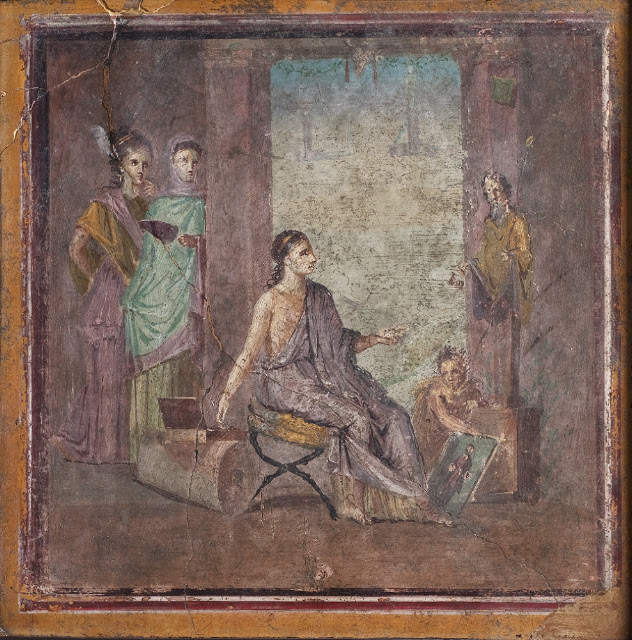
Painter at Work, 1st century CE. Pompeii 
 Fresco from the House of the Surgeon

And it is entirely appropriate that we remember the people of Pompeii, for it is impossible not to reflect on their tragic fate. 

Back in the late 1970's, I saw the spectacular Pompeii AD 79 exhibition at the American Museum of Natural History in New York. It was a "once in a lifetime" exhibit. But I remember feeling pensive and unsettled looking at the display of art and artifacts relating to people who had died en masse, suddenly and tragically. It was the height of the Cold War and apocalyptic thoughts were not uncommon in those days.

Later, I learned that the great Italian poet, Primo Levi, had been moved to write a searing poem comparing the death of a young child at Pompeii to victims of the Holocaust and Hiroshima. In The Little Girl of Pompeii, Levi, who had survived Auschwitz, began his poem with the gripping words: 

Since everyone’s anguish is our own

Levi went on to write:

Centuries have passed, the ash has petrified                                                

To imprison those delicate limbs forever.                                                     

In this way you stay with us, a twisted plaster cast,                                     

Agony without end, terrible witness to how much                                        

Our proud seed matters to the gods.

These haunting words - and the deeply humane sentiments the went into writing them - do "stay with us." It is hard for me to banish them from my mind when thinking about Pompeii and more recent tragedies which invite comparison, as Levi does so memorably in his poem.

Yet, I am happy to say that Pompeii in Color has had a liberating effect upon my feelings. This brilliant exhibition, filled with color and light, love and life, at the ISAW has helped me grapple with the ambivalent, troubled emotions I felt when viewing Pompeii AD 79 so long ago. Though I've yet to see the actual paintings at ISAW, the effect of this exhibition has been spirit and life affirming!

Now, when I think of Primo Levi's The Little Girl of Pompeii, I no longer view her in my mind's eye as "a twisted plaster cast." Rather, I see her as a face surrounded by ripening grapes and green leaves, a fey and ethereal face, emancipated from the hardened ash that entombed her bones. 

Mask amid Bunches of Grapes & Vines, 1st century CE. Pompeii
 Fresco from the House of V. Popidius

Pompeii's "agony without end" has ceased and these wondrous paintings on view at ISAW survive to remind us how delightful and rewarding life can be, even when lived in the shadow of Mount Vesuvius.

***

Text: Copyright of Ed Voves, all rights reserved                                            

Images courtesy of the Institute for the Study of the Ancient World, New York City, and the University of Michigan open access photos, https://quod.lib.umich.edu/a/aict?auth=world;sort=aict_ti;type=boolean;view=reslist;rgn1=ic_all;q1=aict

Introductory Image: Hercules and Omphale, 1st century CE. Herculaneum. Fresco: H. 40.3 cm; W. 41 cm. National Archaeological Museum of Naples: MANN 9004. Image © Photographic Archive, National Archaeological Museum of Naples.

Pompeii: general view to the north, showing paved street with pedestrian crossing blocks; in the background, Mount Vesuvius. University Of Michigan open access photo. ID RM055. Photo Date: June 1993 

Banquet Scene with Inscribed Words, 1st century CE. Pompeii. Fresco from the House of the Triclinium, East wall, central section: H. 77.5 cm; W. 77.6 cm. National Archaeological Museum of Naples: MANN 120029. Image © Photographic Archive, National Archaeological Museum of Naples

Architectural Landscape, 1st century CE. Pompeii. Fresco from the House of the Peristyle: H. 121.3 cm; W. 96.5 cm. National Archaeological Museum of Naples: MANN 8572. Image © Photographic Archive, National Archaeological Museum of Naples

The Three Graces, 1st century CE. Pompeii. Masseria di Cuomo – Irace,. Fresco: H. 60 cm; W. 53.3 cm. National Archaeological Museum of Naples: MANN 9231. Image © Photographic Archive, National Archaeological Museum of Naples.

Shrine fresco from the House of the Vettii, Pompeii: detail of Genius (spirit) of the Paterfamilias flanked by two lares. University Of Michigan open access photo. ID RM063. Photo Date: June 1993

Hercules and Omphale, 1st century CE. Pompeii. Fresco from the House of Marcus Lucretius, triclinium 16, east wall, central section: H. 203.2 cm; W. 162.6 cm. National Archaeological Museum of Naples: MANN 8992. Image © Photographic Archive, National Archaeological Museum of Naples

Hercules and Omphale, 1st century CE (detail). Herculaneum. Fresco (see data for introductory image.

Achilles on the Island of Skyros, 1st century CE. Pompeii. Fresco from the House of Achilles or House of the Skeleton or House of Stronnius, cubiculum u, north wall, central section: H. 156.5 cm; W. 148.6 cm. National Archaeological Museum of Naples: MANN 116085/ Image © Photographic Archive, National Archaeological Museum of Naples

Fourth-style mural painting sequence from the House of the Vettii, Pompeii. University Of Michigan open access photo. ID RM067. Photo Date: June 1993 

Architectural Landscape, 1st century CE. Herculaneum. Fresco from the Villa of the Papyri:, H. 71.1 cm; W. 90.5 cm. National Archaeological Museum of Naples: MANN 9423. Image © Photographic Archive, National Archaeological Museum of Naples

Still-life Fragments representing Vase, Scrolls, Landscape, and Fruit, 1st century CE. Herculaneum.  Fresco: H. 51.1 cm; W. 62.5 cm. National Archaeological Museum of Naples: MANN 9819. Image © Photographic Archive, National Archaeological Museum of Naples

Painter at Work, 1st century CE. Pompeii. Fresco from the House of the Surgeon: H. 45.4 cm; W. 45 cm. National Archaeological Museum of Naples: MANN 9018. Image © Photographic Archive, National Archaeological Museum of Naples.

Mask amid Bunches of Grapes and Vines, 1st century CE. Pompeii. Fresco from the House of V. Popidius or House of Mosaic Doves, triclinium 13, east wall, central section. H. 54.6 cm; W. 55.2 cm. National Archaeological Museum of Naples: MANN 9798. Image © Photographic Archive, National Archaeological Museum of Naples

Friday, November 22, 2019

A Wonder to Behold - Ishtar Gate Exhibition at the Institute for the Study of the Ancient World


A Wonder to Behold:

Craftsmanship and the Creation of Babylon’s Ishtar Gate


Institute for the Study of the Ancient World      
November 6,2019–May 24,2020

Reviewed by Ed Voves                                                                                                    Original Photography by Anne Lloyd                                                                                Guest Photography by Sarah Mitchell

The recently-opened exhibition at the Institute for the Study of the Ancient World (ISAW) in New York City is aptly named: "A Wonder to Behold."

A Wonder to Behold investigates the building of the Ishtar Gate, one of antiquity's greatest architectural and artistic triumphs. The Ishtar Gate was the jewel in the crown of King Nebuchadnezzar II (r.604–562 BC) of Babylon.

The ISAW exhibition is curated by Dr. Clare Fitzgerald, Associate Director of Exhibitions at ISAW, Anastasia Amrhein, an art historian from the University of Pennsylvania and Elizabeth Knott, PhD, an historian specializing in the ancient Middle East from NYU.

The Ishtar Gate's "rebuilding" is also part of the story which the ISAW exhibition tells. Following the excavation of the Ishtar Gate by a team of German archaeologists led by Robert Koldewey, from 1899 to 1917, what amounted to solving the greatest "jigsaw" puzzle in history occurred. 

Eight hundred cases of fragments of Nebuchadnezzar's imposing gateway were sent to Germany to be sorted and studied. In a wonderful opening display, the ISAW curators evoked the shipment of the brick shards from Babylon to Berlin over a century ago. One of the original wooden cases, filled with battered pieces from the Ishtar Gate, is front and center in ISAW's lobby.


Anne Lloyd, Photo (2019) Gallery view of the ISAW Exhibition, A Wonder to Behold, showing an original wooden case from the excavation of the Ishtar Gate

With vibrant glaze colors still clinging to many of the fragments, the possibility arose of reuniting at least some of the remnants of the Ishtar Gate. A mind-numbing task, it involved identifying and matching the bits and pieces composing the sacred animals on the walls of the Ishtar Gate complex. 


Anne Lloyd, Photo (2019)
Fragments of Bricks from the Ishtar Gate, ca. 602-562 B.C.(top)
 and one from the Achaemenid Period, ca. 559–331 B.C.

Amazingly, enough of the fragments were pieced together so that a reconstructed version  of the Ishtar Gate could be exhibited. Additional blue bricks were created by German artists to fill in the spaces between the reassembled ancient art works. 
Opened in 1930 in the Vorderasiatisches Collection of Berlin's Pergamon Museum, this slightly smaller version of the original is one of the most impressive museum exhibits in the world.


Sarah Mitchell, Photo (2019)
The Ishtar Gate, reconstructed at the Pergamon Museum in Berlin

My friend, Sarah Mitchell, recently visited the Pergamon Museum. Sarah generously shared her photos of the Ishtar Gate, enabling me - vicariously - to get some idea of what it must have been like two thousand five hundred years ago to view the magnificent portal in the days of its glory.

No less impressively, the ISAW, with only two modestly-sized exhibition galleries at its disposal, chronicles the building and "rebuilding" of the Ishtar Gate in fascinating detail.


Anne Lloyd, Photo (2019) Gallery view of the ISAW Exhibition,
 A Wonder to Behold, Craftsmanship and the Creation of Babylon’s Ishtar Gate

Covered in sparkling glazed bricks, embellished with rows of striding lions, bulls and dragons in molded relief, the Ishtar Gate proclaimed the might of the Neo-Babylonian Empire of Nebuchadnezzar II. The "new" Babylon represented the culmination and climax of ancient Mesopotamia. 
For a brief, shining moment, Nebuchadnezzar II surveyed his far-flung realm from the battlements atop the Ishtar Gate in Babylon. 

Power politics certainly played a major role in motivating the massive funding and enormous effort in constructing Babylon's Ishtar Gate. Pomp and glory, however, are not the themes of the ISAW exhibit. Rather, a seemingly lackluster term is key: materiality.

To grasp the meaning of materiality, one needs to understand the tools and natural resources which the Babylonians used. From making mud bricks to recipes for special glazes to color the bricks, the Babylonians drew on expertise dating back to remote antiquity. The practical skill of brick layers, craftsmen and architects was complemented by the "know-how" of an elite group of expert scholars called ummânÅ«. 

Some of the Ishtar Gate bricks were found stamped with inscriptions. These hallmarks likely testify to the contributions of individual workers or supervisors.


                                                 Anne Lloyd, Photo (2019)                                            Detail of a brick stamped with a worker's inscription , ca. 602-562 B.C.

The knowledge and skills used to create the Ishtar Gate reflected the latest technology of the Babylonians but more importantly were founded on centuries of innovation and transmission from the city-states and kingdoms which preceded Nebuchadnezzar's empire. 

A major focus of the exhibition curators is to gain insight into these construction techniques. What may be termed as "experimental" archaeology can be seen below in the model of a brick mold used to create the incredible dragons  of the Ishtar Gate. 


Anne Lloyd, Photo (2019)
      Gallery view of the A Wonder to Behold exhibition, showing a reconstructed      
 brick mold used to create the head of a muÅ¡huššu-dragon

Since the design of the dragon - a muÅ¡huššu-dragon, to be exact - was repeated, it made sense to create a technique allowing duplication for the individual heads, necks, legs, etc. of these fabulous beasts. 

Among the more curious objects on display in the ISAW exhibit is brick stamped with the inscription of Nebuchadnezzar. While drying, the brick received a visit from a wandering animal not included in the select company of lions, dragons and bulls. A dog's paw print can be seen directly on the royal title of Nebuchadnezzar II.


                                                   Anne Lloyd, Photo (2019)                                                        Gallery view of the A Wonder to Behold exhibition, showing a brick 

stamped with the inscription of Nebuchadnezzar & the imprint of a dog's paw print

The Ishtar Gate was one of the gates to the inner city of Babylon. The all-important New Year procession - held in the Spring - passed through the gate.The Babylonians had not only Nebuchadnezzar II to please, but also a formidable deity as well: Ishtar. Goddess of Love and War, Ishtar was a goddess to be reckoned with.

There are other reasons for focusing attention on materiality in reference to the Ishtar Gate. 

First, the historical record, rich in details on some aspects of the empire of Nebuchadnezzar II, is a blank slate when it comes to the Ishtar Gate. Herodotus, the "Father" of History, wrote about Babylon during the fifth century B.C. but without a single reference to the Ishtar Gate.

Even more frustrating, the fabled list of the Seven "Wonders" of the World mentioned by Greek historians living in the first century B.C., Diodorous Siculus and Antipater of Sidon, are silent as well about the Ishtar Gate. Diodorus commented upon the "hanging gardens" of Babylon, while Antipater listed Babylon's walls as a "wonder" of the world. No evidence of "hanging gardens" of Babylon has ever been found. Claims that Babylon's walls were wide enough to drive a chariot team along them are almost certainly exaggerated.


                                                   Anne Lloyd, Photo (2019)
                       Copy of a 1902 photo showing part of the Ishtar Gate wall
 found in situ during the German excavations at Babylon

Digging down into the foundations of Babylon's walls, the German archaeologists made the sensational discovery that the Babylonians had not stopped at ground level in decorating the Ishtar Gate. Below the surface were surviving reliefs of lions, bulls and dragons, made of molded brick. Unlike those above ground, these were not covered with vibrant color glazes, but they did supply essential evidence for the reconstruction project in Berlin. 

Moreover, these subterranean wall reliefs, which still can be see in Iraq today, proved beyond doubt that the Ishtar Gate was truly a "wonder to behold." 
  
Once the mystery of the Ishtar Gate's place among the Seven Wonders of the World was resolved, another immediately took its place. What happened to the gleaming blue and gold Ishtar Gate?


Unknown Artist, Brick with the head of a Persian archer, ca. 510 B.C, from the Louvre

Less than four decades after the Ishtar Gate was completed, Cyrus the Great of Persia conquered Babylon in 539 B.C. The Persians, though outsiders to Mesopotamia, had integrated many features of the region's cultures. They were notably tolerant of other religions, so the Ishtar Gate was not likely destroyed by the "fire and sword" of Cyrus and his armies.

A likely explanation for the "mystery" of Babylon's walls is that the high-quality baked bricks were re-used by local populations during the centuries after the city was abandoned.

Thanks to the dedication and skill of the German archaeologists and Vorderasiatisches Collection staff, many of the Babylonian lions, bulls and dragons from the Ishtar Gate are prowling around once again - and not just at the Pergamon Museum.


Anne Lloyd, Photo (2019)
Gallery view of the A Wonder to Behold exhibition, showing one of the reconstructed Ishtar Gate lions owned by the Metropolitan Museum of Art

A number of the pieced-together Ishtar Gate masterpieces were sold to other museums. The Metropolitan Museum owns two Ishtar lions, one of which they graciously loaned to ISAW for the exhibition. It did not have to travel far as ISAW is only a couple blocks away from the Met in New York City.

The Ny Carlsberg Glyptotek in Copenhagen owns a full set, lion, dragon and bull (actually an auroch, a wild ancestor of domesticated bulls, now extinct). Scholars at the Ny Carlsberg are among the leaders in studying polychromy, the use of color on ancient statues and monuments. They have determined that the lustrous blue color of the walls of the Ishtar Gate was produced by a glaze recipe composed of a mixture of cobalt and copper. This was intended to replicate lapis lazuli, the precious gemstone from Afghanistan which was used on royal regalia throughout the ancient world.

Glaze recipes account for the color variations on the bricks used throughout the Ishtar Gate complex. The mixing and application of the glazes was likely involved the supervision of  of the ummânÅ«. 


Cuneiform Tablet with Red Glass Recipe,
Middle Babylonian era, ca. 1400-1200 B.C., from the British Museum
                  
On display is a cuneiform tablet with a recipe for making red glass - and thus applicable to glazing making. The "red" recipe dates to nearly a thousand years before the Ishtar Gate.

No doubt the ability to create colorful and durable glazes must have seemed like a form of magic. It would not be an exaggeration to compare the ummânÅ« to the alchemists of the Renaissance period who prepared the way for the Scientific Revolution of the 1600's.

If the Ishtar Gate was a "wonder" to behold, then so is the ISAW exhibition.


Anne Lloyd, Photo (2019) Curator Anastasia Amrhein explains molds used to create sacred objects during the era of the Ishtar Gate’s construction, ca. 602-562 B.C.

While some of the displays at ISAW are traveling exhibits from other museums, most are "home team" efforts.  Like last spring's spectacular Hymn to Apollo:  Ballet Russes and Antiquity, the Ishtar Gate exhibit is one that everyone at ISAW can be proud. And it will be one that I will particularly remember - because of a serendipitous event at the press preview.  

A Q&A was part the "presser," held in the second floor meeting room. ISAW has an  impressive spiral staircase. As Anne and I descended the stairs, Anne suddenly stopped and took an incredible photo of the Vorderasiatisches Collection crate below.


Anne Lloyd, Photo (2019) Gallery view of the ISAW lobby,
 showing an original wooden case from the excavation of the Ishtar Gate

Walking down the stairs took on new meaning. We were replicating the work of archaeologists and curators, reaching down into the past, stepping through the strata of centuries and epochs.

And what did we discover? Crumbled debris of a fallen empire? No, these are "wonderful things," each bearing the finger prints of human beings like people today and across time.

The Vorderasiatisches Collection crate placed next to the ISAW staircase contains nothing less than a portion of the precious inheritance of all humankind.

***
Introductory  Image:                                                                                                        Anne Lloyd, Photo (2019) Detail of Panel with Striding Lion, Ca. 604-562 B.C., Neo-Babylonian  era,  ca. 604–562 B.C.  Ceramic, glaze:  39 1/4 × 90 3/4 in. (99.7 × 230.5 cm) Metropolitan Museum of Art, Fletcher Fund, 1931 # 31.13.2

Anne Lloyd, Photo (2019) Gallery view of the Institute for the Study of the Ancient World (ISAW), showing a crate used to ship bricks from Babylon to Berlin,1903-1927. Wood:  H. 45 cm; W. 85 cm; D. 48 cm. Staatliche Museen zu Berlin, Pergamon Museum, Vorderasiatisches Collection

Anne Lloyd, Photo (2019) Photo of a brick fragments from the Ishtar Gate, ca. 602-562 B.C., sent to the Vorderasiatisches Collection in Berlin.

Anne Lloyd, Photo (2019) Photo of a brick fragment from Babylon, Achaemenid Period, ca. 559–331 B.C., sent to the Vorderasiatisches Collection in Berlin.

Sarah Mitchell, Photo (2019) The Ishtar Gate, reconstructed at the Pergamon Museum in Berlin. Staatliche Museen zu Berlin, Vorderasiatisches Collection.


Anne Lloyd, Photo (2019) Gallery view of the A Wonder to Behold exhibition at the  Institute for the Study of the Ancient World, New York City      

Anne Lloyd, Photo (2019) Gallery view of the A Wonder to Behold exhibition, showing a fragmentary brick stamped with cuneiform inscription of Nebuchadnezzar II and impressed with a dog's paw print (Staatliche Museen zu Berlin), an Egyptian (New Kingdom) brick mold (Metropolitan Museum), and a brick stamp with cuneiform inscription of a king, Akkadian Period, ca. 2334–2154 B.C. (University of Pennsylvania Museum)


Anne Lloyd, Photo (2019)   Copy of a 1902 photo showing part of the Ishtar Gate wall found in situ during the German excavations at Babylon.

Unknown Artist, Brick with the head of a Persian archer, ca. 510 B.C. Glazed siliceous material: H. 27 cm; W. 46.8 cm; D. 12 cm. On loan from the Louvre. # Sb 21878

Anne Lloyd, Photo (2019)

Gallery view of the A Wonder to Behold exhibition, showing one of the reconstructed Ishtar Gate lions owned by the Metropolitan Museum of Art

Unknown Artist (Middle Babylonian Period) Cuneiform tablet with a red glass recipe, ca. 1400–1200 B.C. Clay: H. 8.5 cm; W. 5.8 cm; D. 2.5 cm. The British Museum, London. # 120960


Anne Lloyd, Photo (2019) Curator Anastasia Amrhein explains molds used to create sacred objects during the era of the Ishtar Gate’s construction, ca. 602-562 B.C.


Anne Lloyd, Photo (2019) Gallery view of the ISAW lobby, showing an original wooden case from the excavation of the Ishtar Gate.