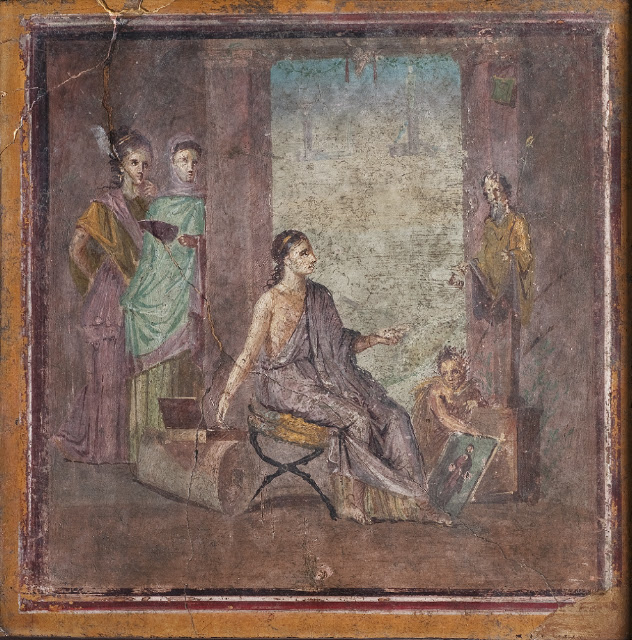
Showing posts with label Pompeii. Show all posts

Thursday, July 14, 2022

Art Eyewitness Review: Chroma: Ancient Sculpture in Color at the Metropolitan Museum of Art


Chroma: Ancient Sculpture in Color

The Metropolitan Museum of Art, New York City

July 5, 2022 - March 26, 2023

Reviewed by Ed Voves

Original Photography by Anne Lloyd

The ancient Greek and Roman galleries at the Metropolitan Museum of Art create a high theater of drama. Here, a daily symphony of shafts of natural light and the counterpoint of shadow awakens the Met's Greek and Roman antiquities from the sleep of the ages.


Ed Voves, Photo (2022)  
Gallery view of the Greek & Roman Wing of the Metropolitan Museum

The portrait busts of Alexander and Caesar Augustus do appear about to speak. But they never do. This is a realm of marble and bronze, where noble words linger on rigid lips. Well-muscled arms and legs do not move, drained as they are of life and color. Until now.

Color has returned to the Greek and Roman galleries at the Metropolitan Museum in a fantastic exhibition, Chroma: Ancient Sculpture in Color. The exhibit will be on view at the Met until March 2023, an added bonus since art lovers are certainly going to want to return for for a second or third look.


                                       Anne Lloyd, Photo (2022) 
          Reconstruction of a Cycladic sculpture of the Spedos group

The use of color (polychromy) is traced over the course of ancient history from the very early, Cycladic sculptures, 2700-2200 B.c., to statues of god, goddesses and heroes which once adorned the Acropolis of Athens or the Forum of Rome. Seventeen specially prepared reconstructions of ancient statues are featured in the exhibition.

Chroma: Ancient Sculpture in Color is a collaborative effort of the Met and a German research institute, the Liebieghaus Skulpturensammlung, located in Frankfurt.  A husband-and -wife team, Vinzenz Brinkmann and Ulrike Koch-Brinkmann, have performed the scientific equivalent of the labors of Hercules, studying and recreating the vibrant color schemes which once enlivened the features  of statues and bas-reliefs. 

An important feature of the exhibition is the use of plaster casts, rather than original works of art. These copies are displayed in the Met's ancient Greek and Roman galleries, replicating ancient masterpieces. Each is painted with colors matching the palate of ancient artists or the metallic finish of bronze statues. The latter category includes reconstructions of the celebrated Riace warriors, discovered by a diver off the coast of Italy in 1971. 


Anne Lloyd, Photo (2022)  
       Gallery view of the Chroma: Ancient Sculpture in Color exhibit,             showing reconstructions of the Riace Warriors, created by          Vinzenz Brinkmann and Ulrike Koch-Brinkmann

In a sense, the use of copies is a reversion to standards of museum curatorial policy of the nineteenth century. Recreations of famous works of art once filled the galleries of museums like the Met, but were exiled to storage rooms as actual works of ancient art were purchased or donated. Now, copies of classical masterpieces are back, this time in "living color."

Sun, wind, rain and rust have all but effaced the skin tones and the hues of garments which Greek and Roman artists skillfully imparted to sculpted portraits of the Olympian gods and lesser mortals.  

Prof. Dr. Vinzenz Brinkmann and Dr. Ulrike Koch-Brinkmann, in a decades-long effort, have begun to undo the damage wrought by the hand of time. Using X-ray fluorescence spectroscopy, ultraviolet-visible absorption spectroscopy, chemical analysis of residues of metallic corrosion and other state-of-the-art technological processes, the Brinkmann's diligent research has revealed the color-drenched world of classical Greece and Rome.                                                                                                                


         Anne Lloyd, Photo (2022)  
Reconstruction of the Alexander Sarcophagus (detail)

To see familiar works of Greek and Roman art newly restored to colorful "life", is both a fascinating and perplexing experience. Conflicting opinions over the relative merits of "colorized" ancient works of art versus the familiar, sun-bleached state, bring to mind the controversies over the introduction of Technicolor films during the 1930's and the "colorization" of vintage black and white classics in the 1990's. Cinema purists were appalled; movie fans  applauded and called for more.

A similar debate took place in antiquity. Many Greek philosophers, including Plato, were suspicious of the emotional effect of over-indulging in color. Likewise, the Roman scholar, Pliny the Elder, took a conservative, tradition-bound approach to color in art.

Pliny insisted that painters should follow the example of Apelles, the court-painter to Alexander, and use a four-color palette - black, white, red and yellow. Yet, across the Bay of Naples from Pliny's country estate, paintings excavated in Pompeii reveal that 29 different pigments were used in the art works preserved by the layers of volcanic ash which buried the city in the year 79 - and killed Pliny as he courageously tried to rescue survivors.


Anne Lloyd, Photo (2022)  
Reconstruction of the Small Herculaneum Woman, 30-1 B.C.

One of the most striking painted replica statues in the Chroma exhibit is known as the Small Herculaneum Woman. This is rather ironic as Herculaneum was destroyed by Vesuvius along with Pompeii in 79. 

The Brinkmann's research revealed that blue and green hues, notably absent from Pliny's restricted palate, had been extensively used on a version of the Small Herculaneum Woman excavated on the island of Delos. Numerous copies of the sculpture have been found  throughout the Graeco-Roman world.
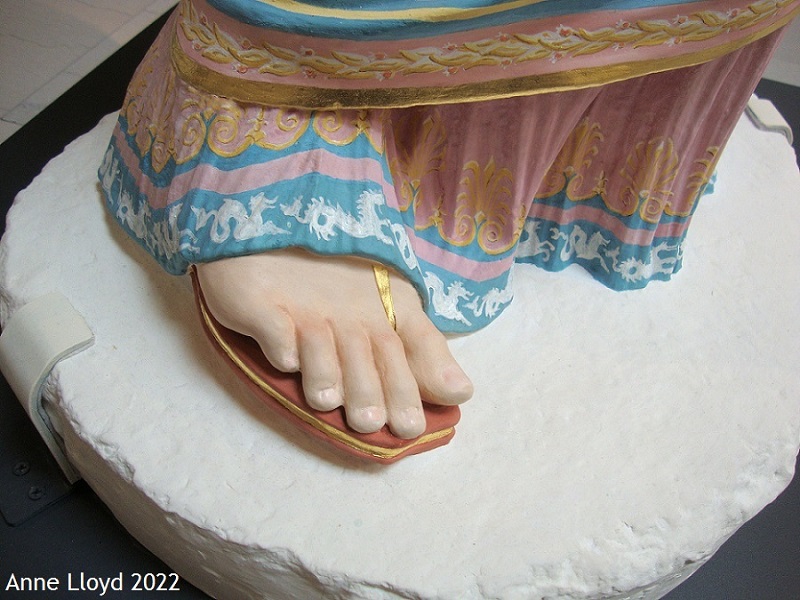


Anne Lloyd, Photo (2022)  
Detail of the reconstructed Small Herculaneum Woman, 30-1 B.C.

Deploying  their high-tech toolkit, the German researchers detected that a light Egyptian blue color and a shade of green made from malachite had been used to paint the garments of the Small Herculaneum Woman from Delos. The artistry involved in applying these scientific insights to the replica is positively sensational, making it a true work or art in its own right.


Anne Lloyd, Photo (2022)  
Gallery view of the Chroma exhibit, showing the reconstruction of the Small Herculaneum Woman (created 2019) 

The noted British scholar, Philip Ball, in his book, Bright Earth: Art and the Invention of Color, believes that artists in Greece and Rome largely ignored the strictures of Plato and Pliny. The advance of the Greeks to the frontiers of India during the campaigns of Alexander brought them into contact with a whole range of new pigments. During the Hellenistic Age which followed Alexander there appear to have been few inhibitions about using the new colors.                                                                 

One of the key works in appreciating ancient color is known as the Treu Head. The original was excavated on the Esquiline Hill in the heart of Rome. It is the head of a statue of Venus or Minerva (Athena), created during  the years, 140-150. 
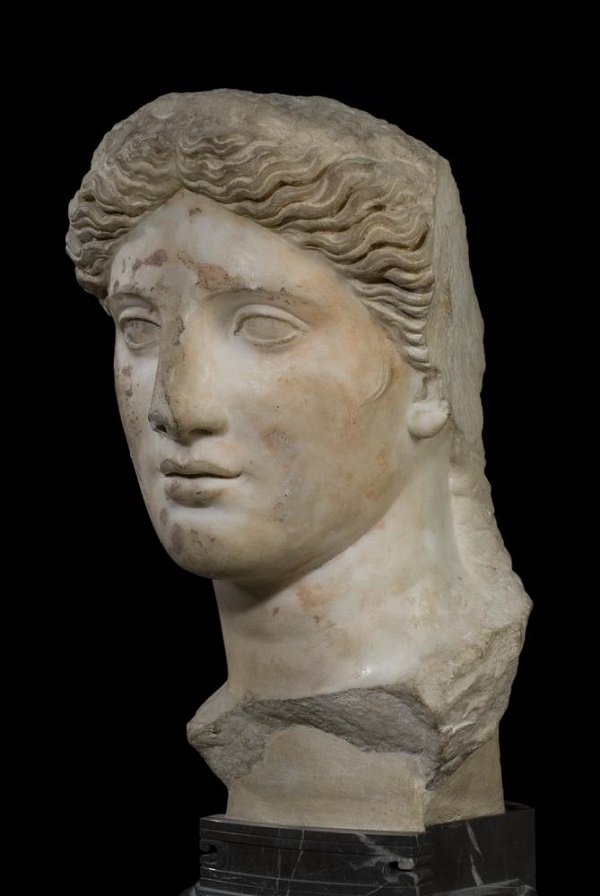

Unknown artist, Treu Head, Late Hadrianic/Antonine , A.D. 140-150

When the Treu Head was unearthed in the early 1880s, traces of color were clearly visible.  An exhaustive effort to examine the head was undertaken by a German scholar, Georg Treu, before it went on display in the British Museum.

The Treu Head is one of the key works of art in the study of polychromy in ancient art. The original is too fragile to travel for international exhibits. But the Brinkmanns pulled-out all the "stops" in their replica to show the stages by which an ancient artist created lifelike features  for this goddess. Particularly interesting is the carbon-black under-drawing, first applied to the marble head to define the features, especially the eyes, as shown here.


Anne Lloyd, Photo (2022)  
Study I of the Treu Head, created in 2014

As works of art like the Treu Head were excavated with traces of paint clearly discernible, scholars were faced with a quandary. Clearly, the ancient use of color served important purposes or satisfied cultural tastes in antiquity. But aesthetic sensibilities in the West, especially since the Renaissance, had been shaped by the design vs. color debate, with the highest accolades going to design, the careful crafting of shape whether in drawing or sculpture.

This quandary remains. Would we today prefer museum galleries displaying row after row of painted statues and bas-reliefs from antiquity rather than time-worn examples which more clearly reveal the creative genius of the sculptors who made them? 

A little time in the company of one of the most infamous men from ancient Rome may help answer that question.


Anne Lloyd, Photo (2022)  
Marble Portrait Bust of Emperor Gaius/Caligula, A.D. 37-41

One of the premier works in the Met's collection of Roman art is a portrait bust of Emperor Gaius, the notorious Caligula. In the Met's likeness of Gaius, the exceptional skill in the sculpting of the emperor's features is beyond dispute. This is a work of three-dimensional artistry of the highest caliber. After examining it for a while, we are left pondering if Caligula really was the most "ignoble" Roman of them all.

The painted head of Gaius/Caligua leads to a very different reaction. It should be noted that the Brinkmanns selected a slightly different portrait bust for their model, but not enough to account for the shock value that one feels when looking at the painted Caligula.  
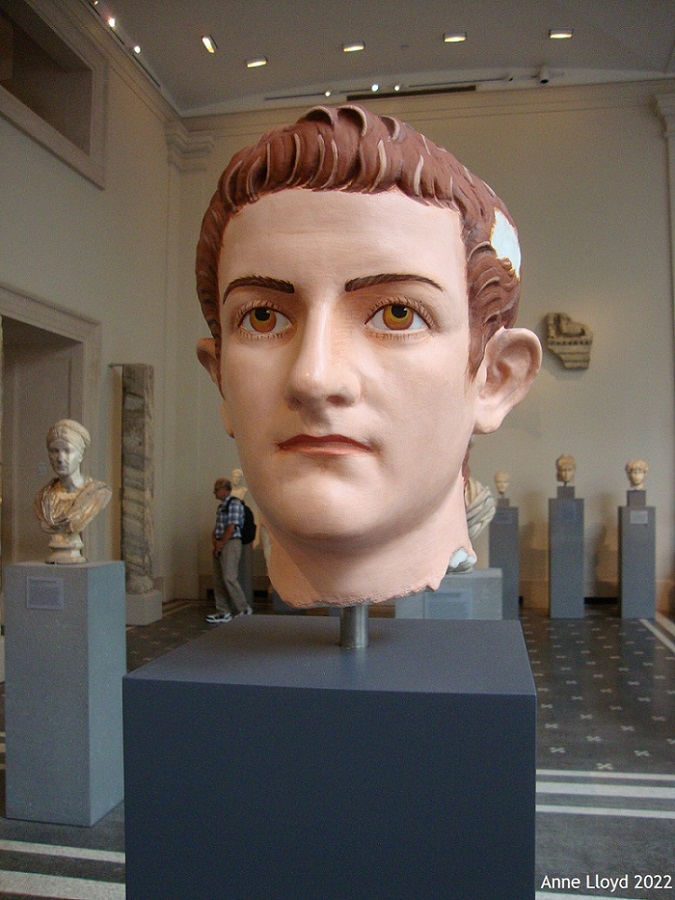


Anne Lloyd, Photo (2022)  
Reconstruction of Portrait Bust of Gaius/Caligula (created 2005)

There are no doubts, no questions of whether or not Caligula was the monster as portrayed by hostile historians like Suetonius. Look into those eyes and one sees the menace of an autocratic ruler which can so easily turn into madness.

Polychromy can obscure or deflect our attention from the design values of ancient sculptures like the Met's portrait bust of Gaius/Caligula. But the reason for painting statues is clear enough. The color applied to statues in ancient times was chiefly intended to influence and educate a public audience, looking from a distance, rather than for the close study by scholars working in elite institutions like the Library of Alexandria - or The Met. 

The spectacular uniform and equipment of the statue of a kneeling archer on view at the Met is a case in point. The original marble archer was part of a Trojan War battle scene positioned on the roof pediment of the Temple of Aphaia, located on the island of Aigina, south of Athens. 


Anne Lloyd, Photo (2022)  
       Reconstruction of the Marble Archer in Scythian Costume,         
from the West Pediment of the Temple of Aphaia, ca. 480 

Most of the details of the kneeling archer which we can see at close hand would have been obscured to visitors to the temple, standing below. However, the vibrant colors, especially of the exotic headgear, would have insured that the identity of the archer, an Amazon warrior fighting on the side of the Trojans, would have been clearly apparent.

Visitors to Athens would also have seen the figure of a winged Sphinx crouching on top of a tall marble stele or grave marker, dedicated to a youth and a little girl. This much-loved Finial in the Form of a Sphinx, which has been in the collection of the Met since the 1930's, was sculpted around 530 B.C. 


  Anne Lloyd, Photo (2022)  
Marble Capital and Finial in the Form of a Sphinx, ca. 530 B.C.

Greek art of these years, known as the Archaic period, is especially expressive. To facilitate study, the Met displays the actual Winged Sphinx at ground level, with a cast copy on top of the column, where it originally perched. Now a third version, modeled and painted by the Brinkmanns keeps them company in Gallery 154.


Anne Lloyd, Photo (2022)  
Reconstruction of a Marble Finial in the Form of a Sphinx, 2022

This Reconstruction of a Marble Finial in the Form of a Sphinx, to give this wondrous beast its full title, is the show stopper of the exhibition. The Sphinx was created specifically for the Chroma exhibition at the Met, with Dr. Brinkmann's team working in close collaboration with the Met's Greek and Roman curators and the museum's Objects Conservation and Scientific Research departments.

Rather than recapitulate the backstory of the creation of the Winged Sphinx replica, it is far more appropriate at this point to highlight the Met's exhibit webpage. Here a full array of useful digital resources is deployed, ready for detailed study. Even by the Met's accustomed standards of excellence, these exhibition aids are truly remarkable.

Of particular value to me, in reviewing the Chroma exhibition, was the glossary page which provided pithy explanations of the technical tool-kit used by the Brinkmanns and the Met curators. Also, the glossary definitions extend to information on the types of pigments used by ancient artists.

The Met also has a special feature for smartphone users, entitled The Chroma AR experience. With this feature, they will be able to follow the reconstruction process of the Winged Sphinx. Chroma AR can be accessed from the Met web page devoted to the exhibition.


Anne Lloyd, Photo (2022)  
Gallery view of the Chroma exhibit, showing reconstructions of the bronze statues, the Terme ruler (left) and the Terme Boxer

One of the surprises of Chroma: Ancient Sculpture in Color is the significant role of bronze casts in the story of polychromy. Given the high artistic value which the Greeks and Romans attached to bronze statues, it makes sense that these metallic portraits should have received added details like inlaid eyes. But close study of two bronze statues, known as the Terme Ruler and Terme Boxer offer fascinating evidence of how the ancients' love of dramatic effect extended to unexpected embellishments.


Anne Lloyd, Photo (2022)  
Reconstruction of The Terme Boxer (The Boxer at Rest), 2022

I was particularly fascinated to study the reconstruction of the Terme Boxer. Back in 2015, a "once in a lifetime" exhibit of ancient bronze statues, organized by the Getty Museum and the National Gallery, had included the Terme Boxer in its lineup. In that exhibit, the bronze statue was entitled "Boxer at Rest." 

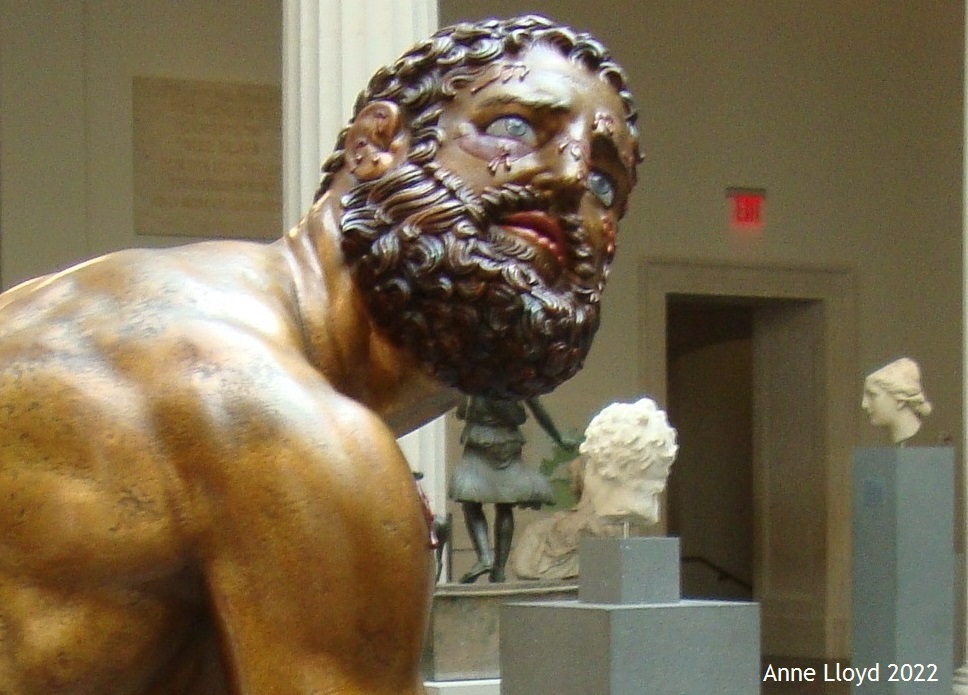
When I saw the ancient original, I was really impressed with the fidelity to lifelike details, especially the boxer's battered, "cauliflower" ears. However, the reconstruction of the Terme Boxer has taken the delineation of his scars and bruises to a level that an unpracticed eye, like mine, could not easily detect.

According to the commentary on the Met's web page, ancient masters of bronze casting used a wide range of techniques to enhance their statues.

Scientific research and ancient written sources show that colorful effects were achieved via multiple methods, including the use of different alloys during casting; artificial patination with sulfurous substances; and the addition of bitumen lacquer, other metals (including gold, silver, copper, tin, and lead), and precious stones. The naturalistic effect of these sculptures was apparently so strong in ancient times that many visitors to the sanctuaries believed them to be alive.


Anne Lloyd, Photo (2022)  
Reconstruction of the Terme Boxer (detail), 2022

Looking at the Terme Boxer, one might well believe him to be alive. The ingenious effort that went into creating that "trick of the eye" is astonishing. For instance, the bruise under the boxer's right eye was produced by applying a sheet of bronze containing a high amount of lead, which "enabled an artificial patination in a highly realistic violet color."

With all of bruises, broken nose and bleeding wounds, there is no wonder that his earlier title, Boxer at Rest, may have seemed inaccurate. Indeed, close technical inspection has lead to a bold new theory about the identity of the Terme Boxer and the Terme Ruler.

The two bronze sculptures were excavated at the same site, in Rome, in 1885. Both figures share a distinctive attribute: the swollen "cauliflower" ears of a pugilist. Yet, there is quite a difference between the two. While the dejected Terme Boxer hunches in pain and exhaustion, the Terme Ruler stands in a triumphant pose. Could there be a connection?

By pairing the two statues in a joint narrative and scouring the record of Greek mythology, scholars now conjecture that the pair represent characters from the tale of Jason and the Argonauts. One of Jason's crew, Polydeukes, (the Terme Ruler) bested Amykos (the Terme Boxer), in a boxing match. 

There were alternative endings for the bout between Amykos and Polydeukes. In one version, Amykos, a brutal brigand fond of beating people to death, was killed. In the second, which we see depicted  in the Met's ancient Greek and Roman gallery, Polydeukes showed mercy to his defeated adversary, on condition that he cease his career of violence.

A dramatic story like this, complete with moral lesson, certainly adds to the status of Terme Ruler and the Terme Boxer, now that we know their likely  identity. Just as we can now match the features of these bronze masterworks to characters in mythology, so did people in the ancient cities see them as the face of the gods and heroes.


Anne Lloyd, Photo (2022)  
Reconstruction of a statue of the Goddess Artemis, created in 2010

Color in ancient art was thus a major feature of ancient religion. Over a great span of time, the priests and temple authorities in Greece and Rome raised-up colorfully painted statues depicting their deities.

These colorful representations of the traditional pantheon of Greece and Rome continued to resonate even after many people had come to doubt in the existence of Zeus and the Olympian gods. Indeed, there is a direct correlation and continuing timeline from the brightly painted art works of Graeco-Roman civilization to the value system of Christianity.

Following the fall of the Western Roman Empire in 476, a Roman aristocrat serving the Christian Church launched a hugely influential cultural program which made use of the artistic techniques of the Greeks and Romans.

"What writing conveys to those who can read," Pope Gregory I (540-604) proclaimed, "a picture shows to the ignorant ... and for that very reason a picture is like a lesson for the people."

Drawing upon the Greek and Roman use of color on statues, bas-reliefs and paintings, Christian artists would go on to create the mosaics of Cefalu and Monreale, the stained glass windows of Chartres and Giotto's Arena Chapel frescoes. 


Anne Lloyd, Photo (2022)  
Gallery 154 at the Met, showing the reconstruction of the Marble Finial in the Form of a Sphinx (left) and the original Sphinx (far right)

The Met's outstanding exhibition Chroma: Ancient Sculpture in Color and the incredible work of Vinzenz Brinkmann and Ulrike Koch-Brinkmann have many lessons to teach. But the greatest one is this - where the visual depiction of authentic religious belief is concerned, there are no gray areas.

***

Text: Copyright of Ed Voves, all rights reserved   

Images copyright of Anne Lloyd, all rights reserved

Introductory Image: Anne Lloyd, Photo (2022) Reconstruction of a Marble Finial in the Form of a Sphinx. Details below)

Ed Voves, Photo (2022)  Gallery view of the Greek & Roman Wing of the Metropolitan Museum, April 2022.

Anne Lloyd, Photo (2022)  Reconstruction of a Cycladic Sculpture of the Spedos Group (Detail), created 2006. Synthetic marble, natural pigments in egg tempera: 14 15/16 × 2 3/8 × 3 1/8 in. (38 × 6 × 8 cm). Vinzenz Brinkmann and Ulrike Koch-Brinkmann, Liebieghaus Skulpturen Sammlung.POL.002/St.P 695

Anne Lloyd, Photo (2022)  Gallery view of the Chroma: Ancient Sculpture in Color exhibit, showing reconstructions of the Riace Warriors, created by Vinzenz Brinkmann and Ulrike Koch-Brinkmann, 2015-16.

Anne Lloyd, Photo (2022)  Reconstruction of the Alexander Sarcophagus (detail), created 2007. Synthetic material, natural pigments in egg tempera:22 1/4 × 54 1/8 × 7 7/8 in. (56.5 × 137.5 × 20 cm) Vinzenz Brinkmann and Ulrike Koch-Brinkmann, Liebieghaus Skulpturen Sammlung. POL.009/St.P 701

Anne Lloyd, Photo (2022) Reconstruction of the Small Herculaneum Woman, 30-1 B.C., created 2019. Marble stucco on plaster cast, natural pigments in egg tempera, gold foil: 72 13/16 × 22 1/16 × 25 9/16 in. (185 × 56 × 65 cm) Vinzenz Brinkmann and Ulrike Koch-Brinkmann, Liebieghaus Skulpturen Sammlung.POL.007/LG 223

Anne Lloyd, Photo (2022) Detail of the reconstructed Small Herculaneum Woman, 30-1 B.C.

Anne Lloyd, Photo (2022) Gallery view of the Chroma exhibit, showing the reconstruction of the Small Herculaneum Woman (created 2019).
 
Unknown artist, Treu Head, Late Hadrianic/Antonine , A.D. 140-150. Parian marble, with traces of paint: 38.10 cm. (Height) British Museum. #1884,0617.1

Anne Lloyd, Photo (2022) Study I of the Treu Head (created 2014.
Marble stucco on plaster cast after 3D scan, natural pigments in egg tempera:14 9/16 × 10 1/4 × 10 1/4 in. (37 × 26 × 26 cm) Vinzenz Brinkmann and Ulrike Koch-Brinkmann, Liebieghaus Skulpturen Sammlung. POL.016 DEP.64

Anne Lloyd, Photo (2022)  Marble Portrait Bust of the Emperor Gaius, known as Caligula. Julio-Claudian, A.D. 37–41. Marble: H. 20 in. x  7 1/16 in (50.8 cm x 18 cm) Metropolitan Museum of Art.

Anne Lloyd, Photo (2022)  Reconstruction (B) of Portrait Bust of Gaius/Caligula (created 2005). Synthetic marble cast, natural pigments in egg tempera: 11 × 9 1/16 × 7 1/16 in. (28 × 23 × 18 cm) Vinzenz Brinkmann and Ulrike Koch-Brinkmann, Liebieghaus Skulpturen Sammlung. POL.013  St.P 691

Anne Lloyd, Photo (2022)  Reconstruction of the Marble Archer in Scythian Costume, from the West Pediment of the Temple of Aphaia, ca. 480 B.C. (Variant C, created 2006) Marble stucco on PMMA, natural pigments in egg tempera, tin, wood, gold foil: 37 13/16 × 30 5/16 × 21 5/8 in. (96 × 77 × 55 cm) Vinzenz Brinkmann and Ulrike Koch-Brinkmann, Liebieghaus Skulpturen Sammlung. POL.008/St.P 947

Anne Lloyd, Photo (2022) Marble Capital and Finial in the Form of a Sphinx. Archaic, ca. 530 B.C. Parian marble: H. with akroterion 56 1/8 in. (142.6 cm) Metropolitan Museum of Art.  Munsey Fund, 1936, 1938. # 11.185d, x

Anne Lloyd, Photo (2022) Reconstruction of a Marble Finial in the Form of a Sphinx, collection of the Metropolitan Museum of Art. (Created 2022). Cast from polymethyl metacrylate, natural pigments in egg tempera, gold foil, and
copper: 33 7/16 × 11 × 22 7/16 in. (85 × 28 × 57 cm) Vinzenz Brinkmann and Ulrike Koch-Brinkmann, Liebieghaus Skulpturen Sammlung. POL.017

Anne Lloyd, Photo (2022) Gallery view of the Chroma exhibit, showing reconstructions of the bronze statues, the Terme Ruler (left) and the Terme Boxer, created by Vinzenz Brinkmann and Ulrike Koch-Brinkmann, 2018.

Anne Lloyd, Photo (2022) Reconstruction of the Terme Boxer (The Boxer at Rest) (Created 2018). Bronze cast: 50 3/8 × 43 5/16 × 21 5/8 in. (128 × 110 × 55 cm) Vinzenz Brinkmann and Ulrike Koch-Brinkmann, Liebieghaus Skulpturen Sammlung. POL.010 St.P 722

Anne Lloyd, Photo (2022)  Reconstruction of the Terme Boxer (detail). 

Anne Lloyd, Photo (2022) Reconstruction of a Statue of the Goddess Artemis. (Variant A, Created 2010).  Vinzenz Brinkmann and Ulrike Koch-Brinkmann, Liebieghaus Skulpturen Sammlung. POL.012

Anne Lloyd, Photo (2022) Gallery 154 at the Metroplitan Museum of Art, showing the reconstruction of the Marble Finial in the Form of a Sphinx (left) and the original Sphinx (far right)

Wednesday, February 9, 2022

Art Eyewitness Review: Pompeii in Color: The Life of Roman Painting at the Institute for the Study of the Ancient World


    Art Eyewitness Review 

    Pompeii in Color: The Life of Roman Painting

      Institute for the Study of the Ancient World, New York

Reviewed by Ed Voves

When Mount Vesuvius erupted in the year 79, most of the unfortunate citizenry of Pompeii and nearby Herculaneum died quickly, if painfully. Deadly showers of blazing pumice and toxic gases ejected into the atmosphere from deep within the volcano killed thousands, perhaps as many 15,000, of the doomed inhabitants. 


Pompeii, general view to the north, looking toward Mount Vesuvius

The violent fury of Vesuvius ironically preserved a complete record of life in Pompeii at the very moment of its extinction. The layers of volcanic ash which buried the city acted as a conservator of the tools and objects of everyday use, even loaves of bread waiting to be removed from bake ovens.


Banquet Scene with Inscribed Words, 1st century CE. Pompeii
 Fresco from the House of the Triclinium

Remarkably, colorful paintings in the homes of Pompeii, which the hand of time has almost completely erased elsewhere in the ancient world, were saved from destruction by this "destroyer of worlds." 

Pompeii in Color: The Life of Roman Painting is a newly-opened exhibition of paintings from Pompeii, presented by the Institute for the Study of the Ancient World (ISAW). Located in New York City,  ISAW is affiliated with New York University and is dedicated to offering insightful examinations of the art and culture of antiquity, often from unusual vantage points which other museums have not explored.

The paintings created in the Greco-Roman world are one such category, though not by oversight or omission. There are few surviving paintings from antiquity to begin with and even fewer in the collections of American museums.  The frescoes from the villa of Boscoreale (located a few miles from Pompeii) are a highlight of the Metropolitan Museum's Greek and Roman galleries. These paintings are literally in a class of their own. 

There are 35 paintings and a number of related artifacts from Pompeii on view in the ISAW exhibition, generously loaned by the National Archaeological Museum of Naples. If you include the Met's Boscorale frescoes a couple of blocks away, this means that one of the most impressive displays of ancient painting ever organized outside of Italy is currently hanging on museum walls in the Big Apple.

However, there is a caveat to Pompeii in Color. ISAW remains closed to the public because of Covid-19 restrictions. Until the "all-clear" is sounded, art lovers will need to access the exhibition via the digital site prepared by the staff of ISAW. Thanks to this outstanding resource, we are able to immerse ourselves in the colorful world of ancient Rome.


Architectural Landscape, 1st century CE. Pompeii
 Fresco from the House of the Peristyle

Pompeii was surrounded by aristocratic country estates like that of Publius Fannius Synistor at Boscoreale. It also contained impressive "townhouses" such as the House of the Faun which occupied an entire square block within the city limits. The walls of these upper class homes proclaimed the artistic tastes of their owners with frescoes and mosaics, original works of art of the highest quality, or skillful versions of famous Greek paintings. Other dwellings, depending on the degree of affluence of the resident families, were decorated with copies of copies, of varying artistic merit.

The number and variety of paintings preserved at Pompeii comprise only a small sample of the vast array of paintings from the Greco-Roman world. Pompeii itself was not a particularly impressive or important city. The works of art which survived under the layers of volcanic ash which engulfed Pompeii are the tip of an "iceberg" which has long since melted away. 

Pompeii's location in Campania, a province in southern Italy settled in earlier centuries by waves of Greek colonists, is a significant factor. Visiting or living in Pompeii offered Romans the opportunity to taste Greek culture close to home. Roman society long retained a veneer of Republican morality. In Pompeii, however, it was easier to indulge in sensual pleasures which were frowned-upon (at least publicly) in Rome itself.


The Three Graces, 1st century CE. Pompeii

The fresco known as The Three Graces, dating to the century prior to the eruption of Mount Vesuvius, depicts a trio of nude young women, most likely allegorical representations of fertility. Or they might be the goddesses who took part in the judgement of Paris which triggered the Trojan War. But it is doubtful that any real religious sentiment was involved in creating this erotic work of art.

As Maxwell Anderson, a specialist on Roman art at the Metropolitan Museum of Art, noted:

The painted walls of Roman villas provide an unparalleled record of the life and world view of the well-to-do two millennia ago. They are not only the physical remains of a site, but also mirrors of the Romans' cultural and artistic concerns. Frescoed walls in private Roman houses seem to have been almost exclusively decorative, only rarely appearing to have served a cultic or religious purpose.

Many of the frescoes from Pompeii deal with subjects from Greek mythology which were interpreted with little in the way of authentic spiritual conviction. Some homes in Pompeii, notably the House of the Vetii, did have shrines with devotional paintings on the walls. Here, in the time-honored fashion of Roman religious practice, portrait statues of bygone ancestors would have been displayed.


Shrine fresco from the House of the Vettii, Pompeii

Along with "old-fashion" religion, another subject was notably absent from the art of Pompeii: military glory. Apart from the famous mosaic of Alexander the Great battling King Darius of Persia, located in the House of the Faun, works of art depicting scenes of warfare do not appear to have been a favored subject in Pompeii.  

This is worthy of some consideration, as Pompeii had been chosen as the site for retirement of a large contingent of the veteran soldiers of the Roman commander, Sulla. This took place following the revolt of southern Italian cities (including Pompeii) against Roman expansion. Pompeii was besieged by Sulla's legions and fell after prolonged resistance in 89 B.C. Land seizure, to provide homes for Sulla's demobilized troops, was widespread.

Perhaps, bitter memories of this uncivil war lingered in Pompeii, with the result that little effort was devoted to creating war memorials and triumphal arches which figured so prominently in Rome and other cities associated with the Roman military.

If several of the paintings on view in Pompeii in Color are any indication, a distinctly "unheroic" view of life characterized the paintings on villa and townhouse walls. Two pairs of paintings, both dated to the years just before the eruption of Vesuvius, are devoted to  incidents which are rich in human comedy, at the expense of mythic heroism.

The first of the paired paintings recounts the story of Hercules and Queen Omphale. Hercules, having murdered a friend in a fit of blind rage, was bound to serve a year of slavery as an act of penitence. As a double blow to his vanity, the muscle-bound hero was forced to serve a "barbarian" queen, Omphale of Lydia. Hercules had to perform all manner of deeds, from burying Icarus after he fell from the skies to assisting Omphale with her knitting.


Hercules and Omphale, 1st century CE. Pompeii
 Fresco from the House of Marcus Lucretius

In one of the paintings, the humiliation apparently got the best of Hercules, requiring several flagons of liguid courage. He is shown, unsteady on his feet, while Omphale looks on him with a dubious gaze. She is clad in Hercules' lion skin cloak and carries his formidable club. Clearly, the inebriated hero could not be trusted with his own weapons!

Love, in such tales, always finds a way to reach a happy ending. Eventually, Hercules and Omphale fell in love. They appear in a double portrait, which to me is the "show-stopper" of the entire exhibition. It is a moving evocation of the  bond between two people who truly care for each other. The emotion underpinning their mutual regard reminds me of the expressions on the faces of husband and wife in Rembrandt's The Jewish Bride.


Hercules and Omphale, 1st century CE (detail) Herculaneum

This heart-felt work of art must surely be the portrait of a real-life pair of lovers from Pompeii, in the guise of a hero and heroine from the mythic past!

The second pair of paintings concerns an incident leading to the Trojan War. The story of Achilles on the Island of Skyros does not appear in the Illiad, but comes out of the vast number of related legends or later "spin-offs" of the fabled war. It is a tale of gender-bending, mistaken-identity which has a greater affinity with Shakespeare's comedies than Homeric epic.

According to this story, Achilles' mother induces him to go into hiding on the Island of Skyros so that he will not be killed in the Trojan War. Achilles ditches his combat gear, donning women's clothing to avoid detection. Odysseus, sent to bring him to the Greek camp at Troy, tricks Achilles into reaching for a sword, thereby revealing his identity. 


Achilles on the Island of Skyros, 1st century CE. Pompeii
 Fresco from the House of Stronnius

Achilles' misadventures on Skyros likely served as the plot for a comic play in ancient times. It is pleasant to think of the citizens of Pompeii laughing at this hilarious send-up of the heroes of the Trojan War. Theater-going was popular in Pompeii and many of the painted narrative scenes on the walls of homes in the city or surrounding countryside villas likely depicted incidents from favorite plays. 


Fourth-style mural painting sequence from the House of the Vettii

Paintings created in the the two decades before the eruption of Vesuvius, 60-79, are known as Fourth Style paintings. These are notable for the  narrative scenes like those we discussed above, Hercules and Omphale and Achillies on the Island of Skyros. Earlier painting styles stressed architectural details and trompe-l'oeill effects.  

Most of the paintings on view in Pompeii in Color are Fourth Style works. But there are a number which feature elements from the First through Third styles which will make scholarly appraisal possible. 


Architectural Landscape, 1st century CE. Herculaneum

Still-life Fragments,  1st century CE. Herculaneum

The Roman delight in such intricate detail and "trick of the eye" illusionism is rather overdone, to suit my taste. But the paintings stressing quiet moments of life, like the woman painter in her studio or the enigmatic face emerging from a canopy of a grape arbor, are unforgettable.


Painter at Work, 1st century CE. Pompeii 
 Fresco from the House of the Surgeon

And it is entirely appropriate that we remember the people of Pompeii, for it is impossible not to reflect on their tragic fate. 

Back in the late 1970's, I saw the spectacular Pompeii AD 79 exhibition at the American Museum of Natural History in New York. It was a "once in a lifetime" exhibit. But I remember feeling pensive and unsettled looking at the display of art and artifacts relating to people who had died en masse, suddenly and tragically. It was the height of the Cold War and apocalyptic thoughts were not uncommon in those days.

Later, I learned that the great Italian poet, Primo Levi, had been moved to write a searing poem comparing the death of a young child at Pompeii to victims of the Holocaust and Hiroshima. In The Little Girl of Pompeii, Levi, who had survived Auschwitz, began his poem with the gripping words: 

Since everyone’s anguish is our own

Levi went on to write:

Centuries have passed, the ash has petrified                                                

To imprison those delicate limbs forever.                                                     

In this way you stay with us, a twisted plaster cast,                                     

Agony without end, terrible witness to how much                                        

Our proud seed matters to the gods.

These haunting words - and the deeply humane sentiments the went into writing them - do "stay with us." It is hard for me to banish them from my mind when thinking about Pompeii and more recent tragedies which invite comparison, as Levi does so memorably in his poem.

Yet, I am happy to say that Pompeii in Color has had a liberating effect upon my feelings. This brilliant exhibition, filled with color and light, love and life, at the ISAW has helped me grapple with the ambivalent, troubled emotions I felt when viewing Pompeii AD 79 so long ago. Though I've yet to see the actual paintings at ISAW, the effect of this exhibition has been spirit and life affirming!

Now, when I think of Primo Levi's The Little Girl of Pompeii, I no longer view her in my mind's eye as "a twisted plaster cast." Rather, I see her as a face surrounded by ripening grapes and green leaves, a fey and ethereal face, emancipated from the hardened ash that entombed her bones. 

Mask amid Bunches of Grapes & Vines, 1st century CE. Pompeii
 Fresco from the House of V. Popidius

Pompeii's "agony without end" has ceased and these wondrous paintings on view at ISAW survive to remind us how delightful and rewarding life can be, even when lived in the shadow of Mount Vesuvius.

***

Text: Copyright of Ed Voves, all rights reserved                                            

Images courtesy of the Institute for the Study of the Ancient World, New York City, and the University of Michigan open access photos, https://quod.lib.umich.edu/a/aict?auth=world;sort=aict_ti;type=boolean;view=reslist;rgn1=ic_all;q1=aict

Introductory Image: Hercules and Omphale, 1st century CE. Herculaneum. Fresco: H. 40.3 cm; W. 41 cm. National Archaeological Museum of Naples: MANN 9004. Image © Photographic Archive, National Archaeological Museum of Naples.

Pompeii: general view to the north, showing paved street with pedestrian crossing blocks; in the background, Mount Vesuvius. University Of Michigan open access photo. ID RM055. Photo Date: June 1993 

Banquet Scene with Inscribed Words, 1st century CE. Pompeii. Fresco from the House of the Triclinium, East wall, central section: H. 77.5 cm; W. 77.6 cm. National Archaeological Museum of Naples: MANN 120029. Image © Photographic Archive, National Archaeological Museum of Naples

Architectural Landscape, 1st century CE. Pompeii. Fresco from the House of the Peristyle: H. 121.3 cm; W. 96.5 cm. National Archaeological Museum of Naples: MANN 8572. Image © Photographic Archive, National Archaeological Museum of Naples

The Three Graces, 1st century CE. Pompeii. Masseria di Cuomo – Irace,. Fresco: H. 60 cm; W. 53.3 cm. National Archaeological Museum of Naples: MANN 9231. Image © Photographic Archive, National Archaeological Museum of Naples.

Shrine fresco from the House of the Vettii, Pompeii: detail of Genius (spirit) of the Paterfamilias flanked by two lares. University Of Michigan open access photo. ID RM063. Photo Date: June 1993

Hercules and Omphale, 1st century CE. Pompeii. Fresco from the House of Marcus Lucretius, triclinium 16, east wall, central section: H. 203.2 cm; W. 162.6 cm. National Archaeological Museum of Naples: MANN 8992. Image © Photographic Archive, National Archaeological Museum of Naples

Hercules and Omphale, 1st century CE (detail). Herculaneum. Fresco (see data for introductory image.

Achilles on the Island of Skyros, 1st century CE. Pompeii. Fresco from the House of Achilles or House of the Skeleton or House of Stronnius, cubiculum u, north wall, central section: H. 156.5 cm; W. 148.6 cm. National Archaeological Museum of Naples: MANN 116085/ Image © Photographic Archive, National Archaeological Museum of Naples

Fourth-style mural painting sequence from the House of the Vettii, Pompeii. University Of Michigan open access photo. ID RM067. Photo Date: June 1993 

Architectural Landscape, 1st century CE. Herculaneum. Fresco from the Villa of the Papyri:, H. 71.1 cm; W. 90.5 cm. National Archaeological Museum of Naples: MANN 9423. Image © Photographic Archive, National Archaeological Museum of Naples

Still-life Fragments representing Vase, Scrolls, Landscape, and Fruit, 1st century CE. Herculaneum.  Fresco: H. 51.1 cm; W. 62.5 cm. National Archaeological Museum of Naples: MANN 9819. Image © Photographic Archive, National Archaeological Museum of Naples

Painter at Work, 1st century CE. Pompeii. Fresco from the House of the Surgeon: H. 45.4 cm; W. 45 cm. National Archaeological Museum of Naples: MANN 9018. Image © Photographic Archive, National Archaeological Museum of Naples.

Mask amid Bunches of Grapes and Vines, 1st century CE. Pompeii. Fresco from the House of V. Popidius or House of Mosaic Doves, triclinium 13, east wall, central section. H. 54.6 cm; W. 55.2 cm. National Archaeological Museum of Naples: MANN 9798. Image © Photographic Archive, National Archaeological Museum of Naples