Showing posts with label Roman Art. Show all posts

Wednesday, February 9, 2022

Art Eyewitness Review: Pompeii in Color: The Life of Roman Painting at the Institute for the Study of the Ancient World


    Art Eyewitness Review 

    Pompeii in Color: The Life of Roman Painting

      Institute for the Study of the Ancient World, New York

Reviewed by Ed Voves

When Mount Vesuvius erupted in the year 79, most of the unfortunate citizenry of Pompeii and nearby Herculaneum died quickly, if painfully. Deadly showers of blazing pumice and toxic gases ejected into the atmosphere from deep within the volcano killed thousands, perhaps as many 15,000, of the doomed inhabitants. 


Pompeii, general view to the north, looking toward Mount Vesuvius

The violent fury of Vesuvius ironically preserved a complete record of life in Pompeii at the very moment of its extinction. The layers of volcanic ash which buried the city acted as a conservator of the tools and objects of everyday use, even loaves of bread waiting to be removed from bake ovens.


Banquet Scene with Inscribed Words, 1st century CE. Pompeii
 Fresco from the House of the Triclinium

Remarkably, colorful paintings in the homes of Pompeii, which the hand of time has almost completely erased elsewhere in the ancient world, were saved from destruction by this "destroyer of worlds." 

Pompeii in Color: The Life of Roman Painting is a newly-opened exhibition of paintings from Pompeii, presented by the Institute for the Study of the Ancient World (ISAW). Located in New York City,  ISAW is affiliated with New York University and is dedicated to offering insightful examinations of the art and culture of antiquity, often from unusual vantage points which other museums have not explored.

The paintings created in the Greco-Roman world are one such category, though not by oversight or omission. There are few surviving paintings from antiquity to begin with and even fewer in the collections of American museums.  The frescoes from the villa of Boscoreale (located a few miles from Pompeii) are a highlight of the Metropolitan Museum's Greek and Roman galleries. These paintings are literally in a class of their own. 

There are 35 paintings and a number of related artifacts from Pompeii on view in the ISAW exhibition, generously loaned by the National Archaeological Museum of Naples. If you include the Met's Boscorale frescoes a couple of blocks away, this means that one of the most impressive displays of ancient painting ever organized outside of Italy is currently hanging on museum walls in the Big Apple.

However, there is a caveat to Pompeii in Color. ISAW remains closed to the public because of Covid-19 restrictions. Until the "all-clear" is sounded, art lovers will need to access the exhibition via the digital site prepared by the staff of ISAW. Thanks to this outstanding resource, we are able to immerse ourselves in the colorful world of ancient Rome.


Architectural Landscape, 1st century CE. Pompeii
 Fresco from the House of the Peristyle

Pompeii was surrounded by aristocratic country estates like that of Publius Fannius Synistor at Boscoreale. It also contained impressive "townhouses" such as the House of the Faun which occupied an entire square block within the city limits. The walls of these upper class homes proclaimed the artistic tastes of their owners with frescoes and mosaics, original works of art of the highest quality, or skillful versions of famous Greek paintings. Other dwellings, depending on the degree of affluence of the resident families, were decorated with copies of copies, of varying artistic merit.

The number and variety of paintings preserved at Pompeii comprise only a small sample of the vast array of paintings from the Greco-Roman world. Pompeii itself was not a particularly impressive or important city. The works of art which survived under the layers of volcanic ash which engulfed Pompeii are the tip of an "iceberg" which has long since melted away. 

Pompeii's location in Campania, a province in southern Italy settled in earlier centuries by waves of Greek colonists, is a significant factor. Visiting or living in Pompeii offered Romans the opportunity to taste Greek culture close to home. Roman society long retained a veneer of Republican morality. In Pompeii, however, it was easier to indulge in sensual pleasures which were frowned-upon (at least publicly) in Rome itself.


The Three Graces, 1st century CE. Pompeii

The fresco known as The Three Graces, dating to the century prior to the eruption of Mount Vesuvius, depicts a trio of nude young women, most likely allegorical representations of fertility. Or they might be the goddesses who took part in the judgement of Paris which triggered the Trojan War. But it is doubtful that any real religious sentiment was involved in creating this erotic work of art.

As Maxwell Anderson, a specialist on Roman art at the Metropolitan Museum of Art, noted:

The painted walls of Roman villas provide an unparalleled record of the life and world view of the well-to-do two millennia ago. They are not only the physical remains of a site, but also mirrors of the Romans' cultural and artistic concerns. Frescoed walls in private Roman houses seem to have been almost exclusively decorative, only rarely appearing to have served a cultic or religious purpose.

Many of the frescoes from Pompeii deal with subjects from Greek mythology which were interpreted with little in the way of authentic spiritual conviction. Some homes in Pompeii, notably the House of the Vetii, did have shrines with devotional paintings on the walls. Here, in the time-honored fashion of Roman religious practice, portrait statues of bygone ancestors would have been displayed.


Shrine fresco from the House of the Vettii, Pompeii

Along with "old-fashion" religion, another subject was notably absent from the art of Pompeii: military glory. Apart from the famous mosaic of Alexander the Great battling King Darius of Persia, located in the House of the Faun, works of art depicting scenes of warfare do not appear to have been a favored subject in Pompeii.  

This is worthy of some consideration, as Pompeii had been chosen as the site for retirement of a large contingent of the veteran soldiers of the Roman commander, Sulla. This took place following the revolt of southern Italian cities (including Pompeii) against Roman expansion. Pompeii was besieged by Sulla's legions and fell after prolonged resistance in 89 B.C. Land seizure, to provide homes for Sulla's demobilized troops, was widespread.

Perhaps, bitter memories of this uncivil war lingered in Pompeii, with the result that little effort was devoted to creating war memorials and triumphal arches which figured so prominently in Rome and other cities associated with the Roman military.

If several of the paintings on view in Pompeii in Color are any indication, a distinctly "unheroic" view of life characterized the paintings on villa and townhouse walls. Two pairs of paintings, both dated to the years just before the eruption of Vesuvius, are devoted to  incidents which are rich in human comedy, at the expense of mythic heroism.

The first of the paired paintings recounts the story of Hercules and Queen Omphale. Hercules, having murdered a friend in a fit of blind rage, was bound to serve a year of slavery as an act of penitence. As a double blow to his vanity, the muscle-bound hero was forced to serve a "barbarian" queen, Omphale of Lydia. Hercules had to perform all manner of deeds, from burying Icarus after he fell from the skies to assisting Omphale with her knitting.


Hercules and Omphale, 1st century CE. Pompeii
 Fresco from the House of Marcus Lucretius

In one of the paintings, the humiliation apparently got the best of Hercules, requiring several flagons of liguid courage. He is shown, unsteady on his feet, while Omphale looks on him with a dubious gaze. She is clad in Hercules' lion skin cloak and carries his formidable club. Clearly, the inebriated hero could not be trusted with his own weapons!

Love, in such tales, always finds a way to reach a happy ending. Eventually, Hercules and Omphale fell in love. They appear in a double portrait, which to me is the "show-stopper" of the entire exhibition. It is a moving evocation of the  bond between two people who truly care for each other. The emotion underpinning their mutual regard reminds me of the expressions on the faces of husband and wife in Rembrandt's The Jewish Bride.


Hercules and Omphale, 1st century CE (detail) Herculaneum

This heart-felt work of art must surely be the portrait of a real-life pair of lovers from Pompeii, in the guise of a hero and heroine from the mythic past!

The second pair of paintings concerns an incident leading to the Trojan War. The story of Achilles on the Island of Skyros does not appear in the Illiad, but comes out of the vast number of related legends or later "spin-offs" of the fabled war. It is a tale of gender-bending, mistaken-identity which has a greater affinity with Shakespeare's comedies than Homeric epic.

According to this story, Achilles' mother induces him to go into hiding on the Island of Skyros so that he will not be killed in the Trojan War. Achilles ditches his combat gear, donning women's clothing to avoid detection. Odysseus, sent to bring him to the Greek camp at Troy, tricks Achilles into reaching for a sword, thereby revealing his identity. 


Achilles on the Island of Skyros, 1st century CE. Pompeii
 Fresco from the House of Stronnius

Achilles' misadventures on Skyros likely served as the plot for a comic play in ancient times. It is pleasant to think of the citizens of Pompeii laughing at this hilarious send-up of the heroes of the Trojan War. Theater-going was popular in Pompeii and many of the painted narrative scenes on the walls of homes in the city or surrounding countryside villas likely depicted incidents from favorite plays. 


Fourth-style mural painting sequence from the House of the Vettii

Paintings created in the the two decades before the eruption of Vesuvius, 60-79, are known as Fourth Style paintings. These are notable for the  narrative scenes like those we discussed above, Hercules and Omphale and Achillies on the Island of Skyros. Earlier painting styles stressed architectural details and trompe-l'oeill effects.  

Most of the paintings on view in Pompeii in Color are Fourth Style works. But there are a number which feature elements from the First through Third styles which will make scholarly appraisal possible. 


Architectural Landscape, 1st century CE. Herculaneum

Still-life Fragments,  1st century CE. Herculaneum

The Roman delight in such intricate detail and "trick of the eye" illusionism is rather overdone, to suit my taste. But the paintings stressing quiet moments of life, like the woman painter in her studio or the enigmatic face emerging from a canopy of a grape arbor, are unforgettable.
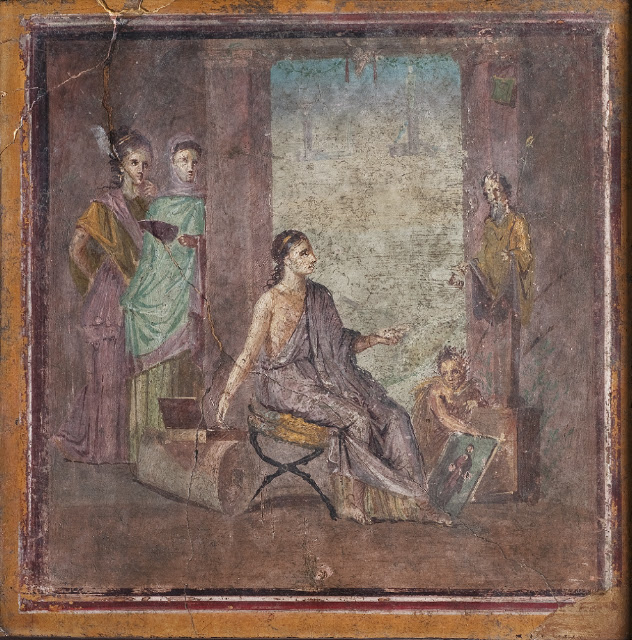


Painter at Work, 1st century CE. Pompeii 
 Fresco from the House of the Surgeon

And it is entirely appropriate that we remember the people of Pompeii, for it is impossible not to reflect on their tragic fate. 

Back in the late 1970's, I saw the spectacular Pompeii AD 79 exhibition at the American Museum of Natural History in New York. It was a "once in a lifetime" exhibit. But I remember feeling pensive and unsettled looking at the display of art and artifacts relating to people who had died en masse, suddenly and tragically. It was the height of the Cold War and apocalyptic thoughts were not uncommon in those days.

Later, I learned that the great Italian poet, Primo Levi, had been moved to write a searing poem comparing the death of a young child at Pompeii to victims of the Holocaust and Hiroshima. In The Little Girl of Pompeii, Levi, who had survived Auschwitz, began his poem with the gripping words: 

Since everyone’s anguish is our own

Levi went on to write:

Centuries have passed, the ash has petrified                                                

To imprison those delicate limbs forever.                                                     

In this way you stay with us, a twisted plaster cast,                                     

Agony without end, terrible witness to how much                                        

Our proud seed matters to the gods.

These haunting words - and the deeply humane sentiments the went into writing them - do "stay with us." It is hard for me to banish them from my mind when thinking about Pompeii and more recent tragedies which invite comparison, as Levi does so memorably in his poem.

Yet, I am happy to say that Pompeii in Color has had a liberating effect upon my feelings. This brilliant exhibition, filled with color and light, love and life, at the ISAW has helped me grapple with the ambivalent, troubled emotions I felt when viewing Pompeii AD 79 so long ago. Though I've yet to see the actual paintings at ISAW, the effect of this exhibition has been spirit and life affirming!

Now, when I think of Primo Levi's The Little Girl of Pompeii, I no longer view her in my mind's eye as "a twisted plaster cast." Rather, I see her as a face surrounded by ripening grapes and green leaves, a fey and ethereal face, emancipated from the hardened ash that entombed her bones. 

Mask amid Bunches of Grapes & Vines, 1st century CE. Pompeii
 Fresco from the House of V. Popidius

Pompeii's "agony without end" has ceased and these wondrous paintings on view at ISAW survive to remind us how delightful and rewarding life can be, even when lived in the shadow of Mount Vesuvius.

***

Text: Copyright of Ed Voves, all rights reserved                                            

Images courtesy of the Institute for the Study of the Ancient World, New York City, and the University of Michigan open access photos, https://quod.lib.umich.edu/a/aict?auth=world;sort=aict_ti;type=boolean;view=reslist;rgn1=ic_all;q1=aict

Introductory Image: Hercules and Omphale, 1st century CE. Herculaneum. Fresco: H. 40.3 cm; W. 41 cm. National Archaeological Museum of Naples: MANN 9004. Image © Photographic Archive, National Archaeological Museum of Naples.

Pompeii: general view to the north, showing paved street with pedestrian crossing blocks; in the background, Mount Vesuvius. University Of Michigan open access photo. ID RM055. Photo Date: June 1993 

Banquet Scene with Inscribed Words, 1st century CE. Pompeii. Fresco from the House of the Triclinium, East wall, central section: H. 77.5 cm; W. 77.6 cm. National Archaeological Museum of Naples: MANN 120029. Image © Photographic Archive, National Archaeological Museum of Naples

Architectural Landscape, 1st century CE. Pompeii. Fresco from the House of the Peristyle: H. 121.3 cm; W. 96.5 cm. National Archaeological Museum of Naples: MANN 8572. Image © Photographic Archive, National Archaeological Museum of Naples

The Three Graces, 1st century CE. Pompeii. Masseria di Cuomo – Irace,. Fresco: H. 60 cm; W. 53.3 cm. National Archaeological Museum of Naples: MANN 9231. Image © Photographic Archive, National Archaeological Museum of Naples.

Shrine fresco from the House of the Vettii, Pompeii: detail of Genius (spirit) of the Paterfamilias flanked by two lares. University Of Michigan open access photo. ID RM063. Photo Date: June 1993

Hercules and Omphale, 1st century CE. Pompeii. Fresco from the House of Marcus Lucretius, triclinium 16, east wall, central section: H. 203.2 cm; W. 162.6 cm. National Archaeological Museum of Naples: MANN 8992. Image © Photographic Archive, National Archaeological Museum of Naples

Hercules and Omphale, 1st century CE (detail). Herculaneum. Fresco (see data for introductory image.

Achilles on the Island of Skyros, 1st century CE. Pompeii. Fresco from the House of Achilles or House of the Skeleton or House of Stronnius, cubiculum u, north wall, central section: H. 156.5 cm; W. 148.6 cm. National Archaeological Museum of Naples: MANN 116085/ Image © Photographic Archive, National Archaeological Museum of Naples

Fourth-style mural painting sequence from the House of the Vettii, Pompeii. University Of Michigan open access photo. ID RM067. Photo Date: June 1993 

Architectural Landscape, 1st century CE. Herculaneum. Fresco from the Villa of the Papyri:, H. 71.1 cm; W. 90.5 cm. National Archaeological Museum of Naples: MANN 9423. Image © Photographic Archive, National Archaeological Museum of Naples

Still-life Fragments representing Vase, Scrolls, Landscape, and Fruit, 1st century CE. Herculaneum.  Fresco: H. 51.1 cm; W. 62.5 cm. National Archaeological Museum of Naples: MANN 9819. Image © Photographic Archive, National Archaeological Museum of Naples

Painter at Work, 1st century CE. Pompeii. Fresco from the House of the Surgeon: H. 45.4 cm; W. 45 cm. National Archaeological Museum of Naples: MANN 9018. Image © Photographic Archive, National Archaeological Museum of Naples.

Mask amid Bunches of Grapes and Vines, 1st century CE. Pompeii. Fresco from the House of V. Popidius or House of Mosaic Doves, triclinium 13, east wall, central section. H. 54.6 cm; W. 55.2 cm. National Archaeological Museum of Naples: MANN 9798. Image © Photographic Archive, National Archaeological Museum of Naples

Tuesday, June 23, 2020

Art Eyewitness Essay: The Etruscans and Rome


The Etruscans and Rome
An Art Eyewitness Essay, Part III

By Ed Voves

"We must, indeed, all hang together," Benjamin Franklin declared to his fellow members of the Continental Congress in 1776, "or most assuredly, we shall all hang separately."

As a man of the eighteenth century Enlightenment, Franklin was well-versed with the histories of the Greeks and Romans. These narratives contained many incidents recounting how the Greeks and Romans had, indeed, failed to "all hang together."

There was another people from classical antiquity whose story also confirms the political lesson to which Franklin referred, the Etruscans.

The Etruscans, unlike the Greeks and Romans, were little known in Franklin's day, but now, two and a half centuries later, we have a much better appreciation of their considerable accomplishments. Thanks to  painstaking scholarship, we also have a significant body of evidence for the Etruscan failure to create an effective confederation of their twelve city-states, as Franklin and his colleagues were to achieve for the fledgling United States.     


Chariot Fitting, 540-520 B.C.
© The British Museum 
                       
The story of Etruscan civilization - and all civilizations - is how their citizens dealt with "existential" problems. These are dire challenges, providing occasions for successful, life-affirming responses or for failures leading to utter disaster.

The theory of civilizational "challenge/response" was the central theme of Arnold Toynbee's A Study of History, published in a multi-volume series from 1930 to 1961. At the risk of over-simplification, Toynbee's theory, "the greater the challenge, the greater the stimulus," can be grasped in several key quotes:

Civilizations, I believe, come to birth and proceed to grow by successfully responding to successive challenges. They breakdown and go to pieces if and when a challenge confronts them that they fail to meet.

The last stage but one of every civilization is characterized by the forced political unification of its constituent parts.

Toynbee also declared that civilizations rise and develop in "environments that are unusually difficult and not unusually easy." Such circumstances present problems which demand solutions. Survival - or extinction - depends on the response.

For the Etruscans the initial problem was how to gain access to the huge store of iron ore and copper ore located in their domains. Mining in the ancient world can never have been easy but the Etruscans managed to exploit the mineral wealth beneath their feet at an early date.

The Etruscan homeland was also rich in defensible positions. As Michael Grant describes in his book, The Etruscans, there were numerous steep-sided plateaus in Etruria. The early Etruscans readily took advantage of these natural fortresses for their villages, which then combined to form city-states.

The key words in the last quote from Toynbee are "unusually difficult." Compared with the problems faced in growing crops in mainland Greece, which is almost devoid of topsoil, the problems faced by the Etruscans were not "unusually" difficult. The Etruscans, skillful miners and metal-workers, were able to extract vast amounts of mineral wealth without extreme levels of effort. 

The Etruscans did confront two existential challenges. Their reactions to these challenges determined the fate of their civilization.

As we saw in the earlier Art Eyewitness essays, the Etruscans brilliantly responded to the first challenge, the overwhelming tides of Greek and Phoenician influence which threatened their cultural independence. Masters at adaptation, the Etruscans borrowed what suited them and ignored what did not, maintaining their own unique identity.

We can assess this response in one of the most famous works of Etruscan art, a magnificent, heartwarming statute of an Etruscan husband and wife from the collection of the Louvre.


The Sarcophagus of the Spouses,  ca. 520 - 510 B.C.
© Musee du Louvre

Known as The Sarcophagus of the Spouses, it was discovered in 1845 near the site of the Etruscan city-state of Caere, now called Cerveteri. The motif of reclining husband and wife on a burial monument originated in Asia Minor and almost certainly was brought to Etruria by the Phoenicians, major trade partners of the Etruscans. The haunting "smile" of the husband and wife exemplifies Greek Archaic art, which flourished during the sixth century B.C. and greatly appealed to the Etruscans.


The Sarcophagus of the Spouses, however, is not a Phoenician statue nor is it a Greek one. In technical terms, this masterpiece demonstrates the skill of the Etruscans in using terracotta ceramics in compensation for the lack of local marble. More fundamentally, this tremendous work of art exudes an equality of husband and wife which could only have existed in a society where women were accorded a very high degree of respect and autonomy. This was exactly the attitude of the Etruscans toward women, very different from that of the Greeks.

The Etruscan skill in using terracotta to sculpt a human likeness was not limited to one or two great works of art. Following Greek example, the Etruscans created terracotta embellishments for the roofs of their temples called antefixes. Modeled to take the form of the heads of a mythological characters, a row of upright antefixes was placed along the eaves of a temple roof to keep rain water from seeping under the roof tiles causing damage to the wooden beams underneath. 

Initially, an antefix was likely to bear the countenance of Medusa or some other fearsome monster. But the Etruscans could not resist creating endearing likenesses of human beings like this antefix, made at Caere, and now in the Getty Museum.


Antefix from Caere , 510–500 B.C.
© J. Paul Getty Museum 

From the humble beginning of creating antefixes, evolved the remarkable Etruscan school of votive portraits, designed to be placed in their temples. There are so many of these to choose from, but the superlative example (below) from the Metropolitan Museum of Art certainly deserves inclusion here. 


Terracotta Head of a Youth, 3rd–2nd century B.C.
© The Metropolitan Museum of Art

Created during the waning years of Etruscan power, this portrait of a helmeted hero looked back to the golden age of the city states of Etruria. Once again, it is a brilliant adaptation of Greek art, in this case evoking the idealized features of Alexander the Great. The hero's face, however, preserves the emotional mystery, as well as the vigor, of Archaic era which Etruscan artists continued to favor after the Greeks themselves had abandoned it.

By studying the examples cited above, we can see how the "challenge/response" to Greek and Phoenician culture sparked a vigorous assertion of Etruscan identity. The first "existential" challenge culminated in an Etruscan success story of the highest order.

The second "existential" challenge, however, resulted in failure, defeat and the eventual loss of Etruscan political independence.

The threat to the Etruscans was posed by the Latin-speaking inhabitants of a village on the banks of the Tiber River, the southern border of Etruria. The name of this huddle of thatched-roofed huts, built on seven hills, was Rome. 

Early Rome had nothing to recommend it, except its location. There were no deposits of iron ore, copper or tin. Rome's strategic position, however, meant a great deal to the southernmost of the Etruscan city-states and to groups of ambitious free-booting Etruscan warriors. They coveted the fertile soil of Campania, the richest agricultural region in the south of Italy. To get there from Etruria, travelers needed to pass through Rome.

Around 600 B.C., Etruscans took control of Rome and, over the course of the next century, transformed it into a city. The Etruscans introduced the alphabet and stone buildings, drained a marshy area to create the Forum and strengthened the defenses with an encircling rampart. Nobody looks favorably on being conquered, however, especially a people who later became very successful conquerors themselves.

In 507 B.C., the Romans rose in rebellion against the Etruscan king, Tarquinius or Tarquin the Proud. According to Roman history, the king's son, Sextus Tarquinius, raped a virtuous noblewoman of Rome, Lucretia. To preserve her family's honor, Lucretia committed suicide, sparking the successful Roman revolt. 

The story of Lucretia was narrated by the Roman historian, Livy, and passed down as part of the foundational myth-history of Rome. Artists from the Renaissance to the Romantic era frequently depicted the event, usually with Lucretia in varying degrees of "undress" to heighten the erotic appeal and selling price of the work.

Rembrandt, ignoring the "sex sells" approach to art, painted two versions of the suicide of Lucretia which are of enduring value.


Rembrandt van Rijn, Lucretia, 1664
© The National Gallery of Art

Though separated by over two thousand years from the actual event, Rembrandt accurately captured the emotional traits of the citizens of early Rome in the way he presented Lucretia: honor, courage, determination, self-sacrifice and patriotism.

Early Rome's virtues may not have been lacking among the Etruscans, but we have no histories of the Etruscans, written during ancient times. This make an impartial judgement difficult, if not impossible. A comparison of a Roman work of art, much later in date though it is, with the The Sarcophagus of the Spouses, does help us take the measure of Roman attitudes vis-a-vis those of the Etruscans.


Funerary Relief of Publius Aiedius Amphio and his wife Aiedia, ca. 30 B.C.

The Funerary Relief of Publius Aiedius Amphio and his wife Aiedia, dates to around 30 B.C. Roman portraits, such as this, evolved directly from the example of Etruscan votive images. However, these highly realistic Roman likenesses developed in reaction to the spirit of Etruscan votive portraiture. 

The couple on The Sarcophagus of the Spouses projects feelings of enjoyment of the "good life" - for all eternity. The careworn faces of Publius Aiedius Amphio and Aiedia testify to their lives of toil and sacrifice on behalf of their family and their fellow citizens of Rome. They pose standing-up (some Roman funerary reliefs are full-figure) not lounging on a couch. This marble sculpture, and many similar Roman portraits, proclaims the implacable willpower of the Roman people.

Generalizations, like the above, are risky. What we can say is that, as Rome gained in strength, the Etruscans failed to muster the kind of emotional fortitude we see on the faces of Publius Aiedius Amphio and Aiedia. As a result, they were unable to  achieve Toynbee's "last stage but one of every civilization ... the forced political unification of its constituent parts."

Michael Grant emphasized that we should "erase the term 'Etruscan' and replace it by the name of one of the Etruscan states." The Romans, "team-players" for much of their early history, quickly learned that they were dealing not with Etruscans but with independent-minded citizens of Caere, Veii, Vulcii, Tarquinii and Clusium.

Between the years 507  to 396 B.C., the Romans successfully dealt with a host of political and social problems. Unified on the home front, the Romans sharpened the point of their most effective weapon: the strategy of "divide and conquer." With this policy, rather than numerically superior forces, the Romans began their campaigns to conquer Italy, starting with the Etruscans.

"Divide and conquer" was first carried-out against Veii, located twelve miles northwest of Rome. Veii competed with Caere to be the most prestigious and powerful of the Etruscan city-states. The leaders of Rome's republic took note, establishing good relations with Caere while marshaling their forces against Veii. In 396 B.C., the Romans launched a devastating attack on Veii, capturing and sacking the city. Not one of the other Etruscan city-states sent support to Veii in its hour of need.

Shortly after seizing Veii, Rome was nearly destroyed by a massive invasion of Celtic warriors in 387 B.C. Caere provided vital assistance to help Rome survive, the kind of aid that had been denied Veii. Rome would always maintain cordial relations with Caere but that did not prevent the Romans from eventually bringing this Etruscan city-state under its power.

Rome's triumph over the Etruscans was as much a campaign of incorporation as conquest. The Romans had the good sense to confer Roman citizenship upon the  Etruscans, and eventually upon all the various peoples of Italy, by 90 B.C. At the same time, local customs were honored and even the non-Indo-European language of the Etruscans continued in use for over a century.


Statue of Aulus Metellus, known as "The Orator"110-90 B.C.

The gradual process of "Romanization" is apparent in the bronze statue known as "The Orator."  Created around 100 B.C., the statue records both the physical features of Aulus Metellus and the regalia of the Roman Senate to which he belonged. 

Yet, Aulus Metellus was not a "noblest Roman of them all," as he looks at first glance. Metellus came from an Etruscan family and the hem of his toga is inscribed with an invocation in the Etruscan language. This statue, which I saw at the 2015 Power and Pathos exhibition organized by the Getty Museum and the National Gallery in Washington, is a masterful expression of the now-combined forces of Etruscan and Roman civilization. 

The rise of Aulus Metellus to the rank of Roman senator set the stage for other Etruscans to gain power in the Roman establishment. For good and ill, Etruscans would continue to affect the course of Rome's destiny.


Cinerary Urn with Aeneas and Turnus, 200–100 B.C.
© J. Paul Getty Museum 

The greatest of these influential Etruscans was Gaius Maecenas, (ca.70 B.C- 8 B.C.). Maecenas, the chief political advisor of Octavian Caesar, later Augustus, was also the most cultivated patron of the arts of his age. Maecenas encouraged Virgil to write an epic poem, based on the legends of Aeneas, the refugee prince of Troy. The adventures of Aeneas were sacred to the Etruscans and Romans and were frequently depicted on works of art such as the cinerary urn, made  between 200 to 100 B.C.

Virgil  (ca.70 B.C-19 B.C.). was born in Mantua, a city founded by Etruscans in the north of Italy. After some prodding by Maecenas and Augustus, he composed his great poem, the Aenead, one of the greatest literary achievements of all time. Sadly, Virgil died before completing it.

Maecenas and Virgil represent the culmination of Etruscan civilization. The legacy of Aelius Sejanus (20 B.C.-31 A.D.) had a very different effect.

Sejanus, "this ambitious Etruscan" as Michael Grant calls him, rose to the rank of prefect or commander of the Praetorian Guard. He was the most trusted official of Tiberius, the second emperor of Rome. Then, as a result of a political power play, Sejanus was accused of plotting against Tiberius and executed in 31 A.D.


Marble Relief of the Praetorian Guard, ca. 50-51 A.D.
© Louvre Lens

Whether Sejanus was planning a coup against Tiberius or trying to position himself to thwart Gaius-Caligula, the mad grand-nephew of Tiberius, will never be proved. What is beyond dispute is that Sejanus transformed the Praetorians from a few battalions of bodyguards into a powerful military unit, capable of murdering the emperors they were supposed to protect. Before they were finally disbanded in 312 A.D., the Praetorians were responsible for assassinating thirteen Roman emperors. Worse, their constant intrigue undermined the very concept of the rule of Roman law. 

By creating the "behind-the-throne" power of the Praetorians, Sejanus set in motion a train of events which led to the eventual collapse of Rome's empire. How ironic it is that an Etruscan, whose ancestors contributed so much to the rise of Rome, should have unintentionally caused its downfall. 

***
Text copyright of Ed Voves. All rights reserved.

Images courtesy of the Metropolitan Museum of Art, J.Paul Getty Museum, the British Museum, the National Gallery of Art, Washington D.C., the Musee du Louvre, Louvre-Lens and the Altes Museum, Berlin

Introductory Image:                                                                       
Candelabrum (detail), ca. 500-475 B.C. Bronze: 61 in. (154.9 cm) height, Metropolitan Museum of Art, Rogers Fund, #61:11.3

Chariot - or Furniture - Fitting (excavated at Castel San Mariano, Perugia), 540 -520 B.C. Silver electrum repoussé: 15.50 cm (length) x 9 cm (width). British Museum, bequeathed by Richard Payne Knight #1824,0420+.2

The Sarcophagus of the Spouses, (found at Cerveteri, in the necropolis of Banditaccia), 520 - 510 B.C.Terracotta  polychrome: H. 1.11 m. ; l.  1.94 m., Musée  du Louvre.  Campana collection, 1863. #Cp 5194

The Sarcophagus of the Spouses (detail)ʩ Paris, Mus̩e du Louvre, D̩partement des Antiquit̩s grecques, ̩trusques et romaines, Dunod

Antefix from Caere (Cerveteri), 510–500 B.C.  Terracotta and slip: 34.5 × 28 × 26.1 cm (13 9/16 × 11 × 10 1/4 in.) The J. Paul Getty Museum,  Gift of Leon Levy. 83.AD.211.11

Terracotta Head of a Youth, 3rd–2nd century B.C. Terracotta: . 8 1/2 in. (21.6 cm). Metropolitan Museum of Art. Purchase by subscription, 1896. #96.18.173 © The Metropolitan Museum of Art

Rembrandt van Rijn (Dutch, 1606-1669) Lucretia, 1664. Oil on Canvas: 120 x 101 cm (47 1/4 x 39 3/4 in.)  National Gallery of Art. Andrew W. Mellon Collection # No.1937.1.76  National Gallery of Art, Washington D.C.

Funerary Relief of Publius Aiedius Amphio and his wife Aiedia (found along the Via Appia in Rome)  30 B.C. Marble sculpture:  64.5 x 102 x 24 cm. Altes Museum, Berlin.   https://commons.wikimedia.org/wiki/File:-0030_Grabrelief_Publius_Aiedius_Amphio_und_Frau_Aiedia_Altes_Museum_anagoria.JPG

Statue of Aulus Metellus, known as "The Orator", (found near Lake Trasimeno in the province of Perugia), 110-90 B.C. Bronze: 179 cm (70 in) National Archaeological Museum, Florence. Photo courtesy of J.Paul Getty Museum

Cinerary Urn with Aeneas and Turnus, 200–100 B.C. Alabaster with polychromy: 34 × 46 × 19 cm (13 3/8 × 18 1/8 × 7 1/2 in.), The J. Paul Getty Museum, Villa Collection, Malibu, California. # 71.AA.294

Marble relief statue of the Praetorian Guard, ca. 50-51 A.D. Marble: 163 cm (64 in) × 134 cm (53 in) × 28 cm (11 in). Musee du Louvre, Louvre-Lens, France. # Ma1079


Sunday, May 17, 2020

Art Eyewitness Book Review: Greek and Roman Art by Susan Woodford


Greek and Roman Art


By Susan Woodford
                 
Thames & Hudson-Art Essentials /$16.95/176 pages

Reviewed by Ed Voves

When we use the word classical to describe the art of ancient Greece and Rome, we are taking a big risk.  "Classical" promotes the idea of timeless, carved-in-marble permanence. Even ruined temples like the Parthenon or an "unarmed" statue like the Venus de Milo are envisioned as somehow safeguarded from the long attrition of the centuries. This is obviously not so - nor was it the case even when such classical masterpieces were first displayed in Athens, Corinth and on the seven hills of Rome.

Change and experimentation defined the art of the Greeks and Romans. This is the theme of a new volume in Thames and Hudson's "Art Essentials" series, Susan Woodford's Greek and Roman Art.


Woodford, a scholar well-versed in the intertwined civilizations of Greece and Rome, expertly analyses a select group of ancient masterpieces. Woodford emphasizes the dynamism of Greek art and of Roman art, too, though not to the degree exercised by the bold artists of Hellas. 

Before proceeding with a review of Woodford's Greek and Roman Art, it is worthy to ask why Thames & Hudson published another book for the general public on this subject when it has already produced one of the greatest works in the field aimed at non-specialists. As I mentioned in another Art Eyewitness post, John Boardman's Greek Art in the World of Art series is a true classic. Yes, the word is deserved!

Boardman brilliantly charted the fascinating course of Greek art following the fall of the Bronze Age palace kingdoms like Pylos and Mycenae around 1200 B.C. The primitive, yet vigorous, creative steps during Greece's "Dark Age," followed by Geometric art, the Orientalizing period, the Archaic Age, the "Golden" fifth century B.C. and the Hellenistic era expansion - Boardman expertly handled each in progression. The latest edition of this exceptional book only adds to its laurels.

Woodford takes a bold, alternative approach to Boardman's narrative. By focusing on a few works of exceptional merit and then showing how the progressive development of Greek and Roman art occurred, Woodford presents an original and much-needed introduction for the general reader. I suspect Greek and Roman Art will prove quite insightful for those already familiar with ancient art. 

Woodford's first chapter deals with the challenges of carving the human body in marble. When Greek merchants and mercenary soldiers began journeying to Egypt following the Dark Age, they observed impressive statues such as the limestone figure of Tjaysetimu(British Museum) created at some point between 664-525 B.C.


Standing figure of Tjayasetimu, Egypt, 26th Dynasty, ca. 664-525 B.C.

Lacking the skill of the Egyptian masters, the first Greek sculptors used repetitions of certain shapes in order to depict a coherent bodily form. With excellent charts and crisp, clear commentary, Woodford demonstrates how the early Greeks achieved success with the rigid, yet startlingly alive, figure of the Kouros (Youth). This imposing statue, created around 590-580 B.C. will be readily recognizable to visitors to the Metropolitan Museum of Art in New York City.


Marble Statue of a Kouros (Youth), Attica, Greece, ca. 590–580 B.C.

The Greeks, however, were not satisfied with the Met's Kouros and they commenced upon what Woodford calls the "bumpy road to realism."

Woodford studies two slightly later examples of the Kouros model, both in the collection of the National Archaeological Museum in Athens, to demonstrate just how difficult was this journey. 

The progressive development of the Kouros statues is displayed on the page format of the book (below). We soon grasp Woodford's point. The much more naturalistic pose of the ca. 530 B.C., Anavyssos Kouros (left-hand page) was compromised by the stylized handling of the braided hair which had not seemed such a problem with the Met Kouros sixty years before. Two decade later, the now almost completely realistic Aristodikos Kouros (extreme right) demonstrates how its skillful sculptor had solved all the problems of the earlier statues except one - its basic pose. Even for a grave marker, the Aristodikos Kouros is truly a "stiff."


Each step forward, each successful handling of a detail lacking in realism exposed a new problem. An underlying pattern emerged with marble sculpting in sixth century Greece which would challenge artists in all media during the ancient world - change, emergence of a problem, solution of that problem and emergence of another. Woodford notes that "failures" were as important a driving force as was success. She writes movingly about the artists of Greece:

They could have endlessly repeated the same proven formulae, as the Egyptians did, and run no risks, but their restlessness and sense of adventure spurred them on from one problem to another. Each problem led to a solution on a higher level of complexity until finally the Greeks produced solutions that carried such conviction that they left an impress on all later western art and eventually reached the far corners of the world.

The carving of the famous Kritios Boy during the first decades of the fifth century B.C. seemed to have addressed the earlier chain of problem-causing solutions. The "at-ease" pose of the Kritios Boy, balancing his weight on one leg and looking very-much pleased with himself, marked the beginning of the Golden Age of Greek art. 


Kritios BoyAttica, Greece, ca. 480 B.C.

The creation of the Kritios Boy also coincided with rise of democratic government in Athens, where this magnificent statue posed, before the invading Persians knocked him off his pedestal in 480 B.C. Significantly, the Athenians did not try to repair the Kritios Boy. Instead, they commissioned new statues full of motion and dynamism. The lost-wax method of casting bronze statues was a preferred medium for this vigorous democratic art form.

Making bronze statues presented a whole new set of challenges, solutions and new problems which Woodford cogently explores. But the chief problem with a bronze statue, like silver plate and gold jewelry, is that its value in times of economic crisis and war made it a prime target for melting and recasting into coinage.

Back in 2015, the Getty Museum and the National Gallery of Art in Washington D.C. mounted Power and Pathos, a sensational exhibition of surviving bronze statues from both Greece and Rome. These ranged from portrait busts of Hellenistic kings and Roman consuls, their brows furrowed by affairs of state, to the delightful Dancing Faun, a Roman copy of a famous third century B.C. Greek original.


Dancing Faun, Roman copy of a Greek statue, 3rd Century B.C.

Most of the great bronze statues of antiquity did not share the good fortune of Dancing Faun. We only know Myron's incredible Discobolus or Discus-thrower from Roman marble copies. Several versions of the marble Discobolus survived but, rather comically, there was a dispute over how to position the severed-head of the British Museum's copy. The version displayed in Italy's National Roman Museum, (which introduces this review) shows it correctly.

Ancient bronzes that did survive the smelting furnace were buried or lost at sea. Roman ships, weighed down with the loot from conquered Greek cities often sank en route to Italy. The discovery of iconic bronze statues like the Zeus of Artemisium has transformed our knowledge of ancient art and science. 

For the recovery of ancient painting, the "blessings" of adversity also held true. Without the horrific destruction of Pompeii in 79 A.D., we would know little indeed about Greek and Roman painting. Likewise, the resilience of Greek ceramic vessels, whether whole or in shards, preserved the basics of this major form of ancient creative expression.


Bedroom from the Villa of P. Fannius Synistor at Boscoreale, ca. 50–40 B.C.

Woodford's pattern of artistic development - change, emergence of a problem, solution of that problem and emergence of another - does not hold true for ancient painting. Too little has survived for us to follow the "march of progress" which Woodford traces so brilliantly in her discussion of the Kouros statues.

Change and experimentation certainly characterized Greek vase painting. But it cannot be asserted that the later red-figure method is de facto superior to black-figure. The artist known as the Berlin Painter was a master of both techniques. His signature work, which gives him his modern name, is a red-figure depiction of a satyr and the god Mercury. It is a great work of art because the Berlin Artist was a great vase painter. The same holds true for Exekias.


Exekias, Achilles and Ajax Playing a Board Game, Attica, Greece, 540-530 B.C.

Exekias painted a scene from the Trojan War showing Achilles and Ajax relaxing from the carnage by playing a board game. Created around 540 B.C., this superlative black-figure painting was never surpassed - and rarely matched - by red-figure painting, though the Berlin Painter as his best was certainly Exekias' equal. This stunning work of art combines the primal vigor of Archaic era art with a haunting, psychological probity that pulls the viewer into the scene. 

With their shields framing the action, Achilles and Ajax lean forward to concentrate on the game board. Their muscles are relaxed, but their brains are fully engaged. Here we see the Greek mind at work in all of its restless, competitive striving. The intellectual force that would lead to the fifth century Golden Age is at "play" here, not just two warriors. 

By contrast, Woodford shows a later amphora decorated with the same scene. Amazingly, the game between Achilles and Ajax appears on both sides of the vase, one done in black-figure, the other in red-figure. Neither come close to Exekias' powerful handling. 


Unknown Artist, Achilles and Ajax Playing a Board Game, 525-520 B.C.

It's a case of "too much." Too much stylization, too many special-effects.  Like a master film maker, Exekias clears the deck and lets the story draw the viewer in. Twenty-five centuries have passed and the game keeps going, engaging us with the same intensity as it does for Achilles and Ajax.

Woodford concludes Greek and Roman Art with a brief, but perceptive, survey of art among the non-Greek inhabitants of Egypt and Rome's other provinces. In the case of Egypt, the "fortunate survival" scenario reoccurs, as with Pompeii. In Egypt, the dry, arid conditions preserved paintings, fabric art, documents and much else which otherwise perished in Greece and Italy.


Mummy-portrait from Rubaiyat, Egypt, ca.160-170  A.D.

Of these "survivors," the mummy portraits from Egypt, created at the height of Rome's rule, are the most important. Painted with the encaustic wax technique, the best of these memorial portraits show Greek technique, Roman pragmatic realism and Egyptian concern for the afterlife seamlessly combined in tour-de-force masterpieces.

The same accolades apply to Woodford and her wonderful book. I wish she could have found room to discuss the role of coins in the diffusion of art throughout the Greco-Roman world. This topic would certainly make for another, much-needed volume in the Thames and Hudson's Art Essentials and Woodford would be the perfect guide.

For the time being, I am confronted with the happy "hardship" of finding room for Woodford's Greek and Roman Art among the "essentials" on my bedside bookshelf. It's going to be a tight squeeze, but I will definitely be placing this superb volume in the company of my battered copy of Kenneth Clark's Civilization and other "classics."

 ***
Text: Copyright of Ed Voves, all rights reserved                                                                 Book cover and page-spread images, courtesy of Thames & Hudson, Publishers. 


Introductory Image:
Roman-era copy of Myron's Discobolus or Discus-thrower,  Marble: 125 cm. (49 1/4 in.)  National Roman Museum, Palazzo Massimo alle Terme, Rome, Italy

Standing figure of Tjayasetimu, Egypt, 26th Dynasty, ca. 664-525 B.C. Limestone: 125  x  32 cm. British Museum # EA1682 © The Trustees of the British Museum

Marble Statue of a Kouros (Youth), Attica, Greece, ca. 590–580 B.C. Attica, Greece. Marble: 76 5/8 × 20 5/16 × 24 7/8 in. (194.6 × 51.6 × 63.2 cm) Metropolitan Museum of Art. Fletcher Fund, 1932. # 32.11.1 © Metropolitan Museum of Art

Kritios BoyAttica, Greece, ca. 480 B.C.  Marble:  86 cm. (33 1/4 inches) height. Acropolis Museum, Athens, Greece. University of Michigan open access images, aict GS036 full 1336 2948 0 default

Dancing Faun, Roman copy of a Greek statue, 3rd Century B.C. Bronze: 71 cm. (28 in.) height. National Archaeological Museum, Naples, Italy


Cubiculum (bedroom) from the Villa of P. Fannius Synistor at Boscoreale, ca. 50–40 B.C. Fresco: 8 ft. 8 1/2 in. × 10 ft. 11 1/2 in. × 19 ft. 1 7/8 in. (265.4 × 334 × 583.9 cm) Metropolitan Museum of Art. Rogers Fund, 1903. # 03.14.13a–g © Metropolitan Museum of Art


Exekias, Achilles and Ajax Playing a Board Game. Attica, Greece, 540-530 B.C. Black-figure painted amphora: 61 cm. (24 inches) height, diameter at mouth 27.8 cm. Vatican Museum, Rome. Cat. 16757.  

Unknown Artist, Achilles and Ajax Playing a Board Game, 525-520 B.C. Black-figure painted amphora, red-figure on reverse: 55.5 cm. (21 1/8 inches) height. Museum of Fine Arts, Boston.

Mummy-portrait from Rubaiyat, Egypt, ca.160-170  A.D. Leaf-gilded and encaustic paint on lime wood: 44.4 x 16 cm. (17 1/2 x 6 1/4 in.) British Museum. #1939,0324.211 © The Trustees of the British Museum