The Tudors: Art and Majesty in Renaissance England
Metropolitan Museum of Art,
October 10, 2022- January 8, 2023
Reviewed by Ed Voves
Original Photography by Anne Lloyd
Roses are blooming in the Tisch Galleries, the special exhibition area of the Metropolitan Museum of Art. There is just one variety of rose on view and it emits no fragrant scent. But almost everywhere you look in the Tisch Galleries, you will see this remarkable flower.
The Tudor Rose.
Created as an emblem of a unified English nation, the Tudor Rose symbolized the return of peace to England, following a long, savage civil war during the 1400's. But roses have thorns, too. As the Tudor Dynasty, 1485-1603, strengthened its control of England, the Tudor Rose was used to project the power of mighty monarchs, Henry VIII and his daughter, Elizabeth I.
The Tudors: Art and Majesty in Renaissance England is currently on view in the Met's Tisch Galleries until early January 2023. Following their reign over the Tisch Galleries, The Tudors will travel to Cleveland and San Francisco. Without exaggeration, this exhibition is an astounding "time machine" transporting art lovers back to the 1500's.
Ed Voves, Photo (2022) Gallery view of The Tudors: Art and Majesty showing Michael Sittow's portrait of Mary Tudor, ca. 1514
Originally scheduled for the fall of 2020, the Met's 150th anniversary year, The Tudors: Art and Majesty presents a vast array of works of art, from sprawling wall-tapestries to gleaming silverplate to jem-like portraits created by Nicholas Hilliard, England's master of the Miniature.
Anne Lloyd, Photo (2022)
Gallery view of The Tudors: Art & Majesty showing The “Sea- Dog” Table, ca. 1575, and The Division of the Booty from The Story of David and Bathsheba tapestry series, 1526-28.
Anne Lloyd, Photo (2022) Gallery view of The Tudors: Art and Majesty. The Silver Basin, in foreground, is attributed to Hans Holbein, ca. 1535
According to the "myth" history of England, the contending factions in the civil wars of the late 1400's identified their respective forces by a different colored rose, red for the House of Lancaster, white for the House of York. It was not quite that straightforward during the bloody course of events, which would not be popularly known as the Wars of the Roses until centuries later.
However, when the "last man standing," Henry Tudor, won the final battle at Bosworth Field in 1485, he saw the need to unite the survivors of both camps under a conciliatory banner. The Tudor Rose made its debut, when the triumphant Tudor, now Henry VII, married a princess of the House of York.
The Tudor Rose appeared in many guises. It was embroidered on sumptuous garments. It was affixed to Royal documents, as can be seen on the 1553 "Letters Patent" granting a heraldic coat of arms to William Paget, henceforth known as 1st Baron Paget de Beaudesert.
Anne Lloyd, Photo (2022)
Detail of Letters Patent Granting Arms to William Paget, 1553
Among the suits of armor on view in The Tudors: Art and Majesty, there is a particularly splendid example, owned by George Clifford, Earl of Cumberland. Dating to 1586, it is engraved with the fleur d' lis of France - England continued to claim dominion over France, despite defeat in the Hundred Years War - and the Tudor Rose.
Anne Lloyd, Photo (2022)
Helmet owned by George Clifford, Third Earl of Cumberland,1586
Anne Lloyd, Photo (2022)
Detail of Hans Holbein the Younger's Sir Thomas More, 1527
Perhaps the most impressive of all was the golden Tudor Rose suspended from the chain of office of the Lord Chancellor of England, the second most powerful man in the kingdom.
Once in power, Henry VII (reigned 1485-1509) revealed himself as a thrifty, capable king. He kept England out of war, repairing its battered economy. Displays of Royal iconography, including the Tudor Rose, were carefully stage-managed to promote the image of responsible, not grandiose, monarchy.
Henry VII did devote significant funding to artistic and cultural programs, especially if such expenditure bolstered his image as a dutiful Christian king. His son and heir, Henry VIII did so too - initially.
As a result of the early Tudor emphasis on ecclesiastical art, the opening display of the Met's exhibition evokes a sense of medieval Christendom rather than English majesty.
Anne Lloyd, Photo (2022)
Gallery view of The Tudors: Art and Majesty.
Shown here are works by Benedetto da Rovezzano, Angels Bearing Candlesticks, ca. 1524–29, and Candelabrum, ca. 1529–40
There is more than a touch of irony here as the pair of spectacular bronze angels (who wear headbands being a Tudor Rose medallion) and a towering candelabrum were made by Benedetto da Rovezzano (1474–1554), a Florentine sculptor who worked in England from 1519-1543.
Ed Voves, Photo (2022)
Bronze Angel wearing Tudor Rose by Benedetto da Rovezzano
Benedetto's first English patron was the immensely ambitious Cardinal Wolsey who employed him to create bronze figures for his tomb, much as Michelangelo was contracted to do for Pope Julius II. When Wolsey fell from power, Henry VIII took over the tomb project for himself but it was never completed.
Ed Voves, Photo (2022)
Detail of Candelabrum by Benedetto da Rovezzano, ca. 1529-40
Much of Benedetto's English work was later dispersed. The candelabrum was sold by the Puritan regime of Oliver Cromwell during the 1650's. The candle-bearing angels, instead of guarding the remains of Cardinal Wolsey, disappeared into private hands until being recognized in recent decades. They are now in the collection of the Victoria and Albert Museum.
Anne Lloyd, Photo (2022)
Gallery view of The Tudors exhibit, showing the Luttrell Table Carpet
The most significant - and perhaps, surprising - treasures acquired by the Tudors were works of fabric art. These are brilliantly displayed in the Met's exhibit: tapestries, carpets, glittering examples of cloth of gold and religious vestments.
Anne Lloyd, Photo (2022) Fencing Doublet, ca. 1580
Some of the most spectacular items of personal clothing ever worn in Europe were created for the ruling elite of Tudor England. Very few examples of these remain, however. On view in the Met exhibit, there is a man's tight-fitting doublet, padded to protect against swords and daggers while fencing, and a pair of gloves.
The rare survivals in the other fabric categories reveal the rich world of color, texture and symbolism so prized by the Tudors. One example comes from a set of ten tapestries, The Story of the Redemption of Man. This was likely woven in the southern Netherlands (Belgium). In 1502, the entire set was purchased by Henry VII. If displayed side-by-side the ten tapestries would have extended more than a fifth of a mile. The other nine tapestries have not been seen since 1673.
The surviving wall hanging of the set,The Creation and Fall of Man, is remarkable on many counts. Of especial note is the manner in which the Divine Trinity is depicted. God the Father, the Son (Jesus) and the Holy Spirit are shown in nearly identical form as crowned and robed rulers, each bearing a royal scepter. The Trinity appears seven times in this regal mode on the broad field of the tapestry, once for each of the Seven Days of Creation.
Ed Voves, Photo (2022)
Detail of Creation and Fall of Man Tapestry, 1497–1502
Whatever the reason for departing from the traditional presentation of the Holy Trinity, the tremendous artistic skill used to create the images of the kingly Father, Son and Holy Spirit is of the highest caliber.
Moreover, the emotion imparted to the faces of the Trinity testifies to a profound level of religious belief of both patrons and artists of the tapestry. The heartfelt religious convictions of the 1500's were indeed woven into the warp and woof of this magnificent wall hanging.
Ed Voves, Photo (2022) Henry VII Cope, 1499–1505
The same can said can be said of the Henry VII Cope. Worn by Catholic priests during the celebration of the Mass, this cope was part of a wardrobe of over thirty vestments commissioned for use in Westminster Abby. The total cost of these garments, made in Italy, has been calculated in the currency of the time, at £100,000.
The staggering price tag can be explained by the materials used. The cope on view in the Met's exhibit was made of velvet cloth of gold with loops of gilded silver and silver-wrapped threads. The bands of embroidered decoration, examples of the celebrated Opus Anglicanum needle work, were added after the garments arrived in England. In the case of this cope, the embroidered decoration we see here was not original to it. Although dating to the same era, it was added at a later date.
Ed Voves, Photo (2022)
Detail of Henry VII Cope, showing Opus Anglicanum needle work
Judging from the attention and funding devoted to religious matters by the early Tudors, England's loyalty to the Roman Catholic faith seemed unshakable when Martin Luther launched the Protestant Reformation in 1517. Yet, during the next two decades, Henry VIII's break with the Papacy over his marriage to Catherine of Aragon, transformed the cultural, as well as the spiritual, landscape of England. The "King's Great Matter" pitted Henry VIII against Emperor Charles V, the loyal nephew of Catherine of Aragon, as much as against the Papacy. Thus, the initial break with Rome was primarily a political act. In terms of The Met's exhibit, there are few works of art which evoke this epic event in European and British history, except for portraiture.
That is a very big exception since it involved Han Holbein the Younger, the German/Swiss painter at the court of Henry VIII. Holbein was indisputably one of the greatest portrait painters in world history. Until the advent of photography, no historical era's "great and powerful" have ever be so brilliantly documented. Moreover, Holbein exerted such a powerful impact on British art that his presence continued to be felt long after he died, suddenly and unexpectedly, in 1543.
Hans Holbein the Younger
Henry VIII of England, ca. 1537
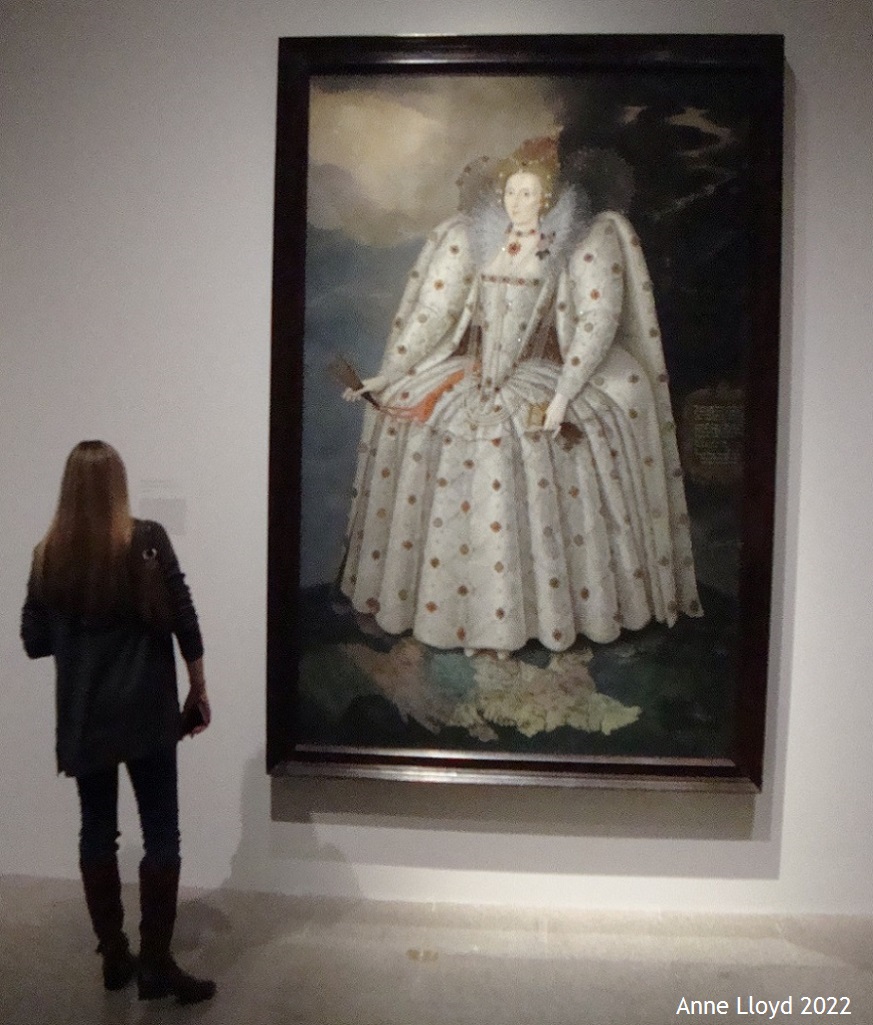
Given the importance of portraiture under the Tudor dynasty and thus, as a component of The Tudors: Art and Majesty, I have elected to do a follow-up review which will focus exclusively on the portraits in the exhibition. Special attention will be paid to the attempt to turn the likeness of Elizabeth I into a near-religious icon.The Tudors: Art and Majesty does include one work in its awesome array of art which indirectly addresses the horrific effect of the "King's Great Matter" and the persecutions and counter-persecutions which it triggered.
Ed Voves, Photo (1922) Dirck Vellert's Martyrdom of the Seven Maccabee Brothers and Their Mother, ca. 1530-35
This is a stained glass window showing the Martyrdom of the Seven Maccabee Brothers and Their Mother. It was created by Dirck Vellert (ca. 1480/85–ca. 1547) during the crisis years of Henry's "Great Matter," though for which church or chapel is not known. Vellert was a highly regarded artist during his lifetime - Durer held him in great esteem - but much of his work was latter lost or destroyed. Many of his masterpieces were no doubt casualties in the wave of iconoclastic destruction which was part of the "radical" Reformation.
Vellert's Seven Maccabee Brothers shows the two-step process of discussion and debate followed by death and destruction which was taking place in Europe even as he worked on the design for this window.
Ed Voves, Photo (1922)
Detail of Martyrdom of the Seven Maccabee Brothers and Their Mother
In the foreground, the Hellenistic Greek ruler, Antiochus IV, confers with members of his court on how to crush the rebellious Jews who refuse to endorse Greek customs such as eating pork. In the background, his troops are executing his orders - literally. Burning, flaying alive, beheading, the full "play-book" of state-terror tactics, it's all there illustrated in stained-glass.
Anne Lloyd, Photo (2022)
Hans Holbein the Younger's Sir Thomas More, 1527
On July 6, 1535, around the time that Vellert was completing the Seven Maccabee Brothers window, Sir Thomas More was beheaded on Tower Hill. More, who had only lately worn the golden Tudor Rose of the Lord Chancellor of England around his neck, was executed for refusing to take the oath acknowledging Henry VIII as the supreme leader of the Church of England.
History, as the tired old saying goes, always repeats itself.
***
Text and photos: Copyright of Ed Voves, all rights reserved Original photos: Copyright of Anne Lloyd, all rights reserved
Introductory Image: Anne Lloyd, Photo (2022) Gallery view of The Tudors: Art and Majesty exhibition at the Metropolitan Museum of Art, Henry VIII by the Workshop of Hans Holbein the Younger, ca 1540. Oil on panel: 93 5/8 × 52 3/4 in. (237.9 × 134 cm) Walker Art Gallery, National Museums, Liverpool
Ed Voves, Photo (2022) Gallery view of The Tudors: Art and Majesty showing Michael Sittow's portrait of Mary Tudor, later Queen of France and Duchess of Suffolk, ca. 1514. Oil on panel, 115/16 × 8¼ in. (28.7 × 21 cm) Gemäldegalerie, Kunsthistorisches Museum, Vienna
Anne Lloyd, Photo (2022) Gallery view of The Tudors: Art and Majesty showing The “Sea-Dog” Table , ca. 1575. Walnut wood, gilded silver, marbled inlay, 33½ × 58 × 33½ in. (85 × 147 × 85 cm) National Trust, Hardwick Hall, The Devonshire Collection and The Division of the Booty from The Story of David and Bathsheba tapestry series, made by an unknown Flemish artist, ca. 1526-28, 10-piece set. Wool, silk and gilded silver metal-wrapped threads: 15 ft. 5/16 in. x 19 ft. 5 7/8 in. ( 458 x 594 cm) Musee national de la Renaissance, chateau d'Ecouen, France.
Anne Lloyd, Photo (2022) Gallery view of The Tudors: Art and Majesty. In the foreground is a Basin, attributed to design by Hans Holbein the Younger, ca. 1535-36. Silver, gilded silver with colored enameling: 2 1/16 x 17 1/2 - 17 1/16 in. (5.2 cm x 44.5 -44.9 cm) Focke Museum, Bremen, Germany.
Anne Lloyd, Photo (2022) Detail of Letters Patent Granting Arms to William Paget, 1st Baron Paget de Beaudesert, by King Edward VI, March 25, 1553 Ink and bodycolor on vellum, with wax seal, 34¼ × 367/16 in. (87 × 92.5 cm) Marquess of Anglesey, Plas Newydd, Anglesey
Anne Lloyd, Photo (2022) Helmet from the Armor Garniture owned by George Clifford, Third Earl of Cumberland,1586. Made under the direction of Jacob Halder, master armorer at the Royal Workshops at Greenwich. Steel, gold, leather, textile: H. 69 1/2 in. (176.5 cm), W.60 lb. (27.2 kg) The Metropolitan Museum
Anne Lloyd, Photo (2022) Detail of Han Holbein the Younger's Sir Thomas More, 1527. Oil on panel: 29 ½ x 23 ¾ inches The Frick Collection.
Anne Lloyd, Photo (2022) Gallery view of The Tudors: Art and Majesty. Shown are: Angels Bearing Candlesticks, created by Benedetto da Rovezzano, ca. 1524–29. Bronze, each 39¾ × 193/4 × 13 in. (101 × 50 × 33 cm) Victoria and Albert Museum, London (A.1-2015, A.2-2015) & Candelabrum by Benedetto da Rovezzano , ca. 1529–40 Bronze, 106¼ × 17¾ × 17¾ in. (270 × 45 × 45 cm) Sint-Baafskathedraal, Ghent.
Anne Lloyd, Photo (2022) Gallery view of The Tudors: Art and Majesty, showing the Luttrell Table Carpet, before 1580. Wool, silk, gilded silver and silver metal wrapped threads: 6 ft. 4 in. x 18 ft. 15/16 in. (193 x 651 cm) Glasgow City Council, the Burrell Collection, Glasgow.
Anne Lloyd, Photo (2022) Fencing Doublet, ca. 1580. Leather, silk, linen, cotton: H. 30 in. (76.2 cm) W. 24 3/4 in. (60.3 cm) D. 14 1/4 in. (36.2 cm) The Metropolitan Museum of Art.
Anne Lloyd, Photo (2022) Detail of Creation and Fall of Man Tapestry from a Ten-Piece Set of the Story of the Redemption of Man, designed by an unknown Flemish artist, ca. 1497–99 Probably Brussels, before 1502. Wool (warp), wool, silk, silver, and gilded-silver metal-wrapped threads (wefts:167¾ × 3291/8 in. (426 × 836 cm) Cathédrale Saint-Just-et-Saint-Pasteur, Narbonne
Anne Lloyd, Photo (2022) Henry VII Cope, 1499–1505. Velvet cloth of gold, made in Italy, brocaded with loops of gilded silver and silver metal wrapped threads. Orphrey and hood: England, ca. 1500. Linen embroidered with silk and gilded-silver metal-wrapped threads: 64 1/8 × 130¾ in. (163 × 332 cm) Trustees of the British Jesuit Province–Jesuits in Britain
Hans Holbein the Younger (German/Swiss, 1497/98–1543) Henry VIII of England, ca. 1537. Oil on panel, 11 × 7 7/8 in. (28 × 20 cm) Museo Nacional Thyssen-Bornemisza, Madrid (191 [1934.39])
Ed Voves, Photo (2022) Martyrdom of the Seven Maccabee Brothers and Their Mother, designed and executed by Dirck Vellert, ca. 1530-35. Stained glass: 27 3/4 x 18 1/2 in. (70. x 47 cm).The Metropolitan Museum of Art
Anne Lloyd, Photo (2022) Hans Holbein the Younger's Sir Thomas More, 1527. Oil on panel: 29 ½ x 23 ¾ inches The Frick Collection.