
Visitors to Versailles,1682-1789
The Metropolitan Museum of Art
April 16, 2018 - July 29, 2018
Reviewed by Ed Voves
Photos by Anne Lloyd
"The best of all possible worlds."
That was how, in 1710, the great German scientist and philosopher Gottfried Leibniz described the moral order of Planet Earth. Leibniz’ book, Essays on the Goodness of God, the Freedom of Man and the Origin of Evil, was an essential text of the Enlightenment.
A generation before Leibniz published his theory of how God regulated the universe, the king of France, Louis XIV (1638-1715), had created his version of “the best of all possible worlds." A centralized political power structure, with Louis XIV as the absolute ruler, governed France from an awe-inspiring palace that was the wonder of the world.
In ancient Rome, all roads had led to to the palace of the Caesars. During the reigns of Louis XIV and his successors, all roads led to Versailles.
A sensational exhibit now at the Metropolitan Museum of Art, Visitors to Versailles, tells the incredible story of how a distant suburb of Paris became the center point of the Western world from 1682 to 1789. It also shows how the French Revolution destroyed Louis XIV‘s “best of all possible” realms.

Anne Lloyd, Photo (2018) Gallery view of the Visitors to Versailles exhibit
The Tisch Galleries on the second floor of the Met have been transformed to evoke the glistening Hall of Mirrors and the incredible gardens at Versailles. The famed labyrinth of Versailles featured statues from Aesop's Fables. We see these wondrous creatures on display in a simulated garden setting at the Met and the effect is magical.

Anne Lloyd, Photo (2018) Gallery view of Visitors to Versailles exhibit Sculpture of Fox Setting Fire to the Tree with the Eagle’s Nest,1673–74

Anne Lloyd,
Photo (2018) Antoine
Coysevox’s Louis XIV,1678–81
Louis was indeed astonished at the beauty and grandeur of Vaux-le Vicomte but suspected (correctly) that Fouquet was embezzling state funds. Louis ordered Captain d’Artagnan, of Three Musketeers fame, to find lodgings for Fouquet in the Bastille. Louis proceeded to seize Vaux-le Vicomte as a country palace for himself. It was the most superb building of recent design in all of France. But there was one problem. Vaux-le Vicomte would always be associated with Fouquet, even though he was rotting in a dungeon.
Looking around for a site for his own version of Vaux-le Vicomte, Louis focused his plans on the hunting lodge built by his father, ten miles southwest of Paris. It was called Versailles and there Louis sent Fouquet's architect, Louis Le Vau (1612-1670) and landscape designer, André Le Nôtre (1613-1700). Under Le Vau (before he died of overwork) and Jules Hardouin-Mansert (1646-1708), Versailles was transformed from a modest red brick country retreat to a virtual capital city in its own right.

Anne Lloyd, Photo (2018) Gallery view of Visitors
to Versailles,1682–1789 exhibit Pierre Denis Martin’s View of the Château de Versailles from the Place d'Armes,1722
By 1682, the vast building project was completed. Louis XIV lived at Versailles year round, ruling France in an autocratic fashion. The entire French court and many government ministers relocated to Versailles or spent the bulk of their time at the palace complex. Paris (which Louis XIV detested) was relegated to second-rank.
The French nobility, foreign ambassadors and celebrities from across Europe all thronged to Versailles. Given the prestige of France in the late 1600's to the mid-1700's, Versailles exerted a magnetic attraction for the powerful, the power-hungry and curiosity-seekers.

Anne Lloyd, Photo (2018) Gallery view of Visitors to Versailles exhibit Travelers’ costumes: man’s wool suit, c.1755-65, & woman’s riding habit,1770’s.
The Metropolitan Museum exhibit recreates the world of Versailles with special attention to those who visited the magnificent palace and gardens. Spectacular displays of period clothing contrast the sensible suits and traveling attire worn by people journeying to Versailles with the elaborate court costumes of the French nobility and the foreign diplomatic staff.
The eighteenth century was not only the Age of Enlightenment. It was the heyday of the Grand Tour. Many of the young English aristocrats on their way to Italy to view Roman ruins stopped at Versailles to see the sights.

Pompeo Batonia, John Montagu, Lord Brudenell, 1758
Lord Brudenell and other "grand tourists" from Britain shared the stage of Versailles with visitors from father afield. Dignitaries from Turkey, North Africa and the Indian subcontinent arrived for audiences at Versailles.

Anne Lloyd, Photo (2018) Sculptures by Claude-André Deseine Muhammad Osman Khan (right) and his nephew, 1788
Among the last to visit before the French Revolution toppled the court at Versailles, were Muhammad Osman Khan and his nephew, representing the Kingdom of Mysore in today's India. Claude-André Deseine, a deaf-mute sculptor, presents these Asian diplomats with exceptional skill and sensitivity.
From closer to home, Russians, Germans and Swedes visited Versailles in large numbers. The King of Sweden, Gustav III was so impressed with Versailles when he toured the palace in 1771, that he tried to rule Sweden in the absolutist style of Louis XIV. For a time, it looked like Gustav was going to succeed. In 1792, as revolution swept Europe, Gustav was assassinated at a masked ball in Stockholm.

Anne Lloyd, Photo (2018) Joseph Siffred Duplessis’ Benjamin Franklin (1778)
Versailles figured in another political drama, with a happier ending. In December 1776, a visitor arrived representing the world’s newest nation, the “United States” of America.
The purpose of Benjamin Franklin’s visit to Versailles was business, not pleasure. The ceramic group, which serves as the introductory illustration of this review, shows Franklin getting what he wanted: a military treaty from France. The biscuit-porcelain group shows King Louis XVI, looking every inch a grand monarch, presenting the treaty to a clueless-looking Franklin.
The inaccuracy, indeed absurdity, of the ceramic group would not have bothered Franklin. He knew that the revolutionary agenda of the Americans would not easily gain favor in France where the mystique of monarchy was greater than in Britain. Nor would fawning flattery win French support.
Franklin cleverly used the appeal of rustic charm, pragmatism and integrity to impress the French court. He arrived at Versailles, posing as the very embodiment of the character he had invented in 1732 for his almanacs, Poor Richard. To courtiers sated with protocol and indulgence, the appearance of Bonhomme Richard at Versailles was a sensation.

Benjamin Franklin's Three-Piece Suit (habit à la française), 1778-79
One of Franklin’s unadorned suits is on display in the Metropolitan exhibition. This “ditto” (all of one color) suit was almost certainly made for Franklin in France. It may well be the plum-colored suit, with the addition of a fur collar, which we see in the 1778 portrait of Franklin by Joseph Duplessis. The suit was made with exceptional craftsmanship but without the embroidered decorations which were part of the standard uniform of dignitaries at Versailles. It has browned with age and has been very carefully treated by conservators at the Smithsonian in order to appear in the exhibit.
Franklin made a virtue of simplicity in a world of excess. The French were quick to acknowledge his human quality, as can been seen in Duplessis’ portrait (which Franklin highly approved) and even in the picture frame. There is no better tribute to Franklin than the single Latin word Vir which was inscribed at the bottom of the frame. Vir means “man,” in this case a man of virtue.

Anne Lloyd, Photo (2018) Detail of Joseph Duplessis’ Benjamin Franklin
Versailles could be described by one word too, magnificence. But Louis XIV and his architects could have benefited from a little of Franklin’s common sense. Versailles could boast of 2300 rooms, 2153 windows, 67 staircases, gardens covering nearly 2000 acres with 50 fountains and a grand canal, 5.57 km in length. But there were no public lavatories. There was a commode in each of the 350 private apartments and that was all.
The call of nature, cannot be denied for long. Every secluded nook at Versailles served as a latrine. People, including nobles, urinated in stairways and behind columns. The foul smell that hung like a miasma about the palace wafted out to the gardens as well. The scent from the citrus trees in the Orangerie helped to ward off the stench from the palace.
Yet Versailles was worth a visit and not just to get military and financial aid as Franklin sought in the 1776. Versailles was the scene of great human drama and even more engaging human comedy, as Horace Walpole noted in a 1765 letter :
Versailles, like everything else, is a mixture of parade and poverty, and in every instance exhibits something most dissonant from our manners. In the colonnades, upon the staircases, nay in the antechambers of the royal family, there are people selling all sorts of wares. While we were waiting in the Dauphin’s sumptuous bedchamber, till his dressing-room door should be opened, two fellows were sweeping it, and dancing about in sabots to rub the floor.
Versailles in its heyday can be imagined by the details on a vast decorative screen painted Charles Cozette (1713–1797) around 1768-1770. It was originally a painting before being transferred onto a screen.
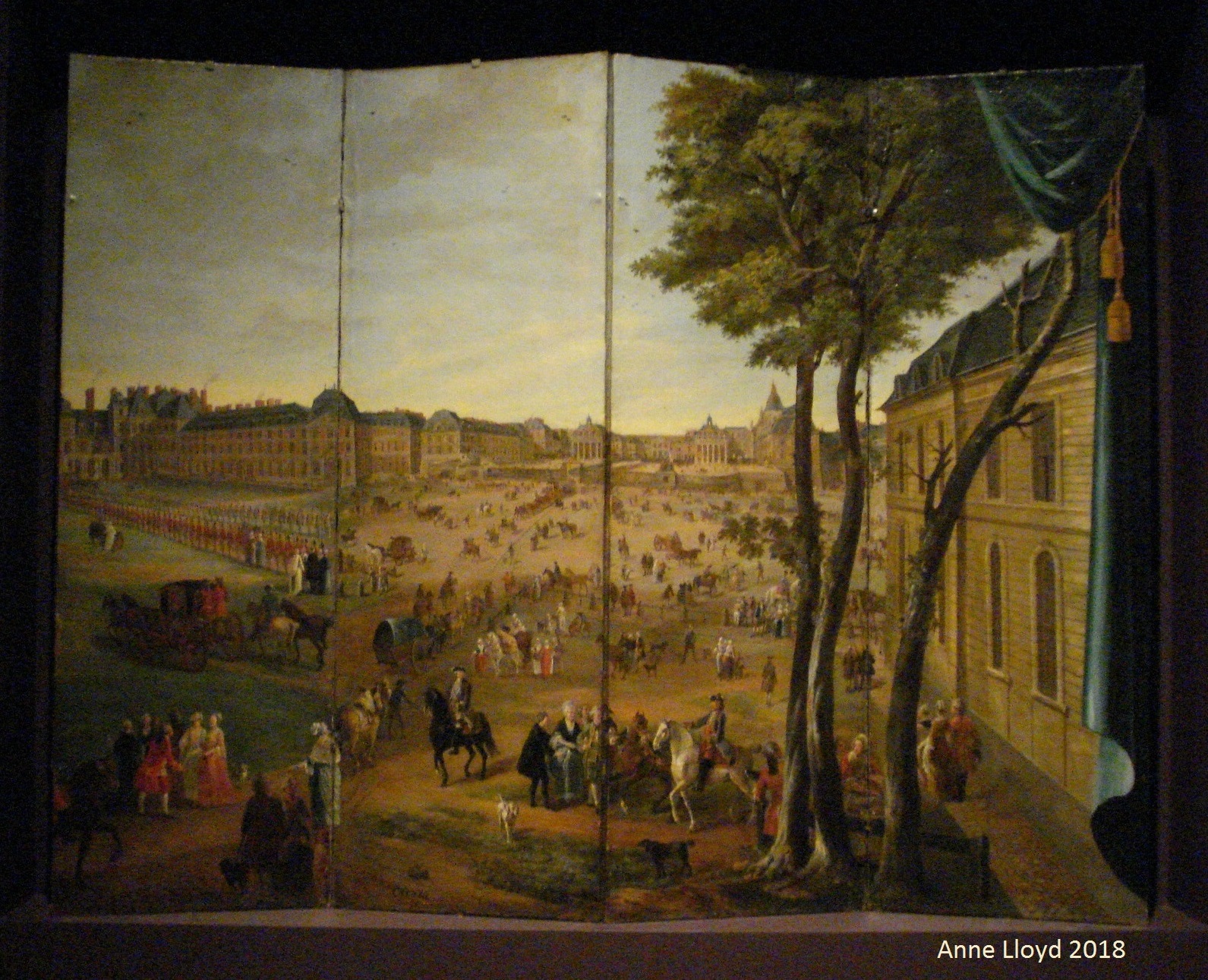

Anne Lloyd, Photo (2018) Folding Screen & detail by Charles Cozette, 1768-70
There was certainly a lot to see at Versailles. Diplomats from distant realms such as the Kingdom of Mysore in India and Siam, present-day Thailand, brought expensive gifts which were displayed as testaments to the greatness of France.

Anne Lloyd, Photo (2018) Gallery view of Visitors to Versailles,1682–1789 exhibit Lacquer cabinet from Japan,17th century, and cannon from Siam, c.1686
The silver-plated, long-barreled cannon from Siam and the lacquer cabinet from Japan also point to the French trade initiatives in Asia that would lead to war with Britain over control of India during the mid-1700's and the eventual dominion of France in Indochina.
The black and gold lacquer on this 1783 Drop-front Secretary, created by Jean Henri Riesener for Marie-Antoinette, recall the popularity of Asian motifs in European decorative arts during the eighteenth century. But this imposing cabinet has a more significant story to tell.

Anne Lloyd, Photo (2018), Drop-front secretary by Jean Henri Riesener, 1783
Thomas Jefferson, who took over from Franklin as ambassador to France, observed the "best of all possible worlds" for kings and aristocrats come crashing down in 1789. The keen, perceptive eyes, so brilliantly sculpted in Houdon's portrait bust of Jefferson, watched as Louis XVI pinned a revolutionary cockade on his hat in a vain attempt to mollify the triumphant besiegers of the Bastille.
With shocking rapidity, the Ancien Regime collapsed and the staggering debts accumulated to build and maintain Versailles were paid for in blood. The ledger books for the construction of Versailles had been burned on the orders of Louis XIV. Following the fall of the Bastille, accounts were settled at the cost of the lives of the brave Swiss guards at Versailles, of loyal courtiers like Princesse de Lamballe who was hacked to pieces by the mob, and ultimately of Louis XVI and Marie-Antoinette, "Madame Déficit."

Anne Lloyd, Photo (2018) Jean Antoine Houdon’s Thomas Jefferson, 1789
Even before these deadly acts of retribution took place, Jefferson could see the ominous direction events in France were heading. He clearly understood the cost of maintaining the "dead weight" of past glory and unmerited privilege. In a letter to James Madison, dated September 6, 1789, Jefferson wrote:
I say, the earth belongs to each of these generations during its course, fully and in its own right. The second generation receives it clear of the debts and incumbrances of the first, the third of the second, and so on. For if the first could charge it with a debt, then the earth would belong to the dead and not to the living generation. Then, no generation can contract debts greater than may be paid during the course of its own existence.
These sobering words, as true today as in 1789, are the most valuable insights which can possibly be derived from the Met's provocative exhibit, Visitors to Versailles.
***
Text: Copyright of Ed Voves, all rights reserved Photos courtesy of Anne Lloyd, the Metropolitan Museum of Art and the Smithsonian's National Museum of American History
Introductory Image
Anne Lloyd, Photo (2018) Charles-Gabriel Sauvage's Figure of Louis XVI and Benjamin Franklin, 1780–85. Porcelain, 12 3/4 x 9 1/2 x 6 in. (32.4 x 24.1 x 15.2 cm) Metropolitan Museum of Art. Gift of William H. Huntington, 1883. Accession Number:83.2.260
Anne Lloyd, Photo (2018) Gallery view of the Visitors to Versailles exhibition at the Metropolitan Museum of Art.
Anne Lloyd, Photo (2018) Sculpture of Fox Setting Fire to the Tree with the Eagle’s Nest, 1673–74. Painted lead, 47 1/4 × 33 1/16 in., 2204.6 lb. (120 × 84 cm, 1000 kg) Musée National des Châteaux de Versailles et de Trianon (MV 7946.1)
Anne Lloyd, Photo (2018) Antoine Coysevox's Louis XIV, 1678-81. Marble, 47 1/4 × 37 3/8 × 13 3/8 in., 661.4 lb. (120 × 95 × 34 cm, 300 kg) Musée des National des Châteaux de Versailles et de Trianon (MV 789)
Anne Lloyd, Photo (2018) Pierre Denis Martin's View of the Château de Versailles from the Place d'Armes, 1722. Oil on canvas, 56 5/16 × 59 13/16 in. (143 × 152 cm). Musée National des Châteaux de Versailles et de Trianon (MV 726)
Anne Lloyd, Photo (2018) Gallery view of the Visitors to Versailles exhibition, British traveling attire, man’s wool suit, c.1755-65, Metropolitan Museum Collection & woman’s riding habit,1770’s from the Victoria and Albert Museum.
Pompeo Batoni (Italian, 1708–1787) John Montagu, Lord Brudenell, Later Marquess of Monthermer, 1758. Oil on canvas, 38 × 28 in. (96.5 × 71.1 cm) The Duke of Buccleuch & Queensberry, Boughton House, United Kingdom (BLHT/BH/122)
Anne Lloyd, Photo (2018) Claude-André Deseine's Sculptures of Nephew of Muhammad Osman Khan and Muhammad Osman Khan, 1788. Both sculptures, Terracotta with carved wood base. Nephew, without base: 18 1/2 × 13 3/16 × 7 11/16 in. (47 × 33.5 × 19.5 cm). Muhammad Osman Khan, without base: 21 1/4 × 15 3/4 × 9 13/16 in. (54 × 40 × 25 cm) Musée du Louvre, Paris, Département des Sculptures, (RF 4664, RF 2334) Muhammad Osman Khan, Gift of Pierre-Évariste Villemant, 1934
Anne Lloyd, Photo (2018) Joseph Siffred Duplessis' Benjamin Franklin (1706–1790), 1778, Oil on canvas, Oval, 28 1/2 x 23 in. (72.4 x 58.4 cm) Metropolitan Museum of Art. The Friedsam Collection, Bequest of Michael Friedsam, 1931. Accession Number:32.100.132
Benjamin Franklin's Three-Piece Suit (habit à la française), c.1778–79. Ribbed silk and linen (reproduction shirt, shoes, and stockings) Mounted on form: 60 × 30 × 24 in. (152.4 × 76.2 × 61 cm) Smithsonian’s National Museum of American History, Washington, D.C. (2012.0187.001)
Anne Lloyd, Photo (2018) Gallery view of the Visitors to Versailles exhibition at the Metropolitan Museum of Art.
Anne Lloyd, Photo (2018) Sculpture of Fox Setting Fire to the Tree with the Eagle’s Nest, 1673–74. Painted lead, 47 1/4 × 33 1/16 in., 2204.6 lb. (120 × 84 cm, 1000 kg) Musée National des Châteaux de Versailles et de Trianon (MV 7946.1)
Anne Lloyd, Photo (2018) Antoine Coysevox's Louis XIV, 1678-81. Marble, 47 1/4 × 37 3/8 × 13 3/8 in., 661.4 lb. (120 × 95 × 34 cm, 300 kg) Musée des National des Châteaux de Versailles et de Trianon (MV 789)
Anne Lloyd, Photo (2018) Pierre Denis Martin's View of the Château de Versailles from the Place d'Armes, 1722. Oil on canvas, 56 5/16 × 59 13/16 in. (143 × 152 cm). Musée National des Châteaux de Versailles et de Trianon (MV 726)
Anne Lloyd, Photo (2018) Gallery view of the Visitors to Versailles exhibition, British traveling attire, man’s wool suit, c.1755-65, Metropolitan Museum Collection & woman’s riding habit,1770’s from the Victoria and Albert Museum.
Pompeo Batoni (Italian, 1708–1787) John Montagu, Lord Brudenell, Later Marquess of Monthermer, 1758. Oil on canvas, 38 × 28 in. (96.5 × 71.1 cm) The Duke of Buccleuch & Queensberry, Boughton House, United Kingdom (BLHT/BH/122)
Anne Lloyd, Photo (2018) Claude-André Deseine's Sculptures of Nephew of Muhammad Osman Khan and Muhammad Osman Khan, 1788. Both sculptures, Terracotta with carved wood base. Nephew, without base: 18 1/2 × 13 3/16 × 7 11/16 in. (47 × 33.5 × 19.5 cm). Muhammad Osman Khan, without base: 21 1/4 × 15 3/4 × 9 13/16 in. (54 × 40 × 25 cm) Musée du Louvre, Paris, Département des Sculptures, (RF 4664, RF 2334) Muhammad Osman Khan, Gift of Pierre-Évariste Villemant, 1934
Anne Lloyd, Photo (2018) Joseph Siffred Duplessis' Benjamin Franklin (1706–1790), 1778, Oil on canvas, Oval, 28 1/2 x 23 in. (72.4 x 58.4 cm) Metropolitan Museum of Art. The Friedsam Collection, Bequest of Michael Friedsam, 1931. Accession Number:32.100.132
Benjamin Franklin's Three-Piece Suit (habit à la française), c.1778–79. Ribbed silk and linen (reproduction shirt, shoes, and stockings) Mounted on form: 60 × 30 × 24 in. (152.4 × 76.2 × 61 cm) Smithsonian’s National Museum of American History, Washington, D.C. (2012.0187.001)
Anne Lloyd, Photo (2018) Charles Cozette's Folding Screen, showing Scenes of Versailles, c. 1768–70. Wood, oil on canvas, painted leather, 79 1/2 in. × 12 ft. 9 9/16 in. (202 × 390 cm) Collection of Monsieur and Madame Dominique Mégret, Paris
Anne Lloyd, Photo (2018) Cabinet from Japan, 17th century. Lacquer, 45 11/16 × 42 1/2 × 24 7/16 in., 198.4 lb. (116 × 107.9 × 62 cm, 90 kg) Musée du Louvre, Paris, Département des Objets d’Art (OA 5474) Cannon from Siam, before 1686. Cast iron, silver-plated brass inlay, 2 3/8 × 73 5/8 in., 283.1 lb. (6.1 × 187 cm, 128.4 kg) The Royal Artillery Museum, Larkhill, United Kingdom (GUN1/020)
Anne Lloyd, Photo (2018) Drop-front secretary (Secrétaire en armoire) made by
Jean Henri Riesener,1783. Oak veneered with ebony and 17th-century Japanese lacquer, 57 × 43 × 16 in. (144.8 × 109.2 × 40.6 cm) Metropolitan Museum of Art.Bequest of William K. Vanderbilt, 1920. Accession Number:20.155.11
Anne Lloyd, Photo (2018) Jean Antoine Houdon's Thomas Jefferson, 1789. Marble, 22 1/4 × 18 7/8 × 10 1/4 in., 125 lb. (56.5 × 48 × 26 cm, 56.7 kg) Museum of Fine Arts, Boston, George Nixon Black Fund (34.129


