Showing posts with label Thomas Jefferson. Show all posts

Sunday, November 29, 2020

Art Eyewitness Review: Alexander von Humboldt and the United States


                                      Alexander von Humboldt and the United States:                                Art, Nature, and Culture 

Smithsonian American Art Museum 

September 18 - November 22, 2020

By Ed Voves

Alexander von Humboldt was one of the greatest German scientists of all time. During his lifetime, 1769 to 1859, Humboldt was a world-renowned figure. Surprisingly, he is under-appreciated today, especially in the English-speaking world. 

A recent exhibition at the Smithsonian American Art Museum attempted to rectify this situation but was bedeviled by the Covid-19 quarantine. Originally scheduled to begin on March 14, 2020, the exhibit finally opened in mid-September. Then, on November 22nd, six weeks before its slated January 3, 2021 end date, it closed and the trove of exhibit treasures were returned to their home museums. 

I was one of the fortunate art lovers able to see Alexander von Humboldt and the United States: Art, Nature, and Culture. Instead of encouraging you to visit this exhibit, I find myself - sadly - writing about it in the past tense. However, Alexander von Humboldt's achievements are part of the living legacy of humankind and are not easily dismissed. 


Ed Voves, Photo (2020) 
Gallery view of the Humboldt and the United States exhibition 

In some ways the obstacles which were encountered in presenting this wonderful exhibition recall the many challenges faced by Humboldt during his epic expedition to South America, 1799-1804. Likewise, the shortened length of the exhibition seems ironically in keeping with the mere six weeks which Humboldt was able to spend in the United States. Although Humboldt never explored the frontier regions of the U.S., he made a huge impact during his brief stay in the young American republic.

Humboldt's dates are important to consider in understanding his influence upon the U.S. and indeed the entire world. The year he was born, 1769, witnessed the true beginning of the Industrial Revolution, when James Watt registered for a patent for his design of a steam engine with a separate condenser. Ninety years later, as the world mourned Humboldt, Charles Darwin's Origin of Species was published. 

Throughout the decades of revolutionary changes which occurred between 1769 to 1859, Humboldt played a highly significant role. 

Every branch of the sciences during this pivotal era were transformed by discoveries or educated theories made by Humboldt. From his exacting measurement of the temperature of ocean currents to the study of volcanic action to observations on the atmospheric factors causing tropical storms, Humboldt made important contributions.

Baron Alexander von Humboldt was educated in the precepts of the 18th century Enlightenment. A gifted student of chemistry, he was also interested in the direct study of the natural world. Humboldt's brilliance was quickly recognized. The government of Prussia, the leading state of Germany, appointed the young scholar as inspector of mines in one of its territories and also sent him on diplomatic missions.


Charles Willson Peale, Alexander von Humboldt, 1804

Humboldt yearned for wider horizons and, in the company of a French naturalist, Aimé Bonpland, set off late in 1799 to explore the Spanish colonies in the Americas. Beginning with a perilous canoe journey up the Orinoco River into the Amazon rain forest, Humboldt constantly put his life at risk. In the process, Humboldt amassed a mountain-sized haul of specimens of flora and fauna and volumes of meticulously compiled notes. 

Symbolically, the climax to Humboldt's quest was an amazing ascent of Mount Chimborazo in Ecuador, then believed to be the highest mountain in the world. Without proper mountaineering equipment - much less oxygen cylinders - Humboldt and Bonpland scaled Chimborazo to the dizzying height of 18,893 feet, establishing the world's record for mountain climbing for many years thereafter. 

The Smithsonian exhibition briefly surveyed Humboldt's adventures in Latin America, displaying the hand-colored chart he made after descending from Chimborazo. The chart, later made into a print, showed the correlation of plant species with climate zones, rising from the floor of the jungle to snow-capped mountain peaks. 


Alexander von Humboldt & Aimé Bonpland,
 Géographie des plantes Équinoxiales: Tableau physique
 des Andes et Pays voisins, 1805

With this amazing graphic, Humboldt illustrated his greatest discovery. All of nature was united in a living, organic force he called Naturgemälde.

As the title of the Smithsonian exhibition attests, the primary topic was Humboldt's short visit to the United States and its long train of consequences. The news of his exploits in Latin America reached the U.S. and members of the nation's scientific establishment, led by President Thomas Jefferson, were eager to meet him.


Rembrandt Peale, Thomas Jefferson, 1805

Quite apart from Jefferson's insatiable appetite for scientific information, Humboldt's expedition validated plans already underway for similar American initiatives. In 1803, as Humboldt and Bonpland completed the last of their studies in Mexico, Captain Meriweather Lewis and Lt. William Clark were setting forth to explore the vast Western territory recently purchased from France by Jefferson. Humboldt's audacity - and real scientific achievements - created a template for Americans to utilize in their bold plans to push westward to the Pacific.

Humboldt was hailed as a hero when he reached the United States in May 1804. He was invited by Jefferson to come to the White House, but another highlight of his sojourn in the U.S. was his visit to Peale's Museum in Philadelphia. Charles Willson Peale, the leading American artist of this era, was also a science enthusiast. In 1801, Peale led the effort to "exhume" the bones of a prehistoric mastodon which had been discovered near Newburgh, New York. He then transported the complete skeleton of the mighty beast to Philadelphia where it was reassembled and placed on display. 


Ed Voves, Photo (2020)
 Gallery view of Humboldt and the United States, showing the Skeleton of the Mastodon, excavated by Charles Willson Peale

In an outstanding curatorial "coup," the mastodon skeleton was brought to the Smithsonian from a museum in Germany, where it eventually went after Peale's death. 


What a fantastic experience to be able to study the mastodon, back on its native soil. It was close to stepping back in time to the moment of its discovery. To see the very mastodon skeleton, excavated by Peale and admired by Humboldt, was a moment to treasure.

The "exhumation" of the Mastodon, coming at the same time as Humboldt's achievements, marked the triumph of scientific methodology. It was not just a lucky discovery of rare fossils. Peale later painted a detailed view of the event, complete with water wheel and pulley system, used in dredging the muck from the excavation site. 


Charles Willson Peale, Exhumation of the Mastodon, ca. 1806–08

Peale placed himself in a commanding position in the picture, as might be expected from a self-promoting showman, as he indeed was. But without Peale's ambition and risk-taking, American art and science would not have been ready to take advantage of Humboldt's lead.

Humboldt always expected to return to the U.S. for an expedition similar to his exploits in South America and Mexico. This objective was never realized due to the long years of examining and cataloging the specimens from his journey with Bonpland. Also, the king of Prussia loaded Humboldt with honors, but also piled-on endless court duties which consumed his time and energy.

It has also to be considered that Humboldt did not return to America because he was deeply troubled by the simmering crisis over slavery in the U.S. Humboldt had traveled to Cuba with Bonpland and was horrified by the treatment of African slaves on the Spanish-held island. Also, he saw frequent acts of inhumanity toward the native populations in Latin America. 


John Quincy Adams Ward, The Freedman, 1863

Although Humboldt deeply admired the democratic institutions of the U.S., he was skeptical of the view of many Americans that slavery and the "Indian problem" would eventually fade away, as the great economic strength of the nation asserted itself. Too much of a diplomat to raise the topic while he was visiting the U.S., Humboldt urged the cause of freedom in his writings upon returning to Europe.

If Humboldt was disappointed with the continuance of African-American slavery in the U.S., his hopes for Latin America were also dashed, following the revolt against Spain led by Simon Bolivar. Everywhere, in Europe as well, the cause of freedom during the early decades of the 1800's seemed to be in retreat.


After Eduard Hildebrandt, Humboldt in His Library, 1856

Humboldt retired to his study to write a book testifying to the power of  Naturgemälde. In this great, multi-volume work, Humboldt aimed to convince the general reading public of the unity of creation where "organic powers are incessantly at work."

Humboldt's book was entitled Cosmos: Sketch of a Physical Description of the Universe. Volume I, the product of years of work, was published in 1845. In its pages, Humboldt proclaimed:

Nature is a unity in diversity of phenomena: a harmony, blending together all created things, however dissimilar in form and attributes: one great whole animated by the breath of life.

These words were reassuring, scientifically and spiritually. Humboldt's thesis especially appealed to the citizens of the United States, grappling with complex social issues. Humboldt's ideals were reflected in the paintings of the Hudson River School. One of these influential artists, Frederick E. Church (1826-1900) embraced Humboldt's creed with special fervor.

Church had studied painting with Thomas Cole, who had raised landscape painting in the U.S. almost to the status of religion. When Cole died in 1848, Church was poised to take up his mantle as the prophet-painter of American nature. But in 1853, he made the unexpected move of traveling to South America, following in the footsteps of Humboldt.

The Smithsonian exhibition displayed an impressive array of Church's drawings, oil sketches and finished paintings. 


Ed Voves, Photo (2020) Frederic Edwin Church's Cayambe, 1858
 
 
Frederic Edwin Church,
 Mount Chimborazo through Rising Mist and Clouds, 1857

Special emphasis in the exhibit was given to Church's prolonged efforts to depict Mount Chimborazo. This mountain, the scene of Humboldt's mountaineering exploits, came to obsess Church to the point that he repeated Humboldt's perilous climb.

In 1857, Church returned to South America, determined to paint a huge work which would evoke the atmosphere and ambiance of the Andes. Chimborazo would feature in Church's magnum opus, Heart of the Andes, though it was not the focus of the work. Instead, Church presented a "spiritual topography" rather than a depiction of a specific locale. 


Frederic Edwin Church, Study for “The Heart of the Andes”, 1858

This huge work, in its finished form, is one of the key paintings of the Metropolitan Museum of Art's collection. It is too fragile to be transported to other museums for special exhibitions, but the Smithsonian presented a special audio-visual study exploring how Church created his masterpiece.

Church intended to take Heart of the Andes to Germany to show Humboldt, writing to a friend:

The "Andes" will probably be on its way to Europe before your return to the City ... [The] principal motive in taking the picture to Berlin is to have the satisfaction of placing before Humboldt a transcript of the scenery which delighted his eyes sixty years ago—and which he had pronounced to be the finest in the world.

Sadly, Humboldt died before Church was able to travel to Europe, but the painting created a sensation when it was displayed in London. 

Church followed the great success of Heart of the Andes with "sublime landscapes" set in the United States. During the Civil War years, Church's paintings, extolling the unity of nature, likewise testified to the ideals of political union and individual freedom. 

Humboldt's Naturgemälde became so much an American ideal that it could easily be forgotten that a foreign scholar had originally planted the seed of America the "beautiful." When looking at the sympathetic portraits of Native Americans by George Catlin, several of which were on display in the Smithsonian exhibit, or Carlton Watkins' incredible photo, Cascade, Nevada Falls, Yosemite, California, there is no denying the influence of Humboldt.


Ed Voves, Photo (2020)
     George Catlin's portraits of Little Wolf & Strutting Pigeon, 1844-45


Carleton Watkins, Cascade, Nevada Falls, Yosemite, Calif., ca. 1861

Alexander von Humboldt and the United States: Art, Nature, and Culture was an outstanding exhibition. Eleanor Jones Harvey, senior curator at the Smithsonian American Art Museum, deserves special credit for organizing the exhibit and keeping it open for at least part of its scheduled run. Along with the excellent recent biography of Humboldt, The Invention of Nature, by Andre Wulf, the Smithsonian exhibit has re-established Humboldt's preeminent position as one of the most influential scientists of all time - and especially so for the United States.  

Reflecting upon Humboldt's legacy, I could not help but smile - inwardly - about the "science as the last frontier" rhetoric which used to be a common mantra of TV documentaries.  Alexander von Humboldt was so far ahead of his time that we are still catching up with him. If humankind ever does reach that "last frontier," I have the feeling that Humboldt will already have reached there ahead of us.


  Henry Berger, Bust of Humboldt, 1860

***

Text: Copyright of Ed Voves, all rights reserved. Humboldt and the United States exhibition images courtesy of the Smithsonian American Art Museum, Washington D.C.

Introductory Image:                                                                          Friedrich Georg Weitsch, Portrait of Alexander von Humboldt (1769–1859), 1806. Oil on canvas:49 5/8 x 36 3/8 in. Staatliche Museen zu Berlin, Nationalgalerie, Photo: bpk Bildagentur / Nationalgalerie, Staatliche Museen, Berlin, Germany / Klaus Goeken / Art Resource, NY. 

Ed Voves, Photo (2020) Gallery view of the Humboldt and the United States exhibition at the Smithsonian American Art Museum, Washington D.C.

Charles Willson Peale, Portrait of Baron von Humboldt, 1804. Oil on canvas: 21 x 17 in., The College of Physicians of Philadelphia, The image of the Baron Von Humboldt is used by kind permission of The College of Physicians of Philadelphia. Photograph by Constance Mensh, Copyright 2019 by The College of Physicians of Philadelphia.

Alexander von Humboldt and Aimé Bonpland, Géographie des plantes Équinoxiales: Tableau physique des Andes et Pays voisins, from Essai sur la géographie des plantes, 1805. Hand colored print: 24 x 36 in., Royal Botanic Gardens, Kew, © Copyright The Board of Trustees of the Royal Botanic Gardens, Kew.

Rembrandt Peale, Thomas Jefferson, 1805. Oil on linen: 28 x 23 1/2 in., New-York Historical Society, Gift of Thomas Jefferson Bryan, Photography ©New-York Historical Society.

Ed Voves, Photo (2020) Gallery view of the Humboldt and the United States exhibition, showing the Skeleton of the Mastodon, excavated 1801–2 by Charles Willson Peale. Bone, wood, and papier mâché: approx. 118 × 177 × 65 in., Hessisches Landesmuseum, Darmstadt, Germany. 

Charles Willson Peale, Exhumation of the Mastodon, ca. 1806–08. Oil on canvas: 49 x 61 1/2 in.  Maryland Historical Society, Baltimore City Life Museum Collection, Gift of Bertha White in memory of her husband, Harry White, BCLM-MA.5911.

John Quincy Adams Ward, The Freedman, 1863. Bronze: 19 1/2 x 14 11/16 x 9 5/8 in.Boston Athenæum, gift of Elizabeth Frothingham (Mrs. William L.) Parker, 1922, Photograph by Jerry L. Thompson for the Boston Athenæum

After Eduard Hildebrandt, Humboldt in His Library, 1856. Chromolithograph on paper: 18 5/8 x 26 5/8 in. Collection of Mr. and Mrs. Robert F. Norfleet Jr., Photo: Travis Fullerton, Courtesy Virginia Museum of Fine Arts.

Ed Voves, Photo (2020) Frederic Edwin Church's Cayambe, 1858. Oil on canvas: 30.48 x 45.72 cm (12 x 18 in.) Museum of Fine Arts, Boston. Gift of Martha C. Karolik # 47.1237

Frederic Edwin Church, Mount Chimborazo through Rising Mist and Clouds, 1857. Oil and pencil on paperboard: 13 9/16 x 21 1/8 in. Cooper Hewitt, Smithsonian Design Museum, Gift of Louis P. Church, 1917-4-824, Photo © Cooper Hewitt, Smithsonian Design Museum. 

Frederic Edwin Church, Study for “The Heart of the Andes,” 1858. Oil on canvas: 10 1/4 x 18 1/4 in. Olana State Historic Site, New York State Office of Parks, Recreation and Historic Preservation, OL.1981.47.A.B.

Ed Voves, Photo (2020) George Catlin's Shon-ta-yi-ga, Little Wolf, a Famous Warrior, 1844-1845. Oil on canvas. Smithsonian American Art Museum, Gift of Mrs. Joseph Harrison, Jr. 1985.66.521 and Ru-ton-ye-wee-ma, Strutting Pigeon, Wife of White Cloud, 1844. Oil on canvas. Smithsonian American Art Museum.  Gift of Mrs. Joseph Harrison, Jr., 1985.66.525

Carleton E. Watkins, Cascade, Nevada Falls, Yosemite, California, ca. 1861. Albumen silver print:15 5/8 x 20 7/8 in., Smithsonian American Art Museum, Museum purchase from the Charles Isaacs Collection made possible in part by the Luisita L. and Franz H. Denghausen Endowment, 1994.91.276. 

Henry Berger, Bust of Humboldt, 1860. Painted plaster: 27 x 16 x 12 1/2 in., The National Museum of Natural History, Smithsonian Institution.


Friday, May 25, 2018

Visitors to Versailles,1682-1789 at the Metropolitan Museum of Art


Visitors to Versailles,1682-1789 


The Metropolitan Museum of Art
April 16, 2018 - July 29, 2018

Reviewed by Ed Voves
Photos by Anne Lloyd

"The best of all possible worlds." 

That was how, in 1710, the great German scientist and philosopher Gottfried Leibniz described the moral order of Planet Earth. Leibniz’ book, Essays on the Goodness of God, the Freedom of Man and the Origin of Evil, was an essential text of the Enlightenment.

A generation before Leibniz published his theory of how God regulated the universe, the king of France, Louis XIV (1638-1715), had created his version of “the best of all possible worlds." A centralized political power structure, with Louis XIV as the absolute ruler, governed France from an awe-inspiring palace that was the wonder of the world.

In ancient Rome, all roads had led to to the palace of the Caesars. During the reigns of Louis XIV and his successors, all roads led to Versailles.

A sensational exhibit now at the Metropolitan Museum of Art, Visitors to Versailles, tells the incredible story of how a distant suburb of Paris became the center point of the Western world from 1682 to 1789. It also shows how the French Revolution destroyed Louis XIV‘s “best of all possible” realms.  


Anne Lloyd, Photo (2018) Gallery view of the Visitors to Versailles exhibit

The Tisch Galleries on the second floor of the Met have been transformed to evoke the glistening Hall of Mirrors and the incredible gardens at Versailles. The famed labyrinth of Versailles featured statues from Aesop's Fables. We see these wondrous creatures on display in a simulated garden setting at the Met and the effect is magical.


        Anne Lloyd, Photo (2018) Gallery view of Visitors to Versailles exhibit          Sculpture of Fox Setting Fire to the Tree with the Eagle’s Nest,1673–74


Nearly two hundred works of art, many from the collection of the Palace of Versailles, document the role of Versailles in shaping political and social attitudes during the seventeenth and eighteenth centuries. Louis XIV attempted to build a model of Divine Right Absolutism with marble, gilded mirrors and spectacular fountains. Ironically, this generated so much popular interest in Versailles that it become more of a tourist attraction than a political stronghold.

Louis XIV came to the throne at age four in 1643. He spent his youth under the close supervision of the regent, Cardinal Mazarin. When he attained full power in 1661, Louis discovered that his finance minister, Nicholas Fouquet, was putting the finishing touches to a grand chateau northeast of Paris, Vaux-le Vicomte. Fouquet invited the young monarch for a visit in the hope of impressing him. 


Anne Lloyd, Photo (2018) Antoine Coysevox’s Louis XIV,1678–81

Louis was indeed astonished at the beauty and grandeur of Vaux-le Vicomte but suspected (correctly) that Fouquet was embezzling state funds. Louis ordered Captain d’Artagnan, of Three Musketeers fame, to find lodgings for Fouquet in the Bastille. Louis proceeded to seize Vaux-le Vicomte as a country palace for himself. It was the most superb building of recent design in all of France. But there was one problem. Vaux-le Vicomte would always be associated with Fouquet, even though he was rotting in a dungeon.

Looking around for a site for his own version of Vaux-le Vicomte, Louis focused his plans on the  hunting lodge built by his father, ten miles southwest of Paris. It was called Versailles and there Louis sent Fouquet's architect, Louis Le Vau (1612-1670) and landscape designer, André Le Nôtre (1613-1700). Under Le Vau (before he died of overwork) and Jules Hardouin-Mansert (1646-1708), Versailles was transformed from a modest red brick country retreat to a virtual capital city in its own right. 


Anne Lloyd, Photo (2018) Gallery view of Visitors to Versailles,1682–1789 exhibit       Pierre Denis Martin’s View of the Château de Versailles from the Place d'Armes,1722

By 1682, the vast building project was completed. Louis XIV lived at Versailles year round, ruling France in an autocratic fashion. The entire French court and many government ministers relocated to Versailles or spent the bulk of their time at the palace complex. Paris (which Louis XIV detested) was relegated to second-rank.

The French nobility, foreign ambassadors and celebrities from across Europe all thronged to Versailles. Given the prestige of France in the late 1600's to the mid-1700's, Versailles exerted a magnetic attraction for the powerful, the power-hungry and curiosity-seekers.


Anne Lloyd, Photo (2018) Gallery view of Visitors to Versailles exhibit                Travelers’ costumes: man’s wool suit, c.1755-65, & woman’s riding habit,1770’s.

The Metropolitan Museum exhibit recreates the world of Versailles with special attention to those who visited the magnificent palace and gardens. Spectacular displays of period clothing contrast the sensible suits and traveling attire worn by people journeying to Versailles with the elaborate court costumes of the French nobility and the foreign diplomatic staff.

The eighteenth century was not only the Age of Enlightenment. It was the heyday of the Grand Tour. Many of the young English aristocrats on their way to Italy to view Roman ruins stopped at Versailles to see the sights. 


Pompeo Batonia, John Montagu, Lord Brudenell, 1758

One of these “milords" was a handsome, cultured grandee named John Montagu, Lord Brudenell. His Lordship went on the Grand Tour in 1751. His tutor, Henry Lyte  reported home that "Lord Brudenell wore his blue velvet for the first time" at a reception at Versailles. Later,  Pompeo Batoni, the talented Italian portraitist, painted Lord Brudenell in a blue velvet suit, likely the one he wore to the court of Louis XV.

Lord Brudenell and other "grand tourists" from Britain shared the stage of Versailles with visitors from father afield. Dignitaries from Turkey, North Africa and the Indian subcontinent arrived for audiences at Versailles. 


                     Anne Lloyd, Photo (2018) Sculptures by Claude-André Deseine                     Muhammad Osman Khan (right) and his nephew, 1788 

Among the last to visit before the French Revolution toppled the court at Versailles, were Muhammad Osman Khan and his nephew, representing the Kingdom of Mysore in today's India. Claude-André Deseine, a deaf-mute sculptor, presents these Asian diplomats with exceptional skill and sensitivity.

From closer to home, Russians, Germans and Swedes visited Versailles in large numbers. The King of Sweden, Gustav III was so impressed with Versailles when he toured the palace in 1771, that he tried to rule Sweden in the absolutist style of Louis XIV. For  a time, it looked like Gustav was going to succeed.  In 1792, as revolution swept Europe, Gustav was assassinated at a masked ball in Stockholm.


Anne Lloyd, Photo (2018) Joseph Siffred Duplessis’ Benjamin Franklin (1778)

Versailles figured in another political drama, with a happier ending.  In December 1776,  a visitor arrived representing the world’s newest nation, the “United States” of America.

The purpose of Benjamin Franklin’s visit to Versailles was business, not pleasure. The ceramic group, which serves as the introductory illustration of this review, shows Franklin getting what he wanted: a military treaty from France. The biscuit-porcelain group shows King Louis XVI, looking every inch a grand monarch, presenting the treaty to a clueless-looking Franklin.

The inaccuracy, indeed absurdity, of the ceramic group would not have bothered Franklin. He knew that the revolutionary agenda of the Americans would not easily gain favor in France where the mystique of monarchy was greater than in Britain. Nor would fawning flattery win French support.

Franklin cleverly used the appeal of rustic charm, pragmatism and integrity to impress the French court. He arrived at Versailles, posing as the very embodiment of the character he had invented in 1732 for his almanacs, Poor Richard. To courtiers sated with protocol and indulgence, the appearance of Bonhomme Richard at Versailles was a sensation. 


Benjamin Franklin's Three-Piece Suit (habit à la française), 1778-79

One of Franklin’s unadorned suits is on display in the Metropolitan exhibition. This “ditto” (all of one color) suit was almost certainly made for Franklin in France. It may well be the plum-colored suit, with the addition of a fur collar, which we see in the 1778 portrait of Franklin by Joseph Duplessis. The suit was made with exceptional craftsmanship but without the embroidered decorations which were part of the standard uniform of dignitaries at Versailles. It has browned with age and has been very carefully treated by conservators at the Smithsonian in order to appear in the exhibit.

Franklin made a virtue of simplicity in a world of excess. The French were quick to acknowledge his human quality, as can been seen in Duplessis’ portrait (which Franklin highly approved) and even in the picture frame. There is no better tribute to Franklin than the single Latin word Vir which was inscribed at the bottom of the frame. Vir means “man,” in this case a man of virtue.


Anne Lloyd, Photo (2018) Detail of Joseph Duplessis’ Benjamin Franklin 

Versailles could be described by one word too, magnificence. But Louis XIV and his architects could have benefited from a little of Franklin’s common sense. Versailles could boast of 2300 rooms, 2153 windows, 67 staircases, gardens covering nearly 2000 acres with 50 fountains and a grand canal, 5.57 km in length. But there were no public lavatories. There was a commode in each of the 350 private apartments and that was all.

The call of nature, cannot be denied for long. Every secluded nook at Versailles served as a latrine. People, including nobles, urinated in stairways and behind columns. The foul smell that hung like a miasma about the palace wafted out to the gardens as well. The scent from the citrus trees in the Orangerie helped to ward off the stench from the palace.

Yet Versailles was worth a visit and not just to get military and financial aid as Franklin sought in the 1776. Versailles was the scene of great human drama and even more engaging human comedy, as Horace Walpole noted in a 1765 letter :

Versailles, like everything else, is a mixture of parade and poverty, and in every instance exhibits something most dissonant from our manners. In the colonnades, upon the staircases, nay in the antechambers of the royal family, there are people selling all sorts of wares. While we were waiting in the Dauphin’s sumptuous bedchamber, till his dressing-room door should be opened, two fellows were sweeping it, and dancing about in sabots to rub the floor.

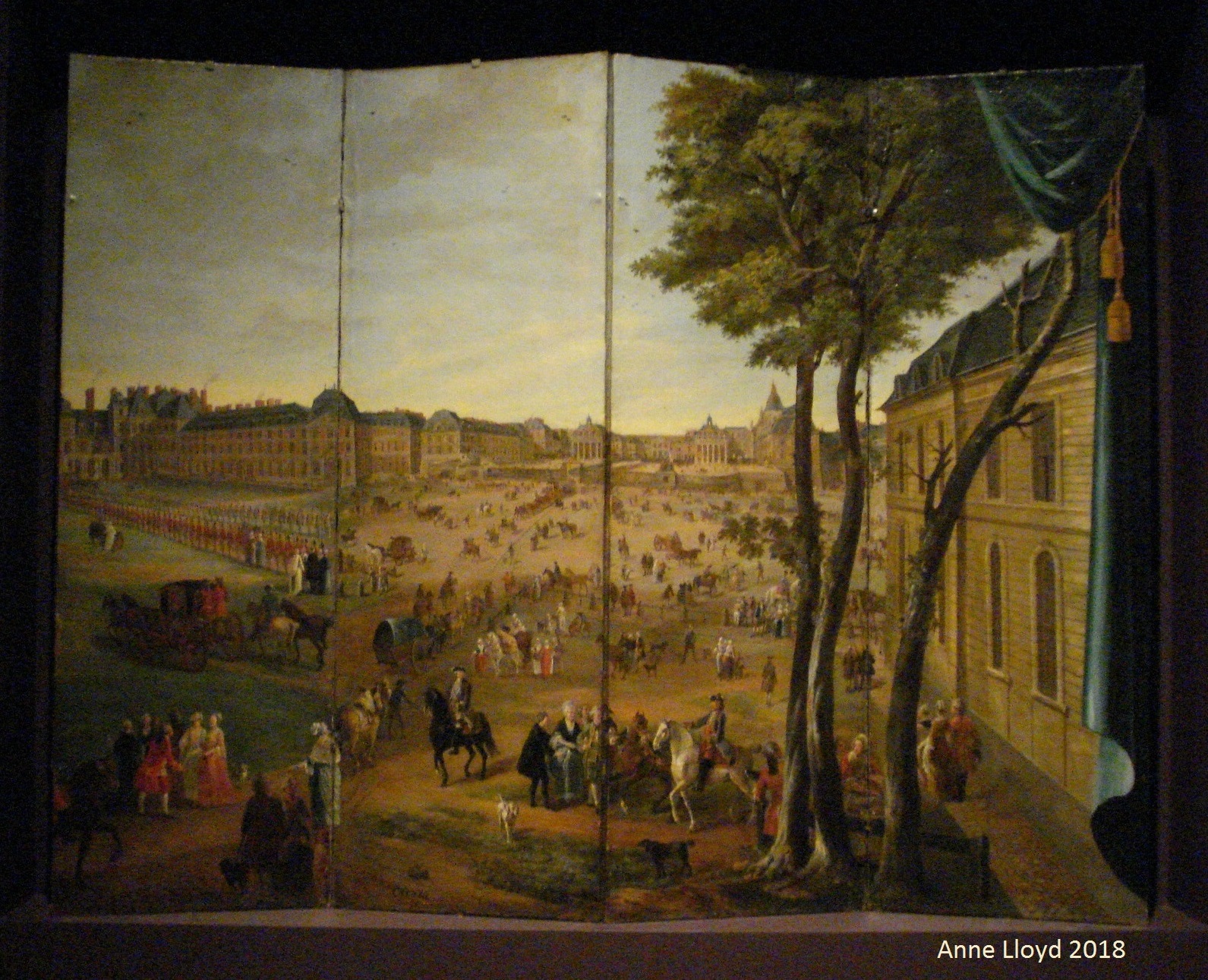
Versailles in its heyday can be imagined by the details on a vast decorative screen painted Charles Cozette (1713–1797) around 1768-1770.  It was originally a painting before being transferred onto a screen. 


Anne Lloyd, Photo (2018) Folding Screen & detail by Charles Cozette, 1768-70
                                       
We can see red-coated Swiss guards lined up on the drill ground of the Place d’Armes in front of the palace. Everywhere else is cheerful disorder, servants at work or taking their time about it, sauntering nobles and sight-seeing tourists.

There was certainly a lot to see at Versailles. Diplomats from distant realms such as the Kingdom of Mysore in India and Siam, present-day Thailand, brought expensive gifts which were displayed as testaments to the greatness of France. 


Anne Lloyd, Photo (2018) Gallery view of Visitors to Versailles,1682–1789 exhibit   Lacquer cabinet from Japan,17th century, and cannon from Siam, c.1686

The silver-plated, long-barreled cannon from Siam and the lacquer cabinet from Japan also point to the French trade initiatives in Asia that would lead to war with Britain over control of India during the mid-1700's and the eventual dominion of France in Indochina.

The black and gold lacquer on this 1783 Drop-front Secretary, created by Jean Henri Riesener  for Marie-Antoinette, recall the popularity of Asian motifs in European decorative arts during the eighteenth century. But this imposing cabinet has a more significant story to tell. 


Anne Lloyd, Photo (2018), Drop-front secretary by Jean Henri Riesener, 1783

The secretary was made by a  German-born craftsman for the very unpopular Austrian queen of France. There are several secret drawers in the secretary hidden beneath the hinged floor of the central compartment. Here, under separate  lock-and-key, Marie-Antoinette stored confidential documents. Of all the glittering objects from Versailles on view at the Met, this Secrétaire en armoire reveals the false, fragile structure of court life at Versailles.

Thomas Jefferson, who took over from Franklin as ambassador to France, observed the "best of all possible worlds" for kings and aristocrats come crashing down in 1789. The keen, perceptive eyes, so brilliantly sculpted in Houdon's portrait bust of Jefferson, watched as Louis XVI pinned a revolutionary cockade on his hat in a vain attempt to mollify the triumphant besiegers of the Bastille.

With shocking rapidity, the Ancien Regime collapsed and the staggering debts accumulated to build and maintain Versailles were paid for in blood. The ledger books for the construction of Versailles had been burned on the orders of Louis XIV. Following the fall of the Bastille, accounts were settled at the cost of the lives of the brave Swiss guards at Versailles, of loyal courtiers like Princesse de Lamballe who was hacked to pieces by the mob, and ultimately of Louis XVI and Marie-Antoinette, "Madame Déficit."


Anne Lloyd, Photo (2018) Jean Antoine Houdon’s Thomas Jefferson, 1789

Even before these deadly acts of retribution took place, Jefferson could see the ominous direction events in France were heading. He clearly understood the cost of maintaining the "dead weight" of past glory and unmerited privilege. In a letter to James Madison, dated September 6, 1789, Jefferson wrote: 

I say, the earth belongs to each of these generations during its course, fully and in its own right. The second generation receives it clear of the debts and incumbrances of the first, the third of the second, and so on. For if the first could charge it with a debt, then the earth would belong to the dead and not to the living generation. Then, no generation can contract debts greater than may be paid during the course of its own existence.

These sobering words, as true today as in 1789, are the most valuable insights which can possibly be derived from the Met's provocative exhibit, Visitors to Versailles. 

***
Text: Copyright of Ed Voves, all rights reserved                                                                Photos courtesy of Anne Lloyd, the Metropolitan Museum of Art and the Smithsonian's National Museum of American History

Introductory Image
Anne Lloyd, Photo (2018) Charles-Gabriel Sauvage's Figure of Louis XVI and Benjamin Franklin, 1780–85. Porcelain, 12 3/4 x 9 1/2 x 6 in. (32.4 x 24.1 x 15.2 cm) Metropolitan Museum of Art. Gift of William H. Huntington, 1883. Accession Number:83.2.260

Anne Lloyd, Photo (2018) Gallery view of the Visitors to Versailles exhibition at the Metropolitan Museum of Art.

Anne Lloyd, Photo (2018) Sculpture of Fox Setting Fire to the Tree with the Eagle’s Nest, 1673–74. Painted lead, 47 1/4 × 33 1/16 in., 2204.6 lb. (120 × 84 cm, 1000 kg) Musée National des Châteaux de Versailles et de Trianon (MV 7946.1)

Anne Lloyd, Photo (2018) Antoine Coysevox's Louis XIV, 1678-81. Marble, 47 1/4 × 37 3/8 × 13 3/8 in., 661.4 lb. (120 × 95 × 34 cm, 300 kg)  Musée des National des Châteaux de Versailles et de Trianon (MV 789)

Anne Lloyd, Photo (2018) Pierre Denis Martin's View of the Château de Versailles from the Place d'Armes, 1722. Oil on canvas, 56 5/16 × 59 13/16 in. (143 × 152 cm). Musée National des Châteaux de Versailles et de Trianon (MV 726)

Anne Lloyd, Photo (2018) Gallery view of the Visitors to Versailles exhibition, British traveling attire, man’s wool suit, c.1755-65, Metropolitan Museum Collection & woman’s riding habit,1770’s from the Victoria and Albert Museum.

Pompeo Batoni (Italian, 1708–1787) John Montagu, Lord Brudenell, Later Marquess of Monthermer, 1758. Oil on canvas, 38 × 28 in. (96.5 × 71.1 cm) The Duke of Buccleuch & Queensberry, Boughton House, United Kingdom (BLHT/BH/122)


Anne Lloyd, Photo (2018) Claude-André Deseine's Sculptures of Nephew of Muhammad Osman Khan and Muhammad Osman Khan, 1788. Both sculptures, Terracotta with carved wood base.  Nephew, without base: 18 1/2 × 13 3/16 × 7 11/16 in. (47 × 33.5 × 19.5 cm). Muhammad Osman Khan, without base:  21 1/4 × 15 3/4 × 9 13/16 in. (54 × 40 × 25 cm) Musée du Louvre, Paris, Département des Sculptures, (RF 4664, RF 2334) Muhammad Osman Khan, Gift of Pierre-Évariste Villemant, 1934

Anne Lloyd, Photo (2018) Joseph Siffred Duplessis' Benjamin Franklin (1706–1790), 1778, Oil on canvas, Oval, 28 1/2 x 23 in. (72.4 x 58.4 cm) Metropolitan Museum of Art. The Friedsam Collection, Bequest of Michael Friedsam, 1931. Accession Number:32.100.132


Benjamin Franklin's Three-Piece Suit (habit à la française), c.1778–79. Ribbed silk and linen (reproduction shirt, shoes, and stockings) Mounted on form: 60 × 30 × 24 in. (152.4 × 76.2 × 61 cm) Smithsonian’s National Museum of American History, Washington, D.C. (2012.0187.001)

Anne Lloyd, Photo (2018) Charles Cozette's Folding Screen, showing Scenes of Versailles, c. 1768–70. Wood, oil on canvas, painted leather, 79 1/2 in. × 12 ft. 9 9/16 in. (202 × 390 cm) Collection of Monsieur and Madame Dominique Mégret, Paris

Anne Lloyd, Photo (2018) Cabinet from Japan, 17th century. Lacquer, 45 11/16 × 42 1/2 × 24 7/16 in., 198.4 lb. (116 × 107.9 × 62 cm, 90 kg) Musée du Louvre, Paris, Département des Objets d’Art (OA 5474) Cannon from Siam, before 1686. Cast iron, silver-plated brass inlay, 2 3/8 × 73 5/8 in., 283.1 lb. (6.1 × 187 cm, 128.4 kg) The Royal Artillery Museum, Larkhill, United Kingdom (GUN1/020)

Anne Lloyd, Photo (2018) Drop-front secretary (Secrétaire en armoire) made by
Jean Henri Riesener,1783. Oak veneered with ebony and 17th-century Japanese lacquer, 57 × 43 × 16 in. (144.8 × 109.2 × 40.6 cm) Metropolitan Museum of Art.Bequest of William K. Vanderbilt, 1920. Accession Number:20.155.11

Anne Lloyd, Photo (2018) Jean Antoine Houdon's Thomas Jefferson, 1789. Marble, 22 1/4 × 18 7/8 × 10 1/4 in., 125 lb. (56.5 × 48 × 26 cm, 56.7 kg) Museum of Fine Arts, Boston, George Nixon Black Fund (34.129

Monday, December 25, 2017

Religion in Early America at the Smithsonian National Museum of American History


Religion in Early America


Smithsonian National Museum of American History 

June 28, 2017 -  June 3, 2018

Reviewed by Ed Voves

On his way to take the Oath of Office as President of the United States in February 1861, Abraham Lincoln stopped at Trenton, New Jersey, to address the legislature of that state. After alluding to the great Revolutionary War battles of Trenton and Princeton, Lincoln made a reference to the religious ideals of the American people, as well as the tense political situation. 

I am exceedingly anxious that this Union, the Constitution, and the liberties of the people shall be perpetuated in accordance with the original idea for which that struggle was made, and I shall be most happy indeed if I shall be an humble instrument in the hands of the Almighty, and of this, his almost chosen people ...

God's "almost chosen people" are the subject of an excellent, year-long, exhibit at the Smithsonian's National Museum of American History. Beginning with the arrival of Christianity in what is now the United States, Religion in Early America surveys a long span of history from the early decades of the 1600's to just before the Civil War.


Gallery view of the Smithsonian exhibit, Religion in Early America

From the establishment of the first English "plantations" or settlements in the New World, Protestantism defined the spiritual expression and codes of morality of the majority of "early" Americans. However, the idea of an "established church" never took hold, either in the  English-speaking colonies as a collective entity or in the individual "plantations."

Diversity categorized the religious lives of "early" Americans. Dissent and divisiveness affected virtually every denomination at some point during the long period covered by the exhibition. Even the Society of Friends was periodically embroiled in controversy. 

Edward Hicks (1780-1849), painted sixty-two versions of the Bible verse from the Book of Isaiah (11: 6-8) which proclaimed "the wolf shall dwell with the lamb, and the leopard shall lie down with the kid." Hicks, a Quaker from Bucks County, Pennsylvania, did not live in such a "Peaceable Kingdom" himself. The Quakers were bitterly divided by a doctrinal dispute, sparked by the "inner light" teachings of Hicks' cousin, Elias Hicks, which many interpreted as contradicting established rules of religious observance.

Religious controversies, long a feature of European society, soon left their mark on the fledgling colonies. Some of the ruling elites made concerted efforts to enforce conformity, especially in Puritan New England.

The exhibit highlights two artifacts that testify to this struggle. On display are the chalice of John Winthrop (1588-1649), the brilliant "enforcer" of Puritan orthodoxy in Massachusetts, and the compass - sundial of Roger Williams, founder of Rhode Island. 


Roger William's Compass-Sundial, 1630-1635

Roger Williams (1603-1683) was a Puritan clergyman of radical views. Refusing to adhere to the orthodox Calvinism of the Puritan elite, Williams was banished from Massachusetts in 1635. Williams used this compass to explore sites in the wilderness to build a refuge for fellow victims of Winthrop's implacable enmity.

Religion in Early America also examines Native American religious practice, the fascinating story of how religion has shaped the African-American struggle for justice and the story of America's Jewish community, small in numbers and hugely significant in patriotism and public service. 


Noah’s Ark Playset, 1828

All of the exhibition artifacts are well-chosen to illustrate the profound religiosity and cultural diversity of colonial America and the early Republic. This toy ark, intended for Sabbath Day play, shows how seriously people took religious observance.

However, the organizational framework of Religion in Early America is open to question.  The curators, faced with so many "varieties of religious experience" (to borrow the title of William James' famous book) organized the exhibit on a geographical basis. 

Regional factors, rather than adhering to a timeline, provides the focus of the exhibit. For the early chapters of American religious history, regionalism works as a satisfactory method to organize the great mass of material. As the pace and scope of America's development increased, however, regionalism's usefulness falters.  

The Great Awakening evangelical movement of the 1740's was the first widespread event in American history. The preaching and published sermons of George Whitefield and Jonathan Edwards inspired congregations from New Hampshire to Georgia. The Great Awakening was a precursor to the political Revolution that took place thirty years later. 

Following the Great Awakening, regionalism steadily declined as a factor in American religious life. The life of Lucretia Mott (1793-1880) illustrates this trend.

Lucretia Mott was born in Nantuckett, Massachusetts fifty years after the Great Awakening. Her austere bonnet is on display in the section of the exhibit devoted to New England. This is misleading placement. Though born in New England, Mott was hardly more than an "ex-pat" from that region.


Bonnet belonging to Lucretia Mott, c.1850-1880

Mott, one of the greatest Abolitionist leaders, was educated in New York and resided for most of her life in Philadelphia - when she was not travelling around the U.S. or visiting England in order to preach the cause of freedom for African-Americans and later the right to vote for women. 

Mott was a national figure, indeed, an international force for good. She transcended state borders, appealing to hearts and minds across the nation and the world.

Religion in Early America is too important an exhibition to get side-tracked by its regional orientation. A better technique to appreciate its many treasures is to focus on selected objects as they strike your interest and then relate these to a similar - or a very different - artifact. There are certainly plenty of outstanding exhibit treasures to compare and contrast.

One of the most intriguing displays in the exhibit is a a small beribboned box containing two crucifixes and a religious medal worn by the African-American, Roman Catholic nun, Elizabeth Lange (later Mother Mary Lange). These were discovered when the body of Mother Lange was exhumed as part of the process of officially bestowing sainthood upon her.


Mother Mary Elizabeth Lange's Crucifixes and religious medal

Born in Cuba, Elizabeth Lange (1794-1882), devoted herself to teaching children of African-descent in Baltimore. In 1828, a French priest,  Father James Joubert, supported Lange and three other devout African-American women in founding a religious order of nuns, the Oblate Sisters of Providence.

In 1836, a school building run by the Oblate sisters was opened and, for a time, achieved considerable success. The 1840's were a decade of severe economic instability following the Panic of 1837. Financial support for Mother Lange and her sisters diminished. At one point, they were forced to ask permission from Church authorities in Baltimore to beg on the streets to support their school.
  
A German-born priest of the Redemptorist order, Father Thaddeus Anwander, came to their aid and the Oblate sisters were saved from financial ruin. Their school and mission expanded to other cities in the U.S., and later to Cuba, until Casto's communist regime forced them out, and Costa Rica where the Oblate Sisters still flourish.

By way of comparison with Mother Lange's crucifixes, the saddlebags of an itinerant Methodist preacher serve as an excellent counterpoint. 


Freeborn Garrettson’s Saddlebags, 18th Century

Freeborn Garretson (1752–1827) was born in Maryland, where Mother Lange was later to work. When he inherited several slaves, he experienced a spiritual vision which turned him into an ardent abolitionist. Garretson's crusading zeal encouraged the emancipation movement in Maryland and Delaware. Among those set free was Richard Allen (1760-1831) who later founded Mother Bethel Church in Philadelphia in 1794, the first independent African-American church in the U.S.

Another treasure of the exhibition is the Torah scroll from Congregation Shearith Israel in New York City. During the Revolutionary War, the British Army occupied New York in 1776. Congregation Shearith Israel's synagogue was looted by British soldiers and this Torah scroll, and one other, were desecrated. In an effort to regain community support, the British high command ordered the offending soldiers flogged and one of them died from his wounds.


Shearith Israel Torah Scroll, 18th century

Congregation Shearith Israel was founded in 1654, the first Jewish congregation to be established in North America. These Torah scrolls were carefully preserved, though longer fit for actual religious services, as relics of the storied past of this historic faith community.

The history of American religion does not always yield its secrets so readily as Mother Lange's crucifixes or the Congregation Shearith Israel Torah scrolls. The material remains of religious movements - a book of sermons or a painting of an event in sacred history - can appear as arcane, almost alien artifacts to modern day museum goers.

Thomas Jefferson solved the problem of religious doctrine by literally cutting out of the Bible all that he refused to believe, including the miracles performed by Jesus. Jefferson produced an abridged version of the New Testament gospels, 84 pages in length, with all of the "nonsense" excised with a pen knife.


Thomas Jefferson's The Life and Morals of Jesus of Nazareth (1820)

The Jefferson Bible or The Life and Morals of Jesus of Nazareth (1820) was never published in Jefferson's lifetime or for many decades thereafter. Jefferson's original copy is on view in the exhibit. It is a rare treat to see such a fabled treasure, but it is disturbing too.

Jefferson was the greatest political thinker to ever occupy the White House. As a man who embodied the Age of Reason, Jefferson could hardly have remained untouched by the secularizing philosophy of his era. Yet, cutting-out the unpalatable passages of the Bible was disturbingly like the willful mishandling of the escalating controversy over slavery. 

Jefferson and most of the other leaders of the new United States were deeply troubled by the moral and political implications of slavery. Yet, they devoted little effort to redress this wrong. Believing that the inherent strengths of the nation would suffice, the Founders trusted that slavery would wither away on its own. A nation of small farmers would arise. Reason would triumph.

None of this happened. The "Era of Good Feelings," during which the aged Jefferson worked on his Life and Morals of Jesus of Nazareth, lasted but a few short years.The scandal of slavery in the land of freedom could not be brushed aside.

Along with Jefferson's The Life and Morals of Jesus of Nazareth, the exhibit displays the Bible used for George Washington's inauguration as the nation's first president on April 30, 1789. This copy of the Bible was loaned to Washington by the St. John’s Masonic Lodge in New York City. Printed in London in 1765, it is a King James Version Bible, Old and New Testament with Apocrypha. In a thoroughly eighteenth century touch, an appendix with historical and scientific data was included.


Washington Inaugural Bible, owned by St. John’s Masonic Lodge, NYC, since 1770.

Washington selected Genesis 49 as the chapter to be opened upon which he would place his hand. This was the Bible passage in which the dying patriarch, Jacob, blesses and admonishes his sons, the leaders of the twelve tribes of Israel. Washington, often ridiculed (behind his back) for his lack of education, chose a "text" of special relevance for the thirteen "tribes" engaged in forming a new nation - and for us, their descendants and heirs. 

All these are the twelve tribes of Israel: and this it is that their father spake unto them, and blessed them: every one according to his blessing he blessed them.

One can only hope that the Smithsonian will create a follow-up exhibition to Religion in Early America. The story of how the religious principles of God's "almost chosen people" were put to the test as they sought a "new birth of freedom" is ever timely. 

***
Text: Copyright of Ed Voves, all rights reserved 
Images, courtesy of the Smithsonian Institution, National Museum of American History.  

Introductory Image:                                                                                                          Edward Hicks (American, 1780 -1849) Peaceable Kingdom, c. 1834. Oil on canvas:            74.5 x 90.1 cm (29 5/16 x 35 1/2 in.)  National Gallery of Art, Washington D.C. Gift of Edgar William and Bernice Chrysler Garbisch 1980.62.15                                                        

Smithsonian Institution, Photo (2017) Gallery view of Religion in Early America at the Smithsonian’s National Museum of American History

Roger William's Compass-Sundial, 1630-1635. Made in the United Kingdom. Brass: Height:.875 in x Width:2.5 in. Rhode Island Historical Society 1902.3.1  Gift of Mrs. Sophia Augusta Brown, 1902

Noah’s Ark Playset, 1828.  Made in the United Kingdom. Loan from collection of Judy and Jim Konnerth


Bonnet belonging to Lucretia Mott, c.1850-1880. Buckram covered with gray-green silk, handsewn. Brim lined with white silk. National Museum of American History, Smithsonian Institution, Behring Center. Gift of Lucretia Mott Churchill Jordan

Mother Mary Elizabeth Lange's Crucifixes and medal, 19th century. Two crucifixes and a religious metal. Loan from the  Oblate Sisters of Providence,  Baltimore, MD

Freeborn Garrettson’s Saddlebags, 18th Century. Loan from C. Wesley Christman Archives, New York Annual Conference of the United Methodist Church                                
Shearith Torah Scroll, 18th century. Loan from Congregation Shearith Israel, New York City

Thomas Jefferson, (American 1743-1826) The Life and Morals of Jesus of Nazareth, c. 1819-1820. Red Morocco goatskin leather, handmade wove paper, iron gall ink: .8.3 in × 5.2 in × 1.3 in (21.1 cm × 13.2 cm × 3.3 cm) Smithsonian Institution, acquired in 1895

Washington Inaugural Bible. King James Version with Printed by Mark Baskett, London, 1767. Presented by Jonathan Hampton, 1770, to St. John’s Lodge No. 1, Ancient York Masons, New York City. On loan from St. John’s Lodge Masonic Lodge