Showing posts with label Christianity. Show all posts

Friday, June 17, 2022

Art Eyewitness Book Review: Catholica: the Visual Culture of Catholicism


Catholica: the Visual Culture of Catholicism

By Suzanna Ivanic

Thames & Hudson, $35, 256 pages

Reviewed by Ed Voves

For over a thousand years, the Christian Church was the greatest patron of the arts and architecture in the world. Beginning in the year 312, when the Roman emperor Constantine embraced Christianity, almost every aspect of thought, culture and craft in Europe was dominated by the effort to build and maintain a civilization based on the life and teachings of Jesus of Nazareth.

Catholica, a brilliant new book published by Thames and Hudson, explores the visual record of Roman Catholicism. This was the dominant form of Christianity in Europe, until it was divided into warring camps by the publication of Martin Luther's radical views on religious doctrine in 1517. 

Despite the Reformation, Roman Catholicism survived - and thrived. This was due in no small part because of the impact of Catholic art and the religious convictions upon which it was founded. After losing control over parts of Germany, England and the Netherlands, Roman Catholicism spread to Latin America, much of sub-Saharan Africa and to Asian countries like the Philippines. 

Roman Catholicism still exerts a strong and inspiring influence over millions of faithful Christians the world over. Yet many of its works of art, or sacred objects like the vestments worn by Catholic clergy and vessels used in devotional ceremonies, have an unfamiliar, even unsettling, feel to them. 

For instance, many people today have no idea as to the significance of the golden vessel known as the monstrance. 


Diego de Atienza, Spanish artist in Ecuador & Peru, Monstrance, c. 1646 

The monstrance is used to display the Host, unleavened bread transformed into Christ's body during the Mass. The role and importance of this sacred object is, needless to say, difficult to grasp by those unacquainted with Roman Catholicism. Thanks to Catholica, the process of understanding and appreciating Christian art and ideas will be a great deal easier.

Catholica was written by Suzanna Ivanic, who teaches history at the University of Kent, England. Ivanic has excellent credentials for investigating the works of art, architecture and artifacts of Catholicism, for her research field (according to the publisher's blurb) is the "lived religion and material and visual culture in Central Europe."

Equally important, Ivanic writes with conviction and insight. Indeed, the sensitivity of her commentary and the scope of her knowledge are awesome and admirable.

Catholica is organized into three parts. Tenet surveys the basics of Roman Catholic religious doctrine; Locus examines the sites where Catholics worship, ranging from magnificent Gothic cathedrals to prayer sites in the homes of the faithful; Spiritus focuses on Christian devotion, as practiced by communities and by individuals.

As noted above, many Catholic works of art or devotional objects may be unfamiliar. In some cases, they are "wondrously strange" and Ivanic has her work cut-out to explain them. This she does in "decoding" units where baffling, arcane details of famous paintings and church architecture are analyzed. 


Pieter Bruegel the Elder, The Fight Between Carnival and Lent, 1559

The Fight Between Carnival and Lent, painted by Pieter Bruegel the Elder in 1559 is one of the masterpieces decoded by Ivanic. Indeed, it was created with exactly that purpose in mind. A wealth of examples of folly, greed, gluttony and social mayhem during Mardi Gras was included in Bruegel's painting. These are compared with the sober performance of Christian charity during the season of Lent.
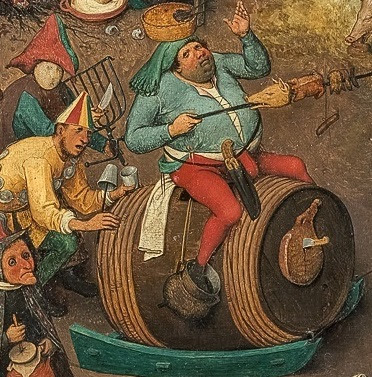


Bruegel's The Fight Between Carnival and Lent (details)

Other "decoded" paintings include The Penitent Magdalen by Georges de la Tour (c. 1640) and Caravaggio's The Seven Works of Mercy (1607). 


Anonymous (Japan), The Arrival of the Europeans, early 1600's

A fascinating Japanese screen painting, dating to the early 1600's, shows Catholic missionaries from the Jesuit and Franciscan orders in one of its vignettes. Here we can see the global outreach of Christianity as seen - and very attentively examined - by non-Europeans.

Profiles of important themes in Christian culture also feature prominently in the book. These range widely from the important events and rites associated with the seasons of Christmas and Easter, the "roles" assigned to the Virgin Mary - Mother of Sorrows, Mary of the Rosary, etc. - and the Catholic ways of coping with Death. This last profile is especially compelling, as I will comment in more detail later in this review.

With this investigative format in mind, it might seem that Catholica is primarily a reference work. Indeed it is, but the best way to appreciate Catholica is to begin on page one and follow Ivanic as she guides us along the path of Roman Catholicism's engagement with art of the spirt.

The profoundly moving nature of Ivanic's text is due to more than her command of source material. She writes about matters of religious faith with a real sense of what Christian belief in God and the divine ordering of the universe is like. 

A brief quotation from Ivanic's discussion of the role of Abbot Suger (1081-1151) regarding the rise of Gothic cathedrals is indicative of the marvelous and moving narrative of Catholica:

Key to understanding the birth of the Gothic is Suger's emphasis on the transformative power of the liturgical performance. Just as during the Mass the bread and wine are turned into the body and blood of Christ, so does the ritual performance of the cathedral transform it from stones, glass and metal into a divinely powerful space... 

Christianity traces its origin to Judaism. Like Jews, Christians base their beliefs on the written (and sanctified) words of the Bible. But early in the history of the Christian Church, images of Jesus, the Virgin Mary and saints like the Apostle Peter were treated with an unprecedented sense of importance. 


Metalcut print showing The Mass of St. Gregory, late 1400's

Pope Gregory I (540-604) realized that visual representations of the episodes of Biblical history and the life of Jesus were essential teaching tools. Vast numbers of Christians were illiterate and thus excluded from reflecting upon and understanding what they heard preached by the Christian clergy.

Yet, images of Jesus and other saintly people from the Bible were potentially dangerous. Pope Gregory was aware that Christians might come to adore sacred pictures or religious objects, rather than worship God. It was a risk he felt compelled to take. Ivanic quotes Gregory's famous, and hugely influential, pronouncement.

It is one thing to worship a picture and another to learn from the story of a picture what is to be worshiped. For what writing conveys to those who can read, a picture shows to the ignorant ... and for that very reason a picture is like a lesson for the people.

To understand a picture, people need to identify with its subject and message. As a result, depictions of the great events of the Bible and the life of Jesus stressed relevancy rather than historical accuracy of setting and costume. Artists frequently showed biblical characters in contemporary attire, surrounded by details of architecture and artifacts similar to those of the people gathered together to view such works of art as part of Christian worship.

Catholic images were modified to suit geography and social convention as part of the Christian missionary movement. One of the book's most fascinating images comes from Ethiopia in the 1600's where Jesuit missionaries sought to influence the Christian population to embrace Catholicism, rather than the version they practiced which was based on the Coptic Church of Egypt.


Anonymous (Ethiopia) Diptych of Life of Virgin Mary, c. 1630's-1700

The diptych above presents episodes from the life of Mary, mother of Jesus.  The bottom scene of the left-hand panel presents Mary showing the infant Jesus to the Three Kings, who look like Ethiopian nobles rather than magi from the Middle East.  Above, shepherds, having already seen Jesus, play a hockey-like game called genna


Diptych of Life of Virgin Mary (detail)

Unfortunately, such culturally-sensitive artwork did not always convince. The mass of Ethiopia's people resisted conversion to Catholicism, even when the country's ruler, Emperor Susenyos, did so in 1622. After years of dissension and civil war, the Jesuit mission ended in failure. 

Spanish missionaries experienced greater success in grafting Catholic cultural forms onto native roots in Mexico, Peru and other Latin American nations. The process led to the creation of enduring expressions of Christian piety. The image of Our Lady of Guadalupe (below) was based on the religious visions of a Mexican native, Juan Diego, in 1531, only a few years after the Spanish conquest of the Aztecs. 


Anonymous artist (Mexican), Our Virgin & Child of Guadalupe, 1745

Juan Diego's vision of Mary was depicted in various amalgams of ethnic attributes and styles of clothing. The facial features of Our Lady of Guadalupe in this version, almost obscured by layers of sumptuous Spanish robes, bears a strong resemblance to the Aztec earth goddess, Tonatzin. 

Roman Catholicism never missed an opportunity to present the guiding principles of Christianity in ways that believers and would-be believers could appreciate and enjoy. From soaring stained glass windows to the charming maiolica ensemble of movable figures at the Last Supper, Catholic art was on view everywhere one looked.
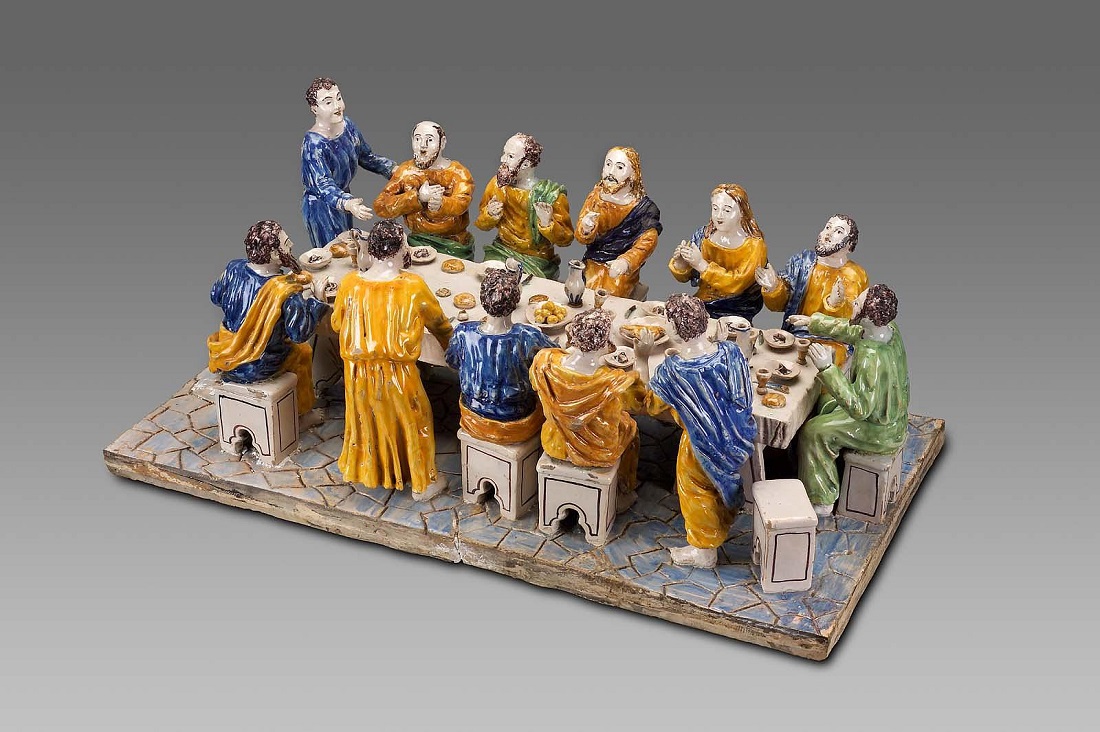

Maiolica model of the Last Supper, from Faenza, Italy, 1500's

Judged in this manner, Roman Catholic art represents an early - and very successful - form of corporate "branding." But there is one staggering difference. 

Modern-day public relations techniques emphasize sprightly images and upbeat banter to keep customers buying, consuming and buying some more in an endless cycle of happy days and Happy Meals. Roman Catholicism, by contrast, fixated upon the inevitable negation of earthly pleasure and human life by Death. 

The supreme symbol of Roman Catholicism is the Cross, the emblem based upon the crucifixion of Jesus. This form of torture and execution was reserved for slaves and criminals under Roman rule. 

Early Christians did not display the Cross, so terrible was the memory of Jesus' execution. Also, they lived in the daily expectation of the End Time. When the Apocalypse did not come, the brutal fact of Jesus' crucifixion remained. But so too, did the Christian believe that Jesus had secured redemption for them from sin, with the promise of immortal life for the souls of those who believed in him.

Death, Christ's death, has conquered death. 

This paradox, which St. Paul called the "scandal of the Cross," placed the reviled symbol of a slave's execution at the summit of human devotion, a place it still holds for millions. Christians, especially Roman Catholics, have created, collected and cherished works of art related to the Crucifixion since the Middle Ages and continue to do so. 


Aelbert Bouts, The Man of Sorrows, c.1525

From sublime depictions of the Crucifixion by Giotto and Velazquez to harrowing, nightmarish portraits of Jesus, like Aelbert Bouts' The Man of Sorrows, c. 1525, to tattooed images of the crucified Christ on human skin, the Cross is ubiquitous, recognizable to believers and detractors alike.

There will never - hopefully - be a final word on Christian art. For now, in a deeply troubled world, menaced by disease and war, Susanna Ivanic's Catholica is a much needed volume. To her, we will leave the final word.

The art of Catholicism is the art of the human condition. Devotional artworks that dwell on the gaze of the grieving mother or the lifeless body of Jesus resonate with the soul. They are designed to raise one's spirit and deepen one's reservoirs of faith, inspiring intense, reverential joy and pain.

***

Text: Copyright of Ed Voves, all rights reserved. 

Introductory Image: Cover art for Catholica by Suzanna Ivanic. Courtesy of Thames & Hudson

Diego de Atienza (Spanish, born in Ecuador, 1610) Monstrance, c. 1646. Silver gilt with enamel, cast, chased, and engraved: Height: 22 1/2 in. (57.2 cm) Metropolitan Museum of Art. The Friedsam Collection, Bequest of Michael Friedsam, 1931. #32.100.231a, b.

Pieter Bruegel the Elder The Fight Between Carnival and Lent, 1559,  Oil-on-panel: 118 cm × 164 cm (46 in × 65 in). Kunsthistorisches Museum, Vienna

Anonymous (Japan) The Arrival of the Europeans, early 1600's. Pair of six-panel folding screens; ink, color, gold, and gold leaf on paper: each screen: 41 3/8 in. × 8 ft. 6 5/8 in. (105.1 × 260.7 cm) Metropolitan Museum of Art.  Mary Griggs Burke Collection, Gift of the Mary and Jackson Burke Foundation, 2015. #2015.300.109.1, .2

Master of the Church Fathers' Border (German, late 15th century) The Mass of Saint Gregory, late 1400's. Metalcut with traces of hand-coloring; second state:  13-7/8 x 19-15/16 in.; 10-5/8 x 7-7/16 in. Metropolitan Museum of Art. Harris Brisbane Dick Fund, 1924 # 2448

Anonymous (Ethiopia) Diptych of Life of Virgin Mary, c. 1630's-1700. Wooden diptych: distemper, gesso and cloth, each painted panel having three registers, H x W x D: 51.7 x 43 x 2.5 cm (20 3/8 x 16 15/16 x 1 in.). Smithsonian National Museum of African Art. Gift of Ciro R. Taddeo in memory of Raffael and Alessandra Taddeo. #98-3-3

Anonymous (Mexico) Our Virgin & Child of Guadalupe, 1745. Oil on canvas:106 x 84.5 cm. Wellcome Library, London. #44828i

The Last Supper (Faenza, Italy), 1500's. Tin-glazed earthenware (maiolica): H. 8 1/2"; W. 12 5/6" (14 3/4" with base); L. 22 7/8" (24 1/2" with base) Museum of Fine Arts, Boston. Bequest of R. Thornton Wilson in memory of Florence Ellsworth Wilson  #1983.61

Aelbert Bouts & workshop (Netherlandish, ca. 1451/54–1549) The Man of Sorrows, c. 1525. Oil on oak: arched top, 17 1/2 x 11 1/4 in. (44.5 x 28.6 cm) Metropolitan Museum of Art.  The Friedsam Collection, Bequest of Michael Friedsam, 1931. # 32.100.55

Saturday, December 28, 2019

Art Eyewitness Book Review: Dominion by Tom Holland


Dominion: How the Christian Revolution Remade the World


By Tom Holland
Basic Books/$32/612 pages

Reviewed by Ed Voves

As I read Tom Holland's Dominion: How the Christian Revolution Remade the World, my thoughts turned to Dietrich Bonhoeffer, theologian, philosopher and martyr. 

In Holland's powerful account of Christian history, the price paid to secure Christian values and human justice is a paramount theme. Bonhoeffer, whose most famous book is entitled The Cost of Discipleship, is but one of Christianity's many martyrs.

By extension, Bonhoeffer's death calls to mind how the sacrifice of self is of fundamental importance to Christian art.

Dominion is not a coffee-table type art book and only indirectly deals with Christian art. Holland's cogent analysis and his brilliant retelling of the life-stories of saints and sinners motivated me to select Dominion for review in Art Eyewitness. This absorbing, unsparing book has enabled me to better grasp the concepts upon which great works of Christian art, like Caravaggio's masterpiece, The Crucifixion of St. Peter, are founded. 


Caravaggio, The Crucifixion of St. Peter, 1601 

Bonhoeffer was executed in April 1945 for his opposition to Hitler's genocidal madness. The Lutheran theologian had less than four months to live when he wrote a profoundly moving poem entitled "By the Powers for Good." 

The year just past still lingers in our hearts,                                                                     And evil times on us their burden weigh,                                                                               O Lord, to shaken souls bestow your peace,                                                                      Your promised grace, your solace, this bleak day.

But should you tend your cup of sorrow,                                                                               To drink the bitter dregs at your command,                                                                       We accept with thanks and without trembling,                                                                  This offering from your gracious, loving hand.

But if joy be once again your gift bestowed,                                                                          To this our world with sunlit skies so fair,                                                                        May we always hearken to these days of old,                                                                    And commit our lives to your loving care.

As a devout Christian, Bonhoeffer seemingly contradicted himself. How could a loving God press the cup of "bitter dregs" to the lips of a person of faith and/or bestow "promised grace"?  How can arbitrary acts of divine willfulness be squared with the Sermon on the Mount?

For Bonhoeffer (1906-1944), the crucifixion of Jesus of Nazareth is the definitive act of martyrdom. Christians like Bonhoeffer believe that Jesus, sharing in the divinity of God, shattered the chains of sin that had bound human beings to an unpredictable wheel of fortune.

What then of Christian history, with its less than edifying incidents of bloodshed and bigotry? For Holland, the very "scandal" of Jesus' agonizing, humiliating death is proof of the singular nature of the Crucifixion's history-changing consequence. 

Over the centuries, interpretations of the life and - especially - the death of Jesus have changed, reflecting shifts in opinion. In ancient times, practicing Christians attempted to cover the shame of the Crucifixion with a more benign, reassuring image. Early Christian art showed Jesus as the young, beardless Good Shepherd, the Kriophoros. 


The Good Shepherd (Kriophoros), Third-Fourth Century, A.D. 
Courtesy of the British Museum (Image does not appear in Dominion)

Following the fall of Rome in 410, "evil times" cast the world into suffering and shadow. Christian iconography responded to the emotional torment felt by the faithful to this shocking event. In place of the Kriophoros, Jesus, nailed hands and feet, to a Roman cross became  - and remains - the absolute symbol of the Christian faith.


The Borradaile Triptych, Tenth Century A.D.
Courtesy of the British Museum (Image does not appear in Dominion)

Everywhere we look, often in very unexpected places, there are testimonials to the transforming effect of the execution of Jesus, of the sacrifice of his life for humanity. Holland, one of the most perceptive historians on the contemporary scene and a marvelous writer, follows the course of the Christian revolution and shows how it is now part of the "web and woof" of human culture throughout the world.

Belief in the death and resurrection of Jesus created a whole new sense of time. Instead of an endless cycle of war, famine and plague, presided over by fickle or indifferent gods, Christianity was different. It was dynamic and linear. Time was headed in one direction and toward a single goal: eternal life and spiritual communion with God.

The earthly conduct of those who embraced Christianity was marked by sequential steps: concern for salvation followed by virtuous deeds which testified to one's acceptance of Jesus' teaching. The onward journey of the Christian soul never stopped - prayer, reflection, faith and good works.

This progression engendered a new ideal which has since spread all over the world, in both religious and secular forms: progress. 

Holland brilliantly shows how the early Christian reordering of time was based on the belief that Time would soon come to a cosmic conclusion. Over the centuries, this led to periodic outbursts of religious fervor stemming from a conviction that the eschaton was approaching. This "end time" never arrived - at least not yet - but outbreaks of insurrection often did. Several are memorably chronicled in Dominion, notably the Taborite Revolt of 1420 against the Holy Roman Empire and the Papacy.


The Declaration of the Rights of Man and the Citizenca. 1789


Later revolts followed a similar pattern. The goals might be political or economic, but the imprint of a Christian mindset was not hard to discern. Though hostile to the Catholic Church, the French Revolutionaries of 1789 proclaimed the Declaration of the Rights of Man and the Citizen, a grandiose document graced by a Madonna-like figure and an angel who gestures toward the "all-seeing eye' of Providence. Holland writes:

That the Declaration of Rights claimed an authority for itself more universal than that of Christianity only emphasised the degree to which, in the scale of its ambitions and the scope of its pretensions, it was profoundly Christian.

The only thing missing from the Declaration of the Rights of Man and the Citizen was the Cross. The centrality of the image of Jesus on the Cross is a vital concern for Holland in Dominion and for all who wish to understand Western art.

Among the pictures in Dominion's center-spread of illustrations is the gruesome image of the heel bone of a crucifixion-victim named Jehohanan. A Jew living approximately at the same time as Jesus, Jehohanan was executed by the Romans and buried in a stone tomb with a nail still embedded in his right heel. The tomb was discovered in Israel in 1968. The pierced heel bone is the only skeletal evidence from antiquity of crucifixion, a cruel form of execution which the Persians and Greeks also utilized.


The bone fragments of Jehohanan  are contrasted with a vitally important work of Christian art. This is the oldest known depiction of the crucifixion of Jesus, circa 420-430 AD. It is one of the four Maskell Passion Ivories in the collection of the British Museum. This, the second of the ivory carvings, shows two scenes, the remorseful Judas dangling from a tree and Jesus hanging from  the Cross. The book illustration only shows the detail of Jesus' Crucifixion.


Crucifixion, Panel of Maskell Passion Ivories, ca. 420-430 A.D.

In the Maskell Passion ivory, the crucified Jesus is shown as a young man like the Good Shepherd. The picture caption in Dominion astutely notes that in the Maskell Passion ivory Jesus looks "buff and ripped, Jesus boasts the the physique of a victorious athlete."

During the Victorian era, Christian artists conflated the crucified Jesus with the Good Shepherd to create the image of a tender-hearted Messiah. This persona was treated with contempt by a disparate group of critics: the Marquis de Sade, Karl Marx and Friedrich Nietzsche, to name a few. Holland is particularly brilliant in his analysis of Nietzsche's baleful influence on the German artist, Otto Dix (1891-1969).

A machine-gunner in one of the German units sent to the 1916 Battle of the Somme, Dix had become enthralled with Nietzsche's man/superman theories even before 1914. This embrace of Nietzsche's controversial  philosophy was at the expense of his Lutheran religious convictions. What Dix endured during the slaughter on the Somme convinced him that Nietzsche was correct in proclaiming "God is Dead!"

Holland writes:

Dix ... refused to see Christ's suffering as having served any purpose. To imagine that it might have done so was to cling to the values of a slave... Dix, volunteering in 1914, had done so out of a desire to know the ultimate extremes of life and death: to feel what it was to stick a bayonet in an enemy's guts and to twist it around, to have a comrade suddenly fall, a bullet square between his eyes; 'the hunger, the fleas, the mud'. Only in the intoxication of such experiences could a man be more than a man, an Ubermensch.

Another German veteran of the Somme reached similar conclusions about the status of Ubermenschen and the way that Christianity degraded human society. A failed artist unlike Dix, Adolf Hitler decided to put Nietzsche's precepts into practice.

Hitler's design for a "Thousand Year Reich" perversely mirrored the millennium of Christendom. From the fall of Rome to the Renaissance, Christianity aimed to create a "total society" for the benefit of its believers until the Second Coming finally took place.  Many less-than-Christian episodes occurred, described in grim detail in Dominion. But under the auspices of Christianity, truly astonishing accomplishments took place - and still do.  

The concept of charitable work (virtually unknown in antiquity), the founding of Europe's universities, a rise in the social status of women (due in large measure to the devotion to Mary, mother of Jesus), the abolition of slavery and the creation of the glories of visual art in the West - all took place in lands where Christianity was the dominant religion and the guiding light.

In  "throwing  the baby out with the bath water," in this case the Infant Jesus, intellectuals and secular reformers like Nietzsche undermined the foundations of the Western world. Nothing of lasting merit has been set in its place, though Holland contends that praiseworthy charitable initiatives like the 1985 Live Aid rock concert reflect continuing Christian values. 

While certainly reassuring, Holland's conclusions cannot banish concern over where these good intentions will lead. Nor does it answer a very pressing question.


Anne Lloyd, Photo (2019) Gallery photo of the Philadelphia Museum of Art, Crucified Christ with the Virgin Mary, Saint John the Evangelist, and Angels, ca 1460-1490 

How long will this neutral, anonymous form of Christianity continue to function - without acknowledgement of Christ's Cross?

To expect Holland to resolve this dilemma is hardly fair. What I can say is that Dominion is a book of such critical importance that it will be joining a select group of treasured volumes on my bedside bookshelf for future - and frequent - consultation.

***
Text: Copyright of Ed Voves, all rights reserved   
Original Photography, Copyright of Anne Lloyd

The quoted stanzas from Dietrich Bonhoeffer's "By the Powers for Good" appear in A Testament to Freedom: the Essential Writings of Dietrich Bonhoeffer, edited by Geoffrey B. Kelly and F. Burton Nelson (HarperOne,1990)

Introductory Image:
Book Cover of Dominion: How the Christian Revolution Remade the World by Tom Holland. Courtesy Basic Books

Michelangelo Merisi da Caravaggio (Italian 1571-1610) The Crucifixion of St. Peter, 1601 Oil on Canvas: 230 cm x 175 cm (91 in x 69 in) Santa Maria del Popolo, Rome. Courtesy of Wikipedia.org.

Artist unknown (Possibly Sasanian) The Good Shepherd (Kriophoros), Third-Fourth Century, A.D.  Find spot - Zubayr in South Iraq. Marble, carved: Height: 61 centimetres (cm)  Width: 39.5 cm  Thickness: 16.5 cm  Height: 74.5 cm (with stone base) Width: 35 cm (of stone base) Thickness: 25 cm(with stone base)Weight: 63 kilograms (including base) Copyright of the British Museum, # 114262

Artist unknown (Byzantine, Middle Period) The Borradaile Triptych, Tenth Century A.D. Ivory, carved: Height: 270 millimetres (mm) -  centre panel  Width: 157 mm Height: 278 mm - leaves Width: 85 mm Thickness: 10 mm. Copyright of the British Museum, # 1923,1205.1

The Declaration of the Rights of Man and the Citizenca. 1789. Oil on panel: Height: 71 cm (27.9″); Width: 56 cm (22″). Musée Carnavalet, Paris. Given by Georges Clemenceau, 1896. Courtesy of Wikimedia Commons.

Unknown Artist, Crucifixion, Panel of Maskell Passion Ivories, Circa 420-430 A.D., Carved Ivory, H: 75 mm W: 98 mm W: 106 grams, British Museum, 1856,0623.5 

Anne Lloyd, Photo (2019) The Crucified Christ with the Virgin Mary, Saint John the Evangelist, and Angels with Instruments of the Passion, ca. 1460-1490. Flemish. Painted oak: Cross: 14 feet x 9 feet 6 inches (426.7 x 289.6 cm) Base: 10 3/4 inches × 7 feet 2 1/4 inches × 12 inches (27.3 × 219.1 × 30.5 cm) Philadelphia Musuem of Art # 1945-25-86a,b Purchased with Museum funds from the George Grey Barnard Collection, 1945.  


Monday, October 8, 2018

Armenia! at the Metropolitan Museum of Art


Armenia!


The Metropolitan Museum of Art
September 22, 2018 - January 13, 2019

Reviewed by Ed Voves

"My kingdom is not of this world," Jesus of Nazareth declared to Pontius Pilate. Ignoring this truthful testimony, the Roman procurator "washed his hands" and sent Jesus to his death. 

The same scenario applies to the first Christian nation, an "other-worldly" state which has suffered murderous persecution and exile during its long, tortured existence.

That nation is Armenia.

The Metropolitan Museum of Art has just opened a spectacular exhibition showcasing Armenian art over the course of a thousand and more years, beginning in 301 AD. That year, the Armenian king, Tiridates III adopted Christianity as the state religion for his ancient country. 

The vast span of time covered by the Met's exhibit witnessed endless wars and invasions, heart-rending suffering and incredible fortitude. The cast of would-be conquerors changed over the centuries but the result was always the same: the survival and triumph of Armenian national identity.                                                                                                                 
  
Ed Voves Photo (2018), Gallery view of Armenia! at the Metropolitan Museum of Art
                                                                                         
It is absolutely essential, before examining the wondrous Met exhibition, to emphasize that the resilient Armenian nation differs from what is normally considered a "nation." The French scholar, Jean Michel Thierry, wrote in his massive 1987 study of Armenian art that it is "impossible to define Armenia as a state, for it has seldom been one in the full sense of the word, that is to say it has rarely enjoyed autonomous political and social structures.”

Armenian art should not be considered as art made within well-defined borders. Armenian identity likewise transcends the limitations that define what other peoples regard as normal. Thierry concluded: 

If it is difficult to define Armenia as a country, a state or a race, the Armenians are nonetheless a very specific people, independent from all others. Armenians are supportive of one another, and have a strong sense of solidarity. They thus form a nation united by these very feelings, which emanate from their own two cultural bases: language and religion.

These two foundations of Armenian identity are exemplified by the impressive number of illuminated manuscripts on display in the Metropolitan exhibition and by the astonishing carved monuments known as khachkars (cross stones), most of which were created during the late Middle Ages.


Sargis Pidzak, Bible of Yerevan, 1338


The precious, hand-written bibles and chronicles on display in Armenia! are testaments to an unbroken chain of heritage and religion. The Armenian language is one of the most ancient in the world, a survivor of the Thracian language group which was brought to Central Asia when the ancestors of the Armenians migrated there around 1200 BC. This was the ancient "Dark Age" during which the Bronze Age empires bordering on the Mediterranean Sea collapsed and new political entities arose. The city states of Greece originated during this time of "overturning." So too did Armenia.

The Bible of Yerevan, created  in 1338, is a superb example of the sacred books of the Armenians. It was made for the Cathololicos or leader of the Armenian Church, Hakob II. A very significant - and charming -  feature of this Bible is the portrait of the artist and scribe, Sargis. He appears in the lower left-hand corner of the page, busily working away. This may explain his "nickname" of Pidzak, which means bee.

The above pages of the Bible of Yerevan show the Gospel of St. Matthew. If the language of the Armenians survives from remote antiquity, their alphabet is a more recent creation. The Armenian alphabet was developed about 405 AD by the Christian church leader, Mesrop Mashtots.

A century before, Armenia had embraced Christianity in 301 AD and the need for a vernacular translation of the Bible was paramount. Without an Armenian alphabet, Armenia risked being engulfed by the Greek culture of the Roman Empire. Armenia faced a comparable Persian threat from the east. It was a land-locked version of "between the devil and the deep-blue sea." 

Sacred scripture, Christian religious doctrines, the lives of Armenia's saintly heroes, moral precepts and folk wisdom - all were written in the Armenian alphabet and copied into stunningly beautiful manuscripts. And when movable print enabled the publication of books in massive print runs, the Armenians were quick to embrace the new technology. 


Book of Friday (Urbat'agirk'), the first printed book in Armenian, 1512

The first printed volume in the Armenian language was a religious work called the Book of Friday or Urbat'agirk'. It was published in Venice in 1512, a hugely significant point. 

The Ottoman Turkish overlords of Armenia had banned the printing press in 1485 to thwart dissent among their subjects. That decision cost the Turks dearly. Though still a formidable military force for the next century, the Turks doomed their empire by stifling scientific inquiry and technological innovation. The Armenians, through their business contacts in Italy, survived and thrived by using the printing press.

Over a thousand years before, the Armenians, beset by danger on all sides, had embraced Christianity in similar fashion. They did so both from sincere, religious belief and from an instinctive awareness of threats to their existence. That is still true today. No greater testament to the faith-based endurance of Armenia exists than the awesome khachkar.


Ed Voves, Photo (2018) Khachkar (Stone Cross), 12th century, Northern Armenia

This stunning work of art and faith stands six feet high, taller than the average height of a man during the thirteenth century. At the very top corners, are two pairs of birds who symbolize the risen dead. At the foot of the cross are the symbols of the four gospel writers: the ox at the very bottom for St. Luke, the lion for St. Mark, the eagle for St. John and the face of a man for St. Matthew.  


 Ed Voves, Photo (2018) Khachkar from Northern Armenia (detail)

The man's face may also  have been intended for "double duty." In Christian imagery, a skull is often shown at the foot of the cross, based on the belief that the site of Jesus' execution was the burial place of Adam. In this way, the khachkar is doing "double duty" as a memorial to a Christian believer and as a symbol of the power of Holy Scripture.

Thousands of khachkars were sculpted over the centuries, beginning around 800 AD. Most were original works of devotion, rearing-up over the rugged countryside of Armenia. For the most part, khachkars were commissioned by individual patrons to express their desire for the salvation of their souls and of their loved ones, living and dead. 


Cruciform Khachkar, made in Sevan, Eastern Armenia, 1448

Some khatchers, from the Lake Van region, reused ancient stele monuments from the predecessors of the Armenians, the Urartu kingdom. Most khachkars are inscribed rectangles of stone, but there are rare examples like the one shown above that were carved in a cruciform shape.

Looking at the khachkars in the Armenia! exhibition taps into primal emotions. Khachkars, without exaggeration, are some of the most impressive works of human faith and creativity in the world.

Sadly, khachkars are also objects of desecration. Hundreds have been destroyed or damaged, casualties in a deliberate campaign of cultural destruction aimed at removing all trace of Armenian civilization.


Khachkar (damaged), 13th–14th century, made in Eastern Armenia

Fortunately, the Metropolitan Museum of Art has played a key role in promoting awareness of the beauty and importance of the imperiled art of Central Asia, the Middle East and other war-torn areas. Armenia! follows in the footsteps of some of the most landmark exhibitions of modern times: The Glory of Byzantium (1997), Byzantium: Faith and Power (2004), Byzantium and Islam (2012).  

A common thread - indeed a crucial point - of all these exhibitions has been the role of Dr. Helen C. Evans of the Metropolitan staff. She was the curator of each of the Byzantine exhibits as well as Armenia! The "before and after" effect of the earlier ones dealing with the art and culture of the Eastern Roman or Byzantine Empire has been remarkable.


Dr.Helen C. Evans (center), with members of the clergy of the Eastern Diocese of the Armenian Church of America, at the preview of Armenia! 

Before the Met's Byzantium exhibits, many art text books often glossed over Byzantine art - but no longer. Hopefully, Dr. Evans' tremendous efforts on behalf of Armenian art will have the same beneficial result.

Dr. Evans has assembled over 140 masterpieces for the Armenia! exhibition. Like its Byzantium predecessors, the sheer number, variety and antiquity of these works leaves the gallery visitor stunned by the magnitude of this curatorial achievement.

Many of the works of art on display have never traveled from Armenia or from the communities of Armenians living in Iran and Europe. I hope in a future review to focus on some of the more unusual pieces in the exhibition. For now, I will highlight three artifacts from the exhibit, including a carved door, dating to the fifteenth century that is little short of miraculous.

The first of these signature works need a bit of explaining. One is a tapestry showing Chinese dragons. What seems an unusual piece to include in this exhibit is indeed one of the key works of Armenia! at The Met.


Silk tapestry from China, 11th–12th century

During the long period covered by the exhibition, Armenian merchants played a crucial role as "middle-men" on the Silk Road trade. So important were the Armenians in the east-west commerce during the Middle Ages, that the otherwise ferocious Mongol khans utilized their talents and, for the most part, allowed them to keep their heads on their shoulders. 

The silk treasured in Europe was principally used to create garments of western design for the nobility and merchant class. But this tapestry, dated to the eleventh or twelfth centuries, is worthy of note because it shows a direct influence on Armenian art.


Gospel Book of Archbishop John, made in Sis, Lesser Armenia, 1289

 An illuminated manuscript, the Gospel Book of Archbishop John, created around 1289 AD, shows a Chinese dragon on the hem of the vestments of a very high-ranking Armenian clergyman. Archbishop John was the half-brother of the Armenian king, Hetum I. The dragon robe which he wears was likely a gift from the Mongols. It takes considerable attention to spot the dragon on the archbishop's robes but it's worth the extra effort. 

In the case of the carved wooden door from the Church of the Holy Apostles at the Monastery of Sevan, an entire review seems in order for just this one, wondrous work of art! 


Ed Voves, Photo (2018) 
Carved Door from the Church of the Holy Apostles, Eastern Armenia, 1486

I kept returning to look and study this astonishing door while at the Armenia! exhibit. Comparison with the "Gates of Paradise" of the Baptistry of Florence seems entirely appropriate. Created slightly later than the Renaissance masterpiece of Lorenzo Ghiberti (1425-1452), the door was carved from walnut wood in 1486. An inscription at the bottom mentions the artists, Abraham and Grigoris. 

While the "Gates of Paradise" depict historical scenes from the Old Testament, the Sevan doors are dedicated to the heaven-oriented spirituality of the New Testament. 


Carved Door from the Church of the Holy Apostles (detail)
Courtesy of the Metropolitan Museum of Art

Here we see the risen Christ attended by the symbolical creatures of the four gospel writers. Below this scene, Christ's disciples are shown, receiving the Holy Spirit on Pentecost. Stylistic elements from khachkars and illuminated manuscripts are clearly identifiable.

The Sevan Monastery doors are the total embodiment of the Armenian view of the cosmos. For all of their mercantile acumen and survival skills, the ultimate goal of life in Armenian civilization is the resurrection of the immortal soul and union with God. 


Carved Door from the Church of the Holy Apostles (detail)

The works of art on view in Armenia! testify to this "other-worldly" world view. Armenians, past and present, well know the importance of keeping the eye of faith focused on the life of the world to come.

***
Text: Copyright of Ed Voves, all rights reserved                                                                                           
Images courtesy of the Metropolitan Museum of Art and Ed Voves

Introductory Image:
Altar Frontal, 1741. Made in Isfahan, Iran. Embroidered textiles. Gold thread, silver thread, and silk thread on silk: 26 9/16 × 38 3/8 in. (67.5 × 97.5 cm) Mother See of Holy Etchmiadzin, Armenia (626)

Ed Voves, Photo (2018) Gallery view of the Armenia! exhibition at the Metropolitan Museum of Art.

Sargis Pidzak (Armenian, active 14th century) Bible of Yerevan, 1338. Manuscript and illuminations. Ink, tempera, and gold on parchment: 546 folios. 9 3/16 × 6 5/16 in. (23.4 × 16 cm) Weight: 5.4 lb. (2430g) “Matenadaran” Mesrop Mashtots‘ Institute-Museum of Ancient Manuscripts, Yerevan, Armenia (ms 2627)

Book of Friday (Urbat'agirk'), 1512. Printed book, published in Venice. Ink on paper,124 pages: 6 1/4 × 4 3/4 in. (15.8 × 12.1 cm) Armenian Mekhitarist Congregation, Library of San Lazzaro Abbey, Venice, Italy (2225)
  
Ed Voves, Photo (2018) Khachkar (Stone Cross), 12th century. Made in Lori-Berd, Armenia. Basalt: 72 x 38 3/4 x 9 in. (182.9 x 98.4 x 22.9 cm). Weight: 2000lb. (907.2kg). Special loan of the History Museum of Armenia

Ed Voves, Photo (2018) Khachkar (Stone Cross) from Lori-Berd, Armenia (Detail). 


Cruciform Khachkar, 1448. Made in Lake Sevan. Tufa stone: 52 3/8 × 31 1/2 × 11 13/16 in. Weight: 563.1 lb. (255.4 kg) History Museum of Armenia, Yerevan (1658)

Khachkar (damaged), 13th–14th century. Made in Eastern Armenia. Tuff: 50 3/8 × 27 3/16 × 7 1/16 in. Weight  392.6 lb. (178.1 kg) Mother See of Holy Etchmiadzin, Armenia (N 4-Q)

Ed Voves, Photo (2018) Dr. Helen Evans, curator of Armenia! at the Metropolitan Museum of Art, with members of the clergy of the Eastern Diocese of the Armenian Church of America.

Tapestry with Dragons and Flowers, 11th–12th century. Made in China. Silk tapestry: 21 x 13 in. (53.3 x 33 cm) Metropolitan Museum of Art.  Fletcher Fund, 1987  Accession Number:1987.275 Image: © The Metropolitan Museum of Art, New York

Gospel Book of the Archbishop John, 1289. Made in Sis, Lesser Armenia. Manuscript and Illuminations. Ink, tempera, and gold on parchment; 353 folios. 10 3/16 × 7 11/16 in. (25.8 × 19.5 cm) Weight: 6.2 lb. (2805g) “Matenadaran” Mesrop Mashtots‘ Institute-Museum of Ancient Manuscripts, Yerevan, Armenia (ms 197)

Ed Voves, Photo (2018) Carved Door, 1486. Made in Sevan, Armenia. Walnut wood: 72 13/16 × 38 9/16 × 7 7/8 in. Weight: 335.8 lb. (152.3 kg) History Museum of Armenia, Yerevan (86)


Carved Door, made in Sevan, Armenia. (Detail views, courtesy of the Metropolitan Museum of Art and Ed Voves, 2018).