Monday, January 2, 2017

Art Eyewitness Looks at the Art Scene in 2016


Reflections on the Art Scene during 2016


By Ed Voves

A few years following World War II, the British writer Rose Macaulay (1881-1958) pondered the vagaries of human imagination, "half of whose desire is to build up, while the other half smashes and levels to the earth."

These lines appeared in A Pleasure of Ruins, published in 1953. In this brilliant meditation on art and life, Macaulay surveyed the bittersweet experience of reflecting on the shattered remains of ancient civilizations. She also detailed the bizarre, chiefly 18th century British, mania for building artificial "ruins" or follies on country estates. If you could not travel to Rome to tour the Forum Romanum, then you could build your own version, smaller of course, in Sussex or Oxfordshire.

During the past year, I have had a number of "pleasure of ruins" moments while reviewing exhibitions for Art Eyewitness. 2016 was crowded with great exhibits, especially ones dealing with ancient times and modern war. All provided food for thought.

The Metropolitan Museum of Art showcased Pergamon and the Hellenistic Kingdoms of the Ancient World, a stunning appraisal of later Greek art between the conquests of Alexander and the rise of the Roman Empire. 
                                                                   
A month before the Met's Pergamon exhibit previewed, the Onassis Cultural Center in New York City reopened its doors on March 24th, after being closed for renovation since the spring of 2012. The premier exhibit at the Onassis Center, Gods and Mortals at Olympus, looked at the course of Ancient Greek culture by focusing on the archaeological discoveries at the city of Dion in northern Greece overshadowed by the home of the gods on Mount Olympus.

In November, my wife Anne and I attended the press preview of the Met's exhibition, Masterworks: Unpacking Fashion, which I plan to review in coming weeks.


Anne Lloyd, Gallery view of the Masterworks: Unpacking Fashion exhibit

After leaving Masterworks, I was delighted to see that two of the monumental art works from the Pergamon exhibit remained on display in the lobby galleries of the Met. These are on extended loan from the Staatliche Museum in Berlin, which is being refurbished as the Onassis Cultural Center had been.

Anne took a magnificent photo of the fragmentary marble head of Apollo or Alexander. It is believed to have decorated the wall of the gymnasium of Pergamon. This city was the capital of the Greek dynasty which ruled much of what is now Turkey until the Romans marched in. The degree of skill which went into the carving of this monumental object needs to be emphasized because its very size is so striking that the artistry that went into its creation can easily be overlooked.


Anne Lloyd, Gallery view of the Metropolitan Museum of Art, showing Fragmentary Colossal Marble Head of a Youth, 2nd century B.C., from Staatliche Museen zu Berlin 

When I studied Anne's photo of the shattered head of Apollo/Alexander, I was immediately struck by the way the composition of her picture evokes paintings by Hubert Robert, the French eighteenth century painter who specialized in depictions of ruins, real and imagined.  
The National Gallery of Art in Washington D.C. mounted a spectacular exhibit of the oeuvre of "Robert of the Ruins" during the summer of 2016. I saw it just before it closed and was especially impressed by Robert's fantastical depiction of the Louvre - in ruins.

Robert painted View of the Grande Galerie of the Louvre in Ruins in 1796, shortly after he had been released from prison during the French Revolution. Artists and scientists who had enjoyed the patronage of the Ancien Regime were held in suspicion by the Republican tribunals and Robert was lucky to escape with his head on his shoulders. 

Robert's close shave with the Madame Guillotine coincided with the rampage of destruction that took place in France during the Revolution. It was not just the Bastille, hated symbol of Royal repression, that was destroyed but churches and sacred sites like St. Denis as well. 


Hubert Robert, View of the Grande Galerie of the Louvre in Ruins, 1796

The open vault of the ruined Louvre in Robert's painting so closely mirrors the curved ceiling of the Metropolitan's Ancient Greek galleries in Anne's photo that it causes me to cringe to contemplate these two images. Could the grim fantasy of Robert's painting actually occur to the Louvre, to the Met or one of our other beloved museums?

Given the on-going destruction of World Heritage sites like Palmyra in Syria by terrorist groups, the answer is - sadly - yes. And history shows that this is not just a contemporary phenomenon. The devastation of World War Two included a number of terrible cultural losses. The cloisters of Camposanto Cemetery in Pisa, for instance, were hit by Allied bombs in 1944 resulting in the destruction of some of the most important frescoes from the early Renaissance. 

The hand of Father Time is the ultimate and inevitable curator of Macaulay's "pleasure of ruins." Occasionally, what seems lost forever is rediscovered. Around 800 A.D., two cities on Nile delta in Egypt, Thonis-Heracleion and Canopus, were lost to erosion and the encroachment of the Mediterranean Sea. 


Christoph Gerigk, Franck Goddio during the excavation of the Stele of Nectanebo I

Artifacts are now emerging from these cities, one populated by Greek immigrants, the other - Canopis - a major Egyptian religious site. Beginning in the 1990's, a major underwater archaeological campaign has recovered a trove of statues, cult images and everyday objects abandoned to the rising tides over thousand years ago.

In May, Anne and I visited the British Museum to see an unforgettable exhibit of these works of art and daily life, Sunken Cities: Egypt's Lost Worlds. Incredible images of Franck Goddio and his team of divers, excavating treasures from beneath the waves of Aboukir Bay, were matched with the actual objects. Whether it was the imposing Stele of Pharaoh Nectanebo I (378-362 BC) or an exquisite statue of the god Osiris, the works on display in Sunken Cities were profoundly moving.


Christoph Gerigk, Statue of Osiris, ca. 664-610 B.C. 

The special nature of the Sunken Cities exhibit was reinforced by the fact that Anne and I nearly missed our chance to see it. We had tickets for the opening day of the exhibit but a protest by Green Peace over the sponsorship of the exhibit by British Petroleum nearly derailed our plans. The British Museum staff rose to the challenge and we were able to visit the exhibit next day.  

However well-meaning, the Green Peace protesters might have been better advised to encourage people to see the Sunken Cities exhibit than to prevent them from getting into the British Museum. If there is a more prescient warning of the dangers of Global Warming than Sunken Cities, I'll be very much surprised.

Sunken Cities also highlighted the special relationship of Greeks and Egyptians during ancient times.  These two ethnic groups generally lived in harmony. The tremendous cultural heritage of Egypt influenced Greek artistic expression while the vigor and intellectual achievements of the Greeks supplied an infusion of vitality to Egypt.  

The dynamism of Ancient Greece was very much in evidence in the exhibit,The Greeks: Agamemnon to Alexander the Great. Drawn from the collections of Greek museums, it traced the entire evolution of Greek culture from prehistory to Alexander's empire. 


Meda's Wreath, Gold wreath of myrtle leaves, Macedon, 4th century B.C.

This traveling exhibition displayed striking archaeological finds like the golden myrtle wreath discovered at the royal tombs of Macedon. It is thought to have been worn by Queen Meda, the fifth wife of Philip II of Macedon, father of Alexander.

It was another work of Greek art dealing with a crown that deeply impressed me when I saw Agamemnon to Alexander at its final stop, the National Geographic Museum in Washington D.C. Carved from marble, this striking work from the fifth century B.C. is entitled Votive Relief of a Youth Crowning Himself. It was discovered at Sounion near Athens. 


Votive Relief of a Youth Crowning Himself, Athens, ca. 470-460 B.C

This bas relief, created in the austere "Severe" style, shows a victorious athlete placing an olive crown on his own head. It is a self-confident act, evoking the triumphant emotions of the Greeks following their defeat of mighty Persia in 480-479. 

War, however, begets more war. The victories of Athens and Sparta over the Persians planted the seeds of the self-destructive battles they soon began to wage against each other. Amid all of the wonderful 2016 exhibits which I saw, several had military themes which left unsettled feelings and unanswered questions in my mind. 

The Frick Collection mounted Watteau's Soldiersa small but brilliant display of paintings and sketches by the least warlike artist imaginable, Antoine Watteau (1684-1721). 


Jean-Antoine Watteau, The Portal of Valenciennes, ca. 1710−11

Watteau was born in Valenciennes, on the border of France and Belgium. This was one of the most fought-over regions of Europe. Watteau's home turf provided him with the subjects for scenes utterly different from his scenes of wistful romance. Tired, dispirited troops populate Watteau's paintings and sketches, their once-smart uniforms now tattered and dingy gray.

In November, the Pennsylvania Academy of the Fine Arts opened World War I and American Art. In May 2017, this searing, disquieting exhibit will travel to the New-York Historical Society, and then on to the Frist Center for the Visual Arts in Nashville during the autumn. Seldom has the direct relationship between propaganda and the destructiveness of war been so convincingly presented.


Clagett Wilson, Front Line Stuff, ca. 1919

The menacing apparitions emerging from the detonating shells seem to be advancing on the embattled infantrymen in Clagett Wilson's Front Line Stuff. Clagett Wilson (1887-1952) served with the U.S. Marines in the thick of the 1918 campaign. He painted this watercolor shortly after the Armistice. It is an accurate depiction  of battlefield conditions but also of the psychotic state inflicted on the minds of the survivors.

Clagett Wilson went on to design Broadway theatrical sets. His World War I watercolors were forgotten and then rediscovered in the Smithsonian archives. The past yields both lost treasures and haunted images.

From the foregoing, you might derive the idea that 2016 was a year of doom and gloom. The art scene, however, provided much to be confident about and worthy of gratitude. 


Gallery view of the East Building, National Gallery of Art, showing works by  Constantin Brancusi, left to right: Maiastra (1911), Bird in Space (1925), Bird in Space (1927), Agnes B. Meyer (1929) Photo by Rob Shelley

The East Building of the National Gallery of Art was reopened in September with a brilliant configuration of the Modern collection at the NGA. The role of women in the arts was championed by sensational Metropolitan Museum exhibits on Elizabeth Vigée Le Brun and Diane Arbus. The Philadelphia Museum of Art presented fabulous exhibits of Pop Art, the art of Africa and the Mexican Renaissance. Ruins were nowhere in evidence.

If I were forced to pick one image to evoke 2016, it would be the portrait of Charlotte Brontë  by George Richmond. This stunning, truly iconic work anchored the phenomenal exhibit, Charlotte Brontë: An Independent Will, at the The Morgan Library and Museum.


Anne Lloyd, Photo (2016), Charlotte Brontë by George Richmond (1850)

A couple days after Christmas, Anne and I went back to the Morgan for a last look at this exhibit. The Richmond Portrait fairly glowed with the life force of Charlotte Brontë.
Melancholy spirits may choose to meditate on the "pleasure of ruins." But when you look into the eyes of Charlotte Brontë in the Richmond Portrait, you are struck and inspired by the vitality of the human soul. 

Ruins collapse and human bodies age, wither and finally perish. The human soul, when possessed of unquenchable spirit such as Charlotte Brontë had in abundance, endures.

Empires fall. Art lives.

Text: Copyright of Ed Voves, all rights reserved 

Introductory Image:                                                                                                         Anne Lloyd, Photo (2016), Gallery View of the Metropolitan Museum of Art, New York City, showing Statue of Athena Parthenos Greek, Hellenistic period, ca. 170 B.C.; copy of a mid-5th century B.C. chryselephantine cult statue of Athena Parthenos by Pheidias. On loan from the Antikensammlung, Staatliche Museen zu Berlin (AvP VII 24). 

Anne Lloyd, Photo (2016), Gallery view of the Masterworks: Unpacking Fashion exhibit at the Metropolitan Museum of Art, New York City, November 18, 2016 - February 5, 2017.

Anne Lloyd, Photo (2016), Gallery View of the Metropolitan Museum of Art, New York City, showing Fragmentary Colossal Marble Head of a Youth, Greek, Hellenistic period, 2nd century B.C. Discovered at Pergamon, on upper terrace of gymnasium, 1879. On loan from the Antikensammlung, Staatliche Museen zu Berlin (AvP VII 283) Cat. 58

Hubert Robert (French, 1733-1808) View of the Grande Galerie of the Louvre in Ruins, 1796. Oil on canvas, 115 x 145 cm (45 1/4 x 57 1/16 in.) Musée du Louvre, Département des Peintures, Paris © RMN-Grand Palais / Art Resource, NY (Image courtesy of the National Gallery of Art, Washington, D.C.) 

Christoph Gerigk, Photo, Franck Goddio during the excavation of the Stele of Nectanebo I. © Christoph Gerigk / Franck Goddio / Hilti Foundation. (Image courtesy of the British Museum, London, U.K.)

Christoph Gerigk, Photo, Statue of Osiris, ca. Egyptian, 664-610 B.C. © Christoph Gerigk / Franck Goddio / Hilti Foundation. (Image courtesy of the British Museum, London, U.K.)

Meda's Wreath, Greek-Macedonian, 4th century B.C. Gold wreath of myrtle leaves and blossoms. Found in the antechamber of the tomb of Philip II of Macedon, at ancient Aigai, 1977. Archaeological Museum of Thessaloniki, Greece. (Image courtesy of the National Geographic Society, Washington, D.C.)

Votive Relief of a Youth Crowning Himself, Greek, Severe style (Attic). ca. 470-460 B.C. Marble, 48x50cm. National Archaeological Museum, Athens, Greece ID GSM025 (Image courtesy of the National Geographic Society, Washington, D.C.)

Jean-Antoine Watteau (French,1684−1721) The Portal of Valenciennes, ca. 1710−11. Oil on canvas (lined). 12 3/4 x 16 in. (32.4 x 40.6 cm) Framed: 18 11/16 × 21 5/8 in. (47.5 × 54.9 cm) The Frick Collection, New York City. Purchased with funds from the bequest of Arthemise Redpath, 1991. Accession number: 1991.1.173 (Image courtesy of the Frick Collection)

Claggett Wilson (American, 1887–1952) Front Line Stuff, c. 1919 Watercolor, pencil and varnish on paperboard, 18 3/4 × 22 7/8 in. Smithsonian American Art Museum, Gift of Alice H. Rossin, 1981.163.11 Photo: Smithsonian American Art Museum, Washington, DC/Art Resource, NY (Image courtesy of the Pennsylvania Academy of Art)

Rob Shelley, Photo (2016) Installation view of Modern Art in East Building, Upper level galleries. Photo Copyright © 2016 Board of Trustees, National Gallery of Art, Washington 

Anne Lloyd, Photo (2016) Detail of Charlotte Brontë, 1850, by George Richmond, National Portrait Gallery Collection, London. (Image courtesy of the Morgan Library and Museum, New York City)

Monday, December 26, 2016

Art Eyewitness Book Review: Art in Detail: 100 Masterpieces by Susie Hodge


Art in Detail: 100 Masterpieces


By Susie Hodge
Thames & Hudson/$39.95/432 pages

Reviewed by Ed Voves

Art in Detail: 100 Masterpieces is an acutely perceptive survey of some of the greatest paintings and sculptures of the Western world. Written by the noted scholar, Susie Hodge, it is truly an "eye-opening" look at art.

In reviewing a wide-ranging book like Art in Detail, the first task is to find  a common theme uniting all of the disparate parts. That is easy enough with Hodge's book. Every one of the one hundred works she examines, like Georges De La Tour's astonishing contrast of light and shadow, is indeed a "masterpiece."


Georges De La Tour, St Joseph the Carpenter, c. 1642

One might argue that Hodge should have selected several different choices for analysis. Leonardo da Vinci's The Virgin and Child with St. Anne would have made for intriguing study rather than another look at the relentlessly examined Mona Lisa. Yet - overwhelmingly - Art in Detail delivers what it promises: fascinating insights into one hundred of the supreme treasures of Western art.

Lurking just below the surface is another theme that is not so readily apparent. Each of these works of art was painted or sculpted by a recognizable artist. Each can be documented. We know who created it, when, where and what materials the artist used. 

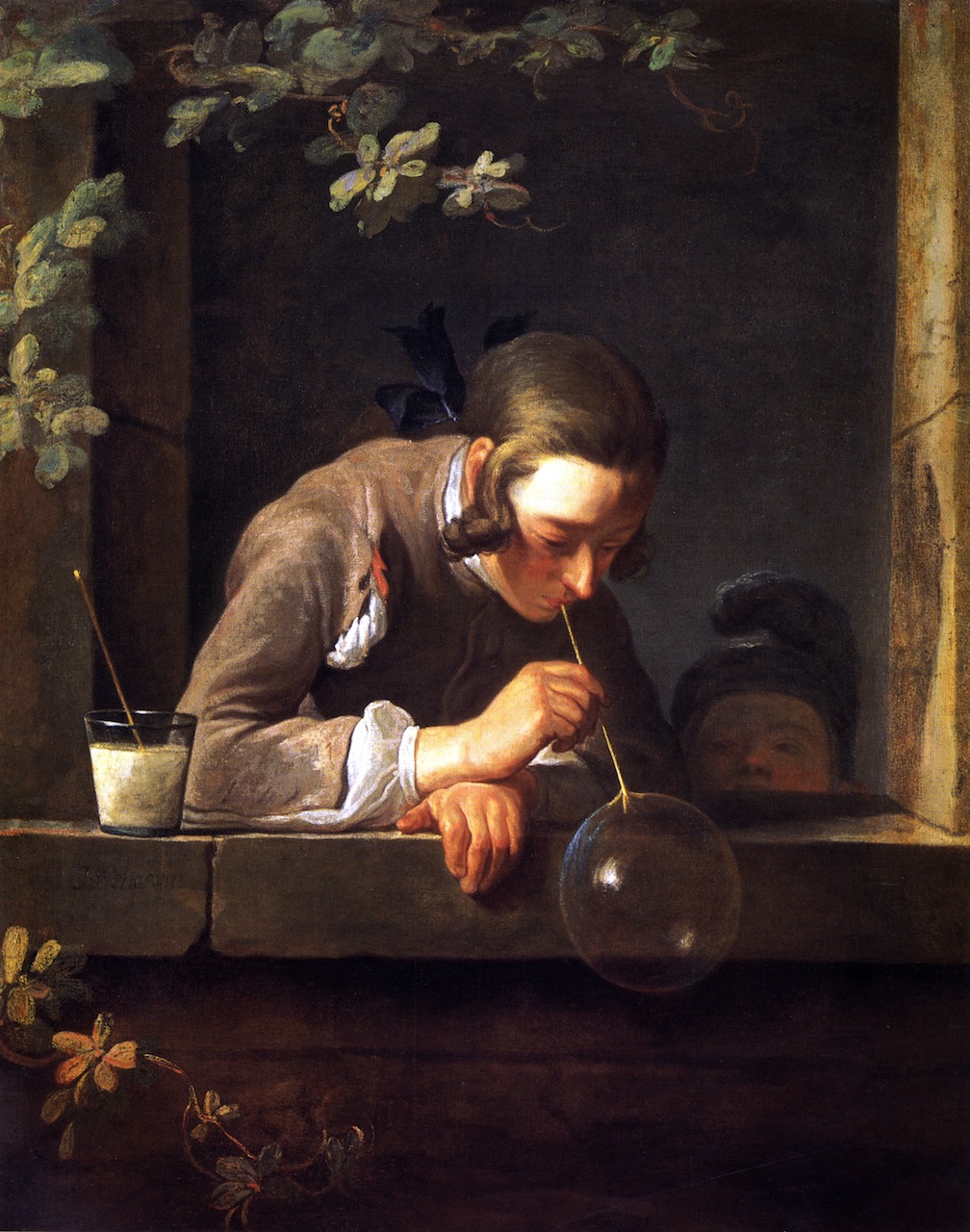
Beginning with Giotto in 1305 and extending to a 2014 painting by Paula Rego, Art in Detail charts the rise of artists as creative individualists. Hans Holbein's The Ambassadors (1533), with its trove of cryptic details, and Jean-Baptiste-Siméon Chardin's Soap Bubbles, painted exactly two centuries later, treat the subject of human mortality in totally unique and absolutely dissimilar ways.


Hans Holbein The Younger, The Ambassadors, 1533


Jean-Baptiste-Siméon Chardin, Soap Bubbles, c. 1733-34

Over the vast expanse of human history, almost all artists were anonymous creators of       religious images or monuments to kings and rulers. Occasionally, a master from antiquity like Apelles achieved lasting renown but nothing of his actual oeuvre has survived. Several indisputable masterpieces like the Riace bronzes have been recovered but we do not know the identity of their creator.

That changed at the dawn of the Renaissance with Giotto and the painting of the Arena Chapel frescoes. Giotto was credited by Giorgio Vasari as having initiated 'the great art of painting as we know it today, introducing the techniques of drawing from life ..."

Hodge studies Giotto's Adoration of the Magi from the Arena Chapel frescoes, noting for instance that the Star of Bethlehem was painted to resemble Halley's Comet which had appeared in 1301. 

Significantly, the resounding success of the Arena Chapel frescoes did not lead to carbon copy imitations all over Italy. Every major artist who followed Giotto - even Lorenzo Monaco whose narrative sense was much the same - always left a different "finger print" in style and technique.


Lorenzo Monaco, The Adoration of the Magi, 1420-22

This is the central paradox of Western art. The Classical tradition was relentlessly extolled by high-brow theorists. Generation after generation of students were indoctrinated to paint or sculpt like the Old Masters. Yet, nobody taught Rembrandt van Rijn to paint like Rembrandt.

No one taught Frans Hals to paint in his unique manner either. Hodge has selected Hals'     The Laughing Cavalier for analysis and it is a brilliant choice. Painted in 1624, this work has many of the elements of Hals' signature style. But it also has a high degree of detail and "finish" not found in his later portraits.

Early in his career, the Flemish-born Hals used a color-drenched palette and an exacting eye for detail to impress his aristocratic patrons. We don't know the identity of the Cavalier (who really isn't laughing) but he would surely have been pleased with the embroidered lovers' knots, Mercury's staff and other motifs on his sleeves.


Frans Hals, The Laughing Cavalier, 1624

During the 1630's and 1640's, the Dutch middle-class gained social status to match their growing economic power. Hals found a ready market for portraits or character studies, the now famous tronies which American collectors have long favored.

Since many of these middle-class patrons dressed in black, Hals experimented with a bold, loose brushstroke to evoke the folds and sheen of the dark cloth. We can see an early example of this in the Cavalier's black cloak. Focusing closely on Hals' technique, Hodge provides illuminating commentary on this important detail. The following quote is characteristic of the power of perception which she devotes to all one hundred of the art works she studies:

At a time when brushstrokes were meant to be invisible, Hals made his obvious, from fine blended marks in the face to longer marks in the clothing, which create a sense of spontaneity. This freely handled application was unusual then, but in the 19th century was seen as a precursor to Realism and Impressionism.

Hodge has created a very effective technique of analyzing the details of these masterpieces. She divides each work under discussion into tightly-cropped frames. This enables her to focus on technical matters, for instance, the "wet-in-wet" method which Hals often used, "layering wet paint, rather than waiting for previous layers to dry."

This method of analysis also provides insight on thematic factors as well. The exceptional attention that Hals paid to the lace and embroidered sleeve enables Hodge to make the educated guess that the "Laughing Cavalier" was likely a cloth merchant as silk, lace and damask weaving had become major industries in Haarlem, the city in Holland where Hals worked.

Hodge's technique succeeds both for unfamiliar works or art and for paintings we've seen so often that we roll our eyes at the mention of their title. There is always something of value to discover in Art in Detail.


Jacques-Louis David,The Oath of the Horatii, 1784

Jacques-Louis David's The Oath of the Horatii, painted in 1784, has appeared in countless art history books. Kenneth Clark discussed it in the Civilization documentary series as a revolt against the status quo of Europe's Age of Enlightenment. Clark likened The Oath of the Horatii to Picasso's Guernica (which Hodge also discusses), calling it "the supreme picture of revolutionary action..."

The Oath of the Horatii is also the "supreme picture" of Neoclassical art. As such it can be readily contrasted with the "supreme picture" of Romanticism, Goya's The Third of May, 1808, which also is studied in Hodge's book.  But I was very stuck by a lesser known Romantic painting, which movingly demolishes all the male vanity and "call of duty" propaganda evoked by The Oath of the Horatii.

Eugéne Delacroix's Entry of the Crusaders Into Constantinople depicts a harrowing moment in one of the most disgraceful episodes of Western history. Crusading knights marching (ostensibly) to liberate Jerusalem from the Saracens in 1204 conspired with the Venetians to attack and despoil the Christian city of Constantinople instead.


Eugéne Delacroix, Entry of the Crusaders Into Constantinople,1840

The treachery of this incident needs no further comment here. But it is worth noting that Delacroix painted this compelling work of art while memories of the horror of the Napoleonic Wars still lingered in the European mind. These bloody, ruinous wars were founded upon the heartless sentiments of David's The Oath of the Horatii.

Delacroix saw war a bit differently from David. In Entry of the Crusaders Into Constantinople, the outstretched arm of the old man is a plea for the right to life rather than an invocation of the cold steel of revenge and slaughter.

When viewed in this light, Delacroix's Entry of the Crusaders Into Constantinople is not a "history" painting but a testament to humanity. The same can be said, to a greater or lesser degree, for all one hundred masterpieces in Hodge's book.

Art in Detail provides more than a mass of technical detail involved in creating a painting or a sculpture. Here, in this very fine book, is a wealth of information that will draw us back for many a return visit. Here we can explore how great artists have sought to find insights into the dilemmas of human existence and the mysteries of creative expression.

Genius is in the details, as Hodge certainly shows. Yet, the scope of skill in the visual arts is far wider than mastery of technique. Ever since cave walls served as the "picture plane," artists have been searching for ways to express the greater truths of earthly life. It's a messy, often chaotic process, but one that is directly related to human self-realization.

To her credit, Hodge finds room for such visionary matters. In an engaging discussion of Helen Frankenthaler's early experimentation with Color Field painting, Hodge quotes Frankenthaler's reaction to her efforts. Standing on a ladder to survey her work, Frankenthaler declared that she was "sort of amazed and surprised and interested."

No better description could possibly be given for the electric moment when a work of art becomes a masterpiece.

***
Text: Copyright of Ed Voves, all rights reserved 

Images Courtesy of Thames & Hudson 

Introductory Image: Art in Detail: 100 Masterpieces, 2016 (cover) Image credit: Thames & Hudson 

Georges De La Tour (French, 1593-1652) St Joseph the Carpenter, c. 1642. Oil on canvas. 137 x 102 cm (54 x 40 in.)  Louvre, Paris, France © ACTIVE MUSEUM/Alamy Stock Photo),  

Hans Holbein The Younger (German, 1497-1543) The Ambassadors, 1533. Oil on oak panel. 207 x 209.5 cm (81 1/2 x 82 1/2 in.) National Gallery, London, UK © Peter Barritt/Alamy Stock Photo

Jean-Baptiste-Siméon Chardin (French, 1699-1779) Soap Bubbles, c. 1733-34.  Oil on canvas. 93 x 74.5 cm (36 5/8 x 29 3/8 in.) National Gallery of Art, Washington, DC, USA     classicpaintings/Alamy Stock Photo        

Lorenzo Monaco (Italian, c.1370-c.1425) The Adoration of the Magi, 1420-22. Tempera on panel, 115 x 183 cm (45 x 72 in.) Uffizi, Florence, Italy The Art Archive/Alamy Stock Photo       

Frans Hals (Dutch, 1582-1666) The Laughing Cavalier, 1624. Oil on canvas. 83 x 67.5 cm (32 5/8 x 26 1/2 in.) Wallace Collection, London, UK © SuperStock/Alamy Stock Photo

Jacques-Louis David (French, 1748-1825) The Oath of the Horatii, 1784. Oil on canvas. 330 x 425 cm (129 7/8 x 167 3/8 in.) Louvre, Paris, France © Heritage Image Partnership Ltd/Alamy Stock Photo

Eugéne Delacroix (French, 1798-1863) Entry of the Crusaders Into Constantinople,1840. Oil on canvas. 410 x 498 cm (161 1/2 x 196 in.) Louvre, Paris, France © Heritage Image Partnership Ltd/Alamy Stock Photo        


Friday, December 9, 2016

Art Eyewitness Review: Mystical Landscapes: From Vincent Van Gogh to Emily Carr


Mystical Landscapes: From Vincent Van Gogh to Emily Carr

                                                                                                                       
Edited by Katherine Lochlan
Delmonico Books-Prestel/356 pages/$60
                      
Mystical Landscapes Exhibit
Art Gallery of Ontario, Toronto  
October 22, 2016 - January 29, 2017

Reviewed by Ed Voves

In September 1888, Vincent van Gogh wrote to his brother, Theo, about his "tremendous need for, shall I say the word - for religion - so I go outside at night to paint the stars." 
This was the genesis of two of van Gogh's most famous paintings, The Starry Night over the Rhone, created at the time of his note to Theo, and the tumultuous, visionary Starry Night, painted less than a year later, in June 1889.

The Starry Night over the Rhone, from the collection of the Musée d'Orsay, Paris, is currently on display in a splendid exhibition at the Art Gallery of Ontario in Toronto, Mystical Landscapes. The brilliant art and provocative ideas set forth in the exhibit are treated in an outstanding companion catalog, Mystical Landscapes: Vincent Van Gogh to Emily Carr.


Vincent van Gogh, The Starry Night over the Rhone, 1888

Van Gogh's search for religion led him to paint the constellation, Ursa major - commonly referred to as the Big Dipper. Glimmering above the Rhone River as it flows through the city of Arles in southern France, the star-filled sky evoked a sense of promise and purpose. 

Van Gogh, full of plans for his "Studio of the South," painted this scene which reflected his hopes for the future. Only a few months later, tragic disputes with Paul Gauguin triggered a shattering nervous breakdown.

Mystical Landscapes at the Art Gallery of Ontario shows that van Gogh's yearning for "shall I say the word - for religion" was part of a cultural quest known as Symbolism. Beginning in the 1880's and continuing to the years immediately before World War II, Symbolism was a search for "meaning." Artists probed the human soul and reflected upon the spiritual environment in which they - and we - live.  

Symbolism as an art movement included such a diversity of styles that is easy to think of it as an idiosyncratic sideshow of Modern Art. Yet, Symbolism was regarded by most artists of the late nineteenth and early twentieth centuries as a serious and sincere response to the troubles and challenges of the Industrial Age.

The exhibit Mystical Landscapes was conceived by Katherine Lochlan, one of the leading curators of the Art Gallery of Ontario. In her poignant introduction to the exhibit catalog, Lochlan notes that she experienced a spiritual awakening during a visit to Ireland. This motivated her to begin planning Mystical Landscapes

Several of the team of scholars who assisted Lochlan are members of the clergy. Their essays provide insights of enduring value. Especially valuable are reflections on the need to approach art  - and life - from the point of view of humility and contemplation. John Franklin, who teaches theology at the University of Toronto, comments on mysticism:

This is the way of unknowing. At the heart of this invitation to unknowing is the fact that God is not an object of human knowing. All efforts to include God as simply one more object for our human knowledge bank ultimately fail because of the uniqueness of the divine. 

Comprehending these theological concepts sometimes entails concerted effort on the part of readers. Franklin's essay, for instance, provides a detailed contrast of the two paths of mysticism. Cataphatic, the positive, proactive form of mysticism, takes place when God's presence is closely felt. Apophatic mysticism occurs in the "absence" of God, during the Dark Night of the Soul.

Van Gogh's experience of cataphatic and apophatic mysticism is graphically depicted in his Starry Night paintings. Other artists experienced pain and tragedy, too, like Charles-Marie Dulac who died, aged 33 in 1898, from lead-poisoning which he had contracted early in life while working in the wall paper industry. The dying Dulac was inspired to create stunning works of art based upon the poem by St. Francis of Assisi, Cantacle of the Creatures.

The art works on view in Mystical Landscapes range in date from the 1880's to the 1930's. Yet this impressive exhibit and the superb catalog, jointly published by Delmonico Books and Prestel Publishing, is a tract for our times. Indeed, it will remain relevant for a very long time to come.

The late Victorian era and the first decades of the twentieth century were marked by a crisis of faith. The heartless creed of Social Darwinism became the new "gospel," preempting the place of the four Evangelists. The seeds of spiritual doubt were sown by philosophers like Ernest Renan (1823-1892) who praised the historical Jesus while demythologizing Christ.

Reacting against these developments, artists and poets looked for signs, symbols, testaments to God's presence in the universe. Some artists, like Maurice Denis, remained devout Christians. Denis depicted traditional Christian imagery like Christ's "agony in the garden." Denis, however, placed this sacred scene in a contemporary setting. Gethsemane in his 1918 painting has been relocated to Brittany where a small vessel sails perilously close to the rocky shoreline.


Maurice Denis, La Solitude de Christ, 1918

Brittany was an interesting locale for Denis' La Solitude de Christ. This remote province had been the site of the artist's colony of Pont Aven, founded during the 1880's. It was in Brittany that Paul Gauguin first shaped the religious orientation of Symbolism with three stunning works on view in Mystical Landscapes.

Vision after the Sermon (1888), The Yellow Christ (1889) and Christ in the Garden of Olives (1889) combine Christian iconography with personal, some might say blasphemous, elements. Gauguin placed his own features in each of these works: on a Breton priest, on a statue of the crucified Christ and finally on the face of the suffering, agonized Jesus. 
This identification appears to be scandalous but actually reflects a mystical experience where God and believer become one. 


Paul Gauguin, Christ in the Garden of Olives, 1889

In a brilliant essay in the exhibit catalog, Gauguin's three paintings are interpreted as a triptych, created in a similar way to medieval works by Hans Memling and other masters of religious art. The noted  scholar, Bobomila Welsh-Ovcharov, also makes a convincing case that these paintings reflect the stages of spiritual searching. 

These steps would feature in the seminal 1911 book by Evelyn Underhill, Mysticism: A Study in the Nature and Development of Spiritual ConsciousnessUnderhill's five steps - Awakening of Self, Purgation of Self, Illumination, Dark Night of the Soul and Unitive Life  - appear again and again in the paintings on display in Mystical Landscapes

I have yet to visit Mystical Landscapes exhibit. But when I did see Gauguin's three Breton paintings at an exhibit at the National Gallery of Art in 2011 the relation of these works to the stages of spiritual searching escaped me. Once the connection is grasped between the religious convictions of artists like Gauguin and the elements of their paintings, these works take on a whole new significance. They become "icons" in the true sense of the word.

Van Gogh found Gauguin's artistic approach to mysticism hard to accept. Van Gogh, raised a Protestant, believed  that spiritual encounters should be conveyed in "here and now" images not by "abstractions" as he described Gauguin's Breton paintings. While enduring a spiritual "Dark Night" at the Saint-Paul asylum in Saint-Rémy, he painted his markedly different version of the Garden of Olives. Here, a cloud (representing the Holy Spirit) drifts over the olive trees, signifying God's presence in our lives.


Vincent van Gogh, The Olive Trees, 1889

At first glance, van Gogh's choice of terms to describe his painting is hard to grasp. His mysterious cloud is more of an abstraction than Gauguin's identification with the face of Jesus. In a moving letter to Emil Bernard, a fellow artist and mutual friend of Gauguin, van Gogh advised against painting "sterile metaphysical meditations that aren't up to bottling chaos, which is chaotic for the very reason that it won't fit into any glass of our caliber..."

As I noted earlier, I am familiar with Gauguin's Breton triptych and I studied van Gogh's 
Starry Night over the Rhone at a 2008 exhibit at MOMA. But Mystical Landscapes presents works by major artists rarely seen in exhibits in the United States. We are introduced to unfamiliar artists like Eugène Jansson, the Swedish painter who brilliantly evoked the Dark Night of the Soul in several paintings. 


Eugène Jansson, Dawn over Riddarfjarden, 1899

In an exhibit that emphasizes the way of unknowing, it is a very good thing when we are introduced to new artists or have our assumptions challenged about artists we thought we knew.

In the case of Claude Monet, an unexpected spiritual dimension is explored in the essay on his Nympheas, the fabled Water Lilies.


Claude Monet, Water Lilies (Nymphéas), 1907

Most accounts simply accept that Monet was an atheist. Lochlan notes that Monet worked on the huge panel paintings of the water lilies after prolonged periods of meditation. 

"Monet spent so much time in contemplation," Lochlan writes, "that he entered into a mystical state that he compared to a hypnotic trance."

Learning about the Canadian painters featured in Mystical Landscapes was also a revelation. The spiritual power of Tom Thomson, the Group of Seven and especially the astonishing Emily Carr is certainly worthy of more study - and further exhibits "south of the border."                                                                                                                          
The experience of these Canadian artists was shaped by many factors, a number of which linked them to the mystical experiences of Symbolist artists in Europe and the United States. Walt Whitman's poetry. Ralph Waldo Emerson's transcendental philosophy and military service in World War I were powerful factors. So too were the Theosophical writings of Madam Blavatsky which Lawren Harris fervently embraced. 

Ultimately, it was the Canadian landscape that lead Tom Thomson, Harris, Emily Carr and the others to approach God from the "way of unknowing." Vast, breathtakingly beautiful and still (relatively) undeveloped, Canada in the 1920's inspired these Canadian artists. 


Emily Carr, Sky (ciel), 1935-6

Writing in her journal, Emily Carr placed into words what she had visualized with brush and paint - the mystical landscape within all our souls. 

We are of the same substance for there is only one substance. God is all there is. There is one life, God life, that flows through all. He that formed me formed you. Oh Father of all raise my consciousness to that sense of oneness with the universal.

Mystical Landscapes will travel to the Musée d'Orsay, Paris, in the spring of 2017. It will not, sadly, be making a stop-over in the U.S. But thanks to the wonderful catalog, I have profited immensely by journeying to this exhibition in spirit.

***
Text: Copyright of Ed Voves, all rights reserved 
Images courtesy of the Art Gallery of Ontario, Toronto

Introductory Image:                                                                                                         
Edvard Munch (Norwegian,1863-1944) The Sun,1910-13. Oil on canvas, 162 x 205 cm. Collection of the Munch Museum, Oslo. Image courtesy of Munch Museum 

Vincent van Gogh (Dutch, 1853-1890) The Starry Night over the Rhone, 1888. Oil on canvas, 73 x 92 cm. Collection of Musée d’Orsay Image courtesy the Musee d'Orsay, Paris, France/Bridgeman Images 

Maurice Denis (French, 1870-1943) La Solitude de Christ, 1918. Oil on canvas, 88 x 136 cm. Private Collection 

Paul Gauguin (French, 1848-1903) Christ in the Garden of Olives, 1889. Oil on canvas, 73 x 93 cm. Norton Museum of Art, Gift of Elizabeth C. Norton

Vincent van Gogh (Dutch, 1853-1890) The Olive Trees,1889. Oil on canvas, 72.6 x 91.4 cm. The Museum of Modern Art, New York Mrs. John Hay Whitney Bequest, 1998 
© The Museum of Modern Art / Licensed by SCALA / Art Resource, NY 

Eugène Jansson (Swedish 1862-1915) Dawn over Riddarfjarden, 1899. Oil on canvas, 150 x 201 cm. Collection of Prins Eugens Waldemarsudde 

Claude Monet (French, 1840-1926) Water Lilies (Nymphéas), 1907. Oil on canvas, 80.98 x 92.07  cm. Museum of Fine Arts, Houston Gift of Mrs. Harry C. Hanszen Courtesy Bridgeman Images 

Emily Carr (Canadian, 1871-1945) Sky (ciel), 1935-6. Oil on wove paper, 58.7 x 90.7 cm. National Gallery of Canada, Ottawa, Purchased, 1937