Showing posts with label Eugène Delacroix. Show all posts

Monday, December 26, 2016

Art Eyewitness Book Review: Art in Detail: 100 Masterpieces by Susie Hodge


Art in Detail: 100 Masterpieces


By Susie Hodge
Thames & Hudson/$39.95/432 pages

Reviewed by Ed Voves

Art in Detail: 100 Masterpieces is an acutely perceptive survey of some of the greatest paintings and sculptures of the Western world. Written by the noted scholar, Susie Hodge, it is truly an "eye-opening" look at art.

In reviewing a wide-ranging book like Art in Detail, the first task is to find  a common theme uniting all of the disparate parts. That is easy enough with Hodge's book. Every one of the one hundred works she examines, like Georges De La Tour's astonishing contrast of light and shadow, is indeed a "masterpiece."


Georges De La Tour, St Joseph the Carpenter, c. 1642

One might argue that Hodge should have selected several different choices for analysis. Leonardo da Vinci's The Virgin and Child with St. Anne would have made for intriguing study rather than another look at the relentlessly examined Mona Lisa. Yet - overwhelmingly - Art in Detail delivers what it promises: fascinating insights into one hundred of the supreme treasures of Western art.

Lurking just below the surface is another theme that is not so readily apparent. Each of these works of art was painted or sculpted by a recognizable artist. Each can be documented. We know who created it, when, where and what materials the artist used. 

Beginning with Giotto in 1305 and extending to a 2014 painting by Paula Rego, Art in Detail charts the rise of artists as creative individualists. Hans Holbein's The Ambassadors (1533), with its trove of cryptic details, and Jean-Baptiste-Siméon Chardin's Soap Bubbles, painted exactly two centuries later, treat the subject of human mortality in totally unique and absolutely dissimilar ways.


Hans Holbein The Younger, The Ambassadors, 1533
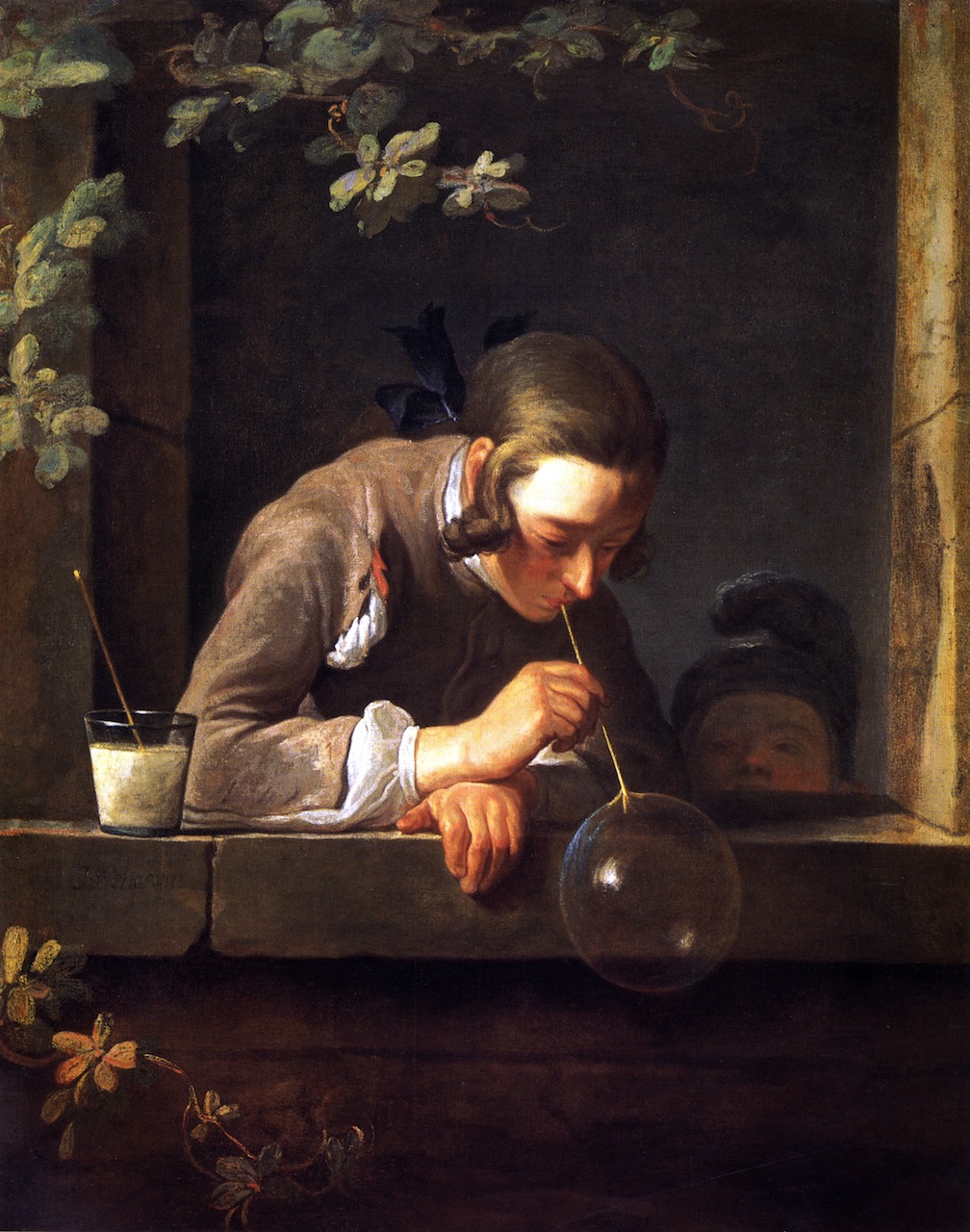

Jean-Baptiste-Siméon Chardin, Soap Bubbles, c. 1733-34

Over the vast expanse of human history, almost all artists were anonymous creators of       religious images or monuments to kings and rulers. Occasionally, a master from antiquity like Apelles achieved lasting renown but nothing of his actual oeuvre has survived. Several indisputable masterpieces like the Riace bronzes have been recovered but we do not know the identity of their creator.

That changed at the dawn of the Renaissance with Giotto and the painting of the Arena Chapel frescoes. Giotto was credited by Giorgio Vasari as having initiated 'the great art of painting as we know it today, introducing the techniques of drawing from life ..."

Hodge studies Giotto's Adoration of the Magi from the Arena Chapel frescoes, noting for instance that the Star of Bethlehem was painted to resemble Halley's Comet which had appeared in 1301. 

Significantly, the resounding success of the Arena Chapel frescoes did not lead to carbon copy imitations all over Italy. Every major artist who followed Giotto - even Lorenzo Monaco whose narrative sense was much the same - always left a different "finger print" in style and technique.


Lorenzo Monaco, The Adoration of the Magi, 1420-22

This is the central paradox of Western art. The Classical tradition was relentlessly extolled by high-brow theorists. Generation after generation of students were indoctrinated to paint or sculpt like the Old Masters. Yet, nobody taught Rembrandt van Rijn to paint like Rembrandt.

No one taught Frans Hals to paint in his unique manner either. Hodge has selected Hals'     The Laughing Cavalier for analysis and it is a brilliant choice. Painted in 1624, this work has many of the elements of Hals' signature style. But it also has a high degree of detail and "finish" not found in his later portraits.

Early in his career, the Flemish-born Hals used a color-drenched palette and an exacting eye for detail to impress his aristocratic patrons. We don't know the identity of the Cavalier (who really isn't laughing) but he would surely have been pleased with the embroidered lovers' knots, Mercury's staff and other motifs on his sleeves.


Frans Hals, The Laughing Cavalier, 1624

During the 1630's and 1640's, the Dutch middle-class gained social status to match their growing economic power. Hals found a ready market for portraits or character studies, the now famous tronies which American collectors have long favored.

Since many of these middle-class patrons dressed in black, Hals experimented with a bold, loose brushstroke to evoke the folds and sheen of the dark cloth. We can see an early example of this in the Cavalier's black cloak. Focusing closely on Hals' technique, Hodge provides illuminating commentary on this important detail. The following quote is characteristic of the power of perception which she devotes to all one hundred of the art works she studies:

At a time when brushstrokes were meant to be invisible, Hals made his obvious, from fine blended marks in the face to longer marks in the clothing, which create a sense of spontaneity. This freely handled application was unusual then, but in the 19th century was seen as a precursor to Realism and Impressionism.

Hodge has created a very effective technique of analyzing the details of these masterpieces. She divides each work under discussion into tightly-cropped frames. This enables her to focus on technical matters, for instance, the "wet-in-wet" method which Hals often used, "layering wet paint, rather than waiting for previous layers to dry."

This method of analysis also provides insight on thematic factors as well. The exceptional attention that Hals paid to the lace and embroidered sleeve enables Hodge to make the educated guess that the "Laughing Cavalier" was likely a cloth merchant as silk, lace and damask weaving had become major industries in Haarlem, the city in Holland where Hals worked.

Hodge's technique succeeds both for unfamiliar works or art and for paintings we've seen so often that we roll our eyes at the mention of their title. There is always something of value to discover in Art in Detail.


Jacques-Louis David,The Oath of the Horatii, 1784

Jacques-Louis David's The Oath of the Horatii, painted in 1784, has appeared in countless art history books. Kenneth Clark discussed it in the Civilization documentary series as a revolt against the status quo of Europe's Age of Enlightenment. Clark likened The Oath of the Horatii to Picasso's Guernica (which Hodge also discusses), calling it "the supreme picture of revolutionary action..."

The Oath of the Horatii is also the "supreme picture" of Neoclassical art. As such it can be readily contrasted with the "supreme picture" of Romanticism, Goya's The Third of May, 1808, which also is studied in Hodge's book.  But I was very stuck by a lesser known Romantic painting, which movingly demolishes all the male vanity and "call of duty" propaganda evoked by The Oath of the Horatii.

Eugéne Delacroix's Entry of the Crusaders Into Constantinople depicts a harrowing moment in one of the most disgraceful episodes of Western history. Crusading knights marching (ostensibly) to liberate Jerusalem from the Saracens in 1204 conspired with the Venetians to attack and despoil the Christian city of Constantinople instead.


Eugéne Delacroix, Entry of the Crusaders Into Constantinople,1840

The treachery of this incident needs no further comment here. But it is worth noting that Delacroix painted this compelling work of art while memories of the horror of the Napoleonic Wars still lingered in the European mind. These bloody, ruinous wars were founded upon the heartless sentiments of David's The Oath of the Horatii.

Delacroix saw war a bit differently from David. In Entry of the Crusaders Into Constantinople, the outstretched arm of the old man is a plea for the right to life rather than an invocation of the cold steel of revenge and slaughter.

When viewed in this light, Delacroix's Entry of the Crusaders Into Constantinople is not a "history" painting but a testament to humanity. The same can be said, to a greater or lesser degree, for all one hundred masterpieces in Hodge's book.

Art in Detail provides more than a mass of technical detail involved in creating a painting or a sculpture. Here, in this very fine book, is a wealth of information that will draw us back for many a return visit. Here we can explore how great artists have sought to find insights into the dilemmas of human existence and the mysteries of creative expression.

Genius is in the details, as Hodge certainly shows. Yet, the scope of skill in the visual arts is far wider than mastery of technique. Ever since cave walls served as the "picture plane," artists have been searching for ways to express the greater truths of earthly life. It's a messy, often chaotic process, but one that is directly related to human self-realization.

To her credit, Hodge finds room for such visionary matters. In an engaging discussion of Helen Frankenthaler's early experimentation with Color Field painting, Hodge quotes Frankenthaler's reaction to her efforts. Standing on a ladder to survey her work, Frankenthaler declared that she was "sort of amazed and surprised and interested."

No better description could possibly be given for the electric moment when a work of art becomes a masterpiece.

***
Text: Copyright of Ed Voves, all rights reserved 

Images Courtesy of Thames & Hudson 

Introductory Image: Art in Detail: 100 Masterpieces, 2016 (cover) Image credit: Thames & Hudson 

Georges De La Tour (French, 1593-1652) St Joseph the Carpenter, c. 1642. Oil on canvas. 137 x 102 cm (54 x 40 in.)  Louvre, Paris, France © ACTIVE MUSEUM/Alamy Stock Photo),  

Hans Holbein The Younger (German, 1497-1543) The Ambassadors, 1533. Oil on oak panel. 207 x 209.5 cm (81 1/2 x 82 1/2 in.) National Gallery, London, UK © Peter Barritt/Alamy Stock Photo

Jean-Baptiste-Siméon Chardin (French, 1699-1779) Soap Bubbles, c. 1733-34.  Oil on canvas. 93 x 74.5 cm (36 5/8 x 29 3/8 in.) National Gallery of Art, Washington, DC, USA     classicpaintings/Alamy Stock Photo        

Lorenzo Monaco (Italian, c.1370-c.1425) The Adoration of the Magi, 1420-22. Tempera on panel, 115 x 183 cm (45 x 72 in.) Uffizi, Florence, Italy The Art Archive/Alamy Stock Photo       

Frans Hals (Dutch, 1582-1666) The Laughing Cavalier, 1624. Oil on canvas. 83 x 67.5 cm (32 5/8 x 26 1/2 in.) Wallace Collection, London, UK © SuperStock/Alamy Stock Photo

Jacques-Louis David (French, 1748-1825) The Oath of the Horatii, 1784. Oil on canvas. 330 x 425 cm (129 7/8 x 167 3/8 in.) Louvre, Paris, France © Heritage Image Partnership Ltd/Alamy Stock Photo

Eugéne Delacroix (French, 1798-1863) Entry of the Crusaders Into Constantinople,1840. Oil on canvas. 410 x 498 cm (161 1/2 x 196 in.) Louvre, Paris, France © Heritage Image Partnership Ltd/Alamy Stock Photo        


Wednesday, May 25, 2016

Delacroix and the Rise of Modern Art at the National Gallery, London


Delacroix and the Rise of Modern Art

National Gallery, London

February 17 – May 22, 2016

Reviewed by Ed Voves

There is an intangible element to the character and achievement of  Eugène Delacroix (1798-1863) that makes it easy to describe him as "the last of the Old Masters" or the "last Romantic." 

The provocative exhibit at the National Gallery in London, Delacroix and the Rise of Modern Art, considered him from a different vantage point. Delacroix was the first of the New Masters.

When I recently visited Delacroix and the Rise of Modern Art, I was struck by some basic similarities with an earlier exhibit, Cezanne and Beyond at the Philadelphia Museum of Art in  2009. The exhibits featured major works by Delacroix or Cezanne, and by artists whom they inspired.

This comparative approach enables us to grasp how Delacroix and Cezanne created new paths for painting which subsequent generations of artists were to follow. There was an all-important difference, however, in their respective legacies.

Cezanne and Beyond charted the efforts of Henri Matisse, Alberto Giacometti, Ellsworth Kelly and others to articulate the motifs and techniques of the "Father of Modern Art." Delacroix's paintings,  on the other hand, were used by his successors more as a source of broad artistic themes. 


Eugène Delacroix, Women of Algiers in their Apartment, 1847-9

Delacroix and the Rise of Modern Art displayed sixty paintings, one-third of which were by Delacroix. This relatively small number was unavoidable since much of Delacroix's work cannot leave France. Delacroix was a major mural painter, covering the walls of government institutions and churches in Paris with paintings that rank high in his life work. Likewise, his most famous painting, Liberty Leading the People, is so central to the identity of the French nation that even a short visit to London is out of the question.

Thanks to judicious selection and an excellent short film about Delacroix's murals, the range of Delacroix's oeuvre was surveyed with admirable balance. 

The display of one of Delacroix's early works underscores the effort that went into the design of this exhibition. The Death of Sardanapalus, painted in 1827, is essential to understanding Delacroix's bravura use of color and his anti-authoritarian political views. As Kenneth Clark wrote, "It is the most liberated of all his works, the one in which he most unreservedly gratified all of his appetites."


Eugène Delacroix, The Death of Sardanapalus, 1844

Yet The Death of Sardanapalus was simply too big to transport from the Louvre, measuring 12 ft 10 in x 16 ft 3 in.  Fortunately, Delacroix painted a smaller, personal copy in 1844. This version was displayed in the exhibition, illustrating major themes in Delacroix's art without overwhelming the exhibit as the huge original would have done. 

Delacroix's influence on the rise of Modernism was  thus well established by this fine exhibition.  With works like The Death of Sardanapalus, Delacroix bequeathed a manifesto of artistic freedom to  those who followed him.

"O young artist," Delacroix exclaimed, "you want a subject? Everything is a subject; the subject is yourself; they are your impressions, your emotions before nature. You must look within yourself and not around yourself.” 


Eugène Delacroix, View of Tangier, 1852-53
 
In a bold move, Delacroix went to Morocco in 1833 as the official artist on a diplomatic mission. While in North Africa,  Delacroix sketched "living antiquity" in a setting little touched by European civilization.  When he returned to France, he had source material for a lifetime of painting.

Delacroix never traveled  beyond the borders of France again. But the trip to Morocco was not an isolated act. Repeatedly, Delacroix ventured to realms left unexplored by other artists.

Following an earlier visit to Great Britain in 1824, Delacroix incorporated techniques of English landscape painting in his work. This was an unthinkable act for French painters. At a time when still-life painting was considered fit only for women artists, he revived the genre as a bold exploration of color. And though a skeptic in matters of faith, Delacroix's murals at the Church of Saint-Sulpice in Paris rank among the greatest masterpieces of religious art since the Renaissance.


Eugène Delacroix, A Basket of Fruit in a Flower Garden,1848-49

An excellent vantage point for considering the legacy factor of Delacroix's career is a comparison of his A Basket of Fruit in a Flower Garden (1848-49) with The Trellis, painted by Gustave Courbet in 1862. 

The French term for still-life is nature morte. There is nothing "dead" about Delacroix's painting. The flowers and fruit are bursting with life, thanks to the vibrancy of color and the exceptional skill of the modeling. 

Delacroix's work evokes the fertility of nature, the recurring cycle of life - seeds, flowers, fruit - that propels earthly existence. Courbet's The Trellis takes this a step further by including a young woman in contemporary dress, "blooming" with health and vitality. 


Gustave Courbet, The Trellis, or Young Woman arranging Flowers, 1862

The influence of Delacroix on succeeding generations of painters is particularly notable in landscape painting. Delacroix had been friends with the tragically short-lived Richard Parkes Bonnington (1802-1828), who might well have succeeded J.M.W. Turner as the pillar of British landscape painting. After Bonnington's death, Delacroix carried on with vivid depictions of English Channel seascapes. 

Long before Courbet and Monet immortalized  the rocky coast around Etretat, Delacroix was there painting in water color and oil sketch. Some of Delacroix's seascapes (and landscapes) were imaginative evocations of nature, such as Shipwreck on the Coast. Whether Delacroix witnessed the aftermath of an actual maritime disaster is beside the point. Here he depicted the living sea, the source of life and the taker of life.


Eugène Delacroix, Shipwreck off a Coast,1862

Delacroix was a master technician of painting. He closely studied the new theories about complementary colors which  Michel-Eugène Chevreul began to promulgate in 1828. Delacroix created a new method of painting called flochetage which blended short strokes of complementary colors to brilliant effect.     

Delacroix's experimental use of color led to claims that he was a pioneer of scientific painting. No artist was more determined to lionize Delacroix in that respect than Paul Signac, the great pointillist painter who was born in 1863, the same year that Delacroix died.

Taking on the leadership of pointillism after the early death of Georges Seurat, Signac invoked Delacroix's name and achievements to promote this exacting school of painting. In 1899, Signac published a polemical book, From Eugéne Delacroix to Neo-Impressionism. Intending to establish the credentials of Post-Impressionism, Signac traced the movement's signature "dots" back to Delaroix's flochetage.


Paul Signac, Snow: Boulevard de Clichy, Paris, 1886

Signac was personally generous, for all his doctrinaire theorizing. He supported Matisse emotionally and financially during a very difficult period of his life and after the First World War, he led the effort to preserve Delacroix's Paris studio as a museum. I surmise that Delacroix would have enjoyed Signac's company - Signac was a superb sailor - while brusquely rejecting an honorary role as the apostle of Post-Impressionism. 

Delacroix is likely to have been displeased with the later appreciation of his paintings from Morocco, as well. His vivid depictions of life in North Africa were linked to one of the less praiseworthy genres of nineteenth century art, Orientalism. 

Delacroix's expedition to Morocco enabled him to grasp the humanity and nobility of the people there. Unfortunately, as the "scramble for Africa" commenced, a cultural veneer was applied to the crass, ruthless exploitation of African peoples by the colonial powers of Europe. By stressing exotic, sensual and violent themes, Orientalism was used to justify the conquest of the "Dark Continent."


Eugène Delacroix, Lion Hunt, 1861

Delacroix's scenes of savage lion hunts and sultry Moroccan women were interpreted in ways that he never intended. Orientalism, as in the Arab slave market scenes of Jean-Léon Gérôme, provided jaded Western audiences with erotic images, discretely bordering on pornography. At the same time, paintings of this genre asserted the superiority of European civilization.

As his writings reveal, Delacroix's complex character was not without elements of chauvinism. He did not, however, engage in the hypocrisy of colonialism. His portraits of the common people of North Africa, women in particular, were respectful and conveyed a real sense of their humanity.


Henri Matisse, The Red Carpet (Le Tapis rouge), 1906

Several of Delacroix's heirs, Renoir and Matisse, continued his more benign treatment of North African themes. Matisse, who visited Morocco in 1912, drew upon Delacroix's vision and empathy, painting his famous Moroccan Triptych, now in Moscow's Pushkin Museum. 

The National Gallery exhibit illustrated Matisse's debt to Delacroix with a work dating to 1906. The Red Carpet, shows how a spiritual affinity between two artists can flourish, even when one of them had not (yet) visited the country whose culture both evoked.


Vincent van Gogh, Olive Trees, 1889

Vincent van Gogh was another of Delacroix's heirs. In September 1889, while convalescing at Saint-Rémy, van Gogh wrote his brother Theo about the influence of Delacroix and the way it inspired him to continue with his own art. The letter beautifully sums up the essential message of the National Gallery exhibit. Van Gogh wrote:

Although I am well aware of the worth and originality and superiority of Delacroix or Millet, for example, I can still say, yes, I too am something, I too can achieve something. 

***
Text: Copyright of Ed Voves, all rights reserved 

Images courtesy of the National Gallery, London                                                
Introductory Image:
Eugène Delacroix (1798-1863) Self Portrait, ca. 1837. Oil on canvas, 65 x 54.5 cm. Musée du Louvre, Paris (RF 25) © RMN-Grand Palais (musée du Louvre) / Jean-Gilles Berizz

Eugène Delacroix (1798-1863) Women of Algiers in their Apartment, 1847-9. Oil on canvas, 85 x 112 cm. Musée Fabre, Montpellier (868.1.38) © Musee Fabre, Montpellier aglomeration

Eugène Delacroix (1798-1863) The Death of Sardanapalus, 1844. Oil on canvas, 73.7 x 82.4 cm. © Philadelphia Museum of Art, Pennsylvania   Henry P. McIlhenny Collection in memory of Frances P. McIlhenny, 1986 (1986-2617)

Eugène Delacroix (1798-1863) View of Tangier, 1852-53. Oil on canvas, 45.09 x 54.61 cm. © The Minneapolis Institute of Art  Gift of Georgiana Slade Reny

Eugène Delacroix (1798-1863) A Basket of Fruit in a Flower Garden, 1848-9. Oil on canvas, 106.7 x 142.2 cm. © Philadelphia Museum of Art, Pennsylvania  John G. Johnson Collection, 1917 (1917,974)

Gustave Courbet (1819-1877) The Trellis, or Young Woman arranging Flowers, 1862. Oil on canvas, 109.2 x 135.3 cm. © The Toledo Museum of Art, Toledo, Ohio Purchased with funds from the Libbey Endowment, Gift of Edward Drummond Libbey, 1950.309

Eugène Delacroix (1798-1863) Shipwreck off a Coast, 1862. Oil on canvas, 38.1 × 45.1 cm. The Museum of Fine Arts, Houston, Texas. Museum purchase funded by the Agnes Cullen Arnold Endowment Fund (2004.1693) © The Museum of Fine Arts, Houston, Texas / Bridgeman Images

Paul Signac (1863-1935) Snow: Boulevard de Clichy, Paris, 1886. Oil on canvas, 66 x 43.2 cm. © The Minneapolis Institute of Art Bequest of Putnam Dana McMillan 61.36.16

Eugène Delacroix (1798-1863) Lion Hunt, 1861. Oil on canvas, 76.3 x 98.2 cm. © The Art Institute of Chicago, Illinois Potter Palmer Collection, 1922.404

Henri Matisse (1869-1954) The Red Carpet (Le Tapis rouge), 1906. Oil on canvas, 89 x 116 cm. Musée de Grenoble Agutte-Sembat Bequest © Succession H. Matisse/ DACS 2015; photo © Musée de Grenoble

Vincent van Gogh (1853-1890) Olive Trees, 1889. Oil on canva, 73.7 x 92.7 cm © The Minneapolis Institute of Art The William Hood Dunwoody Fund 51.7