Verrocchio: Sculptor and Painter of Renaissance Florence
National Gallery of Art, Washington D.C.
September 15, 2019 - January 12, 2019
Reviewed by Ed Voves
Original Phoitography by Anne Lloyd
Is it a masterpiece by an "Artist as Hero"? This was the memorable description of Leonardo - and of Raphael and Michelangelo - by Kenneth Clark in the classic television series, Civilization.
Perhaps, wearied by all the current media-hype over the five hundred year anniversary of Leonardo's death in 1519, you are counting the days to 2020.
If you have the opportunity to view Leonardo's early masterpiece Ginevra de' Benci (1474/1478) in its current setting at the National Gallery of Art, Washington D.C., you may change your opinions about Leonardo and Renaissance art.

Ed Voves, Photo (2019)
Gallery view of the Verrocchio exhibition, showing
Leonardo da Vinci's Ginevra de' Benci
The current setting for Ginevra de' Benci is a place of honor in an exhibition devoted to a different artist of Renaissance Italy. This not a 'back-handed" compliment to Leonardo since the protagonist of the National Gallery exhibit is Andrea del Verrocchio.
Verrocchio was the master of the studio in Florence where the young Leonardo was sent by his father, Ser Piero da Vinci, to learn the craft of art. Verrocchio, as the National Gallery exhibition shows, was a supremely gifted artist and a very efficient businessman. Leonardo worked in Verrocchio's study from 1466 to 1476. Indeed, he thrived to such an extent that the older artist's reputation withered under the shadow of Leonardo's legend.
Verrocchio: Sculptor and Painter of Renaissance Florence restores a sense of balance to the lives and creative works of Verrocchio and Leonardo. It shows that Verrocchio is such a major Renaissance artist that his career does not need - or deserve - to be appraised in terms of Leonardo's. A very good exhibit, last year at Yale, did exactly that.
Verrocchio at the National Gallery in Washington D.C. tells the whole story and it confirms that this neglected artist was one of the greatest Renaissance masters. Painting, sculpting, drawing and teaching - Verrocchio excelled in all of these pursuits. He was the best of all teachers for Leonardo - and other major Renaissance artists.

Anne Lloyd, Photo (2019) Gallery view of the Verrocchio exhibit showing
Verrocchio’s
Putto with a Dolphin,
c.1465/1480
Andrea del Verrocchio (1435-1488) was born in Florence just as the Renaissance gained impetus as a defining force in European affairs. Like many great artists, he trained as a goldsmith, then launched himself into painting and sculpting with impressive skill.
Verrocchio, however, was very much a figure of the "springtime of the Renaissance." He was ready and able to work as a collaborative artist. The government and mercantile patrons of Florence during the early decades of the Renaissance expected the works of art they commissioned to be of the highest quality and delivered on time and within the budget.
The best method for satisfying such patrons was an efficient workshop rather than the work ethic of a solitary "hero." That is exactly the kind of establishment which Verrocchio set up when he had gained sufficient means and reputation to do so.

Andrea del Verrocchio & assistants (Leonardo da
Vinci & Pietro Perugino)
Madonna and Child with Two Angels, c.1470/1474
In the paintings produced by Verrocchio's workshop, the division of labor is often very clear. The hands of Verrocchio's assistants, Leonardo and Pietro Perugino, are detected in Madonna and Christ with Two Angels (c.1470-1474) on loan from the National Gallery in London. After close inspection and repeated changes in opinion, the lily-holding angel on the left is attributed to Leonardo, while Perugino, the teacher of Raphael, is credited with the angel on the right.
Exactly what year Verrocchio founded his studio has not been established. Very little is known about Verrocchio's youth. Most of his early oeuvre, in metal work especially, has not survived. However, a small covered vase, likely used to hold saintly relics, is of interest in regard to his rise in the Florentine art community. Though attributed to Verrocchio later in his career, it is likely to be the kind of exquisite object d'art that would have caught the eye of would-be patrons as he made a name for himself as a professional artist.

Andrea del Verrocchio (attributed) Small Vase with Cover, c. 1480/1485
The delicate silver-gilt settings on this agate vase are worked with motifs that can securely be traced to Verrocchio. Curator Andrew Butterfield is confident that this is a work by him. Butterfield also notes that the vase is inscribed "LAV. R. MED." This means that it was owned by Lorenzo de' Medici, "Il Magnifico."

Ed Voves, Photo (2019)
Portrait Bust of Lorenzo de' Medici, ca.1513/1520,
In 1478, Medici supporters commissioned a wax statue of Lorenzo, celebrating his survival in the assassination attempt known as the Pazzi Conspiracy. Butterfield maintains that Verrocchio made or assisted with the wax statue, now lost. This work later served as the source for an extremely lifelike terracotta bust of Lorenzo, made about 1513.
Verroccio sculpted another statue of a Medici-family member which has survived: a terracotta portrait of Lorenzo's brother, Guiliano, the "golden youth" of Florence.

Ed Voves, Photo (2019)
Andrea del Verrocchio’s Giuliano
de' Medici, c. 1475/1478
The portrait busts of Lorenzo and Guiliano share an exhibition gallery with with one of Verrocchio's greatest works, the bronze statue, David with the Head of Goliath, dating to around 1465. Verrocchio's David, along with the more famous statues of the Old Testament hero by Donatello and Michelangelo, testifies to the always-tense political situation in Florence.

Ed Voves, Photo (2019) Gallery view of the Verrocchio exhibit
showing Verrocchio’s David with the Head of Goliath, c. 1465
An independent city-state and a republic, Florence was surrounded by powerful enemies, Milan, Urbino and the Papacy. Strong leadership, by the Medici, was needed to oppose these external foes, but political factions in Florence feared that this powerful family would erode the democratic constitution, as eventually happened.
The image of the young, heroic, giant-killing David was selected by the Florentines as the perfect symbol of their small, dynamic state. Three statues of David were commissioned by Donatello, Verrocchio and Michelangelo. Each represented a pivotal moment in the development of sculpture in Florence. Donatello's David, dating to the 1440's, is an enigmatic figure, relaxed and arrogant, posing in a homoerotic stance. Michelangelo's David (1501-1504) is likewise nude, but stands tense and belligerent.
Verrocchio's David with the Head of Goliath, created around 1465, is one of his earliest works that can be dated. His David is clothed, wearing a kilt and a form-fitting tunic or jerkin. He is confident, but ready for action, just in case the Philistines try to avenge their fallen champion.

Ed Voves, Photo (2019) Andrea del Verrocchio’s Head of Goliath, c. 1465
Lying at David's feet is the head of Goliath. It is a detail which Verrocchio's youthful hero shares with Donatello's. There the comparison ends.
Goliath's decapitated head is treated by Donatello's David with smirking contempt. Verrocchio presents him with compassion, indeed empathy. At one point, when the body of Verrocchio's David and the head of Goliath were still separate, the latter was assumed by visitors to Verrocchio's studio to be the head for a statue of St. John the Baptist. There could be no higher, if unintended, praise for Verrocchio since John the Baptist was the patron saint of Florence.
How and why did this emotional transformation occur? So little is known of Verrocchio's life that we can only ponder debatable theories for his sympathetic depiction of the fallen Goliath.
Perhaps the best explanation lies with the rise of Humanism as the dominant philosophical school of thought in Italy during the 1400's, notably in Florence. Based on dedicated study of classical texts, many newly translated from Greek, Humanism stimulated an awareness of the psychological complexity of people, ancient and modern.

Ed Voves, Photo (2019) Gallery view of the Verrocchio exhibit
showing Verrocchio’s David
with the Head of Goliath, c. 1465
Verrocchio's David perfectly matched the mood and mission of Florence at the moment when the freedom-loving Tuscan city, Humanist scholarship and the "new art" of fifteenth century painting and sculpture were coming into a full-flowering.

Ed Voves, Photo (2019)
Andrea
del Verrocchio’s Bust
of Christ, c.1470/1483
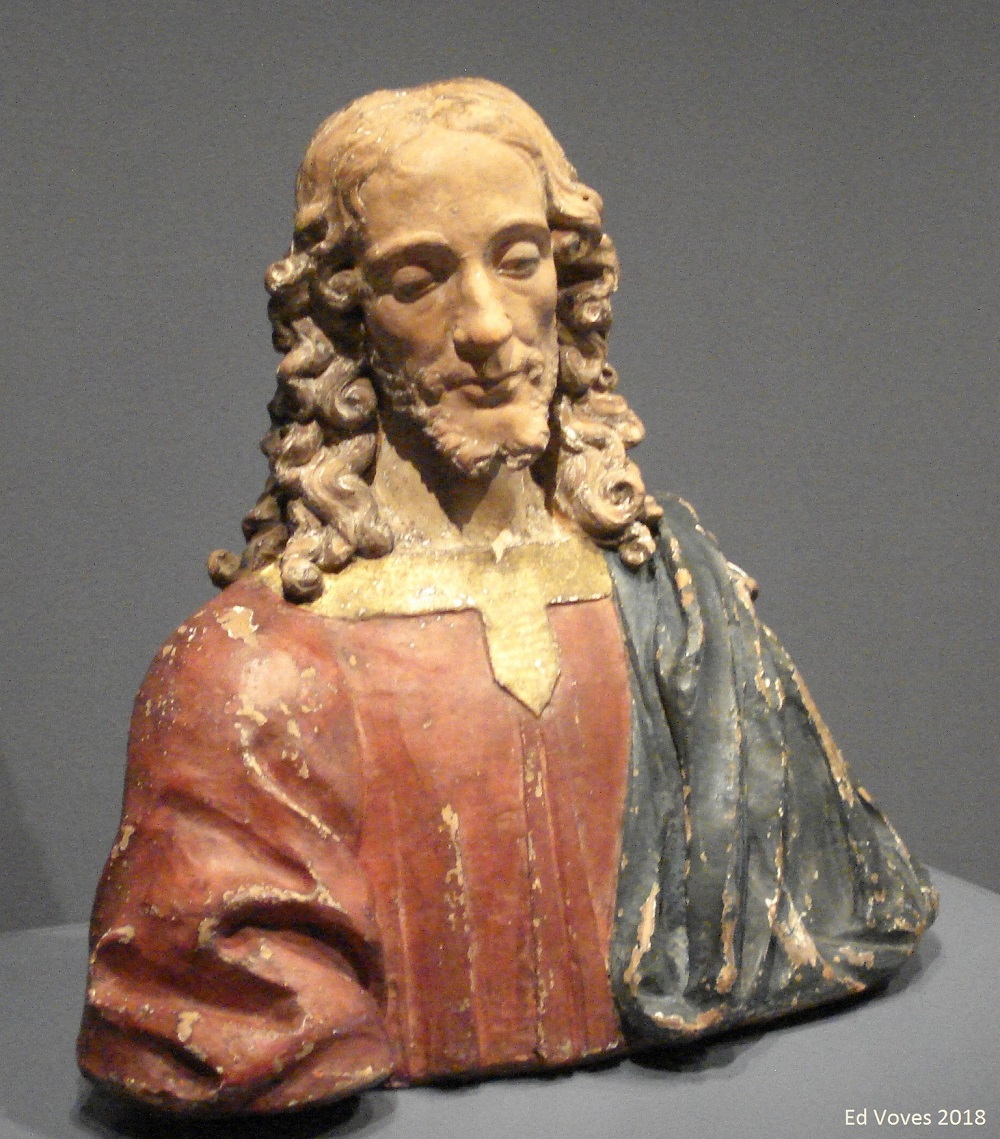
The humanity with which Verrocchio depicted David and Goliath appears in work after work in the National Gallery exhibition. Especially notable is the Bust of Christ which Verrocchio originally modeled for one of his major full-bodied works, a statue of Christ and St. Thomas. This portrait of Jesus, renowned in its day as "the most beautiful head of Christ ever made," was then reworked as a terracotta bust. The version of this bust on view at the National Gallery, was likely a collaborative effort, with the head sculpted by Verrocchio and the torso handled by an assistant.Later, with the tilt of the head changed left to right, this 'fully human, fully divine" Jesus would anchor a scene of bustling human activity in a famous painting: Leonardo's The Last Supper.
Verrocchio, I believe, should be regarded as a Humanist in the visual arts. Verrocchio's "close study" of the human body paralleled the diligent efforts, in translating ancient texts and writing learned commentaries, that transmitted this knowledge to an eager audience of young scholars throughout Italy and then in all the major nations of Europe.
Verrocchio's students, along with Leonardo and Perugino, likely included Domenico Ghirlandaio, in whose studio the young Michelangelo briefly worked. Thus, we can trace a pedigree of creative genius from the workshop/studio of Verrocchio to the "artist as hero" of the High Renaissance.
In the case of Verrocchio's "passing the baton" to Leonardo, signature works by each artist reveal the way that this was accomplished.

Ed Voves, Photo (2019)
Andrea del Verrocchio’s Lady
with Flowers, c. 1475/1480
Verrocchio sculpted his half-length marble, Lady with Flowers, during the years, 1475 to 1480. At the same time, the young Leonardo painted Ginevra de' Benci, but not as the head-and-shoulders portrait as it now is. The curators of the Verrocchio exhibit make a very cogent case that Ginevra de' Benci was originally a half-length portrait before being cut-down at a later date. Viewed in this way, Leonardo's Ginevera strikes a similar pose to Verrocchio's Lady, which likely influenced Leonardo's painting.

Anne Lloyd, Photo (2019)
Copy
of exhibition wall illustration, contrasting a hypothetical version of Leonardo’s Ginevra de' Benci
with Verrocchio’s Lady
with Flowers

Andrea
del Verrocchio, Head of a Woman with Braided Hair, late
1470s
I was prepared to be impressed by Verrocchio's statues and sculpture. The gallery display of his drawings was a complete, if pleasurable, shock. The magnificent drawing from the British Museum collection, Head of a Woman with Braided Hair literally stopped me in my tracks each time I visited the Verrocchio exhibition - and I have been there three times!
So masterful is the gradation of shading around the eye lids, that you half-expect them to open and Woman with Braided Hair to return your gaze.
This is double-sided work, with a finished drawing on one side. An equally impressive preparatory sketch on the reverse, Head of a Woman Leaning on Her Right Hand. The identity of Woman with Braided Hair is a matter of speculation, with some scholars believing it to be a portrait of Simonetta Vespucci, the most beautiful woman of Florence. If so, it might have been a presentation piece for Guiliano de' Medici, who regarded her with courtly affection. Alas, Simonetta Vespucci died from tuberculosis, aged twenty-two, shortly before Guiliano was cut down by the Pazzi assassins.

Ed Voves, Photo (2019)
Gallery
view of the Verrocchio
exhibit at the National Gallery, Washington D.C., showing Verrocchio’s
Head of a Woman Leaning on Her Right
Hand
Head of a Woman with Braided Hair and her compatriot provide the central, focusing point of this gallery of Verrocchio's drawings. These are all superlative works of art, worthy of comparison to Michelangelo's drawings. There are only twenty-five known drawings by Verrocchio, so to be able study this selection at the National Gallery is an experience not likely to be repeated for many, many years to come.

Ed Voves, Photo (2019)
Andrew
Butterfield, Curator of the Verrocchio
exhibit at the National Gallery
Andrew Butterfield, the eminent authority on Verrocchio's sculptures, has done the art world an enormous service for the outstanding job of curating this magnificent exhibition. Similar accolades are due to him as editor and principle author of the exhibit catalog, truly a Renaissance masterpiece in its own right. I plan to review the catalog in order to more fully explore Verrocchio's art, especially his drawings.
The greatest praise - and thoroughly deserved - that can be paid to Verrocchio: Sculptor and Painter of Renaissance Florence is to affirm that the study of Renaissance art will never be the same. The vital role of the workshop/studio system and of collaborative effort are themes which the exhibition underscores, in addition to documenting Verrocchio's individual contributions.
And what of the Renaissance "Artist as Hero" school of thought? Well, Leonardo, Raphael and Michelangelo are still there. Donatello and Masaccio, too. They will just have to squeeze a little closer, to make room on the pediment frieze for Andrea del Verrocchio.
***
Text: Copyright of Ed Voves. Original Photos: Anne Lloyd. All rights reserved
Images courtesy of the National Gallery of Art, Washington D.C.
Introductory Image:
Ed Voves, Photo (2019) Andrea del Verrocchio’s Putto with a Dolphin (Detail), c. 1465/1480. Bronze: overall: 73.03 cm (28 3/4 in.); base: 125 cm (49 3/16 in.) Museo di Palazzo Vecchio, Florence, Italy.
Ed Voves, Photo (2019) Gallery view of the Verrocchio exhibit at the National Gallery, Washington D.C., showing Leonardo da Vinci’s Ginevra de' Benci.
Anne Lloyd, Photo (2019) Gallery view of the Verrocchio exhibit at the National Gallery, Washington D.C., showing Verrocchio’s Putto with a Dolphin, c. 1465/1480
Andrea del Verrocchio & assistants (Leonardo da Vinci & Pietro Perugino) Madonna and Child with Two Angels, c.1470/1474. Tempera on panel: overall: 97 x 71 cm (38 3/16 x 27 15/16 in.) The National Gallery, London, Bought, 1857
Andrea del Verrocchio (Attributed) Small Vase with Cover, c. 1480/1485. Sardonyx with silver-gilt mountings: height: 16 cm (6 5/16 in.); diameter: 9 cm (3 9/16 in.); diameter: 5 cm (1 15/16 in.) Gallerie degli Uffizi, Tesoro dei Granduchi, Florence.
Ed Voves, Photo (2019) Portrait Bust of Lorenzo de' Medici, ca.1513/1520, probably after a model by Andrea del Verrocchio and Orsino Benintendi, ca/ 1478. Polychrome terracotta: overall: 65.8 x 59.1 x 32.7 cm (25 7/8 x 23 1/4 x 12 7/8 in.)
National Gallery of Art, Washington, Samuel H. Kress Collection
Ed Voves, Photo (2019) Andrea del Verrocchio’s Giuliano de' Medici, c. 1475/1478. Terracotta with traces of polychromy: overall: 61 x 66 x 28.3 cm (24 x 26 x 11 1/8 in.) National Gallery of Art, Washington, Andrew W. Mellon Collection
Ed Voves, Photo (2019) Gallery view of the Verrocchio exhibit at the National Gallery, Washington D.C., showing Verrocchio’s David with the Head of Goliath, c. 1465. Bronze with traces of gilding: overall: 120 cm (47 1/4 in.) Museo Nazionale del Bargello, Florence, Italy.
Ed Voves, Photo (2019) Andrea del Verrocchio’s Head of Goliath, c.1465. Bronze with traces of gilding: overall: 120 cm (47 1/4 in.) Museo Nazionale del Bargello, Florence, Italy.
Ed Voves, Photo (2019) Gallery view of the Verrocchio exhibit at the National Gallery, Washington D.C., showing Verrocchio’s David with the Head of Goliath, c.1465.
Ed Voves, Photo (2019) Andrea del Verrocchio’s Bust of Christ (Detail), c. 1470/1483. Polychrome terracotta: overall: 68 x 71.2 x 40.6 cm (26 3/4 x 28 1/16 x 16 in.) Private collection. Photo: Yale University Art Gallery.
Ed Voves, Photo (2019) Andrea del Verrocchio's Lady with Flowers, c. 1475/1480. Marble: overall: 60 x 48 x 25 cm (23 5/8 x 18 7/8 x 9 13/16 in.) Museo Nazionale del Bargello, Florence.
Anne Lloyd, Photo (2019) Copy of exhibition wall illustration, contrasting a hypothetical version of Leonardo’s Ginevra de' Benci with Verrocchio’s Lady with Flowers.
Andrea del Verrocchio. Head of a Woman with Braided Hair (recto); Head of a Woman Leaning on Her Right Hand (verso),late 1470s. Recto: black chalk or charcoal, lead white gouache, pen and brown ink, reworked with oil charcoal on cream prepared paper; verso: charcoal on white paper: overall: 32.4 x 27.3 cm (12 3/4 x 10 3/4 in.) On loan from the Trustees of the British Museum, London.
Ed Voves, Photo (2019) Gallery view of the Verrocchio exhibit at the National Gallery, Washington D.C., showing Verrocchio’s Head of a Woman Leaning on Her Right Hand.
Ed Voves, Photo (2019) Andrew Butterfield, Curator of the Verrocchio exhibit at the National Gallery of Art, Washington D.C.