Art Eyewitness Essay:
Morgan Library and Museum Centennial Tribute
By Ed Voves
Original Photography by Anne Lloyd and Ed Voves
"Life is a spell so exquisite,” Emily Dickinson wrote, “that everything conspires to break it.”
If Dickinson’s hometown of Amherst, Massachusetts, was hostile to enchantment, how much so is the “24/7” tidal wave of distractions which daily engulfs our lives? Wherever one lives in our harried, mind-fatigued world, the “spell” of a meaningful life is difficult to cultivate.
Yet, it is possible to find places of refuge – mental, emotional, life-affirming. Occasionally, these sanctuaries of sanity may be found in the middle of the maelstrom. 225 Madison Avenue at 36th street in New York City is one such location:
The Morgan Library & Museum.
Brett Beyer (Photo 2022)
J.P Morgan’s Library & Garden, looking west toward the Annex
The Morgan, if I may, is celebrating its centennial year as a public institution. But the Morgan Library and Museum’s pre-history, spanning two decades before its incorporation in 1924, is of crucial importance in understanding the Morgan’s mission as a premier American venue of culture.
The Morgan was designed as a private library by the celebrated architect, Charles McKim, and built between 1902 and 1906. Set amid brownstone townhouses in the Murray Hill neighborhood of New York, the Morgan Library was constructed of Tennessee marble. From its inception, the Morgan was intended to be exceptional.
At McKim’s behest, the emplacement of the marble exterior stonework was done without the use of mortar. This exacting procedure would make the Morgan “the only building ever built in modern times as the ancients built and will require, as was required of them, the utmost accuracy and nicety known in mechanics.”
J. P. Morgan’a Library & Garden with sculptures of lionesses by Edward Clark Potter (photo by Henry Wysham Lanier),1906. Brett Beyer (2022) Entrance to J. P. Morgan’a Library, evening view
McKim modeled the entrance area of the Morgan after the Villa Medici, a Renaissance palazzo from the 1500’s. As the patron of McKim’s masterpiece was an American “Medici”, the building was designed to match the man.
J. Pierpont Morgan (1837-1913) was a hugely controversial figure of his time – and since. He was praised by some and vilified by others for his financial transactions. The prompt action he took in 1893 – and later in 1907 - to prevent a bank panic from spiraling into a nation-wide depression was both public-spirited and sound business practice.
Hayman Selig Mendelssohn, J. Pierpont
Morgan, c. 1890
The private library which McKim built for Morgan, adjacent to his family residence, was to be Morgan’s refuge from the harsh world of Gilded Age finance. An avid reader since childhood, Morgan could retreat into the spell of an “exquisite life.” His version of Dickinson’s dream state was a place of eternal verities and timeless ideals, in a setting of commensurate grandeur.
Ed Voves (Photos 2023) Gallery views of Pierpont Morgan's Library
One commentator, upon being given a tour of the completed Morgan Library in 1907, described it as “the bookman’s paradise.”
Ed Voves (Photo 2023)
Gallery view of the Rotunda of the Morgan Library and Museum
Morgan was indeed a “bookman.” He treasured the manuscript of a Sir Walter Scott novel which his father, a collector of autographs, had purchased. When the senior Morgan died in 1890, Pierpont (as he was known in his family) followed his father’s lead as a collector. But he did not limit himself to individual volumes and manuscripts. Morgan began to purchase entire collections, sometimes numbering a hundred or more volumes at a time.
Udo J. Keppler, The Magnet, 1911. Published in Puck Magazine
Masterpieces of ancient and medieval art complemented these book acquisitions. European connoisseurs were enraged to see treasures like the Lindau Gospels lost to Morgan’s clutches. Such was the power of the “almighty dollar” and the astute advice of his bibliophile nephew, Junius, that Morgan was an unstoppable force.
Ed Voves (Photo 2023)
The Lindau Gospels, c. 880, manuscript from St. Gall, Switzerland
To a significant degree, Morgan's book collecting was motivated by his religious faith. This led him to buy rare and historic bibles like the famed Gutenberg Bible (the Morgan now has three copies) and Coptic biblical codices, inscribed by hand in Egypt during the early Middle Ages. The fascinating interaction of worshiping God and obsession with books was documented in the exhibition, Morgan's Bibles: Splendor in Scripture (October 2023-January 2024).
Ed Voves (Photos 2023) Johan Gutenberg’s Biblia Latina, c. 1455 (top photo); Samuel 1 & 2 in Coptic, before 893. From Egypt, Al-Fayyum
Closer to home, Morgan made his earliest headline-grabbing purchase in 1879. Dubbed the "Thousand-Dollar Bible" by the New York Times, this was the first bible printed in America, dating to 1663. John Eliot's translation of the Old and New Testament into the language of Algonquian Native American people was also featured in Morgan's Bibles.
J.P. Morgan died on March 31, 1913 in Rome. With his passing, care for the “bookman’s paradise” entered into the capable hands of J.P. (Jack) Morgan Jr. and the now legendary librarian, Belle da Costa Greene (1883-1950). Greene was an African-American woman who "passed" as a person of Portuguese descent. Greene's sharp eye at detecting fakes and forgeries was invaluable in maintaining the integrity of the Morgan's collection.
Ed Voves (Photo 2023)
Gallery view of the Morgan Library, East Room, showing terracotta bust of Belle da Costa Greene, by Jo Davidson
To round off its centennial celebrations, the Morgan has just opened an exhibition devoted to Belle Greene. Many of the outstanding manuscripts and books purchased on the advice of Greene are on display. Art Eyewitness will review Belle da Costa Greene: A Librarian's Legacy in a future post.
In 1924, Jack Morgan decided to recast the Morgan as a public research institution, eventually as a museum as well. In this essay, we shall focus on the Morgan as a museum.
The Morgan is a unique institution, functioning – quite successfully - for many years without large galleries for long-term display of its collection. Approximately 7,000 works of art were donated to the Metropolitan Museum of Art, of which Morgan was president at the time of his death. These included masterpiece paintings like Raphael's Colonna Alterpiece.
Morgan's vast collection of "works on paper" - medieval manuscripts, Rembrandt etchings and original musical scores such as Beethoven''s Violin and Piano Sonata, op. 96 in G major - were retained under the careful guardianship of Belle Greene.
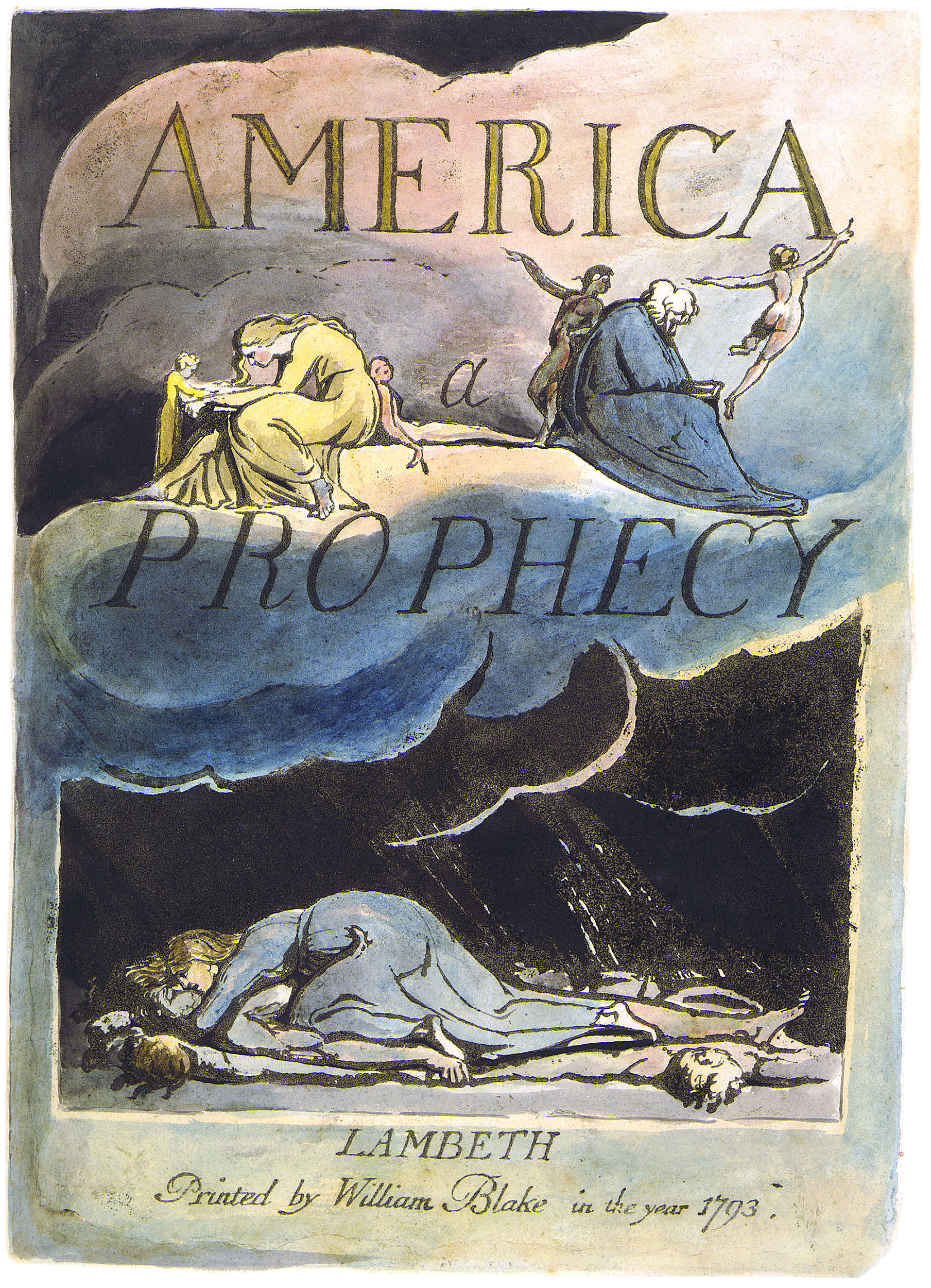
William Blake, America, a Prophecy, 1793-95
Incredibly, works by William Blake, with their prophetic religious visions and radical political views, also remained in the Morgan collection. One would never have assumed that a "robber baron" like J.P. Morgan would have held Blake in esteem, yet apparently he did.Today, most of the Morgan's 350,000 collection items remain in storage for significant periods. This is due to conservation requirements, as well as space restrictions. To deal with the latter concern, major renovations of the Morgan campus in 1991 and 2006 added additional room,. Especially worthy of note is a more spacious second floor display area, the Englehard Gallery.
Ed Voves (Photo 2023)
The Englehard Gallery, during the Medieval Money exhibit
However, the Morgan curators must still make optimum use of small spaces by comparison with the cavernous galleries of the Metropolitan Museum of Art.
Anne Lloyd (Photo 2017)
Exhibition banners, Summer 2017, at the Morgan Library & Museum
Special exhibitions and rotating “treasures from the vault" are key to the Morgan’s presentation of its vast and varied collections. Generous loans from major museums from around the world are also a major feature of the Morgan’s mission of addressing epic themes in art, music and literature.
The opulent decor of “Mr. Morgan’s Library” never changes. Everything else is in a state of creative flux. As a result, the Morgan's revolving exhibition schedule enables us to step-out of the pressures and frustrations of “this moment” into realms of the imagination, past, present and future.
Anne Lloyd (Photo 2024)
The Beatrix Potter: Drawn to Nature Exhibition,
with display of illustrated letters to Noel Moore, 1890's
Many of the Morgan exhibitions are immensely enjoyable. The 2012 Charles Dickens tribute, 2019’s Drawing the Curtain: Maurice Sendak’s Design for Opera and Ballet and this year’s Beatrix Potter: Drawn from Nature occupy an especially memorable place in my regard for the Morgan.
The wonderful exhibitions at the Morgan, superb articulations of word and image, have all left their mark on me. To conclude this tribute, I will focus on a sequence of three exhibitions from 2016-2017 and an earlier one, which was mounted in 1971.
This 70's exhibition occurred before I began visiting the Morgan. But judging from its impact, the display of photos of Native Americans taken by Edward S. Curtis from the 1890’s to 1930 was a landmark event in American museum history – and America’s cultural history, writ large.
Edward S. Curtis, Self-Portrait, 1905
In 1906, Edward Curtis (1868-1952), a self-taught photographer based in Seattle, Washington, approached J.P. Morgan for financial support to enable him to document the endangered culture of the North American Indians. Construction of “Mr. Morgan’s Library” was in its final stages and Morgan gave Curtis the brush-off. Or tried to.
Curtis would not take no for an answer. He thrust several or his portraits of Native-American people from the south-west territories into Morgan’s hands. The aging titan of Wall Street was intrigued.
Edward S. Curtis, Native American Portraits from lantern slides: Unidentified girl (A:shiwi/Zuni), at left, c. 1903;
Luzi (Tohono O’odham/Papago), c. 1906
Curtis received a generous, if not lavish, stipend, paid in installments. Morgan provided $15,000 per year for five years, to be spent on field work, but not publication costs.The funding from Morgan enabled Curtis to continue with his ever-expanding project - photographs for his multi-volume book, The North American Indian, ethnographic study of social customs and religious practices and production of sound and motion picture recordings. It was a stupendous achievement.
Edward Curtis had, at great personal cost, saved America’s Native American heritage. But, by the time he finished his epic task, the U.S. was in the grip of the Great Depression. Few of the expensive book sets were sold. Curtis died in obscurity in 1952.
Edward S. Curtis, The Courier (Apache), c. 1906. Lantern slide
Carefully stored in the Morgan’s vault were over 400 lantern slides of Curtis photos which had been used by the intrepid photographer in his public-speaking tours. Many had been hand-tinted to heighten their visual appeal to the public. The lantern slides formed the core of the sensational 1971 exhibition at the Morgan which revived Curtis' reputation and heightened awareness of the rich heritage of the Native American peoples Curtis had immortalized.
The Curtis/Morgan saga is surely one of the most dramatic and influential episodes involving a museum in American history. That being said, I would contend that three exhibitions, presented by the Morgan during 2016-2017, should be considered as a benchmark achievement in curatorial excellence.
Over the twelve-month course of a single year, the Morgan mounted back-to-back-to-back exhibitions surveying the lives and times of three giants of mid-19th century literature:
· Charlotte Brontë: An
Independent Will (September 2016–January 2017)
· I’m Nobody! Who are you? Life & Poetry of Emily Dickinson (Jan- May 2017)
· This Ever New Self: Thoreau and
His Journal (June–September 2017)
Art Eyewitness Image
From left- Charlotte Brontë, Emily Dickinson & Henry David Thoreau
The Morgan exhibitions generated an extraordinary confluence of genius, as if these three very different writers had joined forces, each using their own singular talent to address the issues of their day and the challenges facing human beings in every era.
In preparing these exhibitions, the Morgan curators searched through the Morgan's considerable holdings of material related to Charlotte Brontë, Emily Dickinson and Henry David Thoreau and augmented these with loan items from all over the world.
Anne Lloyd (Photo 2016)
Charlotte Brontë’s portable writing desk
For Brontë, and Thoreau, the results of this research were dazzling. Charlotte Brontë's portable writing desk, a dress she wore on a visit to London where she met William Makepeace Thackeray, tiny hand-written story books made for her youngest sister, Anne, and much more testified to the almost religious devotion which the author of Jane Eyre has inspired.
The Thoreau exhibition was almost as well-endowed with pictures, letters and memorabilia related to this Yankee philosopher. Even the lock on the Middlesex County Jail, where Thoreau spent a night-time of protest against the Mexican War, was on view.
Anne Lloyd (Photo 2017)
Steel lock & key from Middlesex County Jail
As befits a reclusive individual, the Emily Dickinson exhibition was a more difficult proposition. The Morgan exhibition, I'm Nobody! Who are You? took an interesting route to gain insight into the source of Dickinson's creativity. The curators recreated the safe, cozy gentility of Dickinson's childhood. By taking this approach, the astonishing, unpredictable length to which her poetic vision carried Dickinson was underscored.
There is no calculus for determining genius. No secret formula will ever be be found in the arcane tomes of the alchemists. At some point, each creative person sits down before a sheaf of paper, a blank canvas, a smooth, untouched piece of marble. What happens next is inspiration, also impossible to define but an established fact.
Ed Voves (Photo 2023) Gallery view of the Morgan's Bibles exhibition
For one hundred years, the Morgan Library and Museum has been providing creative people with the means to be inspired and inspiring others to be creative. From a rich man's palazzo to a palace of enlightenment and enjoyment for all, the Morgan has truly become a place for inspiration.
One hundred years of inspiration at the Morgan! As the calendar page is flipped, a new century of inspiration begins.
***
Text: Copyright of Ed Voves, all rights reserved
Original photography, copyright of Anne Lloyd and Ed Voves
Introductory Image:
Anne Lloyd,
Photo (2024) The logo of the Morgan Library and Museum.
Brett Beyer (Photo 2022) J.
Pierpont Morgan’a Library and Garden, view looking west toward the Annex.
Courtesy of the Morgan
Library and Museum, N.Y. Copyright Brett Beyer, 2022
J. Pierpont Morgan’a Library
and Garden with sculptures of lionesses by Edward Clark Potter (photo by Henry Wysham
Lanier), 1906 Gelatin silver print Morgan Library archives
Brett Beyer (Photo 2022)
Original entrance to J. Pierpont Morgan’a Library, evening view. Courtesy of
the Morgan Library and Museum, N.Y. copyright Brett Beyer, 2022
Hayman Selig Mendelssohn (1848-1908) J. Pierpont
Morgan, c. 1890. Photograph, Albumen Albumen print. Morgan Library
archives
Ed Voves (Photo 2023) Gallery
views of Pierpont Morgan's Library
Ed Voves (Photo 2023)
Gallery view of the Rotunda of the Morgan Library and Museum
Udo J. Keppler (1872-1956) The
Magnet, 1911. Published by Keppler & Swarzmann in Puck Magazine, Vol. 60,
#1790. Library of Congress, Prints and Photographs Divison #2011649038
Ed Voves (Photo 2023) The Lindau Gospels, c. 880 (manuscript, from
St. Gall in Switzerland) Front cover, France, c. 870; back cover, Salzburg, c.
780-800. Morgan Library and Museum.
Ed Voves (Photo 2023) John Gutenberg’s Biblia Latina, c. 1455. Morgan Library and Museum.
Ed Voves (Photo 2023) Samuel 1 and 2 in Coptic, before 893. Transcribed
in Egypt, Al-Fayyum region. Morgan Library and Museum.
Ed Voves (Photo 2023)
Gallery view of Pierpont Morgan's Library, East Room, showing terracotta bust of Belle da Costa
Greene, by Jo Davidson.
William Blake (1757-1827) America,
a Prophecy, 1793-95. 18 plates (in 2 vplumes): illustrated; 53 cm. Morgan
Library and Museum, purchased in 1909.
Ed Voves (Photo 2023) View
of the Englehard Gallery during the Medieval Money, Merchants and Morality
exhibition.
Anne Lloyd (Photo 2017)
Exhibition banners, Summer 2017, at the Morgan Library and Museum.
Anne Lloyd (Photo 2024) View
of the Beatrix Potter: Drawn to Nature Exhibition, with display of letters to
Noel Moore, 1890’s
Edward S. Curtis (1868-1952)
Self-Portrait, 1905. Photogravure: 18.5 x 12 cm. (7 5/16 x 4 ¾ in.) National Portrait Gallery, Washington D.C.
Edward S. Curtis Native American Portraits from lantern slides:
An unidentified girl (A:shiwi/Zuni), c. 1903; Luzi (Tohono O’odham/Papago), c. 1906. Morgan
Library and Museum.
Edward S. Curtis The Courier (Apache), c. 1906. Lantern slide:
photograph on glass, hand colored; 3 ¼ x 4 inches. Morgan Library and Museum.
Art Eyewitness Image. Photo Montage of Portraits
of Charlotte Bronte, Emily Dickinson and Henry David Thoreau.
Anne Lloyd (Photo 2016) Charlotte Brontë’s
portable writing desk, with contents including pen nibs, ink bottle, and other
tools, Parsonage Museum, Haworth, UK
Anne Lloyd (Photo 2017) Steel lock and key
from Middlesex County jail, ca. 1788 Concord Museum, gift of Cummings E. Davis,
1886; M2081
Ed Voves (Photo 2023)
Gallery view of the Morgan's Bibles exhibition


.jpg)