Showing posts with label Giorgio Vasari. Show all posts

Sunday, July 21, 2019

Art Eyewitness Book Review: The Oxford Illustrated History of the Renaissance


The Oxford Illustrated History of the Renaissance


Edited by Gordon Campbell

Oxford University Press/$39.95/506 pages

Reviewed by Ed Voves


Andy Warhol and the Renaissance of the 1400's-!500's seldom occupy the same paragraph in art history books or essays. Yet as I finished reading The Oxford Illustrated History of the Renaissance, Warhol's famous (or infamous) prediction came to mind.

"In the future, everyone will be world-famous for fifteen minutes."

Since the fame of Leonardo, Michelangelo and Durer has lasted a lot longer than a quarter of an hour, my reflection on Warhol's statement seemed little more than a random thought. But as I reread some of the especially cogent passages of the Oxford volume, the following statement seemed a likely candidate for having directed my thoughts in Warhol's direction.

The proliferation of images and texts brought about by the invention of printing (c.1440) confirm that the Renaissance experienced a revolution comparable in magnitude to the recent emergence of the Internet. The word 'selfie' is recent but the Renaissance brought about and developed the self-portrait and the portrait. 

This perceptive insight appears in the chapter of the Oxford book, "The Civilization of the Renaissance," written by François Quiviger. An echo of the title of the famous nineteenth century book, The Civilization of the Renaissance In Italy by Jacob Burckhardt, is detectable here. Quiviger and the other members of the team of scholars who wrote The Oxford Illustrated History of the Renaissance show that the impact of this cultural revolution spread far wider than Italy.
   

Hans Holbein, The Ambassadors, 1533

The Renaissance was marked by world-changing inventions like movable-print and realistic portrait painting. These in turn facilitated the emergence of "the sense of the self in the world." During this long-ago era, the seeds of modern individualism were planted. Whether our opportunity for fame lasts fifteen minutes or five centuries, the debt we owe to the "brave new world" of the Renaissance is considerable.

The Oxford Illustrated History of the Renaissance is the latest in an outstanding series of books dating back to the 1980's. Based on the latest historical research but aimed at the general reader, the Oxford "Illustrated's" have maintained a very high standard over the years. This volume, edited by the great Renaissance scholar, Gordon Campbell, certainly maintains the Oxford University Press reputation for excellence.

Among the historians recruited to write this authoritative book is Felipe Fernández-Armesto, who edited The Oxford Illustrated History of the World, reviewed earlier this year in Art Eyewitness. The chapter written by Fernández-Armesto deals with the global impact of the Renaissance. With his usual verve and command of the historical source material, Fernández-Armesto investigates the way that interconnected bonds were forged between far-flung nations and societies.

 The process of globalization was very slow during the 1400's and early 1500's, being contingent more on mariners' understanding of the trajectory of the "trade winds" than of strategic planning by the governments of Europe.

"The history of the world, as traditionally written," Fernández-Armesto wryly observes, "contains too much hot air and not enough wind."


Afro-Portuguese Ivory Hunting-horn, c.1490-1530

The carved ivory horn, shown above, illustrates this world-wide perspective on the Renaissance. It was made in Africa for the European market and taken back by Portuguese maritime traders. The base of the horn shows an armillary sphere, the Coat of Arms of the Portuguese royal house and the cross of Beja. Scenes of Europeans and Africans fighting and hunting animals are also featured.

If the global trade had been limited to exotic products such as this ivory horn, the world  would be a different place today. Vast hauls of treasure from the New World, chiefly silver, flowed into the Spanish treasury and flowed right out again. The "King's Fifth" was used chiefly to purchase weapons, especially gunpowder-firing cannon, state-of-the-art warships and elaborate fortifications capable of resisting the formidable armies and fleets of the rival Valois French monarchy and  the Ottoman Turks. There is an instructive chapter on the Renaissance "arms-race" written by David Parrott in the Oxford volume.


Giorgio Vasari, The Battle of Lepanto, 1572

If the Renaissance witnessed endemic warfare, the growth of a world-wide slave trade (with plenty of guilt to share among all the participants of this "trafficking of souls") and social repression in most European societies, can we really justify the claim that a "Renaissance" actually took place? Or is such a claim more of the "hot air and not enough wind" which Fernández-Armesto derides?

It is the contention of the Oxford team that the Renaissance was indeed a revolutionary epoch in every field of creative endeavor. This was especially true in the visual arts, which we will focus upon shortly. The unpleasant aspects of the Renaissance are not brushed aside and the prevailing theme of the book is best summarized by Quiviger in the concluding remarks of his chapter:

Many scholars have observed that the ideals and values of the Renaissance are merely a sugar coating concealing the darker, violent, and ever present nature of men, driven by ambition and rivalry. Sugar coating is nevertheless a first step towards sweetening. This is simply a matter of not confusing a period with its ideals… Similarly, the ideals of good manners and elegance… may not have been the norms of their time but their European diffusion suggests that they did eventually have an impact upon the world.

The "sugar coating" which the Renaissance applied to European society and indirectly to the world was a long and complex process. Because we still see the results in art, architecture and literature produced during 1400's and 1500's, it is easy to miss two fundamental points.

Most of the texts used by Renaissance scholars were available only because "Dark Age" scribes, many of them Irish monks, had preserved them. If a manuscript copy of a Latin text survived to the ninth century, as Peter Mack writes in his chapter on Renaissance humanism, it "was never truly lost again." Greek texts were similarly preserved in the Byzantine Empire and transmitted to Italy in the years prior to the fall of Constantinople in 1453. 


Petrarch's copy of Livy, c.1329.
 Detail of manuscript copy of the history of Rome by Livy, 22.1

The "heroic" role of the Renaissance scholar was to rigorously organize and study what had been salvaged from ancient times and to disseminate this "new" knowledge all over Europe. Humanism, as the new scholarship was called, had commenced decades before the first use of the printing press in the early 1450's. We can see Humanism in action on the manuscript pages of the Roman history of Livy, personally copied and corrected by Petrarch (1304-1374) and further annotated by Lorenzo Valla (1407-1457).

Secondly, the artistic revolution of depicting Jesus, the Virgin Mary and other saintly figures with flesh and blood naturalism was another Medieval development. The preaching of St. Francis of Assisi (1181-1226) and his followers, the Franciscans, emphasized the humanity of Jesus and the need for Christians to practice levels of devotion that reflected the sufferings of Jesus and the Christian martyrs.

The preaching of the Franciscans called for "art that bleeds" as Andrew Graham-Dixon memorably described in his wonderful book, Renaissance. Artists, both in Italy and Flanders, complied with alacrity. 


Jan van Eyck, Madonna of Chancellor Rolin, c.1435

It was the Flemish who took the key step of transferring the naturalism used in portraying Jesus, Mary and the Apostles to portraits of Christian believers. Special attention was given to those willing to pay to be included in the picture, like Chancellor Rolin of Burgundy, shown above. But the real breakthrough came about when Italian merchants working in Flanders, like Tommaso Portinari, commissioned paintings showing them and their wives praying before Jesus and his mother.

 Prior to the arrival in Italy of these oil paintings from Flanders, Italian artists had been exploring other aspects of art, such as creating a sense of visual space through the use of linear perspective. Portraits in Italy were chiefly done in profile, because of the obsession with collecting ancient Roman coins. Of deeply-probing psychological insight, there was precious little. When the portraits by Flemish masters like Jan van Eyck and Hans Memling reached Italy, the effect was dramatic.


Antonello da Messina, Portrait of a Man (Il Condottiere),1475

In this sensational portrait by Antonello da Messina, we can see the result. This incredible work is the perfect embodiment of the Renaissance "sense of the self in the world."

Antonello may have learned oil painting from an itinerant Flemish painter at the court of the Kingdom of Naples. However he acquired the techniques of the Flemish masters, Antonello soon matched them in the ability to probe the human soul and to portray the result on canvas or panel.

The age of Individualism had dawned.


Albrecht Dürer, The Large Piece of Turf, 1503

The techniques of close investigation of human character began to be applied to the study of nature, stunningly revealed in Durer's Large Piece of Turf. Soon the new critical thinking and observation was being trained on the stars and planets, leading to Copernicus' challenge to traditional, earth-centered astronomy. The Oxford volume includes a chapter filled with insightful analysis of the Scientific Revolution which ultimately was the most momentous result of the Renaissance.

Just about every facet of life in Europe was affected by the "new" learning and meticulous tinkering which the Renaissance engendered. This extended even to special techniques for folding napkins at banquets into the shape of animals, ships and castles! This too is described in The Oxford Illustrated History of the Renaissance.

The Oxford volume, however, does not cover in great detail the famous incidents in the careers of the titans of Renaissance art. Leonardo, Michelangelo, Raphael, Durer and Titian do make appearances in the book and their art works are considered in the broad context of Renaissance civilization. Two chapters provide a solid foundation to the study of Italian art (written by Francis Ames-Lewis) and the Northern Renaissance (Paula Nuttall and Richard Williams).

Most of the familiar and fascinating events, feuds, etc. are not featured. No mention of screaming matches between Michelangelo and Pope Julius II. Discussion of Italian art ends for the most part with the death of Raphael in 1520.

I can see the point of Gordon Campbell and his team of Renaissance scholars, given the global framework of this outstanding book. There is so much ground to cover and it makes sense to concentrate on the factors that created the Renaissance "sense of the self in the world."

Never-the-less, reading The Oxford Illustrated History of the Renaissance has placed me in a perplexing situation not unlike that faced by the actor, Bill Murray, in the movie Groundhog Day!

My very first exposure to Renaissance art ended - as does the corresponding chapter of the Oxford book - with Italian art in the early 1500's. Way back in the 1970's, I took an undergrad course in Renaissance art. The professor was so smitten with Brunelleschi, Donatello  and other Quattrocento masters that we ran out of time. When the course ended, Leonardo was still waiting for the paint to dry on The Last Supper.

Hopefully, Oxford University Press will publish an Illustrated History of the Later Renaissance and I will finally discover what happened to Michelangelo.

***
Text: Copyright of Ed Voves, all rights reserved                                                                                           
Images courtesy of the National Gallery, London, the British Museum, Musée du Louvre, the Albertina Museum, the British Library and Wikipedia.org 

Introductory Image:
Book Cover. Courtesy of Oxford University Press

Hans Holbein (German/Swiss, 1497/8-1543) Jean de Dinteville and Georges de Selve ('The Ambassadors'), 1533. Oil on oak: 207 x 209.5 cm. National Gallery, London: NG1314

Artist unknown ((Africa,Sierra Leone) Afro-Portuguese Ivory Hunting-horn, c.1490-1530. Carved from elephant ivory, base of horn fitted with silver-gilt rim:  48.2 centimetres. British Museum, Af1979,01.3156.

Giorgio Vasari (Italian,1511–1574) The Battle of Lepanto, 1572. Fresco in the Sala Regia of the Vatican. 
https://commons.wikimedia.org/wiki/File:Giorgio-vasari-battle-of-lepanto.jpg

Petrarch's copy of Livy. Detail of manuscript copy of the history of ancient Rome by Livy, 22.1, with corrections by Petrarch, 1304-1374, (interlinear) and Lorenzo Valla (marginalia). Italy and France (Avignon), late 12th century-c 1329. British Library, London. Harley MS 2493, f 105v.

Jan van Eyck (Flemish, c.1390-1441) Madonna of Chancellor Rolin, c. 1435. Oil on panel: 66cm x 62cm. Musée du Louvre, Paris https://en.wikipedia.org/wiki/Madonna_of_Chancellor_Rolin

Antonello da Messina (italian/Sicilian, 1430-1479) Portrait of a Man (Il Condottiere), 1475. Oil on panel: 36.2 cm (14.2 ″); Width: 30 cm (11.8 ″).  Musée du Louvre, Paris. http://cartelen.louvre.fr/cartelen/visite?srv=obj_view_obj&objet=cartel_13724_28067_p0003425.002.jpg_obj.html&flag=false

Albrecht Dürer (German, 1471-1528) The Large Piece of Turf, 1503. Watercolor and body color, heightened with white body color: 40.8 cm (16 ″) x 31.5 cm (12.4″). Albertina Museum,Vienna.
https://commons.wikimedia.org/wiki/File:Albrecht_D%C3%BCrer-The_Large_Piece_of_Turf,_1503_-_Google_Art_Project.jpg

Sunday, November 19, 2017

Michelangelo: Divine Draftsman and Designer at the Metropolitan Museum of Art


Michelangelo: Divine Draftsman and Designer


Metropolitan Museum of Art
November 13, 2017–February 12, 2018


Reviewed by Ed Voves

Michelangelo: Divine Draftsman and Designer joins a long list of landmark exhibitions at Metropolitan Museum of Art. These exhibits do far more than just present great works of art for us to enjoy.  New insights, sometimes revolutionary in their implications, emerge from the Met exhibitions.

Many of these exhibits, like Michelangelo: Divine Draftsman and Designer, appeared in the Tisch Galleries on the second floor of the Met. I have been privileged to see quite of few of them over the years and to review the more recent ones in Art Eyewitness.

To name but a few: Byzantium: Faith and Power (2004), Impressionism, Fashion, and Modernity (2013) and Ancient Egypt Transformed: The MIddle Kingdom (2015). These brilliant exhibits transformed the Tisch Galleries into portals to the past and to the living essence of art. 

Michelangelo: Divine Draftsman and Designer does no less.  However, the exhibit curator, Dr. Carmen Bambach, faced a seemingly impossible obstacle which her colleagues generally do not encounter. Michelangelo's greatest masterpieces do not travel.

David, "Il Gigante," cannot be loaned to museums like the Metropolitan. Nor can The Pieta - though it was sent over from the Vatican for the 1964 New York World's Fair.To view the statue, art lovers stood on a conveyor-belt like the moving walkway between the East and West buildings of the National Gallery in Washington, D.C. That permitted about a 45 second look at The Pieta.

With Michelangelo's "greatest hits" off-limits, Dr. Bambach focused on what was available. In an epic eight year quest, she secured the loan of several smaller sculptures, a very good copy of The Last Judgement, much reduced in scale, a splendid selection of Michelangelo's drawings and a number of contrasting art works by other Renaissance artists.Two hundred pieces of art are on view, the greatest number of works by Michelangelo ever presented in a single exhibition.


Michelangelo, Three Labours of Hercules, 1530–33
Royal Collection Trust © Her Majesty Queen Elizabeth II, 2017

With these drawings - and a "special effects" masterstroke - Dr. Bambach has curated a comprehensive and readily comprehensible introduction to the life of Michelangelo Buonarroti (1475-1564).

Michelangelo is known to have burned many of his drawings toward the end of his life and was only prevented from destroying more by the art historian, Giorgio Vasari. But the great Florentine would have approved of an exhibition which emphasizes the importance of disegno or drawing. Disegno was the foundation of Michelangelo's art and life.

“Draw Antonio," Michelangelo wrote to his studio assistant, Antonia Mini. "Draw and don't waste time.” 

Mini did not waste any time selling the trove of drawings that Michelangelo had given him to inspire his practice of disegno. Deeply in debt, Mini sold the drawings, ironically insuring that they would survive to bear witness to Michelangelo's rise to greatness.

Michelangelo learned the basics of art in the workshop of Domenico Ghirlandaio (1448/49–1494). Several of Ghirlandaio's sketches are on view in the opening gallery, along with early efforts by Michelangelo. Ghirlandaio was a master of the fresco technique in painting and the main thrust of his desegno was to prepare the images to be painted in his frescoes.

Michelangelo must have profited by working with Ghirlandaio but he claimed to have taught himself art.There is some truth to that claim as Michelangelo's drawings have a sustained power and insight that Ghirlandaio's seldom match. 


Michelangelo, Portrait of Andrea Quaratesi, 1532

Michelangelo's Portrait of Andrea Quaratesi, created in black chalk in 1532, is one of the finest Renaissance character studies, matching the best of Hans Holbein's similar works. 

After a bit more than a year,1488-89, Michelangelo left Ghirlandaio's studio to survey the art collection of Lorenzo da Medici. Il Magnifico had created a sculpture garden at the Medici palace in Florence. Michelangelo was permitted to sketch the antiquities and then try his hand at sculpture.
  
In a famous encounter, Lorenzo da Medici commented favorably on the small sculpture of an aged satyr that Michelangelo had made. He noted, with wry humor, that the mythological creature would not likely have had a full set of teeth, as Michelangelo had depicted. The thirteen-year-old artist took a file and chipped away one of the satyr's teeth. Il Magnifico was so impressed that he invited Michelangelo to join his court.

Michelangelo's apprenticeship was over.


Anne Lloyd, Photo (2017) Michelangelo’s Study of Adam & Eve after Masaccio

The young Michelangelo also spent a lot of time in the Brancacci Chapel in Florence, sketching the frescoes created by the tragically short-lived Masaccio (1401-1428). Michelangelo's copy in red chalk of Masaccio's Expulsion from the Garden of Eden adheres closely to Masaccio but we can glimpse the beginnings of his version of this fabled event, immortalized on the ceiling of the Sistine Chapel.

Lorenzo da Medici died in 1492 and within a few, short years, the searing drama of Masaccio's fresco was repeated in the lives of countless people in Italy, including Michelangelo. The French invasion of 1494 and the wave of puritanical religious fervor under Savanorola led to the fall of the Medici. The fragile political framework of the Italian city-states, especially Florence, never recovered, though the cultural awakening of the  Renaissance continued. 

Michelangelo found himself without a patron, a refugee from the lost Medici paradise. He  sought work first in Bologna and then in Rome under the revived power of the Papacy. 
Michelangelo  took with him an impressive portfolio of artistic skills. But his years with the Medici gifted him with a philosophical treasure of equal value: the Neo-Platonic philosophy of Pico della Mirandola (1463-1494). 

Pico's teaching emphasized human dignity, the ability of individuals to shape their own destiny and the ideal of perfection as goal. Human beings could thus worship their Divine Creator with deeds, as well as prayers.


Michelangelo, Il Sogno (The Dream), 1530's

Michelangelo's The Dreamfrom the collection of the Courtauld Gallery in London, illustrates Pico's philosophy in action. A young man, perfect in bodily form, listens to the word of God, transmitted by an angelic trumpeter. The young man grasps the globe, while behind him rages scenes of cruelty, violence, lust and greed.

The symbolism in The Dream invites speculation and interpretation. Some commentators believe that the idealized youth is grappling with melancholy, as well as resisting temptation. The drawing was created in the early 1530's, following the terrible Sack of Rome in 1527 by the mercenary troops of Emperor Charles V.  It was certainly a depressing period in Italian history.


The Dream was probably part of a group of presentation drawings which Michelangelo made as gifts for Tommaso de’ Cavalieri. A young Roman nobleman, Tommaso de’ Cavalieri was also the recipient of Michelangelo's passionate friendship. Quaratesi likely was, as well. 

Michelangelo's homoerotic yearnings for these young nobles is quite evident. Yet the degree to which this passion was physically pursued will never be known. Michelangelo's private life, extremely limited by his obsessive work ethic, left him little time for self-indulgence. 

Michelangelo was a devout Christian and during his later years was a member of the religious circle inspired by the reform-minded poet, Vittoria Collona. Michelangelo was a close friend of Collona, for whom he created a powerful depiction of the Pieta, very different from the famous statue he had carved decades before.


Anne Lloyd, Photo (2017), Michelangelo's Pieta, ca. 1540 

Throughout his life, Michelangelo labored to create visual images testifying to the glory of God. This was done  chiefly through depictions of the male nude, including those of the dead Christ in his mother's arms. For Michelangelo, the youthful male body represented the epitome of God's creative handiwork.

This was such a far-reaching ideal that Michelangelo extended it to the way he portrayed women. A number of cultural historians, including Camille Paglia in her book, Sexual Personae, maintain that Michelangelo used male models for female characters in his paintings. Looking on his painted panel of the Holy Family called the Doni Tondo, the lithe, athletic body of the Virgin Mary certainly lends weight to that argument.

The Doni Tondo is not in the Metropolitan Museum exhibition but confirmation of this theory can be found in one of the the Met's own treasures, Michelangelo's Studies for the Libyan Sibyl which he painted on the Sistine Ceiling. The rippling arm muscles, the broad shoulders and ramrod straight spinal column are matched by the strength of character of the Libyan Sibyl's face. 


Michelangelo, Studies for the Libyan Sibyl, c.1510–11

It should not it be forgotten that the finished version of the Libyan Sibyl is holding a massive volume, a Wisdom Book. The Libyan Sibyl represents the incarnation of mind/body perfection possible to a person, male or female, who is devoted to God's truth.

The incomparable physique of the Libyan Sibyl sketch is also evident in a preparatory study made around 1504 for the famous, now lost, cartoon for the Battle of Cascina fresco. Looking at Male Back with a Flag, one is struck by the obvious fact that Michelangelo retained much of his sculptor's technique even when he sketched and painted.


 Anne Lloyd, Photo (2017), Detail of Michelangelo's Male Back with a Flag, c. 1504. 

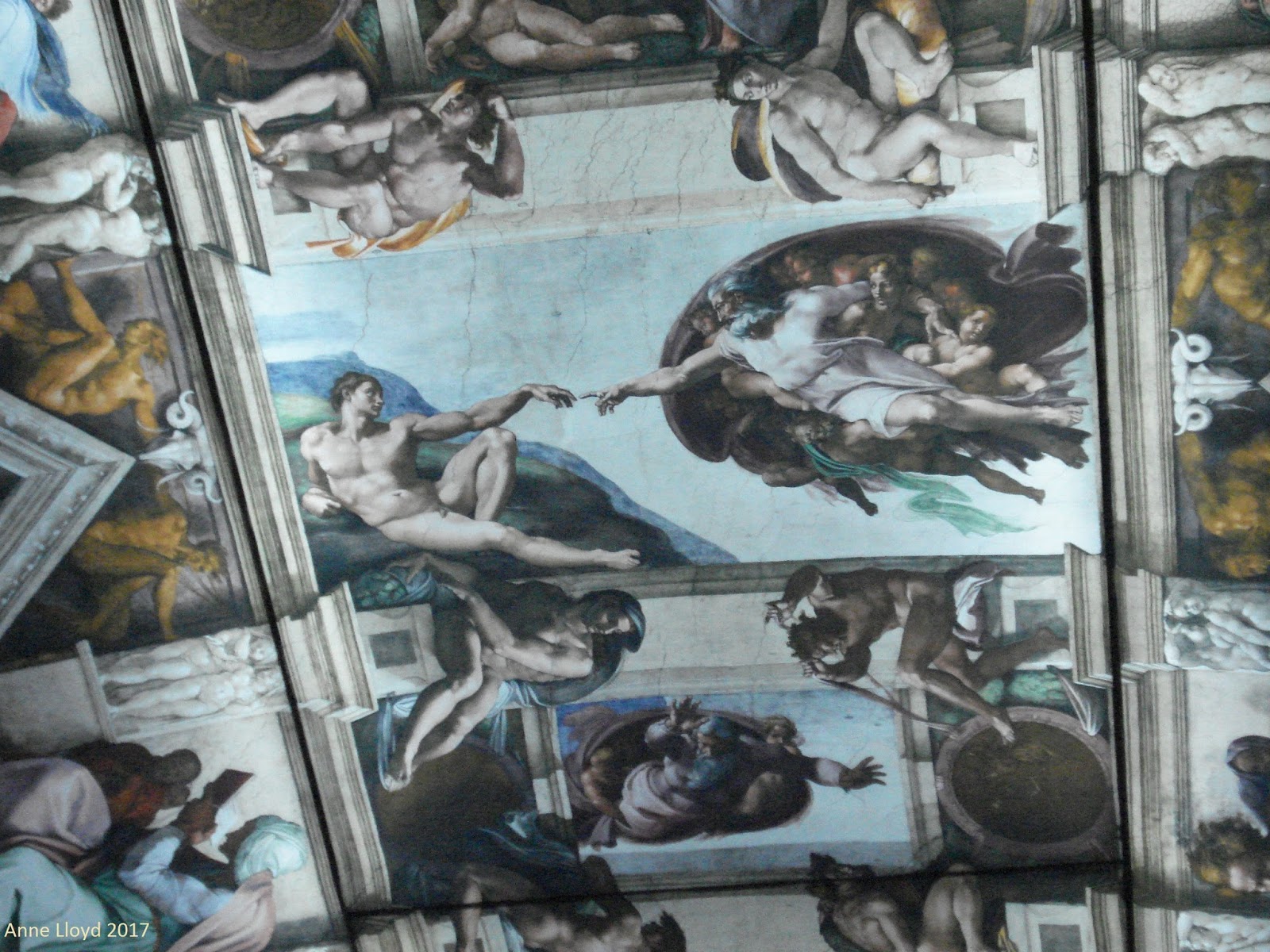
That was especially true of the Sistine Chapel frescoes. Unlike the Battle of Cascina, the cosmic drama of the Book of Genesis was carried through to completion. With skill and audacity to match Michelangelo, the Metropolitan has replicated the fabled Sistine Chapel ceiling with a lighted photo version above the Tisch galleries. The scale, though reduced, approximates the experience of looking at the original in Rome.


Anne Lloyd, Photo (2017) Gallery view of Michelangelo: Divine Draftsman & Designer

The effect of being able to study Michelangelo's studies for the figures of the Sistine ceiling and then to look above you at the wondrous copy is enlightening in a way that no close study of the many fine books dealing with the Sistine frescoes can ever be. 

The sheer brilliance of the Metropolitan exhibit enables you to look at the original study for the Cumaean Sybyl, check it against the dazzling overhead display and thus progressively see how the image was incorporated into the whole design of the Sistine Chapel fresco.


Anne Lloyd, Photo (2017) Detail of Michelangelo' s Study of the Cumaean Sibyl (top),
followed by details of Metropolitan Museum reproductions of the Cumaean Sibyl


Even straining your neck to look at the original in the Vatican does not allow you to do that. My wife, Anne, an accomplished artist herself, described the effect. 

"I finally get the Sistine Chapel," Anne said. 

The sensational impact of the re-imagined Sistine Chapel is reinforced by the presence of a sculpture group in the very next gallery. To see a Michelangelo statute in the United States is a rare treat. There are two in this group, along with contrasting portrait busts, one from ancient Rome and another of Julius Caesar by Andrea Ferrucci (1465-1526). 


.Anne Lloyd, Photo (2017) Gallery view of the Michelangelo: Divine Draftsman and Designer exhibit, Michelangelo's David/Apollo at left.

The standing sculpture, David/Apollo, begun around 1530, was never completed by the overworked Michelangelo. As a result, this non-finito work is impossible to identify as either David or Apollo. 


Anne Lloyd, Photo (2017) Gallery view of the Michelangelo: Divine Draftsman and Designer exhibit, Michelangelo's Brutus at center.

That's not case with the bust of Brutus. Sculpted in 1539, Brutus exerts a living presence. Here unquestionably is the portrait of a noble Roman. This forceful evocation of Caesar's assassin also points to the power-politics of Michelangelo's era.

Michelangelo was a supporter of the Republic of Florence, which had been suppressed by one of the Medici successors to Lorenzo the Magnificent. This was the brutal Duke Alessandro, assassinated in 1537 by his cousin, Lorenzino da Medici. Lorenzino was motivated by Republican sentiments similar to Michelangelo's. Alessandro's death, alas, did not lead to the restoration of the Florentine Republic. Michelangelo may have left his bust of Brutus unfinished in silent protest to the passing of Florence's republican tradition.

It is incredible to think that when Michelangelo stopped working on Brutus in 1539, he had a quarter of a century of life before him. Could he not have finished the bust of Brutus?

The obvious answer to this question is provided by the Metropolitan exhibit which cogently outlines his later epic works: the Last Judgment fresco and the architectural design of the basilica of St. Peter's. Michelangelo might cease working on a statue like Brutus but he never stopped working.

There is another reason, I believe, that many of the statues from his later years remained non-finito. Michelangelo was motivated by spiritual impulses that compelled him to work to the point that Spirit, God's spirit, was satisfied and then to move on. It was a case of God's will be done rather than Michelangelo's.

Michelangelo composed a beautiful poem, a madrigal, around 1534. These verses, translated by the great Renaissance scholar, Creighton Gilbert, confirm that Michelangelo certainly believed that he was obeying God's will.

Beautiful things are the longing of my eyes,                                                              
 Just as it is my soul’s to be secure,                                                                                 
 But they’ve no other power                                                                                              
That lifts to Heaven, but staring at all those.                                                                    
A shining glory falls                                                                                                          
From furthest stars above,         
Toward them our wish it pulls,                                                                                       
 And here we call it love.                                                                                                
Kind heart can never have,                                                                                                
To enamor and fire it, and to counsel,                                                                            
More than a face with eyes that they resemble.

If my interpretation of this madrigal is correct, Michelangelo believed that God's face, with eyes that resemble stars, watched over his creative achievements. It was not Michelangelo's "kind heart" but heavenly inspiration that impelled him to attempt and to achieve the impossible.


Anne Lloyd, Photo (2017) The Metropolitan Museum reproduction of the Sistine Chapel ceiling, with Michelangelo's Creation of Adam at center. 

Any person fortunate to visit Michelangelo: Divine Draftsman and Designer at the Metropolitan is likely come to the same conclusion. The evidence is overwhelming.

***
Text: Copyright of Ed Voves, all rights reserved    

Madrigal by Michelangelo Buonarroti, c.1534. Translated by Creighton Gilbert in Complete Poems and Selected Letters of Michelangelo, Princeton University Press, 1980, first edition published by Random House, 1963.

Images courtesy of the Metropolitan Museum of Art and Anne Lloyd

Introductory Image:
Anne Lloyd, Photo (2017) Daniele da Volterra's Portrait of Michelangelo Buonarroti, ca. 1544, oil on wood, 34 3/4 x 25 1/4 in. (88.3 x 64.1 cm) Metropolitan Museum of Art

Michelangelo Buonarroti (Italian, 1475–1564) Three Labours of Hercules, 1530–33. Drawing, red chalk; 10 11/16 x 16 5/8 in. (27.2 x 42.2 cm) ROYAL COLLECTION TRUST / © HER MAJESTY QUEEN ELIZABETH II 2017, www.royalcollection.org.uk.


Michelangelo Buonarroti (Italian, 1475–1564) Portrait of Andrea Quaratesi, 1532.
Drawing, black chalk; 16 3/16 x 11 ½ in. (41.1 x 29.2 cm) The British Museum, London

Anne Lloyd, Photo (2017) Photo of Michelangelo’s Study of Adam and Eve after The Expulsion from Paradise fresco by Masaccio, c. 1503-04. Red chalk. Musée du Louvre, Department des arts Graphiques, Paris (3897 recto)

Michelangelo Buonarroti (Italian, 1475–1564) Il Sogno (The Dream), 1530's. Black chalk. Sheet: 15 5/16 × 10 15/16 in. (38.9 × 27.8 cm) Sheet: 15 5/16 × 10 15/16 in. (38.9 × 27.8 cm) London, Courtauld Gallery, Prince Gate Bequest (1978) inv. D 1978.PG.424

Anne Lloyd, Photo (2017) Michelangelo's Pieta, ca. 1540, Black chalk,  28.9 x 18.9 cm (11 3/8 x 7 7/16 in. Isabella Stewart Gardner Museum. 1.2.o.16


Michelangelo Buonarroti (Italian,1475–1564) Studies for the Libyan Sibyl (recto), Ca. 1510–11. Red chalk, with small accents of white chalk. Sheet: 11 3/8 x 8 7/16 in. (28.9 x 21.4 cm) The Metropolitan Museum of Art, Purchase, Joseph Pulitzer Bequest, 1924. 24.197.2


Anne Lloyd, Photo (2017), Detail of Michelangelo's Male Back with a Flag, c. 1504.  Albertina, Vienna.123v

Anne Lloyd, Photo (2017) Gallery view of Michelangelo: Divine Draftsman & Designer.

Anne Lloyd, Photo (2017) Detail of Michelangelo' s Study of the Cumaean Sibyl and the Metropolitan Museum of Art's reproductions of the Cumaean Sibyl on the Sistine Chapel ceiling at the Michelangelo: Divine Draftsman and Designer exhibit.

Anne Lloyd, Photo (2017) Gallery view of the Michelangelo: Divine Draftsman and Designer exhibit at the Metropolitan Museum of Art, showing Michelangelo's David/Apollo (C. 1530) and Brutus (1539), Marble Portrait of Emperor of Caracalla, Third Century A.D., and Andrea Ferrucci's Julius Caesar (c.1512-14) 

Anne Lloyd, Photo (2017) Gallery view of the Michelangelo: Divine Draftsman and Designer exhibit at the Metropolitan Museum of Art, Michelangelo's Brutus, center.

Anne Lloyd, Photo (2017) Gallery view of Michelangelo: Divine Draftsman and Designer, showing the Metropolitan Museum reproduction of the Sistine Chapel ceiling, with Michelanglo's Creation of Adam at center.