Showing posts with label Mayan Art. Show all posts

Saturday, March 25, 2023

Art Eyewitness Review: Lives of the Gods: Divinity in Maya Art


Lives of the Gods: Divinity in Maya Art

Metropolitan Museum of Art, Nov. 2022 - April 2, 2023

Kimbell Art Museum, Fort Worth TX, May 7 - Sept. 3, 2023

Reviewed by Ed Voves

Original photography by Anne Lloyd

To compare ancient peoples, separated by thousands of miles and hundreds of years, is always problematical. The danger of emphasizing superficial resemblances between two cultures can easily lead to dubious or untenable conclusions.

Despite this risk, I think that the astonishing Mayan kingdoms of southern Mexico and Central America rank with the ancient Greeks as the most dynamic cultures of their respective regions. What the Greeks were to the lands bordering the Mediterranean Sea, the Maya equaled in their influence on the Mesoamerican world.

After visiting the Lives of the Gods: Divinity in Maya Art exhibition, now in its final weeks at the Metropolitan Museum, one is struck by the singular nature of Mayan civilization. The parallels with Greece, however, are certainly interesting. The small Mayan kingdoms, like the Greek city-states, never formed a united coalition or empire. But that can be said of other native peoples of the Americas as well, like the Moche of Peru.


Anne Lloyd, Photo (2022)
 Gallery view of the Lives of the Gods Art exhibit,
 showing Column, from Campeche, Mexico, c. 800-900

The fundamental influence of religion on both the Maya and the Greeks is what really counts in comparing the two cultures. As the subtitle of the Met's exhibition, Divinity in Maya Art, affirms, religion was fundamental to the Mayan peoples.

Lives of the Gods: Divinity in Maya Art is a superb exhibition, very much in the grand tradition of the Met. Inevitably, it will be compared with the 2018 Golden Kingdoms exhibit which presented 200 treasures, notably exquisite gold jewelry, of the Aztecs, Incas and Mayas. There is little glitter in the 100 works of art on view in Lives of the Gods, but visitors should not be disappointed. The Maya regarded jade as far more valuable than gold and they honored their gods with a another precious substance which cannot be put on view in a modern art museum: blood.


Anne Lloyd, Photo (2022)
 Maya jade pendants, 7th-9th century

Mayan gods were powerful, capricious beings, willful and cruel like Zeus and company. But they were different, too. Mayan gods, especially the youthful and much-loved Maize God, could perish and be reborn. 


Anne Lloyd, Photo (2022 )
 Gallery view of Lives of the Gods, showing Maize God, from Copan, 715

The gallery devoted to images of the Maize God is centered on a sensational limestone carving from Copan in Honduras. The exhibition text, expressed in almost poetical terms, deserves quotation here because it demonstrates the emotional appeal of certain aspects of Mayan religion:

The Maize God is an eternally youthful being who endures trials and overcomes the forces of death. Maya artists portrayed him as a graceful young man with glossy skin and a sloping forehead, his elongated head resembling a maize cob crowned with silky, long locks of hair... Formally appealing and conceptually rich, the Maize God’s transit through death and his subsequent rebirth were metaphors for regeneration and resilience.

Not all of Mayan cosmology touched the hearts of the people with the reassuring symbolism of the Maize God. Religion for the Maya was an awe-inspiring, often terrifying system of belief.


Anne Lloyd, Photo (2022)
 Censer Stand, from Palenque, Mexico, c. 690–720
 
Among the first images to greet visitors to Lives of the Gods are fearsome-looking censer stands, on the top of which were placed vessels of smoldering incense. Often these censers bore the image of jaguar gods, incarnations of nocturnal menace. Jaguars, stealthy predators lurking in the jungles surrounding the Mayan cities, were an obvious choice to symbolize divine wrath.


Anne Lloyd, Photo (2022)
 Jaguar God Censer Stand, from Palenque, 7th–8th century

The terrifying aspect of statues and paintings of the Mayan gods was emulated by the kings or ajaws of Mayan states like Palenque or Tikal. This wasn't just "dress-up" on the part of Mayan rulers like the formidable King Jaguar Bird Tapir of Tonina in southern Mexico. The rulers of Mayan kingdoms assumed the personality of gods for important ceremonial and religious functions.


Anne Lloyd, Photo (2022)
 King Jaguar Bird Tapir, from Tonina, Mexico, early 7th century
 
For all of the "divine-right" authority with which Jaguar Bird Tapir and his peers were invested, being a Mayan monarch was no easy task. And of all the royal burdens of state, none was more significant than keeping the gods "happy."

Due to the challenging natural environment of the Mayan world, which the Met exhibition evokes with brilliant video and sound clips, the gods of the Maya needed to be constantly placated.


Anne Lloyd, Photo (2022)
 Gallery view of the Lives of the Gods exhibit,
 showing video of Tikal and El Mirador, filmed by Ricky Lopez Bruni

The Mayas - like their northern rivals in the great city of Teotihuacan in central Mexico, lived in danger of frequent droughts, the annual hurricane season, periodic earthquakes and the occasional volcanic eruption. These disasters involved the anger of deities like Chahk, the god of rain and storms, or K’awiil, the celestial lord of lightning. These heavenly overlords lashed out when provoked by human failure to pay them due homage.

To keep the gods pleased required rich gifts, chiefly of human blood. This sacrificial bloodletting is not pleasant to consider but it is necessary given the role it played in Mayan religion.

Blood sacrifice among the Maya came in two forms. The first involved the ritual execution of captives, an almost universal practice by the peoples of Mesoamerica. We will address this briefly later in the essay.

The other form involved shedding one's own blood, an act largely reserved for the Mayan kings, queens and nobility at moments of high importance, such as transition points on the calendar cycle or the opening of a military campaign. This act of personal mutilation was known as ch'ahb' meaning "penance" and was often inflicted by stabbing with a stingray spine.


Anne Lloyd, Photo (2022) 
Lady K'abal Xook Conjuring a Supernatural Warrior, Yaxchilan, Mexico, 725

One of the key works of art in the exhibition is a carved limestone lintel which depicts such an act of blood sacrifice. It is entitled Lady K'abal Xook Conjuring the Spirit of a Warrior. Lady K’abal Xook, was the wife of Shield Jaguar III, king of Yaxchilan, located on the border of Chiapas, southern Mexico, and Guatemala.


In this work from the British Museum collection, Lady K'abal Xook has pieced her tongue and is bleeding into a bowl containing pieces of cloth. These, most likely made of cotton fabric, will absorb the blood and then be burned as an offering. Weakened by bleeding and related rituals such as fasting, Lady K’abal Xook will be enabled to enter into a trance state and commune with the other world.


This is exactly what is depicted in the detail above. A spirit warrior, armed with shield and spear, emerges from a giant serpent's mouth, in order to converse with Lady K'abal Xook. The scene most likely refers to preparations for war, as her husband's kingdom, Yaxchilan, was one of the most aggressive Mayan states.

The impressive carving of Lady K'abal Xook and the spirit warrior bears a few faint traces of the vivid colors with which it was painted when created around the year 725. Whatever guidance she received in her vision ultimately failed to help Lady K'abal Xook's homeland. The population of Yaxchilan, worn-down by constant warfare and drought, abandoned the city a century later, during the widespread collapse of the Classical Mayan kingdoms.


Anne Lloyd, Photo (2022) 
Gallery view of the Lives of the Gods exhibit,
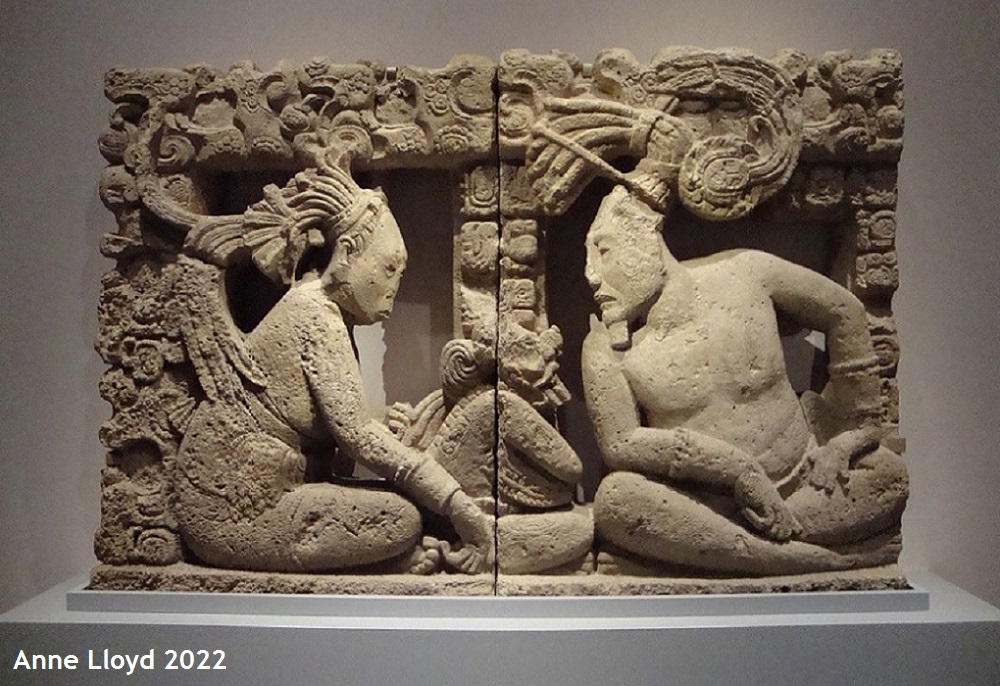
 showing Throne Back, from Mexico or Guatemala, 7th-9th century

A very different visit by a celestial being was carved into the upright back panel of a throne  (above). It was discovered in Guatemala, at a site on the Usumacinta River not far from Yaxchilan. The date of its creation is unknown, but is projected as occurring between the seventh and ninth centuries. I don't profess to being an expert in Mayan art, but I suspect that this wondrous work of art (my favorite in the exhibition) was created in the earlier range of these dates.

This carved backrest to a throne shows a Mayan king (at right) conversing with a small, supernatural visitor (center). This unearthly creature has the face of a jaguar deity and wings. His upward gaze meets that of the Mayan ajaw. It is truly a meeting of two worlds.
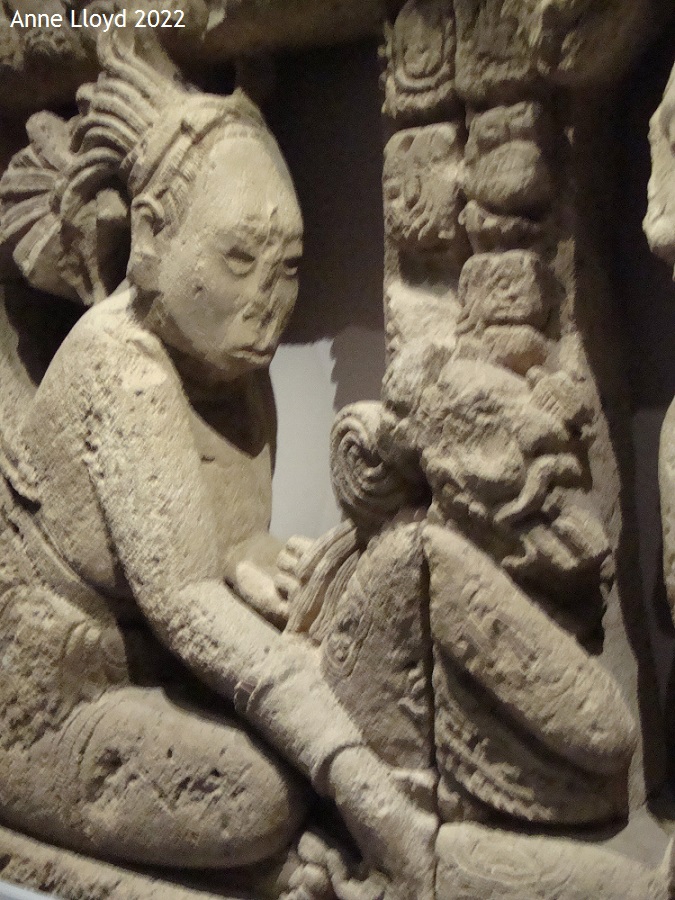


Details of Throne Back, 7th-9th century

Oddly enough, the face of the jaguar deity resembles that of a shipwrecked Spanish sailor, though centuries before Columbus. Behind him, a royal attendant takes in the interview, perhaps mystified, as we are, at what is going on.

What message does the jaguar deity impart to the intently-listening king? Of course, we cannot know. But experts in Mayan art and religion locate the scene to a cave, sacred places to the Maya. Whatever communication is being given, it is certainly of importance. 

What impresses me with this magnificent carving is the tone of a style and presentation. It is free of the frightful imagery which we see on carvings from the eighth and ninth centuries when the Mayan kingdoms were in their death spiral. That is why I surmise that it should be dated earlier, before the fatal steps to the dissolution of the Classical Mayan age had been taken.

Indeed, Mayan art of the earlier periods, (proto-Classical and early Classical, third-fifth centuries) often demonstrates humane values and a sense of humor. There are quite a few examples of early Mayan art on view in Lives of the Gods, making this part of the exhibition a very enjoyable and compelling trip back in time.


Anne Lloyd, Photo (2022) Whistling Vessel, 5th century

Displayed close to the Throne Back carving is a whistling device showing another mythical scene. Activated by being filled with water, the ceramic vessel mounts a vignette showing  a trickster tale. A fearsome bird deity confronts a kneeling human being, unaware of a cat climbing-up the side of the vessel, ready to pounce.

Other ceramic masterworks on view comprise a group of lidded vessels for feast days, topped with animal knobs or handles. Howler monkeys, a peccary and a turtle with a grinning man's head emerging from its mouth attest to the Maya kinship with the animal realm and a generous helping of fun. It's hard to resist a smile when looking at these wonderful examples of Mayan pottery.


Anne Lloyd, Photo (2022) Lidded vessel with Peccary Handle, 4th century


Anne Lloyd, Photo (2022)
 Lidded Vessel with Mythological Turtle, 4th century

As the timeline of Lives of the Gods reaches the eighth and ninth centuries, the  Mayan success story began to turn to ashes. The complex turn of event, drought, soaring population, hardening class distinctions are still being studied by historians. One thing can be certain, during the 700's, the time of Lady K’abal Xook's vision quest, warfare in the Mayan world escalated from low-intensity raids to secure a few captives for sacrifice to rampaging campaigns of wholesale destruction.


Anne Lloyd, Photo (2022)
 Gallery view of Lives of the Gods, showing statues of captive warriors

The terrible eclipse of Classical Mayan civilization is evoked in the carved images of bound prisoners awaiting execution. As part of his humiliation, a captive warrior named Yak Ahk' has been dressed as a jaguar deity, who had been tortured and killed in a tale from Mayan myth. 


Anne Lloyd, Photo (2023)  
Yak Ahk' as Captive, Impersonating a Jaguar Deity, c. 700

The precise chronology of the Maya wars is still incomplete and likely to remain so. Looking at this one carving is quite sufficient, however, to illustrate the suicide of the Classical Maya kingdoms. The image of Yak Ahk's suffering recalls the haunting 1971 photo of a young Vietnamese girl, Phan Thi Kim Phuc, set aflame by napalm. One picture tells us all we need to know.

The Mayan people proved able to survive the apocalypse of the Classical kingdoms. After the great cities were abandoned, by the year 900, Mayan life reconfigured on a localized, village basis. This decentralized community structure produced less in the way of great art, but enabled the Maya to survive the Spanish invasions of the 1500's and the epidemic diseases which followed in the footsteps of the Conquistadors.

The Met exhibit pays tribute to contemporary Maya life with a colorful video clip of a modern day festival. Dance of the Macaws in the Santa Cruz Verapaz, Guatemala, was filmed by Ricky Lopez Bruni. Dance of the Macaws exudes the life and spirit of the Maya, filling the exhibition gallery with incandescent light - and a palpable feeling of life!


Anne Lloyd, Photo (2022) 
Gallery View of the Lives of the Gods exhibit, showing
 Dance of the Macaws, filmed by Ricky Lopez Bruni

The survival of the Maya over the ages and their still-flourishing folk-culture is as remarkable a phenomenon as the pyramids, statues and paintings their ancestors created over twelve hundred years ago.

Happily, Lives of the Gods: Divinity in Mayan Art will be traveling to the Kimbell Art Museum, Fort Worth, Texas,  after it closes at The Met. This year marks the 50th anniversary of the Kimbell Museum and I can't conceive of better company for this celebration than the Maya, ancient and modern.

 ***

Text: Copyright of Ed Voves, all rights reserved                                                      

Original photography, copyright of Anne Lloyd

Introductory Image: Anne Lloyd, Photo (2022) Maize God, 715, from the British Museum. Details below.

Anne Lloyd, Photo (2022) Gallery view of the Lives of the Gods: Divinity in Maya Art exhibit, showing Column, from Campeche, Mexico, c. 800-900. Limestone: H. 68 3/4 x 29 in. Metropolitan Museum of Art. 

Anne Lloyd, Photo (2022) Gallery view of the Lives of the Gods exhibit, showing Maya jade pendants, 7th-9th century. Collection of the Metropolitan Museum of Art. 

Anne Lloyd, Photo (2022 ) Gallery view of the Lives of the Gods exhibit, showing Maize God, from Copan, Honduras, 715. Limestone: H. 35 1/16 x W. 22 1/4 in. x D. 11 13/16 in. 264.6  lbs. British Museum.

Anne Lloyd, Photo (2022 ) Censer Stand, from Palenque, Mexico, c. 690–720. Ceramic, traces of pigments: H. 44 × W. 22 × D. 12 1/4 in.,103 lb. (111.8 × 55.9 × 31.1 cm, 46.7 kg) Kimbell Art Museum, Fort Worth, TX

Anne Lloyd, Photo (2022 ) Jaguar God Censer Stand, from Palenque, Mexico, 7th–8th century. Ceramic: H. 26 × W. 14 9/16 × D. 6 5/16 in., 132.3 lb. (66 × 37 × 16 cm, 60 kg) Museo de Sitio de Palenque Alberto Ruz

Anne Lloyd, Photo (2022 ) King Jaguar Bird Tapir, from Tonina in Chiapas, Mexico, early 7th century. Limestone: 8 ft 5 9/16 in. x 28 3/4 in. x 20 1/16 in. 881.8 lb. Museo de Sitio de Tonina, Mexico.

Anne Lloyd, Photo (2022 ) Gallery view of the Lives of the Gods exhibit, showing video of Tikal and El Mirador, Guatemala, filmed by Ricky Lopez Bruni.

Anne Lloyd, Photo (2022) Lady K'abal Xook Conjuring a Supernatural Warrior, Yaxchilan, Mexico, 725. Limestone: H. 47 5/8 × W. 33 11/16 × D. 5 5/16 in., 509.3 lb. (121 × 85.5 × 13.5 cm, 231 kg) British Museum.

Anne Lloyd, Photo (2022) Detail views of Lady K'abal Xook Conjuring a Supernatural Warrior.

Anne Lloyd, Photo (2022) Gallery view of the Lives of the Gods exhibit, showing Throne Back, from Mexico or Guatemala, 7th-9th century. Limestone: H. 43 11/16 x W. 65 3/8 x D. 9 1/4 in. 937 lb. Museo Amparo Collection, Puebla, Mexico

Anne Lloyd, Photo (2022) Detail views of Throne Back (See above). 

Anne Lloyd, Photo (2022) Whistling Vessel, from Guatemala or Mexico, 5th century. Ceramic: H. 11 7/8 x W.  7 3/4 x D. 5 1/4 in. Metropolitan Museum of Art

Anne Lloyd, Photo (2022) Lidded vessel with Peccary Handle, from Guatemala, 4th century. Ceramic: H. 10 5/8 x Diam. 12 5/8 inches. Museo de Nacional Arqueologia & Ethologia, Guatemala.

Anne Lloyd, Photo (2022) Lidded Vessel with Mythological Turtle, 4th century. Ceramic: H. 9 5/8 x Diam. 10 7/16 inches. Museo de Nacional Arqueologia & Ethnologia, Guatemala.                                                                                                                                                                                                             Anne Lloyd, Photo (2022) Gallery view of the Lives of the Gods exhibit, showing statues of captive warriors, Yak Ahk' (left) and Muwaan Bahlam,     

Anne Lloyd, Photo (2023)  Yak Ahk' as Captive, Impersonating a Jaguar Deity, c. 700. Sandstone: H. 22 7/16 x W. 18 1/8 x D. 4 5/16 in. 176.4 lb. Museo de Sitio de Tonina, Mexico.

Anne Lloyd, Photo (2022) Gallery view of the Lives of the Gods exhibit, showing video clip of Dance of the Macaws. Filmed by Ricky Lopez Bruni. 


Friday, March 9, 2018

Golden Kingdoms: Luxury and Legacy in the Ancient Americas at the Metropolitan Museum of Art


Golden Kingdoms: 

Luxury and Legacy in the Ancient Americas


Metropolitan Museum of Art
February 28 - May 28, 2018

Reviewed by Ed Voves
Photos by Anne Lloyd

It is a very rare occasion when an art lover can relive the experience of a great exhibition of the past. We can make such a journey, thanks to the Metropolitan Museum of Art's new exhibit, Golden Kingdoms: Luxury and Legacy in the Ancient Americas.

Albrecht Dürer visited the townhall of Brussels on August 27, 1520. There he saw the spectacular treasures sent from Mexico by Hernan Cortes to the Holy Roman Emperor, Charles V. 

None of the incredible array of art works from the Aztec, Maya, Inca and other native American cultures at the Met actually appeared in Brussels nearly 500 years ago. But the emotional impact which these dazzling objects makes surely approximates what Dürer felt as he beheld the glittering jewelry and "idols" seized by the Spanish conquistadores:

I saw the things which have been brought to the King from the new land of gold, a sun all of gold a whole fathom broad, and a moon all of silver of the same size, also two rooms full of armor of the people there, and all manner of wondrous weapons of theirs, harness and darts, very strange clothing, beds, and all kinds of wonderful objects of human use...  All the days of my life I have seen nothing that rejoiced my heart so much as these things, for I saw amongst them wonderful works of art, and I marveled at the subtle Ingenia of men in foreign lands. Indeed I cannot express all that I thought there.

Walking through the galleries of Golden Kingdoms produces the same sensations.This vast exhibit displays over 300 works of art of astonishing beauty and craftsmanship. There is enough here for three or four exhibitions and plenty of food for thought!


Anne Lloyd, Photo (2018) Gallery view of the Golden Kingdoms Exhibit

Golden Kingdoms was organized and presented by the Getty Museum in Los Angeles, before coming to the Met. It is the most comprehensive examination of the art produced by the network of cultures that together constituted the civilization of the Americas before the arrival of Columbus and Cortes in the early sixteenth century.

As the title suggests, the emphasis is placed on works of cast gold ornaments and votive objects. This decision is sure to produce a lot of "bling" for the exhibit, no small consideration in trying to entice big crowds to art museums these days.

The Metropolitan exhibition of pre-Columbian art works is equally significant for the attention given to art works which were not created from precious metals.The native American peoples actually rated gold and silver as less valuable than jade and bird feathers. After glimpsing the few remaining  examples of featherwork, like the sleeveless garment or tabard decorated with feathers, made in Peru at some point between 500 to 750 AD, it is much easier to appreciate the regard for such works of art.


Tabard with Lizard-like Creatures, Nasca culture, 500-750 A.D.

This tabard was made by artists of the Nasca culture (100 B.C-800 A.D.), one of the precursors of the more famous Inca Empire. The Incas were the last of a long line of innovative peoples who lived on the arid west coast of Peru. The Chavin, 800–550 B.C., Moche, A.D. 200–850 A.D, Wari, A.D. 600–1000, and Chimú, A.D. 900–1470, cultures created astonishing art works, in all media, examples of which are on display in the Metropolitan exhibit.

The same pattern of creative achievement by earlier, less-well-known, groups is apparent in Mexico, Central America and the north coast of South America, today's nation of Columbia. The spectacular eagle-shaped pendents worn by the Chiriqui people of Costa Rica were observed by Columbus on his fourth voyage of 1502. Suspended by a cord around the neck, these pendents reminded Columbus of Christian religious medals, as "an Agnus Dei or other relic." 


Anne Lloyd, Photo (2018) Eagle Pendants, Chiriqui culture, 800-1519 A.D

Today, we marvel at the artistry of these works, but the Spanish conquistadors who came after Columbus valued them for their gold content. Whether crafted from gold, jade or other precious materials, the art works on display at the Metropolitan are testaments to a New World civilization that owed nothing to the influences or example of the Old - until after the conquests of the 1500's. 

Certainly, there were contacts and shared technologies between the native American cultures before Columbus. According to the exhibit curators, the innovations for working with gold began in Peru and gradually spread northward. But what is really remarkable about the works on display in Golden Kingdoms is the extreme level of artistic accomplishment among all these cultures, from very early dates. The skillful, unnamed artists could only have had limited interaction.

Comparison of two exceptional works of art are instructive in this regard: a golden octopus-shaped frontlet made by a Moche artist in Peru and a jade mask from the Olmec realm near the present-day city of Veracruz, Mexico.

The Moche, like the ancient Greeks, lived in a network of small independent communities. Based on the northern coast of Peru, facing the Pacific Ocean, the Moche are most famous today for creating ceramic portrait heads, which we will examine later. 


Anne Lloyd, Photo (2018) Octopus Frontlet, Moche culture, 300-600 A.D.

The Moche mastery of goldsmithing was every bit as sensational. A sheet of beaten gold was cut into the shape of an extraordinary mythological being, a menacing octopus-like beast with clawed feet and catfish heads on the tips of its tentacles.

This frontlet, was designed to be affixed to a headdress, no doubt sporting eagle or condor feathers. The mythological beast it depicts is a composite being. No octopus has a human skull-shaped head with reptile fangs, and of course the Moche artists knew that. 


Anne LloydPhoto (2018) Olmec Mask, 900-400 B.C.

Rather, this extraordinary creation projects fearsome attributes that were intended to be emblematic of the power of a Moche leader or warrior. Moche culture was notable for astonishing creativity - and for internicine warfare.

Two thousand miles to the north of Peru, the Olmecs created the foundational culture of Mesoamerica, where the later Toltec, Maya and Aztec empires were to rise. The Olmecs flourished in the tropical coastal region bordering the Gulf of Mexico from 1200 to 400 BC. Their downfall, about which we know little, preceded the rise of the Moche in Peru by six hundred years.

If the Olmecs had any influence on the native American cultures of Peru, it could only have been indirect. Olmec carvings were collected by the Aztecs and others, much as Greek and Roman statues were sought after by the nobility of Europe during the Renaissance.   

The Olmecs perfected sculpting in jadeite and this gray-green stone was viewed as immensely valuable in Mesoamerica until the arrival of the Spaniards in 1519. This striking mask was created between 900 to 400 B.C., the same period as the flowering of Greek art. 


Anne Lloyd, Photo (2018) Olmec Mask, 900-400 B.C.

The mask is noteworthy for the incredible degree of skill in carving out the jadeite core to make the mask lightweight and thereby wearable. Notable too, is the simplicity, the almost abstract quality of the face, so appealing to modern sensibilities. 

This mask likely represented an ancestor spirit. It has several small holes drilled near the top rim for a headdress to be attached, and holes in the ears for dangling ornaments. The Olmecs worshiped a maize god, in keeping with the vital role of the crop which fed the people of Mesoamerica for thousands of years. Perhaps, the mask was worn by a priest leading the people in religious devotions.

Golden Kingdoms provides a wealth of outstanding art to enjoy. I was particularly impressed with the reclining figure from the Mayan pilgrimage site of Chac Mool in the Yucatan Peninsula. Chac Mool was considered to be a portal to heaven because there was a pool of water on the site held to be sacred. Pilgrims brought offerings to Chac Mool, placing some on the tray held by this celestial being.


Anne Lloyd, Photo (2018) Chac Mool Sculpture, Maya Culture, 800-1250 A.D.

The great British sculptor, Henry Moore (1898-1986) was intrigued with Mesoamerican statues, especially Chac Mool figures of this type. The influence on Moore's work is obvious, even when looking at illustrations in art books. But when you come face-to-face with the real thing, the impact is tremendous.

Many of the objects on view in Golden Kingdoms are much smaller and less imposing than the Chac Mool statue. Exquisite golden pendants, ear rings and other items or personal adornment feature prominently in the exhibit. These were coveted items by Cortes and the Conquistadores, who melted them down into bullion.


Anne Lloyd, Photo (2018) Aztec ornaments and bar of gold bullion, ca. 1500's

Not all of this looted gold made it to Spain. One of the concluding galleries of Golden Kingdoms shows what happened to many treasures not on view. A bar of gold, excavated in Mexico City, was almost certainly made of Aztec gold, smelted by the Spanish and then  lost on the Noche Triste, the "Night of Sorrows."

On June 30,1520, Cortes and his men tried to escape from the Aztec capital under the cover of night. Laden with gold bullion and weighed down by their armor, many of the Spaniards were killed. Wounded in the fighting or disoriented in the darkness, they plunged to their deaths from the causeway into the lake surrounding Tenochtitlan.

The native American peoples were no strangers to war, even before the arrival of Cortes and his Conquistadores.


Aztec warrior from the Codex Ixtlilxochitl, Folio 106 (recto), 1582 A.D.

Just as the early native American cultures, the Olmecs and the Moche, set the tone of artistic achievement, so the manner and objectives of warfare were established at a distant time.The capture of enemies, who would then be sacrificed to appease the gods, became the principle goal of war among the peoples of Mexico and Peru. 

By an amazing stroke of luck, we can put a human face to this unpleasant aspect of life - and death - in the ancient Americas. A ceramic portrait vessel was discovered, showing a Moche warrior, whom archaeologists call "Black Stripe." Dated to ca. 550 A.D., this is a masterpiece of the first rank. In terms of physiological depiction and psychological insight, the ancient Greeks could not have done better in marble or bronze.


Anne Lloyd, Photo (2018) Moche Portrait Vessel, 400-650 A.D.

This magnificent portrait shows Black Stripe in his prime, a victorious combatant in many a duel. It reminds me of nineteenth century photographs of the warrior chiefs of the Great Plains who fought the U.S. Cavalry, Red Cloud of the Lakota Sioux and Quanah Parker of the Comanches. Here is the face of battle: bravery, cunning, toughness and cruelty.

There is however, another portrait of Black Stripe, which is not shown in the Golden Kingdoms exhibit. It appears in the Thames and Hudson book, What Makes a Masterpiece (2010). In this later portrait, Black Stripe is a captive, stripped of his regalia and no longer wearing his signature war paint. He is waiting to be sacrificed.

Historians have still to figure out why the Moche would go to such great lengths to create unforgettable portraits on ceramic vessels with stirrup-like handles. It is a mystery and will probably ever remain so. 


Detail of Moche Portrait Vessel, 400-650 A.D.

However, in a delicious piece of irony, Moche ceramics were collected by Paul Gauguin's mother, Alina, while they lived in Peru during his childhood. It is amazing to think that these were the first art works that Gauguin studied. The artist who later rejected many of the canons of Western art, in order to embrace the "savage," spent time as a boy looking at examples of Moche art similar to the portrait of Black Stripe! 

Moche art and other superlative examples of native American creativity are now displayed in the Golden Kingdoms exhibit at the Metropolitan Museum of Art. There's no telling what impact these things "from the new land of gold" may have on a future Albrecht Dürer, Paul Gauguin or Henry Moore. 

***
Text: Copyright of Ed Voves, all rights reserved                                                               

Photos courtesy of Anne Lloyd and the Metropolitan Museum of Art

Introductory Image:                                                                                                          Anne Lloyd, Photo (2017) Gallery view of Golden Kingdoms: Luxury and Legacy in the Ancient Americas, showing a Pendant, Tolima culture, 1 B.C. – 700 A.D. Gold.  H. 12 5/8 × W. 6 3/8 in. (32 × 16.2 cm) Museo del Oro, Banco de la República, Bogotá (O06061)

Anne Lloyd, Photo (2017) Gallery view of Golden Kingdoms: Luxury and Legacy in the Ancient Americas

Tabard with Lizard-Like Creatures, Nasca culture, Peru, 500-750 A.D. Feathers on cotton. W. 30 1/2 × L. 46 in. (77.5 × 116.8 cm) Virginia Museum of Fine Arts, Richmond, Arthur and Margaret Glasgow Fund (60.44.3)

Anne Lloyd, Photo (2018) Gallery view of Golden Kingdoms: Luxury and Legacy in the Ancient Americas, showing Eagle Pendants, Chiriqui culture,  800-1519  A.D. Gold. Collection of the Metropolitan Museum of Art.

Anne Lloyd, Photo (2018) Photo of an Octopus Frontlet, Moche Culture, Peru, 300-600 A.D.  Gold, chrysocolla, shells  H. 11 × W. 16 15/16 × D. 1 3/4 in. (27.9 × 43.1 × 4.4 cm) Museo de la Nación, Lima, Ministerio de Cultura del Perú (MN-14602)

Anne Lloyd, Photo (2017) Detail of an Octopus Frontlet, Moche Culture, Peru, 300-600 A.D.  Museo de la Nación, Lima, Ministerio de Cultura del Perú (MN-14602

Anne Lloyd, Photo (2018) Photo of an Olmec Mask, Olmec Culture, Mexico, Veracruz 900-400 B.C. Jadeite. H. 6 3/4 x W. 5 7/8 x D. 3 5/8 in., Approximately 144 oz.) Museo de Antropologia de Xalapa, Universidad Veracruzana, Xalapa (10-582642)

Anne Lloyd, Photo (2017) Gallery view of Golden Kingdoms: Luxury and Legacy in the Ancient Americas, showing a Chac Mool sculpture, Mayan culture, 800-1250  A.D. Stone. (H. 36 1/2 × W. 41 × D. 22 1/4 in., Wt. 1200 lb. (92.7 × 104.1 × 56.5 cm, 544316.429g) Museo Regional de Antropología de Yucatán, Palacio Cantón, Secretaría de Cultura-INAH, Mérida (10-290458)

Anne Lloyd, Photo (2018) Photo of Aztec-era golden pendant and ornaments and a bar of gold bullion, ca. 1519-20 A.D. Aztec and Spanish.  Pendant and ornaments -  Museo Baluarte de Santiago, Secretaría de Cultura-INAH, Veracruz (10-213084) Bar of gold bullion - Museo Nacional de Antropología, Secretaría de Cultura-INAH, Mexico City (10-220012)

Codex Ixtlilxochitl, Folio 106 (recto) Paper, pigment Nahua-Spanish, A.D. 1582. Mexico, Tetzcoco Compilation attributed to Fernando de Alva Ixtlilxochitl (Nahua-Spanish, ca. A.D. 1578–1650) Paris, Bibliothèque nationale de France Source: Bibliothèque nationale de France

Anne Lloyd, Photo (2018) Photo of Moche Portrait Vessel. Ceramic, pigment. Moche, A.D. 400–650 Peru, North Coast Museo Larco, Lima, Peru (ML018883) 

Anne Lloyd, Photo (2017) Detail of Moche Portrait Vessel.