Showing posts with label Ancient Egypt. Show all posts

Tuesday, November 4, 2025

Art Eyewitness Review: Divine Egypt at the Metropolitan Museum of Art


Divine Egypt

Metropolitan Museum of Art

October 12, 2025 - January 19, 2026 

Reviewed by Ed Voves

Original photography by Anne Lloyd and Ed Voves

Visitors to the web site of the Metropolitan Museum of Art are greeted with the welcoming statement, "The Met presents 5,000 years of art from around the world for everyone to experience and enjoy."

That's no idle remark. The Met does indeed share great works of art from across the centuries and spanning the entire human habitat. 

What is remarkable about this statement is that one of the star performers among the Met's nineteen curatorial departments presents works of art created in just one geographical location for a period of over 3000 years.

Where was this society of ancient over-achievers to be found? It was the extraordinary nation whose "lifeblood" was the Nile River. From the waters of the Nile arose the "black land." Carefully cultivated, this narrow ribbon of rich soil produced bountiful crops of wheat and barley, of temples and tombs.

This astonishing realm was, of course, Egypt.


Anne Lloyd, Photo (2025)
 Triad of Osiris, Isis, and Horus, 872-837 B.C.

The Met's Department of Egyptian Art is mounting its most audacious enterprise since the opening of the Temple of Dendur in September 1978, which was followed a few months later by the fabled Treasures of Tutankhamun exhibition at the Met.

Divine Egypt charts the entire course of ancient Egyptian history. This is a radical departure from earlier exhibitions focusing on a single era, like the Met's 2015 Ancient Egypt Transformed: The Middle Kingdom (2010 -1630 B.C.). From the pre-dynastic period (beginning around 3,800 B.C.) to the occupation of Egypt by the Greeks under Alexander the Great three millennia later, Divine Egypt emphasizes the centrality of religion in the lives of generation after generation of people living along the banks of the Nile.


Ed Voves, Photo (2025) 
   Gallery view  of Divine Egypt , showing, from left, Double Statue of King Haremhab and Horus, ca. 1323–1295 B.C. & Hathor seated between King Menkaure and a Personification of the Hare Nome, ca. 2490–2472 B.C.

Divine Egypt at the Met is not a "once in a lifetime" exhibition but, rather, one for the ages.

Max Hollein, the President/CEO of The Met, Diana Craig Patch, head of the Met's Egyptian art department, and the entire Divine Egypt team have achieved a level of curatorial excellence where even the remark, "only the Met could have done this", is not praise enough.


Anne Lloyd, Photo (2025)
Max Hollein, President/CEO of the Metropolitan Museum of Art, 
examining the statue of Wepwawet and Isis-Hathor, 1279-1213 B.C.


Anne Lloyd, Photo (2025)
 Diana Craig Patch, head of the department of Egyptian Art at The Met

Two hundred works of art in a wide range of artistic media insure that Divine Egypt is a visually stunning exhibit, as well as an encyclopedic treatment of Egyptian culture. Most of these "beautiful things" proclaimed Egypt's inter-twined religious and political ideology, but quite a few served utilitarian purposes as well.


Anne Lloyd, Photos (2025)
At left, Water Lily Attachment (1070-664 B.C.), probably a processional ornament; Mirror Displaying a Bat-like Face, 1479-1425 B.C.

One hundred forty of these works of art come from the Met's own collection. Others have traveled from the Louvre, the Ny Carlsberg in Denmark, the Kunsthistorisches Museum, Vienna, and the British Museum, which loaned its huge sculpture of a sacred scarab beetle. Easily, the most alarming object in the Met's exhibition (at least, to modern eyes), the scarab beetle was a more reassuring creature to ancient Egyptians. It symbolized creation and rebirth.


Ed Voves, Photo (2025) 
Gallery view of the Divine Egypt exhibit, showing a scarab sculpture,
 Ptolomaic era, 332-30 B.C. from the British Museum collection

From closer to home, comes one of the first highlights of Divine Egypt. This is the Triad Statue of Hathor, King Menhaure and a Personification of the Hare Nome. Excavated by the famous Harvard University–Museum of Fine Arts Boston Expedition in 1908–9, this Old Kingdom sculpture never loses its power.


Ed Voves, Photo (2025) 
 Hathor seated between King Menkaure and a Personification of the
 Hare Nome, Old Kingdom, Dynasty 4, ca. 2490–2472 B.C. 

The extraordinary masterpieces displayed in Divine Egypt illustrate five key themes of the Egyptian attitude to daily living and eternal life.

This topical approach stresses insight into fundamental ideals and a sense of continuity rather than a conventional historical narrative. Let's take a look at these themes.

The first theme, "Expressing the Divine", focuses on two of Egypt's oldest gods: Horus and Hathor. The falcon-headed Horus can be traced back to pre-dynastic times. Hathor, a shape-shifting, nurturing deity is first documented in 2,600 B.C., during the Old Kingdom. This goddess was certainly a potent spiritual figure far earlier.


Ed Voves, Photo (2025) 
Hathor Pendant, Napatan era, 747-713 B.C. 1665. 

Hathor is recognizable by her distinctive head-ornament composed of cattle horns and a sun disk. This regalia evoked the very distant past of the Egyptians when many of them were nomads with herds of cattle which grazed on the "Green" Sahara. Then a shift in weather patterns, from 4900 to 4400 B.C., scorched this verdant area, evaporating its lakes and rivers and turning the grasslands into the world's most formidable desert. With Hathor as their guide, these first Egyptians found refuge in the valley of the Nile.

According to a later Egyptian writing, the fearsome-visaged Horus battled Seth, the god of the desert and lord of chaos, in a cosmic struggle to determine who would rule Egypt. 

Horus emerged as victor in this mythological combat, earning a prominent place in both religious and political iconography. In Egypt, these were practically the same thing.


Anne Lloyd, Photo (2025)
Double Statue of King Haremhab and Horus, ca. 1323–1295 B.C.


Anne Lloyd, Photo (2025)
 Serekh of King Raneb, Dynasty 2, ca. 2880 B.C.

So important was Horus to Egypt's identity, that all pharaohs took a "Horus name" as part of their title. The symbol of a falcon was placed on top of a rectangular emblem of a palace (above).This badge of authority was called a serekh, usually sculpted onto granite pillars called stelae.

Where Hathor changed her appearance in often bewildering ways, Horus the Falcon retained his original identity, century after century. This can be studied by examining one of the oldest, if rather mundane, artifacts on view in Divine Egypt. This, in turn, may be contrasted with one of the most striking works of art in the entire exhibition.


From left: Ed Voves, Photo (2025) Wine Jar with an early Serekh.  Predynastic Period, ca. 3300–2960 B.C; Anne Lloyd, Photo (2025) 
Statue of Horus as a Falcon Protecting King Nectanebo II, 360 B.C.

The earthenware vessel, likely a wine jar, in the above illustration was produced at some point between 3300 to 2960 B.C. If the latter date is the correct one, then it was created 2,600 years before the Statue of Horus as a Falcon Protecting King Nectanebo II. But this staggering age differential is not the most significant feature of these contrasting artifacts. Both are dedicated to Horus.


Ed Voves, Photo (2025)
 Detail of Horus/Falcon Motif on a Wine Jar with an early Serekh.  Predynastic Period, ca. 3300–2960 B.C.

If you carefully examine the pitted surface of the wine jar, you will see a carefully inscribed symbol of a falcon, standing on top of a serekh. Its design is similar to a serekh associated with the first pharaoh, Narmer, who unified Egypt's two major regions.

The wine jar comes from the area of Naqada. Located in the bend of the Nile in Upper (southern) Egypt, Naqada was one of the first major cities on the banks of the Nile. This was the region ruled by Narmer before he subdued the northern, delta area of Egypt, where the Nile flows into the Mediterranean Sea.

Since beer was the national drink of Egypt and wine was a rare, mostly imported, product, this raises a tantalizing speculation. Might this wine jar, marked with the Horus serekh, have been transported from the Mediterranean coast as a tribute gift for Narmer or another early Egyptian ruler of the unified kingdom?

We are never likely to answer this question for certain. But the representation of Horus on both of these remarkable works of art testifies to the astonishing longevity of Egyptian religious symbolism and the enduring faith experience which sustained it, century upon century.


Anne Lloyd, Photo (2025)
 Gallery view of Divine Egypt showing an Obelisk from a cemetery for sacred mummified rams, Ptolemaic Period, 332-30 B.C.

The second theme, "Ruling the Cosmos", shifts our attention to Amun-Re, whose majestic countenance is revealed in the introductory image of this review. Sun God and supreme ruler of Egypt's numerous gods and goddesses, Amun-Re made a daily journey across the sky bringing light and life to the world. At night, he ventured to the underworld to preserve the cosmic order of "what was right."


Anne Lloyd, Photo (2025)
 Relief of Maat, New Kingdom, reign of Seti I, ca. 1294–1279 B.C.

While engaged in these tasks, Amun-Re could rely on the assistance of subordinates from the Egyptian pantheon. Especially important was Goddess Maat, who judged the souls of human beings by weighing them with the ostrich feather which adorned her wig.

In the third theme, the curators of Divine Egypt emphasize a truly distinctive attribute of Egyptian religion. There was not one creation myth to explain how world began. Instead, there were several origin stories. These complemented, rather than contradicted, each other.

Two of the "show-stopper" works of art help us grasp how the multiplicity of gods and goddesses, symbols and coded images worked to create an all-embracing Egyptian "world view." These are the Inner Coffin of Singer Nauny and the Coffin of Wedjarenes.


Anne Lloyd, Photo (2025)
 Inner Coffin of Nauny, Third Intermediate period, ca. 1050 B.C.


Ed Voves, Photo (2025)
 Interior of the Coffin of Wedjarenes, Saite period, 600-575 B.C.

In the case of the Coffin of Wedjarenes, the really significant cosmological images are inside the coffin. Only Wedjarenes, the daughter of one of Egypt's priestly caste, can see them. And Wedjarenes will continue to see these for all time. Her body has been properly embalmed and treated with the all of the rituals and prayers which are due to individuals whose souls have been weighed on the ostrich feather of Maat and found worthy of eternal life.

Here we confront one of the central features of Egyptian art, especially the great treasures on view in museums around the world. 

The great mass of Egypt's people seldom glimpsed these works of art; in many cases, even priests like Wedjarenes' father, never saw them at all. 


Anne Lloyd, Photo (2025)
 An installation in the Divine Egypt exhibition evoking Egyptian religious processions. Sacred images of gods like the golden Amun-Re were carried in a shrine on a barque, or boat. 

However, on festival days, certain works of art were placed on movable shrines, shaped like the river boats which ferried the gods through the afterlife. These were carried through the streets of Egyptian cities like Thebes. 

The Met curators created a splendid tableau evoking these public celebrations, with a golden statuette of Amun positioned serenely at its helm. In the actual procession such a stature would have remained shrouded, unseen from the crowds of people, asking and petitioning for a blessing or cure from illness.


Anne Lloyd, Photo (2025)
 Statuette of Amun-Re, ca. 945-712 B.C.

No great religion can survive for long without offering outlets for widespread devotion or prayers for divine assistance. Ancient Egypt certain provided these, as shown by the Met's fourth theme, "Coping with Life." But a principal form of popular expression involved Bes-images. As I have had little opportunity to study these curious objects, I will defer commenting on them until I write a follow-up essay on Divine Egypt.

The fifth theme is "Overcoming Death." The Egyptian quest for immortality hardly needs elaboration here. But two points raised in this final exhibit gallery do call for comment.

The main mythological drama surveyed here is the epic tale of the death and rebirth of Osiris, the valiant role of Isis in reviving Osiris, and the procreation of the savior child, Horus. 


Anne Lloyd, Photos (2025)
  Details from statues (from left) of Osiris (664-332 B.C.) -
 Isis/Hathor (1779-1213 B.C.) - Horus the Child (332-30 B.C.)

All of the figures in this legendary story incorporated attributes of older gods and goddesses. Osiris wears a kingly crown and carries the scepters of rulership, like Amun-Re. Isis has become almost indistinguishable from Hathor. Horus, no longer falcon-headed, presents the appealing face of youth and hope for the future.

The second point is perhaps more significant. The Osiris-Isis-Horus myth was immensely appealing - and not just for Egyptians. It pointed the way to the mystery creeds of late-antiquity and the religious revolution of monotheism. 

Over time, Egypt's many gods and goddesses began to merge into an awesome spiritual unity, a divine presence which was no longer to be confined in the darkened recesses of temple and tomb.

***

Text: Copyright of Ed Voves, all rights reserved.

Original photgraphy, copyright of Anne Lloyd and Ed Voves

Introductory image: Anne Lloyd, Photo (2025) A Statue of Amun-Re Presenting and Protecting King TutankhamunNew Kingdom, Dynasty 18, reign of Tutankhamun (ca. 1336–1327 BCE) From Egypt, Thebes, Karnak. Diorite. Musée du Louvre, Paris, Départment des Antiquités Egyptiennes(E11609)

Anne Lloyd, Photo (2025) Triad of Osiris, Isis, and Horus. Glass, Gold, Lapis Lazuli: 9 × 6.6 cm (3 9/16 × 2 5/8 in.) Pedestal: 5 × 10.3 × 15.2 cm (1 15/16 in. × 4 1/16 in. × 6 in.) Musée du Louvre DE.075

 Ed Voves, Photo (2025) Gallery view of the Divine Egypt Exhibition, showing, from left, Double statue of King Haremhab and Horus, ca. 1323–1295 B.C. and, on the right, Hathor seated between King Menkaure and a Personification of the Hare Nome, ,ca. 2490–2472 B.C. Full citations below.

Anne Lloyd, Photo (2025) Max Hollein, President/CEO of the Metropolitan Museum, examines a statue of Wepwawet and Isis/Hathor, 1279-1213 B.C.

Anne Lloyd, Photo (2025) Diana Craig Patch, head of the Department of Egyptian Art at The Met.

Anne Lloyd, Photo (2025) Water lily attachment, probably for a processional          barque. Bronze, gold foil over gesso; white, dark blue, and light blue glass inlays over light and dark blue grounds: H. 13.5 × W. 15.8 × D. 9.2 cm (5 5/16 × 6 1/4 × 3 5/8 in) The Metropolitan Museum of Art #30.8.232a

Anne Lloyd, Photo (2025)Mirror with a papyrus-shaped handle displaying a Bat-like face. Silver disk with a wood (modern) handle sheathed in gold; the inlays are modern: H. 33.4 × W. 15.5 × D. 2 cm (13 1/8 × 6 1/8 × 13/16 in.) The Metropolitan Museum of Art. #26.8.98

Ed Voves, Photo (2025) Gallery view of the Divine Egypt Exhibition, showing  a Monumental Scarab Stone, Diorite: 153 × 119 × 90 cm, 1600 kg (60 1/4 × 46 7/8 × 35 7/16 in., 3527.4 lb.) British Museum, # DE.097

Ed Voves, Photo (2025) Hathor seated between King Menkaure and a Personification of the Hare Nome, Old Kingdom, Dynasty 4, reign of Menkaure (ca. 2490–2472 B.C.) Graywacke: Stone – Greywacke: 84.5 × 43.5 × 49 cm, 187.8 kg (33 1/4 × 17 1/8 × 19 5/16 in., 414 lbHarvard University–Museum of Fine Arts Expedition excavations, 1908–9 Museum of Fine Arts Boston. #09.200

Ed Voves, Photo (2025) Hathor-Headed Pendent, Napatan era, 747-713 B.C. Gold and rock crystal: 5.3 x 3.3 cm. (2 1/16 x1 5/16 in.) Museum of Fine Arts Boston

Anne Lloyd, Photo (2025) Double statue of King Haremhab and Horus. New Kingdom, Dynasty 18, reign of Haremhab (ca. 1323–1295 B.C.) Limestone: 53 × 73 × 77 cm, 942 kg (60 1/4 × 28 3/4 × 30 5/16 in., 2076.7 lb.) Pedestal: 40 × 87 × 91 cm (15 3/4 × 34 1/4 × 35 13/16 in.) Kunsthistorisches Museum, Vienna #ÄS 8301

Anne Lloyd, Photo (2025) Serekh of of King Raneb, Dynasty 2, ca. 2880 B.C.  Granite: 100 x 42.5 x 27 cm. (39 3/8 x16 3/4 x10 5/8 inches) Metropolitan Museum of Art

Ed Voves, Photo (2025) Wine Jar with an early Serekh, Predynastic Period, Naqada III–Early Dynastic Period, Dynasty 1 (ca. 3300–2960 B.C.). Pottery. The Metropolitan Museum of Art, #61.122

Anne Lloyd, Photo (2025) Statue of Horus as a Falcon Protecting King Nectanebo II, 360 B.C. Stone - Metagraywacke:H. 72 × W. 20 × D. 46.5 cm, 55.3 kg (28 3/8 × 7 7/8 × 18 5/16 in., 122 lb.)

Ed Voves, Photo (2025) Detail of Horus/Falcon motif on a Wine Jar with an early Serekh, ca. 3300–2960 B.C.) Citation above.

Anne Lloyd, Photo (2025) Gallery view of Divine Egypt showing an Obelisk from a cemetery for sacred mummified rams, Ptolemaic Period, 332-30 B.C.

Anne Lloyd, Photo (2025) Relief of Maat, New Kingdom, Dynasty 19, reign of Seti I (ca. 1294–1279 B.C.). From Egypt, Thebes, Valley of the Kings, tomb of Seti I (KV 17) Limestone painted with pigments. Museo Archeologico Nazionale, Florence (2469)

Ed Voves, Photo (2025) Inner Coffin of the Singer of Amun and Royal Daughter Nauny, Third Intermediate period, ca. 1050. Coniferous wood, Sycomore wood, mud, glue, paste paint, varnish, linen: L. 193 × W. 61 × D. 65.1 cm, 76.2 kg (76 × 24 × 25 5/8 in., 168 lb.) The Metropolitan Museum of Art 30.3.24a, b 

Anne Lloyd, Photo (2025) Inner Coffin of Nauny (detail). See citation, above.

Ed Voves, Photo (2025) Interior of the Coffin of Wedjarenes, Saite period, 600-575 B.C. Wood (tamarisk and sycomore fig), paste, paint: Base (a): H. 190.1 × W. 58.8 × D. 21.7 cm (74 13/16 × 23 1/8 × 8 9/16 in.);Lid (b): H. 191.3 × W. 58.8 × D. 37 cm (75 5/16 × 23 1/8 × 14 9/16 in.) Metropolitan Museum of Art #O.C.22a, b

Anne Lloyd, Photo (2025) An installation in the Divine Egypt exhibition evoking Egyptian religious processions. Sacred images of gods like the golden Amun-Re were carried in a shrine on a barque, or boat. 


Anne Lloyd, Photo (2025) Statuette of Amun, Gold H. 17.5 × W. 4.7 × D. 5.8 cm, 0.9 kg (6 7/8 × 1 7/8 × 2 1/4 in, 2 lbs). The Metropolitan Museum of Art #26.7.1412

Anne Lloyd, Photos (2025) Photo of details of statues of Osiris (664-332 B.C.) - Isis/Hathor (1779-1213 B.C.) - Horus the Child (332-30 B.C.). All three statues are from the collection of the Metropolitan Museum of Art.


Monday, February 10, 2025

Art Eyewitness Review: The Mysterious Fayum Portraits and The World of Late Antiquity


The Mysterious Fayum Portraits: Faces from Ancient Egypt

By Euphrosyne Doxiadis

Thames & Hudson/248 pages/$50

Reviewed by Ed Voves

It is always a wonderful occasion to catch sight of a familiar, smiling face in the crowded, bustling galleries of the Metropolitan Museum of Art.

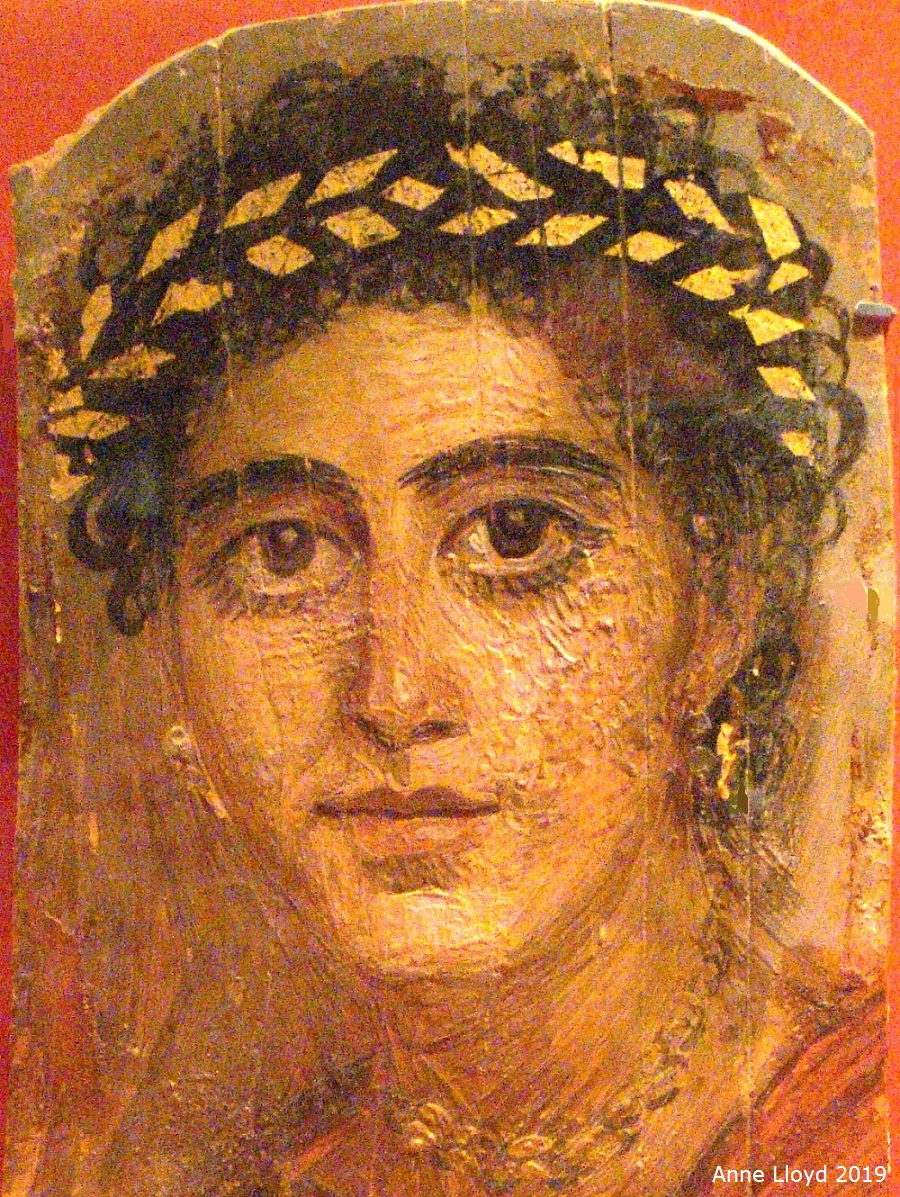
Whenever I visit The Met, I can always count on such a friendly reunion in the first floor, Ancient Egyptian wing. There to greet me is a beaming adolescent boy named Eutyches and a stylish, vivacious young woman whose luminous dark eyes outshine the gilded wreath which adorns her hair.


Fayum portraits, from left, The Boy Eutyches, c. 100-150, and Young Woman with a Gilded Wreath, c. 120-150 © Metropolitan Museum of Art

Alas, Eutyches and the unnamed young woman are no longer “in the flesh.”  They died during the era when the power of the Roman Empire was at its apogee, between the years 100-150. However, both are very much present, “in the spirit” by virtue of the extraordinary portraits which once were affixed to their caskets.

The amazing likenesses of Eutyches and the golden-wreathed woman are known to art history as Fayum portraits. Painted on thin wooden panels, these images were made to last for eternity, along with the souls of those they depict. A classic study, just republished by Thames & Hudson, is a moving testimonial to these bids for immortality.

The Mysterious Fayum Portraits: Faces from Ancient Egypt was originally published in 1995. The author, Euphrosyne Doxiades, is an accomplished artist, expert in the encaustic wax painting technique which was used to create many of the Fayum portraits.

The late 1990’s were marked by a revival of interest in Fayum funerary art, sparked by a major British Museum exhibition of these ancient paintings. During the winter of 2000, a major collaboration of the British Museum and The Met brought Ancient Faces: Mummy Portraits from Ancient Egypt to New York. 


Gallery view of Ancient Faces: Mummy Portraits from Ancient Egypt
at the Metropolitan Museum of Art, 2000 

Doxiadis contributed a short chapter on encaustic painting to the catalog of this exhibition. Mysterious Faces is her own, independent study. It ranks as the most definitive book on the Fayum portraits yet published– and likely to remain so thanks to this impressive, lavishly illustrated volume.

Doxiadis analyzed mummies and mummy portraits from a wide range of museum collections in Egypt, Europe and the U.S. Drawing upon her own artistic expertise, Doxiadis  writes of the artists who created the Fayum portraits:

The methods used by the painters are of the greatest importance not only for the study of the portraits themselves but because they can tells us more about the technique of the Hellenistic tradition as a whole, of which so few works have survived. The mummy portraits provide a link between the painting of antiquity and that of Byzantium, and it is in the techniques used that this continuity can be seen most clearly.


Anne Lloyd, (Photo 2019)
Portrait of a Young Woman in Red (detail), c. 90-120 AD

The welcome arrival of the new edition of Mysterious Faces was graced by a stroke of incredible luck. In December 2022, a major archaeological discovery in the Faiyum region, located 62 miles southwest of Cairo, unearthed a mud-brick necropolis with intact mummies from the Roman-period and several Fayum portraits. 

These "new" portraits came to light, too late for inclusion in the second edition of Mysterious Faces. Their discovery, however, adds a note of timely relevance to this insightful account of Egyptian art during the final centuries of ancient times. 


The era of the late ancient world is the subject of another classic book, recently republished, The World of Late Antiquity by Peter Brown will also be reviewed in this Art Eyewitness post in order to probe the legacy of the Fayum portraits.

The process of deliberately preserving the bodies of deceased pharaohs and members of the Egyptian nobility through mummification began about 2,600 B.C. By the time that painted images of the dead - which we call Fayum portraits - became an accepted technique, the elaborate process of preparing Egyptians for eternal life had been going on for over two millennia!

The Faiyum (or Fayoum) Oasis is one of the most historic sites in the story of Ancient Egypt. It was originally known as Shedit or sea because of its vast expanse. By the time Greek rule of Egypt began with the arrival of Alexander the Great, the waters of the oasis had greatly diminished. With the construction of an elaborate system of irrigation channels, however, the area remained one of the most bountiful agricultural regions of Egypt.

The prosperity generated from the grain trade made for a wider distribution of wealth. This in turn enabled more people than kings and nobles to prepare their mortal remains and ka, their soul, for eternal life. 

Although Fayum portraits were made in other regions of Egypt, the Faiyum Oasis favored the creation and survival of this astonishing art form. The oasis was ringed with hilly terrain which remained dry during the annual inundation of the Nile Valley, which extended to low-lying areas of the oasis. On these secure uplands, the mummified remains of the deceased were interred. 

Two compelling Fayum portraits, both from the Getty Museum, provide a fascinating insights to the varied levels of artistic technique and resources devoted to Fayum portraiture - and the people immortalized by these paintings.


Mummy Portait of a Woman (Isidora), c. 100 AD

The first image is of an aristocratic lady named Isidora, who lived around the year 100. Isidora's portrait was obviously painted by an accomplished master, who lavished pricey encaustic pigments on this exquisite work. Four different shades of red were used to convey the coloration of her sensuous lips. Isidora's hair style is an exacting rendition of the tightly-braided, plaited bun favored by Roman ladies during the reign of the Emperor Trajan (98-117).


Mummy Shroud with Painted Portait of a Boy, c. 150-250 AD

By contrast, the almost-expressionless face of a boy with a falcon resting on his shoulder was created "on the cheap." Just tempora paint was used, applied directly on a linen shroud. (Isidora, and most other Fayum portraits, were painted on expensive limewood panels). But we should not judge this as a "primitive" work of art. 

As Doxiadis notes, in comparison with other Fayum portraits, this work has an appeal of its own, which modern art is helping us evaluate:

A hundred years after most of the portraits were discovered, now that we have seen Paul Klee, we are better able to appreciate the schematic and seemingly unsophisticated qualities of portraits such as this; stylistic differences do not necessarily mean differences in artistic merit.

Though Isidora and the falcon-bearing youth appear to be from separate schools of art, both are Greek in spirit. The painterly-style of the Fayum portraits resulted from the naturalism of Greek art, reaching back several centuries to Apelles, the renowned court painter for Alexander. Yet, this obvious fact is not all that easy to grasp. Fayum portraits, in many respects, seem more Egyptian than Greek.

Except for a very few exceptions, Greek painting from antiquity has been obliterated by the unforgiving hand of time. The arid conditions of Egypt have preserved over 1,000 Fayum portraits, making them the largest surviving body of paintings from ancient times.


Mummy with an Inserted Panel Portrait, c. 80-100, & Mummy of Artemidorus in a Cartonnage Body Caseearly 2nd century AD

The significance of the Fayum portraits is not only a matter of artistic interest. When we see Greek-style portraits applied to Egyptian mummy cases, we are witnessing a meeting of cultures on a deep spiritual level.

After Alexander's death in 323 B.C., Egyptians and Greeks resident in Egypt were ruled by the Greco-Macedonian Ptolemaic dynasty. During the generally-benign regime of the Ptolemies, both groups borrowed freely from each other. If Egyptians adopted this Greek artistic style, many Greeks were inspired by the profound concepts related to the afterlife of their new neighbors. 


l
Greek inscription on the cartonnage body case of Artemidorus,
reading "O Artemidorus, Farewell" (British Museum Collection)

From the evidence of the Fayum portraits, it is apparent that numerous Greeks buried their dead in the hope of immortality according to the rites and rituals of eternal Egypt.

Doxiadis calls the Fayum portraits "mysterious faces." One of the mysteries about them, or perhaps irony is a more accurate term, is that the heyday of Fayum funerary art occurred under the Pax Romana, established by Caesar Augustus in 31 BC. 

What interested the Romans about Egypt, particularly the Faiyum Oasis, were the abundant crops it produced. And yet, the reign of Tiberius, (AD14-37) marked the real beginning of the three century-long period when Greek artists created a human face for the Egyptian quest for immortality.


Anne Lloyd, (Photo 2019)
The Boy Eutyches (detail), c. 100-150 

There are a number of ways to approach the study of Fayum portraiture. But in a short review like this, it is important to focus on what is absolutely essential. In considering a Fayum portrait the most important feature, transcending all others, is the treatment of the eyes.

The eye figured prominently in Egyptian religious belief and practice for thousands of years. The "eye of Horus", inscribed on protective amulets, was an omnipresent feature of Egyptian life. 


Wedjat Eye Amulet,
 Third Intermediate Period, c. 1070-664 BC

Egyptian artists, in order to show the eye in its fullest and most perfect form, almost always featured it on a face in profile. Their Greek counterparts, by contrast, depicted the eye with absolute scientific fidelity. On the Fayum portraits,however, the eyes are often presented much larger in proportion to the rest of the face, than would normally be so.


Fayum portraits from the era of Hadrian & Antoninus Pius (2nd Century AD). The woman at left wears a torc from the city of Antinoopolis. 

One theory for the large, luminous eyes of the Fayum portraits contends that Greek artists were attempting to heighten a sense of soulful vitality in the face of the deceased. If so, this raises the question of the identity of the "eye of the beholder."

Since Fayum portraits were not created for display in the land of the living, the "big eyes" clearly were intended for the life to come. But were those eyes meant to be seen or to do the seeing?

When one looks at Fayum portraits in a museum gallery, you often have the peculiar sensation that Eutyches, Isidora and Artemidorus are intently peering at us. Normally, this sensation can be pleasurable, in a curious sort of way. However, when I visited the Ancient Faces exhibition at The Met in 2000, the experience was unnerving.


Gallery view of Ancient Faces: Mummy Portraits from Ancient Egypt, 
showing Portrait of a Woman in Tempora & Encaustic, AD 70-100 

To put it bluntly, I was unnerved, rattled by all of those faces of dead people. Dead people who are somehow still alive and aware - on some level - of us.


Fayum portrait of a Roman soldier, identifiable by his
 shoulder-sword belt. The portrait dates to the Antonine era, 138-192

After reading The Mysterious Fayum Portraits, I discovered that I was not alone in my reaction to an uncanny presence in these ancient works of art.

in the introduction to her book, Euphrosyne Doxiades writes:

Looking at the most beautifully painted among the Fayum portraits is a unique and enriching experience. They transgress formal, cultural and physical barriers. The depicted person lives on in spite of mortality, decay and the span of millenia... An experience I had in Berlin convinced me of the power inherent in the best of the Fayum faces: I was left in a storage room on my own with about twenty portraits, and when the door closed behind me I felt a strange sensation - that I was not alone...

The author's reaction to her Berlin storage room experience is revelatory. Doxiadis is anything but an impressionable savant. She felt the inherent power of religious works. 

For that is what the Fayum portraits were intended to be and remain so, even when displayed in museum gallery cases.

The real mystery in these "mysterious faces" is why, after a thriving three century span, the creation of Fayum portraits began to decline and eventually ceased. This "fade-out" is part of a vast shift in consciousness which - among many other significant developments - saw realistic portraiture lose its appeal over much of the world during the Middle Ages. This was especially true in regions ruled or influenced by the Byzantine (East Roman) Empire.

These complex and compelling changes of life and thought were brilliantly analyzed by Peter Brown in his 1971 book, The World of Late Antiquity. Thames & Hudson recently republished this impressive work in a fully illustrated new edition (World of Art series/239 pages/$24.95). Brown's book is essential reading for anyone interested in ancient history. What follows are some reflections, inspired by The World of Late Antiquity, on the factors which led to the eventual disappearance of Fayum portrait painting.

Symbolical imagery began to edge-aside works of naturalism during the third century. This was the Roman Empire's first great time of troubles. Ceaseless military coups and assassinations, Germanic invasions across the Rhine and Danube and the menace of a revived Persian Empire nearly brought Rome to its knees.


The Brescia Medallion
 Gold glass portrait of a family from Alexandria, c. fourth century 

Rome's political power survived, battered but resilient. So too did the traditional forms of Greco-Roman culture, including naturalistic painting. At least outwardly, that is, as testified by the Brescia Medallion (above). This miniature masterpiece, only 2.4 inches in diameter, of gold glass engraving is clearly related to Fayum portraiture.

The reassertion of Roman military power in the final years of the third century concealed hidden currents of fundamental change. An undertow of social, cultural and religious transformations included an unprecedented new conception of the nature of morality. 

This innovation in humanity's outlook was, in the words of Peter Brown, "that most fateful legacy of Zoroastrian Persia to the western world - a belief in the absolute division of the spiritual world between good and evil powers, between angels and demons."

Brown comments further:

The sharp smell of an invisible battle hung over the religious life of Late Antique man. To sin was no longer to err: it was to allow oneself to be overcome by unseen forces. To err was not to be mistaken: it was to be unconsciously manipulated by some invisible malign power. 

In this highly-charged moral atmosphere, it was no longer sufficient for an individual seeking salvation to simply sacrifice to the gods or make careful preparations to insure the transit of one's soul to the afterlife. Each person must seek the aid of a divine savior or prophet and then join in the struggle against the forces of evil, visible and invisible.


  A panel painting from Bawit, Egypt, showing Christ embracing
 St. Menas. The painting, dates to the sixth - seventh century.

Gradually, the two-thousand year traditions and rituals of Egyptian religion lost their appeal. Artists turned their skills from painting realistic portraits of the dead to imagined likenesses of Jesus and holy men like St. Menas. 

The wheels of time turned. Antiquity faded, the medieval age of monotheistic faiths took its place. The wheels of time revolved again and again. Brief years of enlightenment were followed by dark ages of war.


Art Eyewitness Image
A collage of Fayum portraits. The two right-hand panel paintings 
come from the collection of the British Museum

Interred beneath the sands surrounding the Faiyum Oasis, Eutyches, Isidora and the unnamed others slept the sleep of eternity. And then, they were awakened to grace the gallery walls of our museums. 

There they greet us with a smile or a faint look of reproach, reminding us of the kinship of all human beings, ancient and modern, living and dead.

***

Text: Copyright of Ed Voves, all rights reserved reserved                                     

Original photography, copyright of Anne Lloyd.

 Introductory Image: Cover art of The Mysterious Fayum Portraits by Euphrosyne Doxiadis. Courtesy of Thames & Hudson.

Fayum portraits:  Portrait of the Boy Eutyches, 100–150 AD. Encaustic on wood: h. 38 cm (14 15/16 in); w. 19 cm (7 1/2 in) Metropolitan Museum of Art 18.9.2. Portrait of a Young Woman with a Gilded Wreath. 120–140 AD. Encaustic on wood with gold leaf: H. 36.5 x W. 17.8 cm (14 3/8 x 7 in.) # 09.181.7 © Metropolitan Museum of Art

Gallery view of Ancient Faces: Mummy Portraits from Ancient Egypt at the Metropolitan Museum of Art, 2000.  © Metropolitan Museum of Art

Anne Lloyd, (Photo 2019) Portrait of a Young Woman in Red (detail), c. 90-120 AD. A.D. 90–120. Encaustic on limewood with gold leaf: H. 38.1 x W. 18.4 cm (15 x 7 1/4 in.) Metropolitan Museum of Art. # 09.181.6

Cover art of The World of Late Antiquity by Peter Brown. Courtesy of Thames & Hudson.

Mummy Portait of a Woman (Isidora), c. 100 AD.   Encaustic on linden wood, gilt, ( Entire Assemblage): 48 × 36 × 12.8 cm (18 7/8 × 14 3/16 × 5 1/16 in.) Portrait : 33.6 × 17.2 cm (13 1/4 × 6 3/4 in.) Getty Museum #81.AP.42

 Mummy Shroud with Painted Portait of a Boy, c. 150-250 AD. Tempera on linen:  62 × 52.5 cm (24 7/16 × 20 11/16 in.) Getty Museum. #75 AP 87

Mummy with an Inserted Panel Portrait, c. 80-100, AD. Mummy with an Inserted Panel Portrait of a Youth. Panel portrait: encaustic on limewood. Mummy: L. 169 cm (66 9/16 in.); W. 45 cm (17 11/16 in.); Panel as exposed: H. 38.1 cm (15 in.); W. 18 cm (7 1/16 in.) Metropolitan Museum of Art # 11.139.  Mummy of Artemidorus in a Cartonnage Body Case, early 2nd century AD. Panel Portrait: Encaustic on wood with gold leaf: British Museum #EA21810 © British Museum.

Greek inscription on the cartonnage body case of Artemidorus, reading "O Artemidorus, Farewell" (British Museum Collection) For details, see above entry.

Anne Lloyd, (Photo 2019) The Boy Eutyches (detail), c. 100-150. For full citation see above.)

 Wedjat Eye Amulet, Third Intermediate Period, c. 1070-664 BC. Faience, aragonite: L. 6.5 cm (2 9/16 in.) Metropolitan Museum of Art. # 26.7.1032

Fayum portraits from the era of Hadrian & Antoninus Pius (2nd Century AD).   Head of a Woman, c. 130 and 160 AD. Encaustic with gilded stucco on wood panel: 17 5/8 × 9 3/4 inches (44.8 × 24.8 cm) Detroit Institute of Art # 25.2. Portrait of a Woman c. 117-138 AD. Encaustic on wood: 35.3 × 22.5 × 2 cm (13 7/8 × 8 7/8 × 13/16 in.) Harvard Art Museums/ Sackler Museum # 1923.60

Gallery view of Ancient Faces: Mummy Portraits from Ancient Egypt, showing showing Portrait of a Woman in Tempora & Encaustic, AD 70-100. 

Portrait of a Roman Soldier, Antonine era, 138-192. Encaustic painting on wood: 40 x 20 cm. Myers Collection, Eton College.

The Brescia Medallion. Gold glass engraved portrait, 4th century AD. Gold leaf, enamel and glass: Diameter - 6 cm. (2.4 inches) Collection: Santa Giulia Museum in Brescia. https://commons.wikimedia.org/wiki/File:Galla_Placidia_(rechts)_und_ihre_Kinder.jpg

Icon of Christ embracing St. Menas, from Apollo Monestary, Bawit, Egypt, sixth- seventh century. Encaustic on panel: 57 by 57 centimetres (22.4 by 22.4 inches). Louvre Museum..

 Art Eyewitness Image  A collage of Fayum portraits, from the collections of the Metropolitan Museum of Art, the J. Paul Getty Museum and the British Museum.