Showing posts with label Late Antiquity. Show all posts

Monday, February 10, 2025

Art Eyewitness Review: The Mysterious Fayum Portraits and The World of Late Antiquity


The Mysterious Fayum Portraits: Faces from Ancient Egypt

By Euphrosyne Doxiadis

Thames & Hudson/248 pages/$50

Reviewed by Ed Voves

It is always a wonderful occasion to catch sight of a familiar, smiling face in the crowded, bustling galleries of the Metropolitan Museum of Art.

Whenever I visit The Met, I can always count on such a friendly reunion in the first floor, Ancient Egyptian wing. There to greet me is a beaming adolescent boy named Eutyches and a stylish, vivacious young woman whose luminous dark eyes outshine the gilded wreath which adorns her hair.


Fayum portraits, from left, The Boy Eutyches, c. 100-150, and Young Woman with a Gilded Wreath, c. 120-150 © Metropolitan Museum of Art

Alas, Eutyches and the unnamed young woman are no longer “in the flesh.”  They died during the era when the power of the Roman Empire was at its apogee, between the years 100-150. However, both are very much present, “in the spirit” by virtue of the extraordinary portraits which once were affixed to their caskets.

The amazing likenesses of Eutyches and the golden-wreathed woman are known to art history as Fayum portraits. Painted on thin wooden panels, these images were made to last for eternity, along with the souls of those they depict. A classic study, just republished by Thames & Hudson, is a moving testimonial to these bids for immortality.

The Mysterious Fayum Portraits: Faces from Ancient Egypt was originally published in 1995. The author, Euphrosyne Doxiades, is an accomplished artist, expert in the encaustic wax painting technique which was used to create many of the Fayum portraits.

The late 1990’s were marked by a revival of interest in Fayum funerary art, sparked by a major British Museum exhibition of these ancient paintings. During the winter of 2000, a major collaboration of the British Museum and The Met brought Ancient Faces: Mummy Portraits from Ancient Egypt to New York. 


Gallery view of Ancient Faces: Mummy Portraits from Ancient Egypt
at the Metropolitan Museum of Art, 2000 

Doxiadis contributed a short chapter on encaustic painting to the catalog of this exhibition. Mysterious Faces is her own, independent study. It ranks as the most definitive book on the Fayum portraits yet published– and likely to remain so thanks to this impressive, lavishly illustrated volume.

Doxiadis analyzed mummies and mummy portraits from a wide range of museum collections in Egypt, Europe and the U.S. Drawing upon her own artistic expertise, Doxiadis  writes of the artists who created the Fayum portraits:

The methods used by the painters are of the greatest importance not only for the study of the portraits themselves but because they can tells us more about the technique of the Hellenistic tradition as a whole, of which so few works have survived. The mummy portraits provide a link between the painting of antiquity and that of Byzantium, and it is in the techniques used that this continuity can be seen most clearly.
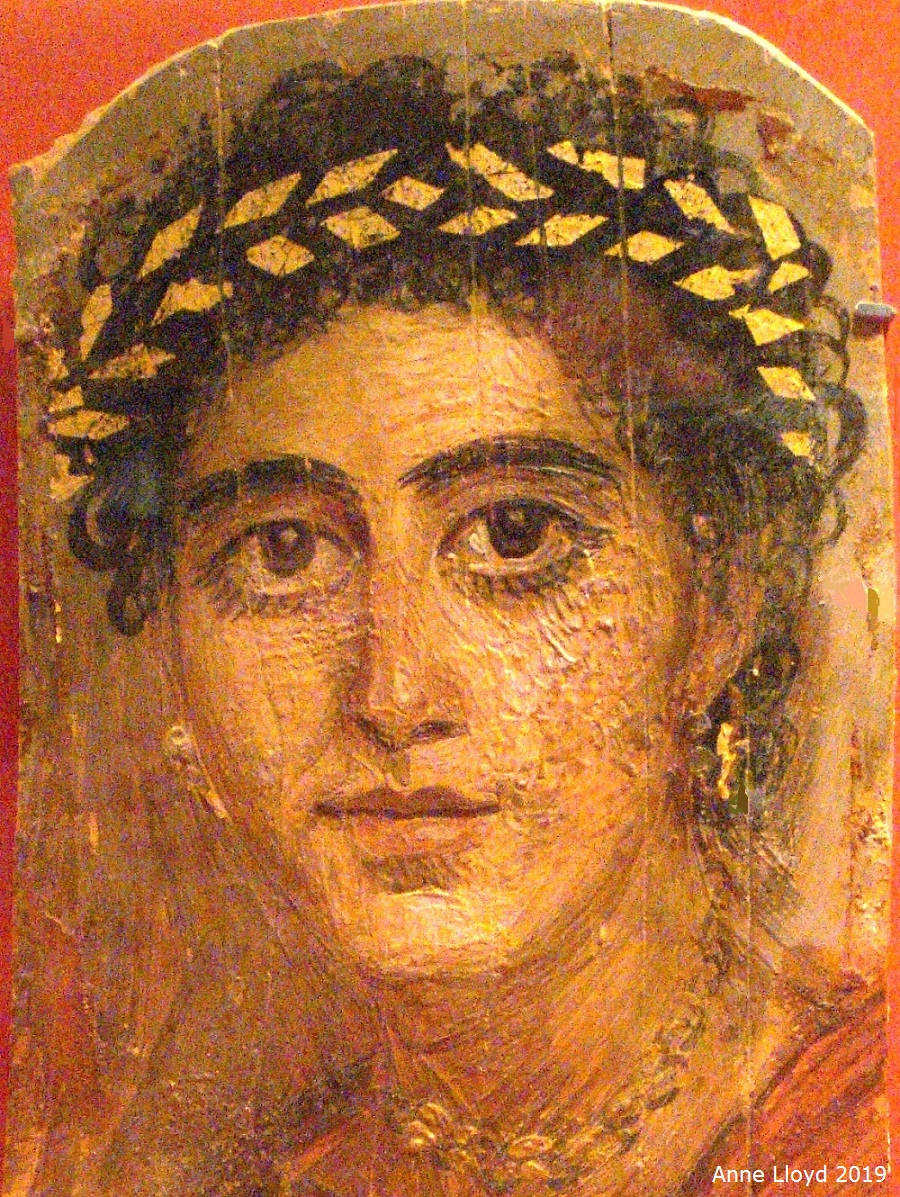

Anne Lloyd, (Photo 2019)
Portrait of a Young Woman in Red (detail), c. 90-120 AD

The welcome arrival of the new edition of Mysterious Faces was graced by a stroke of incredible luck. In December 2022, a major archaeological discovery in the Faiyum region, located 62 miles southwest of Cairo, unearthed a mud-brick necropolis with intact mummies from the Roman-period and several Fayum portraits. 

These "new" portraits came to light, too late for inclusion in the second edition of Mysterious Faces. Their discovery, however, adds a note of timely relevance to this insightful account of Egyptian art during the final centuries of ancient times. 


The era of the late ancient world is the subject of another classic book, recently republished, The World of Late Antiquity by Peter Brown will also be reviewed in this Art Eyewitness post in order to probe the legacy of the Fayum portraits.

The process of deliberately preserving the bodies of deceased pharaohs and members of the Egyptian nobility through mummification began about 2,600 B.C. By the time that painted images of the dead - which we call Fayum portraits - became an accepted technique, the elaborate process of preparing Egyptians for eternal life had been going on for over two millennia!

The Faiyum (or Fayoum) Oasis is one of the most historic sites in the story of Ancient Egypt. It was originally known as Shedit or sea because of its vast expanse. By the time Greek rule of Egypt began with the arrival of Alexander the Great, the waters of the oasis had greatly diminished. With the construction of an elaborate system of irrigation channels, however, the area remained one of the most bountiful agricultural regions of Egypt.

The prosperity generated from the grain trade made for a wider distribution of wealth. This in turn enabled more people than kings and nobles to prepare their mortal remains and ka, their soul, for eternal life. 

Although Fayum portraits were made in other regions of Egypt, the Faiyum Oasis favored the creation and survival of this astonishing art form. The oasis was ringed with hilly terrain which remained dry during the annual inundation of the Nile Valley, which extended to low-lying areas of the oasis. On these secure uplands, the mummified remains of the deceased were interred. 

Two compelling Fayum portraits, both from the Getty Museum, provide a fascinating insights to the varied levels of artistic technique and resources devoted to Fayum portraiture - and the people immortalized by these paintings.


Mummy Portait of a Woman (Isidora), c. 100 AD

The first image is of an aristocratic lady named Isidora, who lived around the year 100. Isidora's portrait was obviously painted by an accomplished master, who lavished pricey encaustic pigments on this exquisite work. Four different shades of red were used to convey the coloration of her sensuous lips. Isidora's hair style is an exacting rendition of the tightly-braided, plaited bun favored by Roman ladies during the reign of the Emperor Trajan (98-117).


Mummy Shroud with Painted Portait of a Boy, c. 150-250 AD

By contrast, the almost-expressionless face of a boy with a falcon resting on his shoulder was created "on the cheap." Just tempora paint was used, applied directly on a linen shroud. (Isidora, and most other Fayum portraits, were painted on expensive limewood panels). But we should not judge this as a "primitive" work of art. 

As Doxiadis notes, in comparison with other Fayum portraits, this work has an appeal of its own, which modern art is helping us evaluate:

A hundred years after most of the portraits were discovered, now that we have seen Paul Klee, we are better able to appreciate the schematic and seemingly unsophisticated qualities of portraits such as this; stylistic differences do not necessarily mean differences in artistic merit.

Though Isidora and the falcon-bearing youth appear to be from separate schools of art, both are Greek in spirit. The painterly-style of the Fayum portraits resulted from the naturalism of Greek art, reaching back several centuries to Apelles, the renowned court painter for Alexander. Yet, this obvious fact is not all that easy to grasp. Fayum portraits, in many respects, seem more Egyptian than Greek.

Except for a very few exceptions, Greek painting from antiquity has been obliterated by the unforgiving hand of time. The arid conditions of Egypt have preserved over 1,000 Fayum portraits, making them the largest surviving body of paintings from ancient times.


Mummy with an Inserted Panel Portrait, c. 80-100, & Mummy of Artemidorus in a Cartonnage Body Case, early 2nd century AD

The significance of the Fayum portraits is not only a matter of artistic interest. When we see Greek-style portraits applied to Egyptian mummy cases, we are witnessing a meeting of cultures on a deep spiritual level.

After Alexander's death in 323 B.C., Egyptians and Greeks resident in Egypt were ruled by the Greco-Macedonian Ptolemaic dynasty. During the generally-benign regime of the Ptolemies, both groups borrowed freely from each other. If Egyptians adopted this Greek artistic style, many Greeks were inspired by the profound concepts related to the afterlife of their new neighbors. 


l
Greek inscription on the cartonnage body case of Artemidorus,
reading "O Artemidorus, Farewell" (British Museum Collection)

From the evidence of the Fayum portraits, it is apparent that numerous Greeks buried their dead in the hope of immortality according to the rites and rituals of eternal Egypt.

Doxiadis calls the Fayum portraits "mysterious faces." One of the mysteries about them, or perhaps irony is a more accurate term, is that the heyday of Fayum funerary art occurred under the Pax Romana, established by Caesar Augustus in 31 BC. 

What interested the Romans about Egypt, particularly the Faiyum Oasis, were the abundant crops it produced. And yet, the reign of Tiberius, (AD14-37) marked the real beginning of the three century-long period when Greek artists created a human face for the Egyptian quest for immortality.


Anne Lloyd, (Photo 2019)
The Boy Eutyches (detail), c. 100-150 

There are a number of ways to approach the study of Fayum portraiture. But in a short review like this, it is important to focus on what is absolutely essential. In considering a Fayum portrait the most important feature, transcending all others, is the treatment of the eyes.

The eye figured prominently in Egyptian religious belief and practice for thousands of years. The "eye of Horus", inscribed on protective amulets, was an omnipresent feature of Egyptian life. 


Wedjat Eye Amulet,
 Third Intermediate Period, c. 1070-664 BC

Egyptian artists, in order to show the eye in its fullest and most perfect form, almost always featured it on a face in profile. Their Greek counterparts, by contrast, depicted the eye with absolute scientific fidelity. On the Fayum portraits,however, the eyes are often presented much larger in proportion to the rest of the face, than would normally be so.


Fayum portraits from the era of Hadrian & Antoninus Pius (2nd Century AD). The woman at left wears a torc from the city of Antinoopolis. 

One theory for the large, luminous eyes of the Fayum portraits contends that Greek artists were attempting to heighten a sense of soulful vitality in the face of the deceased. If so, this raises the question of the identity of the "eye of the beholder."

Since Fayum portraits were not created for display in the land of the living, the "big eyes" clearly were intended for the life to come. But were those eyes meant to be seen or to do the seeing?

When one looks at Fayum portraits in a museum gallery, you often have the peculiar sensation that Eutyches, Isidora and Artemidorus are intently peering at us. Normally, this sensation can be pleasurable, in a curious sort of way. However, when I visited the Ancient Faces exhibition at The Met in 2000, the experience was unnerving.


Gallery view of Ancient Faces: Mummy Portraits from Ancient Egypt, 
showing Portrait of a Woman in Tempora & Encaustic, AD 70-100 

To put it bluntly, I was unnerved, rattled by all of those faces of dead people. Dead people who are somehow still alive and aware - on some level - of us.


Fayum portrait of a Roman soldier, identifiable by his
 shoulder-sword belt. The portrait dates to the Antonine era, 138-192

After reading The Mysterious Fayum Portraits, I discovered that I was not alone in my reaction to an uncanny presence in these ancient works of art.

in the introduction to her book, Euphrosyne Doxiades writes:

Looking at the most beautifully painted among the Fayum portraits is a unique and enriching experience. They transgress formal, cultural and physical barriers. The depicted person lives on in spite of mortality, decay and the span of millenia... An experience I had in Berlin convinced me of the power inherent in the best of the Fayum faces: I was left in a storage room on my own with about twenty portraits, and when the door closed behind me I felt a strange sensation - that I was not alone...

The author's reaction to her Berlin storage room experience is revelatory. Doxiadis is anything but an impressionable savant. She felt the inherent power of religious works. 

For that is what the Fayum portraits were intended to be and remain so, even when displayed in museum gallery cases.

The real mystery in these "mysterious faces" is why, after a thriving three century span, the creation of Fayum portraits began to decline and eventually ceased. This "fade-out" is part of a vast shift in consciousness which - among many other significant developments - saw realistic portraiture lose its appeal over much of the world during the Middle Ages. This was especially true in regions ruled or influenced by the Byzantine (East Roman) Empire.

These complex and compelling changes of life and thought were brilliantly analyzed by Peter Brown in his 1971 book, The World of Late Antiquity. Thames & Hudson recently republished this impressive work in a fully illustrated new edition (World of Art series/239 pages/$24.95). Brown's book is essential reading for anyone interested in ancient history. What follows are some reflections, inspired by The World of Late Antiquity, on the factors which led to the eventual disappearance of Fayum portrait painting.

Symbolical imagery began to edge-aside works of naturalism during the third century. This was the Roman Empire's first great time of troubles. Ceaseless military coups and assassinations, Germanic invasions across the Rhine and Danube and the menace of a revived Persian Empire nearly brought Rome to its knees.


The Brescia Medallion
 Gold glass portrait of a family from Alexandria, c. fourth century 

Rome's political power survived, battered but resilient. So too did the traditional forms of Greco-Roman culture, including naturalistic painting. At least outwardly, that is, as testified by the Brescia Medallion (above). This miniature masterpiece, only 2.4 inches in diameter, of gold glass engraving is clearly related to Fayum portraiture.

The reassertion of Roman military power in the final years of the third century concealed hidden currents of fundamental change. An undertow of social, cultural and religious transformations included an unprecedented new conception of the nature of morality. 

This innovation in humanity's outlook was, in the words of Peter Brown, "that most fateful legacy of Zoroastrian Persia to the western world - a belief in the absolute division of the spiritual world between good and evil powers, between angels and demons."

Brown comments further:

The sharp smell of an invisible battle hung over the religious life of Late Antique man. To sin was no longer to err: it was to allow oneself to be overcome by unseen forces. To err was not to be mistaken: it was to be unconsciously manipulated by some invisible malign power. 

In this highly-charged moral atmosphere, it was no longer sufficient for an individual seeking salvation to simply sacrifice to the gods or make careful preparations to insure the transit of one's soul to the afterlife. Each person must seek the aid of a divine savior or prophet and then join in the struggle against the forces of evil, visible and invisible.


  A panel painting from Bawit, Egypt, showing Christ embracing
 St. Menas. The painting, dates to the sixth - seventh century.

Gradually, the two-thousand year traditions and rituals of Egyptian religion lost their appeal. Artists turned their skills from painting realistic portraits of the dead to imagined likenesses of Jesus and holy men like St. Menas. 

The wheels of time turned. Antiquity faded, the medieval age of monotheistic faiths took its place. The wheels of time revolved again and again. Brief years of enlightenment were followed by dark ages of war.


Art Eyewitness Image
A collage of Fayum portraits. The two right-hand panel paintings 
come from the collection of the British Museum

Interred beneath the sands surrounding the Faiyum Oasis, Eutyches, Isidora and the unnamed others slept the sleep of eternity. And then, they were awakened to grace the gallery walls of our museums. 

There they greet us with a smile or a faint look of reproach, reminding us of the kinship of all human beings, ancient and modern, living and dead.

***

Text: Copyright of Ed Voves, all rights reserved reserved                                     

Original photography, copyright of Anne Lloyd.

 Introductory Image: Cover art of The Mysterious Fayum Portraits by Euphrosyne Doxiadis. Courtesy of Thames & Hudson.

Fayum portraits:  Portrait of the Boy Eutyches, 100–150 AD. Encaustic on wood: h. 38 cm (14 15/16 in); w. 19 cm (7 1/2 in) Metropolitan Museum of Art # 18.9.2. Portrait of a Young Woman with a Gilded Wreath. 120–140 AD. Encaustic on wood with gold leaf: H. 36.5 x W. 17.8 cm (14 3/8 x 7 in.) # 09.181.7 © Metropolitan Museum of Art

Gallery view of Ancient Faces: Mummy Portraits from Ancient Egypt at the Metropolitan Museum of Art, 2000.  © Metropolitan Museum of Art

Anne Lloyd, (Photo 2019) Portrait of a Young Woman in Red (detail), c. 90-120 AD. A.D. 90–120. Encaustic on limewood with gold leaf: H. 38.1 x W. 18.4 cm (15 x 7 1/4 in.) Metropolitan Museum of Art. # 09.181.6

Cover art of The World of Late Antiquity by Peter Brown. Courtesy of Thames & Hudson.

Mummy Portait of a Woman (Isidora), c. 100 AD.   Encaustic on linden wood, gilt, ( Entire Assemblage): 48 × 36 × 12.8 cm (18 7/8 × 14 3/16 × 5 1/16 in.) Portrait : 33.6 × 17.2 cm (13 1/4 × 6 3/4 in.) Getty Museum #81.AP.42

 Mummy Shroud with Painted Portait of a Boy, c. 150-250 AD. Tempera on linen:  62 × 52.5 cm (24 7/16 × 20 11/16 in.) Getty Museum. #75 AP 87

Mummy with an Inserted Panel Portrait, c. 80-100, AD. Mummy with an Inserted Panel Portrait of a Youth. Panel portrait: encaustic on limewood. Mummy: L. 169 cm (66 9/16 in.); W. 45 cm (17 11/16 in.); Panel as exposed: H. 38.1 cm (15 in.); W. 18 cm (7 1/16 in.) Metropolitan Museum of Art # 11.139.  Mummy of Artemidorus in a Cartonnage Body Case, early 2nd century AD. Panel Portrait: Encaustic on wood with gold leaf: British Museum #EA21810 © British Museum.

Greek inscription on the cartonnage body case of Artemidorus, reading "O Artemidorus, Farewell" (British Museum Collection) For details, see above entry.

Anne Lloyd, (Photo 2019) The Boy Eutyches (detail), c. 100-150. For full citation see above.)

 Wedjat Eye Amulet, Third Intermediate Period, c. 1070-664 BC. Faience, aragonite: L. 6.5 cm (2 9/16 in.) Metropolitan Museum of Art. # 26.7.1032

Fayum portraits from the era of Hadrian & Antoninus Pius (2nd Century AD).   Head of a Woman, c. 130 and 160 AD. Encaustic with gilded stucco on wood panel: 17 5/8 × 9 3/4 inches (44.8 × 24.8 cm) Detroit Institute of Art # 25.2. Portrait of a Woman c. 117-138 AD. Encaustic on wood: 35.3 × 22.5 × 2 cm (13 7/8 × 8 7/8 × 13/16 in.) Harvard Art Museums/ Sackler Museum # 1923.60

Gallery view of Ancient Faces: Mummy Portraits from Ancient Egypt, showing showing Portrait of a Woman in Tempora & Encaustic, AD 70-100. 

Portrait of a Roman Soldier, Antonine era, 138-192. Encaustic painting on wood: 40 x 20 cm. Myers Collection, Eton College.

The Brescia Medallion. Gold glass engraved portrait, 4th century AD. Gold leaf, enamel and glass: Diameter - 6 cm. (2.4 inches) Collection: Santa Giulia Museum in Brescia. https://commons.wikimedia.org/wiki/File:Galla_Placidia_(rechts)_und_ihre_Kinder.jpg⁣

Icon of Christ embracing St. Menas, from Apollo Monestary, Bawit, Egypt, sixth- seventh century. Encaustic on panel: 57 by 57 centimetres (22.4 by 22.4 inches). Louvre Museum..

 Art Eyewitness Image  A collage of Fayum portraits, from the collections of the Metropolitan Museum of Art, the J. Paul Getty Museum and the British Museum.


Saturday, December 30, 2023

Art Eyewitness Review: Africa and Byzantium at the Metropolitan Museum of Art


Africa and Byzantium

Metropolitan Museum of Art
November 19, 2023 - March 3, 2024

Reviewed by Ed Voves
Original Photography by Anne Lloyd

Africa and Byzantium is the latest in a series of exhibitions, presented by the Metropolitan Museum of Art, which have transformed our understanding of the region surrounding the Mediterranean Sea during what used to be called the "Dark Ages." Now, we think of those distant centuries as Late Antiquity and the Medieval era. 

Africa is the geographic focus of the latest of The Met exhibitions, as its title proclaims. Africa and Byzantium covers a vast expanse of history, from Late Antiquity to the 1600's. On view until March 3, 2024, this exhibit is part of the current initiative at The Met to emphasize the importance of African art.


Anne Lloyd, Photo (2023)
 Bust of an African Child, 2nd–3rd century

Achieving a greater recognition for African art dating to the long-ago era surveyed in Africa and Byzantium is no easy task. The difficulties are numerous and complex. But the most serious of these, in terms of this exhibition, does not actually relate to Africa or African art.

The problem with Africa and Byzantium lies with the use of "Byzantium" as the title of a political entity which, in actuality, was the surviving, eastern half of the Roman Empire. Ruled by Christian emperors from their strategic stronghold, the city of Constantinople, this much battered bulwark of civilization lasted until 1453.

Never, in its very long history was the Basileia Rhomanaion (Empire of the Romans) or Romania, as its citizens referred to it, called Byzantium.

Founded in the year 330 by the Roman emperor, Constantine, the Eastern Empire’s capital of Constantinople was built on the site of an earlier city, Byzantion. Western European scholars, beginning in the 1500’s, recast the Eastern Roman Empire as Byzantium, thereby undermining its historical significance and mystique.

If a credible "Byzantium" ever existed, it was the phase of the Eastern Roman Empire when Greek-speaking emperors ruled a much-reduced realm. This followed the Islamic conquest of Palestine, Egypt and North Africa in the seventh century, concluding with the attack by the treacherous Venetians and Crusaders on Constantinople in 1204.

For better or worse, the curators at The Met follow the almost universally accepted practice of speaking of "Byzantium.” No doubt, this is due, in part, to the tremendous importance of earlier exhibitions at The Met like Byzantium: Faith and Power in 2004. It is only natural that the curators of Africa and Byzantium would wish to build on their past success, but what works for one exhibition does not always do so for another.

In the promotional text for Africa and Byzantium, “Byzantium” is described as an empire whose “artistic, economic and cultural life” was shaped by the “vibrant multi-ethnic societies of north and east Africa.”  

To underscore this point, the lead artwork chosen for the exhibition is a striking mosaic fragment from the Louvre's collection.


Anne Lloyd, Photo (2023) 
Mosaic Panel with Preparations for a Feast, c.175-200 

Mosaic Panel with Preparations for a Feast was excavated in present-day Tunisia on the northern tip of Africa. It does indeed show workmen with different racial features, but it dates to the end of the second century, when Marcus Aurelius ruled a unified Roman Empire, 161-180. 

This floor mosaic had felt the tread of many a sandal before the mighty walls and palaces of Constantinople were built.


The use of Mosaic Panel with Preparations for a Feast in this manner is a questionable attribution of a work of art from one historical era to illustrate another. It risks over-simplifying the complex nature of the Eastern Roman Empire. 

The leading contemporary historian of the empire, Anthony Kaldellis, treats this topic at length in a just-published narrative history, The New Roman Empire (Oxford University Press) which I plan to review in January 2024.

Rather than belabor the debate on the use and abuse of "Byzantium" as a historical term, let’s speak of the “better” aspects of The Met's exhibition. There are many.


Anne Lloyd, Photo (2023) 
Gallery view of Africa and Byzantium, 
showing Mosaic of Date Palm, from Tunisia, 6th century

Africa and Byzantium is a mighty endeavor, truly an exhibition which only The Met could have carried through to success. The planning, transport and display of some of the rarest and most delicate works of art from ancient times is a fantastic achievement.

The art treasures on view in Africa and Byzantium span the range of human creativity – sacred and secular, precious jewels of the elite, shopworn ceramic molds used by working-class artisans.


Anne Lloyd, Photo (2023)
 Jeweled Bracelet, likely made in Constantinople, 500-700

From delicate carvings made from rock crystal, found in a cistern in Tunisia, to a jewel-encrusted silver crown from Nubia, the Met curators have assembled an array of sensational works of art, related either directly or indirectly to Africa. Few of these, however, document a direct relationship with the Eastern Roman Empire.


Anne Lloyd, Photo (2023) 
Silver Crown, from Nubia, 5th–6th century

At the top of the list of these time-honored masterpieces are two works of art which speak directly to the religious experience of ancient Africa. These are true Icons, one a painting, the other a tapestry. Both date to the sixth century, their 1,500 years of survival due to the warm, dry climate of Egypt and the care of generations of devout Christians.


Anne Lloyd, Photo (2023)
 Icon with the Virgin and Child, Saints, Angels, and the Hand of God, 
from The Holy Monastery of Saint Catherine, Sinai, 6th century

Icon with the Virgin and Child, Saints, Angels, and the Hand of God, was created with the encaustic wax technique. One of the oldest surviving paintings related to Christian worship, it is believed to have been made in Constantinople and sent to Egypt. The apprehensive countenance of the Virgin Mary and the faces of the saints by her side, the bearded St. Theodore and the boyish St. George, reveal stylistic similarities to the mosaic portraits of the Empress Theodora and her retinue at Ravenna, c. 548. 


Anne Lloyd, Photo (2023) 
Icon of the Virgin Enthroned, from Egypt, 6th century 

The second work is a woolen tapestry, with a similar theme. Icon of the Virgin Enthroned is believed to have been made in Egypt, around the same time as the painted Icon with the Virgin and Child. One of the most treasured works in the collection of the Cleveland Museum of Art, the tapestry was woven with woolen yarn dyed in twenty different colors. The price of such dyes was extremely high, making this tapestry more expensive to create than the painted icon.

Both of these icons are especially relevant to the fundamental role of African religious figures in the rise of Christianity, as revealed in two related events: the birth of monasticism and the diffusion of Christian belief from urban congregations to converts in the countryside.

Monasticism began in Egypt in the fourth century, as the political power of the Roman Empire declined and the cohesive unity of Christianity fractured amid disputes over doctrine. 

Zealous individuals such as St. Anthony (251-356) renounced the temptations of secular society and prestigious posts in the hierarchy of the Church. Instead, Anthony and like-minded souls elected to live as monks in sparsely inhabited regions such as the Sinai Desert.


Anne Lloyd, Photo (2023) 
Detail of Painting of Holy Men, 5th–6th century

The reclusive lives of the Christian monks in the Sinai were transformed when the Emperor Justinian (reigned 527-565) built the basilica church of St. Catherine’s, surrounded by a defensive wall, on the reputed site of the incident of Moses and the Burning Bush. This form of monasticism, centered on an imposing church and living quarters for monks and nuns, replaced the hermit-like living conditions of earlier times. 

From St. Catherine's in the Sinai, this monastic revival spread throughout much of the Christian world. It is significant, however, to note that a different form of communal monastic life was being developed by St. Benedict at Monte Casino in Italy around the same time. Western and Eastern Christendom were already beginning to draw apart.

To edify the monks of St. Catherine’s, Justinian sent devotional works of art. One of these images of divinity, dispatched from Constantinople, may well have been Icon with the Virgin and Child, Saints, Angels, and the Hand of God. It is an immensely powerful work, exerting an almost hypnotic intensity, even in the artificial light of a museum gallery.


Anne Lloyd, Photo (2023)
Detail of Icon with the Virgin & Child, Saints, Angels, and the Hand of God
 
“The Hand of God” at the extreme top of Icon with the Virgin and Child, Saints, Angels (barely visible in the present condition of the painting) is likely a direct reference to God’s summons to Moses on the very spot where this icon is kept. 

One of the most fascinating details of this painted icon from St. Catherine's is the degree of realism imparted to the faces of the Virgin Mary and two saints, perhaps even the angels, as well. It is hard to imagine that living persons did not pose for the icon painter. The haunted look on the Virgin Mary's face is surely that of a real woman, perhaps, as mentioned above, a lady-in-waiting of the Empress Theodora's entourage - or even the empress, herself!


A major change in style occurred throughout the Eastern Roman Empire in later centuries. A greater emphasis on mysticism took hold in the religious sentiments of the empire's citizens, due mainly to influences form the east, including Islam. Painting conventions adapted to what the great medieval scholar, Sir Steven Runciman, called the "Aramaic conception of art.

Painters of icon portraits of Jesus, the Virgin Mary, saints and prophets down-played elements of realism in favor of an ethereal, otherworldly art form. The soul, rather than a physical likeness, was given the place of privilege in these depictions of holy persons. The Met exhibition displays several examples of these mystical icons from the later eras of "Byzantine" art.


Anne Lloyd, Photo (2023) 
Icon of the Virgin Galaktotrophousa, 1250-1350


Anne Lloyd, Photo (2023) 
Icon of the Virgin Hodegetria Dexiokratousa, 13th century 

In addition to being aides to spiritual meditation, mystical icons like the 
Virgin Galaktotrophousa and the Virgin Hodegetria Dexiokratousa embodied specific "types" or conventions of Christian beliefs that could be understood without elaborate theological texts. 

The breast-feeding Virgin Galaktotrophousa illustrated compassion and love, while the Virgin Hodegetria ("she who points the way") reminded Christians that the infant in Mary's arms would die on the cross in order to redeem the souls of humankind. 

Icons were thus "pictures worth a thousand words." This was hugely important as the Eastern Roman Empire, under repeated assault and invasion, gradually disintegrated until the final coup de grace was delivered by the Turks in 1453.

Christianity survived the eclipse and eventual fall of the Eastern Roman Empire. Christian devotional art, icons and sacred texts inspired Christians under Islamic rule, like the Copts of Egypt, or the citizens of Constantinople who endured the horrible decades when the once-mighty city was a conquered fiefdom of the Crusaders, 1204-1261.

The Met exhibit displays remarkable examples of these sacred manuscripts which show how true religious faith can outlive political and social adversity. 


Anne Lloyd, Photo (2023)
 Encomium of Saint John Chrysostom, 892–893

The Encomium is one of the impressive group of rare, hand-written and illustrated manuscripts on view in Africa and Byzantium. A collection of religious writings, Encomium was composed by one of the great prelates of the early church, St. John Chrysostom (347-407). Almost five hundred years after the death of this St. John, called “golden-mouth” because of his charismatic preaching, an Egyptian priest, Isaac of Ptepouhar, copied the text and illustrated the manuscript with a full-page depiction of the Virgin Mary and the infant Jesus, accompanied by two angels.

The rather crude ink drawing recalls the more striking images of the Virgin Mary, Jesus and heavenly hosts discussed above. But the power of this image and the accompanying text is truly profound. This book, easy to transport, reveals how Christianity spread beyond urban centers such as Constantinople and Alexandria and monasteries like St. Catherine’s, enabling its message to travel over vast distances and to survive the ravages of war and persecution.

Beneath the Virgin’s throne on the Encomium image is an inscription in Greek, “by Isaac, the priest, the humble one, I have written (it).” Modest clergyman like Apa (Father) Isaac were indeed the intrepid emissaries who carried the Christian faith up the Nile valley into the center of Africa. In the highlands of present-day Ethiopia, Christianity took root, producing a highly-distinctive version of Christian worship and belief.


Anne Lloyd, Photo (2023)
 Diptych of Saint George and the Virgin & Child, late 1400's-1500's

The Africa and Byzantium exhibition concludes with a magnificent display of twenty-five examples of Ethiopian Christian art: icons, illuminated manuscripts, wall paintings. Many of these have the Virgin Mary as the central figure or protagonist, thereby revealing the influence of “Byzantine” art – or seeming to.

Täʾammərä Maryam or (Miracles of Mary) is a vividly-painted manuscript, made in Gondar, an important center of book production in Ethiopia during the late seventeenth century. It includes 32 painted scenes of legendary events related to the Virgin Mary which do not appear in the Holy Bible. These miracles involved cures of individuals like the afflicted man shown in this two-page spread (below), whose club-foot was healed by the intervention of the mother of Jesus.


Anne Lloyd, Photo (2023) 
TäʾammÉ™rä Maryam (Miracles of Mary), late 17th century

Täʾammərä Maryam is a compelling work of art testifying to the spiritual convictions and creative talent of the African artist who made it. So too, do the other Ethiopian paintings and illuminated manuscripts. This is a very distinguished body of work, really an integrated exhibit within the larger exhibition. These impressive and appealing works of art confirm one of the objectives of the Met curators, namely emphasizing the tremendous accomplishments of African artIsts.

Sadly, the story behind TäʾammÉ™rä Maryam does little to highlight the role of “multi-culturalism” in art, another goal of Africa and Byzantium.

This illuminated manuscript of the Virgin Mary’s miracles was produced during a time of religious dissension in Ethiopia, during (or soon after) the reign of King Yohannes I (1667–1682). 

Yohannes spent much time and effort trying to expel Roman Catholic missionaries from Ethiopia. It had been the Jesuits who first brought prints of religious art to Ethiopia, providing a major impetus for creating these wondrous images of the Virgin Mary. 

However, Yohannes and others among the Ethiopian elite grew suspicious of the Roman Catholic clergy and six Franciscans were executed to encourage the others to leave.

The road of good intentions is a hard one to travel, as the six Franciscans found out. The curators of Africa and Byzantium are likewise engaged on a well-meaning initiative. 

The aim of exhibitions like Africa and Byzantium - a praiseworthy one - is to secure a more prominent place for African art on the timeline of world history and to introduce it to a wider audience. It is a missionary-like endeavor and, like most such efforts, it is both visionary and, on certain points, it misses the mark.


Anne Lloyd, Photo (2023)
Mosaic with Lion, from Tunisia, 6th century

Abundant proof of ancient African creativity is certainly established by the trove of art treasures on view in this excellent Met exhibition. But the evidence linking these precious works of African art to an empire called “Byzantium” is stretched very thin indeed.

***

Text: Copyright of Ed Voves, all rights reserved                                                  Original photography, copyright of Anne Lloyd, all rights reserved

 Introductory image: Anne Lloyd, Photo (2023) Jug, 290–320. From North Africa (Tunis El Aouja, Navigius school). African red slip ware: 9 1/16 × 4 1/2 × 4 5/16 in. (23 × 11.5 × 11.6 cm). Musée du Louvre. 

Anne Lloyd, Photo (2023) Bust of an African Child, 2nd–3rd century. Bronze: 5 × 3 15/16 × 1 15/16 in. (12.7 × 10 × 4.9 cm) Museum of Art, Rhode Island School of Design.                                                  

Anne Lloyd, Photo (2023) Mosaic Panel with Preparations for a Feast: 4th quarter of the 2nd century. Mosaics, limestone, glass paste: 83 7/8 × 92 1/2 × 2 9/16 in., 264.6 lb. (213 × 235 × 6.5 cm, 120 kg)  Musée du Louvre.

Anne Lloyd, Photo (2023) Gallery view of Africa and Byzantium, with Mosaic of Date Palm, 6th century. from Hamman Lif, Tunisia. Stone and mortar: without frame: 70 9/16 x 31 x 1 3/8 in., 248 lb. (179.2 x 78.8 x 3.5 cm, 112.5 kg) Brooklyn Museum of Art. 

Anne Lloyd, Photo (2023) Jeweled Bracelet, 500-700. Made in probably Constantinople. Gold, silver, pearl, amethyst, sapphire, opal, glass, quartz, emerald plasma: Overall: 1 7/16 x 3 1/4 in. (3.7 x 8.2 cm) strap: 15/16 x 7 7/8 in. (2.4 x 20 cm) bezel: 1 5/16 in. (3.4 cm) Metropolitan Museum of Art. 

Anne Lloyd, Photo (2023) Silver Crown, 5th–6th century. From Nubia. Silver metalwork and gemstones: 12 × 5 7/8 × 10 7/16 in., 35.27oz. (30.5 × 15 × 26.5 cm, 1 kg) The Egyptian Museum, Cairo.

Anne Lloyd, Photo (2023) Icon with the Virgin and Child, Saints, Angels, and the Hand of God, 6th century. Encaustic on panel: 26 15/16 × 19 1/2 in. (68.5 × 49.5 cm).The Holy Monastery of Saint Catherine, Sinai.

Anne Lloyd, Photo (2023) Icon of the Virgin Enthroned, 6th century. From Egypt. Tapestry, wool: 70 1/16 × 43 5/16 in., 65 lb. (178 × 110 cm, 29.5 kg). The Cleveland Museum of Art.

Anne Lloyd (Photo, 2023) Painting of Holy Men, 5th–6th century (detail). Made in Egypt. Paint on linen: 17 5/16 × 12 13/16 in. (44 × 32.5 cm) Metropolitan Museum of Art.

 Anne Lloyd, Photo (2023) Icon of the Virgin Galaktotrophousa, 1250–1350. Tempera on wood: 7 5/8 × 6 7/8 × 13/16 in. (19.3 × 17.5 × 2 cm). The Holy Monastery of Saint Catherine, Sinai.

 Anne Lloyd, Photo (2023) Icon with the Virgin Hodegetria Dexiokratousa, first quarter of 13th century. From Egypt. Miniature tesserae (gold and other materials), set in wax, on wood: Overall with mounting: 17 1/2 in. × 13 3/16 in. × 1 in. (44.5 × 33.5 × 2.5 cm) The Holy Monastery of Saint Catherine, Sinai.

Anne Lloyd, Photo (2023) Encomium of Saint John Chrysostom, 892–893. Copied and illustrated by Father Issac of Ptepouhar (Egypt). Ink on parchment: Overall with mounting: 8 1/2 × 17 7/8 × 13  1/2 in. (216 x 45.4 x 34.3 cm.) Morgan Library and Museum.

Anne Lloyd, Photo (2023) Diptych of Saint George and the Virgin and Child, late 1400's-1500's. Paint on wood: 20 1/2 in. × 26 5/16 in. × 13/16 in. (52 × 66.8 × 3 cm) National Museum of African Art, Smithsonian Institution.

Anne Lloyd, Photo (2023) TäʾammÉ™rä Maryam (Miracles of Mary), late 17th century. Manuscript made in Gondar, Ethiopia. Parchment, ink, tempera, wood, leather, cotton, and string: 14 5/8 × 12 3/4 × 4 1/4 in. (37.2 × 32.4 × 10.8 cm) The Art Institute of Chicago.

Anne Lloyd, Photo (2023) Mosaic with Lion, 6th century. from Hamman Lif, Tunisia. Stone tessarae: 29 5/16 x 42 1/4 x 1 5/8 in., 172 lb. (74.5 x 107.3 x 41.5 cm, 78 kg) Brooklyn Museum of Art.