Showing posts with label Armory Show of 1913. Show all posts

Monday, October 19, 2026

Art Eyewitness Review: Marcel Duchamp at the Philadelphia Museum of Art


Marcel Duchamp

Philadelphia Museum of Art

 October 10, 2026 - January 31, 2027  

Reviewed by Ed Voves

Original Photography by Anne Lloyd

The other day, I saw a nude descending the staircase of the Great Stair Hall of the Philadelphia Museum of Art. I wasn't the least bit startled or amazed at the sight.

The "nude" was a digital projection of the celebrated painting by Marcel Duchamp. The original, Nude Descending a Staircase (No. 2) painted by Duchamp in 1912, is one of the most cherished works of art in the collection of the Philadelphia Museum of Art (PMA). 


Anne Lloyd, Photo (2026)
Marcel Duchamp's Nude Descending a Staircase (No. 2), 1912

Nude Descending a Staircase is currently one of the anchor works of a massive exhibition at the PMA devoted to Duchamp's controversial career. Three hundred paintings, drawings, sculptures, prints and photos are displayed, along with replicas of the once notorious "Readymades". 


Anne Lloyd, Photo (2026)
 Gallery view of Marcel Duchamp at the Philadelphia Museum of Art. 

Marcel Duchamp is a very important exhibition for the PMA, both for the content on view in the exhibit galleries and for the foundational role that Duchamp's works have played in securing the Philadelphia Museum of Art's reputation as a great museum. 

After opening its neo-classical main building (replacing an earlier structure) in 1928, the PMA struggled to survive the Great Depression and the World War II years. In 1950, thanks to the efforts of Fiske Kimball, the dynamic head of the PMA, the celebrated Arensberg collection of Modern art was bequeathed to the museum. Over 1000 works of art entered the PMA collection, paintings by Matisse and Picasso, sculptures by Brancusi and works of all kind by Duchamp. Lots and lots of Duchamps.

The Marcel Duchamp exhibition previously appeared at the Museum of Modern Art in New York City during the past summer. A collaborative effort by the PMA and MOMA, the exhibition is the first, major survey of Duchamp's life and career since the 1973 retrospective, five years after his death. That exhibition was also organized by these two institutions. 


Anne Lloyd, Photo (2026)
 The curatorial team of the Marcel Duchamp exhibition. 
 From left, Matthew Afron, PMA, Ann Temkin & Michell Kuo, MOMA

The curatorial team, Matthew Afron of the PMA and Ann Temkin and Michelle Kuo of MOMA, has assembled an encyclopedic display of Duchamp's oeuvre which we are unlikely to see again for many years to come.


Anne Lloyd, Photo (2026)
 Gallery views of the Marcel Duchamp exhibit, showing (from top, left)
 Rotary Glass Plates (1920) & Rotary Demisphere (1925); Box in a Valise, Series F (1935-1941); Photo from Andy Warhol's film (1966)

Early sketches by Duchamp, signature paintings, mechanical devices that rivaled the crazy contraptions of the cartoonist, Rube Goldberg, several examples of the "box in a valise" series containing miniature recreations of his art works, a digital-loop showing Andy Warhol's 1966 short film of the aged Duchamp ... the list of Duchamp's works and related documents, photos and periodicals goes on and on.

It is interesting to note the difference in presentation by the curators of the two museums because of the way it reflects the contrasting facets of Duchamp's personality. 

MOMA's exhibit space was graced by pristine white walls (except for one gallery) and bright lights. It was an appropriate forum for considering the cultural impact of one of the most influential pioneers of Modernism.


Jonathan Dorado, Photo (2026), courtesy of MOMA
 Gallery view of Marcel Duchamp at the Museum of Modern Art.

The PMA galleries stressed a different, more inscrutable Duchamp. With an abundance of darkened walls and a subdued ambiance accentuated by rows of glittering track lights, Duchamp the Magus of Modern Art held court.


Anne Lloyd, Photo (2026)
 Gallery view of Marcel Duchamp at the Philadelphia Museum of Art.
Andy Warhol's four minute film of Duchamp is being shown, at right.

Which of the two personas was the "real" Duchamp? Or was he neither?


Marcel Duchamp and his brothers. Duchamp, Jacques Villon (center) and Raymond Duchamp-Villon (right), Puteaux, France, c. 1912.

Marcel Duchamp (1887-1968) was the youngest of three brothers of a well-to-do French family from Normandy. All of his male siblings were artistically gifted, as was his sister, Suzanne, who created an impressive body of work related to the early surrealist movement, Dada. It was Duchamp's brother, Raymond who scored the first major success of their talented family, with several striking Modernist sculptures. Tragically, Raymond died while serving as a medic during World War I.

Duchamp's date of birth, 1887, is significant. So is the year of his first paintings executed to a highly professional standard - in a style recalling Bonnard - 1910. 


Anne Lloyd, Photo (2026)
Marcel Duchamp's The Chess Game, 1910

Duchamp was born the year following the last Impressionist salon. By the time Duchamp painted notable portraits of family members (above), Picasso was adapting Cubism to portraiture. One art movement after another had taken center stage during these years. Each had excited expectations of enduring success, only to lose momentum to the next "big thing."

Duchamp was, thus, a third generation Modernist. He earnestly responded to the latest revolutionary techniques. But the shifting tides of radical innovation soon made his early work appear out-of-date almost as soon as the paint dried.

In 1911-1912, Duchamp embraced Cubism and began to hit the mark. A striking Cubist painting, with one of the first of his cryptic titles, is particularly revealing of the transitional development of his work. 


Anne Lloyd, Photo (2026)
Duchamp's The King and Queen Surrounded by Swift Nudes, 1912

The King and Queen Surrounded by Swift Nudes (1912) was painted on the reverse of an earlier Symbolist-style work, entitled Paradise (Adam and Eve). Flipping the canvas over, Duchamp did not even bother to keep Adam and Eve upright. Perhaps, it was ironic commentary on the "fall of man."


Anne Lloyd, Photo (2026)
Marcel Duchamp's Paradise (Adam and Eve), 1910-11

While Duchamp was completing The King and Queen Surrounded by Swift Nudes in 1911, he began working on the first version of much more important painting, Nude Descending a Staircase (No.1). The canonical version (No. 2), was unveiled in 1912. A final rendition, mostly drawn with pencil and pen and ink, was executed in 1916. All three are on display in the PMA exhibition.


Anne Lloyd, Photo (2026)
The three versions of Marcel Duchamp's Nude Descending a Staircase 

Nude Descending a Staircase (No.2) was a remarkable achievement. However, other artists in Europe were also attempting to depict the effect of rapid, sequential movement in their paintings. This was especially true of the Italian futurist, Giacomo Balla. As a result, Nude Descending a Staircase (No.2) was initially received in French cultural circles with some doubts about its status as a Cubist work of art. The controversy, however, soon subsided.

The reaction in the United States, when Nude Descending a Staircase (No.2) was displayed at the 1913 Armory Show in New York City, was an entirely different matter. 

The degree of hostility, outrage and denunciation which Nude Descending a Staircase (No. 2) generated at the Armory Show is hard to credit today. The gallery where the painting was displayed was popularly known as the "chamber of horrors." Fortunately, for Duchamp, two Americans did favor this controversial work of art.

Walter and Louise Arensberg were an art-loving couple whose New York City apartment was the epicenter of interest in Modern art in America during the early years of the twentieth century. Walter was a chess enthusiast, like Duchamp. Louise was passionate about art. When Duchamp traveled to the U.S. in 1915, the Arensbergs embraced him as a personal friend and began purchasing his art for their collection.

Upon reaching New York, Duchamp was amazed at the welcome he received, considering the notoriety of Nude Descending a Staircase (No.2). A New York art gallery offered him $10,000 per year for his finished canvases. No doubt, the gallery owner envisioned sales of Cubist works to the Arensbergs and like-minded American enthusiasts for Modernism. Duchamp declined, claiming he was working on an experimental painting on glass. 

Duchamp was, indeed, already engaged in creating such a work, initially called The Large Glass. But there was an additional, more deep-seated reason for not accepting a gallery contract.

Painting was "washed-up", Duchamp confided to his friend, Constantin Brancusi, after visiting the Paris Air Show of 1912 where he studied the mechanics of an aircraft propeller. How could an oil-on-canvas compete with an airplane?


Anne Lloyd, Photo (2023)
 Installation view of Duchamp's The Bride Stripped Bare by Her Bachelors, Even (The Large Glass) in the PMA's Duchamp Gallery.

Once comfortably situated in America, Duchamp all but abandoned painting based on aesthetic principles, including Cubism. He played chess with Walter Arensberg and worked intermittently on The Large Glass. 

This huge, fragile work reputedly dealt with frustrated sexual desire. If this actually was the theme, it could only be guessed-at, given the obscure imagery painted on to the glass. The incomprehensible alternate title, The Bride Stripped Bare By Her Bachelers, Even, did little to resolve the mystery. 


Anne Lloyd, Photo (2023)
 Detail views of Duchamp's The Bride Stripped Bare by Her Bachelors, Even (The "Bride" is at left, the "Bachelors" at right)

Duchamp stopped working on The Large Glass in 1923, only to spend years fixing it after it was badly damaged in transit following a museum display in 1927.

Had Duchamp completely abandoned art for chess-playing (first with Walter Arensberg, then competitively, as he did later), it is doubtful if he would merit more than a passing mention in art histories. But one thing can be stated with certitude. It was not Bride Stripped Bare or bizarre machinery serving no clear purpose which have secured Duchamp's place in the pantheon of Modern Art.

It was the Readymades. 

There they are in the PMA's exhibition galleries - or rather replicas of the long-lost original Readymades. Massed produced "things" of everyday use, rather than unique products of human genius.


Anne Lloyd, Photo (2026)
 Gallery view of Marcel Duchamp at the Philadelphia Museum of Art.

Objects of ridicule and loathing to some, venerated talismans of the revolt against Classicism and commercialism to others. The curators sensibly place the Readymades on view, without commentary or vintage photos to help us appreciate their "shock of the new" impact when Duchamp first displayed them. 


Anne Lloyd, Photo (2026)
 A large-scale 1930's replica of Duchamp's L.H.O.O.Q. (1919)

Judge for yourself. That is what Duchamp said was his intention, to "de-deify" the artist, giving the spectator the opportunity to decide if the mustache and goatee on a cheap print of Mona Lisa is in the same category as the original in the Louvre.

And then, there is Fountain. Judge for yourself? How can one do that for an object which is clearly not a work of art, even in reproduction?


Anne Lloyd, Photo (2026)
 A replica (made in 1950) of Duchamp's Fountain Readymade (1917)

According to text book versions of Modern art history, Fountain represents the birth of Conceptual Art. In the spring of 1917, Duchamp submitted this Readymade anonymously to the first exhibition of the Society of Independent Artists, of which he was an official. His intentions in doing so have been endlessly debated. If we accept the ideals of Conceptual Art, then Duchamp likely intended to make a statement that the idea behind a work of art is what is important, more than the actual work, itself.

Accepting this premise, the concept of an everyday, mass-manufactured object - even a urinal - can be a legitimate part or element of artistic discourse. Duchamp, the daring originator of this train of thought, is now extolled as the "Father of Conceptual Art." 

However, a growing body of evidence, suggests that Duchamp was not the originator of Fountain, either as an idea or the actual urinal purchased from a hardware store. A German woman, Elsa von Freytag-Loringhoven, active in the radical Dada group in New York, is now widely held to be the person responsible for this revolutionary  - or revolting - escapade.

Dada artists and poets like von Freytag-Loringhoven were in open rebellion against the unspeakable slaughter and stupidity of World War I. Duchamp was very active in Dada circles in New York, as his sister, Suzanne, was in Paris. 

Duchamp's role in the use of Readymades is best interpreted against the background of World War I, which the U.S. entered in April 1917. Duchamp's motivation for submitting Fountain was surely a brash and defiant repudiation of the escalating horror of his era.

However, by asserting that anything can be art by virtue of the concept behind it,  Duchamp bequeathed a problematical legacy for artists following his lead.


Anne Lloyd, Photo (2026)
 Gallery view of Marcel Duchamp at the Philadelphia Museum of Art.
 A 1964 edition of Bicycle Wheel appears at center.

This point is forcefully made in the perceptive entry on Duchamp in The Oxford Dictionary of Art, third edition, 2004. While acknowledging that "Duchamp's iconoclasm and experimental attitude have been enormously influential...", the Oxford entry concludes with the unsettling comments: 

[Duchamp's] wit and irony have been sadly lacking in most of his followers, however, and it could be argued that his influence has been disastrous, encouraging people of no discernible talent to believe that anything they do, say, or think is worthy of attention as art.

Strong words, indeed, and ones that, perhaps, we would rather not hear. But as I continue to reflect upon the truly great Marcel Duchamp exhibition at the PMA, these are words that I find impossible to easily dismiss from my mind.

***

Text: Copyright of Ed Voves, all rights reserved                                        Original photography, copyright of Anne Lloyd

Introductory Image: Anne Lloyd, Photo (2026) View of the Great Stair Hall and staircase of the Philadelphia Museum of Art. 

Anne Lloyd, Photo (2026) Marcel Duchamp's Nude Descending a Staircase (No. 2), 1912. Oil on canvas: 57 7/8 x 35 1/8 (147 x 89.2 cm.) Philadelphia Museum of Art

Anne Lloyd, Photo (2026) Gallery view of Marcel Duchamp at the Philadelphia Museum of Art.

Anne Lloyd, Photo (2026) The curatorial team of the Marcel Duchamp exhibition. From left, Matthew Afron, PMA, Ann Temkin & Michell Kuo, MOMA

Anne Lloyd, Photo (2026) Gallery views of the Marcel Duchamp exhibit, showing (from top, left) Rotary Glass Plates (1920), Yale University Art Center & Rotary Demisphere (1925), Museum of Modern Art; Box in a Valise, Series F (1935-1941), Alychio Art Collection/Marc Coucke, Belgium; Photo from Andy Warhol's 16mm. silent film of Marcel Duchamp (1966), collection of The Andy Warhol Museum, Pittsburgh.

Jonathan Dorado, Photo (2026), courtesy of MOMA. Gallery view of Marcel Duchamp at the Museum of Modern Art, entrance to the exhibition galleries at MOMA, 2026.

Anne Lloyd, Photo (2026) Gallery view of Marcel Duchamp at the Philadelphia Museum of Art. Andy Warhol's four minute silent film of Duchamp is being shown, at right.

Marcel Duchamp and his brothers. Marcel Duchamp (left), Jacques Villon (center) and Raymond Duchamp-Villon (right), Puteaux, France, c.1912. Photographer unknown. Smithsonian Institution, Archives of American Art. 


Anne Lloyd, Photo (2026) Marcel Duchamp's The Chess Game, 1910. Oil on canvas: 44 7/8 x 57 11/16 (114 x 146.5 cm.) Philadelphia Museum of Art collection.

Anne Lloyd, Photo (2026) Duchamp's The King and Queen Surrounded by Swift Nudes, 1912.Oil on canvas: 45 1/8 x 50 3/4 in., (114.6 x 128.9 cm.) Philadelphia Museum of Art collection.

Anne Lloyd, Photo (2026) Marcel Duchamp's Paradise (Adam and Eve), 1910-11. Oil on canvas: 45 1/8 x 50 3/4 in., (114.6 x 128.9 cm.) Philadelphia Museum of Art collection.

Anne Lloyd, Photo (2026) The three versions of Marcel Duchamp's Nude Descending a Staircase, 1911,1912, 1916. All three paintings are from the Philadelphia Museum of Art collection.

Anne Lloyd, Photo (2023) Installation view of Duchamp's The Bride Stripped Bare by Her Bachelors, Even (The Large Glass), 1915-1923, in the PMA's Duchamp Gallery. Oil, varnish, lead foil, lead wire and dust on two glass panels: 9 ft 1 1/4 in. x 70 in. x 3 3/8 in. (277.5 x 177.8 x 8.6 cm.) Philadelphia Museum of Art collection.

Anne Lloyd, Photo (2026) Gallery view of the Marcel Duchamp exhibition at the Philadelphia Museum of Art.

Anne Lloyd, Photo (2026) A large scale replica, made in 1930, of Marcel Duchamp's L.H.O.O.Q. (1919) Rectified Readymade: 25 1/2 x 19 in. (64.7 x 48.2 cm.) Centre Pompidou, Paris. Musee national d'art moderne - Centre de creation industrielle

Anne Lloyd, Photo (2026) A replica (made in 1950) of Duchamp's Fountain Readymade (1917). Porcelain urinal: 12 x 15 x 18 in. (30.5 x 38.1 x 45.7 cm.) Philadelphia Museum of Art Collection.

Anne Lloyd, Photo (2026) Gallery view of Marcel Duchamp at the Philadelphia Museum of Art. 1951 replica of the 1913 original Bicycle Wheel appears at center. Metal wheel mounted on wooden stool: 51 x 25 x 16 1/2 in. (129.5. x 63.5 x 41.9 cm.) From the collection of the Museum of Modern Art, NYC.


Saturday, December 28, 2013

Armory Show at the New York Historical Society


The Armory Show at 100 


The New York Historical Society, New York City

October 11, 2013 – February 23, 2014

Reviewed by Ed Voves

No one can fault the New York Historical Society for the number or quality of the works of art on display in its exhibition recalling the Armory Show of 1913. This fabled event, when modern art made its debut in the United States, is recreated with an amazing number of the actual paintings and sculptures from the show, as well as vintage photos, documents and newspaper clippings.

I could not help thinking that an opportunity had been missed by not including, for the sake of a laugh as well as a sense of perspective, a modern painting called The Triumph of the New York School. It would have been a perfect parting image at the end of the exhibit.

The Whitney Museum of American Art in New York displays this big, monochromatic work, painted in 1984 by Mark Tansey. Measuring six by ten feet, The Triumph of the New York School depicts artists clad in French World War I uniforms surrendering to American counterparts wearing World War II khakis. Clement Greenberg, the Art Czar of the Abstract Expressionists, presides in the role of General MacArthur, while Henri Matisse and Pablo Picasso, decked-out in a fur overcoat used by flying aces in World War I, wait to sign the articles of capitulation.

The point of this sly, ironical work is well-taken. The New York School, the "Ab-Ex" painters of the 1950's, did triumph over the once revolutionary Fauves and Cubists of Paris. But a half-century before this mythical encounter took place, nobody would ever have guessed that American artists could gain the upper hand over the French. In 1913, in a real life encounter, the Left Bank Revolutionaries had swept the field, leaving the "home team" in disarray.

This face-off of American and European artists was of course the Armory Show in New York City. Despite its once notorious reputation, the Armory Show was not intended to be controversial. It was organized under the title of the International Exhibition of Modern Art in order to educate the public in the United States about current or recent trends in the visual arts. The goal of the Armory Show was to influence the taste of Americans in favor of contemporary art and get them to buy paintings and sculptures by living artists.

When New Yorkers, bundled in furs like Picasso's flying ace attire, braved the freezing weather of February 17, 1913 to attend the opening of the exhibition, a storm of controversy erupted.

The uproar centered upon one painting in particular, Marcel Duchamp's Nude Descending a Staircase. Painted only the year before, Duchamp's work was an interesting attempt to evoke a sense of movement in art. Like the Italian Futurists, Duchamp endeavored to go beyond a static moment, frozen or "hallowed" in time, to animate art.


Marcel Duchamp, Nude Descending a Staircase (No. 2)

Whether it was a bold attempt to take art in a new direction or second generation cubism, Duchamp's painting sparked criticism and ridicule that had more to do with America's latent Puritanism than the vitriolic debate on Modernism. Had Duchamp entitled his work, Woman Descending a Staircase, it hardly would have occasioned more than a shrug or a grimace of disapproval.

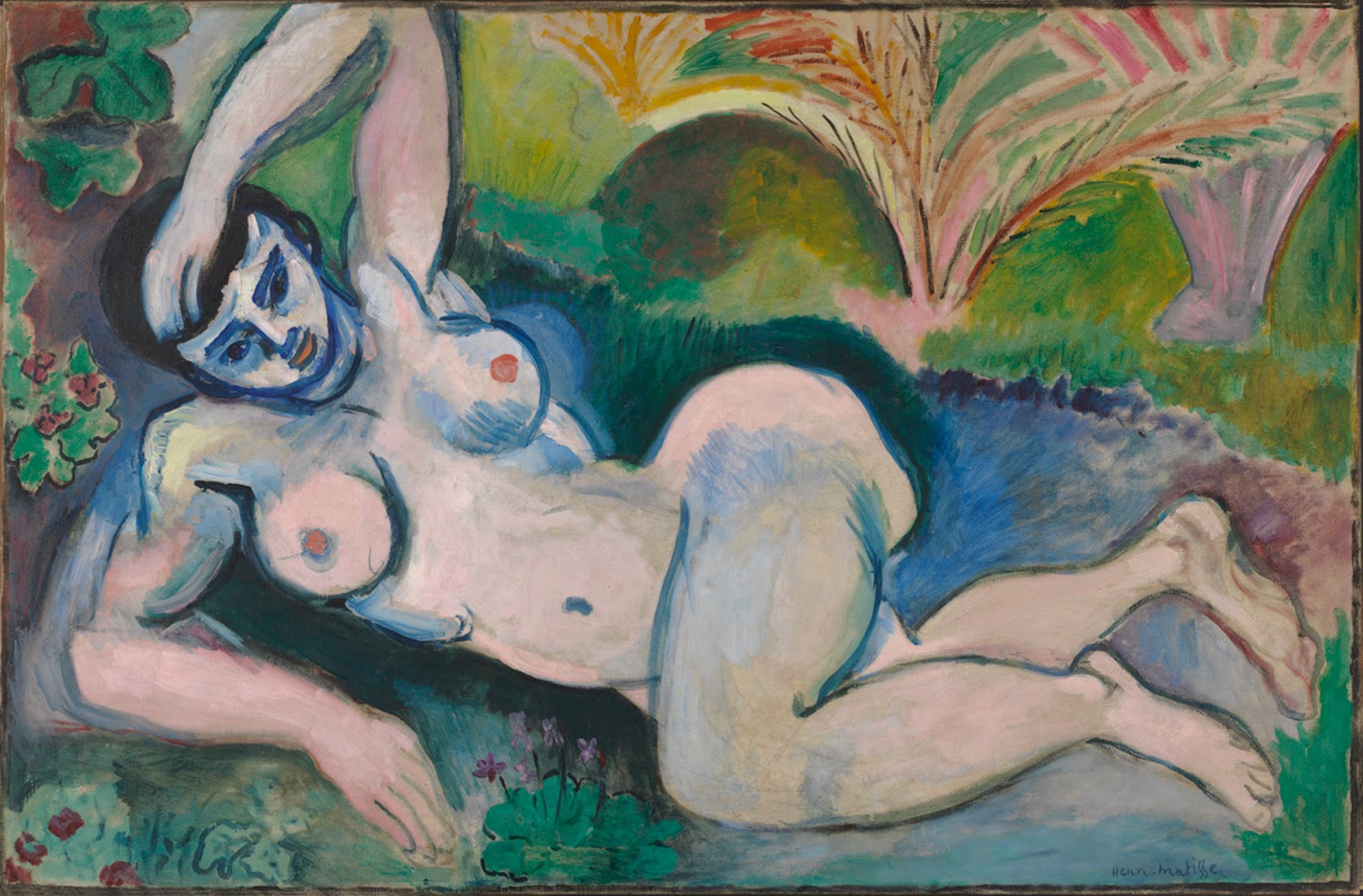
In that case, the howls of protest would likely have surrounded another of the Armory Show's "black sheep." Henri Matisse's Blue Nude, 1907, defied all of the notions of idealized beauty and femininity that had dominated Western art since antiquity. Bernard Berenson, the doyen of Renaissance art, called Blue Nude "the toad." The painting evokes a sense of earthy, primal sexuality totally at odds with Renaissance allegory or with the Gibson Girl ideal of early-1900's America. It was a harbinger of the twentieth century revolts just beginning.


Henri Matisse, Blue Nude

The organizers of the Armory Show, Walt Kuhn and Arthur B. Davies, were - outwardly - anything but revolutionaries. They worked on behalf of the Association of American Painters and Sculptors, formed in 1911 as a progressive alternative to the arch-conservative National Academy of Design. Robert Henri, leader of the ultra-Realist "Ashcan" painters had lampooned the venerable National Academy as being "no more national than the National Biscuit company." Kuhn and Davies were entrusted with putting together an exhibition of contemporary American artists.

Davies was a Symbolist painter and, in a way, Kuhn was one as well. Kuhn's favorite motif, circus performers with haunted, searching eyes, shared a theme with European painters like Gustav Doré and the young Pablo Picasso, both of whom had painted pictures of world-weary acrobats, Les Saltimbanques. To prepare for the Armory Show, Davies and Kuhn visited Europe in 1912, including the Sonderbund Exhibition in Cologne. They were hugely impressed by the upsurge of artistic innovation in the Old World and decided to include European imports in the Armory Show. This decision was to have a momentous effect on American art and culture.

The big exhibit gallery at the New York Historical Society can only hint at the cavernous dimensions of the 69th Regiment Armory on Lexington Ave between 25th and 26th streets. The arrangement of the works on display does allow for a sense of the path that visitors to the Armory Show were expected to follow, from viewing American works of art at the beginning to the octagonal cubicles or "rooms" with European works at the end.


Overhead view of Armory installation, 1913

As the notoriety of Duchamp's work spread, many of the sensation seekers who came to the show went straight to the "Chamber of Horrors" where Nude Descending a Staircase was hanging. American artists watched in dismay as superb paintings that evoked contemporary society like John Sloan's Sunday, Women Drying Their Hair or John Marin's brilliant display of modernist technique, Woolworth Building, No. 28, were passed over with hardly a second glance.


John Sloan, Sunday, Women Drying Their Hair


John Marin, Woolworth Building, No. 28

By the time the Armory Show began, Henri was already nursing emotional wounds from comments made by Alfred Stieglitz about his "conservative" approach to art. Although Henri had voted to approve Davies’ selection and organization methods for the Armory Show, he found himself and other Ashcan painters marginalized along with the National Academy of Design.

When Henri met Davies at the Armory Show, he said tersely, "If the Americans find that they’ve just been working for the French, they won’t be prompted to do this again."

But the European Modernist works sold much better than paintings and sculptures by American artists. The biggest seller was a French Symbolist, Odilon Redon. Another painter, little heard of before or since, Amadeo de Souza-Cardoso (1887-1918), sold seven of his eight works on display. The Portuguese-born Souza-Cardoso was a friend of Walter Pach, another of the organizers of the Armory Show who favored European Modernism over American Realism.

For all the wisecracks about Duchamp’s Rude Descending a Staircase, the European avant-garde made a beach-head on American soil for the first time. A chasm opened in American art which to a real extent has never closed.

Davies and Kuhn had actually done a commendable job organizing the exhibition. They placed the contemporary American works in visible positions, including Henri's Figure in Motion, a realistic nude that might have stirred the ire of the guardians of American morality had not Duchamp done so first. If Davies and Kuhn did one thing differently for the Europeans than for the American artists, it was to trace the roots of Modernism in Europe back to the mid-1800's.


Honoré Daumier, Third Class Carriage

Among the early works of Modernism displayed at the Armory Show were Eugène Delacroix's Christ on the Lake of Genesareth and Honoré Daumier's Third Class Carriage. These works testify to Ernst Gombrich's contention that the real break in the traditions of Western art happened during the early decades of the 1800's rather than during the early 1900's. But that was in Europe. American society had been shielded to a large degree from this cultural revolution. When the Armory Show opened its doors, the effect confirmed Kuhn's prediction that "We will show New York something they never dreamed of."

What Americans saw for the first time was Modernism at full blast. Paintings by Vincent van Gogh and Paul Gauguin from the 1880's and 1890's were displayed in close proximity to Cubist works by Picasso and Francis Picabia of very recent vintage.


Vincent van Gogh, Mountains at Saint Remy


Francis Picabia, Dances at the Spring

Young Americans, especially the Greenwich Village intelligentsia, hailed the works of the European "wild men" as touchstones of revolution. Many, like John Reed and Mabel Dodge, came to the Armory Show primed to revolt.

The New York Historical Society exhibit provides an excellent introduction to this portentous moment in American cultural history. The eventual triumph of the New York School, cleverly evoked in Tansey's 1984 painting, can be traced to the shock of the Armory Show. The same can be said for much of the controversy and intrigue that bedeviled culture in the United States since 1913.

The Armory Show was the moment of Modernism's awakening in the United States. It was also the first of the American Culture Wars.

***

Text: Copyright of Ed Voves, all rights reserved

Images Courtesy of the New York Historical Society
Introductory Image: Association of American Painters and Sculptors, Inc., International Exhibition of Modern Art, 1913. Exhibition catalogue. New-York Historical Society

Marcel Duchamp (French, 1887-1968), Nude Descending a Staircase (No. 2), 1912. Oil on canvas, 57 7/8 x 35 1/8 in. Philadelphia Museum of Art, The Louise and Walter Arensberg Collection, 1950, 1950-134-59. © 2013 Artists Rights Society (ARS), New York / ADAGP, Paris / Succession Marcel Duchamp

Henri Matisse (French, 1869-1954), Blue Nude, 1907. Oil on canvas, 36 ¼ x 55 ¼ in. The Baltimore Museum of Art: The Cone Collection, formed by Dr. Claribel Cone and Miss Etta Cone of Baltimore, Maryland, BMA 1950.228. © 2013 Succession H. Matisse / Artists Rights Society (ARS), New York. Photography by Mitro Hood.

Overhead view of Armory installation, 1913. Walt Kuhn, Kuhn family papers, and Armory Show records, Archives of American Art, Smithsonian Institution

John Sloan (American, 1871-1951), Sunday, Women Drying Their Hair, 1912. Oil on canvas, 26 1/8 x 32 1/8 in. Addison Gallery of American Art, Phillips Academy, Andover, Massachusetts, Museum Purchase, 1938.67. © 2013 Delaware Art Museum / Artists Rights Society (ARS), New York

John Marin (American, 1870-1953), Woolworth Building, No. 28, 1912. Watercolor over graphite, 18 ½ x 15 9/16 in. National Gallery of Art, Washington, Gift of Eugene and Agnes E. Meyer. © 2013 Estate of John Marin / Artists Rights Society (ARS), New York.

Honoré Daumier (French, 1808–1879), Third Class Carriage (Un Wagon de Troisième Classe), 1856–58. Oil on panel, 10¼ × 13⅜ in. (26 × 33.9 cm). Fine Arts Museums of San Francisco, Museum purchase, Whitney Warren, Jr. Bequest Fund in memory of Mrs. Adolph B. Spreckels, Bequest funds of Henry S. Williams in memory of H. K. S. Williams, Magnin Income Fund, Art Trust Fund, Alexander and Jean de Bretteville Fund, Art Acquisition Endowment Income Fund in honor of Mrs. John N. Rosekrans, 1996.51

Vincent van Gogh (Dutch, 1853-1890), Mountains at Saint Rémy (Montagnes à Saint-Rémy), 1889. Oil on canvas, 28 ¼ x 35 ¾ in. Solomon R. Guggenheim Museum, New York, Thannhauser Collection, Justin K. Thannhauser, 1978, 78.2514.24

Francis Picabia (French, 1879-1953), Dances at the Spring, 1912. Oil on canvas, 47 7/16 x 47 ½ in. Philadelphia Museum of Art, The Louise and Walter Arensberg Collection, 1950, 1950-134-155. © 2013 Artists Rights Society (ARS), New York / ADAGP, Paris