Showing posts with label Museum of Modern Art. Show all posts

Monday, October 19, 2026

Art Eyewitness Review: Marcel Duchamp at the Philadelphia Museum of Art


Marcel Duchamp

Philadelphia Museum of Art

 October 10, 2026 - January 31, 2027  

Reviewed by Ed Voves

Original Photography by Anne Lloyd

The other day, I saw a nude descending the staircase of the Great Stair Hall of the Philadelphia Museum of Art. I wasn't the least bit startled or amazed at the sight.

The "nude" was a digital projection of the celebrated painting by Marcel Duchamp. The original, Nude Descending a Staircase (No. 2) painted by Duchamp in 1912, is one of the most cherished works of art in the collection of the Philadelphia Museum of Art (PMA). 


Anne Lloyd, Photo (2026)
Marcel Duchamp's Nude Descending a Staircase (No. 2), 1912

Nude Descending a Staircase is currently one of the anchor works of a massive exhibition at the PMA devoted to Duchamp's controversial career. Three hundred paintings, drawings, sculptures, prints and photos are displayed, along with replicas of the once notorious "Readymades". 


Anne Lloyd, Photo (2026)
 Gallery view of Marcel Duchamp at the Philadelphia Museum of Art. 

Marcel Duchamp is a very important exhibition for the PMA, both for the content on view in the exhibit galleries and for the foundational role that Duchamp's works have played in securing the Philadelphia Museum of Art's reputation as a great museum. 

After opening its neo-classical main building (replacing an earlier structure) in 1928, the PMA struggled to survive the Great Depression and the World War II years. In 1950, thanks to the efforts of Fiske Kimball, the dynamic head of the PMA, the celebrated Arensberg collection of Modern art was bequeathed to the museum. Over 1000 works of art entered the PMA collection, paintings by Matisse and Picasso, sculptures by Brancusi and works of all kind by Duchamp. Lots and lots of Duchamps.

The Marcel Duchamp exhibition previously appeared at the Museum of Modern Art in New York City during the past summer. A collaborative effort by the PMA and MOMA, the exhibition is the first, major survey of Duchamp's life and career since the 1973 retrospective, five years after his death. That exhibition was also organized by these two institutions. 


Anne Lloyd, Photo (2026)
 The curatorial team of the Marcel Duchamp exhibition. 
 From left, Matthew Affron, PMA, Ann Temkin & Michell Kuo, MOMA

The curatorial team, Matthew Affron of the PMA and Ann Temkin and Michelle Kuo of MOMA, has assembled an encyclopedic display of Duchamp's oeuvre which we are unlikely to see again for many years to come.


Anne Lloyd, Photo (2026)
 Gallery views of Marcel Duchamp,(from left) Rotary Glass Plates (1920)
  & Rotary Demisphere (1925); Box in a Valise, Series F (1935-1941)

Early sketches by Duchamp, signature paintings, mechanical devices that rivaled the crazy contraptions of the cartoonist, Rube Goldberg, several examples of the "box in a valise" series containing miniature recreations of his art works, a digital-loop showing Andy Warhol's 1966 short film of the aged Duchamp ... the list of Duchamp's works and related documents, photos and periodicals is prodigious.

It is interesting to note the difference in presentation by the curators of the two museums because of the way it reflects the contrasting facets of Duchamp's personality. 

MOMA's exhibit space was graced by pristine white walls (except for one gallery) and bright lights. It was an appropriate forum for considering the cultural impact of one of the most influential pioneers of Modernism.


Jonathan Dorado, Photo (2026), courtesy of MOMA
 Gallery view of Marcel Duchamp at the Museum of Modern Art.

The PMA galleries stressed a different, more inscrutable Duchamp. With an abundance of darkened walls and a subdued ambiance accentuated by rows of glittering track lights, Duchamp the Magus of Modern Art held court.


Anne Lloyd, Photo (2026)
 Gallery view of Marcel Duchamp at the Philadelphia Museum of Art.
Andy Warhol's four minute film of Duchamp is being shown, at right.

Which of the two personas was the "real" Duchamp? Or was he neither?


Marcel Duchamp and his brothers. Duchamp, Jacques Villon (center) and Raymond Duchamp-Villon (right), Puteaux, France, c. 1912.

Marcel Duchamp (1887-1968) was the youngest of three brothers of a well-to-do French family from Normandy. All of his male siblings were artistically gifted, as was his sister, Suzanne, who created an impressive body of work related to the early surrealist movement, Dada. It was Duchamp's brother, Raymond who scored the first major success of their talented family, with several striking Modernist sculptures. Tragically, Raymond died while serving as a medic during World War I.

Duchamp's date of birth, 1887, is significant. So is the year of his first paintings executed to a highly professional standard - in a style recalling Bonnard - 1910. 


Anne Lloyd, Photo (2026)
Marcel Duchamp's The Chess Game, 1910

Duchamp was born the year following the last Impressionist salon. By the time Duchamp painted notable portraits of family members (above), Picasso was adapting Cubism to portraiture. One art movement after another had taken center stage during these years. Each had excited expectations of enduring success, only to lose momentum to the next "big thing."

Duchamp was, thus, a third generation Modernist. He earnestly responded to the latest revolutionary techniques. But the shifting tides of radical innovation soon made his early work appear out-of-date almost as soon as the paint dried.

In 1911-1912, Duchamp embraced Cubism and began to hit the mark. A striking Cubist painting, with one of the first of his cryptic titles, is particularly revealing of the transitional development of his work. 


Anne Lloyd, Photo (2026)
Duchamp's The King and Queen Surrounded by Swift Nudes, 1912

The King and Queen Surrounded by Swift Nudes (1912) was painted on the reverse of an earlier Symbolist-style work, entitled Paradise (Adam and Eve). Flipping the canvas over, Duchamp did not even bother to keep Adam and Eve upright. Perhaps, it was ironic commentary on the "fall of man."


Anne Lloyd, Photo (2026)
Marcel Duchamp's Paradise (Adam and Eve), 1910-11

While Duchamp was completing The King and Queen Surrounded by Swift Nudes in 1911, he began working on the first version of much more important painting, Nude Descending a Staircase (No.1). The canonical version (No. 2), was unveiled in 1912. A final rendition, mostly drawn with pencil and pen and ink, was executed in 1916. All three are on display in the PMA exhibition.


Anne Lloyd, Photo (2026)
The three versions of Marcel Duchamp's Nude Descending a Staircase 

Nude Descending a Staircase (No.2) was a remarkable achievement. However, other artists in Europe were also attempting to depict the effect of rapid, sequential movement in their paintings. This was especially true of the Italian futurist, Giacomo Balla. As a result, Nude Descending a Staircase (No.2) was initially received in French cultural circles with some doubts about its status as a Cubist work of art. The controversy, however, soon subsided.

The reaction in the United States, when Nude Descending a Staircase (No.2) was displayed at the 1913 Armory Show in New York City, was an entirely different matter. 

The degree of hostility, outrage and denunciation which Nude Descending a Staircase (No. 2) generated at the Armory Show is hard to credit today. The gallery where the painting was displayed was popularly known as the "chamber of horrors." Fortunately, for Duchamp, two Americans did favor this controversial work of art.

Walter and Louise Arensberg were an art-loving couple whose New York City apartment was the epicenter of interest in Modern art in America during the early years of the twentieth century. Walter was a chess enthusiast, like Duchamp. Louise was passionate about art. When Duchamp traveled to the U.S. in 1915, the Arensbergs embraced him as a personal friend and began purchasing his art for their collection.

Upon reaching New York, Duchamp was amazed at the welcome he received, considering the notoriety of Nude Descending a Staircase (No.2). A New York art gallery offered him $10,000 per year for his finished canvases. No doubt, the gallery owner envisioned sales of Cubist works to the Arensbergs and like-minded American enthusiasts for Modernism. Duchamp declined, claiming he was working on an experimental painting on glass. 

Duchamp was, indeed, already engaged in creating such a work, initially called The Large Glass. But there was an additional, more deep-seated reason for not accepting a gallery contract.

Painting was "washed-up", Duchamp confided to his friend, Constantin Brancusi, after visiting the Paris Air Show of 1912 where he studied the mechanics of an aircraft propeller. How could an oil-on-canvas compete with an airplane?


Anne Lloyd, Photo (2023)
 Installation view of Duchamp's The Bride Stripped Bare by Her Bachelors, Even (The Large Glass) in the PMA's Duchamp Gallery.

Once comfortably situated in America, Duchamp all but abandoned painting based on aesthetic principles, including Cubism. He played chess with Walter Arensberg and worked intermittently on The Large Glass. 

This huge, fragile work reputedly dealt with frustrated sexual desire. If this actually was the theme, it could only be guessed-at, given the obscure imagery painted on to the glass. The incomprehensible alternate title, The Bride Stripped Bare By Her Bachelers, Even, did little to resolve the mystery. 


Anne Lloyd, Photo (2023)
 Detail views of Duchamp's The Bride Stripped Bare by Her Bachelors, Even (The "Bride" is at left, the "Bachelors" at right)

Duchamp stopped working on The Large Glass in 1923, only to spend years fixing it after it was badly damaged in transit following a museum display in 1927.

Had Duchamp completely abandoned art for chess-playing (first with Walter Arensberg, then competitively, as he did later), it is doubtful if he would merit more than a passing mention in art histories. But one thing can be stated with certitude. It was not Bride Stripped Bare or bizarre machinery serving no clear purpose which have secured Duchamp's place in the pantheon of Modern Art.

It was the Readymades. 

There they are in the PMA's exhibition galleries - or rather replicas of the long-lost original Readymades. Massed produced "things" of everyday use, rather than unique products of human genius.


Anne Lloyd, Photo (2026)
 Gallery view of Marcel Duchamp at the Philadelphia Museum of Art.

Objects of ridicule and loathing to some, venerated talismans of the revolt against Classicism and commercialism to others. The curators sensibly place the Readymades on view, without commentary or vintage photos to help us appreciate their "shock of the new" impact when Duchamp first displayed them. 


Anne Lloyd, Photo (2026)
 A large-scale 1930's replica of Duchamp's L.H.O.O.Q. (1919)

Judge for yourself. That is what Duchamp said was his intention, to "de-deify" the artist, giving the spectator the opportunity to decide if the mustache and goatee on a cheap print of Mona Lisa is in the same category as the original in the Louvre.

And then, there is Fountain. Judge for yourself? How can one do that for an object which is clearly not a work of art, even in reproduction?


Anne Lloyd, Photo (2026)
 A replica (made in 1950) of Duchamp's Fountain Readymade (1917)

According to text book versions of Modern art history, Fountain represents the birth of Conceptual Art. In the spring of 1917, Duchamp submitted this Readymade anonymously to the first exhibition of the Society of Independent Artists, of which he was an official. His intentions in doing so have been endlessly debated. If we accept the ideals of Conceptual Art, then Duchamp likely intended to make a statement that the idea behind a work of art is what is important, more than the actual work, itself.

Accepting this premise, the concept of an everyday, mass-manufactured object - even a urinal - can be a legitimate part or element of artistic discourse. Duchamp, the daring originator of this train of thought, is now extolled as the "Father of Conceptual Art." 

However, a growing body of evidence suggests that Duchamp was not the originator of Fountain, either as an idea or the actual urinal purchased from a hardware store. A German woman, Elsa von Freytag-Loringhoven, active in the radical Dada group in New York, is now widely held to be the person responsible for this revolutionary  - or revolting - escapade.

Dada artists and poets like von Freytag-Loringhoven were in open rebellion against the unspeakable slaughter and stupidity of World War I. Duchamp was very active in Dada circles in New York, as his sister, Suzanne, was in Paris. 

Duchamp's role in the use of Readymades is best interpreted against the background of World War I, which the U.S. entered in April 1917. Duchamp's motivation for submitting Fountain was surely a brash and defiant repudiation of the escalating horror of his era.

However, by asserting that anything can be art by virtue of the concept behind it,  Duchamp bequeathed a problematical legacy for artists following his lead.


Anne Lloyd, Photo (2026)
 Gallery view of Marcel Duchamp at the Philadelphia Museum of Art.
 A 1964 edition of Bicycle Wheel appears at center.

This point is forcefully made in the perceptive entry on Duchamp in The Oxford Dictionary of Art, third edition, 2004. While acknowledging that "Duchamp's iconoclasm and experimental attitude have been enormously influential...", the Oxford entry concludes with the unsettling comments: 

[Duchamp's] wit and irony have been sadly lacking in most of his followers, however, and it could be argued that his influence has been disastrous, encouraging people of no discernible talent to believe that anything they do, say, or think is worthy of attention as art.

Strong words, indeed, and ones that, perhaps, we would rather not hear. But as I continue to reflect upon the truly great Marcel Duchamp exhibition at the PMA, these are words that I find impossible to easily dismiss from my mind.

***

Text: Copyright of Ed Voves, all rights reserved                                        

Original photography, copyright of Anne Lloyd

Introductory Image: Anne Lloyd, Photo (2026) View of the Great Stair Hall and staircase of the Philadelphia Museum of Art. 

Anne Lloyd, Photo (2026) Marcel Duchamp's Nude Descending a Staircase (No. 2), 1912. Oil on canvas: 57 7/8 x 35 1/8 (147 x 89.2 cm.) Philadelphia Museum of Art

Anne Lloyd, Photo (2026) Gallery view of Marcel Duchamp at the Philadelphia Museum of Art.

Anne Lloyd, Photo (2026) The curatorial team of the Marcel Duchamp exhibition. From left, Matthew Affron, PMA, Ann Temkin & Michell Kuo, MOMA

Anne Lloyd, Photo (2026) Gallery views of the Marcel Duchamp exhibit, showing (from top, left) Rotary Glass Plates (1920), Yale University Art Center & Rotary Demisphere (1925), Museum of Modern Art; Box in a Valise, Series F (1935-1941), Alychio Art Collection/Marc Coucke, Belgium. 

Jonathan Dorado, Photo (2026), courtesy of MOMA. Gallery view of Marcel Duchamp at the Museum of Modern Art, entrance to the exhibition galleries at MOMA, 2026.

Anne Lloyd, Photo (2026) Gallery view of Marcel Duchamp at the Philadelphia Museum of Art. Andy Warhol's four minute silent film of Duchamp is being shown, at right.

Marcel Duchamp and his brothers. Marcel Duchamp (left), Jacques Villon (center) and Raymond Duchamp-Villon (right), Puteaux, France, c.1912. Photographer unknown. Smithsonian Institution, Archives of American Art. 


Anne Lloyd, Photo (2026) Marcel Duchamp's The Chess Game, 1910. Oil on canvas: 44 7/8 x 57 11/16 (114 x 146.5 cm.) Philadelphia Museum of Art collection.

Anne Lloyd, Photo (2026) Duchamp's The King and Queen Surrounded by Swift Nudes, 1912.Oil on canvas: 45 1/8 x 50 3/4 in., (114.6 x 128.9 cm.) Philadelphia Museum of Art collection.

Anne Lloyd, Photo (2026) Marcel Duchamp's Paradise (Adam and Eve), 1910-11. Oil on canvas: 45 1/8 x 50 3/4 in., (114.6 x 128.9 cm.) Philadelphia Museum of Art collection.

Anne Lloyd, Photo (2026) The three versions of Marcel Duchamp's Nude Descending a Staircase, 1911,1912, 1916. All three paintings are from the Philadelphia Museum of Art collection.

Anne Lloyd, Photo (2023) Installation view of Duchamp's The Bride Stripped Bare by Her Bachelors, Even (The Large Glass), 1915-1923, in the PMA's Duchamp Gallery. Oil, varnish, lead foil, lead wire and dust on two glass panels: 9 ft 1 1/4 in. x 70 in. x 3 3/8 in. (277.5 x 177.8 x 8.6 cm.) Philadelphia Museum of Art collection.

Anne Lloyd, Photo (2026) Gallery view of the Marcel Duchamp exhibition at the Philadelphia Museum of Art.

Anne Lloyd, Photo (2026) A large scale replica, made in 1930, of Marcel Duchamp's L.H.O.O.Q. (1919) Rectified Readymade: 25 1/2 x 19 in. (64.7 x 48.2 cm.) Centre Pompidou, Paris. Musee national d'art moderne - Centre de creation industrielle

Anne Lloyd, Photo (2026) A replica (made in 1950) of Duchamp's Fountain Readymade (1917). Porcelain urinal: 12 x 15 x 18 in. (30.5 x 38.1 x 45.7 cm.) Philadelphia Museum of Art Collection.

Anne Lloyd, Photo (2026) Gallery view of Marcel Duchamp at the Philadelphia Museum of Art. 1951 replica of the 1913 original Bicycle Wheel appears at center. Metal wheel mounted on wooden stool: 51 x 25 x 16 1/2 in. (129.5. x 63.5 x 41.9 cm.) From the collection of the Museum of Modern Art, NYC.


Thursday, August 5, 2021

Cézanne Drawing at the Museum of Modern Art, New York City


Cézanne Drawing 

Museum of Modern Art, New York

June 6, 2021 - September 25, 2021

Reviewed by Ed Voves

Paul Cézanne wrote two letters to Emil Bernard which directly relate to the stupendous exhibition currently on view at the Museum of Modern Art in New York City. 

Since Cézanne Drawing at MOMA confounds the popular image of Cézanne as primarily a painter rather than a master draftsman, it is worth a few moments to consider the insights he offered to Bernard.

The first letter to Bernard is Cézanne's most famous, dated July 15, 1904. Cézanne counselled Bernard - and through him, a rising generation of artists - "to deal with nature by means of the cylinder, the sphere and the cone, all placed in perspective ..." 

This famous advice, however, was not the call to revolution that many consider it.  Rather, it was an emphatic affirmation for adhering to the fundamentals of artistic form. 


Ed Voves, Photo (2021) Cézanne's Self-Portrait and Apple, 1880-1884

A year later, October 23, 1905, Cézanne again returned to the importance of focusing and observation, of rendering "what we actually see, forgetting everything that appeared before our time." He concluded the letter to Bernard with "a warm hand-clasp and push ahead. The visual sense, as it develops in us by dint of study, teaches us to see."

These profound words, however you interpret them, all point to the pivotal role of drawing for Cézanne. His development as an artist and his sense of human awareness were stimulated by devotion to constant sketching.


Ed Voves, Photo (2021) 
Gallery view of the Cézanne Drawing exhibition at MOMA

Cézanne Drawing at MOMA is a vast exhibition. Over two hundred works of art are on display. The majority are drawings, complemented by an impressive array of watercolors. There are also several oil paintings (chiefly for comparative purposes) on view. 

Quite a number of the exhibited works appear in series of similar drawings, many of these with themes rooted in classical art. Cézanne often drew copies of the sculptures in the Louvre, such as Jean-Baptiste Pigalle's marble statue (1744) of Mercury. 


Paul Cézanne, Mercury after Pigalle. c. 1890

The repetition of such traditional images may come as something of a surprise, given Cézanne's reputation. But, as I will comment upon shortly, Cézanne nurtured the flame of the human spirit deep within himself and the works of art in this wonderful exhibition open a portal to his mind and soul.

Cézanne Drawing begins by examining pages filled with multiple drawings, seemingly unrelated in subject. These study sheets, for the most part,  were originally bound in the nineteen sketchbooks which Cézanne is known to have used over the course of his career. 

Interestingly, Cézanne did not regularly complete a sketchbook and then proceed to a new one, filled with unused pages. Instead, as the spirit moved him, he would refer to  older sketchbooks with some open space and fill in the blank area with a new drawing. When I read about this unusual work habit, I smiled to myself that Cézanne's French peasant roots were showing, seeking to make use of every bit of paper. 

This, however, was not the case - or a least not all the time. Often, Cézanne was actually creating underlying structure and thematic patterns on his multiple sketch sheets, with intriguing combinations of images. Several of these study sheets include self-portraits which bring us, the viewers, into a dialog with Cézanne and the objects and natural surroundings he is drawing.


Paul Cézanne (French, 1839-1906) 
Studies of Three Figures, c. 1876, 1883, 1885

Whether this process was the result of Cézanne's conscious decisions or following inner impulses, is a matter of speculation. What can be said is that many of these pages of multiple imagery were not created merely as record of objects and shapes, intended for later use. Instead, these were part of a process, an interaction between Cézanne and the objects he drew.

"Objects penetrate one another," Cézanne told Joachim Gasquet, the noted poet who wrote an early biography of him."They never cease being alive."

This insight is key to understanding Cezanne and his work practice. And, for enabling us to grasp this point, praise and acknowledgment is due to Jodi Hauptman, who organized Cézanne Drawing. The level of curatorial skill which Hauptman devoted to the exhibition is of the highest order. The wall texts accompanying the works of art are hugely rewarding, filled with essential insights. 


Ed Voves, Photo (2021) 
Gallery view of Cézanne Drawing at MOMA, showing two self-portraits

Cézanne's drawings make for fascinating viewing. Some of these, as noted, deal with related subjects which explain why Cézanne went back and forth filling in empty spaces. A composite sheet from the collection of the Albertina in Vienna, with drawings, front and back, is filled with superb character studies of the artist's young son. Paul.


Paul Cézanne, Studies and Portraits of the Artist's son, 1877-78

Before leaping to absolute conclusions about such composite works, it should also be noted that Cézanne sketched a small cooking vessel, a casserole, along with these portraits of young Paul. Perhaps there was an element of humor in these juxtaposed images, or perhaps it was simply a case of Cézanne drawing what interested him.


Ed Voves, Photo (2021) 
Gallery view of Cézanne Drawing, showing a Study Sheet by Paul Cézanne, including a portrait of Francisco Goya, 1877-1880

Another composite, study sheet shows a superb copy of a self-portrait of Francisco Goya, originally used to introduce his "Los Caprichos" illustrations. The same sheet presents a beautifully shaded apple, several figure studies and a glowering self-portrait of Cézanne. If you want a signature sketch for this MOMA exhibition, showing Cézanne's range of mind and drawing ability, this is an excellent choice.

Cézanne's portrait sketches assert a powerful degree of psychological depth which is lacking in some of his portraits-in-oil. This was not due to any lack of ability on Cézanne's part, but rather due to his excruciating slowness as a painter. Several bona fide masterpieces - if they had been completed - testify to that. Cézanne's portait of the art writer, Gustave Geffroy, which was displayed in the National Gallery's 2018 Cézanne exhibiton, is perhaps the most notable example of the artist's over-exactitude.


Ed Voves, Photo (2021) 
Detail of Paul Cézanne Fils as a Harlequin, c.1888

With his portrait sketches, such as the one he did of his son, dressed for Mardi Gras, Cézanne showed what he was capable of in the realm of character delineation.

Following the trail of Cézanne's work habits, the exhibition also explores the possibility that he created composite oil studies. It is speculated that he then divided the canvases into independent works of art, intended for sale. 

A pair of still life paintings, on view in the exhibition, are believed to have been painted on the same canvas and then, carefully cut into separate works. There is a fascinating video detailing this thesis, which MOMA conservators are seeking to confirm with further testing.


Ed Voves, Photo (2021) Gallery view of Cézanne Drawing.
 From left, Glass and Apples & Still Life with Apples, late 1870's

Cézanne's still life compositions occupy a prominent place in the exhibition, especially those created with watercolor. With this medium, Cezanne was able to explore the fluid nature of liquid substances, water, wine, even ink, held in containers and displayed on the flat surfaces of his still lives. 


Paul Cézanne, Still Life with Blue Pot, 1900-1906

Cézanne, by virtue of constant practice, became a master of using blank space in his sketches and still lifes. This enabled him to evoke a sense of solid materiality with a few deft strokes of graphite or traces of pigment on an otherwise unpainted surface. We see this virtuoso ability displayed in the table cloth and white jug in his Still Life with a Blue Pot, one of the "show-stopper" works in the exhibition, on loan from the Getty Museum.

Cézanne did not just make "something out of nothing." He also  utilized unworked space or "unfinish" in the figures of the people he sketched.


Paul Cézanne, Hortense Fiquet (Madame Cézanne) Sewing, c. 1880

This is spectacularly evident in the way that Cézanne depicted his wife, intent on her sewing. Her body seems to materialize from the blank area in the center of the drawing. Yet, this is not a void or empty spot. It is rather the very core of the picture, the glowing heart of his wife, Hortense. 

The more that you look at Cézanne's sketches, the more you realize that he was attempting to get to the "region of the spirit" of his subjects. His drawings are a record of his feelings, as much as of the objects, people and places he drew.

“I paint as I see, as I feel,” Cézanne announced early in his career, “and I have very strong sensations.” 

That these sensations may still be palpable was brought home to me by an incident which occurred during my time in the Cézanne Drawing galleries, I was particularly struck by a two-sided work, executed with pencil and watercolor. On one side (recto), there was an interesting, almost abstract study of a vase of flowers.


Paul Cézanne, Vase of Flowers (recto), c. 1887-90

When I walked to the other side of the display frame to see the verso, I was stopped in my tracks. The English title of the verso image is Study of Trees, but the original French version does it full justice. Clairière. Clearing. 


Paul Cézanne, Study of Trees (Clairière) (verso), 1885-88

Clairière. This is the still heart of the forest. Just as the body of the sewing Hortense materializes from the glowing center of the sketch above, so the trees rise up, framing an ethereal woodland clearing. Here one can pause, bask in the sun's rays, listen to the breeze rustling the leaves above. Cézanne has once again made brilliant use of the blank space of the paper to create an almost numinous feeling that God, spirit of the universe, is present.

I could not take my eyes off this stunning work of art. And when I forced myself to go to nearby galleries to see the rest of the exhibit, I kept being drawn back. Finally, after returning a third or fourth time, a fellow art-lover came up and said, "This is one of my favorite Cézannes, too."

"I've never seen it before," I replied. "There's a spiritual quality, here, which I can feel but is hard to describe."


Ed Voves, Photo (2021) 
Gallery view of the Cézanne Drawing exhibition,
showing Cézanne's Study of Trees (Clairière) c.1885-88

"People say that Cézanne was the least emotional of the Impressionists," the woman sagely noted, "but I think he was the most emotional of them all."

To think of Cézanne in these terms, as an artist with an open-heart, as well as a probing mind, helps us understand just how important drawing was to his life - and to his art. Indeed, it would be almost impossible to separate the two.

Yet, to concentrate entirely on Cézanne's spiritual qualities, runs the risk of neglecting his role as "Father of Modern Art." The MOMA exhibition certainly displays examples of Cézanne's oeuvre which reveal his interest in modern subjects. Geology especially fascinated him and he went to great lengths to incorporate natural forms as the building blocks in his landscape works.


Paul Cézanne, Rocks Near the Château Noir, 1895-1900

Cézanne's investigation of nature began early in his life. A close school friend, Antoine-Fortuné Marion (1846–1900) later became one of France's greatest geologists. Marion accompanied Cezanne on nature walks and contributed some scientific drawings to his sketchbooks, including a depiction of a trilobite fossil. From these rambles with Marion to the last rain-soaked painting session which led to his death in 1906, Cezanne never stopped observing, drawing and painting the hills of home. 


Paul Cézanne, Mont Sainte-Victoire, 1902–06

Details of the topography of Provence figure on Cezanne's study sheets and sketchbooks, the result of long hours of study at the Bibémus quarry and of his beloved Mont Sainte-Victoire. 


Ed Voves, Photo (2021) Paul Cézanne's Forest Landscape, 1904-1906

And then there were the trees, majestic groves, studies of roots and branches, masses of leaves. The MOMA wall text notes a contemporary comment which stated that Cézanne "had no real friends except for trees."

Remarks like this fueled the legend of Cézanne the irascible, artist/hermit who had fled the Paris art scene to commune with nature. Cézanne certainly preferred his own company while engaged in art. But it is safer to say that when Cézanne took his backpack of easel, canvas, sketchbook, tubes of paint, pencils and brushes and trudged up toward Mont Sainte-Victoire, he was not trying to escape from the world. Rather, he sought to embrace it with his art.

***

Text: Copyright of Ed Voves, all rights reserved. Cézanne Drawing exhibition images courtesy of the Museum of Modern Art , New York City

Introductory Image: Paul Cézanne (French, 1839-1906)  Foliage, 1900–04. Watercolor and pencil on wove paper, 17 5/8 × 22 3/8″ (44.8 × 56.8 cm). The Museum of Modern Art, New York. Lillie P. Bliss Collection. Photo © 2021 MOMA, NY

Ed Voves, Photo (2021) Paul Cézanne's Self-Portrait and Apple, 1880-1884. Pencil on paper: 6 13/16 × 9 1/16" (17.3 × 23 cm) Cincinnati Art Museum.

Ed Voves, Photo (2021) Gallery view of the Cézanne Drawing exhibition at the Museum of Modern Art, New York. 

Paul Cézanne (French, 1839-1906) Mercury after Pigalle. c. 1890. Pencil on paper, 15 x 11″ (38.1 x 27.9 cm). The Museum of Modern Art. The Joan and Lester Avnet Fund © 2021 The Museum of Modern Art, Imaging and Visual Resources, photo Peter Butler

Paul Cézanne (French, 1839-1906) Studies of Three Figures, Including a Self-portrait, c. 1876, 1883, 1885 Pencil on laid paper: 19 1/8 × 12 5/8" (48.5 × 32 cm) Museum Boijmans Van Beuningen, Rotterdam. 

Ed Voves, Photo (2021) Gallery view of Cézanne Drawing at MOMA, showing two self-portraits.

Paul Cézanne (French, 1839-1906) Studies and Portraits of the Artist's son (recto); Studies, Including a Head and a Small Casserole (verso), 1877-1878 (recto); c. 1878 (verso). Pencil on paper: 9 3/4 × 12 1/8" (24.8 × 30.8 cm) Albertina, Vienna

Ed Voves, Photo (2021) Gallery view of the Cézanne Drawing exhibition, showing a Study Sheet by Paul Cézanne, including a portrait of Francisco Goya (recto), 1877-1880. Pencil on paper: 19 11/16 × 11 13/16" (50 × 30 cm) From a private collection, NY.

Ed Voves, Photo (2021) Detail of Cézanne's drawing, Paul Cézanne Fils as a Harlequin, Studies for Mardi Gras, c. 1888. Pencil on paper: 7 15/16 × 10 11/16" (20.1 × 27.2 cm) Kunstmuseum Basel

Ed Voves, Photo (2021) Gallery view of the Cézanne Drawing exhibition, showing a Cézanne's Glass and Apples, Oil on canvas: 12 3/8 × 15 3/4" inches. Collection Rudolf Staechelin, Basel, and Cézanne's Still Life with Apples, c. 1878. Oil on canvas: 7 1/2 × 10 1/2" (19 × 26.7 cm) Fitzwilliam Museum, Cambridge, UK. 

Paul Cézanne (French, 1839-1906) Still Life with Blue Pot, 1900-1906. Pencil and watercolor on paper: 18 15/16 × 24 7/8" (48.1 × 63.2 cm). The J. Paul Getty Museum, Los Angeles.

Paul Cézanne (French, 1839-1906) Hortense Fiquet (Madame Cézanne) Sewing, c. 1880. Pencil on laid paper: 18 9/16 × 12 3/16" (47.2 × 30.9 cm) The Samuel Courtauld Trust, The Courtauld Gallery, London. Princes Gate Bequest

Paul Cézanne (French, 1839-1906) Vase of Flowers (recto), c. 1885-88; Study of Trees (Clairière) (verso), 1887-90.  Pencil and watercolor on paper: 18 3/8 × 11 13/16" (46.6 × 30 cm) Fitzwilliam Museum, Cambridge, UK. Bequest of Captain Stanley W. Sykes.

Ed Voves, Photo (2021) Gallery view of the Cézanne Drawing exhibition, showing Cézanne's Study of Trees (Clairière) c. 1885-88.

Paul Cézanne (French, 1839-1906) Rocks Near the Château Noir, 1895-1900. Watercolor on paper. 18 3/16 × 11 15/16″ (46.2 × 30.3 cm). Private collection

Paul Cézanne (French, 1839-1906) Mont Sainte-Victoire, 1902–06. Watercolor and pencil on wove paper: 16 3/4 x 21 3/8″ (42.5 x 54.2 cm). The Museum of Modern Art, New York. Gift of Mr. and Mrs. David Rockefeller. Photo © 2021 MoMA, NY

Ed Voves, Photo (2021) Paul Cézanne's Forest Landscape, 1904-1906. Pencil and watercolor on paper: 18 5/8 × 23 5/8 inches. Private collection


Sunday, May 8, 2016

Edgar Degas: A Strange New Beauty at the Museum of Modern Art


Edgar Degas: A Strange New Beauty


Museum of Modern Art, New York City

March 26, 2016–July 24, 2016

Reviewed by Ed Voves

Edgar Degas: A Strange New Beauty at the Museum of Modern Art follows in the footsteps of MOMA's 2014 exhibit, Gauguin: Metamorphoses. Both exhibitions treat an aspect of creative expression - printmaking - normally regarded as secondary to the main focus of two artists renowned as painters.  

Gauguin: Metamorphoses charted the familiar, if exotic, venture to the "savage, primitive" world of Tahiti and the Marquesas Islands. MOMA's exhibit of Degas goes even further. It reveals creative endeavors by this enigmatic artist which until now most of us never knew existed.

Amazingly, Edgar Degas: A Strange New Beauty is the first MOMA exhibit to focus exclusively upon Degas. Brilliantly organised by MOMA curator, Jodi Hauptman, this exhibition definitively transforms the appreciation of Degas' already towering achievements.
  
Fittingly, the focus of this solo exhibit is the printing format which preoccupied Degas, known as monotype. This was a "one of a kind' form of printing, as we shall see, created by a very singular artist.   

Degas became interested in printmaking very early in his career when he closely studied the etchings of Rembrandt. The influence of a less famous artist, however, stimulated Degas' embrace of monotype printing. This was Ludovic Napoleon Lepic (1839-1899), a cigar smoking, dog-loving aristocrat who was a close friend of Degas.

There are several etchings by Lepic from the early 1870's in the MOMA show, with "variable inking" done to the print. Such a work strictly speaking is a monoprint, one in a series, with changes made to produce distinctive prints rather than make exact copies.


Edgar Degas, Dancer Onstage with a Bouquet, c.1876

What really intrigued Degas were monotypes. In this process, the artist draws directly with ink on a metal plate, usually copper, which is pressed with a sheet of dampened paper and run through a hand-operated press. The result is a truly unique work of art.

As if the distinction between monoprints and monotypes was not complicated enough, there are two methods of creating monotypes.

The drawing method is known as "light-field." The resultant print resembles a conventional sketch. The plate, however, can be inked with other colors and run though the press with the print again to add a further layer of color. This process can be repeated multiple times to produce almost full-color images. 

A second method, “dark-field manner,” is even more dramatic. The plate is entirely covered with ink and the image is created by removing ink with a pen, brush or rag - or fingers. In a way, creating dark-field monotypes is akin to sculpture. Just as marble is chipped away to reveal the body "concealed" inside the stone, so the ink is wiped clear, allowing the form of a person to take shape or a mountain to emerge.

Degas became quite a master of monotypes. One can surmise that the monotype process, exacting and unpredictable, engaged him on an emotional level usually held in check by his austere demeanor.

Degas also grasped that monotypes could capture the essence of modern life. One of Degas' most notable monotypes, Heads of a Man and a Woman, leaves the faces of this pair unformed and out-of-focus. This brilliantly evokes the sensation of having only a fleeting glimpse of a person's features as they pass us by in the "stream of consciousness" of daily living.


Edgar Degas, Factory Smoke, 1877-79

Another example of the way that Degas depicted modernity is the unprecedented work, Factory Smoke. Except for Turner's Rain, Steam and Speed – The Great Western Railway, there is not a more evocative work of art dealing with the Industrial Revolution than this stunning monotype from the collection of the Metropolitan Museum of Art.

The energy and risk-defying zeal that Degas devoted to these monotypes was prodigious.  A friend and fellow printmaker, Marcellin Desboutin, left an unforgettable description of Degas, totally absorbed in the challenging art of monotypes.

Degas, Desboutin declared “is no longer a friend, a man, an artist! He’s a zinc or copper plate blackened with printer’s ink, and plate and man are flattened together by his printing press whose mechanism has swallowed him completely!”

Degas created his first monotype with Lepic's assistance and both artists signed the finished work. This was The Ballet Master, most likely done in 1876. The theme may be a predictable choice by Degas. What he did with this print had huge implications for his continued exploration of the potential of monotypes. 

When a monotype is successfully rolled through the press, most artists are content to have produced a unique work of art. Not Degas. He saw the possibility of adding detail and depth to his monotypes with the application of chalk or pastel crayon. Occasionally, Degas dampened his pastels to create a watercolor effect. 


Edgar Degas, The Ballet Master, c. 1876

The Ballet Master provides telling insight into this process. Degas applied pearly white color (most likely opaque watercolor) to the dancer's legs and skirt in such a way that they seem to be illuminated by the stage lights. Only an artist of Degas' stature could have contrived to evoke "limelight" in a monotype. 

Degas kept pushing the monotype to new levels of artistic brilliance. He began making second prints with the residue of the inked copper plate - a seeming contradiction for a monotype. This second print, termed a cognate, is better understand by its nickname, "ghost." Using pastels or other media, Degas transformed this barely discernible print into an entirely new work of art. A comparison of the two versions of Three Ballet Dancers testifies to Degas' technical mastery in this respect.


Edgar Degas, Three Ballet Dancers, c. 1878


Edgar Degas, Ballet Scene, c. 1879

Degas exhibited several monotypes at the Third Impressionist Salon in 1877. Afterwards, a number of his colleagues, particularly Camille Pissarro, began to experiment with monotype printing. None of his fellow Impressionists ever matched Degas in skill and diversity of monotype printing.

The sheer variety of subject matter in Degas' monotypes is what struck me with such force and surprise. Degas seemed absolutely determined to overturn his reputation as a talented painter of a restricted range of subjects. Perhaps the one person Degas really needed to convince was an arch-traditionalist who worshiped the memory of Jean Auguste Dominique Ingres and spurned the title of Impressionist - himself. 


Edgar Degas, The Singer, c. 1875-1880

In some of his monotypes, Degas achieved profound levels of individuality and spontaneity, as in The Singer. One can almost feel the electrical charge surge through the chanteuse de café-concert  as she prepares to sing. It is a virtuoso image, a depiction of the act of song, of the incarnation of melody.

With his Frieze of Dancers, on the other hand, Degas created an image of poetry in motion. This monotype approaches the effect of Eadweard Muybridge's human and animal "locomotion" photo series. 


Edgar Degas, Frieze of Dancers, 1895

Instead of a scene of marble gods and satyrs, frozen in time on a temple pediment, Degas' Frieze of Dancers depicts potential energy turning kinetic. His ballerinas, lacing their slippers, are like coiled metal-springs at the moment of release.

There were other aspects of his embrace of monotype printing that confirm and confound what we thought we knew about Degas. There are the expected Degas nudes, views of women sponging themselves, emerging from their baths. But more unsettling are the haggard prostitutes, "waiting for the client." Their sad faces and tired bodies mark them as drudges in the nineteenth century sex industry. 

Degas' brothel scenes are devastating, more so than Picasso's Les Demoiselles d’Avignon. In their frank, matter-of-fact depiction of bodies for hire, they reduce both the artist and the art lover to the status of voyeur. There is no gawking at these unfortunate women for the sake of discussing the influence of African motifs as in Demoiselles. If you look at Degas' nude women, you are implicated. It is that straightforward. Degas does not let us - or himself - off the hook. 

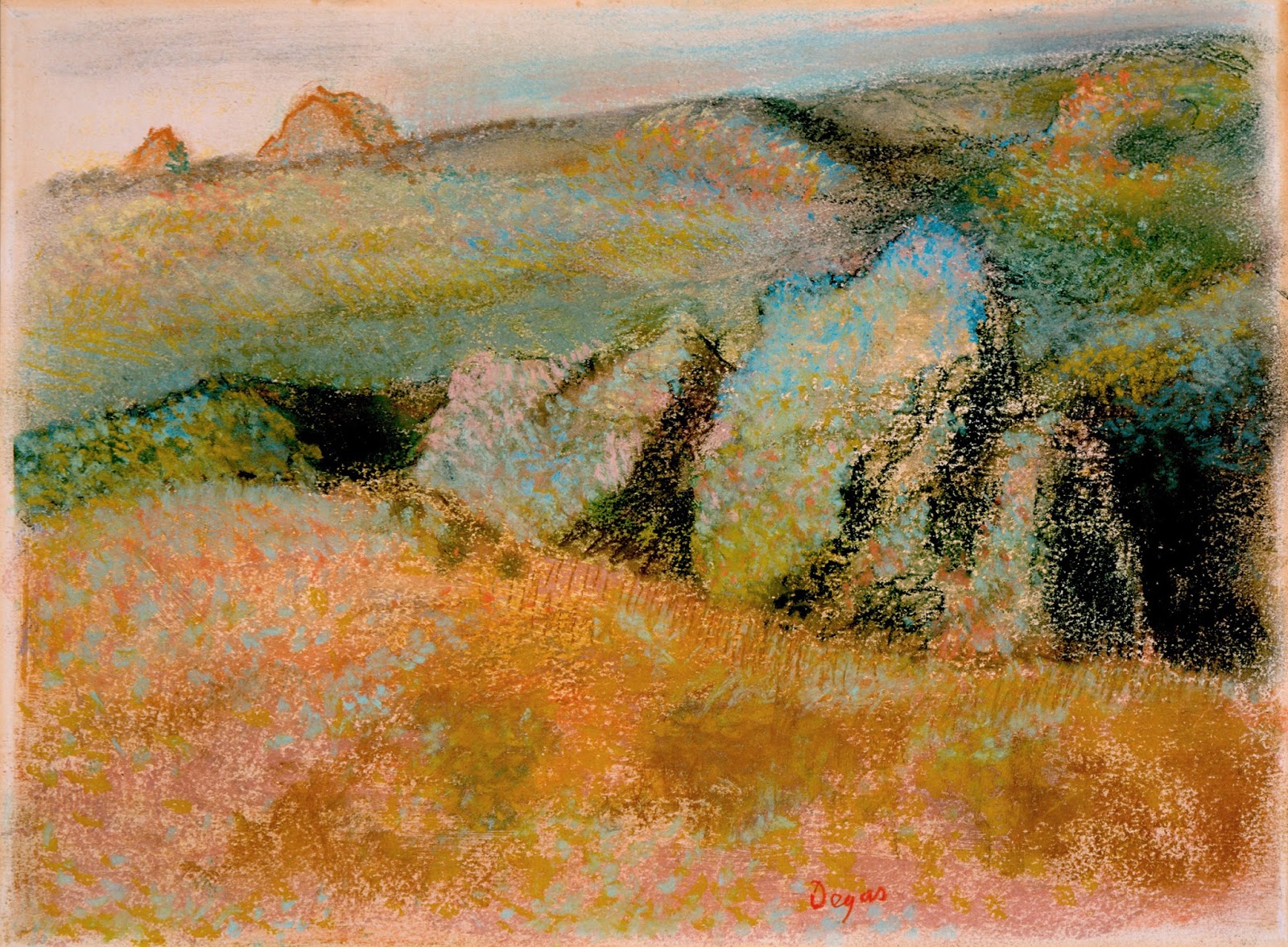
Fortunately, the Degas exhibit has a further surprise in store - a most pleasant one. In 1890, Degas visited Burgundy and was inspired to create landscapes, more ethereal than realistic. This uncharacteristic interest in landscape art revived Degas' utilization of monotype printing which had declined during the late 1880's.


Edgar Degas, Landscape with Rocks, c. 1892

Except in two or three cases, the scenery depicted by Degas in these astonishing monotypes did not correspond to actual geographic localities. Like the "late Turner" landscapes, which are now viewed as a foundation of Modern Art, these sites existed in a distant realm not to be found on any map.

Both Degas and Turner were aging artists, struggling against time and bodily infirmity. As they created their near-abstract landscapes, the "real" world faded around them. This was literally the case for Degas, whose eyesight began to fail in the mid-1870's, just as he took up printing and pastels to create these incredible monotypes. 


Edgar Degas, Forest in the Mountains, c. 1890

The "mind's eye" of  Degas, however, remained unimpaired. The poet, Stéphane Mallarmé, fittingly described the monotypes of Degas as having "a strange new beauty." 

Thanks to this MOMA exhibit we are finally able to appreciate Degas' character and the courage and honesty which he brought to the creation of great art, monotypes in particular. These previously overlooked prints help us to realize that Degas was not a man of contradiction but rather struggled to achieve inner harmony through his art.

Degas declared that he "should like to be famous and unknown." In their first major Degas exhibit, MOMA has insured that his fame will grow, even as his life becomes a little less of an enigma.

 ***
Text: Copyright of Ed Voves, all rights reserved 
Images courtesy of the Museum of Modern Art, New York City                                                                                                                                                                                     Introductory Image: 
Edgar Degas (French, 1834–1917). Heads of a Man and a Woman (Homme et femme, en buste), c. 1877–80. Monotype on paper. Plate: 2 13/16 x 3 3/16 in. (7.2 x 8.1 cm). British Museum, London. Bequeathed by Campbell Dodgson                                                                                                                                                     
Edgar Degas (French, 1834–1917). Dancer Onstage with a Bouquet, c.1876. Pastel over monotype on laid paper. Plate: 10 5/8 × 14 7/8 in. (27 × 37.8 cm). Private collection

Edgar Degas (French, 1834–1917). Factory Smoke (Fumées d’usines), 1877–79. Monotype on paper. Plate: 4 11/16 x 6 5/16 in. (11.9 x 16.1 cm), sheet: 5 13/16 x 6 13/16 in. (14.7 x 17.3 cm). The Metropolitan Museum of Art, New York. The Elisha Whittelsey Collection, The Elisha Whittelsey Fund, 1982.
                                    
Edgar Degas (French, 1834–1917). The Ballet Master (Le Maître de ballet), c. 1876. White chalk or opaque watercolor over monotype on paper. Plate: 22 1/4 x 27 9/16 in. (56.5 x 70 cm), sheet: 24 7/16 x 33 7/16 in. (62 x 85 cm). National Gallery of Art, Washington, D.C. Rosenwald Collection, 1964.

Edgar Degas (French, 1834–1917). Three Ballet Dancers (Trois danseuses), c. 1878-80. Monotype on cream laid paper. Plate: 7 13/16 × 16 3/8″ (19.9 × 41.6 cm). Sterling and Francine Clark Art Institute, Williamstown, Massachusetts.

Edgar Degas (French, 1834–1917). Ballet Scene (Scène de ballet), c. 1879. Pastel over monotype on paper. Plate: 8 x 16 in. (20.3 x 40.6 cm). William I. Koch Collection

Edgar Degas (French, 1834–1917). The Singer (Chanteuse de café-concert), 1875-1880 Pastel over monotype on paper Plate: 6 1/4 x 4 1/2" (15.9 x 11.4 cm) Reading Public Museum, Reading, Pennsylvania. Gift, Miss Martha Elizabeth Dick Estate 

Edgar Degas (French, 1834–1917). Frieze of Dancers (Danseuses attachant leurs sandales), c. 1895. Oil on fabric. 27 9/16 × 78 15/16″ (70 × 200.5 cm). The Cleveland Museum of Art, Gift of the Hanna Fund. © The Cleveland Museum of Art.

Edgar Degas (French, 1834–1917). Landscape with Rocks (Paysage avec rochers), 1892. Pastel over monotype in oil on wove paper. Sheet: 10 1/8 × 13 9/16″ (25.7 × 34.4 cm). High Museum of Art, Atlanta, Purchase with High Museum of Art Enhancement Fund.

Edgar Degas (French, 1834–1917). Forest in the Mountains (Forêt dans la montagne), c. 1890. Monotype in oil on paper. Plate: 11 13/16 x 15 3/4″ (30 x 40 cm). The Museum of Modern Art, New York. Louise Reinhardt Smith Bequest.