Showing posts with label Fiske Kimball. Show all posts

Wednesday, August 31, 2022

Art Eyewitness Essay: A Late Summer's Day Visit to the Philadelphia Museum of Art


A Late Summer's Day Visit to the Philadelphia Museum of Art 

An Art Eyewitness Essay

Photos by Anne Lloyd
Text by Ed Voves

April 2, 2022 was a noteworthy day in the art world. It was Slow Art Day.

This special day, usually celebrated on the second Saturday of April, is dedicated to adjusting the pace at which we race through art galleries. Slow down. Take time to appreciate and enjoy the works of art which museum curators work so diligently to present to us. What's the rush?

I missed Slow Art Day this year, I'm embarrassed to report. I can't recall what I was doing on April 2, but I made-up for it a few days later.

On April 7, I took part in a press preview of a wonderful retrospective of paintings and prints by Sean Scully at the Philadelphia Museum of Art. Mr. Scully graciously analyzed key works and answered questions with great good humor. It was truly enlightening to spend an unhurried hour or so with him - and his works of art.


Ed Voves, Photo (2022)
Sean Scully & Timothy Rub, President/CEO of the Phila. Museum of Art

Taking a note from that wonderful experience, I decided to extend the close attention to the general collection of the Philadelphia Museum of Art (PMA) which normally I reserve for special exhibitions.  

My wife, Anne, and I live in Philadelphia. With so many exhibits to cover for Art Eyewitness, there is always the temptation to wait and study local treasures at a later date. We are just a bus ride away from the PMA. We can always come back, in a week, in a month ...

If the Covid-19 lockdowns have taught art lovers one thing, it is to never take museums and galleries for granted. 


Anne Lloyd, Photo (2021)
View of the Philadelphia Museum of Art

The late summer seemed a good time for a leisurely, if focused, tour of the Philly Museum. There being a lull between the Sean Scully retrospective and the big Matisse exhibition planned for October, our attention would be undivided. 


Anne Lloyd, Photo (2022) 
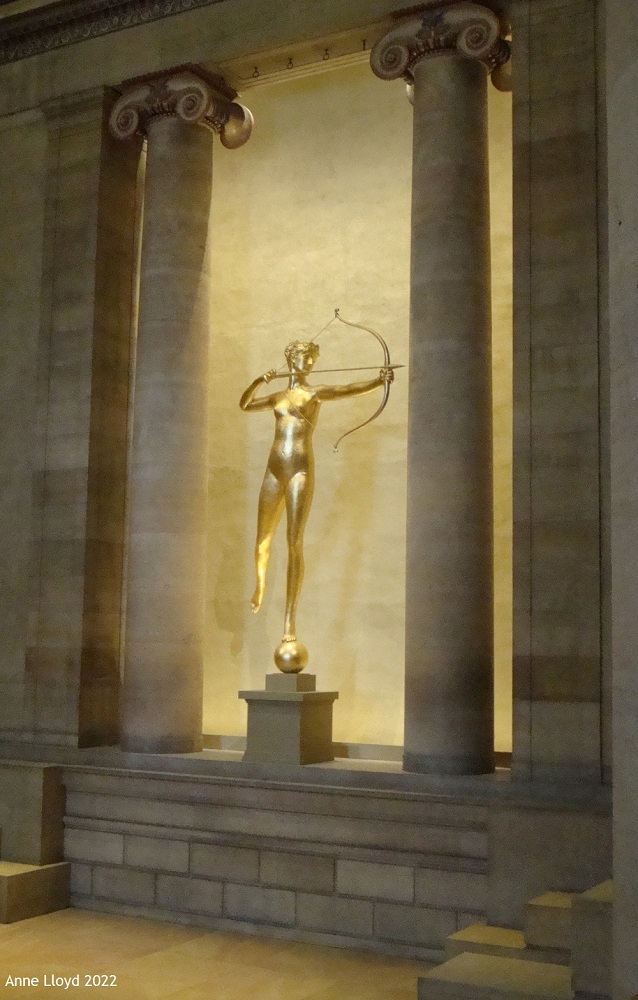
Augustus Saint-Gaudens, Diana, 1885-86

Our plan was to head for the third floor of the museum, via the  imposing staircase graced by Augustus Saint-Gaudens' statue of the goddess, Diana. This gilded lady once served as the weathervane atop the original Madison Square Garden in New York City. 

Dangling overhead is Ghost, a mobile made by Alexander Calder in 1964 for an exhibition at the Guggenheim Museum.
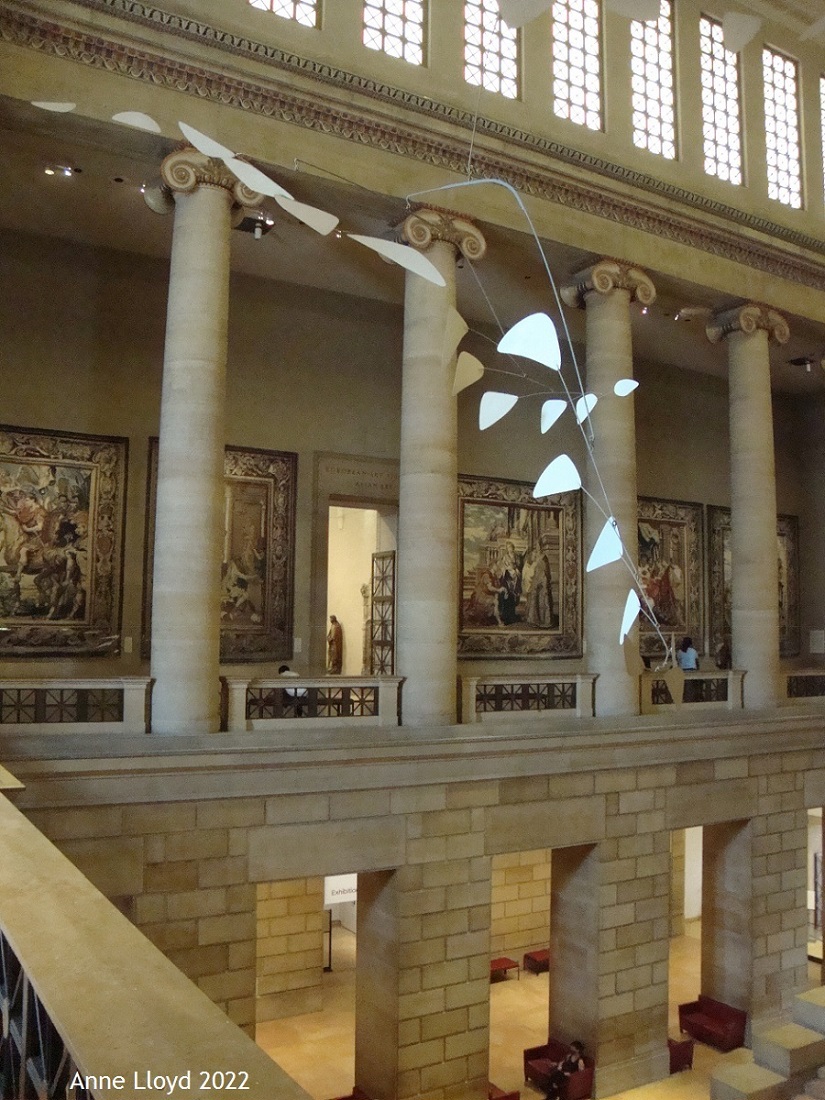


Anne Lloyd, Photo (2022) 
Alexander Calder, Ghost, 1964

Before we began our climb, we decided to check-in with two "friends" on the main floor of the museum, Madame Cézanne and Mary Cassatt.

There are different strategies of how to explore a museum. Anne and I often begin by paying our "respects" to the three portraits of Madame Cézanne at the PMA and to the works by Mary Cassatt at the museum.


Anne Lloyd, Photo (2022)
                    Gallery view of the Philadelphia Museum of Art,                      showing portraits by Paul Cézanne of his wife

Madame Cézanne is in a notably dour mood in these three portraits by her husband. In the center one, however, Madame Cézanne has such a compelling look in her eyes that she seems about to favor us with a nod, if not a smile.


Anne Lloyd, Photo (2022) 
Paul Cézanne's Portrait of Madame Cézanne, 1885-86

There is a really important point here, one that slowing down and making repeated visits to a favorite painting makes easier to grasp. 

Great works of art possess a sense of possibility, a charge of potential energy. Madame Cézanne will never change, never smile. But these great portraits invite our close study and emotional engagement. This in turn triggers our thoughts and awareness. And we change, maybe even smile, too.

In the case of Mary Cassatt, I especially cherish her magnificent 1879 painting, Woman with a Pearl Necklace in a Loge. But, for quite awhile, I failed to give it the attention it deserved. I thought that the elegant young woman (the model is thought to have been Cassatt's sister, Lydia) is turning in her seat to greet companions as they enter the loge.


Anne Lloyd, Photo (2022) 
Mary Cassatt's Woman with a Pearl Necklace in a Loge, 1879

Not so. Look again and we see the back of the young woman's head reflected in a mirror. Reflected too, are other opera fans, in loges or opera boxes on the other side of the theater. Why on earth would a mirror have been placed in the confined space of an opera box?  Was this an artistic device of Cassatt's?

After a bit of research, I found that the Teatro di San Carlo in Naples, Europe's oldest opera house, has mirrors in its loges. Each is set at an incline to offer a glimpse of what is occurring in the Royal Box. I would assume that loges at the Paris Opera were similarly equipped in Cassatt's day. Yet, the inclusion of a mirror in Cassatt's painting has more to do, I suspect, with the subject of optics than with celebrity snooping.

In Woman in a Loge, Cassatt depicted her protagonist as if we could look directly at her, as she sits in the loge. But the reflections of the audience in the opera boxes across the way show how she would appear to them. The beaming young woman is a singular person, a special "someone" with grace and charm. Yet, seen from the opposite side of the theater, she is a face in the crowd. 

That may be a sobering thought, but a few moment's of meditation before a great painting or sculpture can help us assess our place in the universe. Each of us is a unique individual, one soul among many, many millions of souls.


To apply the same level of attention to all the  works on view in a museum, that we have accorded to Woman with a Pearl Necklace in a Loge, is clearly impossible. So how to proceed, having paid our respects to Madame Cezanne and Miss Cassatt?

"Festina lente," as the Roman emperor, Augustus, said. Make haste, slowly.

Several art museum studies have shown that many visitors follow the first part of Augustus' advice. In 2001, the Metropolitan Museum of Art conducted a survey which found that the average time spent looking at a work of art was 27.2 seconds. Fifteen years later, the Art Institute of Chicago repeated the experiment. The findings were similar: 28.6 seconds. 


Anne Lloyd, Photo (2022)
 Gallery view of the Phila. Museum of Art, with works by Claude Monet

As Anne and I walked up the steps past the gleaming statue of Diana, we clearly had to do better, that is observe art at a slower and more patient pace. 

Luckily, the Philadelphia Museum of Art put some serious thought into how to  present its collection. When it opened in 1927, the museum's first director, Fiske Kimball, worked on a master plan to transform the third floor into a chronological succession of galleries and period rooms. 

Fiske Kimball's initiative was eventually crowned with success. Today, we can visit the splendid galleries which he and his team installed. These include the Reception Hall from a Ming Dynasty palace, early 1600's, and the Pillared Hall from a South Indian temple to Vishnu, dating to the 1500's. The sculptures and fixtures comprising this incredible gallery were acquired by an intrepid Philadelphia lady, Adeline Pepper Gibson, during a trip to India in the early 1900's and bequeathed to the PMA.


Anne Lloyd, Photo (2022)
 Gallery view of the Philadelphia Museum of Art, showing 
the Pillared Hall from a South Indian temple, 1500's 

Fiske Kimball was notably successful with evoking the religious faith of Christendom during the Middle Ages. Since I discussed the medieval galleries of the PMA in a recent review, Anne and I decided to devote most of our late summer day's visit to the European galleries and period rooms of later centuries.

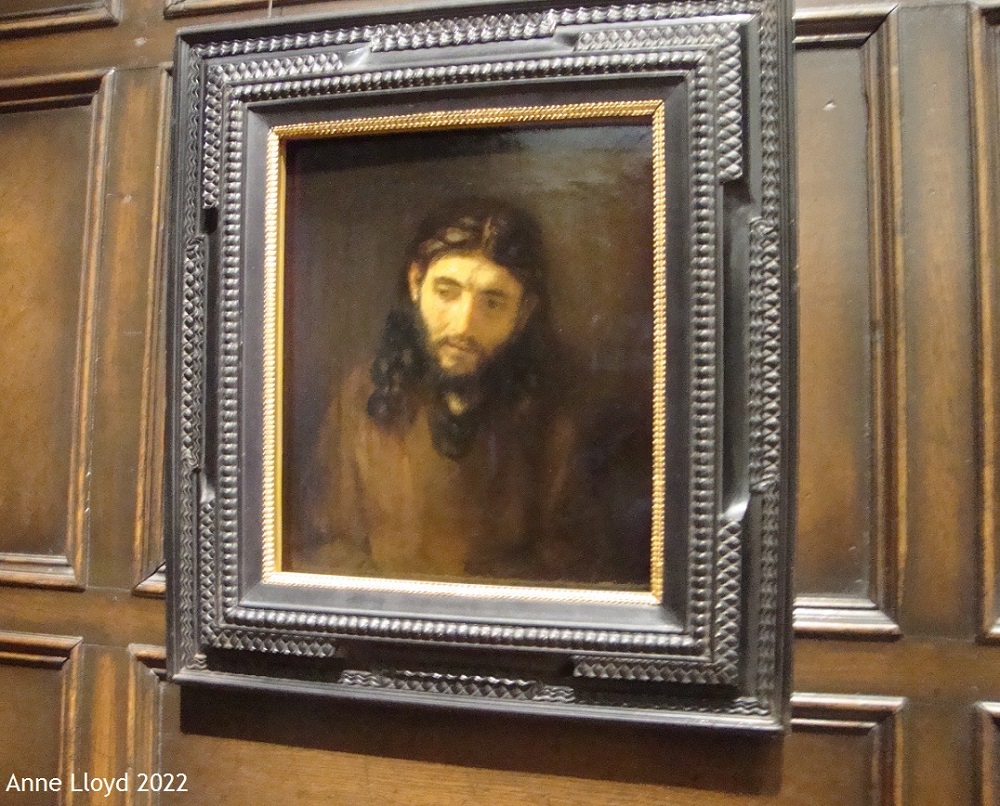
This historical era, the early modern age, is the time when the "Old Master" painters flourished. Thanks to collectors like John G. Johnson, the PMA certainly has its share of Old Master works of art. One of my favorites is Rembrandt's Head of Christ. Rembrandt used a model from Amsterdam's Jewish population to evoke the face of Jesus, thus promoting greater religious sensitivity.


Anne Lloyd, Photo (2022)
 Rembrandt's Head of Christ, 1648-56

In our tour of these early modern galleries, Anne and I were especially interested in the work of "anonymous." Despite the fame of Rembrandt, Rubens and other titans of brush and oils, unknown artisans active in the folk tradition of their respective countries created inspirational works of art.


   Anne Lloyd, Photo (2022)
            Gallery view of the Philadelphia Museum of Art, showing               Latin American colonial-era art, 1600-1700's

The settings of the early galleries in this wing of the PMA deal with Italy and Spain during the 1500's and 1600's. These are unexpectedly austere from the standpoint of material culture, though well provided with religious art.


  Anne Lloyd, Photo (2022)
            Gallery 353 of the Philadelphia Museum of Art, showing              Spanish doors, furniture and paintings, 1500-1600's.

This period was the High Renaissance and the Golden Age of Spain. Yet the living standards of the great mass of citizens in Italy and Spain were blighted by endless wars, galloping inflation and dreadful outbreaks of the plague. The obsessive - to us - emphasis on art dealing with the sufferings of Jesus and the saints was embraced by the people of that era rather than imposed upon them.

And yet, there were displays of humor in those hard times and a sense of mischief which could border on irreverence. Comic elements are surely to be seen in some of the carvings on a pair of walnut doors made in Spain, 1550-1600, and on a stone fireplace created in Italy around the same time.


Anne Lloyd, Photo (2022)
 Top: Pair of Doors from Spain, with carvings of the Annunciation and Saints Peter and Paul, 1550-1660; Italian Chimneypiece, 1550-1660

The identity of the maker of these handsome Spanish doors is a mystery. It is likely that the doors come from Castile, in central Spain, but beyond that, little is known about them. All of the decorative motifs are inspired by the Roman Catholic form of Christianity espoused by the Spanish monarchy of Philip II. Close inspection of the carving, however, reveals a sense of mirth which could have been explained away to all but the most suspicious officials of the Inquisition.


Anne Lloyd, Photo (2022)
 Details from Pair of Doors from Spain, with carvings of the Annunciation and Saints Peter and Paul, 1550-1660

At the top of the doors, we see an officious-looking Angel Gabriel barging into the room of the Virgin Mary who is poised to flee. The look of alarm on the faces of cherubs above and other details, such as St. Peter with his enormous set of keys, belong to the European folk art tradition which left many traces of wit and humor on the decoration of churches and cathedrals.

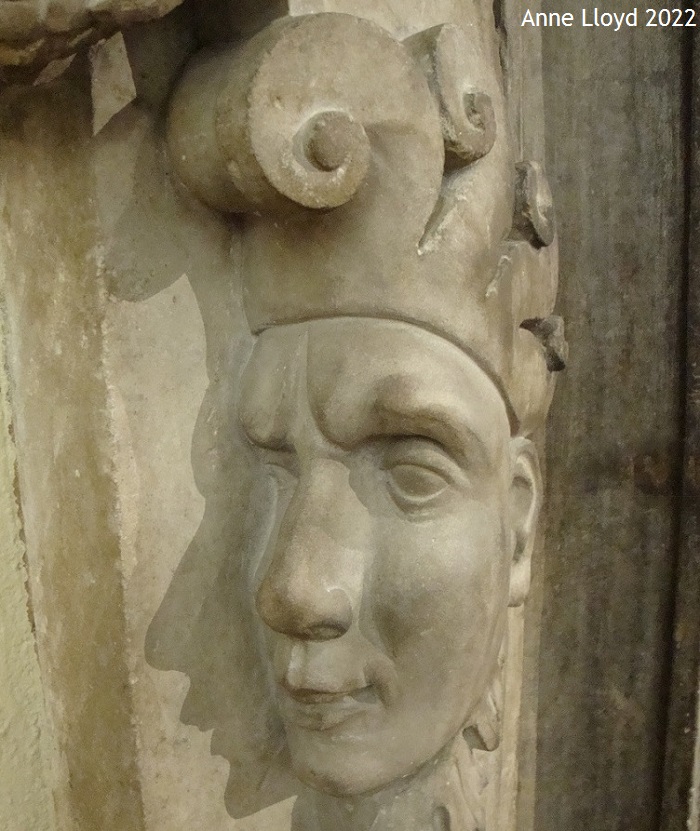
In the case of the Italian chimney piece, it is not difficult to grasp how the shadows cast by its carved faces can generate a sense of fantasy and drama. 


Anne Lloyd, Photo (2022)
 Details from an Italian Chimneypiece, 1550-1660

The Chimneypiece obviously had a great deal of use. Standing before it today, we can visualize how the dancing, darting flames would have projected the flickering faces of jesters and mythical characters around the room on a winter's night.

More carvings in the European folk tradition appear further on in the 1500-1850 galleries. Three of these works feature in a story of incredible coincidence or of the intervention by divine providence, depending on your point-of-view. 

Three sculptures, choir screen, altarpiece and statue of the Virgin Mary and Jesus, form an ensemble from the Chapel of the Chateau of Pagny, the Renaissance-era estate of the Admiral of France, Philippe Chabot de Brion, located in Burgundy.

The Chateau Pagny's Choir Screen, made from marble and alabaster, 1536-38, was acquired by the PMA in 1930. It was - and remains - one of the most significant works of art in the Museum's collection.


Anne Lloyd, Photo (2022)  
Choir Screen from Chapel at the Château of Pagny, 1533

The Choir Screen extended across the nave of the chapel, purposely shielding the altar and the sacred ritual of the Christian Mass from the gaze of the congregation. This arcane practice is hard for even faithful Christians to grasp today, given the emphasis on openness and participation. Yet, during 1500's-1600's, the concept of the altar as a sanctuary or "holy of holies" was of central importance to Roman Catholics.

The spectacular gilded, carved Altarpiece, now placed behind the Pagny Choir Screen  was purchased fifteen years later. And that is where the story gets really interesting..


Anne Lloyd, Photo (2022)
 Detail of Altarpiece with Scenes of the Passion, c. 1535

Fiske Kimball and his team of PMA curators purchased the altarpiece in 1945. They did so on the likelihood that it was similar to the one in the Pagny Chapel, of which all trace had been lost. Incredibly, after diligent research into the provenance of this magnificent work, they discovered that it was the actual altarpiece which had been sited behind the Choir Screen of the Chapel of Pagny, just as we see it today. 

I don't know what is the mathematical probability of reuniting the long-separated Choir Screen and Altarpiece, but the author of the Handbook to the PMA's collection is absolutely correct to use the word "miraculously" to describe the whole transaction.


Anne Lloyd, Photo (2022)  
Virgin and Child beneath a Canopy, from the Château of Pagny, 1533

The third of the artworks from the chapel of the Chateau of Pagny is a tall, slender sculpture, Virgin and Child beneath a Canopy. Measuring 14 feet 5 1/4 inches in height, it presented a considerable challenge for Anne to get a photo. Luckily, many of the most interesting details of this work - certainly from the European folk art tradition - were down at the bottom, almost at eye level.


Anne Lloyd, Photo (2022)  
Detail from Virgin and Child beneath a Canopy, 1533

There we see several carved heads and two small figures.The heads look-out from little niches, their faces a mix of agitation or incredulity. Who are they?  Souls in Purgatory awaiting redemption? Or perhaps, could they be self-portraits of the stone carvers who made the statue? For now, it is mystery. But considering how much we now know about these splendid sculptures, it is not impossible that one day we will learn their identity.

As we proceed with our tour through the European period rooms and galleries, 1500-1850, we see fewer and fewer religious paintings and a diminishing number of quirky, rough-hewn works by artisans of the old school. Occasionally, craft genius asserted itself with demonstrations of individualism and skill. But unforgettable works in the folk art tradition such as a wrought iron flagstaff holder from Italy, made in the 1500's, were increasingly pushed to the margins by the "fine" arts.


Anne Lloyd, Photo (2022)
Flagstaff Holder in the Form of a Dragon, Italy, 1500's

In the place of the culture of Christendom and folk tradition, what we observe is the growth of secular society in the West.

The relegation of religion to the realm of the private conscience brought many benefits, but it spawned problems, too. A growing spiritual malaise among the aristocrats and gentry in Great Britain was noted as the eighteenth century progressed. Shockingly, not a few clergyman in England grew lax in their spiritual duties, as well.


Anne Lloyd, Photo (2022)
Vicar and Moses, 1782-1795

The decline in religious faith among England's "upper crust" was satirized by this lead-glazed earthenware piece, entitled Vicar and Moses. It is actually a very significant work of art, a very early product from an Industrial Revolution factory in Staffordshire.


Anne Lloyd, Photo (2022)  
Period rooms at the Philadelphia Museum of Art.
               Top, the Grand Salon from the Chateau de Draveil, 1735;                below, the Drawing Room of Lansdowne House, 1766-1773  

The reconstruction of period rooms such as the Grand Salon from the Chateau de Draveil or the Drawing Room of Lansdowne House brought the polished elegance of 18th century France and England to the galleries of the Philadelphia Museum of Art. To transfer the fixtures, mirrors, woodwork, furnishings, etc., and reassemble them  in the Philadelphia Museum of Art was indeed a mighty accomplishment, worthy of the Age of Enlightenment.

In 1938, as Fiske Kimball worked on his master plan, four magnificent statues from the eighteenth century were donated to the PMA. They had come onto the art market in 1922, with little information about their provenance. Each statue depicted one of the seasons of the year in the guise of a Roman god or goddess, Autumn as Bacchus, for instance.


Anne Lloyd, Photo (2022) 
View of Gallery 366, showing two of the Four Seasons statues,1770-1790. From left, Winter as Saturn and Autumn as Bacchus

At the time of their arrival at the museum, the Four Seasons were attributed to the  sculptor, Augustin Pajou (1730–1809), one the masters of that era. This claim is disputed today, but the fact that Pajou was credited shows how superbly carved they are.. 

Today, the statues stand, slightly over-life sized, in Gallery 366. This, for the most part, is a fine placement for viewing them, but the gallery also functions as busy corridor. I can't imagine the times I've walked through on my way to another gallery, without paying attention to these Enlightenment -era masterpieces.

On the day of our "Slow Art" tour of the 1500-1850 galleries, Anne and I did stop to look at the Four Seasons. Or rather, we were stopped in our tracks by the sheer excellence of these statues.

Each of the Four Seasons is an allegorical figure but exudes real human feeling. Look at Saturn, huddled in his robe and you cannot help but believe that he feels the cold of Winter coming on.


 Anne Lloyd, Photo (2022) 
Detail of Winter as Saturn from the Four Seasons

Each of the Four Seasons inhabits a natural setting, made believable by incredible attention to detail, the chipped and scaling bark on the stump by the foot of Bacchus, the stalks of grain, billowing in the wind at the leg of Ceres.


Anne Lloyd, Photo (2022) 
Detail from Autumn as Bacchus from the Four Seasons

If you stand awhile in Gallery 366, you will see the shadows cast by the statues on the walls, looming large, looking like the souls of the statues and of the seasons they represent.


Anne Lloyd, Photo (2022) 
Gallery view showing Autumn as Bacchus from the Four Seasons

Each of the Four Seasons is an individual being, a real person rather than a type. 


Anne Lloyd, Photo (2022)
 Detail of Spring as Flora from the Four Seasons

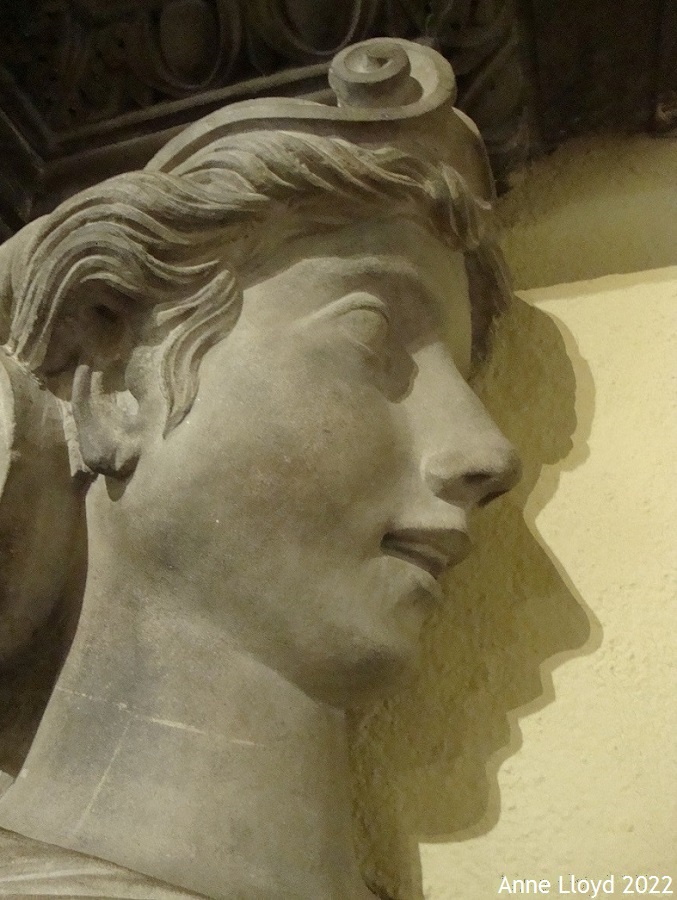
When I looked up and studied the countenance of Flora, I recognized the same liveliness which  Cassatt's Woman in a Loge exudes. The same compassion that can be glimpsed in the eyes of Rembrandt's Christ, was there in Flora's eyes.

These Four Seasons are incomparable works, regardless of who carved them. They live in a universe of stone, ready for our summons to spring to life.

But that call to action will have to wait. Our world was summoning us. It was time for us to leave. 

Plenty of great art to enjoy on our next tour of the Philadelphia Museum of Art! Plenty to think about and appreciate from this visit.

It's amazing what you see when you slow down - and look. 

***

Text: Copyright of Ed Voves, all rights reserved    

Images copyright of Anne Lloyd, all rights reserved

All photographed works of art are from the collection of the Philadelphia Museum of Art.

Introductory Image: Anne Lloyd, Photo (2022) Gallery view of the Philadelphia Museum of Art.

Ed Voves, Photo (2022) Sean Scully & Timothy Rub, President/CEO of the Philadelpha Museum of Art.

Anne Lloyd, Photo (2021) Exterior view of the Philadelphia Museum of Art.

Anne Lloyd, Photo (2022) Augustus Saint-Gaudens, Diana, 1892-94.

Anne Lloyd, Photo (2022) Alexander Calder, Ghost, 1964.

Anne Lloyd, Photo (2022) Gallery view of the Philadelphia Museum of Art,          showing portraits by Paul Cézanne of his wife

Anne Lloyd, Photo (2022) Portrait of Madame Cézanne by Paul Cézanne, 1885-1886. Oil on canvas: 24 3/8 × 20 1/8 inches. The Henry P. McIlhenny Collection in memory of Frances P. McIlhenny, 1986.

Anne Lloyd, Photo (2022) Mary Cassatt's Woman with a Pearl Necklace in a Loge, 1879. Oil on canvas: 32 × 23 1/2 inches (81.3 × 59.7 cm) Bequest of Charlotte Dorrance Wright, 1978.

Anne Lloyd, Photo (2022) Gallery view of the Philadelphia Museum of Art, with works by Claude Monet.

Anne Lloyd, Photo (2022)  Gallery view of the Philadelphia Museum of Art, showing the Pillared Hall from a South Indian temple, 1500's.

Anne Lloyd, Photo (2022) Rembrandt's Head of Christ, 1648-1656. Oil on oak panel, laid into larger oak panel: 14 1/8 × 12 5/16 inches. John G. Johnson Collection, 1917.

Anne Lloyd, Photo (2022)  Gallery view of the Philadelphia Museum of Art, showing Latin American colonial-era art, 1600-1700's. In the foreground is a silver gilt monstrance created by Franciso de Soria Hurtado (Peru, active 1651-92).

Anne Lloyd, Photo (2022) Gallery 353 of the Philadelphia Museum of Art, showing Spanish doors, furniture and paintings, 1500-1600's.

Anne Lloyd, Photo (2022) Pair of Doors from Spain, with carvings of the Annunciation and Saints Peter and Paul, 1550-1600. Walnut; iron mounts: Dimensions: Including posts: 7 feet 6 3/4 inches × 55 1/2 inches × 4 3/4 inches. Gift of The Rosenbach Company, 1944 

Anne Lloyd, Photo (2022) Italian Chimneypiece, 1550-1600 Stone: 7 feet 2 5/8 inches × 9 feet 6 3/16. Gift of Mr. & Mrs. W. Lawrence Saunders II, 1928

Anne Lloyd, Photo (2022) Choir Screen from Chapel at the Château of Pagny, 1533

Anne Lloyd, Photo (2022) Detail of Altarpiece with Scenes of the Passion,from the Chapel at the Château of Pagny  :c. 1535. Artist unknown, perhaps from the workshop of Master of the Oplinter Altarpiece, (Flemish) Gilded and painted wood sculptures; tempera-painted panels: Height: 9 feet 8 inches (294.6 cm)  Width (Wings closed): 7 feet 6 inches (228.6 cm). Purchased with Museum funds from the George Grey Barnard Collection, 1945

Anne Lloyd, Photo (2022)  Virgin and Child beneath a Canopy from the Château of Pagny, 1533. Stone:Height:14 feet 5 1/4 inches. Purchased with funds contributed by Mrs. Charles Wolcott Henry from the Edmond Foulc Collection, 1930. 

Anne Lloyd, Photo (2022) Flagstaff Holder in the Form of a Dragon, Italy, 16th century. Wrought iron: 24 x 7 x 18 inches: Purchased with Philadelphia Museum of Art Funds from the George Grey Barnard Collection, 1945

Anne Lloyd, Photo (2022) Vicar and Moses, c. 1782-1795. Made in the factory of Ralph Wood II,  Staffordshire. Lead-glazed earthenware: 9 1/2 x 4 1/2 x 5 1/2 inches. Gift of Charlotte Zeitlin in memory of David E. Zeitlin, 1999

Anne Lloyd, Photo (2022) Grand Salon from the Chateau de Draveil, 1735. Purchased with Philadelphia Museum of Art Funds.

Anne Lloyd, Photo (2022) Drawing Room from Lansdowne House, designed by Robert Adam, c. 1766-1775. Gift of Graeme Lorimer and Sarah Moss Lorimer in memory of George Horace Lorimer, 1931

Anne Lloyd, Photo (2022) Gallery view of the Philadelphia Museum of Art, Gallery 366, showing two of the Four Seasons statues by an unknown artist, 1770-1790. From left, Winter as Saturn, Stone: 6 feet 7 1/2 inches × 27 1/4 inches; Autumn as Bacchus, Stone: 6 feet 7 1/2 inches × 27 1/4 inches. 

The other Four Seasons statues are Flora as Spring, 7 feet 1 1/2 inches × 27 1/4 inches  and Ceres as Summer, 7 feet 1 1/2 inches × 27 1/4 inches.

Gift of Eva Roberts Stotesbury in memory of Edward T. Stotesbury, 1938.


Tuesday, June 28, 2022

Art Eyewitness Review: Medieval Treasures from the Glencairn Museum at the Philadelphia Museum of Art


Medieval Treasures from the Glencairn Museum

Philadelphia Museum of Art

June 24, 2022 - Autumn 2023

Reviewed by Ed Voves  

Original photos by Anne Lloyd

In the prologue to Henry V, William Shakespeare asked if the "cockpit" of the Globe Theatre, shaped like a "wooden o", could provide the setting for retelling the story of the Battle of Agincourt.

We can well raise similar questions about the effectiveness of museums in presenting special exhibitions. When carefully chosen works of art are displayed in a gallery space, can they call forth a "Muse of fire" to ignite our imaginations as Shakespeare did?

In the case of a small, focused exhibition at the Philadelphia Museum of Art, Medieval Treasures from the Glencairn Museum, the answer is a resounding yes! 

A choice selection from Glencairn's renowned collection of art from the Middle Ages is on view in the exhibit, a long-term loan while building renovations are being made at Glencairn. 


Anne Lloyd, Photo (2022)
 Gallery view of Medieval Treasures from the Glencairn Museum

From masterpieces of carved ivory, the earliest dating to around the year 500, to luminous stained glass panels from the era of the Gothic Cathedrals, the exhibition distills the very essence of the culture of Christendom. 

Medieval art was overwhelmingly spiritual in orientation and intended for instructional purposes. But the core humanity of the people who populate the scenes of sacred history on the stained glass panels and church sculptures from Glencairn often transcend the boundaries of theological doctrines. 


Anne Lloyd, Photo (2022) 
The Visitation from the Church of St. Radegonde, c.1270-1275

When we view the greeting of the Virgin Mary and her older cousin, Anne, in  this depiction of the biblical episode known as the Visitation, we are moved to join in their embrace - and extend it to all humanity. Over and over again, the Glencain "treasures" banish all lingering prejudices regarding the medieval era as a "dark age."


Ed Voves, Photo (2021) View of Glencairn Museum, Bryn Athyn, PA

In the early summer of 2021, I visited the Glencairn Museum, located in Bryn Athyn, PA, about fifteen miles north of center city Philadelphia. I won't repeat the story of how the Bryn Athyn Cathedral and the Glencairn Museum came to be built by Raymond Pitcairn (1885-1966). But it has to be emphasized, once again, that "Pitcairn brought the passion and work ethic of the castle and cathedral builders of the Middle Ages to his great venture."  

Like Bishop Bernward, patron of the great German abbey church of St. Michael's at Hildesheim (built 1001-1031) and Abbot Suger, who pioneered the design of Gothic cathedrals a century later, Pitcairn believed in acquiring treasures of religious art to display in his magnificent edifice. 

Although Glencairn has excellent examples of ancient Egyptian, Graeco-Roman and religious art from around the world, medieval European art is the museum's premier attraction. Pitcairn collected approximately 600 works of art, mostly from the Romanesque and early Gothic periods in France, 1100-1300, with special attention to stone carvings and stained glass window panels.

From this world-class array of medieval art, curator Jack Hinton of the Philadelphia Museum of Art (PMA) chose 18 magnificent works of art. But before we examine these treasures from Glencairn, two important points need to be underscored. 

Medieval Treasures from the Glencairn Museum is the latest collaboration between the two museums, dating back to the 1930's. There are a number of other Glencairn works currently on view in the medieval galleries of the PMA. Indeed, some have been on long-term loan for so many years that these works appear to be permanent features of the PMA. 


Anne Lloyd, Photo (2021)
 Gallery view of the Philadelphia Museum of Art, showing Corpus of Christ, late 1200's, & Effigy of a Recumbent Knight, c.1230

This is the case for one of the museum's most effective displays, the pairing of a late thirteenth century crucifixion from Glencairn with the tomb effigy of a recumbent knight from the PMA's collection. 

This Corpus of Christ (as the painted wooden statue is also called) reflects the emphasis upon Jesus' humanity and suffering as preached by St. Francis of Assisi (1181/82-1226). When placed above the monument to an unknown knight of the Crusading-era, this sculptural ensemble symbolizes Europe's Age of Faith in a profoundly moving way.


                                        Anne Lloyd, Photo (2022)                                   Entrance to the Medieval Treasures from the Glencairn Museum exhibit at the Philadelphia Museum of Art

It is entirely fitting that Medieval Treasures from the Glencairn Museum is on display in one of the PMA's galleries devoted to the Middle Ages, only a moment's walk from the Corpus of Christ and the sleeping knight. Stepping through the doorway of Gallery 307 to view the exhibit evokes the feeling of arriving at journey's end on a medieval pilgrimage.


Anne Lloyd, Photo (2022)
 View of Stained Glass Panels from the Glencairn Museum Collection

The first works of art to strike the eye upon entering the exhibit is the bank of five radiant panels of stained glass from the early Gothic era. These are positioned on the wall opposite to the door, yet their appeal is impossible to resist.

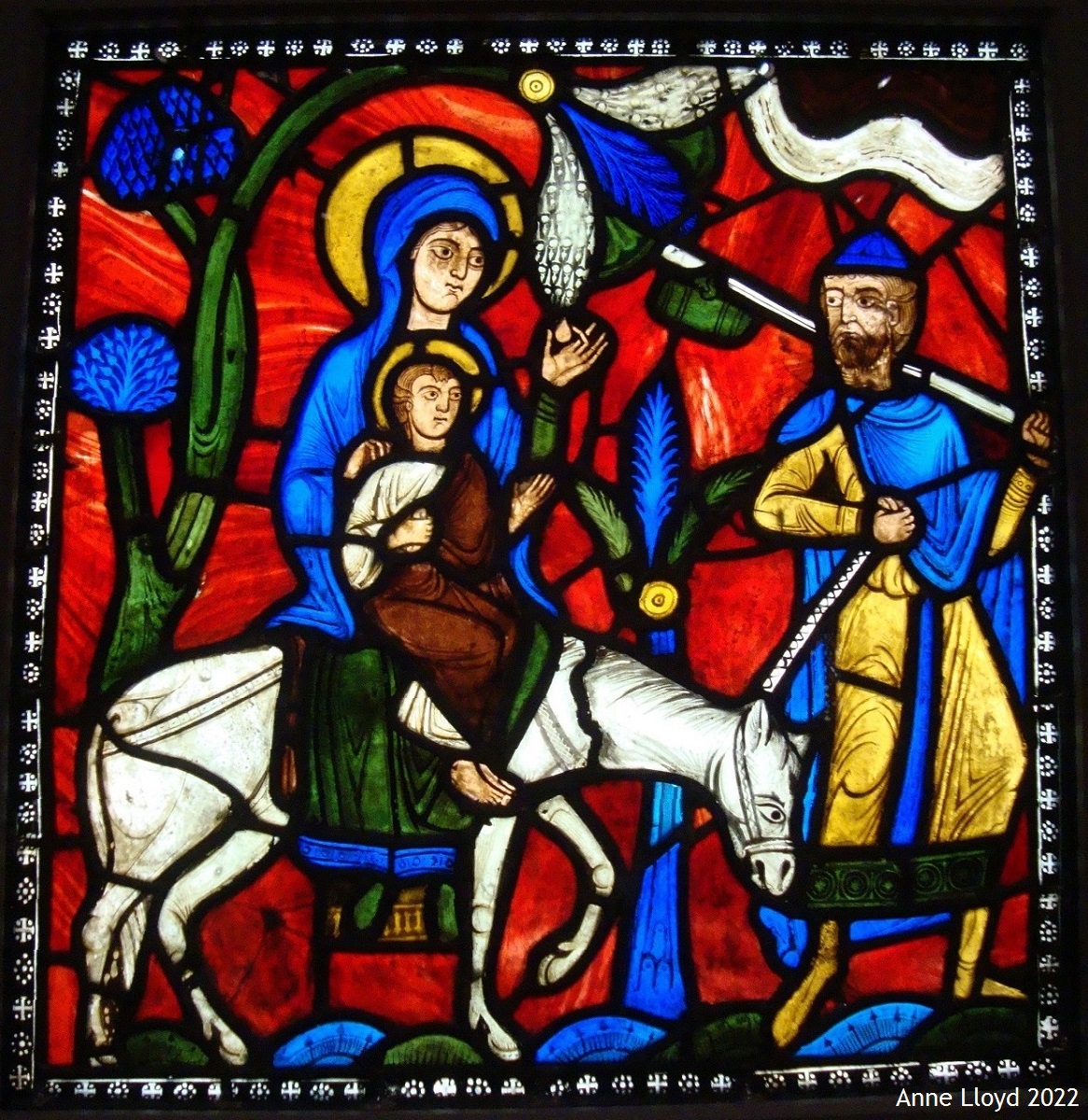
I was drawn immediately to these wondrous art works, particularly to the central panel, The Flight into Egypt. Commissioned by Abbot Suger for the reconstruction of the royal chapel of France, the Abbey Church at Saint-Denis, it dates to 1140-1144. This rare, color-drenched panel is one of the earliest surviving pieces of stained glass in an American art collection.

The Flight into Egypt was also, for several years during the 1970's, a very controversial work of art. Scholarly opinion was divided on whether it was a forgery. It took a long, intensive campaign to prove its authenticity. The dogged determination of a Columbia University grad student, Michael Cothren, and the scientific analysis of Robert Brill of the Corning Museum of Glass insured that The Flight into Egypt regained its status as one of the world's greatest works of medieval art.


                                    Anne Lloyd, Photo (2022)                                      The Flight into Egypt, from the Chapel of St. Denis, c. 1145

To describe The Flight into Egypt as iconic is, for once, entirely appropriate. 

After only a few moments of viewing The Flight into Egypt, one can begin to reach a better understanding of the medieval world view. It was a state of mind where the biblical past was very much alive. Religious pilgrimages figured prominently as deeds of faith. And if one could not make the ultimate journey to Jerusalem, then a visit to a cathedral closer to home, emblazoned with stained glass windows depicting the lives of Jesus, his mother Mary and other saintly persons, would suffice.


Detail of The Flight into Egypt, St. Denis, c. 1145

Likewise, people during the Middle Ages had no problem in believing tales not found in sacred scripture. In The Flight into Egypt, we see Mary picking a fig from a tree which her infant son (who looks remarkably mature) had commanded to lower its branch for her convenience. Incredible, even ridiculous, to our minds, yet such a story would have given encouragement to pilgrims enduring an arduous journey to Chartres, Santiago or even Jerusalem.

Another of the Glencairn stained glass panels strikes an even more apocryphal note. In the legend of the Seven Sleepers of Ephesus, a group of early Christians, fleeing persecution, sought refuge in a cave, which was sealed-up by Roman soldiers. Instead of dying, they fall asleep, waking-up many years later like Rip van Winkle. 


Anne Lloyd, Photo (2022) 
 The Arrest of Malchus in The Seven Sleepers of Ephesus window from Rouen Cathedral, c.1200-1203

One of the seven, Malchus, is arrested for trying to buy bread for breakfast with a now-vintage Roman coin. Ephesus, his home town, had converted to Christianity while he and his companions slumbered, but Malchus, as we see in the charming scene, above, is once again on the wrong side of the law.

Miraculous or far-fetched - or somewhere in between - stories drawn from the Bible and popular religious tales were best told in pictorial format. Romanesque churches featured vigorous, colorful fresco paintings, but in the cold, damp climate of Europe, north of the Alps, these quickly lost their lustre. Stained glass, far more difficult to create, lasted longer. The master glass makers of the Gothic cathedrals, developed an eye for dramatic scene composition that modern-day film makers could not surpass.

The economy of creative effort used in creating narratives of Gothic-era stained glass is readily apparent in Salome Dancing at the Feast of Herod. This was one of a series of roundels depicting the life and death of St. John the Baptist from a church in northern France. While the series progresses like movie storyboards, each roundel is brilliantly self-contained, none more so than this one of sexy Salome's dance.


                                        Anne Lloyd, Photo (2022)                                     Salome Dancing at the Feast of Herod, c. 1235

Here we see the sword-wielding Salome, gyrating at the feet of Herod Antipas. Her mother, Herodias, urges the irresolute Herod to strike at John the Baptist. While the other scenes in the series, (Glencairn owns two more) are equally forceful, this brilliant episode is an absolute masterpiece.

This array of stained glass panels is so brilliant that it was hard to redirect my attention to the other works of art in Medieval Treasures from the Glencairn Museum. Yet, just a few feet away was a Romanesque sculpture, carved from limestone around 1150-60, which rivals the narrative inventiveness and emotional intensity of the stained glass panels.


Anne Lloyd, Photo (2022)
 Capital with the Story of Dives and Lazarus, c. 1150-60

Capital with the Story of Dives and Lazarus would have perched atop a column at the Abbey of Moutiers-Saint-Jean, France. It shows Jesus' parable of the pious, impoverished Lazarus and rich, selfish Dives. Lazarus dies in misery but is redeemed, coming to rest "in the bosom of Abraham." Dives, clutched in the jaws of damnation, begs that Lazarus dip his finger into water to relieve his agony.


                                       Anne Lloyd, Photo (2022)                                  Capital with the Story of Dives and Lazarus (detail)

Romanesque sculptures like this capital were once viewed as "primitive" but are now regarded as masterful interpretations of the conflict of good and evil. If outwardly simplistic in its moral judgement, the Lazarus/Dives carving conveys a degree of psychological intensity that certainly informed the mind and guided the hand of the sculptor who made it.  

The terror on the face of Dives when he realizes that he faces divine wrath for his cruel, heedless mistreatment of Lazarus is unforgettable, ranking with images from classic cinema of the 1920's or Francis Bacon's "screaming" popes.


Detail of Capital with the Story of Dives and Lazarus, c.1150-60

Skillful story-telling is indeed a prevailing theme of medeaval art. To an amazing degree, Medieval Treasures from the Glencairn Museum evokes the spirit of the Middle Ages. The "genius" is there in the details of these works and in their skillful juxtaposition in the display cases of the exhibition.


                                       Anne Lloyd, Photo (2022)                                      Gallery view of Medieval Treasures from Glencairn Museum, showing Ivory Box from Spain & Sculpted Head by Giselbertus

Two small artifacts - incredibly so - offer insight into the development of medieval art. The first is a small box, carved from ivory, in Spain, around the year 700. It is placed  next to a sculpted "crowned" head, hardly bigger than a man's clenched fist. Together, these diminutive works of art reveal much about the course of European art during the early Middle Ages.

The carving on the ivory box narrates two episodes in the life of King Solomon, including his crafty judgement of ordering  a baby sliced in two, so that rival women, each claiming to be the child's mother, coud have an equal share of the corpse. (The deed, thankfully, never was carried out.) 


  Anne Lloyd, Photo (2022) 
Box with Scenes from the Book of Kings, c. 700

Though the incident was biblical in origin, the carving on the box was entirely Germanic. Spain, following the collapse of Roman rule, was dominated by Visigothic kings. Brave in battle but inept as administrators, the Visigoths succumbed to the Moorish invasion of Spain in 711.

The ineffectual rule of the Visigoths is reflected in this curious ivory box. But the "crowned" head, displayed in the same  case, shows how far the artistic skill of Europe's sculptors had progressed by the time it was carved, sometime in the early 1100's. It too represents a king, perhaps King Solomon. But the identity of the maker, rather than the subject, is what counts.

The man who carved this Head of a King was almost certainly Giselbertus. His reputation as "one of the great geniuses of medieval art" is based on the astonishing carved scene of the Last Judgement which he sculpted for Autun Cathedral, 1125-1130. Skill alone, however, does not account for the renown of Giselbertus. At the base of his depiction of Christ at Autun, Giselbertus contributed an unexpected detail: his name.

Giselbertus hoc fecit. Giselbertus made this.


Anne Lloyd, Photo (2022)
 Head of a King. Attributed to Giselbertus, Mid-1100's

Looking at this small head reveals that its features are very similar to those on the figures of the Autun Last Judgement. This is the main reason that scholars believe it was carved by Giselbertus. For my part, I was struck by the mobility of expression of the face, of the fey quality of the character of the king, when viewed from different angles. He looks sly and devious on one side, impassive on the other. This might well be a portrait of King Solomon. 

In signing his name on the Autun sculpture, Giselbertus brought medieval art to the point where artists ceased being anonymous. Credit would be given where it was due. Centuries would pass before this process would be complete, but thanks to Giselbertus, artistic individualism had received a huge boost.

This transition in art, from Romanesque to Gothic, with growing public recognition for artists, is the endpoint of the Medieval Treasures from Glencairn exhibit. But the modern-day part of the story has a further chapter to relate: the important role which Raymond Pitcairn played in the development of the Philadelphia Museum of Art.

When the Philadelphia Museum of Art opened in 1927, its first director, Fiske Kimball, worked on a master plan to transform the museum's third floor into a chronological succession of galleries and period rooms. When complete, this would enable art lovers to follow the course of  Western art from the Middle Ages to modern times.


Anne Lloyd, Photo (2022)
 Gallery view of the Philadelphia Museum of Art, 
showing the Fountain from the Monastery of St Michel-de-Cuxa

Fiske Kimball, a brilliant scholar of architecture, was able to place in the museum galleries surviving remains from historic buildings in Europe such as the fountain from the Monastery of St Michel-de-Cuxa and the Portal of the Abbey of Saint-Laurent. This gives visitors a "you are there" passport to the Middle Ages. 

However, the PMA's master plan soon hit a major obstacle. The Stock Market collapse of 1929 and the ensuing Great Depression gravely affected donations of funds and works of art to the museum. Many of the galleries remained empty. As Fiske Kimball and his staff labored to achieve their audacious goal, critics lampooned the museum as a "Grecian parking garage."

Raymond Pitcairn helped Fiske Kimball deal with the dilemma of providing works of art for the fourteen galleries designated for the study of medieval art and culture. During the Depression decade, Pitcairn loaned approximately 70 art works to the PMA, along with several donations. The loans included many of his most treasured sculptures and paintings including the fourteenth century fresco, Christ in Majesty, from a church in Spoleto, Italy. 


Anne Lloyd, Photo (2021) Corpus of Christ, late 1200's

As noted earlier, in the case of the Corpus of Christ, many of Pitcairn's loaned art works graced the medieval galleries of the PMA for very long periods of time. Even after 1945, when funds became available for Fiske Kimball to purchase a large collection of medieval art for the PMA, Pitcairn continued to generously support the museum.

As I left Gallery 307, where Medieval Treasures from the Glencairn Museum will hang until repairs at Glencairn are finished in the fall of 2023, I was in a thoughtful mood. I reflected on the vital role of enlightened artists and patrons, whose contributions make civilized life meaningful - indeed possible. 


Anne Lloyd, Photo (2022)
 Border panel, from the Moses Window, Church of Saint-Denis, c. 1145

Where would we be without visionaries like Abbot Suger, without the stained glass masters who made The Flight into Egypt or gifted sculptors like Giselbertus?

Where would we be - in our own age of great wars, great plagues and great depression - without the likes of Raymond Pitcairn?

***

Text: Copyright of Ed Voves, all rights reserved                                              Images copyright of Anne Lloyd 

Introductory Image: 

Anne Lloyd, Photo (2022) The Flight into Egypt, from the Infancy of Christ Window (detail)

Anne Lloyd, Photo (2022) Gallery view of Medieval Treasures from the Glencairn Museum at the Philadelphia Museum of Art.

Anne Lloyd, Photo (2022)  The Visitation from the Church of St. Radegonde. Artist unknown, France. Stained glass. c. 1270-1275. 30 1/2 × 23 7/8 inches (77.5 × 60.6 cm). On loan from Glencairn Museum, Bryn Athyn, PA. 

Ed Voves, Photo (2021)  View of Glencairn Museum, Bryn Athyn, PA

Anne Lloyd, Photo (2021) Gallery view of the Philadelphia Museum of Art, showing Corpus of Christ, late 13th century, painted wooden statue on loan from the Glencairn Museum and Recumbent Knight from a Tomb Sculpture, France, c. 1230, from the Philadelphia Museum of Art collection.

Anne Lloyd, Photo (2022) Entrance to the Medieval Treasures from the Glencairn Museum exhibit at the Philadelphia Museum of Art.

Anne Lloyd, Photo (2022) View of Stained Glass Panels from the Glencairn Museum Collection.

Anne Lloyd, Photo (2022) The Flight into Egypt, from the Infancy of Christ Window (?), from the Abbey Church of St. Denis, France. Stained glass. c. 1145. 20 1/2 × 19 3/4 inches (52.1 × 50.2 cm). On loan from Glencairn Museum, Bryn Athyn, PA. 

Anne Lloyd, Photo (2022) The Flight into Egypt (detail)

Anne Lloyd, Photo (2022)  Malchus is Led before the Bishop and Prefect from The Seven Sleepers of Ephesus window of the nave aisle of Rouen Cathedral. Stained glass. c. 1200-1203.  24 1/2 × 23 1/4 inches (62.6 × 59 cm).On loan from Glencairn Museum 

Anne Lloyd, Photo (2022) Salome Dancing at the Feast of Herod, Stained glass roundel from the Church of Saint-Martin, Breuil-le-Vert, France, c.1235.  diameter: 47. 5 cm. (18 11/16 inches) On loan from Glencairn Museum, Bryn Athyn, PA.

Anne Lloyd, Photo (2022) Capital with the Story of Dives and Lazarus. Artist unknown, from the Abbey of Moutiers-Saint-Jean, France. Limestone. c. 1150-60. 25 × 11 × 14 1/2 inches (63.5 × 27.9 × 36.8 cm). On loan from Glencairn Museum, Bryn Athyn, PA.

Anne Lloyd, Photo (2022) Capital with the Story of Dives and Lazarus (detail)

Anne Lloyd, Photo (2022) Gallery view of Medieval Treasures from Glencairn Museum, showing Ivory Box from Spain & Sculpted Head by Giselbertus

Anne Lloyd, Photo (2022) Box with Scenes from the Book of Kings. Artist Unknown, Spain. Ivory. c. 700. Approx.: 3 × 6 × 3 inches (7.6 × 15.2 × 7.6 cm). On loan from Glencairn Museum, Bryn Athyn, PA.

Anne Lloyd, Photo (2022) Head of a King. Attributed to Giselbertus, from Autun, Burgundy. Limestone. Mid-1100's. 5 1/8 × 3 1/4 × 3 5/8 inches (13× 8.2 × 9.2 cm). On loan from Glencairn Museum, Bryn Athyn, PA.

Anne Lloyd, Photo (2022) Gallery view of the Philadelphia Museum of Art, showing the Fountain from the Monastery of St. Michel-de-Cuxa.

Anne Lloyd, Photo (2022) Corpus of Christ, late 1200's, from the Glencairn Museum collection, on view at the Philadelphia Museum of Art.

Anne Lloyd, Photo (2022) Border panel, from the Moses Window (?), Artist Unknown, Abbey Church of Saint-Denis, France. Stained glass. c. 1145. 19 1/4 × 9 inches (48.9 × 22.9 cm). On loan from Glencairn Museum