Showing posts with label China. Show all posts

Tuesday, May 6, 2025

Art Eyewitness Review: Recasting the Past: the Art of Chinese Bronzes, 1100-1900


Recasting the Past: the Art of Chinese Bronzes

 1100-1900

Metropolitan Museum of Art 

February 28 - September 28, 2025

Reviewed by Ed Voves

The Metropolitan Museum of Art is currently re-evaluating Chinese civilization from the vantage point of works of art which have not been viewed in particularly high esteem. The objects on display date from the high Middle Ages (by Western date conventions) to the dawn of the twentieth century. 


Ed Voves, Photo (2025 )
 Tripod Incense Burner, Qing Dynasty, created 1736-95

These bronze cast sculptures, along with works in other media, were held to be derivative exercises in scholarly nostalgia rather than bold statements of cultural vitality, such as those The Met featured in the spectacular Art of Empires exhibit in 2017.

Recasting the Past: the Art of Chinese Bronzes, 1100-1900, is sure to lead to a more positive assessment of these striking works of art. But, as with most generalizations, there are elements of fact which, if viewed out of context, can lead to a distorted appraisal.


Ed Voves, Photo (2025 )
 Ritual Ox Tripod (niuding), used as a cauldron at
 the Imperial Ancestral Temple, Northern Song Dynasty, 1114

Two hundred works of art (half from The Met's incomparable collection) are displayed in the exhibition. Though some of these are not bronzes, all exemplify a major feature of Chinese civilization, called fugu or the "return to the past." 

The historical era which these precious objects celebrated was the very distant past: the Shang dynasty (1600-1046 B.C.) and the two successor Zhou dynasties (1046-256 B.C.) This was China's bronze age, which was revered as a "golden" age.

Shang bronzes are among the most notable works of art produced in Asia. These bronze-cast objects were intended to be functional, not merely ornamental. Most importantly, Shang bronzes were foundational to the cultural expression of the subsequent dynasties which followed over the long course of China's history. The Met has several outstanding examples of Shang bronzes on view in nearby galleries. 


Wine pouring Vessel (Gong), Shang Dynasty, 13th-11th century B.C.
Collection of the Metropolitan Museum of Art

If displayed in a direct "face-off" with the works of art on view in Recasting the Past, the Shang bronzes would "win" by almost all standards of aesthetic judgement. Fugu bronzes and works of jade were made, for the most part, for display or contemplation, unlike Shang bronzes. As a consequence, the scales of judgment seem even more tilted against these later works.

Yet, when viewed from the overarching context of Chinese history, Recasting the Past enables us to value the very impressive levels of technical skill devoted to these later works. These were intended to foster appreciation of China's ancient heritage and to revive the craft methods of bronze casting.

Most importantly, the fugu concept enabled China's cultural elite to withstand the depredations of waves of invaders and thus preserve the core values of their remarkable civilization.


Vase with Archiastic Design, Yuan Dynasty, 14th century
 Collection of the Metropolitan Museum of Art

In addressing these criteria, the Recasting the Past artifacts deserve our consideration as high caliber works of art, indeed.


Ed Voves, Photo (2025 )
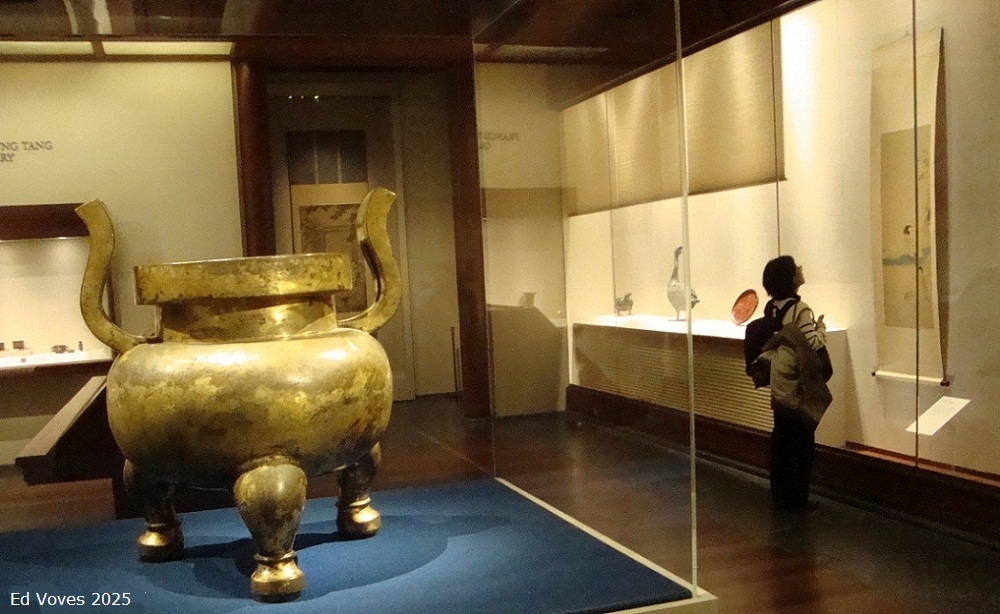
 Gallery view of Recasting the Past: the Art of Chinese Bronzes.  
 At left, is a Tripod Incense Burner, c. 1403-24

"Location, location" is the mantra of real estate agents. "Context, context" is the similar refrain for art historians and curators. Recasting the Past provides both for the study of these masterworks of Chinese civilization.

First, let's examine the location of the exhibition.


Ed Voves, Photo (2025 )
 The Astor Chinese Garden Court at the Metropolitan Museum of Art

The galleries of Recasting the Past are located adjacent to the Astor Chinese Garden Court. Built by expert Chinese craftsman who used traditional techniques and authentic materials, the Astor Court recreates the courtyard of a scholar-official of the Ming Dynasty, 1368-1644 . It was in such settings that the bronze, jade and ceramic works of art on display in Recasting the Past were first collected by gentleman-savants and used in small group discussions.

The Met has a wonderful depiction of such an event, with the engaging title, Elegant Gathering in the Apricot Garden, ca. 1437. It is an elaborate hand scroll showing the Ming Dynasty statesman, Yan Rong, engaged in cultured activities with several other scholar-officials. One of the scenes shows tables set with painting and calligraphy materials and bronze vessels similar to those on view in the exhibition.


 Xie Huan, Elegant Gathering in the Apricot Garden (detail), c. 1437
 
Such "elegant gatherings" must have been idyllic occasions, especially during the early decades of the Ming Dynasty. The Ming Dynasty was comparable both in its begin/end dates and in its influence on Chinese civilization to the role of the Renaissance in Europe.


Ed Voves, Photo (2025 )
 Gallery view of Recasting the Past: the Art of Chinese Bronzes
at the Metropolitan Museum of Art

The bronze and jade favored by scholar-officials like Yan Rong tended to be moderate in size, rather than monumental, and very much in the spirit of fugu. Why would the ideal of a "return to the past" find favor in a dynamic state like the Ming Dynasty? 

For that we need historical context. 


Ed Voves, Photo (2025 )
  Ceremonial Bell with Imperial Procession, Landscape, and
 Mythical Creatures in Waves, Northern Song Dynasty, 12th century

The lead work of art in the exhibition is the Ceremonial Bell with Imperial Procession, Landscape, and Mythical Creatures in Waves. This huge - and hugely impressive - bronze bell dates to the early 12th century, the era of the Northern Song Dynasty (960-1127).

This mighty bell was meant to be functional, sounded by being struck on its surface with mallets. The mythological dragons at its top and the bas-relief depictions of an Imperial procession, replete with elephants and flag bearers, deliberately evoke the artistic motifs and the spirit of the "golden age" Shang Dynasty.


Ed Voves, Photo (2025 )
  Details of Ceremonial Bell with Imperial Procession, Landscape,
 and  Mythical Creatures in Waves

The Song Dynasty, in its two manifestations was ruled by a native Chinese family of Han ancestry. It was a powerful and culturally-dynamic regime. During the 1100's, this political climate changed drastically, as raiders from what is now Manchuria began to assail China. Under pressure, the Song Dynasty regrouped to a new, more defensible capital city, Lin'an, south of the Yangtze River. Then, in 1205, scattered attacks from Mongolia escalated into a full-scale catastrophe. 

By 1279, the unthinkable had occurred. The Mongols under Kublai Khan had invaded all of China. For the first time ever, the entire Middle Kingdom was controlled by a non-Chinese dynasty. 

Historians are divided in their judgments on the Mongol impact on China. The Mongols bestowed high rank on certain elite groups, especially engineers and skilled technicians. Chinese merchants found expanded opportunities in the Mongol dominions which stretched from the Volga River and the Crimea to the shores of the Pacific Ocean. 

The Mongols, however, regarded China's scholar-officials, the traditional governing class of the Middle Kingdom, as a subversive threat to their hegemony over the conquered empire.

The Mongols sharply diminished the access of the scholar-officials to government posts. In a cunning move, the Mongol khans curtailed the elaborate examination process which had long sustained the career track of these scholarly gentlemen in their service to the ruling dynasties of China.

Denied their long-standing position in Chinese society, the scholar-officials retreated to their country homes. In the seclusion of their libraries and gardens, they engaged in fugu connoisseurship. 


Ed Voves, Photo (2025 )
 Fugu artifacts, Yuan Dynasty era, 14th century. From left:
 Incense Burner in the Shape of a Lion; Brush Rest in the Shape of Twin Dragons; Tripod Vase; Paperweights in the Shape of Crabs

The reduction in political status was reflected in the modest scale of the works of art which the scholar-officials treasured. Exquisitely crafted, fugu artifacts were certainly ingenious and conveyed more than a touch of whimsy. Most had at least a nominal use like the intertwined dragons (second from left, above) which functioned as a brush rest and the wrestling crabs which served as a paper weight.


Ed Voves, Photo (2025 )
 Incense Burner in the Shape of a Goose, 14th century

Larger in size, but from the same time period (14th century) was the Incense Burner in the Shape of a Goose. It is a singular creature, with extremely naturalistic detail in its anatomy and plumage, yet with dragon-like eyes. When the incense smoke came wafting out of its beak, the copper-alloy goose must have been an alarming sight to those who had never beheld such a creature before.

These wonderful objects d' art were chiefly meant to please the eyes and console the minds of the Chinese intelligentsia after their demotion in rank. And none better expresses the poignant devotion to China's past by the scholar-officials than a tabletop tableau which evokes the serene atmosphere of the Astor Court.


Rock Landscape with Rectangular Planter "Floating Bridge of Dreams".  Yuan dynasty era, 14th century. Tokugawa Art Museum.

The Rock Landscape with Rectangular Planter dates to the Mongol-dominated 1300's. With a miniature landscape such as this, a scholar-official could find solace and enlightenment,  despite being an "exile" in his native land. And that was especially true for those who lacked the financial resources to maintain an estate like the Astor Chinese Garden Court.

Not just the Chinese were inspired by this small wonder. It is reputed to have been a personal favorite of the Japanese emperor, Go-Daigo, who reigned, 1318-39. The title "Floating Bridge of Dreams", from the last chapter of The Tale of Genji, was bestowed on this marvelous art work, showing that the concept of fugu could be embraced with reverence and enthusiasm in a non-Chinese social setting.

The Mongol Empire took the name of the Yuan Dynasty and assumed many of the traditional features of Chinese civilization. Eventually, they even revived the examination process for government positions. 

However, when factional infighting in the Yuan court occurred during the mid-1300's, the Mongol grip on power weakened. A series of populist uprisings throughout China led to the establishment of the native Ming Dynasty in 1366. 

The Ming triumph revived some of the authority and influence of the scholar-officials who had languished under Mongol disfavor for most of the Yuan era. They celebrated their return to high status by commissioning works of art, very much in the fugu spirit, modestly-proportioned and exquisite in detail. Many of these were created in the workshop of an accomplished father-son team, Hu Wenming and Hu Guangyu.


Hu Wenming, Incense Burner with Flowers,
 Ming Dynasty, late 16th-17th century. 

As might be expected, the revival of traditional ideals of Chinese religious and social mores did occasion the creation of works of art of a size suited to public display. The early Ming emperors sponsored the renovation of Daoist religious shrines, with particular veneration shown to the deity Zhenwu, who was regarded as as a national protector. Several Ming emperors were also devoted to Buddhism and commissioned sculpture portraits of the Buddha and bodhisattvas like Mahamayuri, the Peacock Wisdom King. 


Ed Voves, Photo (2025 )
 Laozi Riding an Ox, created by Xue Mingyang, 
Ming Dynasty, 1569 or 1629

Among the Ming Dynasty works devoted to Daoism, a copper alloy ensemble of Laozi Riding an Ox is particularly striking. Eighteen inches in height, the venerable sage, Laozi, and his ox-steed are depicted headed westward on a journey of enlightenment.


Ed Voves, Photo (2025)
Statue of Sudhana (Shancai Tongz), 1641

Another wanderer in search of enlightenment is Sudhana or Shancai Tongzi. A Buddhist pilgrim, Sudhana is usually shown worshiping Guanyin, the bodhisattva of compassion. This magnificent work of gilded copper alloy, standing 43 inches tall, was made in the Imperial Workshops and is believed have been one of a multi-figure group. If so, it was surely part of one of the greatest of all Ming-era works of art.

Laozi on his ox and the beaming Sudhana are likely to have been favored subjects for Ming patronage because they evoked the chain of events which resulted in the triumph of the Ming Dynasty. The founder of the dynasty had started life as a Buddhist monk. He was named Zhu Yuanshang (1328-1398). In an incredible tale of courage and resourcefulness, Zhu Yuanshang joined a group of peasant rebels known as the Red Turbans and then formed his own resistance force which eventually drove the Mongols out of China. Defeating rival warlords, he took the title of Hongwu Emperor.


Despite his ecstatic expression, Sudhana is actually an isolated, lonely figure in the exhibit gallery. This somber atmosphere is matched by the historical record. In 1644, only three years after this statue - and its likely companions - had been completed, the Ming Dynasty collapsed.

History had repeated itself. A rebellion of peasants, impoverished and starving, overwhelmed the Ming government. Northern "barbarians" from Manchuria smashed the weakened frontier defenses and seized Beijing.

How could such a capable regime like the Ming Dynasty succumb to a revolt much like the one which had enabled them to seize power? The chain of disaster was long, but the primary cause was the impact of the Little Ice Age of the 1600s. A sequence of short, cold planting seasons and failed harvests undermined the Ming Dynasty.

Once the Manchu invaders had crushed or marginalized the last Ming loyalists, a depressing revival of Mongol tactics on China's culture ensued ... but its duration was not as long nor as destructive. 


Ed Voves, Photo (2025)
Qing Dynasty Ritual Artifacts. At left is a Ritual Bell, 1715;
 at right is a Ritual Vessel (xizun), created between 1736-95

Within a few years, the emperors of the Qing Dynasty, as the Manchurian ruling elite stylized themselves, were enthusiastically engaged in collecting and commissioning fugu works of art. Such was the irresistible power of China's traditional culture.

Recasting the Past: the Art of Chinese Bronzes thus concludes on a high note. In fact, the finale of this "only the Metropolitan Museum can do" exhibition is so fantastic that I spent almost as much time examining it, as I did the rest of the exhibited works of art.


Ed Voves, Photo (2025 )
 Gallery view of Recasting the Past: the Art of Chinese Bronzes, 
 showing Mahamayuri on Peacock, 1426-35

I was not alone. Many visitors to the exhibition halted in their tracks to gaze in wonder at Mahamayuri on Peacock. Dating from 1426 to 1435, the apogee of the Ming Dynasty renaissance, this astonishing talisman of Asian spirituality deserves a review just for itself. 

And so, we will cease our contemplation of these precious relics of old China. We close our review of this "once in a lifetime" exhibit at The Met with the promise to "return to the past" with a future Art Eyewitness review devoted to Mahamayuri on Peacock. 

***
Text: Copyright of Ed Voves, all rights reserved

Introductory Image: Statue of Sudhana (Shancai Tongz)(detail), 1641.

Ed Voves, Photo (2025) Tripod Incense Burner, Qing Dynasty, created 1736-95.  Cloisonne enamel, gilt copper alloy: H. 15 3/8 in. (39.1 cm) x W. 8 5/8 in. (21.9); Diam. of rim 8 in. (11.1 cm) Metropolitan Museum of Art.

Ed Voves, Photo (2025)  Ritual Ox Tripod (niuding) Northern Song Dynasty, 1114. Copper alloy: H. 19 11/16 in. (50 cm); W. 24 7/8 in. (63.2 cm); Diam. 20 3/4 in. (52. 7 cm); Wt. 75 lb. (34 kg) Lent by Hebei Provincial Museum

Wine pouring Vessel (Gong), Shang Dynasty, 13th-11th century B.C. Bronze: H. 8 ½ in. (21.6 cm. Metropolitan Museum of Art

Vase with Archiastic Design, Yuan Dynasty, 14th century.  Bronze: H. 15 1/2 in. (39.4 cm); Diam. 8 in. (20.3 cm); Diam. of rim 4 3/8 in. (11.1 cm); Diam. of foot 5 5/8 in. (14.3 cm) Purchase, Brooke Russell Astor Bequest, 20142014.449 Metropolitan Museum of Art

Ed Voves, Photo (2025)  Gallery view of Recasting the Past: the Art of Chinese Bronzes.  At left, Tripod Incense Burner, c. 1403-24. Gilt copper alloy: H. 25 7/8 in. (65.7) x W. 25 3/16 in. (64 cm) Diameter: 20 in. (50.8 cm.) Lent by Qinghai Provincial Museum.

Ed Voves, Photo (2025)  The Astor Chinese Garden Court at the Metropolitan Museum of Art. Ming dynasty (1368–1644), 17th century style. Taihu rocks, granite terrace, ceramic tile flooring, roof tiles, and door frames, various woods (nan wood columns, pine beams, gingko latticework), brass fittings. Metropolitan Museum of Art, Purchase, The Vincent Astor Foundation Gift, 1981

Xie Huan, Elegant Gathering in the Apricot Garden, c. 1437. Handscroll; ink and color on silk: 14 ¾ in. x 95 ¾ in. ( 37.1 x 243.2 cm) Metropolitan Museum of Art

Ed Voves, Photo (2025) Gallery view of Recasting the Past: the Art of Chinese Bronzes at the Metropolitan Museum of Art.

Ed Voves, Photo (2025) Ceremonial Bell with Imperial Procession, Landscape, and Mythical Creatures in Waves, Northern Song Dynasty, 12th century.) Copper alloy cast: H. 70 7/8 in. (180 cm), Diam. 32 in. (81.3 cm); Wt. 1554.2 lb. (705 kg) Lent by Liaoning Provincial Museum, Shenyang, China.

Ed Voves, Photo (2025)  Fugu artifacts, Yuan Dynasty era, 14th century. From left: Incense Burner in the Shape of a Lion; Brush Rest in the Shape of Twin Dragons; Tripod Vase; Paperweights in the Shape of Crabs. All objects are on loan from the Fujian Provincial Museum, China.

Ed Voves, Photo (2025)  Incense Burner in the Shape of a Goose, 14th century.Copper alloy: H. 26 3/8 in. (67 cm); W. 15 in. (38.1 cm); D. 8 1/2 in. (21.6 cm); Wt. 15.5 lb. (7 kg) Private collection on loan to the exhibition at The Met.

Rock Landscape with Rectangular Planter "Floating Bridge of Dreams". Yuan dynasty era, 14th century: 14th century Bronze, rock  Rock: H. 1 3/4 in. (4.4cm); L. 11 7/16 in. (29.1 cm)Planter: H. 3 1/8 in. (7.9 cm); W. 4 5/16 in. (11 cm); L. 14 5/16 in.(36.4cm) Courtesy of Tokugawa Art Museum

Hu Wenming, Incense Burner with Flowers, Ming Dynasty, late 16th-17th century.  Copper alloy, parcel gilding, silver inlay: H. 3 ¼ in. (8.3 cm); Diam. of rim 4 in. (10.2 cm) Metroppolitan Museum of Art.

Ed Voves, Photo (2025) Laozi Riding an Ox, created by Xue Mingyang, Ming Dynasty, 1569 or 1629. Copper alloy, pigments:H. 18 in. (45.7 cm); W. 13 7/8 in. (35.2 cm); D. 5 1/2 in. (14 cm) Promised Gift of Julia and John Curtis, in celebration of the Metropolitan Museum’s 150th Anniversary

Ed Voves, Photo (2025) Statue of Sudhana (Shancai Tongz), 1641. Gilt copper alloy: H. 43 in. (109,2.7 cm); W. 21 in. (53.3 cm); D. 20  in. (50.8 cm) Art Properties, Avery Architectural & Fine Arts Library, Columbia University

Ed Voves, Photo (2025) Qing Dynasty Ritual Artifacts. Ritual Bell, 1715;  Ritual Vessel (xizun), created between 1736-95.  Bell: Gilt copper alloy: H. 12 ¾ in. (32.4 cm); W. 8 ¾ in. (22.2 cm) Metropolitan Museum Collection.  Vessel: Copper alloy: H. 15 3/16 in. (38.6 cm); Diam. 4 5/16 in. (11 cm); Wt. 36.4 lb (16.5 kg) Lent by The Palace Museum.

 Ed Voves, Photo (2025)  Gallery view of Recasting the Past: the Art of Chinese Bronzes, showing Mahamayuri on Peacock, 1426-35


Thursday, January 11, 2018

Art Eyewitness Book Review: China: A History in Objects by Jessica Harrison-Hall


China: a History in Objects


Thames & Hudson - British Museum/$39.95/352 pages

By Jessica Harrison-Hall


Reviewed by Ed Voves

In 2010, the director of the British Museum, Neil MacGregor created a sensation with his book - and related exhibition - A History of the World in 100 Objects. Since then, there have been a host of "100 Objects" books. A quick search of Amazon.com revealed A History of American Sports in 100 Objects, A History of Birdwatching in 100 Objects, The Beatles in 100 Objects and many, many more. 

A similar book, just published by the British Museum and Thames & Hudson, explores the history of China. It is worth pausing a moment to reflect on the title of this splendid volume, China: a History in Objects. 

There is no mention of one hundred or two hundred objects. 

China's astonishing cultural achievements - past and present - cannot be limited to examining a few signature works of art, even ones as radiantly beautiful as the decorated  bronze mirror from the Tang Dynasty (ca. 700-800 AD). Mother-of-pearl was used to create a miniature lotus pond with swimming Mandarin ducks on the back of the mirror. Truly a symbol of eternal China, but only one of many.


Mirror (back), Tang Dynasty, ca. 700-800 AD

The new book coincides with the opening of a magnificent new gallery at the British Museum for the display of treasures of Asian civilization. 

In November 2017, Queen Elizabeth II visited the British Museum for the dedication of the new gallery devoted to the art of China and India, named for the philanthropist, Sir Joseph Hotung. The British Museum's vast collection of Chinese art, among the best in the world, serves as the source for almost all of the works discussed in this book.

The timing of the publication of China: a History in Objects also comes at a moment when China is poised to take a dominant position in world affairs, politically and economically. The British Museum book is commendably free of propaganda. The "objects" in the book speak for themselves and demonstrate the worldwide impact of Chinese creativity that weapons and armies of China have never achieved. 

Blue-and-white porcelain is the best exemplar of the way that beautiful and useful objects from Zhōngguó (as the Chinese call their native land) have transformed the world.


Porcelain Censer, Ming Dynasty, 1625

Durable ceramics in China can be dated back to the Hemudu culture, five thousand or more years ago. White porcelain most likely was introduced under the Tang Dynasty (618–907 AD) but it took several centuries to develop the techniques that earned "china" its global status. 

The startling blue glaze of the blue and-white porcelain was produced from cobalt. Ironically, this "trademark" color was a legacy of the Mongol invasions of China and the Yuan Dynasty they subsequently imposed in 1279 on the entire country. Blue cobalt glaze traveled to China from the Middle East along the trade routes dominated by the Mongols.

China has a habit of conquering its conquerors. When the Ming Dynasty ousted the Mongols in 1368, Chinese blue-and-white porcelain became the first global industrial product. During the dynamic early phase of the Ming hegemony, maritime fleets sailed from China to the Middle East and Africa carrying porcelain of various hues and designs. Later, as Ming power declined, European merchant ships appeared in port cities like Guangzhou. Blue-and-white "china" was at the top of their shopping list.

The British Museum book discusses the great variety of design patterns and uses of blue-and white porcelain under the Ming dynasty. A particularly significant piece is an incense censor decorated with an episode from the classic Chinese novel, The Romance of the Three Kingdoms. In this scene, the hero, Zhao Zilong, rescues a child, wrapped in his cloak, from the pursuing soldiers of the evil General Cao-Cao.


Detail of a Ming-era Porcelain Censer,1625,
showing a scene from The Romance of the Three Kingdoms

The Romance of the Three Kingdoms was based on actual events, the downfall of the Han Dynasty in 220 AD. It is interesting to compare the scene of daring deeds on the censor with Cinemascope movie heroics of films like Ben-Hur and El Cid.

The achievements of the Ming Dynasty,1368-1644, take on added importance in this book because the British Museum mounted a special exhibition devoted to this Imperial regime in 2014. However, China: a History in Objects is a remarkably balanced book. Less famous epochs, like the Song Dynasty, receive their due from the author, Jessica Harrison-Hall, who is the chief curator of Chinese art at the British Museum.

The Song Dynasty, which replaced the more renowned Tang, was continually attacked by nomad raiders until it was finally crushed by the Mongols. After its northern territories were lost, a cultural renaissance of sorts under the Southern Song took place, 1127 to 1279 AD. 

A spectacular example of the Southern Song creative genius is included in the book. Made of black glazed stoneware, its sole decoration was a leaf placed on the glaze before being fired in the kiln. The actual leaf was burned away during the firing, but an impression remained, singularly beautiful and imperishable. 


Tea Bowl, Song Dynasty, ca. 960-1279 AD

This Blackware tea bowl is one of the most striking works of art in the book and - to me at least - far more meaningful than the world-famous ceramic soldiers from the tomb of the First Emperor, Qin Shihuangdi, 221-210 BC. This tea bowl was created nearly one thousand years ago and yet would bring high praise for any ceramic artist capable of making it today. 

The two dominant features of Chinese artistic achievement are reverence for the past and the importance of outside influences. The Ming-era censor celebrates China's past, while the practical purpose of the Southern Song bowl was tea drinking, an import from India during the late Tang era.

Incense vessels and tea bowls alone cannot do justice to these two essential features of Chinese culture. Signature artworks from the British Museum such as Shang bronzes from ca. 1000 BC and splendid Buddhist sculptures enable us to grasp the importance of the precepts of Chinese civilization.


Jia, Ritual Vessel, Late Shang Dynasty, ca. 1200 BC-1050 BC

Reverence for the past, especially for one's ancestors, occasioned China's first great art works, the Shang ritual wine and food vessels. Offerings were left at the tombs of the dead in these spectacular bronze vessels, cast in ceramic piece molds. 

These works of art represent the visible birth of Chinese civilization, though the skills needed to create the Shang bronzes were developed and refined over the preceding centuries.

Tea was introduced to China from India by wide-travelling Buddhist monks who spread the word of the new faith. These religious emissaries brought theological teachings and religious imagery that continue to inspire the estimated 245 million Buddhists in China.  

Few of the ideals and images of Buddhism had greater appeal than the cult of Guanyin. As with the veneration of the Virgin Mary in Christendom, Guanyin, the Goddess of Mercy, was embraced with fervent devotion by China's people and throughout East Asia.


Wooden figure of Guanyin, Late Song Dynasty, 1115-1234 AD

The appeal of a compassionate supernatural being like Guanyin is of course universal. But there is a undercurrent to Chinese history which may not be apparent in a book like China: a History in Objects. 

China's long-suffering peasantry and the well-educated elite have both endured much at the hands of invaders, from the rampaging horsemen of Mongolia during the Middle Ages to the ruthless Japanese invasion which lasted from 1937 to 1945. The most devastating wounds, however, have been inflicted by the centralized, bureaucratic governments of one Chinese dynasty after another. Foreign "devils" often administered the final death blow to regimes which had treated the people of China very poorly indeed.

The fate of the Ming Dynasty graphically demonstrates this tragic aspect of Chinese history. After a brilliant beginning, the Ming court lapsed into a downward spiral of greed and arrogance, political incompetence and disregard for the starving, over-worked populace. In 1644, widespread internal revolts opened the gates to invaders from Manchuria, who established the Qing Dynasty which was to last until 1911.

In the British Museum collection is a painting album that illustrates the human cost of China's violant history. Entitled Eight Views of the South, it contains eight scenes that, on first sight, seem entirely peaceful and harmonious. Yet these remarkable landscapes testify to the bitter cost of rebellion and civil war.

The creator of Eight Views of the South was a Ming prince named Zhu Ruoji. He was born in 1642 and was only an infant when the Manchurian invaders swept in from the north. After the Qing dynasty was established, a purge of the surviving Ming royal family ensued. Zhu Ruoji evaded death by becoming a Buddhist monk and later a Daoist, taking the name Shitao by which he is known in history.


Shitao, album leaf from Eight Views of the South, ca.1662-1707

Look closely at this album leaf and you will see a wandering sage ascending a mountain in search of contemplation, peace and truth. What a compelling scene this is! It comes close to being the real self-portrait of Shitao, though he did paint an actual one of himself, sitting beneath a gnarled pine tree. 

Shitao was a remarkable figure, one of history's great artist-philosophers. Shitao created his paintings from a state of "no mind" where the spirit leads and the human intellect follows. He once wrote:

Mountains and streams compel me to speak for them. Mountains and streams emerge from me and I emerge from Mountains and streams. I thoroughly investigate strange peaks, making rough sketches. Mountains, streams and I meet in spirit and become one.

Translation by Dr Mae Anna Pang 


Liu Kuo-sung, Sun and Moon: Floating? Sinking?, 1970

How wonderful it is to see the modern day painting by Liu Kuo-sung in the concluding chapter of China: a History in Objects. Born in 1932, Liu escaped from Communist rule by going to Taiwan in 1949. He continues to paint in the tradition of great masters like Shitao, while also adapting to the new age of science and technology. 

This 1970 painting was inspired by the U.S. Apollo 11 mission to the moon. It shows the earth and the sun/moon exchanging energy. It is a brilliant work, a testament to the continuing two-fold basis of Chinese creativity. Reverence for the past motivated Liu, as did the example of humanity reaching toward the heavens. 
  
As long as wandering sages and aspiring artists of China look toward the mountain top, then the great ideals of Chinese art discussed in this impressive, thoughtfully written book will find new ways to make their mark.                                                             

***
Text: Copyright of Ed Voves, all rights reserved                                                                                                                                                
Translation of Shitao's reflections on art by Dr Mae Anna Pang, Senior Curator of Asian Art, National Gallery of Art,Victoria, Australia (in 2007). The quotation comes from the article by Dr. Pang, "An Orthodox Master and an Individualist: Wang Yuanqi and Daoji".

Images Courtesy of the British Museum

Introductory Image: China: a History in Objects, 2018 (cover) Image credit: Thames & Hudson 

Mirror (octafoliate). China, Tang Dynasty, ca. 700-800 AD. Engraved and inlaid bronze, mother-of-pearl: diameter: 9.2 cm., 173 grams. The British Museum Purchased from George Eumorfopoulos  #1936.1118.265 © The Trustees of the British Museum

Porcelain censer, China, Ming Dynasty, 1625. Porcelain with underglaze blue decoration: height: 12 cm, diameter: 18.7 cm (mouth of vessel), weight: 2.15 kg. The British Museum  Purchased from Bluett& Sons  #1971.0622.1 © The Trustees of the British Museum

Detail of Ming-era Porcelain censer,1625. The glazed decoration shows a scene from The Romance of the Three Kingdoms, Chapter 41, attributed to the late Yuan/early Ming novelist Luo Guanzhong. The British Museum  Purchased from Bluett & Sons  #1971.0622.1 © The Trustees of the British Museum  

Tea Bowl, China, Song Dynasty, ca. 960-1279 AD. Black glazed stoneware: diameter 14.9 cm The British Museum Bequeathed by Brenda Zara Seligman # 1973,0726.279 © The Trustees of the British Museum   


Jia, Ritual Vessel, China, Late Shang Dynasty, ca. 1200 BC - 1050 BC. Bronze cast: height: 25.6 cm (base + lid), height: 24.2 (base), width: 15.4 cm (base), depth: 15.3 cm (base)  The British Museum Bequeathed by Oscar Charles Raphael # 1945,1017.191 © The Trustees of the British Museum  


Wooden figure of a Bodhisattva, Guanyin. China, Late Song Dynasty, 1115 -1234 AD. Wood: height: 54 cm, width: 30 cm, depth: 21.5 cm The British Museum, Brooke Sewell Bequest, 1945. #1945,1017.191 © The Trustees of the British Museum

Shitao (Chinese, 1642-1707) Eight Views of the South, Ca. 1662-1707. Album, album leaf. Landscape. Ink and colors on paper. Landscape. Ink and colors on paper. Height: 20.9 cm (image)Width: 28.3 cm (image)Height: 52.3 cm The British Museum, Brooke Sewell Bequest.  #1965,0724,0.11.7 © The Trustees of the British Museum

Liu Kuo-sung (Chinese, 1932 - ) Sun and Moon: Floating? Sinking?, 1970. Panel mounted painting in ink and colors on paper collage.Height: 57.2 cm (image)Width: 94.2 cm (image) The British Museum Donated by Michael Goedhuis Gallery and Lin Kuo-sung,         #2010,3017.1 © The Trustees of the British Museum


Sunday, May 21, 2017

Age of Empires: Chinese Art of the Qin and Han Dynasties at the Metropolitan Museum of Art


Age of Empires: Chinese Art of the Qin and Han Dynasties


Metropolitan Museum of Art
New York City

April 3 - July 16, 2017

Reviewed by Ed Voves

China during the era of the Qin and Han Dynasties (221 B.C.–A.D. 220) experienced a "classical" age of artistic and intellectual achievement that forever influenced the character of Chinese civilization. The current exhibition at the Metropolitan Museum of Art, Age of Empires, does justice to this pivotal period of China's past - though not quite in the way I expected.

The headline-grabbing objects in Age of Empires are several of the life-sized terracotta soldiers and court officials found in the tomb of Emperor Qin Shi Huang, the "First Emperor" of China. Qin Shi Huang conquered and united China's six "warring states" and then built himself a tomb complex where he was buried in 210 B.C.

In 1974, this burial site was accidentally discovered. The terracotta statues of the First Emperor's  retinue began to be unearthed. Each was a unique individual, with facial features that testify to the character of the soldier or courtier who was depicted. It was an astonishing discovery and when a statue like the Kneeling Archer on view at the Metropolitan is examined, the experience is a revelation.

It is impossible not to be impressed by the Kneeling Archer and his compatriots. Impressed - but strangely not inspired.


Kneeling Archer, Qin dynasty, 221–206 B.C.

As I made my way through the first galleries of Age of Empires, I felt contrarian sentiments akin to those expressed by the Devil in Rudyard Kipling's ironical reworking of the Bible, The Conundrum of the Workshops. At key moments, the Devil emerges to whisper a subversive refrain:

"It's human, but is it Art?"

Kneeling Archer's individuality is so marked that he appears almost human. But is a terracotta funerary figure, never intended to be seen, really a work of art? 

Certainly the ushabti and offering bearers placed in ancient Egyptian tombs pose the same dilemma. And some of these are among the most life-affirming works of art from antiquity. Yet, this guardsman of Emperor Qin Shi Huang testifies only to the emperor's fear of assassination and yearning for eternal life. Kneeling Archer is a soldier of the Kingdom of the Dead .  

Further on in Age of Empires are art works bursting with life, vitality and joy. Such sentiments are too strong to be reserved for a despot's exclusive welfare. These works also testify to the lasting influence of cultural achievement over the short-term effects of militarism.

The Qin Dynasty (221-206 B.C.) wielded impressive martial force which enabled it to conquer much of China. But it was an short-lived triumph. Within four years of Qin Shi Huang's burial, the Qin hegemony collapsed. The more humanistic Han Dynasty then began its four centuries of power, rivaling the influence of its contemporary in the West, the Roman Empire.

The Han Dynasty art in Age of Empires includes vibrant dancers and musicians that are studies of poetry in motion. Never mind that they are statues. The movement and the music are there before us in the Met's gallery. 


Ed Voves, Photo (2017), Female Dancer, 206 B.C.– A.D. 9

These earthenware figures are examples of mingqi, or spirit goods. Like the terracotta soldiers of Qin Shi Huang, they were destined for an emperor's tomb to provide eternal delight. Now, exhumed from the burial chamber, they perform for us. Two thousand years have not stilled their vitality. 

The entombment of statues of warriors and dancers - rather than actual people - represented a major advance in humanity. Earlier eras of Chinese history had witnessed human sacrifice on a large scale so that retainers and slaves could be sent to serve a deceased monarch or nobleman in the afterlife. 

Mingqi could be individually sculpted as the Kneeling Archer was or cast from a mold like the Han dancer. There were also bronze figures, humans and animals like the mighty horse and its diminutive groom who introduce this review. This pair was excavated in 1990 from a grave dating to the Eastern Han period, which lasted from 26 to 220 A.D.


Dog, Eastern Han dynasty, A.D. 25 - 220

The expressive features of mingqi  animals and the incredible diversity of species found in the Han tombs are wondrous to behold. The artists who created these amazing animals depicting them according to established conventions while imparting a degree of individuality to each of the animals. 

Han-era horses, dogs, lions, elephants, rhinos, cattle, pigs and goats are all on display, exerting a remarkably lifelike presence. 


Ed Voves, Photo (2017), Two Horses, Western Han dynasty, 206 B.C.–A.D. 9

The strength and nobility of these two horses, which come from the Museum of the Yangling Mausoleum, are especially striking. Here in central China, the capable Han ruler, Emperor Jing (188-141 BC), built a tomb with an earthenware army rivaling that of Qin Shi Huang's array in numbers though not size. Most of the figures are one-third in scale to those of the First Emperor's. 

In striking contrast to the vitality of these mingqi animals is the inert Burial Ensemble of Dou Wan. 


Burial Ensemble of Dou Wan, Western Han dynasty, 206 B.C.–A.D. 9

Lady Dou Wan was married to the son of Emperor Jing, Prince Liu Sheng, who died in 113 BC. Both husband and wife were clad in elaborate suits made of over 2,000 jade plaques, stitched together with gold wire. The sacred jade plaques were believed to prevent the decomposition of the body of the deceased, thus causing the release of malignant spirits.  

The Burial Ensemble of Dou Wan failed to preserve her body. Nothing but crumbled bones were found inside the glistening jade plaques, when the tomb was discovered in 1968. 


Ed Voves, Photo (2017), Detail of Burial Ensemble of Dou Wan, 206 B.C.– A.D. 9

Looking down on the mask of Lady Dou Wan is a sobering experience. However magnificent in outward appearance, the jade and gold costume is positively lifeless when compared to the mingqi dancer discussed earlier. It is the Chinese equivalent of the famous verse from the New Testament (Matthew 23:27) warning of "whited sepulchres, which indeed appear beautiful outward, but are within full of dead men's bones, and of all uncleanness."

The Han Empire should not be judged too harshly, as a beneficial interplay of Confucianism, Taoism and Buddhism took place during its rule. Chinese people today rightly regard the Han dynasty as one of the golden eras of their country. Yet, as with the "grave goods" in Egyptian tombs, these jade burial suits were a status item available to an elite few. Grave robbers targeted these jade "ensembles" burning them to retrieve the melted gold wire.


Head of a Warrior, Western Han dynasty, 206 B.C.–A.D. 9

Very few jade burial ensembles survived the the fall of the Han dynasty in 220. Despite relatively benign government, the usual combination of corruption and greed combined to undermine the Han rulers. A peasant uprising called the Revolt of the Yellow Turbans, eventually crushed in 205 A.D., precipitated the slide of the Han Dynasty into oblivion. This rebellion no doubt caused a great deal of grave robbing and destruction of jade burial attire like that of Lady Dou Wan which survived.

The ancient Chinese governments, including the Han Dynasty, all stressed political centralization. Given China's vast size, there was no other recourse. But it is worth noting that most of the cultural vitality of China, so brilliantly displayed in Age of Empires, came from the provinces and outlying frontiers. The elaborate Imperial courts and impressive cities of Han China drew upon the strength and diversity of those outside the privileged center.

The cultural debt of rulers to the ruled is made very clear by one of the most striking art works on display in the Met's exhibit. This is the Cowry Container with Bull and Rider which comes from the Yunan Province in southwestern China, dating some time between 206 B.C.–A.D. 9. 


Cowry Container with Bull and Rider, Western Han dynasty, 206 B.C–A.D. 9

Cowry shells, imported from the Indian Ocean region, were used as China's first currency by earlier, pre-Han dynasties. This bronze container was made by the Dian people in the remote southwestern region bordering on today's Myanmar. The Dian still used cowries as a form of exchange during the Han era, even though bronze coins were in circulation elsewhere. Such backwardness earned the Dian the reputation of “southwestern barbarians” in the official court publication, Records of the Grand Historian.

The dynamism of this remarkable work of art tells a very different story. The superbly sculpted figures of the long-horned cattle, gilded herdsman and stalking tigers make this one of the most striking works on view in Age of Empires. Far from being "barbarians," the Dian artisans who made this wonderful piece were working in a timeless and universal tradition that stretches from the caves of Lascaux to Picasso - and beyond.

The tradition of mingqi "spirit goods" survived the fall of the Han and was given new shape and new life by the vigorous Tang Dynasty (A.D. 618-907) that eventually emerged from the chaos of the Han's eclipse. In this way, the "Art of Empires" outlived the heedless despots who buried it to insure their own immortality, forgetting that only art lives forever.

***
Text: Copyright of Ed Voves, all rights reserved  Images courtesy of the Metropolitan Museum of Art, New York City

Introductory Image
Horse and Groom, China, Eastern Han dynasty, 25– 220 A.D. Bronze. Horse: H. 53 1/8 in. (135 cm); W. 19 11/16 in. (50 cm); L. 43 5/16 in. (110 cm); approx. Wt. 56.7 lb. (25.7 kg) Groom: H. 26 3/4 in. (68 cm); W. 5 1/8 in. (13 cm); L. 11 13/16 in. (30 cm); approx. Wt. 11 lb. (5 kg). QH.353a–k.Lent by Mianyang Museum SL.1.2017.13.3a–k 

Kneeling Archer, China, Qin dynasty,221–206 B.C. Earthenware with traces of pigments. H. 48 in. (121.9 cm): W. 27 in. (68.6 cm); D.19 1/4 in. (48.9 cm); Wt. 304.2 lb. (138 kg) QH.006. Lent by Emperor Qinshihuang's Mausoleum Site Museum SL.1.2017.23.4. 

Ed Voves, Photo (2017), Female Dancer, China, Western Han dynasty, 206 B.C.– A.D. 9. Earthenware with pigment. H. 17 5/8 in. (44.7 cm) QH.087a, b. Lent by Xuzhou City Museum SL.1.2017.27.5a, b. 

Dog, China, Eastern Han dynasty, A.D.25–220, Earthenware. H. 16 3/4 in. (42.5 cm); W. 13 in. (33 cm); L. 19 11/16 in. (50 cm) QH.290 Lent by Henan Museum  SL.1.2017.28.2

Ed Voves, Photo (2017), Two Horses, China, Western Han dynasty, 206 B.C.–A.D. 9. Earthenware with pigment. a (YG1079): H. 23 7/16 in. (59.5 cm): W. 7 1/16 in. (18 cm): L. 27 9/16 in. (70 cm) b (YG1063): H. 24 in. (61 cm); W. 7 5/8 in. (19.3 cm); L. 28 9/16 in. (72.5 cm) QH.289a, b Lent by Museum of Yangling Mausoleum. SL.1.2017.26.7a, b. 

Burial Ensemble of Dou Wan, China, Western Han dynasty, 206 B.C.–A.D. 9. 
Suit: jade (nephrite) with gold wire; pillow: gilt bronze and jade (nephrite); orifice plugs: jade (nephrite)  H. 67 11/16 in. (171.9 cm); W. 30 7/8 in. (78.4 cm); D. 11 1/2 in. (29.2 cm); Wt. 77.2 lb. (35 kg)  QH.225a–r. Lent by Hebei Provincial Museum and Hebei Provincial Institute of Cultural Relics SL.1.2017.19.1a–r. .

Ed Voves, Photo (2017), Detail of Burial Ensemble of Dou Wan, China, Western Han dynasty, 206 B.C.–A.D. 9. Lent by Hebei Provincial Museum and Hebei Provincial Institute of Cultural Relics SL.1.2017.19.1a–r .

Head of a Warrior, China, Western Han dynasty, 206 B.C.–A.D. 9. Earthenware with pigment. H. 4 3/4 in. (12.1 cm); W. 2 5/8 in. (6.7 cm); W. 3 1/4 in. (8.3 cm) QH.055a, b. Lent by Museum of Yangling Mausoleum. SL.1.2017.26.2a, b 

Cowry Container with Bull and Rider, China, Western Han dynasty, 206 B.C.–A.D. 9. 
Bronze  H. 19 11/16 in. (50 cm); Diam. of cover 9 13/16 in. (25 cm) QH.171a, b. Lent by Yunnan Provincial Museum SL.1.2017.10.1a, b.