Showing posts with label Bronze Sculpture. Show all posts

Thursday, July 31, 2025

Art Eyewitness Close-up: Mahamayuri on Peacock, from The Met's "Recasting the Past" Exhibition


Mahamayuri on Peacock 


Recasting the Past: the Art of Chinese Bronzes Exhibition

The Metropolitan Museum of Art


Text by Ed Voves
Original photography by Anne Lloyd and Ed Voves

In an Art Eyewitness post earlier this year, I promised a return visit to Recasting the Past: the Art of Chinese Bronzes, 1100-1900, on view at The Met until September 28, 2025.

The Met's remarkable exhibition convincingly demonstrates that the casting of bronze works of art in China was much more than a long postscript to the glorious Shang bronzes created in China's distant antiquity. Amazingly, this belief was held by a number of reputable scholars.

Having more than proved its point that the long tradition of Chinese mastery in casting bronze and metal alloy works of art extended to modern times, Recasting the Past concludes on a surprising, almost unsettling note. 


   Anne Lloyd, Photo (2025)  Mahamayuri on Peacock,1426-35

The last work on display looks distinctly uncharacteristic of China's artistic conventions. It is a masterpiece so spectacular, so uniquely expressive that it seems more of a stand-alone display than the grand finale of an exhibition detailing the Chinese devotion to fugu, the "return to the past."


                      Ed Voves, Photo (2025)                                 
                    Gallery view of the Recasting the Past exhibition at The Met

This singular masterpiece is entitled Mahamayuri on Peacock. It dates to 1426-35, a cultural high point of the Ming Dynasty (1368-1644). One of the highlights of Berlin's Ethnologisches Museum, Mahamayuri is making a rare visit to the U.S. and its presence in The Met exhibit is deeply significant, as well as a wonder to behold.


The spiritual ideals which which led Chinese artisans of the Ming-era to create Mahamayuri on Peacock can be traced to three of Asia's great "awakenings." In this single work of art can be traced the birth of Buddhism in ancient India, its migration to the kingdoms of the Himalayan region and, finally, the integration of Buddhism within the traditions of Chinese culture.

Mahamayuri is a bodhisattva, a being striving toward enlightenment or Buddhahood.  An important aspect of this process of "becoming" is the bodhisattva's compassion for humanity and indeed all fellow creatures.

Mahamayuri is a Sanskrit name meaning "Great Peahen", in token of the reputation of these extraordinary birds for devouring snakes. One of the principal tasks of Mahamayuri is to safeguard people from poisonous snakes and to help cure those who fall victim to these dangerous reptiles.

Mahamayuri, it should be noted, is viewed as a protector against spiritual poisons, as well as snake venom. At some point in the journey of Buddhism from India to China and further into East Asia, Mahamayuri changed from peahen to peacock. But Mahamayuri remained a female wisdom figure.


Like the bodhisattva Avalokitesvara, who was renamed Guanyin upon reaching China, so Mahamayuri gained a new name in China, Kongque Mingwang (Peacock Wisdom King). And just as the beloved Guanyin was revered for her mercy and benevolence, so the Peacock Wisdom King was extolled as a protector against dangers and calamities, poisonous snakebites as noted above, but also natural disasters, floods and droughts.

According to the accompanying text provided by The Met curators:

 This esoteric Buddhist icon reflects an imaginative fusion of Chinese and Tibetan iconographies in the imperial Ming workshop. In the Chinese Buddhist tradition, the icon has only one face and four arms, while the icon in Tibetan Buddhism does not usually ride a peacock. This new representation of Mahamayuri continued into later centuries.

The Ming-era Mahamayuri/Kongque Mingwang on view in The Met exhibition is thus a synthesis of spiritual traditions from across Asia. 


The three faces, with their benevolent expressions, beam with the wisdom and compassion of a bodhisattva, so cherished by devout Buddhists and other spiritually-motivated people throughout the world.

In the six hands of the Peacock Wisdom King we see some of the symbolical instruments of her protective power - a sword, a scepter, a casket for holding jewels.


In the other hands, a lotus flower, a small piece of fruit, peacock feathers would also have been displayed. All speak of compassion for suffering humanity. All are symbols - and potent ones - for those who seek spiritual enlightenment.


This soul-nurturing work of art made a powerful impression on me on each of my two visits to Recasting the Past. It is the latest in a line of truly inspiring Asian exhibitions at The Met, beginning with the 2014 exhibition, Lost Kingdoms: Hindu-Buddhist Sculpture of Early Southeast Asia.

Part of the reason that Mahamayuri on Peacock registered so powerfully on me is its appeal on a first-time viewer. But I was no less enthralled the second time I beheld this wondrous work of art. If I'm fortunate to make a third visit, I think my reaction will be the same.

I could continue with personal reflections, but I will refrain. The most telling comment on the appeal and attraction of such an astonishing work of art comes from Andre Malroux's The Voices of Silence. And to this great French sage, we will now turn:

The supreme power of art, and of love, is that they urge us to exhaust in them the inexhaustible! The eagerness to enjoy art to the full is no new thing; what is new is that it is leading to the rediscoveries of works whose message fascinates us alike, whether their values seem friendly to us or hostile.

Hostility is not a word I would apply to Mahamayuri on Peacock. Exotic. Uncanny Extraordinary. Difficult to understand. Yes, all of these attributes are a factor, as I grapple with comprehending it.


Yet, when I stood before Mahamayuri on Peacock at The Met and, now, when i look-over the photos which Anne and I took, it is the "inexhaustible" power, warmth and empathy of this astonishing work of art which I feel. 

I want to go back to The Met and try to exhaust the Peacock Wisdom King's inexhaustible store of spiritual treasures ... which, of course, I will never succeed in doing. 

***
Text: Copyright of Ed Voves, all rights reserved                                                 
Original photography, copyright of Anne Lloyd and Ed Voves

 Introductory Image (and all subsequent photos by Anne Lloyd and Ed Voves):

Anne Lloyd, Photo (2025)  Mahamayuri on Peacock, Ming dynasty (1368–1644), Xuande mark and period (1426–35). Gilt copper alloy: H. 57 1/16 in. (145 cm); W. 47 1/4 in. (120 cm); D. 25 9/16 in. (65 cm); Wt. 196.4 lb (89.1 kg) Collection of Ethnologisches Museum, Staatliche Museen zu Berlin


c

Tuesday, May 6, 2025

Art Eyewitness Review: Recasting the Past: the Art of Chinese Bronzes, 1100-1900


Recasting the Past: the Art of Chinese Bronzes

 1100-1900

Metropolitan Museum of Art 

February 28 - September 28, 2025

Reviewed by Ed Voves

The Metropolitan Museum of Art is currently re-evaluating Chinese civilization from the vantage point of works of art which have not been viewed in particularly high esteem. The objects on display date from the high Middle Ages (by Western date conventions) to the dawn of the twentieth century. 


Ed Voves, Photo (2025 )
 Tripod Incense Burner, Qing Dynasty, created 1736-95

These bronze cast sculptures, along with works in other media, were held to be derivative exercises in scholarly nostalgia rather than bold statements of cultural vitality, such as those The Met featured in the spectacular Art of Empires exhibit in 2017.

Recasting the Past: the Art of Chinese Bronzes, 1100-1900, is sure to lead to a more positive assessment of these striking works of art. But, as with most generalizations, there are elements of fact which, if viewed out of context, can lead to a distorted appraisal.


Ed Voves, Photo (2025 )
 Ritual Ox Tripod (niuding), used as a cauldron at
 the Imperial Ancestral Temple, Northern Song Dynasty, 1114

Two hundred works of art (half from The Met's incomparable collection) are displayed in the exhibition. Though some of these are not bronzes, all exemplify a major feature of Chinese civilization, called fugu or the "return to the past." 

The historical era which these precious objects celebrated was the very distant past: the Shang dynasty (1600-1046 B.C.) and the two successor Zhou dynasties (1046-256 B.C.) This was China's bronze age, which was revered as a "golden" age.

Shang bronzes are among the most notable works of art produced in Asia. These bronze-cast objects were intended to be functional, not merely ornamental. Most importantly, Shang bronzes were foundational to the cultural expression of the subsequent dynasties which followed over the long course of China's history. The Met has several outstanding examples of Shang bronzes on view in nearby galleries. 


Wine pouring Vessel (Gong), Shang Dynasty, 13th-11th century B.C.
Collection of the Metropolitan Museum of Art

If displayed in a direct "face-off" with the works of art on view in Recasting the Past, the Shang bronzes would "win" by almost all standards of aesthetic judgement. Fugu bronzes and works of jade were made, for the most part, for display or contemplation, unlike Shang bronzes. As a consequence, the scales of judgment seem even more tilted against these later works.

Yet, when viewed from the overarching context of Chinese history, Recasting the Past enables us to value the very impressive levels of technical skill devoted to these later works. These were intended to foster appreciation of China's ancient heritage and to revive the craft methods of bronze casting.

Most importantly, the fugu concept enabled China's cultural elite to withstand the depredations of waves of invaders and thus preserve the core values of their remarkable civilization.


Vase with Archiastic Design, Yuan Dynasty, 14th century
 Collection of the Metropolitan Museum of Art

In addressing these criteria, the Recasting the Past artifacts deserve our consideration as high caliber works of art, indeed.


Ed Voves, Photo (2025 )
 Gallery view of Recasting the Past: the Art of Chinese Bronzes.  
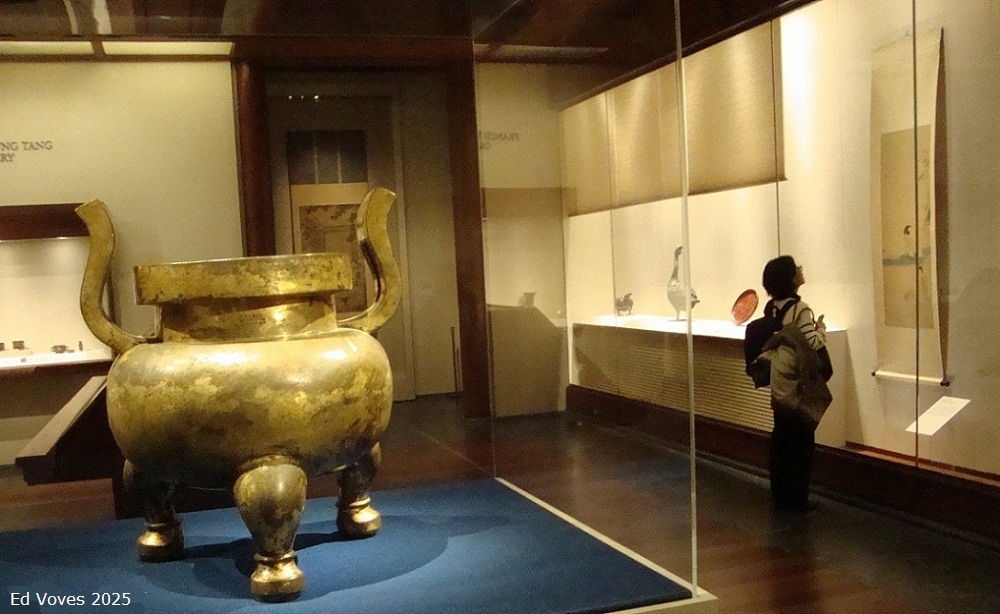
 At left, is a Tripod Incense Burner, c. 1403-24

"Location, location" is the mantra of real estate agents. "Context, context" is the similar refrain for art historians and curators. Recasting the Past provides both for the study of these masterworks of Chinese civilization.

First, let's examine the location of the exhibition.


Ed Voves, Photo (2025 )
 The Astor Chinese Garden Court at the Metropolitan Museum of Art

The galleries of Recasting the Past are located adjacent to the Astor Chinese Garden Court. Built by expert Chinese craftsman who used traditional techniques and authentic materials, the Astor Court recreates the courtyard of a scholar-official of the Ming Dynasty, 1368-1644 . It was in such settings that the bronze, jade and ceramic works of art on display in Recasting the Past were first collected by gentleman-savants and used in small group discussions.

The Met has a wonderful depiction of such an event, with the engaging title, Elegant Gathering in the Apricot Garden, ca. 1437. It is an elaborate hand scroll showing the Ming Dynasty statesman, Yan Rong, engaged in cultured activities with several other scholar-officials. One of the scenes shows tables set with painting and calligraphy materials and bronze vessels similar to those on view in the exhibition.


 Xie Huan, Elegant Gathering in the Apricot Garden (detail), c. 1437
 
Such "elegant gatherings" must have been idyllic occasions, especially during the early decades of the Ming Dynasty. The Ming Dynasty was comparable both in its begin/end dates and in its influence on Chinese civilization to the role of the Renaissance in Europe.


Ed Voves, Photo (2025 )
 Gallery view of Recasting the Past: the Art of Chinese Bronzes
at the Metropolitan Museum of Art

The bronze and jade favored by scholar-officials like Yan Rong tended to be moderate in size, rather than monumental, and very much in the spirit of fugu. Why would the ideal of a "return to the past" find favor in a dynamic state like the Ming Dynasty? 

For that we need historical context. 


Ed Voves, Photo (2025 )
  Ceremonial Bell with Imperial Procession, Landscape, and
 Mythical Creatures in Waves, Northern Song Dynasty, 12th century

The lead work of art in the exhibition is the Ceremonial Bell with Imperial Procession, Landscape, and Mythical Creatures in Waves. This huge - and hugely impressive - bronze bell dates to the early 12th century, the era of the Northern Song Dynasty (960-1127).

This mighty bell was meant to be functional, sounded by being struck on its surface with mallets. The mythological dragons at its top and the bas-relief depictions of an Imperial procession, replete with elephants and flag bearers, deliberately evoke the artistic motifs and the spirit of the "golden age" Shang Dynasty.


Ed Voves, Photo (2025 )
  Details of Ceremonial Bell with Imperial Procession, Landscape,
 and  Mythical Creatures in Waves

The Song Dynasty, in its two manifestations was ruled by a native Chinese family of Han ancestry. It was a powerful and culturally-dynamic regime. During the 1100's, this political climate changed drastically, as raiders from what is now Manchuria began to assail China. Under pressure, the Song Dynasty regrouped to a new, more defensible capital city, Lin'an, south of the Yangtze River. Then, in 1205, scattered attacks from Mongolia escalated into a full-scale catastrophe. 

By 1279, the unthinkable had occurred. The Mongols under Kublai Khan had invaded all of China. For the first time ever, the entire Middle Kingdom was controlled by a non-Chinese dynasty. 

Historians are divided in their judgments on the Mongol impact on China. The Mongols bestowed high rank on certain elite groups, especially engineers and skilled technicians. Chinese merchants found expanded opportunities in the Mongol dominions which stretched from the Volga River and the Crimea to the shores of the Pacific Ocean. 

The Mongols, however, regarded China's scholar-officials, the traditional governing class of the Middle Kingdom, as a subversive threat to their hegemony over the conquered empire.

The Mongols sharply diminished the access of the scholar-officials to government posts. In a cunning move, the Mongol khans curtailed the elaborate examination process which had long sustained the career track of these scholarly gentlemen in their service to the ruling dynasties of China.

Denied their long-standing position in Chinese society, the scholar-officials retreated to their country homes. In the seclusion of their libraries and gardens, they engaged in fugu connoisseurship. 


Ed Voves, Photo (2025 )
 Fugu artifacts, Yuan Dynasty era, 14th century. From left:
 Incense Burner in the Shape of a Lion; Brush Rest in the Shape of Twin Dragons; Tripod Vase; Paperweights in the Shape of Crabs

The reduction in political status was reflected in the modest scale of the works of art which the scholar-officials treasured. Exquisitely crafted, fugu artifacts were certainly ingenious and conveyed more than a touch of whimsy. Most had at least a nominal use like the intertwined dragons (second from left, above) which functioned as a brush rest and the wrestling crabs which served as a paper weight.


Ed Voves, Photo (2025 )
 Incense Burner in the Shape of a Goose, 14th century

Larger in size, but from the same time period (14th century) was the Incense Burner in the Shape of a Goose. It is a singular creature, with extremely naturalistic detail in its anatomy and plumage, yet with dragon-like eyes. When the incense smoke came wafting out of its beak, the copper-alloy goose must have been an alarming sight to those who had never beheld such a creature before.

These wonderful objects d' art were chiefly meant to please the eyes and console the minds of the Chinese intelligentsia after their demotion in rank. And none better expresses the poignant devotion to China's past by the scholar-officials than a tabletop tableau which evokes the serene atmosphere of the Astor Court.


Rock Landscape with Rectangular Planter "Floating Bridge of Dreams".  Yuan dynasty era, 14th century. Tokugawa Art Museum.

The Rock Landscape with Rectangular Planter dates to the Mongol-dominated 1300's. With a miniature landscape such as this, a scholar-official could find solace and enlightenment,  despite being an "exile" in his native land. And that was especially true for those who lacked the financial resources to maintain an estate like the Astor Chinese Garden Court.

Not just the Chinese were inspired by this small wonder. It is reputed to have been a personal favorite of the Japanese emperor, Go-Daigo, who reigned, 1318-39. The title "Floating Bridge of Dreams", from the last chapter of The Tale of Genji, was bestowed on this marvelous art work, showing that the concept of fugu could be embraced with reverence and enthusiasm in a non-Chinese social setting.

The Mongol Empire took the name of the Yuan Dynasty and assumed many of the traditional features of Chinese civilization. Eventually, they even revived the examination process for government positions. 

However, when factional infighting in the Yuan court occurred during the mid-1300's, the Mongol grip on power weakened. A series of populist uprisings throughout China led to the establishment of the native Ming Dynasty in 1366. 

The Ming triumph revived some of the authority and influence of the scholar-officials who had languished under Mongol disfavor for most of the Yuan era. They celebrated their return to high status by commissioning works of art, very much in the fugu spirit, modestly-proportioned and exquisite in detail. Many of these were created in the workshop of an accomplished father-son team, Hu Wenming and Hu Guangyu.


Hu Wenming, Incense Burner with Flowers,
 Ming Dynasty, late 16th-17th century. 

As might be expected, the revival of traditional ideals of Chinese religious and social mores did occasion the creation of works of art of a size suited to public display. The early Ming emperors sponsored the renovation of Daoist religious shrines, with particular veneration shown to the deity Zhenwu, who was regarded as as a national protector. Several Ming emperors were also devoted to Buddhism and commissioned sculpture portraits of the Buddha and bodhisattvas like Mahamayuri, the Peacock Wisdom King. 


Ed Voves, Photo (2025 )
 Laozi Riding an Ox, created by Xue Mingyang, 
Ming Dynasty, 1569 or 1629

Among the Ming Dynasty works devoted to Daoism, a copper alloy ensemble of Laozi Riding an Ox is particularly striking. Eighteen inches in height, the venerable sage, Laozi, and his ox-steed are depicted headed westward on a journey of enlightenment.


Ed Voves, Photo (2025)
Statue of Sudhana (Shancai Tongz), 1641

Another wanderer in search of enlightenment is Sudhana or Shancai Tongzi. A Buddhist pilgrim, Sudhana is usually shown worshiping Guanyin, the bodhisattva of compassion. This magnificent work of gilded copper alloy, standing 43 inches tall, was made in the Imperial Workshops and is believed have been one of a multi-figure group. If so, it was surely part of one of the greatest of all Ming-era works of art.

Laozi on his ox and the beaming Sudhana are likely to have been favored subjects for Ming patronage because they evoked the chain of events which resulted in the triumph of the Ming Dynasty. The founder of the dynasty had started life as a Buddhist monk. He was named Zhu Yuanshang (1328-1398). In an incredible tale of courage and resourcefulness, Zhu Yuanshang joined a group of peasant rebels known as the Red Turbans and then formed his own resistance force which eventually drove the Mongols out of China. Defeating rival warlords, he took the title of Hongwu Emperor.


Despite his ecstatic expression, Sudhana is actually an isolated, lonely figure in the exhibit gallery. This somber atmosphere is matched by the historical record. In 1644, only three years after this statue - and its likely companions - had been completed, the Ming Dynasty collapsed.

History had repeated itself. A rebellion of peasants, impoverished and starving, overwhelmed the Ming government. Northern "barbarians" from Manchuria smashed the weakened frontier defenses and seized Beijing.

How could such a capable regime like the Ming Dynasty succumb to a revolt much like the one which had enabled them to seize power? The chain of disaster was long, but the primary cause was the impact of the Little Ice Age of the 1600s. A sequence of short, cold planting seasons and failed harvests undermined the Ming Dynasty.

Once the Manchu invaders had crushed or marginalized the last Ming loyalists, a depressing revival of Mongol tactics on China's culture ensued ... but its duration was not as long nor as destructive. 


Ed Voves, Photo (2025)
Qing Dynasty Ritual Artifacts. At left is a Ritual Bell, 1715;
 at right is a Ritual Vessel (xizun), created between 1736-95

Within a few years, the emperors of the Qing Dynasty, as the Manchurian ruling elite stylized themselves, were enthusiastically engaged in collecting and commissioning fugu works of art. Such was the irresistible power of China's traditional culture.

Recasting the Past: the Art of Chinese Bronzes thus concludes on a high note. In fact, the finale of this "only the Metropolitan Museum can do" exhibition is so fantastic that I spent almost as much time examining it, as I did the rest of the exhibited works of art.


Ed Voves, Photo (2025 )
 Gallery view of Recasting the Past: the Art of Chinese Bronzes, 
 showing Mahamayuri on Peacock, 1426-35

I was not alone. Many visitors to the exhibition halted in their tracks to gaze in wonder at Mahamayuri on Peacock. Dating from 1426 to 1435, the apogee of the Ming Dynasty renaissance, this astonishing talisman of Asian spirituality deserves a review just for itself. 

And so, we will cease our contemplation of these precious relics of old China. We close our review of this "once in a lifetime" exhibit at The Met with the promise to "return to the past" with a future Art Eyewitness review devoted to Mahamayuri on Peacock. 

***
Text: Copyright of Ed Voves, all rights reserved

Introductory Image: Statue of Sudhana (Shancai Tongz)(detail), 1641.

Ed Voves, Photo (2025) Tripod Incense Burner, Qing Dynasty, created 1736-95.  Cloisonne enamel, gilt copper alloy: H. 15 3/8 in. (39.1 cm) x W. 8 5/8 in. (21.9); Diam. of rim 8 in. (11.1 cm) Metropolitan Museum of Art.

Ed Voves, Photo (2025)  Ritual Ox Tripod (niuding) Northern Song Dynasty, 1114. Copper alloy: H. 19 11/16 in. (50 cm); W. 24 7/8 in. (63.2 cm); Diam. 20 3/4 in. (52. 7 cm); Wt. 75 lb. (34 kg) Lent by Hebei Provincial Museum

Wine pouring Vessel (Gong), Shang Dynasty, 13th-11th century B.C. Bronze: H. 8 ½ in. (21.6 cm. Metropolitan Museum of Art

Vase with Archiastic Design, Yuan Dynasty, 14th century.  Bronze: H. 15 1/2 in. (39.4 cm); Diam. 8 in. (20.3 cm); Diam. of rim 4 3/8 in. (11.1 cm); Diam. of foot 5 5/8 in. (14.3 cm) Purchase, Brooke Russell Astor Bequest, 20142014.449 Metropolitan Museum of Art

Ed Voves, Photo (2025)  Gallery view of Recasting the Past: the Art of Chinese Bronzes.  At left, Tripod Incense Burner, c. 1403-24. Gilt copper alloy: H. 25 7/8 in. (65.7) x W. 25 3/16 in. (64 cm) Diameter: 20 in. (50.8 cm.) Lent by Qinghai Provincial Museum.

Ed Voves, Photo (2025)  The Astor Chinese Garden Court at the Metropolitan Museum of Art. Ming dynasty (1368–1644), 17th century style. Taihu rocks, granite terrace, ceramic tile flooring, roof tiles, and door frames, various woods (nan wood columns, pine beams, gingko latticework), brass fittings. Metropolitan Museum of Art, Purchase, The Vincent Astor Foundation Gift, 1981

Xie Huan, Elegant Gathering in the Apricot Garden, c. 1437. Handscroll; ink and color on silk: 14 ¾ in. x 95 ¾ in. ( 37.1 x 243.2 cm) Metropolitan Museum of Art

Ed Voves, Photo (2025) Gallery view of Recasting the Past: the Art of Chinese Bronzes at the Metropolitan Museum of Art.

Ed Voves, Photo (2025) Ceremonial Bell with Imperial Procession, Landscape, and Mythical Creatures in Waves, Northern Song Dynasty, 12th century.) Copper alloy cast: H. 70 7/8 in. (180 cm), Diam. 32 in. (81.3 cm); Wt. 1554.2 lb. (705 kg) Lent by Liaoning Provincial Museum, Shenyang, China.

Ed Voves, Photo (2025)  Fugu artifacts, Yuan Dynasty era, 14th century. From left: Incense Burner in the Shape of a Lion; Brush Rest in the Shape of Twin Dragons; Tripod Vase; Paperweights in the Shape of Crabs. All objects are on loan from the Fujian Provincial Museum, China.

Ed Voves, Photo (2025)  Incense Burner in the Shape of a Goose, 14th century.Copper alloy: H. 26 3/8 in. (67 cm); W. 15 in. (38.1 cm); D. 8 1/2 in. (21.6 cm); Wt. 15.5 lb. (7 kg) Private collection on loan to the exhibition at The Met.

Rock Landscape with Rectangular Planter "Floating Bridge of Dreams". Yuan dynasty era, 14th century: 14th century Bronze, rock  Rock: H. 1 3/4 in. (4.4cm); L. 11 7/16 in. (29.1 cm)Planter: H. 3 1/8 in. (7.9 cm); W. 4 5/16 in. (11 cm); L. 14 5/16 in.(36.4cm) Courtesy of Tokugawa Art Museum

Hu Wenming, Incense Burner with Flowers, Ming Dynasty, late 16th-17th century.  Copper alloy, parcel gilding, silver inlay: H. 3 ¼ in. (8.3 cm); Diam. of rim 4 in. (10.2 cm) Metroppolitan Museum of Art.

Ed Voves, Photo (2025) Laozi Riding an Ox, created by Xue Mingyang, Ming Dynasty, 1569 or 1629. Copper alloy, pigments:H. 18 in. (45.7 cm); W. 13 7/8 in. (35.2 cm); D. 5 1/2 in. (14 cm) Promised Gift of Julia and John Curtis, in celebration of the Metropolitan Museum’s 150th Anniversary

Ed Voves, Photo (2025) Statue of Sudhana (Shancai Tongz), 1641. Gilt copper alloy: H. 43 in. (109,2.7 cm); W. 21 in. (53.3 cm); D. 20  in. (50.8 cm) Art Properties, Avery Architectural & Fine Arts Library, Columbia University

Ed Voves, Photo (2025) Qing Dynasty Ritual Artifacts. Ritual Bell, 1715;  Ritual Vessel (xizun), created between 1736-95.  Bell: Gilt copper alloy: H. 12 ¾ in. (32.4 cm); W. 8 ¾ in. (22.2 cm) Metropolitan Museum Collection.  Vessel: Copper alloy: H. 15 3/16 in. (38.6 cm); Diam. 4 5/16 in. (11 cm); Wt. 36.4 lb (16.5 kg) Lent by The Palace Museum.

 Ed Voves, Photo (2025)  Gallery view of Recasting the Past: the Art of Chinese Bronzes, showing Mahamayuri on Peacock, 1426-35


Tuesday, June 23, 2020

Art Eyewitness Essay: The Etruscans and Rome


The Etruscans and Rome
An Art Eyewitness Essay, Part III

By Ed Voves

"We must, indeed, all hang together," Benjamin Franklin declared to his fellow members of the Continental Congress in 1776, "or most assuredly, we shall all hang separately."

As a man of the eighteenth century Enlightenment, Franklin was well-versed with the histories of the Greeks and Romans. These narratives contained many incidents recounting how the Greeks and Romans had, indeed, failed to "all hang together."

There was another people from classical antiquity whose story also confirms the political lesson to which Franklin referred, the Etruscans.

The Etruscans, unlike the Greeks and Romans, were little known in Franklin's day, but now, two and a half centuries later, we have a much better appreciation of their considerable accomplishments. Thanks to  painstaking scholarship, we also have a significant body of evidence for the Etruscan failure to create an effective confederation of their twelve city-states, as Franklin and his colleagues were to achieve for the fledgling United States.     


Chariot Fitting, 540-520 B.C.
© The British Museum 
                       
The story of Etruscan civilization - and all civilizations - is how their citizens dealt with "existential" problems. These are dire challenges, providing occasions for successful, life-affirming responses or for failures leading to utter disaster.

The theory of civilizational "challenge/response" was the central theme of Arnold Toynbee's A Study of History, published in a multi-volume series from 1930 to 1961. At the risk of over-simplification, Toynbee's theory, "the greater the challenge, the greater the stimulus," can be grasped in several key quotes:

Civilizations, I believe, come to birth and proceed to grow by successfully responding to successive challenges. They breakdown and go to pieces if and when a challenge confronts them that they fail to meet.

The last stage but one of every civilization is characterized by the forced political unification of its constituent parts.

Toynbee also declared that civilizations rise and develop in "environments that are unusually difficult and not unusually easy." Such circumstances present problems which demand solutions. Survival - or extinction - depends on the response.

For the Etruscans the initial problem was how to gain access to the huge store of iron ore and copper ore located in their domains. Mining in the ancient world can never have been easy but the Etruscans managed to exploit the mineral wealth beneath their feet at an early date.

The Etruscan homeland was also rich in defensible positions. As Michael Grant describes in his book, The Etruscans, there were numerous steep-sided plateaus in Etruria. The early Etruscans readily took advantage of these natural fortresses for their villages, which then combined to form city-states.

The key words in the last quote from Toynbee are "unusually difficult." Compared with the problems faced in growing crops in mainland Greece, which is almost devoid of topsoil, the problems faced by the Etruscans were not "unusually" difficult. The Etruscans, skillful miners and metal-workers, were able to extract vast amounts of mineral wealth without extreme levels of effort. 

The Etruscans did confront two existential challenges. Their reactions to these challenges determined the fate of their civilization.

As we saw in the earlier Art Eyewitness essays, the Etruscans brilliantly responded to the first challenge, the overwhelming tides of Greek and Phoenician influence which threatened their cultural independence. Masters at adaptation, the Etruscans borrowed what suited them and ignored what did not, maintaining their own unique identity.

We can assess this response in one of the most famous works of Etruscan art, a magnificent, heartwarming statute of an Etruscan husband and wife from the collection of the Louvre.


The Sarcophagus of the Spouses,  ca. 520 - 510 B.C.
© Musee du Louvre

Known as The Sarcophagus of the Spouses, it was discovered in 1845 near the site of the Etruscan city-state of Caere, now called Cerveteri. The motif of reclining husband and wife on a burial monument originated in Asia Minor and almost certainly was brought to Etruria by the Phoenicians, major trade partners of the Etruscans. The haunting "smile" of the husband and wife exemplifies Greek Archaic art, which flourished during the sixth century B.C. and greatly appealed to the Etruscans.


The Sarcophagus of the Spouses, however, is not a Phoenician statue nor is it a Greek one. In technical terms, this masterpiece demonstrates the skill of the Etruscans in using terracotta ceramics in compensation for the lack of local marble. More fundamentally, this tremendous work of art exudes an equality of husband and wife which could only have existed in a society where women were accorded a very high degree of respect and autonomy. This was exactly the attitude of the Etruscans toward women, very different from that of the Greeks.

The Etruscan skill in using terracotta to sculpt a human likeness was not limited to one or two great works of art. Following Greek example, the Etruscans created terracotta embellishments for the roofs of their temples called antefixes. Modeled to take the form of the heads of a mythological characters, a row of upright antefixes was placed along the eaves of a temple roof to keep rain water from seeping under the roof tiles causing damage to the wooden beams underneath. 

Initially, an antefix was likely to bear the countenance of Medusa or some other fearsome monster. But the Etruscans could not resist creating endearing likenesses of human beings like this antefix, made at Caere, and now in the Getty Museum.


Antefix from Caere , 510–500 B.C.
© J. Paul Getty Museum 

From the humble beginning of creating antefixes, evolved the remarkable Etruscan school of votive portraits, designed to be placed in their temples. There are so many of these to choose from, but the superlative example (below) from the Metropolitan Museum of Art certainly deserves inclusion here. 


Terracotta Head of a Youth, 3rd–2nd century B.C.
© The Metropolitan Museum of Art

Created during the waning years of Etruscan power, this portrait of a helmeted hero looked back to the golden age of the city states of Etruria. Once again, it is a brilliant adaptation of Greek art, in this case evoking the idealized features of Alexander the Great. The hero's face, however, preserves the emotional mystery, as well as the vigor, of Archaic era which Etruscan artists continued to favor after the Greeks themselves had abandoned it.

By studying the examples cited above, we can see how the "challenge/response" to Greek and Phoenician culture sparked a vigorous assertion of Etruscan identity. The first "existential" challenge culminated in an Etruscan success story of the highest order.

The second "existential" challenge, however, resulted in failure, defeat and the eventual loss of Etruscan political independence.

The threat to the Etruscans was posed by the Latin-speaking inhabitants of a village on the banks of the Tiber River, the southern border of Etruria. The name of this huddle of thatched-roofed huts, built on seven hills, was Rome. 

Early Rome had nothing to recommend it, except its location. There were no deposits of iron ore, copper or tin. Rome's strategic position, however, meant a great deal to the southernmost of the Etruscan city-states and to groups of ambitious free-booting Etruscan warriors. They coveted the fertile soil of Campania, the richest agricultural region in the south of Italy. To get there from Etruria, travelers needed to pass through Rome.

Around 600 B.C., Etruscans took control of Rome and, over the course of the next century, transformed it into a city. The Etruscans introduced the alphabet and stone buildings, drained a marshy area to create the Forum and strengthened the defenses with an encircling rampart. Nobody looks favorably on being conquered, however, especially a people who later became very successful conquerors themselves.

In 507 B.C., the Romans rose in rebellion against the Etruscan king, Tarquinius or Tarquin the Proud. According to Roman history, the king's son, Sextus Tarquinius, raped a virtuous noblewoman of Rome, Lucretia. To preserve her family's honor, Lucretia committed suicide, sparking the successful Roman revolt. 

The story of Lucretia was narrated by the Roman historian, Livy, and passed down as part of the foundational myth-history of Rome. Artists from the Renaissance to the Romantic era frequently depicted the event, usually with Lucretia in varying degrees of "undress" to heighten the erotic appeal and selling price of the work.

Rembrandt, ignoring the "sex sells" approach to art, painted two versions of the suicide of Lucretia which are of enduring value.


Rembrandt van Rijn, Lucretia, 1664
© The National Gallery of Art

Though separated by over two thousand years from the actual event, Rembrandt accurately captured the emotional traits of the citizens of early Rome in the way he presented Lucretia: honor, courage, determination, self-sacrifice and patriotism.

Early Rome's virtues may not have been lacking among the Etruscans, but we have no histories of the Etruscans, written during ancient times. This make an impartial judgement difficult, if not impossible. A comparison of a Roman work of art, much later in date though it is, with the The Sarcophagus of the Spouses, does help us take the measure of Roman attitudes vis-a-vis those of the Etruscans.


Funerary Relief of Publius Aiedius Amphio and his wife Aiedia, ca. 30 B.C.

The Funerary Relief of Publius Aiedius Amphio and his wife Aiedia, dates to around 30 B.C. Roman portraits, such as this, evolved directly from the example of Etruscan votive images. However, these highly realistic Roman likenesses developed in reaction to the spirit of Etruscan votive portraiture. 

The couple on The Sarcophagus of the Spouses projects feelings of enjoyment of the "good life" - for all eternity. The careworn faces of Publius Aiedius Amphio and Aiedia testify to their lives of toil and sacrifice on behalf of their family and their fellow citizens of Rome. They pose standing-up (some Roman funerary reliefs are full-figure) not lounging on a couch. This marble sculpture, and many similar Roman portraits, proclaims the implacable willpower of the Roman people.

Generalizations, like the above, are risky. What we can say is that, as Rome gained in strength, the Etruscans failed to muster the kind of emotional fortitude we see on the faces of Publius Aiedius Amphio and Aiedia. As a result, they were unable to  achieve Toynbee's "last stage but one of every civilization ... the forced political unification of its constituent parts."

Michael Grant emphasized that we should "erase the term 'Etruscan' and replace it by the name of one of the Etruscan states." The Romans, "team-players" for much of their early history, quickly learned that they were dealing not with Etruscans but with independent-minded citizens of Caere, Veii, Vulcii, Tarquinii and Clusium.

Between the years 507  to 396 B.C., the Romans successfully dealt with a host of political and social problems. Unified on the home front, the Romans sharpened the point of their most effective weapon: the strategy of "divide and conquer." With this policy, rather than numerically superior forces, the Romans began their campaigns to conquer Italy, starting with the Etruscans.

"Divide and conquer" was first carried-out against Veii, located twelve miles northwest of Rome. Veii competed with Caere to be the most prestigious and powerful of the Etruscan city-states. The leaders of Rome's republic took note, establishing good relations with Caere while marshaling their forces against Veii. In 396 B.C., the Romans launched a devastating attack on Veii, capturing and sacking the city. Not one of the other Etruscan city-states sent support to Veii in its hour of need.

Shortly after seizing Veii, Rome was nearly destroyed by a massive invasion of Celtic warriors in 387 B.C. Caere provided vital assistance to help Rome survive, the kind of aid that had been denied Veii. Rome would always maintain cordial relations with Caere but that did not prevent the Romans from eventually bringing this Etruscan city-state under its power.

Rome's triumph over the Etruscans was as much a campaign of incorporation as conquest. The Romans had the good sense to confer Roman citizenship upon the  Etruscans, and eventually upon all the various peoples of Italy, by 90 B.C. At the same time, local customs were honored and even the non-Indo-European language of the Etruscans continued in use for over a century.


Statue of Aulus Metellus, known as "The Orator", 110-90 B.C.

The gradual process of "Romanization" is apparent in the bronze statue known as "The Orator."  Created around 100 B.C., the statue records both the physical features of Aulus Metellus and the regalia of the Roman Senate to which he belonged. 

Yet, Aulus Metellus was not a "noblest Roman of them all," as he looks at first glance. Metellus came from an Etruscan family and the hem of his toga is inscribed with an invocation in the Etruscan language. This statue, which I saw at the 2015 Power and Pathos exhibition organized by the Getty Museum and the National Gallery in Washington, is a masterful expression of the now-combined forces of Etruscan and Roman civilization. 

The rise of Aulus Metellus to the rank of Roman senator set the stage for other Etruscans to gain power in the Roman establishment. For good and ill, Etruscans would continue to affect the course of Rome's destiny.


Cinerary Urn with Aeneas and Turnus, 200–100 B.C.
© J. Paul Getty Museum 

The greatest of these influential Etruscans was Gaius Maecenas, (ca.70 B.C- 8 B.C.). Maecenas, the chief political advisor of Octavian Caesar, later Augustus, was also the most cultivated patron of the arts of his age. Maecenas encouraged Virgil to write an epic poem, based on the legends of Aeneas, the refugee prince of Troy. The adventures of Aeneas were sacred to the Etruscans and Romans and were frequently depicted on works of art such as the cinerary urn, made  between 200 to 100 B.C.

Virgil  (ca.70 B.C-19 B.C.). was born in Mantua, a city founded by Etruscans in the north of Italy. After some prodding by Maecenas and Augustus, he composed his great poem, the Aenead, one of the greatest literary achievements of all time. Sadly, Virgil died before completing it.

Maecenas and Virgil represent the culmination of Etruscan civilization. The legacy of Aelius Sejanus (20 B.C.-31 A.D.) had a very different effect.

Sejanus, "this ambitious Etruscan" as Michael Grant calls him, rose to the rank of prefect or commander of the Praetorian Guard. He was the most trusted official of Tiberius, the second emperor of Rome. Then, as a result of a political power play, Sejanus was accused of plotting against Tiberius and executed in 31 A.D.


Marble Relief of the Praetorian Guard, ca. 50-51 A.D.
© Louvre Lens

Whether Sejanus was planning a coup against Tiberius or trying to position himself to thwart Gaius-Caligula, the mad grand-nephew of Tiberius, will never be proved. What is beyond dispute is that Sejanus transformed the Praetorians from a few battalions of bodyguards into a powerful military unit, capable of murdering the emperors they were supposed to protect. Before they were finally disbanded in 312 A.D., the Praetorians were responsible for assassinating thirteen Roman emperors. Worse, their constant intrigue undermined the very concept of the rule of Roman law. 

By creating the "behind-the-throne" power of the Praetorians, Sejanus set in motion a train of events which led to the eventual collapse of Rome's empire. How ironic it is that an Etruscan, whose ancestors contributed so much to the rise of Rome, should have unintentionally caused its downfall. 

***
Text copyright of Ed Voves. All rights reserved.

Images courtesy of the Metropolitan Museum of Art, J.Paul Getty Museum, the British Museum, the National Gallery of Art, Washington D.C., the Musee du Louvre, Louvre-Lens and the Altes Museum, Berlin

Introductory Image:                                                                       
Candelabrum (detail), ca. 500-475 B.C. Bronze: 61 in. (154.9 cm) height, Metropolitan Museum of Art, Rogers Fund, #61:11.3

Chariot - or Furniture - Fitting (excavated at Castel San Mariano, Perugia), 540 -520 B.C. Silver electrum repoussé: 15.50 cm (length) x 9 cm (width). British Museum, bequeathed by Richard Payne Knight #1824,0420+.2

The Sarcophagus of the Spouses, (found at Cerveteri, in the necropolis of Banditaccia), 520 - 510 B.C.Terracotta  polychrome: H. 1.11 m. ; l.  1.94 m., Musée  du Louvre.  Campana collection, 1863. #Cp 5194

The Sarcophagus of the Spouses (detail)ʩ Paris, Mus̩e du Louvre, D̩partement des Antiquit̩s grecques, ̩trusques et romaines, Dunod

Antefix from Caere (Cerveteri), 510–500 B.C.  Terracotta and slip: 34.5 × 28 × 26.1 cm (13 9/16 × 11 × 10 1/4 in.) The J. Paul Getty Museum,  Gift of Leon Levy. 83.AD.211.11

Terracotta Head of a Youth, 3rd–2nd century B.C. Terracotta: . 8 1/2 in. (21.6 cm). Metropolitan Museum of Art. Purchase by subscription, 1896. #96.18.173 © The Metropolitan Museum of Art

Rembrandt van Rijn (Dutch, 1606-1669) Lucretia, 1664. Oil on Canvas: 120 x 101 cm (47 1/4 x 39 3/4 in.)  National Gallery of Art. Andrew W. Mellon Collection # No.1937.1.76  National Gallery of Art, Washington D.C.

Funerary Relief of Publius Aiedius Amphio and his wife Aiedia (found along the Via Appia in Rome)  30 B.C. Marble sculpture:  64.5 x 102 x 24 cm. Altes Museum, Berlin.   https://commons.wikimedia.org/wiki/File:-0030_Grabrelief_Publius_Aiedius_Amphio_und_Frau_Aiedia_Altes_Museum_anagoria.JPG

Statue of Aulus Metellus, known as "The Orator", (found near Lake Trasimeno in the province of Perugia), 110-90 B.C. Bronze: 179 cm (70 in) National Archaeological Museum, Florence. Photo courtesy of J.Paul Getty Museum

Cinerary Urn with Aeneas and Turnus, 200–100 B.C. Alabaster with polychromy: 34 × 46 × 19 cm (13 3/8 × 18 1/8 × 7 1/2 in.), The J. Paul Getty Museum, Villa Collection, Malibu, California. # 71.AA.294

Marble relief statue of the Praetorian Guard, ca. 50-51 A.D. Marble: 163 cm (64 in) × 134 cm (53 in) × 28 cm (11 in). Musee du Louvre, Louvre-Lens, France. # Ma1079