Showing posts with label Virgin Mary. Show all posts

Friday, June 17, 2022

Art Eyewitness Book Review: Catholica: the Visual Culture of Catholicism


Catholica: the Visual Culture of Catholicism

By Suzanna Ivanic

Thames & Hudson, $35, 256 pages

Reviewed by Ed Voves

For over a thousand years, the Christian Church was the greatest patron of the arts and architecture in the world. Beginning in the year 312, when the Roman emperor Constantine embraced Christianity, almost every aspect of thought, culture and craft in Europe was dominated by the effort to build and maintain a civilization based on the life and teachings of Jesus of Nazareth.

Catholica, a brilliant new book published by Thames and Hudson, explores the visual record of Roman Catholicism. This was the dominant form of Christianity in Europe, until it was divided into warring camps by the publication of Martin Luther's radical views on religious doctrine in 1517. 

Despite the Reformation, Roman Catholicism survived - and thrived. This was due in no small part because of the impact of Catholic art and the religious convictions upon which it was founded. After losing control over parts of Germany, England and the Netherlands, Roman Catholicism spread to Latin America, much of sub-Saharan Africa and to Asian countries like the Philippines. 

Roman Catholicism still exerts a strong and inspiring influence over millions of faithful Christians the world over. Yet many of its works of art, or sacred objects like the vestments worn by Catholic clergy and vessels used in devotional ceremonies, have an unfamiliar, even unsettling, feel to them. 

For instance, many people today have no idea as to the significance of the golden vessel known as the monstrance. 


Diego de Atienza, Spanish artist in Ecuador & Peru, Monstrance, c. 1646 

The monstrance is used to display the Host, unleavened bread transformed into Christ's body during the Mass. The role and importance of this sacred object is, needless to say, difficult to grasp by those unacquainted with Roman Catholicism. Thanks to Catholica, the process of understanding and appreciating Christian art and ideas will be a great deal easier.

Catholica was written by Suzanna Ivanic, who teaches history at the University of Kent, England. Ivanic has excellent credentials for investigating the works of art, architecture and artifacts of Catholicism, for her research field (according to the publisher's blurb) is the "lived religion and material and visual culture in Central Europe."

Equally important, Ivanic writes with conviction and insight. Indeed, the sensitivity of her commentary and the scope of her knowledge are awesome and admirable.

Catholica is organized into three parts. Tenet surveys the basics of Roman Catholic religious doctrine; Locus examines the sites where Catholics worship, ranging from magnificent Gothic cathedrals to prayer sites in the homes of the faithful; Spiritus focuses on Christian devotion, as practiced by communities and by individuals.

As noted above, many Catholic works of art or devotional objects may be unfamiliar. In some cases, they are "wondrously strange" and Ivanic has her work cut-out to explain them. This she does in "decoding" units where baffling, arcane details of famous paintings and church architecture are analyzed. 


Pieter Bruegel the Elder, The Fight Between Carnival and Lent, 1559

The Fight Between Carnival and Lent, painted by Pieter Bruegel the Elder in 1559 is one of the masterpieces decoded by Ivanic. Indeed, it was created with exactly that purpose in mind. A wealth of examples of folly, greed, gluttony and social mayhem during Mardi Gras was included in Bruegel's painting. These are compared with the sober performance of Christian charity during the season of Lent.
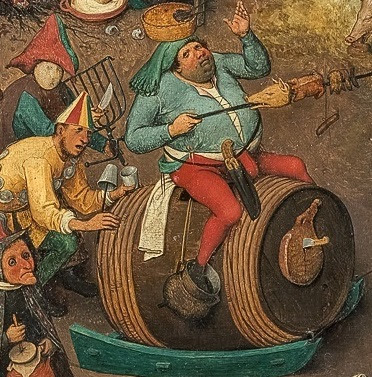


Bruegel's The Fight Between Carnival and Lent (details)

Other "decoded" paintings include The Penitent Magdalen by Georges de la Tour (c. 1640) and Caravaggio's The Seven Works of Mercy (1607). 


Anonymous (Japan), The Arrival of the Europeans, early 1600's

A fascinating Japanese screen painting, dating to the early 1600's, shows Catholic missionaries from the Jesuit and Franciscan orders in one of its vignettes. Here we can see the global outreach of Christianity as seen - and very attentively examined - by non-Europeans.

Profiles of important themes in Christian culture also feature prominently in the book. These range widely from the important events and rites associated with the seasons of Christmas and Easter, the "roles" assigned to the Virgin Mary - Mother of Sorrows, Mary of the Rosary, etc. - and the Catholic ways of coping with Death. This last profile is especially compelling, as I will comment in more detail later in this review.

With this investigative format in mind, it might seem that Catholica is primarily a reference work. Indeed it is, but the best way to appreciate Catholica is to begin on page one and follow Ivanic as she guides us along the path of Roman Catholicism's engagement with art of the spirt.

The profoundly moving nature of Ivanic's text is due to more than her command of source material. She writes about matters of religious faith with a real sense of what Christian belief in God and the divine ordering of the universe is like. 

A brief quotation from Ivanic's discussion of the role of Abbot Suger (1081-1151) regarding the rise of Gothic cathedrals is indicative of the marvelous and moving narrative of Catholica:

Key to understanding the birth of the Gothic is Suger's emphasis on the transformative power of the liturgical performance. Just as during the Mass the bread and wine are turned into the body and blood of Christ, so does the ritual performance of the cathedral transform it from stones, glass and metal into a divinely powerful space... 

Christianity traces its origin to Judaism. Like Jews, Christians base their beliefs on the written (and sanctified) words of the Bible. But early in the history of the Christian Church, images of Jesus, the Virgin Mary and saints like the Apostle Peter were treated with an unprecedented sense of importance. 


Metalcut print showing The Mass of St. Gregory, late 1400's

Pope Gregory I (540-604) realized that visual representations of the episodes of Biblical history and the life of Jesus were essential teaching tools. Vast numbers of Christians were illiterate and thus excluded from reflecting upon and understanding what they heard preached by the Christian clergy.

Yet, images of Jesus and other saintly people from the Bible were potentially dangerous. Pope Gregory was aware that Christians might come to adore sacred pictures or religious objects, rather than worship God. It was a risk he felt compelled to take. Ivanic quotes Gregory's famous, and hugely influential, pronouncement.

It is one thing to worship a picture and another to learn from the story of a picture what is to be worshiped. For what writing conveys to those who can read, a picture shows to the ignorant ... and for that very reason a picture is like a lesson for the people.

To understand a picture, people need to identify with its subject and message. As a result, depictions of the great events of the Bible and the life of Jesus stressed relevancy rather than historical accuracy of setting and costume. Artists frequently showed biblical characters in contemporary attire, surrounded by details of architecture and artifacts similar to those of the people gathered together to view such works of art as part of Christian worship.

Catholic images were modified to suit geography and social convention as part of the Christian missionary movement. One of the book's most fascinating images comes from Ethiopia in the 1600's where Jesuit missionaries sought to influence the Christian population to embrace Catholicism, rather than the version they practiced which was based on the Coptic Church of Egypt.


Anonymous (Ethiopia) Diptych of Life of Virgin Mary, c. 1630's-1700

The diptych above presents episodes from the life of Mary, mother of Jesus.  The bottom scene of the left-hand panel presents Mary showing the infant Jesus to the Three Kings, who look like Ethiopian nobles rather than magi from the Middle East.  Above, shepherds, having already seen Jesus, play a hockey-like game called genna


Diptych of Life of Virgin Mary (detail)

Unfortunately, such culturally-sensitive artwork did not always convince. The mass of Ethiopia's people resisted conversion to Catholicism, even when the country's ruler, Emperor Susenyos, did so in 1622. After years of dissension and civil war, the Jesuit mission ended in failure. 

Spanish missionaries experienced greater success in grafting Catholic cultural forms onto native roots in Mexico, Peru and other Latin American nations. The process led to the creation of enduring expressions of Christian piety. The image of Our Lady of Guadalupe (below) was based on the religious visions of a Mexican native, Juan Diego, in 1531, only a few years after the Spanish conquest of the Aztecs. 


Anonymous artist (Mexican), Our Virgin & Child of Guadalupe, 1745

Juan Diego's vision of Mary was depicted in various amalgams of ethnic attributes and styles of clothing. The facial features of Our Lady of Guadalupe in this version, almost obscured by layers of sumptuous Spanish robes, bears a strong resemblance to the Aztec earth goddess, Tonatzin. 

Roman Catholicism never missed an opportunity to present the guiding principles of Christianity in ways that believers and would-be believers could appreciate and enjoy. From soaring stained glass windows to the charming maiolica ensemble of movable figures at the Last Supper, Catholic art was on view everywhere one looked.
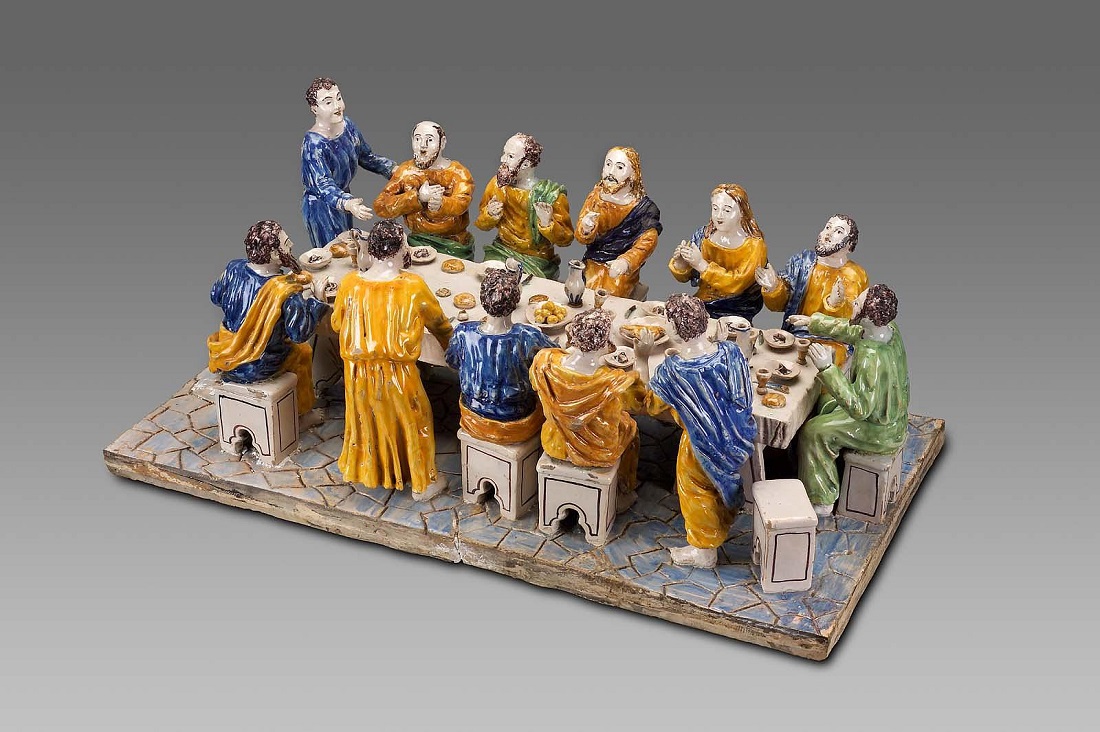

Maiolica model of the Last Supper, from Faenza, Italy, 1500's

Judged in this manner, Roman Catholic art represents an early - and very successful - form of corporate "branding." But there is one staggering difference. 

Modern-day public relations techniques emphasize sprightly images and upbeat banter to keep customers buying, consuming and buying some more in an endless cycle of happy days and Happy Meals. Roman Catholicism, by contrast, fixated upon the inevitable negation of earthly pleasure and human life by Death. 

The supreme symbol of Roman Catholicism is the Cross, the emblem based upon the crucifixion of Jesus. This form of torture and execution was reserved for slaves and criminals under Roman rule. 

Early Christians did not display the Cross, so terrible was the memory of Jesus' execution. Also, they lived in the daily expectation of the End Time. When the Apocalypse did not come, the brutal fact of Jesus' crucifixion remained. But so too, did the Christian believe that Jesus had secured redemption for them from sin, with the promise of immortal life for the souls of those who believed in him.

Death, Christ's death, has conquered death. 

This paradox, which St. Paul called the "scandal of the Cross," placed the reviled symbol of a slave's execution at the summit of human devotion, a place it still holds for millions. Christians, especially Roman Catholics, have created, collected and cherished works of art related to the Crucifixion since the Middle Ages and continue to do so. 


Aelbert Bouts, The Man of Sorrows, c.1525

From sublime depictions of the Crucifixion by Giotto and Velazquez to harrowing, nightmarish portraits of Jesus, like Aelbert Bouts' The Man of Sorrows, c. 1525, to tattooed images of the crucified Christ on human skin, the Cross is ubiquitous, recognizable to believers and detractors alike.

There will never - hopefully - be a final word on Christian art. For now, in a deeply troubled world, menaced by disease and war, Susanna Ivanic's Catholica is a much needed volume. To her, we will leave the final word.

The art of Catholicism is the art of the human condition. Devotional artworks that dwell on the gaze of the grieving mother or the lifeless body of Jesus resonate with the soul. They are designed to raise one's spirit and deepen one's reservoirs of faith, inspiring intense, reverential joy and pain.

***

Text: Copyright of Ed Voves, all rights reserved. 

Introductory Image: Cover art for Catholica by Suzanna Ivanic. Courtesy of Thames & Hudson

Diego de Atienza (Spanish, born in Ecuador, 1610) Monstrance, c. 1646. Silver gilt with enamel, cast, chased, and engraved: Height: 22 1/2 in. (57.2 cm) Metropolitan Museum of Art. The Friedsam Collection, Bequest of Michael Friedsam, 1931. #32.100.231a, b.

Pieter Bruegel the Elder The Fight Between Carnival and Lent, 1559,  Oil-on-panel: 118 cm × 164 cm (46 in × 65 in). Kunsthistorisches Museum, Vienna

Anonymous (Japan) The Arrival of the Europeans, early 1600's. Pair of six-panel folding screens; ink, color, gold, and gold leaf on paper: each screen: 41 3/8 in. × 8 ft. 6 5/8 in. (105.1 × 260.7 cm) Metropolitan Museum of Art.  Mary Griggs Burke Collection, Gift of the Mary and Jackson Burke Foundation, 2015. #2015.300.109.1, .2

Master of the Church Fathers' Border (German, late 15th century) The Mass of Saint Gregory, late 1400's. Metalcut with traces of hand-coloring; second state:  13-7/8 x 19-15/16 in.; 10-5/8 x 7-7/16 in. Metropolitan Museum of Art. Harris Brisbane Dick Fund, 1924 # 2448

Anonymous (Ethiopia) Diptych of Life of Virgin Mary, c. 1630's-1700. Wooden diptych: distemper, gesso and cloth, each painted panel having three registers, H x W x D: 51.7 x 43 x 2.5 cm (20 3/8 x 16 15/16 x 1 in.). Smithsonian National Museum of African Art. Gift of Ciro R. Taddeo in memory of Raffael and Alessandra Taddeo. #98-3-3

Anonymous (Mexico) Our Virgin & Child of Guadalupe, 1745. Oil on canvas:106 x 84.5 cm. Wellcome Library, London. #44828i

The Last Supper (Faenza, Italy), 1500's. Tin-glazed earthenware (maiolica): H. 8 1/2"; W. 12 5/6" (14 3/4" with base); L. 22 7/8" (24 1/2" with base) Museum of Fine Arts, Boston. Bequest of R. Thornton Wilson in memory of Florence Ellsworth Wilson  #1983.61

Aelbert Bouts & workshop (Netherlandish, ca. 1451/54–1549) The Man of Sorrows, c. 1525. Oil on oak: arched top, 17 1/2 x 11 1/4 in. (44.5 x 28.6 cm) Metropolitan Museum of Art.  The Friedsam Collection, Bequest of Michael Friedsam, 1931. # 32.100.55

Friday, January 31, 2020

Art Eyewitness Book Review: Fra Angelico and the Rise of the Florentine Renaissance


Fra Angelico and the Rise of the Florentine Renaissance


By Carl Brandon Strehlke and Ana Gonzales Mozo

Thames & Hudson-Prado Museum/255 pages/$40

Reviewed by Ed Voves

For art scholars, conscientious about assigning correct dates to works of art, the Renaissance presents a problem. When did this "rebirth" of Western art begin? When did painting and sculpture in Europe cease being International Gothic in style and start exhibiting the hallmarks of Renaissance theory and practice?

Most histories of the Renaissance focus on 1401 as the "takeoff" of the Renaissance in Italy. That year marked the momentous competition between Lorenzo Ghiberti and Filippo Brunelleschi to design the bronze doors of the Baptistery for the city of Florence. If one requires timeline accuracy, then Ghiberti vs. Brunelleschi provides a serviceable date.

The year 1425 is also a contender as the alternative birthday for the Renaissance. A brilliant new book, Fra Angelico and the Rise of the Florentine Renaissance, investigates the events of that decisive moment in art history. Published by Thames & Hudson, this thoughtful and lavishly illustrated book documents a major exhibition at the Prado during the summer of 2019 to help celebrate the 200th anniversary of Spain's greatest museum. 

A quarter of a century after the Ghiberti- Brunelleschi competition, a Dominican monk named Fra Giovanni da Fiesole painted a puzzling work entitled Annunciation and Expulsion of Adam and Eve from Paradise. In many ways, his work looks notably medieval. Yet closer inspection reveals that this egg tempora painting on wood panel exhibits Brunelleschi's revolutionary art theories. 

The implications of shifting the start of the Renaissance to this 1425 painting are unsettling. The key player in this scenario now becomes a monk who was proficient in manuscript illumination and application of gold leaf, hardly the skill set of a "Renaissance Man."


Fra Angelico, The Virgin with the Pomegranate, ca. 1424-25

Fra Giovanni da Fiesole is better known today as Fra Angelico. Born Guido di Pietro, around the year 1395, he was a native Tuscan from the town of Vicchio, near to Florence. Trained as an artist, he joined the Dominican Order, along with his brother, who was also a noted illustrator of manuscripts.

Not only did Fra Angelico paint some of the most ethereal, indeed celestial, beings imaginable, but his own personality was close to being angelic. He was held in high esteem during his lifetime, as an artist of exceptional talent and as a devout Christian. In 1982, Fra Angelico was beatified by Pope John Paul II, an important step on the road to sainthood.

Fra Angelico excelled in more than traditional medieval artistic conventions. Both Carl Brandon Strehlke, the primary author of the Thames & Hudson book, and Ana Gonzales Mozo, who contributed a perceptive essay on Fra Angelico's painting technique, affirm that he incorporated advanced ideas from Brunelleschi, solidly based on mathematics, in the Annunciation and Expulsion of Adam and Eve from Paradise.


Fra Angelico, Annunciation and Expulsion of Adam and Eve from Paradise, 1425-1426

Strehlke, Curator Emeritus of the Philadelphia Museum of Art, notes that Fra Angelico took the bold step to accurately position his protagonists, the Angel Gabriel and the Virgin Mary within an architectural setting in the picture. They are not floating in space but occupy a set position, a "you are here" point established by mathematical calculation. Strehlke writes:

The architecture of the Virgin's house shows how open Angelico was to Brunelleschi's ideas about drawing buildings in spatial recession. It is the earliest surviving painted example of architecture in perspective. The manipulation of the orthogonals, horizon line, and vanishing point suggests careful consideration of what Brunelleschi's biographer Antonio Manetti noted 'painters today term perspective.'

Fra Angelico's painting depicts the interface - we might also say the intrusion - of the realm of the sacred into human reality. Although the Virgin Mary's house has a theater-set ambiance, Fra Angelico revealed that he was adept at utilizing Brunelleschi's methodology in the depiction of the small side room which has a "homey" feel to it. Look through that door and you see a small patch of the real world shown in perspective.

Fra Angelico, as a Dominican monk, had also to be faithful to the theological precepts of his Order's great theologian, St. Thomas Aquinas (1225-1274). Aquinas believed that reason, if founded upon faith, will lead to understanding and union with God.


Fra Angelico, Annunciation and Expulsion of Adam and Eve from Paradise (detail)

The painting of the Annunciation is a visualization of this process. The streams of golden light proceeding from the hands of God represent the Incarnation, the act of divine inspiration by which Mary, a virgin, will give birth to Jesus the Son of God. 


Fra Angelico, Annunciation and Expulsion of Adam and Eve from Paradise (detail)

Mary is mystified by the Angel Gabriel's entreaty but accepts that she has been chosen to be mother of the Messiah. This act of faith engenders an awareness, a deeper form of knowledge, that God is intervening in the lives of human beings.

"Human salvation," Aquinas wrote, "demands the divine disclosure of truths surpassing reason."

Hard to believe?  Aquinas, the "Angelic Doctor," is famous for his voluminous, densely argued philosophical treatises, but he "cuts to the quick" on the point of faith.  

"To one who has faith, no explanation is necessary. To one without faith, no explanation is possible."

The faith-acceptance-awareness process is what we see depicted in the major incident of Annunciation and Expulsion of Adam and Eve from Paradise. But what about the  Paradise Lost "sidebar"?  Why was this seemingly-unrelated episode from Genesis placed in juxtaposition with the Annunciation?

The answer reveals more of the "medieval" roots of the Renaissance. 

Fra Angelico painted Annunciation and Expulsion of Adam and Eve from Paradise for the Dominican Order's church, San Domenico in Fiesole. The Thames & Hudson book has an intriguing drawing showing how this painting was displayed. It was positioned on a large frame which straddled the width of the church. Called the Rood Screen, this framework separated the nave of the church where the congregation stood or knelt from the sanctuary and choir. In this most sacred area stood the altar where the priest and monks gathered. Here the priest conducted the sacrifice of the Mass, turning bread and wine into Christ's body and blood.

The positioning of the Rood Screen prevented direct observation of the sacred ceremony by the lay people in the church. By way of compensation, paintings and statues were placed on the Rood Screen for them to contemplate as they listened to the clergy conduct the Mass. 

One of the paintings hung on San Domenico's Rood Screen was Annunciation and Expulsion of Adam and Eve from Paradise. 


Fra Angelico
            Annunciation and Expulsion of Adam and Eve from Paradise (detail)

An important hymn/prayer of the Roman Catholic liturgy during the Renaissance was Salve Regina, in honor of Mary, mother of Jesus. It was included in the evening prayer service known as Compline. The opening words of the prayer reveal why Fra Angelico painted Adam and Eve's banishment from Paradise on the same poplar board with the Angel Gabriel and the Virgin Mary. 

Hail, holy Queen, Mother of Mercy,
Hail our life, our sweetness and our hope.
To thee do we cry,
Poor banished children of Eve; 
To thee do we send up our sighs,
Mourning and weeping in this valley of tears.

The words of the hymn would have been powerfully reinforced by the imagery of the painting. Humanity's suffering, caused by the disobedience of Adam and Eve, would be redeemed through the agency of Mary's faith and the life and death of her son, Jesus.

Fra Angelico created Annunciation and Expulsion of Adam and Eve from Paradise in 1425Another version of the banishment of Adam and Eve was being painted at the same time in Florence: Masaccio's Expulsion of Adam and Eve in the Brancacci Chapel of the Santa Maria del Carmine Church. Fra Angelico almost certainly was aware of Masaccio's handling of this episode from Genesis. While Masaccio portrayed the existential grief of Adam and Eve, Fra Angelico chose to show the pair as less grief-stricken and ultimately redeemable.

Masaccio's Expulsion may appeal more to modern interpretations and ideas. Yet, Fra Angelico was an artist capable of great psychological insight. One of the supporting works in the Prado exhibition reveals the profound extent of his ability to probe human character and emotions.

In 1909, acting on the advice of Bernard Berenson, the Philadelphia collector, John G. Johnson, bought what was believed to be a portrait of St. Francis of Assisi. Johnson bequeathed his collection to the Philadelphia Museum of Art, including this work attributed to Fra Angelico.


Fra Angelico
                          Head and Torso of Saint Francis of Assisi, ca. 1427-30  

Berenson was correct in his assessment but only years later was it discovered that this image of St. Francis had been a part of an ensemble of two saints praying at the foot of the Cross. The figures of St. Francis, his companion on the other side of the Cross, St. Nicholas of Bari and of the martyred Jesus were all painted to appear as if they were statues, thus enhancing the realism of the scene.

Close inspection of the St. Francis "portrait," which survived the centuries since 1430 in much better condition than St. Nicholas, reveals the degree of Fra Angelico's close study of human physiognomy. The sagging "bags" beneath the eyes, the pinched features of the face, the straining neck muscles, all testify to the physical toll and privation of St. Francis'  austere devotion to God.

It is vital to remember that there is no portrait of St. Francis, drawn or painted from life. An imagined likeness was created about three years after his death in 1226. Fra Angelico's depiction of the beloved saint from Assisi is thus a psychological portrait and all the more convincing for being so. Fra Angelico, as a monk, well knew the personal cost of a life of sanctity. It is obvious - at least to me - that Fra Angelico painted the figures in this devotional work while in a state of meditative awareness of Christ, St. Francis and St. Nicholas.

This sense of communion between artist and subject is a key facet of Icon painting in the Greek and Russian Orthodox traditions. Fra Angelico, working according to the Western, Latin canon of Christianity, brought intense levels of spirituality to his work. Regardless of the form of interpretation, whether it was the medieval-looking Annunciation and Expulsion of Adam and Eve from Paradise or the visceral realism of his St. Francis, Fra Angelico painted in "communion" with the divine.

Fra Angelico was later to combine his skill in narrative painting with the profound feel for character and emotion which we see in his St. Francis of Assisi. 

In 1436, Cosimo de Medici funded the rebuilding of the Dominican church and monastery of San Marco in Florence.  Fra Angelico was tasked with painting in fresco a contemplative scene from the life of Christ in each of the monk's cells and larger devotional works in the public spaces of the building. The series was brought to a high state of perfection, as can be seen in the version of the Annunciation which Fra Angelico painted in one of the corridors of San Marco.
     

Fra Angelico
            Annunciation fresco, corridor of the dormitory of San Marco, ca. 1438                                      
Observing Fra Angelico's work decades after his death in 1455, Michelangelo delivered a heartfelt testimonial.

"One has to believe that this good monk has visited paradise and been allowed to choose his models there."

***

Text: Copyright of Ed Voves, all rights reserved 

Images of Fra Angelico paintings from the collection of the Prado in Madrid, Spain, are  courtesy of the Prado web pages:

https://www.museodelprado.es/en/the-collection/art-work/the-virgin-with-the-pomegranate/61b654df-1de2-483f-88bb-4

https://www.museodelprado.es/en/the-collection/art-work/the-annunciation/9b02b6c9-3618-4a92-a6b7-26f9076fcb67

Introductory Image:
Fra Angelico and the Rise of the Florentine Renaissance, 2020 (book cover) courtesy Thames & Hudson

Fra Angelico (Italian, ca. 1395-1455) The Virgin with the Pomegranate, ca.1424. Egg tempera and tooled gold on poplar panel: Height: 87 cm. (height) X 59 cm. (width).  Museo Nacional del Prado, # P8233. Image © the Museo Nacional del Prado. 

Fra Angelico (Italian, ca. 1395-1455) Annunciation and Expulsion of Adam and Eve from Paradise, 1425-1426. Tempera on poplar panel: Height: 190.3 cm. (height) X 191.5 cm (width).  Museo Nacional del Prado, # P0015. Image © the Museo Nacional del Prado.

Fra Angelico (Italian, ca. 1395-1455) Head and Torso of Saint Francis of Assisi, ca. 1427-30. Egg tempera and tooled gold on poplar panel: Height: 61 cm. (height) X 35.2 cm. (width). Philadelphia Museum of Art. John G. Johnson collection. 1917. cat. 14.

Fra Angelico (Italian, ca. 1395-1455) Annunciation fresco, corridor of the dormitory of San Marco, ca. 1438.  Fresco: 230 cm. x 321 cm.  Museo di San Marco, Florence.

Tuesday, December 10, 2019

Art Eyewitness Book Review: The Wyvern Collection: Medieval and Later Ivory Carvings and Small Sculpture


The Wyvern Collection: 

Medieval and Later Ivory Carvings and Small Sculpture


By Paul Williamson
Thames & Hudson/$95/448 pages 

Reviewed by Ed Voves

During the Middle Ages, artists working on masterpieces of religious art utilized the most precious of materials to create sacred objects. Not merely beautiful, these works of art were holy treasures. Crafted by human hands, they were inspired by God.

Gold, silver, gem stones, rock crystal, expensive paint pigments made by grinding semi-precious minerals, silk imported over vast distances from Constantinople and points east. These were the "raw" materials of Ars Sacra.

There was one other highly-valued substance to which medieval craftsmen - and their patrons - devoted much attention. Rare, often unattainable, this artistic medium was mentioned in the Bible, along with gold and jewels, has having been lavished by King Solomon on his palace in Jerusalem: ivory.

An authoritative - and breathtakingly beautiful  - book has recently been published by Thames & Hudson which recounts the story of this intricate and exacting art form. 

Medieval and Later Ivory Carvings and Small Sculpture includes a number of works of art made from other precious materials, mother-of-pearl, amber, red porphry. These chapters, fascinating to be sure, are sidebars to the main theme, the painstaking carving of elephant and walrus tusks to create ivory devotional objects of astonishing beauty. 
       
Today, at least in the Western world, the idea of using ivory from elephant tusks to create a work of art sparks outrage and horror. During the Middle Ages, ivory was often difficult to procure but it was not because elephants were facing extinction. It was simply a matter that nothing was too precious that it should not be used to honor God.


Head of a Crozier with the Coronation of the Virgin, mid-14th century
 © 2019 The Wyvern Collection 
           
The use of rare and costly materials to create works of sacred art underscores the word "use." These ivory carvings were intended to be used.They were not created as status symbols for their owners, either religious institutions like monasteries or wealthy nobles and merchants. Often times, possessing a table-top ivory triptych did serve to confirm the elite status of the owner (if only in their minds) but devotional use was paramount. 

One of the key figures of Western cultural history, Abbot Suger (1081-1151) commented on the importance of ivory religious art, celebrating an especially notable example, "admirable for the most subtle and in our time unattainable carving of its ivory plaques, which exceeded human valuation in the representation of ancient histories."

The object of Suger's praise was the pulpit of the church at the monastery of St. Denis, one of the holiest shrines in France. Most of the ivory art works in the Thames & Hudson book were made for humbler settings.


Diptych with the Virgin and Child and the Crucifixion, c. 1320.
© 2019 The Wyvern Collection

There was an upsurge of piety in Western Europe, following 1000 A.D., with an emphasis on private devotion. It continued into the High Middle Ages, as can be seen above in the Diptych with the Virgin and Child and the Crucifixion, made in the Rhineland, around 1320. The carved figures are set in shallow boxes joined by two hinges. Opened at prayer or reflection times, closed during the rest of the day, this diptych transformed a monk's cell or a nobleman's bedroom into a chapel.


Anne Lloyd Photo (2019)
A view of Romanesque and early Gothic art at the Metropolitan Museum of Art

Many of the great museums of Europe and the United States have impressive collections of medieval ivory art works. The Metropolitan Museum of Art has over two hundred, at its main building and at the fabulous Cloisters located at Fort Tryon Park on the northern tip of Manhattan. The collection of the Walters Museum in Baltimore is even more impressive with over seven hundred medieval "ivories." 

You will not find one ivory work of art from the Met or the Walters - or from an other museum - in the Thames & Hudson volume. The magnificent works of art in the book all belong to a private collection, the Wyvern Collection. Sensibly, the owner has kept his (or her) identity private, as well as the location of these wonderful works of art.

Medieval and Later Ivory Carvings and Small Sculpture is the second Thames and Hudson book to study the Wyvern Collection. The first volume, published in 2018, surveyed sculptures made from wood, stone and metalwork.

The origins of European Ivories can be traced to secular artifacts, like the hilts of Viking swords which often had grips carved from Walrus tusks or the antlers of reindeer. Game pieces like the celebrated Lewis Chessmen of the British Museum were made from walrus ivory. There are a number of delightful game pieces in the Wyvern collection but its most magnificent secular work, carved from ivory, is surely the hunting horn or oliphant shown below.


Oliphant with hunting scenes and wild animals, late 11th or early 12th century
© 2019 The Wyvern Collection

This oliphant is believed to have made in southern Italy during the late eleventh century. 
During this period, the Normans, Vikings on horseback, were aggressively establishing feudal states in Italy and Sicily. One of the most extraordinary sagas in medieval history, the story of the Normans in Italy was memorably recounted by the great historian, John Julius Norwich in his books, The Other Conquest and The Kingdom in the Sun.

The hunting motifs on this horn, however, show cultural signs of the political power which the Normans sought to overturn. As the astute commentary in the Thames & Hudson book notes, "the figure style reveals a Byzantine sensibility transformed into a Western idiom, a mixture commonly found in south Italian Romanesque sculpture."

Artists of the Eastern Roman or Byzantine Empire had long upheld the ancient craft of ivory carving. Much of the religious imagery of Christianity in Western Europe can be traced to presentation pieces sent by the emperors of Byzantium to the rulers of the rising kingdoms of Western Europe. Along with the finished art works from Constantinople came the raw material itself, elephant tusks from East Africa.

It is a noteworthy that the ivory used during the late Middle Ages came from the tusks of wild elephants from East Africa, rather than from the Indian subcontinent. The tusks of African elephants are longer than those from India. Both male and female African elephants grow tusks. The trade in elephant tusks from Africa to Constantinople and later to Italy came via Islamic states and was frequently interrupted by war.

At such times, artists in Europe reworked existing pieces of ivory, some made hundreds of years previously, or carved small plaques, to conserve ivory. These were then incorporated into larger works, such as this reliquary triptych from Siena, dating to 1370.


Bartolo di Fredi, Reliquary triptych with plaques of the Adoration of the Magi and the Crucifixion, c.1370. © 2019 The Wyvern Collection

The carved plaques depict the Adoration of the Magi and the Crucifixion. The painted scene shows the Annunciation, created by Bartolo di Fredi (c.1330–1410). Above the ivory plaques is the portrait of a saint, likely one of the patrons of Siena, St. Ansanus. In a particularly moving touch, God the Father, painted all in sacred blue, hovers over the head of the Angel Gabriel. Thirteen round holes once held relics of Christian saints.

This deeply moving work of art and piety is made all the more incredible by considering its small size. When open, the triptych measures, approximately 14 inches high by 15 inches in width. The ivory plaques are even more astonishing, each measuring a mere 4 inches in height by 2 1/2 inches wide.

The story of this small wonder does not end with its diminutive size or the artistic skill which went into its creation.  Created around 1370, the triptych dates to the years following the Black Death. A world-wide pandemic, Bubonic plague reached Europe from the Mongol domains in 1347. The Black Death is believed to have killed over a third of the continent's population. Siena, the rival city to Florence in Tuscany, was especially hard-hit, with half of its citizenry perishing.

Tom Holland, in his new history of Christianity, Dominion, notes that an ancient statue of Venus had been unearthed in Siena shortly before the outbreak of the plague. The rediscovery and appreciation of ancient art was just beginning in Italy and the town fathers of Siena decided to display the nude Venus in the town square. With the coming of the Black Death, the hunt for scapegoats commenced. The "shameless" Venus was targeted for blame and smashed to bits.  

The surviving people of Siena were lectured to forget about Venus and cherish the special role of the Virgin Mary in Christian doctrine. This post-Black Death reliquary triptych is thus a reminder of a terrible period of human history. It also highlights the human capacity to find spiritual meaning and new visions of beauty even in the most appalling of circumstances.


Central panel of a tabernacle polyptych with the Virgin and Child, c. 1250–60 
 © 2019 The Wyvern Collection

The role, some might say "cult," of the Virgin Mary in late medieval Christianity is a complex issue. Tom Holland, in Dominion, treats it masterfully and I plan to review his book in the new year. 

In an earlier post, I reflected on the Byzantine roots of the Virgin Mary's place in art, as well as religion. The later Middle Ages is no less fascinating as we can see in this ivory masterpiece.

The Central panel of a tabernacle polyptych with the Virgin and Child (above) was likely made in the north of France, around 1250–60. The Virgin and Christ Child shelter in an edifice which mimics the design of the great cathedrals like Chartres and Notre Dame in Paris. These soaring places of sanctity thrill the eye but it is the worship of believing Christians taking place there which make these cathedrals holy places.

The pose of the Virgin and Child in the above work of art re-appears throughout this wonderful Thames & Hudson book. Amidst the Black Death, the Hundred Years War and countless other human-contrived horrors, people of faith created and cherished the works of art in the Wyvern Collection as testaments of their religious belief.

Art lovers today should be grateful to the Wyvern Collection's owner for preserving these ivory works of art. A "shout-out" should also go the author of the accompanying text, Paul Williamson, and to Thames & Hudson for publishing this beautiful volume and its predecessor.

Hopefully, further volumes are in the works and, better still, an exhibition will be organized to present some of the Wyvern Collection treasures to the appreciative gaze of people of faith today.

***
Text: Copyright of Ed Voves, all rights reserved                                                                Images courtesy of the  Wyvern Collection and Thames & Hudson Publishers 

Introductory Image:
Book Cover of The Wyvern Collection: Medieval and Later Ivory Carvings and Small

Sculpture. Courtesy Thames & Hudson
Head of a crozier with the Coronation of the Virgin. Probably north Italian, mid-14th century. Elephant ivory; h. 32.1 cm (incl. knop), 24.5 cm (not incl. knop and
leaf crockets), w. 10.7 cm (volute only) No. 0817 © 2019 The Wyvern Collection

Diptych with the Virgin and Child and the Crucifixion. Lower Rhenish (Cologne), c. 1320. Elephant ivory and wood (probably maple or walnut), painted and gilded; h. 20.6 cm, w. 27 cm (open) No. 0572 © 2019 The Wyvern Collection

Anne Lloyd Photo (2019) A view of Romanesque and early Gothic art at the Metropolitan Museum of Art.


Oliphant with hunting scenes and wild animals. Probably south Italian, late 11th or early 12th century. Elephant ivory; l. 60.2 cm, diam. 12.9 cm (at bell) No. 0580 © 2019 The Wyvern Collection

Reliquary triptych with plaques of the Adoration of the Magi and the Crucifixion
Painted by Bartolo di Fredi (c. 1330–1410) Tuscan (Siena), c. 1370 (triptych); French, c. 1350–70 (ivory plaques). Tempera and gold leaf on wood, elephant ivory, painted; h. 35.5 cm, w. 38.5 cm (open), 18.9 cm (closed), 23.6 cm (at base) No. 0442 © 2019 The Wyvern Collection

Central panel of a tabernacle polyptych with the Virgin and Child. Probably northern French, c. 1250–60. Elephant ivory, with traces of paint and gilding; h. 18 cm, w. 5.3 cm, d. 4 cm No. 1018  © 2019 The Wyvern Collection


Wednesday, August 8, 2018

Art Eyewitness Book Review: The Wyvern Collection


The Wyvern Collection

Medieval and Renaissance Sculpture and Metalwork


By  Paul Williamson

Thames & Hudson/ 384 pages/$95

Reviewed by Ed Voves

Many of the great art museums in Europe and North America preserve significant collections of Christian devotional art from the Middle Ages. A few institutions like the Cloisters Museum in New York City and the Musée de Cluny in Paris specialize exclusively in the magnificent art of Christendom, created during the ten centuries from the fall of Rome to the rise of the Renaissance.

One of the great, modern-day, assemblages of medieval art, however, cannot be found in a museum. The Wyvern Collection was amassed by an unknown - or at least unnamed - art enthusiast over the last thirty years. Thames and Hudson has just published a splendid catalog, highlighting 213 works of art from the Wyvern Collection.

The decades-long act of amassing the Wyvern Collection is an astonishing example of single-minded devotion to preserving - and sharing - the treasures of the past.  In the preface to the book, the personal motivation for collecting these talismans of medieval civilization is explained:

For me, collecting has always been about the wonder of the creative process and awe at the skill of the artist, although most of those who are represented in this volume are anonymous.

Fittingly, the identity of the Wyvern collector remains anonymous.

Superlatives are quickly exhausted after paging through The Wyvern Collection. I was particularly impressed with several of the more "primitive" pieces, statues of the Virgin Mary and Infant Jesus from Catalonia and Umbria in Italy, both dating, c.1230-60. 

The new Thames and Hudson book is a work of art, as well. The large format of the illustrations, along with their clarity and fidelity to color tones, enable readers to appreciate art treasures they are unlikely to see anytime soon.  

Part of the Wyvern collection was displayed in a special exhibit in 2005 at the Victoria and Albert Museum in London. Until the happy day when a repeat presentation is mounted, the Thames and Hudson volume is as good as it gets and this book is superlative.

Special credit should go the author of the accompanying text, Paul Williamson. For many years the curator of medieval sculpture at the V & A, Williamson is one of the world's leading authorities on the art of the Middle Ages. His informative commentary is a model of close analysis and of wide-ranging references to similar works of art.

Before we examine some of the  treasures of the Wyvern collection, it important to recognize a salient fact about the Christian art of the Middle Ages. The wonder about the medieval art of Christendom is that any has survived at all.  

Over the centuries, Christian art has been subjected to savage campaigns of destruction. The Vikings, the Mongols and the Ottoman Turks inflicted great damage during the Middle Ages and early modern era. But the worst perpetrators of violence against Christian art were themselves Christians.

The very act of Christian vandalism of Christian art gave rise to the term Iconoclasm. The inspiring Icons of the Greek Orthodox Church were subjected to widespread destruction from 754 to 843 AD. A group of militaristic Byzantine emperors tried to "purify" the very religion they had sworn to defend.

The Wyvern collection has only a few works of art from the Byzantine Empire. Most of the Wyvern treasures date from the era of the building of the great cathedrals in Western Europe during the twelfth through the fourteenth century. 

In medieval art, form followed function - and faith. An excellent example is the Plaque with the Crucifixion, which is likely to have served as the cover for that rarest of treasures - a sacred book. 


Plaque with the Crucifixion. Northern Spain, c. 1150-75

Created in the north of Spain, c. 1150-75, the plaque was made by the repoussé technique. A sheet of copper was hammered from the reverse side to form the low relief image of the  crucifixion. Forward-facing images of personifications of the sun and moon hover above the extended arms of the crucified Christ. These recall the way that saints posed in Byzantine icons. They also testify to the tenacious staying power of pagan motifs. 

Plaque with the Crucifixion also points to the future of European art. The flanking positions of the Virgin Mary and St. John would be used time and again in paintings of the Crucifixion by Flemish masters like Rogier van der Weyden and his Renaissance successors. 

Here, in this one object d'art, we can see the progression of the Western artistic tradition.

Such exquisite works of art from the Gothic era are survivors of two of the worst acts of Iconoclasm in history: the Protestant Reformation and the French Revolution. The Plaque with the Crucifixion likely escaped destruction because the power and religious fervor of the Spanish monarchy held Iconoclasm at bay in Spain. Other nations were not so fortunate.

Destruction of Christian art was carried out with particular ruthlessness in England during the Reformation and the related Puritan revolt of the 1640's. A document from that tragic time illustrates the zealous bigotry common to "Iconoclasts" throughout history.

In 1547, the government of Edward VI, the sickly, young successor to Henry VIII, ordered the clergy of England:

To take away, utterly extinct and destroy all shrines, coverings of shrines, all tables, candlesticks, trindles or rolls of wax, pictures, paintings, and all other monuments of feigned miracles, pilgrimages, idolatry, and superstition: so that there remain no memory of the same in walls, glass-windows or elsewhere within their churches or houses. And they shall exhort their parishioners to do the like within their several houses.

Similar instructions were issued by the Republican tribunals during the French Revolution. While Robespierre and the Committee of Public Safety were busy sending “enemies of the state” to meet Madame Guillotine, their henchmen were decapitating statues of biblical characters, Hebrew kings like David or Solomon and New Testament figures like Joseph of Arimathea.                   

The Wyvern collection contains several such severed heads. One especially battered example, from France, c, 1160 , shows the head of an apocalyptic figure. Similar examples have been traced to the church of Notre-Dame de la Couldre in Parthenay. These, dispersed to museum collections around the world, are believed to have been hacked down during the French Revolution.  Certainly the damage to this "elder" would support this conclusion. 


Head of a Young Man. France or, c. 1300 

Another head (c.1300), perhaps of an angel, bears comparison with the damaged elder. With an enigmatic smile recalling a kouros of archaic Greece, this striking work of art shows no sign of desecration. It was clearly removed from a stone structure but not, according to Williamson, severed from a statue.
  
Might it have been "removed" from a medieval church during the early years of the Gothic Revival of the nineteenth century? Collectors are not iconoclasts but when a medieval work of art is wrenched from its surroundings, the effect is the same.

To continue commenting on the subject of Iconoclasm would be a disservice to the Wyvern collection. These medieval treasures can be viewed from a number of vantage points. In terms of the number of first-rank works of art, statues of the Virgin Mary with Christ Child dominate the Wyvern collection. These remind us of the revolutionary change in the appreciation of women that took place in Europe during the Middle Ages and the Renaissance - thanks in large part to the Christian reverence for the mother of Jesus.

Goddess or Gorgon. In the ancient world, Greek and Roman art had little place for women save in these two conflicting roles. With the rise - and survival - of Byzantine icons that changed. 

Acknowledgement as saints in heaven and a positive role model in this world were achieved for women through veneration of the Virgin Mary. Her status as Theotokos Hodegetria, "Mother of God who shows the way," influenced art throughout Christendom and inspired unparalleled levels of beauty during the Gothic era and the Renaissance.


The Virgin and Child. France or South Netherlands (Belgium), c. 1380-1400

An especially fascinating example is The Virgin and Child, crafted from fruitwood in the southern Netherlands (modern-day Belgium) or northern France, c.1380-1400. Pious and demure, the Virgin Mary bows her head to the infant Jesus who seems older and wiser than his years would allow. Jesus raises his hand in benediction and Mary lowers her gaze in acknowledgement of God's favor.

This role reversal is difficult to understand in our secularized world. Yet a Christian during the Middle Ages would have understood that this image of a beautiful, girlish Mary was not created to tempt us to "worship" her. Rather, this sculpture was intended to remind us that the salvation of all believers , including the Virgin Mary, comes from the divine child she holds in her arms. 

By comparison, images of the Christ Child as an individual are comparatively rare. The Infant of Prague, which dates to the late sixteenth century, springs readily to mind. The Wyvern collection has an Infant Christ, carved from Walnut wood, and painted and gilded. It was lovingly preserved, perhaps as part of a chapel or convent collection. It would never have been displayed nude, as we see here, but would have been clothed in rich garments, depending on the dates of the Christian liturgical calendar.


The Infant Christ. South Netherlands (Belgium), c. 1500-10

This charming sculpture does represent a "humanization" of the idea of God. This was a  theological innovation of St. Francis of Assisi during the early thirteenth century. Christian teaching has always affirmed that humans are created "in the image and likeness" of God. But the practice of setting up Christmas nativity scenes, credited to St. Francis, was controversial. 

To the Reformation leaders the "humanization of God" turned Christian doctrine inside-out. God was being re-cast, in their offended view, in man's image.

That inversion did not trouble the French revolutionaries who as devout Utopians aimed to make man into a god. But Christian devotional images disturbed them greatly for these provided human beings with an alternative route to self-fulfillment and to a cosmic vision where the State was not the ultimate reality.

As a result, Iconoclasts of both camps went to war against Christian images. What we see of the Wyvern collection in this beautiful book is a mere remnant, a testament to what was lost.

One of my cultural heroes, Carl Sagan, wrote, "History is full of people who out of fear or ignorance or the lust for power have destroyed treasures of immeasurable value which truly belong to all of us.” 

History also raises-up human beings, of generous spirit and enlightened minds, who dedicate themselves to saving and sharing "treasures of immeasurable value which truly belong to all of us.” 

Mr. "Wyvern" (if I may be so bold)... many thanks.

***
Text: Copyright of Ed Voves, all rights reserved                                                               
Photos Courtesy:  The Wyvern Collection and Thames & Hudson

Introductory Image:                                                                                                          The Wyvern Collection Book Cover: Courtesy Thames & Hudson

Plaque with the Crucifixion.  Northern Spanish (Aragon or Navarre), c. 1150-75.                 Copper; repoussé, over a wood core; h. 31cm, w. 21 cm.  No. 0614. © 2018 The Wyvern Collection
Provenance: Bought from Bruno Speybrouck, Kortrijk, Belgium, September 2006. Formerly in the Parra collection, Zaragoza, until 2003; Luis Elvira, Castelló; Jan Pareyn, Brussels

Head of a Young Man.  French (ÃŽle-de-France, or possibly Burgundy or Champagne), c. 1300  Limestone, painted; h. 24 cm  No. 1565  © 2018 The Wyvern Collection
Provenance: Bought at Delorme & Collin du Bocage auction, Cannes, 2 August 2011, lot 25, through Sam Fogg, London. On loan to the Metropolitan Museum of Art, New York, 1993-2000; Sotheby’s, New York, 22 May 2001, lot 15; Hôtel Drouot, Paris, 10 December 2010, lot 230.

The Virgin and Child.  French or South Netherlandish, c. 1380-1400. Fruitwood (possibly pear), painted and gilded; h. 21.5 cm. No. 1696. © 2018 The Wyvern Collection
Provenance: Bought from Sam Fogg, London, May 2012. Formerly in a Dutch private collection; Jan Roelofs, Maastricht.

The Infant Christ. South Netherlandish (Mechelen and Brussels), c. 1500-10. Walnut, painted and gilded (figure); oak, gilded, with applied lead ornaments (base); h. 33.4 cm (figure), 4.7 cm (base). No. 1819. © 2018 The Wyvern Collection
Provenance: Bought from Bernard Descheemaeker Works of Art, Antwerp, January 2013. Formerly in a Belgian private collection.