Showing posts with label Color Theory. Show all posts

Thursday, July 14, 2022

Art Eyewitness Review: Chroma: Ancient Sculpture in Color at the Metropolitan Museum of Art


Chroma: Ancient Sculpture in Color

The Metropolitan Museum of Art, New York City

July 5, 2022 - March 26, 2023

Reviewed by Ed Voves

Original Photography by Anne Lloyd

The ancient Greek and Roman galleries at the Metropolitan Museum of Art create a high theater of drama. Here, a daily symphony of shafts of natural light and the counterpoint of shadow awakens the Met's Greek and Roman antiquities from the sleep of the ages.


Ed Voves, Photo (2022)  
Gallery view of the Greek & Roman Wing of the Metropolitan Museum

The portrait busts of Alexander and Caesar Augustus do appear about to speak. But they never do. This is a realm of marble and bronze, where noble words linger on rigid lips. Well-muscled arms and legs do not move, drained as they are of life and color. Until now.

Color has returned to the Greek and Roman galleries at the Metropolitan Museum in a fantastic exhibition, Chroma: Ancient Sculpture in Color. The exhibit will be on view at the Met until March 2023, an added bonus since art lovers are certainly going to want to return for for a second or third look.


                                       Anne Lloyd, Photo (2022) 
          Reconstruction of a Cycladic sculpture of the Spedos group

The use of color (polychromy) is traced over the course of ancient history from the very early, Cycladic sculptures, 2700-2200 B.c., to statues of god, goddesses and heroes which once adorned the Acropolis of Athens or the Forum of Rome. Seventeen specially prepared reconstructions of ancient statues are featured in the exhibition.

Chroma: Ancient Sculpture in Color is a collaborative effort of the Met and a German research institute, the Liebieghaus Skulpturensammlung, located in Frankfurt.  A husband-and -wife team, Vinzenz Brinkmann and Ulrike Koch-Brinkmann, have performed the scientific equivalent of the labors of Hercules, studying and recreating the vibrant color schemes which once enlivened the features  of statues and bas-reliefs. 

An important feature of the exhibition is the use of plaster casts, rather than original works of art. These copies are displayed in the Met's ancient Greek and Roman galleries, replicating ancient masterpieces. Each is painted with colors matching the palate of ancient artists or the metallic finish of bronze statues. The latter category includes reconstructions of the celebrated Riace warriors, discovered by a diver off the coast of Italy in 1971. 


Anne Lloyd, Photo (2022)  
       Gallery view of the Chroma: Ancient Sculpture in Color exhibit,             showing reconstructions of the Riace Warriors, created by          Vinzenz Brinkmann and Ulrike Koch-Brinkmann

In a sense, the use of copies is a reversion to standards of museum curatorial policy of the nineteenth century. Recreations of famous works of art once filled the galleries of museums like the Met, but were exiled to storage rooms as actual works of ancient art were purchased or donated. Now, copies of classical masterpieces are back, this time in "living color."

Sun, wind, rain and rust have all but effaced the skin tones and the hues of garments which Greek and Roman artists skillfully imparted to sculpted portraits of the Olympian gods and lesser mortals.  

Prof. Dr. Vinzenz Brinkmann and Dr. Ulrike Koch-Brinkmann, in a decades-long effort, have begun to undo the damage wrought by the hand of time. Using X-ray fluorescence spectroscopy, ultraviolet-visible absorption spectroscopy, chemical analysis of residues of metallic corrosion and other state-of-the-art technological processes, the Brinkmann's diligent research has revealed the color-drenched world of classical Greece and Rome.                                                                                                                


         Anne Lloyd, Photo (2022)  
Reconstruction of the Alexander Sarcophagus (detail)

To see familiar works of Greek and Roman art newly restored to colorful "life", is both a fascinating and perplexing experience. Conflicting opinions over the relative merits of "colorized" ancient works of art versus the familiar, sun-bleached state, bring to mind the controversies over the introduction of Technicolor films during the 1930's and the "colorization" of vintage black and white classics in the 1990's. Cinema purists were appalled; movie fans  applauded and called for more.

A similar debate took place in antiquity. Many Greek philosophers, including Plato, were suspicious of the emotional effect of over-indulging in color. Likewise, the Roman scholar, Pliny the Elder, took a conservative, tradition-bound approach to color in art.

Pliny insisted that painters should follow the example of Apelles, the court-painter to Alexander, and use a four-color palette - black, white, red and yellow. Yet, across the Bay of Naples from Pliny's country estate, paintings excavated in Pompeii reveal that 29 different pigments were used in the art works preserved by the layers of volcanic ash which buried the city in the year 79 - and killed Pliny as he courageously tried to rescue survivors.


Anne Lloyd, Photo (2022)  
Reconstruction of the Small Herculaneum Woman, 30-1 B.C.

One of the most striking painted replica statues in the Chroma exhibit is known as the Small Herculaneum Woman. This is rather ironic as Herculaneum was destroyed by Vesuvius along with Pompeii in 79. 

The Brinkmann's research revealed that blue and green hues, notably absent from Pliny's restricted palate, had been extensively used on a version of the Small Herculaneum Woman excavated on the island of Delos. Numerous copies of the sculpture have been found  throughout the Graeco-Roman world.
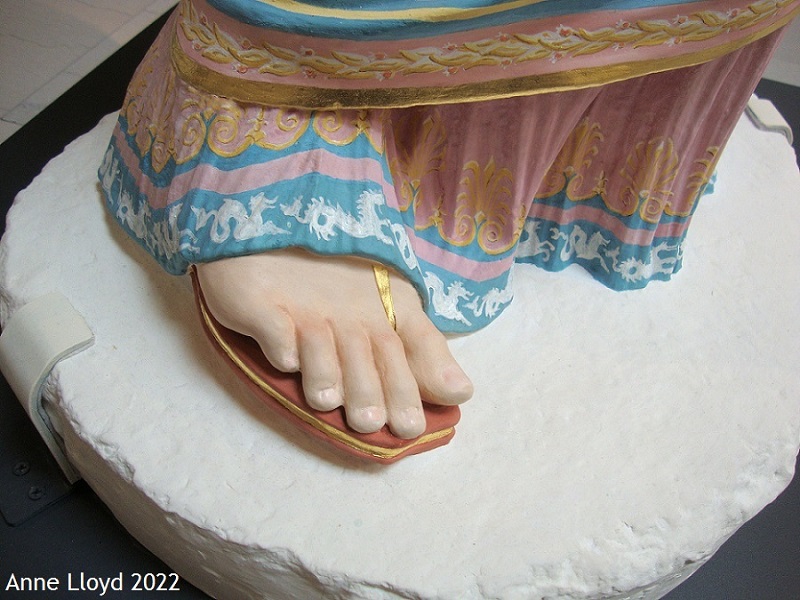


Anne Lloyd, Photo (2022)  
Detail of the reconstructed Small Herculaneum Woman, 30-1 B.C.

Deploying  their high-tech toolkit, the German researchers detected that a light Egyptian blue color and a shade of green made from malachite had been used to paint the garments of the Small Herculaneum Woman from Delos. The artistry involved in applying these scientific insights to the replica is positively sensational, making it a true work or art in its own right.


Anne Lloyd, Photo (2022)  
Gallery view of the Chroma exhibit, showing the reconstruction of the Small Herculaneum Woman (created 2019) 

The noted British scholar, Philip Ball, in his book, Bright Earth: Art and the Invention of Color, believes that artists in Greece and Rome largely ignored the strictures of Plato and Pliny. The advance of the Greeks to the frontiers of India during the campaigns of Alexander brought them into contact with a whole range of new pigments. During the Hellenistic Age which followed Alexander there appear to have been few inhibitions about using the new colors.                                                                 

One of the key works in appreciating ancient color is known as the Treu Head. The original was excavated on the Esquiline Hill in the heart of Rome. It is the head of a statue of Venus or Minerva (Athena), created during  the years, 140-150. 
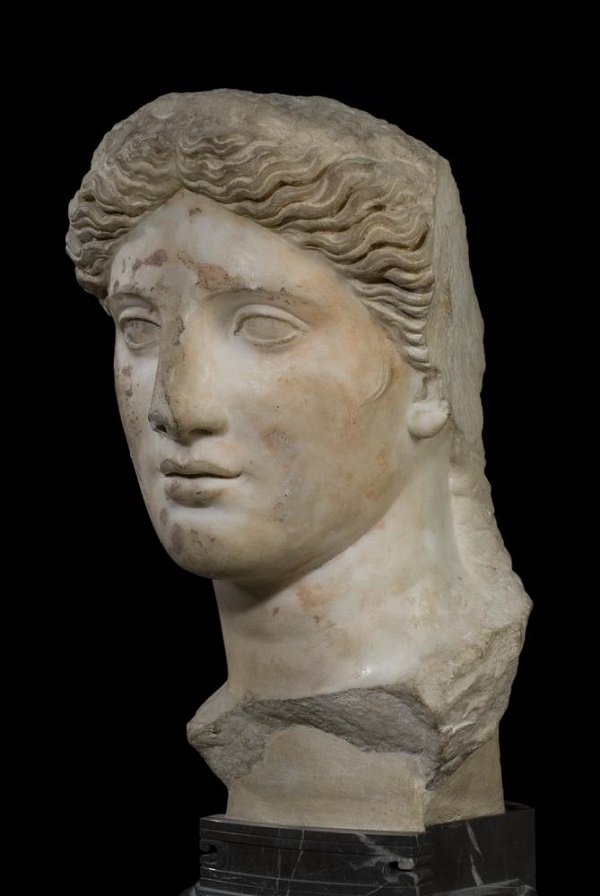

Unknown artist, Treu Head, Late Hadrianic/Antonine , A.D. 140-150

When the Treu Head was unearthed in the early 1880s, traces of color were clearly visible.  An exhaustive effort to examine the head was undertaken by a German scholar, Georg Treu, before it went on display in the British Museum.

The Treu Head is one of the key works of art in the study of polychromy in ancient art. The original is too fragile to travel for international exhibits. But the Brinkmanns pulled-out all the "stops" in their replica to show the stages by which an ancient artist created lifelike features  for this goddess. Particularly interesting is the carbon-black under-drawing, first applied to the marble head to define the features, especially the eyes, as shown here.


Anne Lloyd, Photo (2022)  
Study I of the Treu Head, created in 2014

As works of art like the Treu Head were excavated with traces of paint clearly discernible, scholars were faced with a quandary. Clearly, the ancient use of color served important purposes or satisfied cultural tastes in antiquity. But aesthetic sensibilities in the West, especially since the Renaissance, had been shaped by the design vs. color debate, with the highest accolades going to design, the careful crafting of shape whether in drawing or sculpture.

This quandary remains. Would we today prefer museum galleries displaying row after row of painted statues and bas-reliefs from antiquity rather than time-worn examples which more clearly reveal the creative genius of the sculptors who made them? 

A little time in the company of one of the most infamous men from ancient Rome may help answer that question.


Anne Lloyd, Photo (2022)  
Marble Portrait Bust of Emperor Gaius/Caligula, A.D. 37-41

One of the premier works in the Met's collection of Roman art is a portrait bust of Emperor Gaius, the notorious Caligula. In the Met's likeness of Gaius, the exceptional skill in the sculpting of the emperor's features is beyond dispute. This is a work of three-dimensional artistry of the highest caliber. After examining it for a while, we are left pondering if Caligula really was the most "ignoble" Roman of them all.

The painted head of Gaius/Caligua leads to a very different reaction. It should be noted that the Brinkmanns selected a slightly different portrait bust for their model, but not enough to account for the shock value that one feels when looking at the painted Caligula.  
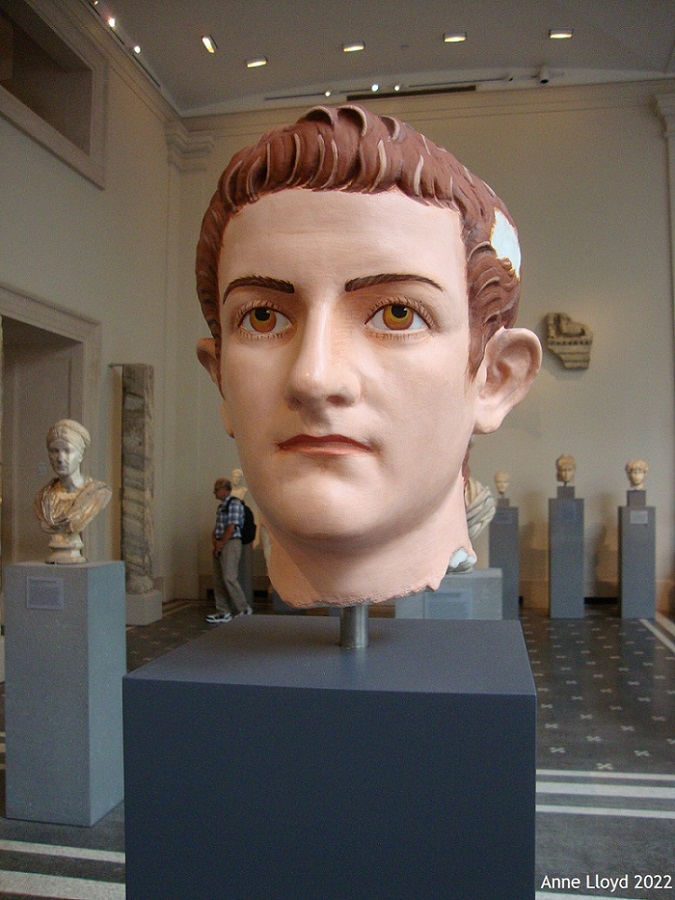


Anne Lloyd, Photo (2022)  
Reconstruction of Portrait Bust of Gaius/Caligula (created 2005)

There are no doubts, no questions of whether or not Caligula was the monster as portrayed by hostile historians like Suetonius. Look into those eyes and one sees the menace of an autocratic ruler which can so easily turn into madness.

Polychromy can obscure or deflect our attention from the design values of ancient sculptures like the Met's portrait bust of Gaius/Caligula. But the reason for painting statues is clear enough. The color applied to statues in ancient times was chiefly intended to influence and educate a public audience, looking from a distance, rather than for the close study by scholars working in elite institutions like the Library of Alexandria - or The Met. 

The spectacular uniform and equipment of the statue of a kneeling archer on view at the Met is a case in point. The original marble archer was part of a Trojan War battle scene positioned on the roof pediment of the Temple of Aphaia, located on the island of Aigina, south of Athens. 


Anne Lloyd, Photo (2022)  
       Reconstruction of the Marble Archer in Scythian Costume,         
from the West Pediment of the Temple of Aphaia, ca. 480 

Most of the details of the kneeling archer which we can see at close hand would have been obscured to visitors to the temple, standing below. However, the vibrant colors, especially of the exotic headgear, would have insured that the identity of the archer, an Amazon warrior fighting on the side of the Trojans, would have been clearly apparent.

Visitors to Athens would also have seen the figure of a winged Sphinx crouching on top of a tall marble stele or grave marker, dedicated to a youth and a little girl. This much-loved Finial in the Form of a Sphinx, which has been in the collection of the Met since the 1930's, was sculpted around 530 B.C. 


  Anne Lloyd, Photo (2022)  
Marble Capital and Finial in the Form of a Sphinx, ca. 530 B.C.

Greek art of these years, known as the Archaic period, is especially expressive. To facilitate study, the Met displays the actual Winged Sphinx at ground level, with a cast copy on top of the column, where it originally perched. Now a third version, modeled and painted by the Brinkmanns keeps them company in Gallery 154.


Anne Lloyd, Photo (2022)  
Reconstruction of a Marble Finial in the Form of a Sphinx, 2022

This Reconstruction of a Marble Finial in the Form of a Sphinx, to give this wondrous beast its full title, is the show stopper of the exhibition. The Sphinx was created specifically for the Chroma exhibition at the Met, with Dr. Brinkmann's team working in close collaboration with the Met's Greek and Roman curators and the museum's Objects Conservation and Scientific Research departments.

Rather than recapitulate the backstory of the creation of the Winged Sphinx replica, it is far more appropriate at this point to highlight the Met's exhibit webpage. Here a full array of useful digital resources is deployed, ready for detailed study. Even by the Met's accustomed standards of excellence, these exhibition aids are truly remarkable.

Of particular value to me, in reviewing the Chroma exhibition, was the glossary page which provided pithy explanations of the technical tool-kit used by the Brinkmanns and the Met curators. Also, the glossary definitions extend to information on the types of pigments used by ancient artists.

The Met also has a special feature for smartphone users, entitled The Chroma AR experience. With this feature, they will be able to follow the reconstruction process of the Winged Sphinx. Chroma AR can be accessed from the Met web page devoted to the exhibition.


Anne Lloyd, Photo (2022)  
Gallery view of the Chroma exhibit, showing reconstructions of the bronze statues, the Terme ruler (left) and the Terme Boxer

One of the surprises of Chroma: Ancient Sculpture in Color is the significant role of bronze casts in the story of polychromy. Given the high artistic value which the Greeks and Romans attached to bronze statues, it makes sense that these metallic portraits should have received added details like inlaid eyes. But close study of two bronze statues, known as the Terme Ruler and Terme Boxer offer fascinating evidence of how the ancients' love of dramatic effect extended to unexpected embellishments.


Anne Lloyd, Photo (2022)  
Reconstruction of The Terme Boxer (The Boxer at Rest), 2022

I was particularly fascinated to study the reconstruction of the Terme Boxer. Back in 2015, a "once in a lifetime" exhibit of ancient bronze statues, organized by the Getty Museum and the National Gallery, had included the Terme Boxer in its lineup. In that exhibit, the bronze statue was entitled "Boxer at Rest." 

When I saw the ancient original, I was really impressed with the fidelity to lifelike details, especially the boxer's battered, "cauliflower" ears. However, the reconstruction of the Terme Boxer has taken the delineation of his scars and bruises to a level that an unpracticed eye, like mine, could not easily detect.

According to the commentary on the Met's web page, ancient masters of bronze casting used a wide range of techniques to enhance their statues.

Scientific research and ancient written sources show that colorful effects were achieved via multiple methods, including the use of different alloys during casting; artificial patination with sulfurous substances; and the addition of bitumen lacquer, other metals (including gold, silver, copper, tin, and lead), and precious stones. The naturalistic effect of these sculptures was apparently so strong in ancient times that many visitors to the sanctuaries believed them to be alive.
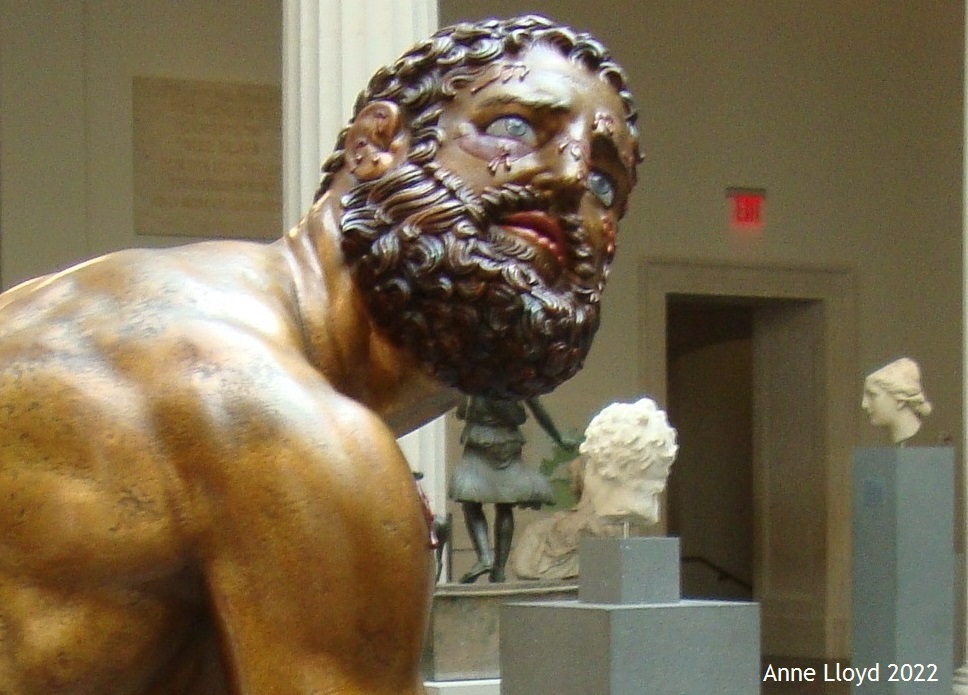


Anne Lloyd, Photo (2022)  
Reconstruction of the Terme Boxer (detail), 2022

Looking at the Terme Boxer, one might well believe him to be alive. The ingenious effort that went into creating that "trick of the eye" is astonishing. For instance, the bruise under the boxer's right eye was produced by applying a sheet of bronze containing a high amount of lead, which "enabled an artificial patination in a highly realistic violet color."

With all of bruises, broken nose and bleeding wounds, there is no wonder that his earlier title, Boxer at Rest, may have seemed inaccurate. Indeed, close technical inspection has lead to a bold new theory about the identity of the Terme Boxer and the Terme Ruler.

The two bronze sculptures were excavated at the same site, in Rome, in 1885. Both figures share a distinctive attribute: the swollen "cauliflower" ears of a pugilist. Yet, there is quite a difference between the two. While the dejected Terme Boxer hunches in pain and exhaustion, the Terme Ruler stands in a triumphant pose. Could there be a connection?

By pairing the two statues in a joint narrative and scouring the record of Greek mythology, scholars now conjecture that the pair represent characters from the tale of Jason and the Argonauts. One of Jason's crew, Polydeukes, (the Terme Ruler) bested Amykos (the Terme Boxer), in a boxing match. 

There were alternative endings for the bout between Amykos and Polydeukes. In one version, Amykos, a brutal brigand fond of beating people to death, was killed. In the second, which we see depicted  in the Met's ancient Greek and Roman gallery, Polydeukes showed mercy to his defeated adversary, on condition that he cease his career of violence.

A dramatic story like this, complete with moral lesson, certainly adds to the status of Terme Ruler and the Terme Boxer, now that we know their likely  identity. Just as we can now match the features of these bronze masterworks to characters in mythology, so did people in the ancient cities see them as the face of the gods and heroes.


Anne Lloyd, Photo (2022)  
Reconstruction of a statue of the Goddess Artemis, created in 2010

Color in ancient art was thus a major feature of ancient religion. Over a great span of time, the priests and temple authorities in Greece and Rome raised-up colorfully painted statues depicting their deities.

These colorful representations of the traditional pantheon of Greece and Rome continued to resonate even after many people had come to doubt in the existence of Zeus and the Olympian gods. Indeed, there is a direct correlation and continuing timeline from the brightly painted art works of Graeco-Roman civilization to the value system of Christianity.

Following the fall of the Western Roman Empire in 476, a Roman aristocrat serving the Christian Church launched a hugely influential cultural program which made use of the artistic techniques of the Greeks and Romans.

"What writing conveys to those who can read," Pope Gregory I (540-604) proclaimed, "a picture shows to the ignorant ... and for that very reason a picture is like a lesson for the people."

Drawing upon the Greek and Roman use of color on statues, bas-reliefs and paintings, Christian artists would go on to create the mosaics of Cefalu and Monreale, the stained glass windows of Chartres and Giotto's Arena Chapel frescoes. 


Anne Lloyd, Photo (2022)  
Gallery 154 at the Met, showing the reconstruction of the Marble Finial in the Form of a Sphinx (left) and the original Sphinx (far right)

The Met's outstanding exhibition Chroma: Ancient Sculpture in Color and the incredible work of Vinzenz Brinkmann and Ulrike Koch-Brinkmann have many lessons to teach. But the greatest one is this - where the visual depiction of authentic religious belief is concerned, there are no gray areas.

***

Text: Copyright of Ed Voves, all rights reserved   

Images copyright of Anne Lloyd, all rights reserved

Introductory Image: Anne Lloyd, Photo (2022) Reconstruction of a Marble Finial in the Form of a Sphinx. Details below)

Ed Voves, Photo (2022)  Gallery view of the Greek & Roman Wing of the Metropolitan Museum, April 2022.

Anne Lloyd, Photo (2022)  Reconstruction of a Cycladic Sculpture of the Spedos Group (Detail), created 2006. Synthetic marble, natural pigments in egg tempera: 14 15/16 × 2 3/8 × 3 1/8 in. (38 × 6 × 8 cm). Vinzenz Brinkmann and Ulrike Koch-Brinkmann, Liebieghaus Skulpturen Sammlung.POL.002/St.P 695

Anne Lloyd, Photo (2022)  Gallery view of the Chroma: Ancient Sculpture in Color exhibit, showing reconstructions of the Riace Warriors, created by Vinzenz Brinkmann and Ulrike Koch-Brinkmann, 2015-16.

Anne Lloyd, Photo (2022)  Reconstruction of the Alexander Sarcophagus (detail), created 2007. Synthetic material, natural pigments in egg tempera:22 1/4 × 54 1/8 × 7 7/8 in. (56.5 × 137.5 × 20 cm) Vinzenz Brinkmann and Ulrike Koch-Brinkmann, Liebieghaus Skulpturen Sammlung. POL.009/St.P 701

Anne Lloyd, Photo (2022) Reconstruction of the Small Herculaneum Woman, 30-1 B.C., created 2019. Marble stucco on plaster cast, natural pigments in egg tempera, gold foil: 72 13/16 × 22 1/16 × 25 9/16 in. (185 × 56 × 65 cm) Vinzenz Brinkmann and Ulrike Koch-Brinkmann, Liebieghaus Skulpturen Sammlung.POL.007/LG 223

Anne Lloyd, Photo (2022) Detail of the reconstructed Small Herculaneum Woman, 30-1 B.C.

Anne Lloyd, Photo (2022) Gallery view of the Chroma exhibit, showing the reconstruction of the Small Herculaneum Woman (created 2019).
 
Unknown artist, Treu Head, Late Hadrianic/Antonine , A.D. 140-150. Parian marble, with traces of paint: 38.10 cm. (Height) British Museum. #1884,0617.1

Anne Lloyd, Photo (2022) Study I of the Treu Head (created 2014.
Marble stucco on plaster cast after 3D scan, natural pigments in egg tempera:14 9/16 × 10 1/4 × 10 1/4 in. (37 × 26 × 26 cm) Vinzenz Brinkmann and Ulrike Koch-Brinkmann, Liebieghaus Skulpturen Sammlung. POL.016 DEP.64

Anne Lloyd, Photo (2022)  Marble Portrait Bust of the Emperor Gaius, known as Caligula. Julio-Claudian, A.D. 37–41. Marble: H. 20 in. x  7 1/16 in (50.8 cm x 18 cm) Metropolitan Museum of Art.

Anne Lloyd, Photo (2022)  Reconstruction (B) of Portrait Bust of Gaius/Caligula (created 2005). Synthetic marble cast, natural pigments in egg tempera: 11 × 9 1/16 × 7 1/16 in. (28 × 23 × 18 cm) Vinzenz Brinkmann and Ulrike Koch-Brinkmann, Liebieghaus Skulpturen Sammlung. POL.013  St.P 691

Anne Lloyd, Photo (2022)  Reconstruction of the Marble Archer in Scythian Costume, from the West Pediment of the Temple of Aphaia, ca. 480 B.C. (Variant C, created 2006) Marble stucco on PMMA, natural pigments in egg tempera, tin, wood, gold foil: 37 13/16 × 30 5/16 × 21 5/8 in. (96 × 77 × 55 cm) Vinzenz Brinkmann and Ulrike Koch-Brinkmann, Liebieghaus Skulpturen Sammlung. POL.008/St.P 947

Anne Lloyd, Photo (2022) Marble Capital and Finial in the Form of a Sphinx. Archaic, ca. 530 B.C. Parian marble: H. with akroterion 56 1/8 in. (142.6 cm) Metropolitan Museum of Art.  Munsey Fund, 1936, 1938. # 11.185d, x

Anne Lloyd, Photo (2022) Reconstruction of a Marble Finial in the Form of a Sphinx, collection of the Metropolitan Museum of Art. (Created 2022). Cast from polymethyl metacrylate, natural pigments in egg tempera, gold foil, and
copper: 33 7/16 × 11 × 22 7/16 in. (85 × 28 × 57 cm) Vinzenz Brinkmann and Ulrike Koch-Brinkmann, Liebieghaus Skulpturen Sammlung. POL.017

Anne Lloyd, Photo (2022) Gallery view of the Chroma exhibit, showing reconstructions of the bronze statues, the Terme Ruler (left) and the Terme Boxer, created by Vinzenz Brinkmann and Ulrike Koch-Brinkmann, 2018.

Anne Lloyd, Photo (2022) Reconstruction of the Terme Boxer (The Boxer at Rest) (Created 2018). Bronze cast: 50 3/8 × 43 5/16 × 21 5/8 in. (128 × 110 × 55 cm) Vinzenz Brinkmann and Ulrike Koch-Brinkmann, Liebieghaus Skulpturen Sammlung. POL.010 St.P 722

Anne Lloyd, Photo (2022)  Reconstruction of the Terme Boxer (detail). 

Anne Lloyd, Photo (2022) Reconstruction of a Statue of the Goddess Artemis. (Variant A, Created 2010).  Vinzenz Brinkmann and Ulrike Koch-Brinkmann, Liebieghaus Skulpturen Sammlung. POL.012

Anne Lloyd, Photo (2022) Gallery 154 at the Metroplitan Museum of Art, showing the reconstruction of the Marble Finial in the Form of a Sphinx (left) and the original Sphinx (far right)

Sunday, February 21, 2021

Art Eyewitness Book Review: The V&A Book of Color in Design


The V&A Book of Color in Design

Thames & Hudson/304 pages/$39.95

Reviewed by Ed Voves

Mark Twain was correct. "Man is the only animal that blushes. Or needs to."

What Twain did not mention is that our blushes only register with other human beings. The ruddy red color which spreads across our faces in moments of embarrassment or mortification cannot be detected by dogs, cats, rabbits and most other animals. The range of color which can be perceived by our four-legged friends is far more limited. Dogs and cats can see some shades of blue and green, but not red. 

Even the bulls of Spain, charging towards the matador's cape, are oblivious to its red hue. These fearsome beasts are goaded into action by the motion of the muleta, not by its vivid color.


Color is a very human matter, fascinating, compelling and confusing. A brilliant new study, The V&A Book of Color in Design, goes a long way to help us grasp the way that people understand and make use of color. 

The science behind humanity's appreciation of color has engaged some of the greatest minds in history. The conflicting theories of Sir Isaac Newton and Johann Wolfgang von Goethe set the tone of the Age of Enlightenment dialogue on color. 


Engraving by RenĂ©-Henri Digeon of Michel Chevreul's 
Cercle Chromatique (1864)

The modern version of the color wheel, showing how colors relate to each other, is based on the research of Michel Chevreaul during the nineteenth century. Without Chevreul's Cercle Chromatique (1864), the innovations of the Post-Impressionist painters might never have occurred. 

The V&A Book of Color in Design is a collaborative endeavor of the Victoria and Albert Museum, Here Design Studio of London and Thames & Hudson Publishers. 

Edited by Tim Travis, a curator of the V&A's Word & Image Department, the book can be used as a reference source for artists and designers. Organized in chapters devoted to specific colors, 375 works of art and craft from the V&A collection show how color has been used - and sometimes abused - from antiquity to the present day.


Page spread from The V&A Book of Color in Design

Yet, the importance of The V&A Book of Color in Design transcends its role as a historical survey. This is an insight-rich book which will engage thoughtful readers in focusing their eyes on the world around them.

Human beings have been putting color to use for a long time. The introductory chapter discusses the discovery by archaeologist Lawrence Barham of a layer of sediment used by prehistoric humans to create colors, most likely for cave painting and body decoration. Minerals, many excavated at other sites, were painstakingly ground-down with stone tools to extract a wide range of pigments: brown, red, yellow, purple, blue and pink. 

The site of this color "processing" center was the Twin Rivers Cave in Zambia. The complex activity dates to between 200,000 to 400,000 years ago. 

Even if we accept the most recent of these long-ago dates, the implications are astonishing. Colors were already being "man-made" before the first definitive evidence of Homo sapiens, in the shape of skull fragments found in Ethiopia, dating to 195,000 years ago. Scientists conjecture that human language was not prevalent until 150,000 years ago. Thus, color served as a form of self-expression even before our ancestors could verbally articulate their thoughts and feelings.

The fact that many of the minerals had to be transported a considerable distance to be processed into pigments at the Twin Rivers Cave deserves further consideration. Here we see the sequence of the material/spiritual culture of color. Extracted from the earth, processed by human hands, colors were then projected into "higher" value systems. 

The transformation of raw minerals into gleaming treasures fit for the gods - or godlike humans - is best observed in the chapter dealing with the color Blue. "The difficulty and expense of extracting or creating blue materials," the caption text notes, "elevated the color's status among those keen to demonstrated their wealth and taste."

Rare, costly lapis lazuli, unearthed in mines in remote Afghanistan since the dawn of civilization, was used to create works of art of special significance for the religious and royal authorities of many ancient realms. Merchant "princes" later asserted their claim to elite status with prized possessions embellished with lapis lazuli. A particularly notable example is this chess/backgammon set from sixteenth century Venice which incorporated three shades of the rare blue mineral on the rosewood and gold games board.


Venetian Games Board, ca. 1570

The great lengths required in antiquity to procure lapis lazuli explains the efforts of the ancient Egyptians to find a substitute. Turquoise, a semi-precious gemstone, was available closer to home, but not without effort, for the mines were located in the inhospitable Sinai peninsula. In what is almost certainly the first "R&D" initiative in history, the Egyptians developed faience, a glaze for ceramics composed of ground quartz, plant ash, lime water and copper oxide. This was applied to all manner of objects, secular and sacred, giving them a touch of the color of the heavens above. 

The example of Egyptian faience in the The V&A Book of Color in Design is a monumental representation of the scepter of Pharaoh Amenhotep II, ca. 1401 BC.


               Monumental Ritual Sceptre (Uas) of Amenhotep II,                   New Kingdom Egypt, c.1427 BC-c.1401 BC.

For once, the superlative photos in the book do not give a real "feel" for the size of this incredible example of ancient Egyptian regalia. To gain that insight, it is necessary to see how it is displayed in the V&A gallery.


Gallery view of the Victoria & Albert Museum, London. 
The Ritual Sceptre (Uas) of Amenhotep II appears at right.

Even after the discovery of chemical dyes in the 1850's, the symbolical value of colors remained a central tenant of artists and philosophers. Vasily Kandinsky, Franz Marc and the other Blue Rider artists expounded the "spiritual" nature of color and art, until the drab, uniform brutality of World War I overwhelmed their bold experiments.

Utilizing color has often presented problems. The color Green in oil paintings can quickly fade, an obvious challenge for landscapes painters, like J.M.W. Turner who disliked using it. 

The French glass artist, Emile Charles GallĂ©, however, mastered this tricky color. He created his Oak Leaf Vase in direct communion with nature. GallĂ©'s personal motto was "my roots are in the depth of the woods." Gazing at this green-hued masterwork for a short time, we find ourselves there as well. 


Emile Charles GallĂ©, Oak Leaf Vase, ca. 1895

Red is another color with a problematical past and present. As ceramic artists know, Red is a volatile color. A red-glazed piece of pottery requires close attention to the temperature settings of the kiln and to the reduction of the inflow of oxygen in order to achieve the correct color. Even a slight error can ruin the red coloring of a piece.

Red dyes in clothing were also a challenge. The famous redcoats of the British Army often faded to a russet shade of red after a few weeks in the field. Officers normally had uniforms made by private tailors who used cloth colored with more expensive dyes. Thus, the officers' uniforms retained their vibrant hue longer, making them more conspicuous targets. 


British Hunting Coat, 1810-1820

In the case of the fox hunter (above) from the era of Jane Austin, there were no such dangers. Gentlemen's coats were called "hunting pinks" and the foxes were unarmed!

Colors have taken on a vast range of meanings and connotations. The V&A Book of Color in Design is rich in stimulating commentary on the bewildering differences of opinion and belief regarding the various colors. Red, the color of valor - and blood - is also associated with the seductive, sassy lip gloss of "scarlet" women. 


Page spread from The V&A Book of Color in Design

Happy, cheerful Yellow, available in an abundance of hues, has been singularly unlucky in the negative roles and values ascribed to it.

Language has not always been kind to this colour. To yellow is to age and wither. In English slang, "yellow-bellied" refers to a coward, and "yellow journalism" describes fake news. In French and Italian a yellow person ("jaune","giallo") is deemed a traitor, while in German "gelb laune sein" means to be jealous. Jaundice, yellow fever and bubonic plague are all linked to the colour, and some sources of yellow pigments, such as cadmium, lead and chrome, can be toxic.

All of this negativity relating to Yellow can be banished by looking for a few moments at a print of Vincent van Gogh's Sunflowers and reflecting on his remark to his brother Theo"How lovely yellow is!"

In the conflicting court of opinion regarding color, even Black and White are not "black and white" matters. In the Western world, Black is generally the color of mourning, while in East Asia White is worn on such somber occasions. 

During the 1500's and 1600's, Spanish nobles wore black garments almost as a national uniform. However, the great expense of black dyes made such seemingly austere clothing a source of arrogant pride. 

More than a hint of Black's clandestine qualities appears in the portrait miniature, below, painted by Isaac Oliver, ca. 1605. This is a sexually provocative, emotionally charged keepsake to be worn on a chain over a lover's heart!


Isaac Oliver Portrait Miniature of an Unknown Woman, ca. 1605

Who is this Dark Lady with the jaunty hat and the daring decolletage? We don't know. Might this in fact be a portrait of one of the boy actors who portrayed women on the Elizabethan stage? Could she/he be the model for Virginia Woolf's Orlando? It's really up to us to decide!

And that's just the point about color. The multitude of interpretations made available to us by the variegated nature of color is a call for setting free our own imaginations. And that in turn, requires us to open our eyes and minds to the evolving, ever-expanding universe we inhabit.

If The V&A Book of Color in Design has a "moral", it is this: color cannot be defined. It is what we make of it.

By way of confirmation of the awesome possibilities opened to us by color, I experienced a remarkable epiphany while working on this review. I looked up from reading The V&A Book of Color in Design to see a beam of light streaming through a prism which we have hanging in our bedroom window. There on a pillow case, before my eyes, was the color spectrum in all its glory.


Newton's classic experiment on the division of "white" light into all the colors of the rainbow was taking place, guided by an "invisible hand." Totally unaware of what was taking place, I would never have witnessed this incredible moment of synchronicity, had I not looked up. And by some act of good fortune - or grace - I had a small digital camera close at hand to record this amazing event. 

Here, displayed on the pillow case was color in all of its simple, startling beauty. Glancing down on the pages of the V&A book, I saw examples of creative endeavor, decked out in color effects of every hue and shade.

Color is a manifestation of life itself. It is an invitation to you and me to join in, to live in a world of imagination, provided our minds and hearts are open to the experience.

***
Text: Copyright of Ed Voves. Original Photo: Ed Voves. All rights reserved       
Book cover and page spreads, courtesy of Thames and Hudson, Publishers. Collection images, courtesy of the Victoria & Albert Museum, London.

Introductory Image: 
Vera Willoughby (British, 1870-1939) Wooden figure showing Vaslav Nijinsky in Mikhail Fokine's ballet "Le Spectre de la rose". Pen and ink drawing, with gouache: Height: 236 mm. Lower edge of base width: 172mm. Victroria & Albert Museum. Cyril W. Beaumont Bequest. # S.703-2001

RenĂ©-Henri Digeon, engraver (French, 1844-?)  Des couleurs et de leurs applications aux arts industriels Ă  l'aide des cercles chromatiques (Colors and Their Application to Industrial Arts Using Chromatic Circles), 1864; Book written by Michel Eugène Chevreul (French, 1786–1889) Aquatint with yellow, blue, red, and black ink on paper. Cooper Hewitt-Smithsonian National Museum of Design  # ND1280 .C523 1864

Venetian Games Board, ca. 1570. Rosewood and gilding with lapis lazuli: Height: 37.7cm. Width: 48.5 cm. Depth: 2.5cm. Victoria and Albert Museum. Bequeathed by the 7th Duke of Wellington. # W.9-1972

Monumental Ritual Sceptre (Uas) of Amenhotep II, New Kingdom Egypt, c.1427 BC-c.1401 BC. Found in 1894 at Naqada by William Flinders-Petrie, in the temple of the God Seth. Faience (blue-green turquoise-glazed composition, with painted decoration): Weight: 143 lbs (65.0 kg), Height: 7 feet, 1 inch (215.9 cm), Width: (25.0 cm) Victoria & Albert Museum,# 437-1895.

Gallery view of the Victoria and Albert Museum, showing the Monumental Ritual Sceptre (Uas) of Amenhotep II. Victoria and Albert Museum.

Emile Charles GallĂ© (French,1846-1904)  Oakleaf Vase,  ca. 1895. Cased, wheel-cut, acid-etched and fire-polished glass: Height: 25.3 cm, Width: 15.2 cm. Victoria and Albert Museum. Given by Dr John MacGregor. #  C.599-1920

Unknown Artist/Maker. British Hunting Coat, 1810-1820. Woollen superfine cloth and metal buttons: part-lined with woven sateen and cotton, hand-sewn.  Victoria and Albert Museum.  Purchased with Art Fund support and assistance from the Friends of the V&A, and a number of private donors. # T.100-2003

Isaac Oliver (English, 1565-1617) Portrait Miniature of an Unknown Woman, ca. 1605. Watercolour on vellum: Framed height: 7.5 cm. Framed width: 6 cm. Victoria and Albert Museum. Salting Bequest  # P.130-1910

Ed Voves (Photo, 2021) Color spectrum.