Showing posts with label Germany. Show all posts

Sunday, April 7, 2019

The Self-Portrait, from Schiele to Beckmann at the Neue Galerie, New York City


The Self-Portrait, from Schiele to Beckmann


The Neue Galerie, New York City

February 28 - June  24, 2019

Reviewed by Ed Voves

Shell Shock. The Blast of War. The Thousand Yard Stare.

Today we have new, scientific names for the dreadful psychological and physiological consequences of the horrifying slaughter of World War I.

Shell shock is recognized as posttraumatic stress disorder (PTSD)  while "blast" wounds, which later appear after physical recovery has seemingly occurred, are called Heterotopic Ossification, or HO.

Hundreds of thousands of men suffered from the effects of PTSD during the First World War. So many were emotionally shattered that whole nations could be said to have been "shell shocked." And no nation experienced shell shock to such as debilitating degree as defeated Germany. You can see the effects of war in the many portraits painted by German artists following the Armistice of 1918 or in the photos taken of survivors, soldiers and civilians alike.

You can see the scars of  "Weltkreig" on the faces of the artists themselves.

The Neue Galerie, located on New York City's "museum mile", is currently presenting The Self-Portrait, from Schiele to Beckmann. This brilliant, unsettling exhibition displays self-portraits by most of the the leading German and Austrian painters of the first half of the twentieth century. Although direct references to the First World War are few, the facial expressions and eye contact depicted in these works all testify to what the great British historian, John Keegan, called "the face of battle."

The searing experience of war - and its disturbing, violent aftermath - found artistic expression in a school of new painting. This was known as Neue Sachlichkeit or the New Objectivity. It was a "warts and and all" style of visual representation which made no concessions to beauty. Indeed, the self-portraits painted under the auspices of Neue Sachlichkeit often accentuated the negative.


Lyonel Feininger, Self-Portrait, 1915

Lyonel Feininger (1871-1956) was born in New York City but spent much of his adult life in Germany. He was an accomplished woodcut artist, a pioneer of comic strip art and painted mystical landscapes and seascapes. Yet in this unsparing 1915 self-portrait, Feininger turns a withering glance upon himself and the viewer. The Great War, which experts had predicted would end in victory by Christmas 1914, was still raging. The world where Feininger's abundant artistic gifts had flourished was bleeding from a million wounds.

Was the anger so manifest in Feininger's self-portrait entirely the result of the ravages of war? Or were there deeper, unseen wounds as well?

The seventy-plus paintings on view at the Neue Gallerie testify to the emotional struggle which has characterized the art of the Germanic societies throughout most of modern history. To call Germany a "nation" before 1871 would be a misnomer. After 1871, the German "nation" marched to the orders of the militaristic Prussian elite. Austria during this period should more correctly be referred to as the Austro-Hungarian Empire. Thus, the dynamic cultural forces in Germany and Austria, bursting with achievements in art and science, were imprisoned by the straight-jacket of autocratic rule. 

As a result of making the talents of modern Germanic artists conform to the authoritarianism of the Hapsburgs and Hohenzollerns, a state of psychological warfare was already under way even before 1914.

The Neue Gallerie exhibition begins with the self-portraits of Egon Schiele. This precocious and controversial artist was one of the indirect casualties of World War I. He spent the war guarding Russian POW's, only to succumb to the Influenza pandemic of 1918-1919 which killed over fifty million people worldwide.


Egon Schiele, Self-Portrait in Brown Coat, 1910

Schiele painted this sepia-toned self-portrait in 1910. Here we see a brilliant evocation of the agitated state of mind which was disturbing the European (especially the German) psyche in the run-up to the war. 

Schiele's furrowed brow, unfocused eyes, gaunt face and the drab, uniform-like coat convey the image of a POW, such as he guarded during the war. But what really makes this self-portrait stand-out is the flaring nimbus of harsh, almost blinding, white light which surrounds his head. It is the halo of a martyr, or at least a premonition of martyrdom such as befell so many of Schiele's generation.

For many young Germans, this martyrdom came at the First Battle of Ypres in October 1914. Entire regiments of German students, who had volunteered only a few months before, were hurled at the British trenches and mowed down by rifle and machine gun fire. The slaughter was dubbed the "Kindermord" or "Slaughter of the Innocents." 

One of those who fell in the "Kindermord" was Peter Kollwitz. His mother, Käthe Kollwitz  (1867-1945) was one of the most talented artists of her generation. When Germany's leading painter, Adolf Menzil, recommended her for a medal, Kaiser Wilhelm promptly denied the request.


Käthe Kollwitz, Frontal Self-Portrait, ca. 1910

Kollwitz came from a family with Socialist leanings, so the Kaiser's slight probably had little effect on her. But the death of Peter haunted Kollwitz for the rest of her life.

Amazingly, this self-portrait, shadowed by a wave of black, was created in 1910. As we saw with Schiele's self-portrait of the same year, there is a palpable sense of foreboding, of dread of the unthinkable. Sadly, for Kollwitz, the unthinkable was to happen again in 1942 when her grandson, also named Peter, was killed on the Russian Front.


Unlike Peter Kollwitz, Otto Dix served on the Western Front and survived. He took part in one of the worst slaughters of the war, the Battle of the Somme in 1916. The experience transformed him from a loyal German and a good soldier into a brutally, almost sadistically, honest critic of the folly of war - and of "peace" too. 

"Peacetime" Germany was governed by the Weimar Republic. Weimar leaders like President Friedrich Ebert made an honest, if uninspired, attempt to deal with post-war Germany's many problems. The worst was the rampant inflation (at one point in 1923 a single US dollar was worth 4.6 million German marks). Dix, outraged at the catastrophic influence of Prussian militarism on German politics and society, might have been expected to extend the Weimar Republic a measure of  sympathy.


Otto Dix, Self-Portrait with Easel, 1926

Dix, however, excoriated Weimar's politics and society. He was ruthless in exposing the financial profiteers, the disregard of the vast numbers of crippled and shell-shocked veterans and the lurid sexual atmosphere of Berlin. He also depicted himself with Neue Sachlichkeit candor. 

Following the war, Dix studied Old Master techniques such as the use of tempera paint and layering techniques pioneered by Jan van Eyck in the 1400's. Fellow artist, George Grosz (1893-1959), nicknamed him "Otto Hans Baldung Dix" after the Reformation-era painter, Hans Baldung (1484-1545). Baldung's Death and the Maiden, the most notable version of which was painted in 1517, was emblematic of the collapse of Christendom. Martin Luther set forth his Ninety-five Theses, attacking Church corruption, the same year.

With that demonic look in his eye, Dix may well be painting a twentieth century version of Death and the Maiden. Or he might be peering into the soul of the person whose portrait he is painting. Or is he, the decorated machine-gunner of the Somme (Iron Cross, second-class), looking blankly on the world with a "thousand-yard" stare?"

A century later, we don't know the answers to such questions, either about Dix or Weimar-era culture. Dix's art and that of many other Weimar artists held postwar Germany up for scrutiny. What they discovered was a society adrift, without an anchor and troubled waters looming ahead. That, however, was the only answer to their many questions. In truth, Neue Sachlichkeit could just as well have been termed the New Ambiguity. 


George Scholz, Self-Portrait in Front of an Advertising Column, 1926

George Scholz (1890-1945) was another harsh critic of Weimar. In his self-portrait, he presents himself dressed as a proper business executive. in the background is an advertising column covered with samples of the inventive sales posters which were a trademark of Weimar. Scholz was a staunch Communist, later targeted as a "degenerate" artist by the Nazis. But in posing in a banker's suit and bowler hat, Scholz castigated himself as surely as the Nazis were to do.

Max Beckmann, arguably the greatest German artist of the twentieth century, portrayed himself with similar ambiguity. He often depicted himself as an urban sophisticate, in "tux and tails." Beckmann so often dipped his paint brush in "acid" in his depictions of life in Weimar Germany, that it is hard to know what his inner thoughts and motivations were - especially concerning himself. 


Max Beckmann, Self-Portrait with a Cigarette, 1923

Beckmann had served as a medic in the war, but after only a short spell at the front, he suffered a nervous collapse. Beckmann's work, equally brilliant in painting, sculpture and printmaking, showed a society which had experienced a comparable nervous breakdown.  Sometimes, Beckmann portrayed himself like a clinical psychologist observing his patient. On other occasions, as in the introductory image to this essay, Beckmann presents himself as a clownish figure or a sleazy "cad."

In 1933, the Nazis took power. The failed-artist who commanded them resolved all of the ambiguities of the Weimar Republic by abolishing it. Germany entered into a time of nightmarish certainty.

In 1919, William Butler Yeats had written in "The Second Coming" words that applied to the Weimar Republic, to the Nazi new-order and to its victims:

The blood-dimmed tide is loosed, and everywhere
The ceremony of innocence is drowned;
The best lack all conviction, while the worst
Are full of passionate intensity.

The passionate intensity of the Nazis victimized all of the artists whose self-portraits we see on the walls at the Neue Galerie. All were banished from teaching jobs or driven into exile. But only one paid the ultimate price of Hitler's Final Solution. This was Felix Nussbaum (1904-1944). Originally a Surrealist painter, Nussbaum fled from Germany after Hitler and the Nazis gained power. But he did not go far enough to escape them. In 1944, Nussbaum was murdered in Auschwitz.


Felix Nussbaum, Self-Portrait with Jewish Identity Card, ca. 1943

What can one say, looking upon the self-portraits of Nussbaum on display in this staggering Neue Galerie exhibition? 

The first thing to admit is that the "ceremony of innocence" was drowned in the Communist Soviet Union at the very same time as the moral center collapsed in Nazi Germany. Totalitarianism during the 1930's and 40's flourished on both sides of the battle lines. It can take root anywhere.

The second, most important, admission must be that the "ceremony of innocence" could easily be drowned today. All it would take is for you and I to stop honestly looking 
for answers to the human dilemma. This was something which, despite their inner uncertainties, Otto Dix, Käthe Kollwitz and Max Beckmann never ceased searching for.

***
Images: Courtesy of the Neue Galerie, New York City

Introductory image:
Max Beckmann (German, 1884–1950) Self-Portrait in Front of Red Curtain, 1923.
Oil on canvas: 122.9 x 59.2 cm (48 3/8 x 23 1/4 in.) Private Collection © 2019 Artists Rights Society (ARS), New York/VG Bild-Kunst, Bonn

Lyonel Feininger (German, American, 1871–1956) Self-Portrait, 1915. Oil on canvas:
100.3 x 80 cm (39 1/2 x 31 1/2 in.) The Museum of Fine Arts, Houston, Museum purchase funded by the Caroline Wiess Law Accessions Endowment Fund © 2019 Artists Rights Society (ARS), New York/VG Bild-Kunst, Bonn

Egon Schiele (Austrian,1890–1918) Self-Portrait in Brown Coat, 1910. Watercolor, gouache, and black crayon on paper: 45.6 x 32.2 cm (18 x 12 5/8 in.) Private Collection

Käthe Kollwitz (German,1867–1945) Frontal Self-Portrait, ca. 1910. Charcoal on gray-blue Ingres paper: 28.5 x 26 cm (11 1/4 x 10 1/4 in.). Käthe Kollwitz Museum Cologne. Photo: Käthe Kollwitz Museum Cologne © 2019 Artists Rights Society (ARS), New York/ VG Bild-Kunst, Bonn

Otto Dix (German, 1891–1969) Self-Portrait with Easel, 1926. Tempera on panel
80.5 x 55.5 cm (31 3/4 x 21 7/8 in.) Leopold-Hoesch-Museum, Düren Photo: Peter Hinschläger © 2019 Artists Rights Society (ARS), New York/VG Bild-Kunst, Bonn

George Scholz (1890-1945) Self-Portrait in front of an Advertising Column, 1926.
Oil on canvas: 60 x 77.8 cm (23 5/8 x 30 5/8 in.) Staatliche Kunsthalle Karlsruhe
Photo: bpk Bildagentur / Staatliche Kunsthalle Karlsruhe/Art Resource, NY
© 2019 Artists Rights Society (ARS), New York

Max Beckmann (1884–1950) Self-Portrait with a Cigarette, 1923. Oil on canvas:
60.2 x 40.3 cm (23 3/4 x 15 7/8 in.) The Museum of Modern Art, Gift of Dr. and Mrs. F. H. Hirschland Photo: © The Museum of Modern Art/Licensed by SCALA / Art Resource, NY © 2019 Artists Rights Society (ARS), New York/VG Bild-Kunst, Bonn

Felix Nussbaum (German,1904–1944) Self-Portrait with Jewish Identity Card, ca. 1943. Oil on canvas: 56 x 49 cm (22 x 19 1/4 in.) Felix-Nussbaum-Haus Osnabrück, loan from the Niedersächsische Sparkassenstiftung. Photo: Museumsquartier Osnabrück, Felix-Nussbaum-Haus Osnabrück © 2019 Artists Rights Society (ARS), New York

Wednesday, October 24, 2018

Franz Marc and August Macke, 1909-1914 at the Neue Galerie


Franz Marc and August Macke, 1909-1914


Neue Galerie, New York City 
October 4, 2018 - January 21, 2019

Reviewed by Ed Voves 

Original Photos by Anne Lloyd

During  the spring of 1915, a hastily scrawled postcard arrived at the office of Der Sturm, the avant garde gallery and publishing firm in Berlin. It was a German Army postcard, a quick message format designed to let family and friends know that their soldier son or husband was alive.

In this case, the postcard was addressed to Herwarth Walden, director of Der Sturm, requesting him to sell a painting, The Yellow Cow, for 900 marks. The sender was Franz Marc, Expressionist painter and co-founder of the Blue Rider art group. 


Anne Lloyd, Photo (2018)
View of the Franz Marc and August Macke exhibit, showing Marc's The Yellow Cow

The Yellow Cow now hangs on a gallery wall in a special exhibition at the Neue Galerie. This outstanding New York City museum is dedicated to German and Austrian art of the early twentieth century.

Franz Marc and August Macke, 1909-1914, is a jaw-dropping beauty of an art show. It tells the story of Marc and his close friend, August Macke, who raised modern art in Germany to a pinnacle of insight, innovation and skill during the glorious interlude just before the opening shots of World War I.


Gallery view of the Franz Marc and August Macke exhibit at the Neue Galerie

Hulya Kolbas, Photo (2018) Courtesy Neue Gallery


In his brief 1915 message to Herwarth Walden, Marc concluded with a remark on the 900 marks he hoped to make from the sale of the painting.

"Of course that is the war price and in no way binding for future times, but only for the time being," Marc wrote. "It would be really worth my while to sell now."

 "The time being" was in fact all the time Marc had. Less than a year later, in March 1916,  Marc was struck in the head by a shell fragment during the murderous Battle of Verdun.

August Macke (1887-1914) did not even have the "time being." A devoted husband and father of two  young children, Macke had been drafted into the German Army at the very beginning of the war. In late September 1914, Macke was killed in action in France. He was one of the 116,750 Germans to be listed on the "official" record of war dead on the Western Front for the first four months of World War I, August to November 1914.

By November 1918, Germany had lost a total of 1,773,700 war dead. It is a sobering thought that two such brilliant artists and compelling human beings should have had their lives cut-short during this futile, insane slaughter.

This tragedy was compounded by Marc's posthumous reputation under the Third Reich. Despite his patriotic service and  death in battle, the Nazis blacklisted him after they gained power in 1933. Why would a German hero suffer such a fate?

Marc had enjoyed warm friendships with Jews like Herwarth Walden.  His collaboration with Vasily Kandinsky led to the formation of the Blue Rider group, the kind of progressive and idealistic collaboration which Hitler detested.  As a result, Marc's masterpiece, The Tower of Horses, was among the paintings vilified in the Degenerate Art exhibition of 1937. It disappeared afterward and has never been seen since.


Anne Lloyd, Photo (2018)

  View of the main gallery at the Franz Marc and August Macke exhibit


Despite this catalog of woe, the Neue Galerie's Franz Marc and August Macke, 1909-1914 is a life-affirming experience. It is a brilliantly mounted exhibition with paintings that seem to levitate above the shining floor, rather than hang on the gallery walls.


Indeed there is something of a church-like atmosphere to the exhibition, rather appropriate for these two artists. 

Marc was a notable for his spiritual leanings - he had briefly considered study for the ministry. Following several years of doubt and depression, he journeyed to Greece with his brother Paul, a scholar of Byzantine religion and culture. There he witnessed forms of Christian devotion little changed since the early Church.

Abandoning his Impressionistic landscapes, Marc developed a form of color-coded  symbolism. Animals, rather than humans, embodied the virtues and values of the world as he saw - or felt - it. This was a unexpected turn, given Marc's earlier aspirations to become a clergyman.


Anne Lloyd, Photo (2018) Franz Marc's The Dream, 1912


The paintings of Marc's "blue horse" period are more worthy of Rousseau than of the Apostle Paul. Yet there is a psychological sophistication to The Dream, one of my favorite works by Marc, which shows an affinity with the theories of Sigmund Freud.


In 1908, just as he began to paint his now-celebrated blue horses and yellow cows, Marc expressed his views in a revealing letter:

I am trying to intensify my feeling for the organic rhythm in all things, trying to establish a pantheistic contact with the tremor and flow of blood in nature.

For a few years, Marc achieved spectacular results, bringing forth on his easel a vision of Paradise before it was "lost." 


Franz Marc, Monkey Frieze, 1911 

Every manner of animal - deer, foxes, monkeys - migrated across the canvases upon which Marc worked. This is one of the surprises of the Neue Galerie exhibition. Famous for painting horses, Marc embraced the family of creation in a truly Peaceable Kingdom.

August Macke had something of missionary zeal, too, though his subject was not a  spiritual realm. His signature style paintings have a stained-glass effect, with bold, contrasting colors and, quite often, strongly outlined forms.

August Macke, Forest Stream, 1910 


Macke, unlike Marc, used this format to record the world as it is. A quote from Macke neatly sums-up his philosophy:

He who paints must be able to see an object in its uniform tone, in its whole magic, be it a flower or a human hair. All paintings created this way are the mirrors of a soul in harmony. It is quite simply vast and has no need of symbols to paint the sea.

To an extraordinary degree, Macke evoked a Paradise "regained" just as his friend, Marc, was doing. Macke, however, populated his Eden with people. Most often they were anonymous, featureless beings or nearly so. In virtually every scene, there is a sense of well-being, of the world at peace with itself, a world as people have longed for it to be. 


August Macke, Lady in a Park, 1914 


Lady in the Park (1914), awkward, homely, yet endearing, is an inhabitant of Macke's Arcadia. How different she is from Ernst Kirchner's predatory prostitutes "making the rounds" on Berlin's Potsdamer Platz, painted around the same time!

There is only the faintest delineation of eyes and expression in Lady in the Park. The erasing of physical features from many of his paintings is a troubling aspect of Macke's oeuvre

August Macke, Portrait with Apples, 1909

In 1909, Macke painted a striking portrait of his wife, Elizabeth, pregnant with their first child. It is a lovely, loving work and one is left wondering why Macke abandoned portraiture.

How the two artists met provides insight into their respective characters. Macke was a dedicated patron of art museums and galleries. Visits to France led him to exhibitions of the Fauves and he enthusiastically embraced the vigorous use of color by Matisse. In January 1910, Macke saw two lithographs by Marc in a Munich gallery. He immediately sought the address of Marc's studio and they struck-up a close friendship.

It was Marc, personable, passionate and visionary, who saw the potential for a collaborative relationship. He wrote Macke, "I consider it a great stroke of luck to have at last met a colleague of so inward and artistic a disposition - rarissme! How pleased I would be if we were to succeed in exhibiting our pictures side-by-side."

The opportunity to jointly exhibit their work came quickly. the Blue Rider group - in reality a breakaway faction from an earlier group, the Neue Künstlervereinigung München or NKM. Kandinsky, who had formed a friendship with Marc that paralleled Macke's, was the presiding spirit of Blue Rider. As much a shaman as an artist, Kandinsky aimed to promote the "spiritual in art." This appealed to Marc, but Macke was dubious.

Despite his doubts, Macke exhibited work in the 1911 Blue Rider exhibition at the Galerie Thannhauser in Munich along with Marc. By the end of the exhibition, Macke could not restrain himself and wrote to Marc in January 1912:

I have just been thinking that the Blaue Reiter (Blue Rider) does not really represent my work... All those high-sounding words about the birth of a great spiritual moment still resounding in my ears. Kandinsky can air his personal opinion about that or any other revolution he cares to mention. But I dislike the whole thing...Take my advice – work, and don't spend so much time thinking about blue riders or blue horses.

In keeping with Macke's views, the Neue Galerie exhibition does not linger on the Blue Rider exhibitions. Nor does it examine the celebrated companion volume, the Blue Rider Almanac. Published in 1912 with funds provided by Macke's uncle, the industrialist Bernhard Koehler, this seminal book deserves an exhibition entirely devoted to its development and legacy.

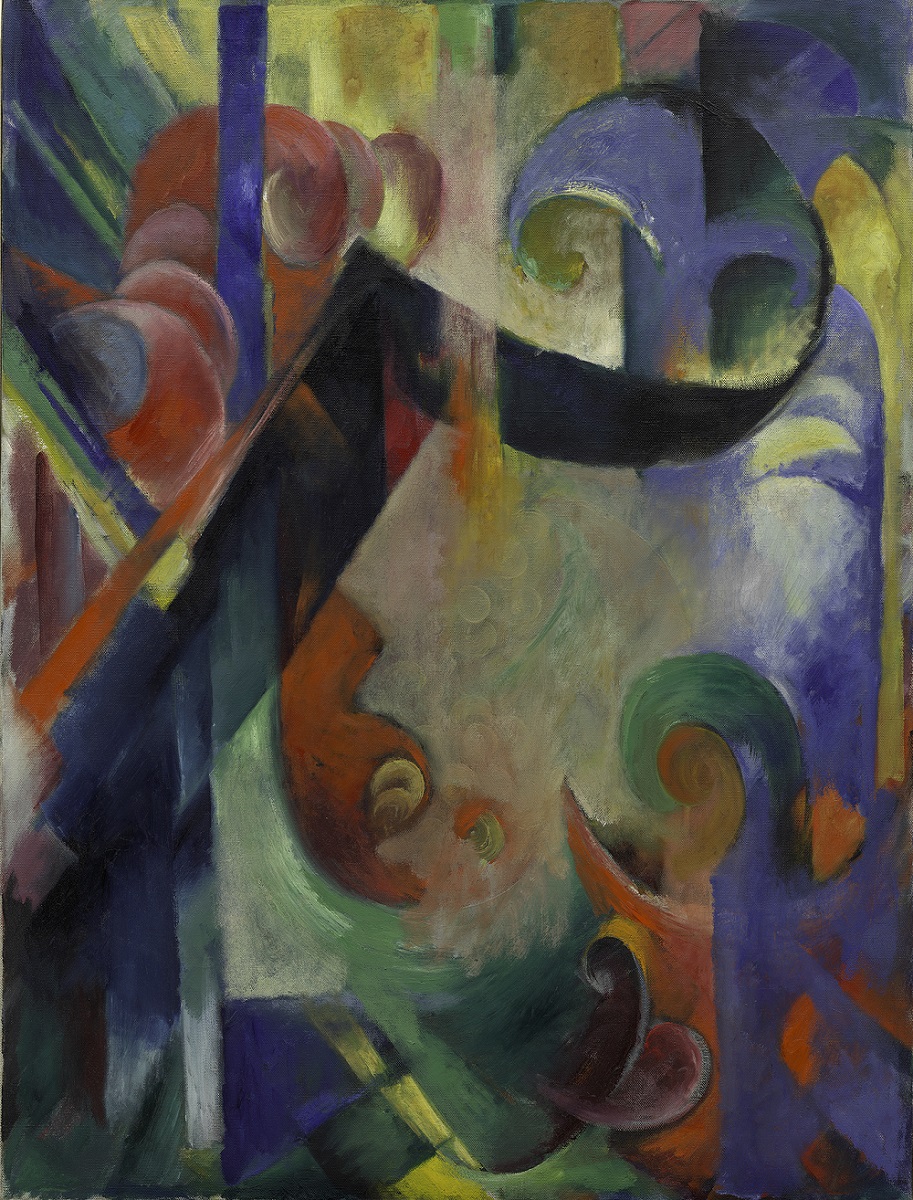
Instead, the Neue Galerie exhibition follows the course of the friendship and artistic development of these two amazing artists. Both of them increasingly ventured beyond their "signature" styles into pure abstraction. 

The exhibition displays several of the abstract works by Macke and Marc. These remarkable experiments show that both artists faced an impasse prior to exploring the realm of abstraction. Macke's investigations of color and light and Marc's symbolism had both reached the point where they must transcend their favored motifs or watch them atrophy. Pure abstraction represented a path to the future. Both Marc and Macke rose to the challenge.


August Macke, Colored Forms I, 1913 (top); Franz Marc, Broken Forms, 1914

These works are amazingly in "sync" given that the two artists saw little of each other from 1913 onward. This was due to conflicting schedules rather than a falling-out over the Blue Rider exhibitions. Macke was planning a painting trip to Tunisia. The future beckoned.

Neither Marc nor Macke had much future remaining when they painted these abstract works. War was coming and Marc appears to have been aware of the ominous developments. In 1913, he combined abstraction with his earlier symbolism in one of the greatest paintings of modern times, Fate of the Animals. A forest fire consumes Marc's beloved beasts. Paradise is lost again - perhaps forever.


Anne Lloyd, Photo (2018) Franz Marc's The Wolves (Balkan War), 1913
Fate of the Animals is not on view in the Neue Galerie exhibition. Given its iconic status, it is unlikely to ever travel from its home location in Switzerland. Marc painted The Wolves (Balkan War) around the same time and in the same vein. It is a powerful, haunting painting.

Given these two works, Marc should have recoiled from war when it did come in August 1914. Shockingly, he did not. Instead, he volunteered for military service in the belief that war would "cleanse" Europe. 

Despite his love of French culture and friendship for Kandinsky, Marc believed in Germany's role as leader of Europe and expected Kaiser Wilhelm's well-drilled army to win. Macke went to war reluctantly, Marc enthusiastically.

It is the word "cleanse" that really casts a shadow on an appraisal of Marc. He certainly did not mean any form of ethnic cleansing. In many ways, he hoped that the war would sweep away ossified political forms in the way that the "Generation of 98" had promoted beneficial change in Spain after that nation was defeated in 1898 by the United States.

The implications of his initial pro-war views were not in keeping with Marc's deep sense of humanity or his genuine spirituality. His wife, Maria, was alarmed by his naive, reckless patriotism and so, after a century, are art lovers like myself who hold Marc in high esteem.

Marc was quickly made aware of his folly. August Macke was killed in action on September 26, 1914. Stunned by Macke's death, Marc wrote, “It is truly the cruelest blow this war could have dealt me; I lost a piece of me when he died.”


Anne Lloyd, Photo (2018) August Macke's Little Walter's Toys, 1912

One of the most affecting paintings in the Neue Galerie exhibition is Macke's Little Walter's Toys. Painted in 1912, Macke shows the playthings of his young son, who was four years old when his father died. The unused toys have taken on a symbolism that was never intended at the time of the painting.

Little Walter's Toys is a precious relic of the "Lost Generation" of 1914-18, of August Macke, of Franz Marc, of the martyred soldiers of all the warring nations. And it is a reminder of all the little Walters, whose hearts were broken by the War to End All Wars.

***
Text: Copyright of Ed Voves, all rights reserved                                                                                           
Images courtesy of the Neue Galerie, New York City, and Anne Lloyd

Introductory Image:
Franz Marc (German, 1880-1916) The First Animals, 1913. Gouache and pencil on paper: 39.05 x 46.67 cm. Private Collection

Anne Lloyd, Photo (2018) Gallery view of the Franz Marc and August Macke, 1909-1914 exhibition, showing Franz Marc's The Yellow Cow, 1911. Oil on Canvas: 55 3/8 x 74 1/2 inches (140.7 x 189.2 cm  Solomon R. Guggenheim Museum, New York Solomon R. Guggenheim Founding Collection

Hulya Kolas, Photo (2018) Gallery view of the Franz Marc and August Macke, 1909-1914 exhibition. Courtesy of the Neue Galerie, New York City.

Anne Lloyd, Photo (2018) Gallery view of the Franz Marc and August Macke, 1909-1914 exhibition at the Neue Galerie, New York City

Anne Lloyd, Photo (2018) Franz Marc's The Dream, 1912. Oil on canvas. 100.5 x 135.5 cm Museo Nacional Thyssen-Bornemisza, Madrid Inv. no. 660 1978.15

Franz Marc (German, 1880-1916) Monkey Frieze, 1911. Oil on Canvas: 135.5 x 75.5 cm Hamburger Kunsthalle

Anne Lloyd, Photo (2018) August Macke's Forest Stream (Waldbach), 1910. Oil on canvas: 24 ¼ x 24 1/8 in. (61.6 x 61.3 cm) Indiana University, Eskenazi Museum of Art, Partial gift of the Robert Gore Rifkind Collection, 78.67

August Macke (German,1887-1914) Lady in a Park, 1914. Oil on canvas: 38 1/2 x 23 1/4" (97.8 x 58.9 cm).The Museum of Modern Art, New York. Gift of the Henry Pearlman Foundation, 1956   

August Macke (German, 1887-1914) Portrait with Apples, 1909. Oil on Canvas:  66 x 59.5 cm Städtische Galerie im Lenbachhaus und Kunstbau, Munich

August Macke (German, 1887–1914) Colored Forms I, 1913 Oil on board, mounted on panel: 53.1 x 38.5 cm. LWL-Museum für Kunst und Kultur, Westfälisches Landesmuseum, Münster, Germany Photo: LWL-LMKuk/Sabine Ahlbrand-Dornseif

Franz Marc (German, 1880-1916) Broken Forms,1914. Oil on Canvas: 44 x 33 1/4 inches (111.8 x 84.4 cm) Solomon R. Guggenheim Museum, New York

Anne Lloyd, Photo (2018) Franz Marc's The Wolves (Balkan War), 1913. Oil on Canvas: 70.8 x 139.7 cm  Albright-Knox Art Gallery Buffalo, NY 

Anne Lloyd, Photo (2018) August Macke's Little Walter's Toys, 1912. Oil on Canvas: 50 x 60 cm, Städel Museum, Frankfurt Germany

Thursday, October 20, 2016

Word and Image: Martin Luther's Reformation at the Morgan Library & Museum


Word and Image: Martin Luther's Reformation

Morgan Library and Museum, New York City
October 7, 2016 - January 22, 2017


Reviewed by Ed Voves

Action really does speak louder than words. Martin Luther's life, the subject of a remarkable exhibit at the Morgan Library and Museum, testifies to the power of deeds. 

Martin Luther (1483-1546) is famous for asserting his opposition to the corruption of the Roman Catholic Church with an immortal declaration, "Here I stand. I can do no other."

Luther never actually said these words himself. A later historian composed the brave, bold statement for him. 

This revelation might lead to the conclusion that "Here I Stand..." is a counterpart to "Washington's Cherry Tree" and other parables from the past. Yet the truth of these words is in their doing. Martin Luther did take a stand, with courage and candor, on behalf of his Christian faith.

Next year is the 500th anniversary of Martin Luther's break with the Church hierarchy in Rome. The momentous events of the Protestant Reformation which followed Luther's defiance changed the course of history for good - and ill.

The title of the Morgan exhibit,Word and Image, is well chosen. The Reformation was the first major event in history marked by widespread use of the printing press, in this case to “spread the word” of religious dissent. Likewise, this "sundering" of Christendom was documented with accurate contemporary engravings of the major participants, also a major innovation.

In 1517, Luther composed the famous Ninety-Five Theses, which sparked the revolt against the Papacy's control of Christian doctrine throughout Europe. Unlike the purported "Here I stand" declaration, the Ninety-Five Theses were very real. Luther, or a supporter, did indeed nail this document to a church door in Wittenberg, the university town in Germany where he taught theology. 


Martin Luther, The Ninety-Five Theses, 1517

The Morgan exhibit displays one of the six remaining printed sheets listing the Ninety-Five Theses. A few copies of a pamphlet version have also survived. Why so few?

The Ninety-Five Theses were not intended to incite a revolution undermining Papal authority but rather were an announcement of a university debate. The subject of this rather routine affair was the sale of Indulgences which granted forgiveness of sins in return for cash contributions to the Church. These ninety-five "talking points," composed in scholarly Latin, mixed spirituality with bluntly speaking truth to power.

They preach only human doctrines who say that as soon as the money clinks into the money chest, the soul flies out of purgatory.  (#27)

The true treasure of the church is the most holy gospel of the glory and grace of God. (#62)

The public debate never took place. But, via the power of the printing press, the Ninety-Five Theses found a wide audience.


Lucas Cranach, Luther as a Monk,1520

Luther had actually been quite respectful of the Pope, targeting the venal Indulgence sellers and emphasizing the need for sincere repentance. But Church leaders over-reacted, sending Cardinal Cajetin (who privately questioned Indulgences) from Rome to insist that Luther recant. Luther refused.

And so a publicity announcement for a debate that never happened became the spark for a revolution that was never intended or planned.

Luther waged a brilliant pamphlet campaign which left the Church hierarchy bewildered and beleaguered. Dissatisfaction - and not just with Indulgences - was rife throughout the Germanic-speaking regions of Europe. 


Anne Lloyd, Gallery view of the Word and Image exhibit at the Morgan Library.
 A wooden chest used to collect payments for Papal Indulgences appears, lower left.

The "heavy artillery" of the Holy Roman Empire was deployed against Luther at a face-to-face meeting with Emperor Charles V in 1521. This pivotal conclave or Diet was held at the city of Worms, which has caused no end of merriment to English-speaking history students. But it was no laughing matter.

Luther refused to recant and went into hiding to prevent his arrest. Posing as "Squire George" at the castle of Wartberg, Luther spent the next ten months translating the New Testament into German from the original Greek text. 

 A complete translation of the Bible took a lot longer for Luther to achieve, appearing in 1534. He was assisted by several of his dedicated co-Reformers, including Philip Melanchthon (1497-1560) and Johannes Bugenhagen (1485-1558). This "official" version in one huge volume was given the unmistakable title: Biblia, das ist: Die gantze heilige Schrifft: Deudsch (Bible: that is the entire Holy Scripture in German).

The Luther Bible, New and Old Testaments, created a sensation. In the process of reaching beyond the Latin Vulgate Bible, Luther shattered the ecclesiastical monopoly of the Roman curia and evoked a key concept known as the Priesthood of All Believers, based on his populist interpretation of the First Epistle of Peter.

Luther also transformed the German language into a dynamic cultural and political force, decisively shifting the political balance of the Holy Roman Empire away from the authoritative control of the Hapsburg dynasty. Christian unity and the Medieval world order collapsed as the first editions of Luther's Bible, the September Testament and December Testament, sold-out as soon as they came off the printing presses in 1522.

The Morgan exhibition covers these momentous events with an array of original documents - many written by Luther himself - and rare books from German collections. On view are the actual notes Luther prepared for his confrontation with Charles V at Worms, the manuscript of Luther's translation of the Old Testament and copies of the September and December Testaments.


Martin Luther, The  New Testament, in German (December Testament), 1522

The Lutheran Reformation was also a major event in art history. Later incidents of the Protestant Reformation, especially in the British Isles where the theology of John Calvin was preferred to Luther's, triggered a tragic destruction of religious images. Luther and Melanchthon denied that religious pictures or statues had spiritual power but asserted that such images could assist the faithful in understanding Christian principles. 

In order to grasp the impact of the Protestant Reformation, it is necessary to understand the late-Medieval world of Luther’s youth. The Morgan curators did a brilliant job evoking “the autumn of the Middle Ages” as this period is sometimes called.


Anne Lloyd, View of St. Anne with the Virgin Mary, by an Anonymous artist, ca. 1520

Among the late-Medieval art works on view is a carved limewood statue depicting St. Anne and the youthful Virgin Mary. St. Anne was the patron-saint of miners, Luther's father being a mine manager. In 1505, Luther, then a law student, was caught in a violent storm. He was nearly struck by lightning and vowed to St. Anne to become a monk if his life was spared. Luther continued to fondly recall St. Anne even after he came to question the role of saints as intercessors with God.

The statue of St. Anne is a fine example of German folk art. But an extraordinary bas- relief, carved by Peter Dell the Elder (1490-1552) is one of the most astonishing works of art on display in Word and Image

Sculpted in pearwood, two of the central incidents of Biblical history are depicted in Dell's Allegory of the Old and New Covenant. With a cinematic grasp of narrative and an absolute mastery of wood-carving, the temptation of Adam and Eve and the Crucifixion of Christ are brought to life. 


Anne Lloyd, Detail of Allegory of the Old and New Covenant by Peter Dell, ca. 1540 

Each of the protagonists portrayed on Dell’s bas-relief is presented as a unique individual, absolutely convincing in their role in the divine drama. Equally believable is the grimacing skull atop the Tree of the Knowledge of Good and Evil. The Death's Head intrudes into Paradise like a hellish apparition. But the striking sensuality of the nude Adam and Eve deflects our attention away from the specter of death.  


Anne Lloyd, Detail of Allegory of the Old and New Covenant by Peter Dell

This current of eroticism is not what you would expect in a work of Christian art from five centuries ago. Yet, it is a powerful, recurring theme in Word and Image, notably in works by Lucas Cranach the Elder.

Lucas Cranach (1472 -1553) was one of Luther's closest friends and an unswerving supporter. Cranach was a brilliant portrait painter and, if not quite of the caliber of Albrecht Dürer or Hans Holbein, he had a knack for capturing the earthy elements in Luther's character and the sharp, hausfrau capability of his wife, Katrina von Bora. 


Lucas Cranach, Katrina von Bora, 1529

Cranach provided illustrations for the early editions of Luther's Bible-translations. But he also painted nudes - nude women from mythology and from the Bible. Almost all of them seem disconcertingly the same, whether they represent Eve, as in the work on display in the Morgan exhibit, or Greek goddesses being judged by Paris.  

In a brilliant book about the friendship of Luther and Cranach, Steven Ozment theorized that Cranach's portraits of women, clothed and nude, were a riposte to the creed of celibacy of the established Church. 


Lucas Cranach, Adam and Eve, 1532

In The Serpent and the Lamb (2011), Ozment writes: 

In the reformatory atmosphere of the early sixteenth century, Cranach’s nudes also confirmed the private desires of Everyman and Everywoman for companionship and intimacy with the opposite sex... Cranach’s alluring images of women drove home the awesome power and divine blessing of human sexuality in and through which new life is created.

Strange things happen during revolutions. Perhaps Ozment, a very perceptive scholar of the Reformation, is correct about this puzzling aspect of Cranach's work.

One thing is certain about the Reformation - and only a little time in the Morgan's Luther exhibit is needed to realize this. The Reformation was a Revolution, the first of modern times. In fact, the Reformation created "modern" times. 


Anne Lloyd, Gallery view of Word and Image: Martin Luther's Reformation.

For an institution which plans and organizes superb exhibits on a "routine" basis, the curators of the Morgan have seemingly surpassed themselves with Word and Image: Martin Luther's Reformation. Yet, an equally outstanding exhibition celebrating Charlotte Brontë (about which I'll be posting a forthcoming review) is currently upstairs at the Morgan and a major exhibit about Emily Dickenson is coming in January 2017.

Art exhibits take years to plan and only remain on display for three to four months. Great exhibits, however, loom large in the memories of those fortunate to visit them. Word and Image: Martin Luther's Reformation at the Morgan is sure to do exactly that.

***
Text: Copyright of Ed Voves, all rights reserved 

Images courtesy of the  Morgan Library and Museum, New York City

Introductory Image:  
Lucas Cranach (German, 1472 - 1553)  Martin Luther, 1529. 14 15/16 x 9 5/8 in. (37.9 x 24.4 cm) Foundation Schloss Friedenstein, Gotha

Martin Luther (German, 1483 - 1546) The Ninety-Five Theses, Disputation on the Power and Efficacy of Indulgences. Nuremberg: Hieronymus Hötzel, 1517. 15 3/4 x 11 in. (40 x 28 cm) Österreichisches Staatsarchiv/Haus-, Hof- und Staatsarchiv


Lucas Cranach (German, 1472 - 1553) Luther as a Monk. Wittenberg, 1520. Oil on panel:
14 15/16 x 9 5/8 in. (37.9 x 24.4 cm) Luther Memorials Foundation of Saxony-Anhalt, Luther Memorials, Foundation of Saxony-Anhalt


Anne Lloyd (2016) Gallery View of the Word and Image: Martin Luther's Reformation Exhibition at the Morgan Library and Museum, New York City

Martin Luther (1483 - 1546) The New Testament in German (December Testament) Leipzig: Melchior Lotter, December 1522 12 x 16 5/16 x 3 1/8 in. (30.5 x 41.5 x 8 cm)

Luther Memorials Foundation of Saxony-Anhalt

Anne Lloyd (2016) Detail of St. Anne with Virgin and Child, ca. 1520, by an Anonymous Artist. Polychrome limewood , 22 7/16 x 14 15/16 x 8 11/16 in. (57 x 38 x 22 cm) Luther Memorials Foundation of Saxony-Anhal

Anne Lloyd (2016) Detail of Peter Dell's Allegory of the Old and New Covenant,

Würzburg, ca. 1540. Pearwood, 16 15/16 x 29 13/16 x 13/16 in. (43 x 75.8 x 2 cm)
Foundation Schloss Friedenstein, Gotha

Anne Lloyd (2016) Detail of Peter Dell's Allegory of the Old and New Covenant.


Lucas Cranach (1472 - 1553) Katrina von Bora, Wittenberg, 1529. 15 1/16 x 9 13/16 in. (38.2 x 24.9 cm) Foundation Schloss Friedenstein, Gotha

Anne Lloyd (2016) Photo of Adam and Eve, 1532, by Lucas Cranach the Elder. 19 11/16 x 13 3/4 in. (50 x 35 cm) Kulturhistorisches Museum Magdeburg

Anne Lloyd (2016) Gallery View of Word and Image: Martin Luther' Reformation at the Morgan Library and Museum, New York City