Reflections on the Art Scene during 2018
By Ed Voves
Original Photos by Anne Lloyd
A new year beckons on the horizon and, like Corot's Curious Little Girl, we strain to look over the wall to get a sneak peek. But at the moment of truth, she - and we - look back to see what we are leaving behind.
That's human nature for you. We want to experience the new while preserving all that we can of the familiar, "comfortable" world of experience. During 2018, I came across a profoundly moving quote that comments upon the way that we appreciate beauty and attempt to integrate it into our art and our lives.
"When a beautiful rose dies", Agnes Martin (1912-2004) wrote, "beauty does not die because it is not really in the rose. Beauty is an awareness in the mind."

Pierre-Auguste Renoir, Roses, c. 1912
Martin wrote those words in an essay, Beauty is the Mystery of Life (1989). Reading them - initially as a wall text at the Philadelphia Museum of Art - was a great comfort to me during a difficult year. The quote brought to mind a painting of roses by Pierre Renoir, created late in life when he was crippled by arthritis and confined to a wheelchair.

Anne Lloyd, Photo (2018)
Film frame from Pierre-Auguste Renoir: Painter, 1920 Silent Film
A film of the aged Renoir, made shortly before his death in 1919, was displayed in the Barnes Foundation's outstanding spring 2018 exhibition, Renoir: Father and Son, Painting and Cinema. The Barnes exhibit showed the close relationship of Renoir and his film director son, Jean Renoir.
During the First World War, Jean Renoir was badly wounded and spent six months home leave recovering from his wounds. During the time he spent with his aged father, he was inspired to go on to become a great artist himself, albeit with a movie camera rather than a paint brush. In my review, I wrote:
This life force, what the French during the World War I era called elan vital, was the great gift which the elder Renoir gave to his wounded son during the six months of convalescence. It lasted Jean Renoir a lifetime, during which he shared this gift with the world.
As I reflected on Renoir's last years, my own father, Ed Voves, Sr., was confined to a wheelchair and in rapidly declining health. He died in November, aged 96. A veteran of World War II, my dad had a special gift for helping others. It was hard to watch him in his final days, but the spark of his elan vital did not flicker out until near the very end.
And when it did ... well elan vital like beauty is an "awareness in the mind" and it lives on the memory of the people we help, either with good deeds or great art... which can be the same thing.
The art exhibitions of 2018 surveyed the varieties of artistic experience (to borrow a phrase from William James) to an extraordinary degree. Indeed, it was often difficult to shift mental "gears" from one insightful exhibition to another. Yet all, in their way, showed how the creative spirit, the sense of the beautiful, is extended and shared from artists to art lovers across the span of generations and centuries.

Ed Voves, Photo (2018)
Gallery view of the Between Worlds: the Art of Bill Traylor exhibition
Between Worlds: The Art of Bill Traylor, which continues until March 2019 at the Smithsonian American Art Museum, was a particularly powerful examination of art at its most elemental. Traylor, born a slave in the pre-Civil War South, began painting mystical, often mystifying, scenes late in life when he could do no other work. These singular images, he declared, "just come to me." Through his painting, Traylor transmitted elements of African and African-American culture, along with talismans of his personal experience. His was an elan vital which would not be denied.
Traylor was not a "primitive" painter. He was a "primal" artist, as was Alberto Giacometti.
The vast exhibition of Giacometti's all-encompassing oeuvre - sculpture, painting and sketches- at the Guggenheim Museum, New York was easily the most spectacular exhibition of 2018.

Anne Lloyd, Photo (2018), Gallery view of the Giacometti exhibit
Art work is Giacometti's Man Pointing (1947)
Seldom has the main rotunda of the Guggenheim with its spiraling ramp and galleries been utilized to better effect. Not only was the evolution of Giacometti's art brilliantly charted, but so too was the struggle of this deeply civilized man, who battled with his inner demons amid the near collapse of Western civilization during the Second World War and after the dawn of the nuclear age.
What made the struggle and despair of "civilized" human beings so desperate during the 20th century was the terrible sense of loss. This applied to what was destroyed in the apocalyptic wars and also what never had a chance to be created. Towering masterpieces never painted, great novels never written, vital achievements lost because death robbed their would-be creators of life and the opportunity to create.
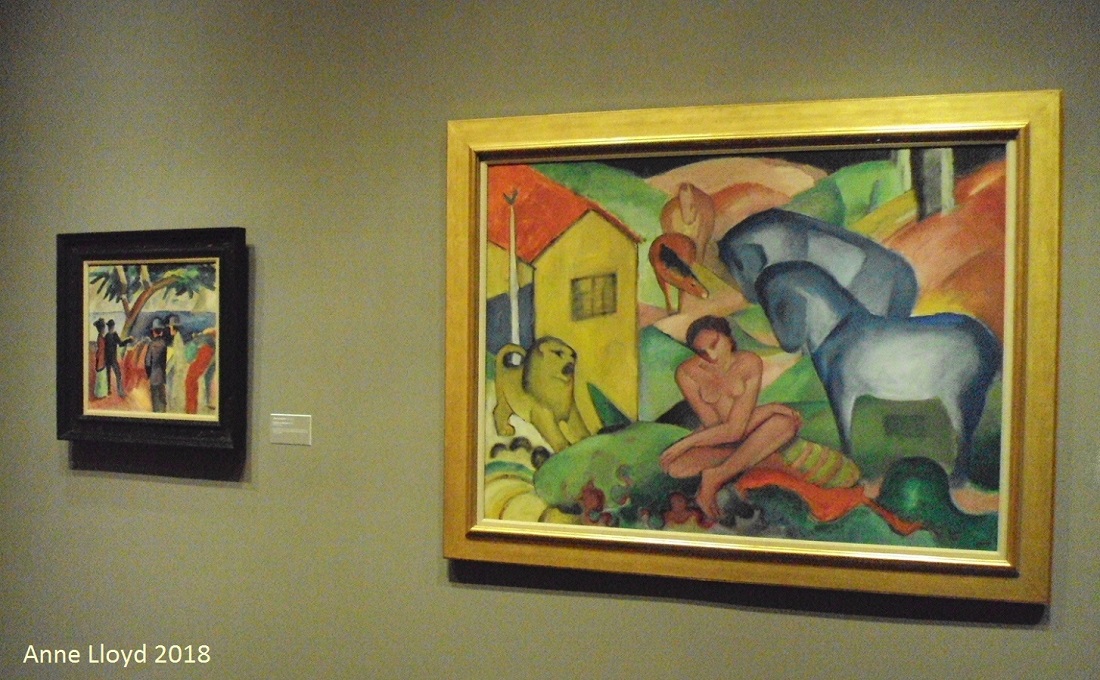
Anne Lloyd, Photo (2018)
August Macke's Strollers at the Lake II, 1912, (left) and Franz Marc's The Dream, 1912
2018 marked the one hundredth anniversary of the end of World War I. The Neue Galerie, the splendid museum of German and Austrian art in New York City, marked this solemn occasion with a much needed exhibition devoted to Franz Marc and August Macke. These close friends and brilliant Expressionist painters were both killed in battle on the Western Front. Despite their importance in the development of modern art, works by these great German Expressionists are rarely shown in the U.S. Incredibly, this beautifully mounted exhibition was the first ever major display of Macke's paintings in America.
Trying to find a unifying context for 2018's special exhibitions is a rather fruitless endeavor. However, two seemingly contradictory trends were very much apparent.
This past year highlighted the absolute necessity of collaboration between museums for mounting major "shows." In marked contrast, a growing number of successful exhibitions were drawn exclusively from the resources of individual institutions. This self-reliance in exhibition presentation is likely to become the dominant model for museums in the future.
Cézanne Portraits illustrated the first of the two trends. It was a "once-in-a-lifetime" exhibition - a display of a lifetime's creative output by one of the greatest artists of all time.

Anne Lloyd, Photo (2018) Detail of Paul Cézanne's Self Portrait, c.1875.
The Cézanne show was a triumph, in no small part because of the difficulty of bringing together so many seminal works by Cézanne for such a long period. The traveling exhibition was shown over the course of 2017 and 2018 at the Musée d’Orsay in Paris, the National Portrait Gallery in London and finally at the National Gallery of Art in Washington D.C., where Anne and I saw it in March 2018. It was organized by John Elderfield, Chief Curator Emeritus of Painting and Sculpture at MOMA, working with curators Mary Morton of the National Gallery of Art and Xavier Rey of the Musée d’Orsay. Talk about a team effort!

Anne Lloyd, Photo (2018) Eagle Pendants, Chiriqui culture, 800-1519 A.D
The same could be said about Golden Kingdoms: Luxury and Legacy in the Ancient Americas. This fabulous survey of the creative genius of the Native American kingdoms was originally presented by the J. Paul Getty Museum as part of a series on Latin American culture, "Pacific Standard Time: LA/LA." It then traveled to the Metropolitan Museum in New York, which also presented a first-rate exhibition on Spanish colonial painting at the same time. The effect of these collaborative efforts was magical.

Anne Lloyd, Photo (2018)
Curators of the Berthe Morisot exhibition. From left: Nicole R. Myers, Dallas Museum of Art, Sylvie Patry, Musée d'Orsay, and Cindy Kang of the Barnes Foundation
Also of note was the Berthe Morisot exhibition, a joint effort by four museums, the Musée national des beaux-arts du Québec, the Dallas Museum of Art, the Musée d'Orsay in Paris and Philadelphia's Barnes Foundation. On view at the Barnes until mid-January 2019, the exhibition is a much needed retrospective of an artist who was regarded as a great painter by her fellow Impressionists. Following her death in 1895, Morisot was marginalized by art historians for much of the twentieth century. This exhibition sets the record straight.
The contrasting tendency of mounting exhibitions with local resources has a lot to be said for it. The Metropolitan Museum mounted an impressive exhibition, Public Parks, Private Gardens: Paris to Provence, almost entirely based on its collection. In October 2018, the Met staff also created a long-term special display of its "Golden Age" Dutch paintings. I will be reviewing this sensational exhibit of "only at the Met" paintings early in 2019.

Anne Lloyd, Photo (2018),
Gallery view of Fabulous Fashion at the Philadelphia Museum of Art.
The dress is a 1962 palazzo pants ensemble designed by Irene Galitzin.
The Philadelphia Museum of Art, midway through a massive renovation project, mounted three outstanding exhibitions during 2018, all drawn exclusively from its vast holdings. These were Old Masters Now (November 2107 to February 2018), Modern Times: American Art 1910–1950 (April to September 2018) and its current blockbuster, Fabulous Fashion: From Dior’s New Look to Now, which runs to March 3, 2019.
Under very challenging circumstances, the Philadelphia Museum of Art staff covered themselves in glory during 2018. Spring 2019 will be welcomed with a similar "home-grown" exhibition on the techniques of the Impressionists
.
Both trends represent good news. Only a kill-joy would go searching for a negative point of view regarding the mounting of special exhibitions. Yet, there certainly are ominous factors regarding the wonderful art exhibits we have grown so accustomed to. The one which really concerns me is the demographic factor of age of museum visitors.
My concern isn't based on age in terms of years. I didn't begin seriously studying art until I was thirty or thereabouts. Young people have a lot of life challenges to meet and the admission charge to an art museum can be a daunting prospect for someone with college loans to repay or young children to rear.

Anne Lloyd, Photo (2018) Gallery view of the Barnes Foundation, Philadelphia, PA
Quite often, I see very few young art patrons in the museum galleries. I wonder if, having grown-up in a digital world, young adults will continue to derive inspiration from seeing original works of art. Certainly, interactive technology is helping redefine art exhibitions for a computer-savvy audience. I think we will see more touch screens and computer simulations - and fewer visiting masterpieces - in future exhibitions.
I still retain hope in "expecting the unexpected." The Metropolitan Museum of Art and the National Gallery in London presented an outstanding exhibition on the Anglo-American landscape painter, Thomas Cole (1801-1848) during 2018.

Thomas Cole, View of the Round-Top in the Catskill Mountains, 1827
Cole, who grew-up in the industrializing region of Lancashire, was moved by the splendor of the American wilderness to embrace landscape painting. This was a defining moment in art history and one that could not have been predicted a half-century before when landscape painting hardly figured in the appreciation of fine art.
Cole, the founder of the Hudson River School, was not alone in his passion for the majesty of nature during the early 1800's. The emphasis on landscape painting - first apparent in Holland in the late 1600's, then later in Great Britain and finally in the U.S. - was largely based upon a sense of "paradise lost."

Detail of Thomas Coles's View from Mount Holyoke, Northampton, Massachusetts, after a Thunderstorm — The Oxbow, 1836
By the late 1700's, there was growing unease at the encroachment of cities, factories and mines on the precious realm of nature. A sensitive and visionary artist, Cole grasped the fragility of the natural world and made this awareness the presiding theme of his art.
Hopefully, as artificial Intelligence, robotics and late-stage mechanization impinge on society, a new generation of art lovers will arise to appreciate the great works of art and support the museums which care and exhibit them.
Ultimately, the health and well-being of the art world takes us back to Agnes Martin's quote on beauty. I explored her comments further and found a wealth of insight - some of it unsettling - but filled with soul-enriching truth.
The path to great art does not proceed from Point A to Point B to Point C, from a great idea to painting a masterpiece to a place on a gallery wall. Art is not dependent on art museums, art exhibitions or even upon a need for visual representation.
Great art can be composing an outstanding piece of music as Leonard Bernstein did - or listening intelligently to the music of a great composer. Great art comes from planting and nurturing a rose or a sunflower. Great art is standing back and seeing the rose or sunflower, appreciating it as a seed of beauty which will continue to flower in our minds.

Anne Lloyd, Photo (2018) Sunflower at the Saul Agricultural School, Philadelphia
Art, in a myriad of differing creative expressions, is based on a healthy, emotional response to life. Art is a reflection of what we see in life and give back to life.
That thought, art as a reflection, was literally reinforced by an extraordinary work of art which Anne and I saw several times this past year in New York City.

Anne Lloyd, Photo (2018) Tear sculpture by Richard Hudson at Plaza 33 in Manhattan
Tear, an enormous sculpture made polished steel, is the creation of British artist, Richard Hudson. It is displayed, not in a museum but smack in the middle of Plaza 33, outside Penn Station. Not a place given to introspection but now a site for reflection!
With this image and these moving words of Agnes Martin, Art Eyewitness bids you a Happy 2019.
Beauty is an awareness in the mind. It is a mental and emotional response that we make. We respond to life as though it were perfect. When we go into a forest we do not see the fallen rotting trees. We are inspired by a multitude of uprising trees. We even hear a silence when it is not really silent. When we see a new born baby we say it is beautiful – perfect. The goal of life is happiness and to respond to life as though it were perfect is the way to happiness. It is also the way to positive art work.
***
Text: Copyright of Ed Voves, all rights reserved
Images courtesy of the Metropolitan Museum of Art, the Barnes Foundation, the Museum of Fine Arts, Boston, and Anne Lloyd
Introductory Image:
Camille Corot (French, 1796–1875) The Curious Little Girl, 1860–64. Oil on cardboard, laid down on wood: 16 1/4 x 11 1/4 in. (41.3 x 28.6 cm). Metropolitan Museum of Art. The Walter H. and Leonore Annenberg Collection, Gift of Walter H. and Leonore Annenberg, 1999, Bequest of Walter H. Annenberg, 2002. Accession Number:1999.288.2 © The Metropolitan Museum of Art
Pierre-Auguste Renoir (1841-1919) Roses, c. 1912. Oil on canvas: 8 7/8 x 17 5/8 in. (22.5 x 44.7 cm) Barnes Foundation, Philadelphia. Accession Number BF1168 © The Barnes Foundation
Images courtesy of the Metropolitan Museum of Art, the Barnes Foundation, the Museum of Fine Arts, Boston, and Anne Lloyd
Introductory Image:
Camille Corot (French, 1796–1875) The Curious Little Girl, 1860–64. Oil on cardboard, laid down on wood: 16 1/4 x 11 1/4 in. (41.3 x 28.6 cm). Metropolitan Museum of Art. The Walter H. and Leonore Annenberg Collection, Gift of Walter H. and Leonore Annenberg, 1999, Bequest of Walter H. Annenberg, 2002. Accession Number:1999.288.2 © The Metropolitan Museum of Art
Pierre-Auguste Renoir (1841-1919) Roses, c. 1912. Oil on canvas: 8 7/8 x 17 5/8 in. (22.5 x 44.7 cm) Barnes Foundation, Philadelphia. Accession Number BF1168 © The Barnes Foundation
Anne Lloyd, Photo (2018) Film frame from Pierre-Auguste Renoir: Painter, 1920 Silent Film produced by Gaumont Actualities. Distributed by Gaumont Pathé Archives. Film was shown at the Renoir: Father and Son exhibit at the Barnes Foundation, Philadelphia, PA.
Ed Voves, Photo (2018) Gallery view of Between Worlds: the Art of Bill Traylor exhibition at the Smithsonian American Art Museum, Washington D.C. Photo shows Bill Traylor's Man and Large Dog, ca. 1939-1942.
Anne Lloyd, Photo (2018) of Alberto Giacometti's Man pointing, 1947 (cast by 1949). Bronze, 70 1/16 x 37 3/8 x 20 1/8" (178 x 95 x 52 cm) Tate Museum, London. # 2016.136. Photo shows Man Pointing in the Giacometti exhibition at the Guggenheim Museum, N.Y.
Anne Lloyd, Photo (2018) August Macke's Strollers at the Lake II, 1912, (left) and Franz Marc's The Dream, 1912. Photo shows these works at the Neue Galerie exhibition, Franz Marc and August Macke, 1909-1914.
Anne Lloyd, Photo (2018) Detail of Paul Cézanne's Self Portrait, c.1875. Musée d'Orsay, Paris. Gift of Jacques Laroche.
Anne Lloyd, Photo (2018) Gallery view of Golden Kingdoms: Luxury and Legacy in the Ancient Americas exhibition, showing Eagle Pendants, Chiriqui culture, 800-1519 A.D. Gold. Collection of the Metropolitan Museum of Art.
Anne Lloyd, Photo (2018) Curators of the Berthe Morisot, Woman Impressionist exhibition at the Barnes Foundation. From left: Nicole R. Myers, Dallas Museum of Art, Sylvie Patry, Musée d'Orsay, Paris, and Cindy Kang of the Barnes Foundation.
Anne Lloyd, Photo (2018), Gallery view of the Fabulous Fashion: From Dior’s New Look to Now exhibition at the Philadelphia Museum of Art. The dress shown is a 1962 palazzo pants ensemble designed by Irene Galitzin.
Anne Lloyd, Photo (2018) Gallery view of the Barnes Foundation, Philadelphia, PA.
Thomas Cole (American (born in England), 1801–1848) View of the Round-Top in the Catskill Mountains - Sunny Morning on the Hudson, 1827. Oil on panel: 47.31 x 64.45 cm (18 5/8 x 25 3/8 in.) Museum of Fine Arts, Boston # 47.1200. © The Museum of Fine Arts, Boston.
Thomas Cole (American, 1801-1848) Detail of View from Mount Holyoke, Northampton, Massachusetts, after a Thunderstorm—The Oxbow, 1836. Oil on canvas, 51 1/2 x 76 in. (130.8 x 193 cm). The Metropolitan Museum of Art, New York, Gift of Mrs. Russell Sage, 1908 (08.228). Image © The Metropolitan Museum of Art
Anne Lloyd, Photo (2018) Sunflower at the Saul Agricultural School, Philadelphia, PA.
Anne Lloyd, Photo (2018) Tear sculpture by Richard Hudson (British, born 1954) at Plaza 33 in Manhattan near Penn Station and Madison Square Garden. Polished stainless steel: height: 250 cm.