Showing posts with label Landscape Painting. Show all posts

Friday, September 25, 2026

Art Eyewitness Essay: Cloud Spotting with John Constable and Alfred Stieglitz


Cloud Spotting with John Constable & Alfred Stieglitz

Constable's Year by Susan Owens (Thames & Hudson, 223 pages, $35)

Chasing Clouds at the Metropolitan Museum of Art (Thru Feb. 28, 2027)

By Ed Voves  Original photos by Anne Lloyd

On the evening of September 12, 1821, John Constable painted a dramatic view of the sunset over Hampstead Heath.  

Constable was working outdoors. He used a palette loaded with dabs of oil paint, rather than his water color box, to create Hampstead Heath, looking toward Harrow at Sunset.


      John Constable,  Hampstead Heath, looking toward Harrow at Sunset, 1821

In this remarkable painting, Constable reversed the order of priority of sky and ground in landscape painting. The dramatic sky above is accorded the starring role. The soil beneath Constable's feet - and of the barely visible people traveling on the path in the foreground - is almost an afterthought.

Constable would later write of this shift of perspective. "It will be difficult to name a class of landscape in which the sky is not the key note," Constable affirmed, "the standard of scale and the chief organ of sentiment.” 


Ramsay Richard Reinagle, Portrait of John Constable, c. 1799

With this remark, John Constable, born 250 years ago, launched a hugely significant dialog with nature. In due course, our perception of the world around - and above -  us would change. Constable's "refocus" continued to resonate in works by John Singer Sargent and Alfred Stieglitz over a century later.

In this Art Eyewitness essay, I will comment on a new book from Thames & Hudson, Constable's Year by Susan Owens, a former curator at the Victoria and Albert Museum and author of a superb history of drawing. Then, we will shift our focus to the just-opened exhibition at the Metropolitan Museum, Chasing Clouds. 


To these insightful surveys, several photos by my wife, Anne, will be added, showing how sky and clouds can continue to strike an artistic "key note" - even when the vantage point is a studio or bedroom window.


Anne Lloyd, Studio Window Skyscapes, 2026

By the standards of the early nineteenth century, Constable's Hampstead Heath, mentioned above, was an oil sketch, not a finished work. Painting in the open air on the following day, September 13, 1821, Constable looked-up again at the clouds swirling overhead. Then, he made a very bold decision.

Constable decided to paint the sky.


John Constable, Study of altocumulus clouds, September 13, 1821

 No distant horizon line. No misty mountains. No path through the forest. Just sky and clouds, very accurately depicted and scientifically classified. Constable entitled his first "skyscape", Study of altocumulus clouds.

On the back of this oil on paper, Constable jotted the following notation,"13 September 1821. one o'clock. Slight wind at North West, which became tempestuous in the afternoon, With Rain all the night following."


John Constable, Cloud Study, September 25, 1821

During the remainder of the early autumn of 1821, Constable continued to paint oil sketches of the cloud-laden skies. As Susan Owens points out in Constable's Year, autumn, with its fading colors and falling leaves, little appealed to Constable. The September skies, with their "peculiar tone and beauty" were a different matter.

A year later, again in September, he was back for another season of "skying" from his favorite vantage points on Hampstead Heath. Constable painted cloud-filled skies, until he could write to his friend, Archdeacon Fisher, "I am the man of clouds."

However, another Englishman of Constable's era was also directing his attention skyward. In 1803, an amateur scientist named Luke Howard (1772-1864) published An Essay on the Modification of Clouds. In this illustrated book, Howard defined and described the cloud types with terminology still in use today: Cirrus, Cumulus and Stratus.

Constable was certainly familiar with Howard’s cloud "modification" (which then meant classification). In many respects, he was more than ready to embrace such close study of nature as an integral facet of art. In an 1836 lecture, Constable asserted:

Painting is a science, and should be pursued as an inquiry into the laws of nature. Why then may not landscape painting be considered as a branch of natural philosophy of which pictures are but the experiments?

Constable's actual practice of art was notably less definitive. He remained more a man of sentiment, rather than a practitioner of "painting as a science." 


John Constable, Hadleigh Castle, 1829

In 1829, Constable, grief-stricken over the death of his wife, painted Hadleigh Castle. Here the sky, though memorably executed, was treated as a backdrop to land and sea and the crumbling battlements erected by man.

Owen's book - compulsively readable, even for readers familiar with British art history - traces Constable's reactions to all four seasons of the year. Owens brilliantly correlates the annual rhythms of life in Regency England to Constable's creative efforts. Predictably, winter put him in a reflective, melancholy frame of mind. 

Constable had a lot more on his mind than the weather when he looked at clouds.

During the last years of his life, Constable wrestled with issues of mortality and morality. Was the sky, merely a "standard of scale" or was it "the chief organ of sentiment?” In 1839, two years after his passing, science, in the shape of photography, seemed to settle the issue. 

"From today, painting is dead," the artist Paul Delaroche exclaimed upon seeing one of the first photographs, a daguerreotype.

Delaroche's obituary for painting was premature, especially in regards to daguerreotypes. These one-of-a-kind pictures were produced from silver-coated sheets of copper, making them unsuitable for almost anything but portraits.

One of the most fascinating works of art in the Met's Chasing Clouds directly relates to the difficulties in trying to expand the range of early photography. In 1844, a pair of French "lensmen", Marie-Charles-Isidore Choiselat and Stanislas Ratel, took-up the challenge of creating a daguerreotype landscape.


Marie-Charles-Isidore Choiselat & Stanislas Ratel, Landscape, 1844

The result of this experiment is little short of miraculous. The astonishing mirror image of the cottage is a masterpiece in its own right. 

Yet, the daguerreotype of Choiselat and Ratel is an unsettling work. It is so focused on surface detail that there is little depth to the photo. And because of the slow exposure speed of daguerreotypes, not a trace of clouds can be seen. If any were in the sky at the time, these would have been moving too fast to be captured by Choiselat and Ratel! 

For artists and the scientific-minded of the Romantic era, the allure of clouds was too great to be resisted. The process of photography was still in its adolescence, when Gustave Le Gray and Charles Marville successfully addressed the problem of focusing on landscape and skyscape. 

Gustave Le Gray (1820-1884) approached this task by combining photographic negatives. This was a process already in use in studio photos, but Le Gray audaciously took it out-of-doors. Beginning in 1855, he took photos of the shoreline and the sky along France's Mediterranean coast, especially the seaport of Sète. He joined the negatives at the horizon line, almost seamlessly.


Gustave Le Gray, The Great Waves, Sète, 1857

Images like The Great Wave earned Le Gray international acclaim. He had succeeded in creating photographs with expertly focused expanses of sky and of land & sea. Moreover, he was able to evoke the pictorial interest and emotional impact of paintings like Constable's Hadleigh Castle.

While Le Gray was preoccupied with his remarkable combination technique, Charles Marville took some time-off from photographing the architecture of Paris to do a little "cloud spotting" for himself.

Marville was anything but a "romantic" photographer. His eye for precision and expert camera work would earn him the commission from Napoleon III to document the demolition of vast swathes of old Paris by Baron Haussmann in order to make way for the boulevards and public spaces of the new "city of light" Paris.

Yet, Marville was intrigued by the masses of clouds he could see from the window of his studio on the rue Saint Dominique. With the dome of the hospital, Les Invalides, as the center point, Marville adjusted the camera lens to focus on the skies, leaving the lower reaches of the scene in shadow. Since the silhouette of Les Invalides was instantly recognizable, the photo succeeded without the need to combined negatives.


Charles Marville, Cloud Study, Paris (top)1855-56; (below)1856-57

A year later, Marville tried again. This time, he achieved a more balanced focus of cloud structure and of architectural detail in the streets below. Given, the technology of the time, this ranks as one of the great achievements of early photography.

Both Le Gray and Marville were "pushing the envelope" of what was feasible for photographers during the 1850's. Though innovations in camera design and film quality were made later, a gulf continued to exist between vision and practice for much of the nineteenth century.

As Chasing Clouds at the Met shows, photography did not kill painting, even when it came to depicting clouds. Many artists continued to follow Constable's lead and kept painting the skies above. 


John Singer Sargent, Clouds, 1897

One of my favorites in the Chasing Clouds exhibition is a watercolor by John Singer Sargent. Sargent's Clouds was painted in 1897, exactly one year before a major technological innovation which would change photography and cloud spotting forever.

A new hand-held camera, the Graflex single-lens-reflex, was introduced by the Folmer and Schwing Manufacturing Company of New York City in 1898. Though bulky-looking to modern eyes, the Graflex had a rapid-shutter speed and portability that Gustave Le Gray and Charles Marville could only have dreamed of using.

In the hands of a skilled photographer, the Graflex was capable of producing masterpiece-caliber pictures. In the hands of Alfred Stieglitz (1864-1946), it did. 


Clara Sipprell, Alfred Stieglitz, 1932

Stieglitz used a Graflex to create his iconic The Steerage in 1907. A decade and a half later, Stieglitz tilted his Graflex upward and began taking cloud photos. Initially, he called this series, Music - a Sequence of Ten Cloud Photographs. Then, as the number of cloud photos escalated, the title was changed to Equivalents. 


 Alfred Stieglitz, Equivalent,1924

Stieglitz prints of the Equivalent photos are prized possessions of a number of American art museums. But they cannot be shown on a long-term basis. Thus, Metropolitan Museum is doing art lovers a great service by presenting twenty-one Equivalents for their close inspection. Opportunities like this do not often occur.

In a short essay, published in 1923, Stieglitz explained his motivation for taking cloud photos:

I wanted to photograph clouds to find out what I had learned in 40 years about photography. Through clouds to put down my philosophy of life—to show that my photographs were not due to subject matter—not to special trees, or faces, or interiors, to special privileges—clouds were there for everyone. 

Thus, in looking toward the clouds, Stieglitz was grappling with Constable's dilemma. When depicting the skies, is the artist's goal to establish a "standard of scale" or to gain access to "the chief organ of sentiment?” 

Stieglitz' answer was one of ironclad certainty, nothing is "due to subject matter... clouds were there for everyone." 

Perhaps unconsciously, this assertion provides a clue for the way that the clouds became less-and-less identifiable and the images more cryptic as the Equivalent series evolved. Some of the cloud-filled skies look the ripples in a stream of water or a crust of ice on a frosted window in winter.


Alfred Stieglitz, Equivalent, 1926


Alfred Stieglitz, Equivalent, 1926

Other photos bore little resemblance to anything, including clouds. This ambiguity would lead to applause for Stieglitz from the connoisseurs of modern art and the embrace of the Equivalents as an important addition to the growing body of Abstract art. 

Stieglitz' effort to use cloud study to open a portal to personal feelings and insights was certainly a heroic endeavor. It took place over an extended period, 1922 to 1931. Over four hundred sky and cloud photos were taken, some of which were quickly presented in exhibitions such as Seven Americans in 1925 at the Anderson Galleries in New York. Others were not published or exhibited until many years later. 

Stieglitz' cloud photography was something of an on-going venture during his lifetime. Might we then interpret the Equivalents as an open-ended, never officially closed endeavor? Might we not add some of our own renderings of the ethereal realm above our heads?

Here to answer these questions and to conclude our essay is a selection of Anne's cloud studies. 


Anne Lloyd, Sky & Cloud Studies, 2022, 2024 & 2025  

There is no doubt in my mind, reflecting on Anne's photos, that Constable was correct in stating that the sky supplies the "keynote" of landscape art.


And clouds? Stieglitz was right, too. The clouds are "there for everyone."

***

Text: Copyright of Ed Voves, all rights reserved                                                                                          

Original photography, copyright of Anne Lloyd, all rights reserved

Book Cover of Constable’s Year by Susan Owens Courtesy of Thames & Hudson

Promotional Image for the Chasing Clouds exhibition, Courtesy of the Metropolitan Museum of Art, NYC

The Equivalent photos by Alfred Stieglitz, used in this review, are from the collection of the Art Institute of Chicago. These are comparable to those on display in the Metropolitan Museum’s exhibition, Chasing Clouds. The Met’s Stieglitz photos are currently embargoed for use in Internet articles and reviews.

Introductory Image:

Anne Lloyd, Photo (2014) A cloud study made at Haworth, Yorkshire, UK, near the Bronte Parsonage Museum.

John Constable Hampstead Heath, looking toward Harrow at Sunset, 1821 Oil on paper: 24.1 x 29.8 cm. (9 ½ x 11 ¾ in.) Private collection. Courtesy of Thames & Hudson

Ramsay Richard Reinagle, Portrait of John Constable, c.1799 Oil on canvas: 76.2 cm × 63.8 cm (30.0 in × 25.1 in) National Portrait Gallery, London.

Anne Lloyd, Photo (2026) Studio Window Skyscapes, 2026.

John Constable, Study of altocumulus clouds, September 13, 1821. Oil on paper: 24.8 x 30.3 cm. (9 7/8 x 11 ½ in.) Yale Center for British Art. B1981.25.156

John Constable, Cloud Study, September 25, 1821. Oil on paper: 24.8 x 30.3 cm. (9 7/8 x 11 ½ in.) Yale Center for British Art. B1981.25.156 Courtesy of Thames & Hudson

John Constable, Hadleigh Castle, 1829. Oil on canvas: 122 x 164.5 cm. (48 1/8 x 64 7/8 in.) Yale Center for British Art. B1977.4.42Courtesy of Thames & Hudson

Marie-Charles-Isidore Choiselat & Stanislas Ratel, Landscape, 1844. Daguerreotype: 16.4 x 21.7 cm (6 7/16 x 8 9/16 in.) Metropolitan Museum of Art. #1994.417J

Gustave Le Gray, The Great Wave, Sète, 1857. Albumen silver print from two glass negatives: 33.7 x 41.4 cm (13 1/4 x 16 5/16 in.) Metropolitan Museum of Art. #1976.646

Charles Marville, Cloud Study, Paris (top) 1855-56. Albumen silver print from glass negative: 15.4 x 21 cm (6 1/16 x 8 1/4 in.) Metropolitan Museum of Art. #2005.100.353; (below) 1856-57. Albumen silver print from glass negative: 16.7 x 20.6 cm (6 9/16 x 8 1/8 in.) Metropolitan Museum of Art. #1987.1094

John Singer Sargent, Clouds, 1897. Watercolor on white wove paper: 35.6 x 25.2 cm. (19 x 9 15/16 in.) Metropolitan Museum of Art #50.130.30

Clara Sipprell, Alfred Stieglitz, 1932. Gelaton Silver Print: Image Sheet: 22.3 x 17.6 cm. (8 ¾ x 6 15/16 in.) National Portrait Gallery, Washington D.C. NPG 82.196

Alfred Stieglitz, Equivalent, 1924.Gelatin silver print: Image: 9.6 × 12.1 cm (3 13/16 × 4 13/16 in.); Paper: 10.1 × 12.7 cm (4 × 5 in.): Art Institute of Chicago. Alfred Stieglitz Collection. #1949.793

Alfred Stieglitz, Equivalent, 1926. Gelatin Silver print. Image: 11.9 × 9.3 cm (4 11/16 × 3 11/16 in.) Art Institute of Chicago. Alfred Stieglitz Collection. #1949.809

Alfred Stieglitz, Equivalent, 1926. Gelatin Silver print: Image: 11.6 × 9.2 cm (4 5/8 × 3 5/8 in.)Art Institute of Chicago. Alfred Stieglitz Collection. #1949.809

Anne Lloyd, Photos. Sky & Cloud Studies, 2022, 2024 & 2025

Anne Lloyd, Photo (2025) November Clouds, 2025.


Thursday, August 5, 2021

Cézanne Drawing at the Museum of Modern Art, New York City


Cézanne Drawing 

Museum of Modern Art, New York

June 6, 2021 - September 25, 2021

Reviewed by Ed Voves

Paul Cézanne wrote two letters to Emil Bernard which directly relate to the stupendous exhibition currently on view at the Museum of Modern Art in New York City. 

Since Cézanne Drawing at MOMA confounds the popular image of Cézanne as primarily a painter rather than a master draftsman, it is worth a few moments to consider the insights he offered to Bernard.

The first letter to Bernard is Cézanne's most famous, dated July 15, 1904. Cézanne counselled Bernard - and through him, a rising generation of artists - "to deal with nature by means of the cylinder, the sphere and the cone, all placed in perspective ..." 

This famous advice, however, was not the call to revolution that many consider it.  Rather, it was an emphatic affirmation for adhering to the fundamentals of artistic form. 


Ed Voves, Photo (2021) Cézanne's Self-Portrait and Apple, 1880-1884

A year later, October 23, 1905, Cézanne again returned to the importance of focusing and observation, of rendering "what we actually see, forgetting everything that appeared before our time." He concluded the letter to Bernard with "a warm hand-clasp and push ahead. The visual sense, as it develops in us by dint of study, teaches us to see."

These profound words, however you interpret them, all point to the pivotal role of drawing for Cézanne. His development as an artist and his sense of human awareness were stimulated by devotion to constant sketching.


Ed Voves, Photo (2021) 
Gallery view of the Cézanne Drawing exhibition at MOMA

Cézanne Drawing at MOMA is a vast exhibition. Over two hundred works of art are on display. The majority are drawings, complemented by an impressive array of watercolors. There are also several oil paintings (chiefly for comparative purposes) on view. 

Quite a number of the exhibited works appear in series of similar drawings, many of these with themes rooted in classical art. Cézanne often drew copies of the sculptures in the Louvre, such as Jean-Baptiste Pigalle's marble statue (1744) of Mercury. 


Paul Cézanne, Mercury after Pigalle. c. 1890

The repetition of such traditional images may come as something of a surprise, given Cézanne's reputation. But, as I will comment upon shortly, Cézanne nurtured the flame of the human spirit deep within himself and the works of art in this wonderful exhibition open a portal to his mind and soul.

Cézanne Drawing begins by examining pages filled with multiple drawings, seemingly unrelated in subject. These study sheets, for the most part,  were originally bound in the nineteen sketchbooks which Cézanne is known to have used over the course of his career. 

Interestingly, Cézanne did not regularly complete a sketchbook and then proceed to a new one, filled with unused pages. Instead, as the spirit moved him, he would refer to  older sketchbooks with some open space and fill in the blank area with a new drawing. When I read about this unusual work habit, I smiled to myself that Cézanne's French peasant roots were showing, seeking to make use of every bit of paper. 

This, however, was not the case - or a least not all the time. Often, Cézanne was actually creating underlying structure and thematic patterns on his multiple sketch sheets, with intriguing combinations of images. Several of these study sheets include self-portraits which bring us, the viewers, into a dialog with Cézanne and the objects and natural surroundings he is drawing.


Paul Cézanne (French, 1839-1906) 
Studies of Three Figures, c. 1876, 1883, 1885

Whether this process was the result of Cézanne's conscious decisions or following inner impulses, is a matter of speculation. What can be said is that many of these pages of multiple imagery were not created merely as record of objects and shapes, intended for later use. Instead, these were part of a process, an interaction between Cézanne and the objects he drew.

"Objects penetrate one another," Cézanne told Joachim Gasquet, the noted poet who wrote an early biography of him."They never cease being alive."

This insight is key to understanding Cezanne and his work practice. And, for enabling us to grasp this point, praise and acknowledgment is due to Jodi Hauptman, who organized Cézanne Drawing. The level of curatorial skill which Hauptman devoted to the exhibition is of the highest order. The wall texts accompanying the works of art are hugely rewarding, filled with essential insights. 


Ed Voves, Photo (2021) 
Gallery view of Cézanne Drawing at MOMA, showing two self-portraits

Cézanne's drawings make for fascinating viewing. Some of these, as noted, deal with related subjects which explain why Cézanne went back and forth filling in empty spaces. A composite sheet from the collection of the Albertina in Vienna, with drawings, front and back, is filled with superb character studies of the artist's young son. Paul.


Paul Cézanne, Studies and Portraits of the Artist's son, 1877-78

Before leaping to absolute conclusions about such composite works, it should also be noted that Cézanne sketched a small cooking vessel, a casserole, along with these portraits of young Paul. Perhaps there was an element of humor in these juxtaposed images, or perhaps it was simply a case of Cézanne drawing what interested him.


Ed Voves, Photo (2021) 
Gallery view of Cézanne Drawing, showing a Study Sheet by Paul Cézanne, including a portrait of Francisco Goya, 1877-1880

Another composite, study sheet shows a superb copy of a self-portrait of Francisco Goya, originally used to introduce his "Los Caprichos" illustrations. The same sheet presents a beautifully shaded apple, several figure studies and a glowering self-portrait of Cézanne. If you want a signature sketch for this MOMA exhibition, showing Cézanne's range of mind and drawing ability, this is an excellent choice.

Cézanne's portrait sketches assert a powerful degree of psychological depth which is lacking in some of his portraits-in-oil. This was not due to any lack of ability on Cézanne's part, but rather due to his excruciating slowness as a painter. Several bona fide masterpieces - if they had been completed - testify to that. Cézanne's portait of the art writer, Gustave Geffroy, which was displayed in the National Gallery's 2018 Cézanne exhibiton, is perhaps the most notable example of the artist's over-exactitude.


Ed Voves, Photo (2021) 
Detail of Paul Cézanne Fils as a Harlequin, c.1888

With his portrait sketches, such as the one he did of his son, dressed for Mardi Gras, Cézanne showed what he was capable of in the realm of character delineation.

Following the trail of Cézanne's work habits, the exhibition also explores the possibility that he created composite oil studies. It is speculated that he then divided the canvases into independent works of art, intended for sale. 

A pair of still life paintings, on view in the exhibition, are believed to have been painted on the same canvas and then, carefully cut into separate works. There is a fascinating video detailing this thesis, which MOMA conservators are seeking to confirm with further testing.


Ed Voves, Photo (2021) Gallery view of Cézanne Drawing.
 From left, Glass and Apples & Still Life with Apples, late 1870's

Cézanne's still life compositions occupy a prominent place in the exhibition, especially those created with watercolor. With this medium, Cezanne was able to explore the fluid nature of liquid substances, water, wine, even ink, held in containers and displayed on the flat surfaces of his still lives. 


Paul Cézanne, Still Life with Blue Pot, 1900-1906

Cézanne, by virtue of constant practice, became a master of using blank space in his sketches and still lifes. This enabled him to evoke a sense of solid materiality with a few deft strokes of graphite or traces of pigment on an otherwise unpainted surface. We see this virtuoso ability displayed in the table cloth and white jug in his Still Life with a Blue Pot, one of the "show-stopper" works in the exhibition, on loan from the Getty Museum.

Cézanne did not just make "something out of nothing." He also  utilized unworked space or "unfinish" in the figures of the people he sketched.


Paul Cézanne, Hortense Fiquet (Madame Cézanne) Sewing, c. 1880

This is spectacularly evident in the way that Cézanne depicted his wife, intent on her sewing. Her body seems to materialize from the blank area in the center of the drawing. Yet, this is not a void or empty spot. It is rather the very core of the picture, the glowing heart of his wife, Hortense. 

The more that you look at Cézanne's sketches, the more you realize that he was attempting to get to the "region of the spirit" of his subjects. His drawings are a record of his feelings, as much as of the objects, people and places he drew.

“I paint as I see, as I feel,” Cézanne announced early in his career, “and I have very strong sensations.” 

That these sensations may still be palpable was brought home to me by an incident which occurred during my time in the Cézanne Drawing galleries, I was particularly struck by a two-sided work, executed with pencil and watercolor. On one side (recto), there was an interesting, almost abstract study of a vase of flowers.


Paul Cézanne, Vase of Flowers (recto), c. 1887-90

When I walked to the other side of the display frame to see the verso, I was stopped in my tracks. The English title of the verso image is Study of Trees, but the original French version does it full justice. Clairière. Clearing. 


Paul Cézanne, Study of Trees (Clairière) (verso), 1885-88

Clairière. This is the still heart of the forest. Just as the body of the sewing Hortense materializes from the glowing center of the sketch above, so the trees rise up, framing an ethereal woodland clearing. Here one can pause, bask in the sun's rays, listen to the breeze rustling the leaves above. Cézanne has once again made brilliant use of the blank space of the paper to create an almost numinous feeling that God, spirit of the universe, is present.

I could not take my eyes off this stunning work of art. And when I forced myself to go to nearby galleries to see the rest of the exhibit, I kept being drawn back. Finally, after returning a third or fourth time, a fellow art-lover came up and said, "This is one of my favorite Cézannes, too."

"I've never seen it before," I replied. "There's a spiritual quality, here, which I can feel but is hard to describe."


Ed Voves, Photo (2021) 
Gallery view of the Cézanne Drawing exhibition,
showing Cézanne's Study of Trees (Clairière) c.1885-88

"People say that Cézanne was the least emotional of the Impressionists," the woman sagely noted, "but I think he was the most emotional of them all."

To think of Cézanne in these terms, as an artist with an open-heart, as well as a probing mind, helps us understand just how important drawing was to his life - and to his art. Indeed, it would be almost impossible to separate the two.

Yet, to concentrate entirely on Cézanne's spiritual qualities, runs the risk of neglecting his role as "Father of Modern Art." The MOMA exhibition certainly displays examples of Cézanne's oeuvre which reveal his interest in modern subjects. Geology especially fascinated him and he went to great lengths to incorporate natural forms as the building blocks in his landscape works.


Paul Cézanne, Rocks Near the Château Noir, 1895-1900

Cézanne's investigation of nature began early in his life. A close school friend, Antoine-Fortuné Marion (1846–1900) later became one of France's greatest geologists. Marion accompanied Cezanne on nature walks and contributed some scientific drawings to his sketchbooks, including a depiction of a trilobite fossil. From these rambles with Marion to the last rain-soaked painting session which led to his death in 1906, Cezanne never stopped observing, drawing and painting the hills of home. 


Paul Cézanne, Mont Sainte-Victoire, 1902–06

Details of the topography of Provence figure on Cezanne's study sheets and sketchbooks, the result of long hours of study at the Bibémus quarry and of his beloved Mont Sainte-Victoire. 


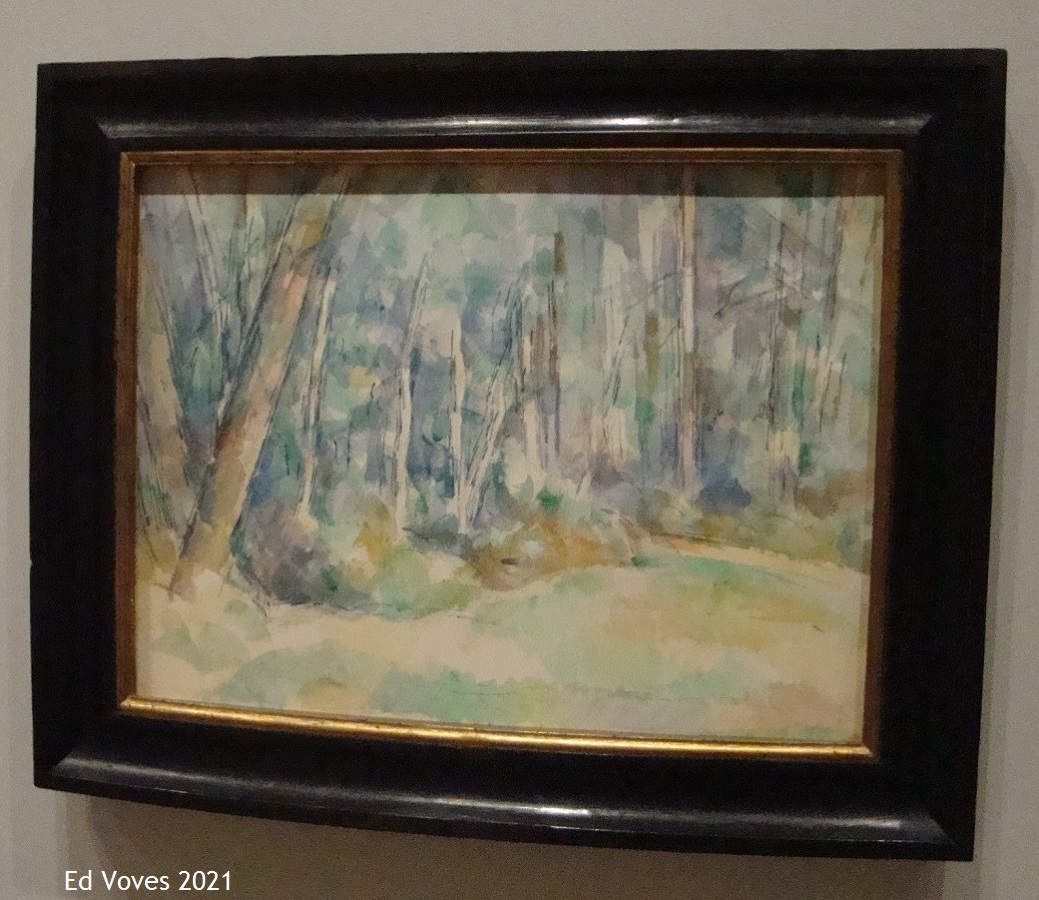
Ed Voves, Photo (2021) Paul Cézanne's Forest Landscape, 1904-1906

And then there were the trees, majestic groves, studies of roots and branches, masses of leaves. The MOMA wall text notes a contemporary comment which stated that Cézanne "had no real friends except for trees."

Remarks like this fueled the legend of Cézanne the irascible, artist/hermit who had fled the Paris art scene to commune with nature. Cézanne certainly preferred his own company while engaged in art. But it is safer to say that when Cézanne took his backpack of easel, canvas, sketchbook, tubes of paint, pencils and brushes and trudged up toward Mont Sainte-Victoire, he was not trying to escape from the world. Rather, he sought to embrace it with his art.

***

Text: Copyright of Ed Voves, all rights reserved. Cézanne Drawing exhibition images courtesy of the Museum of Modern Art , New York City

Introductory Image: Paul Cézanne (French, 1839-1906)  Foliage, 1900–04. Watercolor and pencil on wove paper, 17 5/8 × 22 3/8″ (44.8 × 56.8 cm). The Museum of Modern Art, New York. Lillie P. Bliss Collection. Photo © 2021 MOMA, NY

Ed Voves, Photo (2021) Paul Cézanne's Self-Portrait and Apple, 1880-1884. Pencil on paper: 6 13/16 × 9 1/16" (17.3 × 23 cm) Cincinnati Art Museum.

Ed Voves, Photo (2021) Gallery view of the Cézanne Drawing exhibition at the Museum of Modern Art, New York. 

Paul Cézanne (French, 1839-1906) Mercury after Pigalle. c. 1890. Pencil on paper, 15 x 11″ (38.1 x 27.9 cm). The Museum of Modern Art. The Joan and Lester Avnet Fund © 2021 The Museum of Modern Art, Imaging and Visual Resources, photo Peter Butler

Paul Cézanne (French, 1839-1906) Studies of Three Figures, Including a Self-portrait, c. 1876, 1883, 1885 Pencil on laid paper: 19 1/8 × 12 5/8" (48.5 × 32 cm) Museum Boijmans Van Beuningen, Rotterdam. 

Ed Voves, Photo (2021) Gallery view of Cézanne Drawing at MOMA, showing two self-portraits.

Paul Cézanne (French, 1839-1906) Studies and Portraits of the Artist's son (recto); Studies, Including a Head and a Small Casserole (verso), 1877-1878 (recto); c. 1878 (verso). Pencil on paper: 9 3/4 × 12 1/8" (24.8 × 30.8 cm) Albertina, Vienna

Ed Voves, Photo (2021) Gallery view of the Cézanne Drawing exhibition, showing a Study Sheet by Paul Cézanne, including a portrait of Francisco Goya (recto), 1877-1880. Pencil on paper: 19 11/16 × 11 13/16" (50 × 30 cm) From a private collection, NY.

Ed Voves, Photo (2021) Detail of Cézanne's drawing, Paul Cézanne Fils as a Harlequin, Studies for Mardi Gras, c. 1888. Pencil on paper: 7 15/16 × 10 11/16" (20.1 × 27.2 cm) Kunstmuseum Basel

Ed Voves, Photo (2021) Gallery view of the Cézanne Drawing exhibition, showing a Cézanne's Glass and Apples, Oil on canvas: 12 3/8 × 15 3/4" inches. Collection Rudolf Staechelin, Basel, and Cézanne's Still Life with Apples, c. 1878. Oil on canvas: 7 1/2 × 10 1/2" (19 × 26.7 cm) Fitzwilliam Museum, Cambridge, UK. 

Paul Cézanne (French, 1839-1906) Still Life with Blue Pot, 1900-1906. Pencil and watercolor on paper: 18 15/16 × 24 7/8" (48.1 × 63.2 cm). The J. Paul Getty Museum, Los Angeles.

Paul Cézanne (French, 1839-1906) Hortense Fiquet (Madame Cézanne) Sewing, c. 1880. Pencil on laid paper: 18 9/16 × 12 3/16" (47.2 × 30.9 cm) The Samuel Courtauld Trust, The Courtauld Gallery, London. Princes Gate Bequest

Paul Cézanne (French, 1839-1906) Vase of Flowers (recto), c. 1885-88; Study of Trees (Clairière) (verso), 1887-90.  Pencil and watercolor on paper: 18 3/8 × 11 13/16" (46.6 × 30 cm) Fitzwilliam Museum, Cambridge, UK. Bequest of Captain Stanley W. Sykes.

Ed Voves, Photo (2021) Gallery view of the Cézanne Drawing exhibition, showing Cézanne's Study of Trees (Clairière) c. 1885-88.

Paul Cézanne (French, 1839-1906) Rocks Near the Château Noir, 1895-1900. Watercolor on paper. 18 3/16 × 11 15/16″ (46.2 × 30.3 cm). Private collection

Paul Cézanne (French, 1839-1906) Mont Sainte-Victoire, 1902–06. Watercolor and pencil on wove paper: 16 3/4 x 21 3/8″ (42.5 x 54.2 cm). The Museum of Modern Art, New York. Gift of Mr. and Mrs. David Rockefeller. Photo © 2021 MoMA, NY

Ed Voves, Photo (2021) Paul Cézanne's Forest Landscape, 1904-1906. Pencil and watercolor on paper: 18 5/8 × 23 5/8 inches. Private collection