Showing posts with label Outsider Art. Show all posts

Saturday, June 17, 2023

Art Eyewitness Essay: Meditations on Death and Mortality in the Of God and Country Exhibition, Philadelphia Museum of Art


Art Eyewitness Essay:
 Meditations on Death and Mortality
in the Of God and Country Exhibition 


Philadelphia Museum of Art
 May 19, 2023 - January 1, 2024

Reviewed by Ed Voves  

Original Photography by Anne Lloyd

When the Saints Go Marching In is one of the most famous and popular of African-American Spirituals. It has been so widely embraced as a standard of the jazz repertoire, a favorite of pop and rock n' roll singers and even as a chant at British rugby football games that the religious nature of “The Saints” can easily be forgotten.

A key work of art in an exhibition currently at the Philadelphia Museum of Art addresses the heavenly focus of “The Saints”. It also treats the very special earthly locale where this immortal song originated – New Orleans.


Anne Lloyd, Photo (2023)
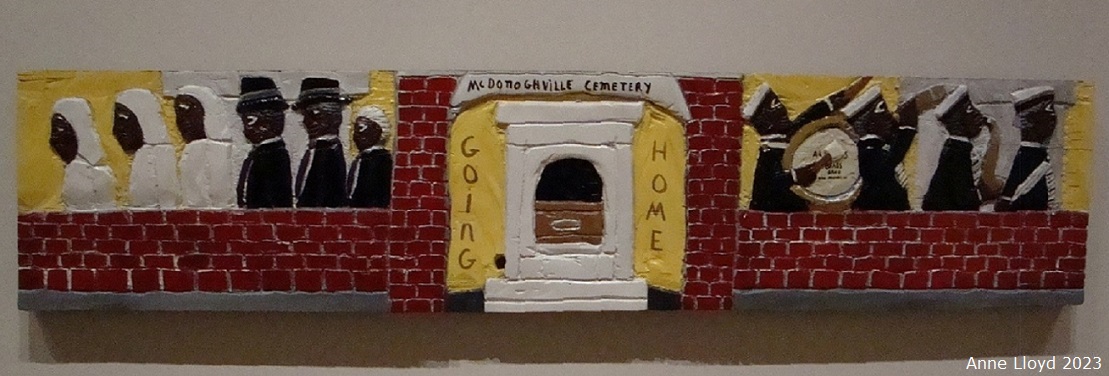
 Herbert Singleton's Going Home: McDonoghville Cemetery. 

The carved wood relief, sculpted by Herbert Singleton, depicts a funeral procession, making its way through the Algiers neighborhood of New Orleans. Members of an African-American church and an accompanying brass band escort one of their congregation on the journey to immortal life.


Anne Lloyd, Photo (2023)
  Going Home: McDonoghville Cemetery (Details)

Going Home: McDonoghville Cemetery is featured in the fourth and last gallery of the Of God and Country exhibition. This exhibit presents works of Outsider Art from the collection of two Philadelphia patrons of the arts, Jill and Sheldon Bonovitz. I commented upon the first three galleries of Of God and Country in an earlier review. But – as I discussed there – I felt that the weighty subject matter of the concluding gallery deserved detailed study and reflection.

The final gallery, fittingly enough, is all about Death and Mortality.

As I mentioned in the earlier review, many of the artists whose works appear in Of God and Country were devout Christians. Many had difficult and stressful lives. Herbert Singleton (1945-2007) spent thirteen years in the Louisiana State Penitentiary on a drug charge. He was also the victim of a vicious beating by police officers. For people living lives of adversity and privation, death is often a release, an act of spiritual liberation. That is the sentiment evoked by When the Saints Go Marching In and in Singleton's Going Home.

Oh, when the trumpet sounds its call

Oh, when the trumpet sounds its call

Oh Lord I want to be in that number

When the saints go marching in.

Death wears many masks, however, and touches the emotions of people in very different ways. If this final gallery in Of God and Country has a unifying theme it is, ironically, the  bewildering diversity of interpretations which artists devote to the subject of death.


Anne Lloyd, Photo (2023)
  Purvis Young's Funeral and Horses, late 20th century

The art works on view in the Death and Mortality gallery are certainly an eclectic mix, with memorable creations by Jon Serl, Eugene von Brueuchenhein and Howard Finster. Purvis Young's Funeral and Horses provides a somber contrast to Singleton's Going Home.

Anne Lloyd, Photo (2023)
  Leroy Almon's Life, 1990 

Leroy Almon's ironically titled Life updates the Vanitas tradition of classic art with macabre, Outsider immediacy. A small mirror is positioned for the viewer, just below the “Skull and Cosmetics” motif. 

The transition from the art works in the earlier galleries to these dealing with death is generally smooth and effective. This is especially true for the works of Christian art which are displayed just before one enters the Death and Mortality gallery. There is – or seems to be – one exception.

Simon Sparrow's mosaic, Assemblage with Faces, is a real “show-stopper”. The enigmatic faces which emerge from among the swirls of glitter and Star Wars figurines grab on to one's imagination. This is a tremendous work of art and it is hard to pull yourself away from it. 


Ed Voves, Photo (2023)
Gallery view of the Of God and Country exhibition, 
showing Simon Sparrow's Assemblage with Faces

So far, I have made three visits to the Of God and Country exhibition. Each time, visitors are congregated before Sparrow's sensational mosaic. By contrast, the Death and Mortality gallery appears to be generating less interest. While I was there, a number of visitors took a brief “look-see” before making quick departures. At several points, the gallery was empty, except for me.


Ed Voves, Photo (2023)
Detail of Simon Sparrow's Assemblage with Faces

I may be reading too much into this situation, but I wonder if the placement of Assemblage with Faces makes it difficult for visitors to properly appreciate the art works in the following gallery. Or might the subject of death be too emotionally charged in the aftermath of Covid-19?

Whatever the answers to these questions, there is plenty to reward a lengthy visit to the Death and Mortality gallery.

Howard Finster (1916-2001) created some of the most vivid images to appear in the Of God and Country exhibition, including its final gallery. A Baptist minister in the American South, Finster said that he had a vision from God bidding him to paint sacred art. Finster obeyed the divine summons, though many of his thousands of paintings strain the boundaries of traditional religion and art to the breaking point.


Anne Lloyd, Photo (2023) 
Howard Finster's People and Time Come Together..., #16,977

Finster's dinosaur in People and Time Come Together . . . , #16,977, created in 1990, is unlike any creature which ever roamed the earth, despite a superficial resemblance to a T-Rex. The giant reptile is covered with scales, each bearing a human face. Around it are positioned signs with warnings of impending doom. Although Finster was sometimes challenged in the presentation of the full text of his dire messages, his earnest concern for the future welfare of humanity is undeniable.


Ed Voves, Photo (2023) 
Howard Finster's People and Time Come Together... (Detail)

Along with painting apocalyptic dinosaurs, Finster carved and painted this elaborate clock frame, commenting on the passage of time.


Ed Voves, Photo (2023) 
Howard Finster's Your the Clock That Counts My Time Away, 1990

Even more mind-boggling is a shadow box filled with angelic figures and ghostly faces – and more messages. This amazing piece was created in 1982 and is entitled Heaven is Worth It All, #2,798. It invites comparison to Simon Sparrow's Assemblage with Faces, no small achievement.


Anne Lloyd, Photo (2023) 
Howard Finster's Heaven is Worth It All, #2798, 1982

There is usually enough practical wisdom in Finster's works to balance the evangelical fervor of his preaching. But with the paintings by Jon Serl, which share space with Finster in the final gallery, there is an ethereal quality which often transcends rational explanation.

“You don't see my paintings,” Serl once said, “you feel them.”

Jon Serl (1894-1993) brought a tremendous sum of life experience to his paintings. He was born in Olean, New York, to a theatrical family. He was active in the Vaudeville circuit, at one point working as a female impersonator known as “Slats”. Later, in Hollywood, he provided voiceover for silent film stars challenged by the “talkies”. During the Depression years, he made a living as a migrant fruit picker.

Serl's employment resume, however, does not explain his wonderfully strange images. If he had visions, like Finster, he did not dwell on the experience. Serl started painting late in life and painted what he felt. Some critics have categorized his work as “expressionist” but it would take a great deal of effort to fit Serl into any “school” of art except his own.


Anne Lloyd, Photo (2023) 
Jon Serl's Between Two Worlds, late 20th century 

Otherworldly entities, birdlike creatures and haunted individuals populate Serl's paintings. Between Two Worlds shows what appears to be funeral home viewing for a man lying prone, the top of his coffin pushed back to allow a gathering of ethereal mourners to pay their respects.

Between Two Worlds is not going to allow its audience to walk away with just one explanation, however. 


Anne Lloyd, Photo (2023) 
Jon Serl's Between Two Worlds (Detail) 

Take a second look. We see a ghostly-being clutching the edge of the scene as if it were a painted canvas or a movie screen being rolled back. Another “ghost” peers over the top of the scene. We are left wondering if the funeral viewing is taking place or is just a simulation, a real vision or clever fake like a theatrical backdrop.

Is life, indeed, but a stage and when the show is over, it's over? Or is there an other, more mysterious, reality to come in the next act?

The final gallery of Of God and Country raises serious questions like this. And the incredible artists whose work we see on view attempted to come to terms with death and mortality from their own, unique perspectives.

Herbert Singleton's Going Home: McDonoghville Cemetery shows the prosaic, real world appreciation of death. A Christian congregation in New Orleans bids an extravagant farewell to one of their number, after which they will get on with their lives.


Anne Lloyd, Photo (2023) 
Howard Finster's People and Time Come Together... (Detail)

Howard Finster was  quite emphatic, “The World faces the cross roads of Time. We are now at our last chance... it is now time for a Worlds change or the end of the World."

Joh Serl presents - or seems to – the point of crossing over, from this world to the next, but leaves it to us to decide how valid his images are.

None of this may mean a great deal, if we view life and death in Cosmic terms. Is our brief existence in a universe of planetary systems, of stars going supernova, all there is? Such is the realm evoked by Eugene Von Bruenchenhein's The Grand Mass of Titanium—Voyages Through Space—No. 815 (1959).
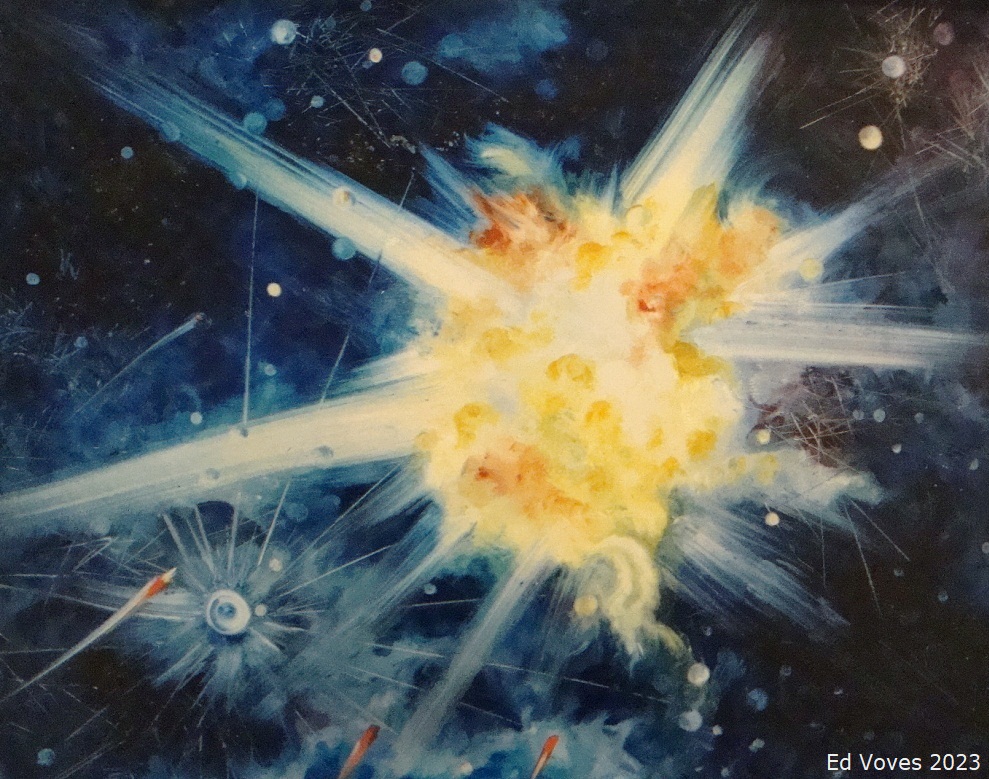

Ed Voves, Photo (2023)
Eugne Von Bruenchenhein's The Grand Mass of Titanium (detail)

Cosmology, however, is cold comfort to most people when they finally come face-to-face with Father Time.


Anne Lloyd, Photo (2023)
Elijah Pierce's Father Time (detail), 20th century

If we, as human beings, live with our heads in the clouds, our feet always remain on the ground. Every step we take is ultimately directed toward that point when each one of us must confront and make peace with our mortality.

Such reflections come naturally after spending some time in this extraordinary exhibition gallery. A debt of gratitude needs to be accorded to Jill and Sheldon Bonovitz and the curators of the Philadelphia Museum of Art. They have shared with us provocative works of art on a subject which none of us can ignore, however much we try.

***

Text: Copyright of Ed Voves, all rights reserved

Original photography, copyright of Anne Lloyd and Ed Voves, all rights reserved.

Introductory Image: Ed Voves, Photo (2023) Gallery view of the Of God and Country exhibtion at the Philadelphia Museum of Art, showing Howard Finster's People and Time Come Together . . . , #16,977. The Jill and Sheldon Bonovitz Collection.

Anne Lloyd, Photo (2023) Herbert Singleton's Going Home: McDonoghville Cemetery. Date Unknown. Alkyd industrial paint, including metalic paint, on carved red cedar with yellow pine battens: 12 3/4 by 60 inches (32.4 x 152.4 cm) The Jill and Sheldon Bonovitz Collection, Promised Gift to the Philadelphia Museum of Art.

Anne Lloyd, Photo (2023) Purvis Young's Funeral and Horses, late 20th century. Paint on wood construction, record sleeve displays.

Anne Lloyd, Photo (2023) Leroy Almon's Life, 1990. Paint and mirror on carved wood. The Jill and Sheldon Bonovitz Collection. 

Ed Voves, Photo (2023) Gallery view of the Of God and Country exhibtion, showing Simon Sparrow's Assemblage with Faces, date unknown. The Jill and Sheldon Bonovitz Collection.

Ed Voves, Photo (2023) Simon Sparrow's Assemblage with Faces (detail), date unknown. Glitter, paint, and other found objects on wood; artist-made painted wood frame: 56 1/2 inches × 8 feet 11 inches × 3 1/2 inches (143.5 × 271.8 × 8.9 cm. The Jill and Sheldon Bonovitz Collection.

Anne Lloyd, Photo (2023) Howard Finster's People and Time Come Together..., #16,977, 1990. Paint on wood cutout: artist-made frame of Douglas fir branded with artist-made metal stamps: Framed: 15 1/4 x 15 inches (38.7 x 38.1 cm) The Jill and Sheldon Bonovitz Collection.

Anne Lloyd, Photo (2023) Howard Finster's Your the Clock That Counts My Time Away, #16,294, 1990. Carved, stained, and burned wood; paint and Sharpie permanent marker on board; General Electric clock. Collection of Jill and Sheldon Bonovitz.

Anne Lloyd, Photo (2023) Howard Finster's Heaven is Worth It All, #2,798, 1982. Shadowbox construction of wood with acrylic sheet front, painted inside and out; artificial flowers; metal chains; cut sheet-metal figures: 28 x 19 1/2 x 3 3/4 inches (71.1 x 49.5 x 9.5 inches) Collection of Jill and Sheldon Bonovitz, Promised Gift to the Philadelphia Museum of Art.

Anne Lloyd, Photo (2023) Jon Serl's Between Two Worlds, late 20th century. Oil on board, artist-made frame: 24.25 x 26.25 inches. Collection of Jill and Sheldon Bonovitz.

Ed Voves, Photo (2023) Eugene Von Bruenchenhein's The Grand Mass of Titanium—Voyages Through Space—No. 815, (detail) 1959. Oil on Masonite: 24 x 24 inches. Collection of Jill and Sheldon Bonovitz.

Anne Lloyd, Photo (2023) Elijah Pierce's Father Time (detail), 20th century. Paint, glitter, and varnish on carved white pine with corrugated cardboard background: 18.5 x 12 inches. Collection of Jill and Sheldon Bonovitz, Promised Gift to the Philadelphia Museum of Art.


Saturday, May 27, 2023

Art Eyewitness Review: Of God and Country: American Art from the Jill & Sheldon Bonovitz Collection, Philadelphia Museum of Art

Of God and Country:

 American Art from the Jill & Sheldon Bonovitz Collection

Philadelphia Museum of Art
May 19, 2023 - January 1, 2024


Reviewed by Ed Voves 
Original Photography by Anne Lloyd 

Some special exhibitions stay in the mind long after the art works are taken down from the gallery walls. It may be the oeuvre of a particular artist, an especially accomplished display of curatorial talent or the unusual subject of the art works in the exhibition which make for an unforgettable show.

“Great and Mighty Things”: Outsider Art from the Jill and Sheldon Bonovitz Collection was definitely an exhibition which met the criteria of “all of the above.” And so does its sequel, Of God and Country: American Art from the Jill and Sheldon Bonovitz Collection.

“Great and Mighty Things” was presented in the spring of 2013. It was my first real exposure to “outsider” art. Self-taught artists like Bill Traylor (1854-1949), Elijah Pierce (1892-1984), William L. Hawkins (1895-1990) and many others in the exhibit were unfamiliar names. Their paintings and sculptures were radical departures from what I normally beheld on museum walls.


Anne Lloyd, Photo (2023)
 William L. Hawkin's Boffo, 20th century

Ten years have gone by and these “Outsiders” are back at the Philadelphia Museum of Art. Like the art works on view in the earlier show, all of the paintings and sculptures in Of God and Country come from the collection of a dynamic duo, Jill and Sheldon Bonovitz. Their perceptive eye for great folk art is matched by their magnanimous generosity. The Bonovitz collection is a promised gift to the Philadelphia Museum of Art.


Anne Lloyd, Photo (2023) 
Sheldon and Jill Bonovitz at the Of God and Country exhibit.

The new exhibition, Of God and Country, takes its name from the deeply-held religious sentiments and personal convictions of these “outsider” artists.

When considered in conjunction with notable events in twentieth century U.S. history, the art works on view in Of God and Country share in the idealism and civic spirit which motivated the Civil Rights movement and efforts to preserve the natural environment of our nation.

Use of the term “outsider art” to describe the work of artists lacking formal training is a matter of some controversy. Outsider Art appeared as the title of a 1972 book by a British scholar, Roger Cardinal, and was embraced by the art community in the English-speaking world.

Personally, I think “inspired art” is far more accurate than “outsider.” Not only were many of these artists devout members of Christian congregations, but several of the leading figures testified that actual religious visions motivated them to create their amazing - and occasionally alarming - art.


Anne Lloyd, Photo (2023)
 Howard Finster’s Angel, #3,236, 1984

Howard Finster (1916-2001) claimed that at age 60, God's message appeared to him on a paint smudge on his finger and commanded him to make “sacred art.” Finster, who had been a preacher at religious revivals since his teens, heeded the divine calling, as we will examine in some detail later in this review.


                                       Anne Lloyd, Photo (2023)                                                             Gallery view of the Of God and Country exhibit,                        showing three of Felipe Archuleta’s carved animals.

Felipe Archuleta (1910-1991) is on record on how he came to sculpt his incredible animal statues, stating that “I asked God for some kind of miracle, some kind of thing to do, to give me something to make my life with. I started carving and they just came out of my mind after that.”

The most succinct statement on “outsider” inspiration – and one of the great quotes in American art history – is Bill Traylor's terse, ironic remark on the origin of his impulse to create art: “It just come to me.”

Of God and Country's inspired art is organized in four thematic sections: U.S. History & Life in America, The American Landscape, Christianity and Spirituality and Death and Mortality. All of the artists brought unique viewpoints to these topics, as might be expected. But many, indeed most, of their works are very subtle, open to different interpretations.


Anne Lloyd, Photo (2023) 
Bill Traylor's House with Two Men, a Turkey, and a Dog, c. 1939-42

One of Bill Traylor's signature, silhouetted drawings is a good example of the challenges posed to quick and easy interpretation. The drawing is entitled House with Two Men, a Turkey, and a Dog, c. 1939-42. We see a top-hatted man climbing-up on a roof top to snatch a large bird, while another fellow, protected by a ferocious guard dog, appears to have passed-out, the victim of one drink too many.


Anne Lloyd, Photo (2023) 
Bill Traylor's House with Two Men, a Turkey, and a Dog (Detail)

That is a conventional explanation for this cryptic scene. However birds frequently figure in Traylor's drawings. These birds are depicted in a generalized, schematic fashion, as with this supposed “turkey.” Art scholars have speculated that Traylor's avian imagery may reflect the folk memory of a sacred bird, the Sankofa from Ghana.

The African-American community preserved much of the heritage of their ancestral cultures during the long years of slavery, so this may well be the case for Traylor's drawing. Whether this intriguing drawing evokes a memory of a specific incident from Traylor's early life or an mythic image from Africa is only one of the many, many fascinating questions posed by works of art in the Bonovitz collection.


Anne Lloyd, Photo (2023) 
Gallery view of the Of God and Country exhibition, showing William L. Hawkin's American Flag with Cone-Shaped Fireworks

Of God and Country opens with an appealing and easy-to-appreciate icon. The carved and painted American Flag with Cone-shaped Fireworks by William L. Hawkins recalls the Rogers and Hammerstein lyrics from South Pacific: High as a flag on the Fourth of July! But most of the works of art which follow are less straightforward. Of God and Country has a lot of gray area, mixed in with the red, white and blue.

Consider Uncle Sam by Leroy Almon (1938-1997). Is Uncle Sam a star-spangled superhero, returning to Capital Hill to rid the halls of Congress of corrupt politicians? Or has he become a demonic figure, his hands choking the American Eagle and crushing the symbolic arrows it normally holds in its talons?


Anne Lloyd, Photo (2023) 
Leroy Almon’s Uncle Sam, late 20th century

Whatever is going on in this brilliant, disturbing work, it was surely based on deep thinking in the mind of its creator. Almon, who trained as a wood carver with Elijah Pierce, often addressed the theme of good and evil in his work. As we see here, the issue was often left very much in doubt.

Another talented African-America artist, Josephus Farmer, created two narrative scenes dealing with the experience of slavery in the American South. Both focus on the role of Eli Whitney, whose 1793 invention of the cotton gin led to the extension of African-American slavery at a time when many thought or hoped it was on the decline. Whitney, a New Englander, was also a central figure in the development of heavy industry which was a key factor in the Union war effort which ultimately triumphed over the Cotton Kingdom of the South.


Anne Lloyd, Photo (2023) 
Josephus Farmer 's Eli Whitney Nemesis of the South, c. 1985

Josephus Farmer describes Whitney as the “Nemesis of the South.” Did this reference allude to Whitney's unintended role in spreading slavery or in laying the foundation for the Northern military machine? Either answer is valid but the decision is ours to make.


Anne Lloyd, Photo (2023) Elijah Pierce's Love (Martin Luther King, Jr.)

We are - seemingly - on much firmer ground in judging works dealing with themes related to Christianity. Many of these are portraits of heroic figures, exemplified by Elijah Pierce's iconic Love (Martin Luther King, Jr. or based on readings from the Holy Bible. 

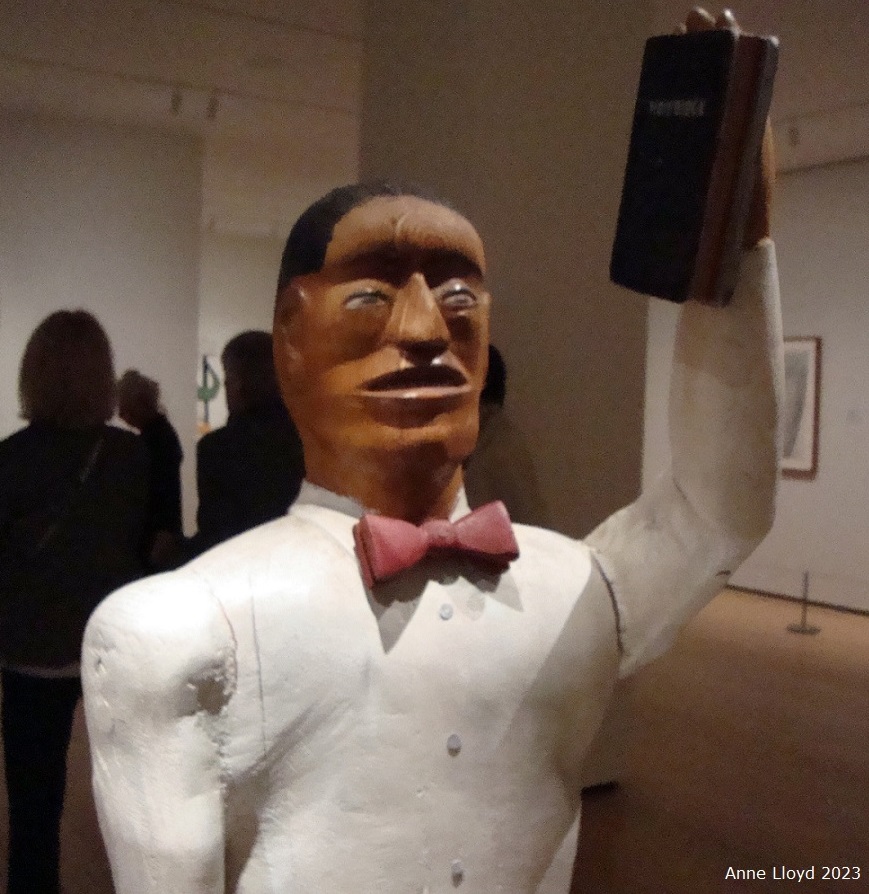
The gallery devoted to religious art is dominated by works of art by two other artists: the nearly life-sized  Preacher and his Wife, carved by S.L. Jones, and Simon Sparrow's Assemblage with Faces. Both are sensational works and, though sharply different in technique, these two masterpieces work together to anchor the entire exhibition. 

Both S.L. Jones and Simon Sparrow were men of deep religious faith, tempered by lives of poverty and toil. Their contrasting approaches to art embody the two essential aspects of religion: the practice of lives of devotion by members of a faith community and the mystical, contemplative experience of God by individual believers. 


Anne Lloyd, Photo (2023) 
Gallery view of the Of God and Country exhibition,
 showing S.L. Jones’ Preacher and His Wife, date unknown

Jones, a sharecropper's son from West Virginia, worked long years for the Chesepeake and Ohio Railroad.  A devoted member of the Primitive Baptist Church, he started carving religious figures to ease the pain in his heart, following the death of his wife. According to the beliefs of the Primitive Baptists, every man and woman can be called to preach the Gospel. There is no need for an ordained clergy as in other denominations.


Anne Lloyd, Photo (2023)
Details of S.L. Jones' Preacher and His Wife


Jones did not aim to carve portraits of specific individuals but rather to evoke the expression of faith on the features of two Christian believers. Their faces radiate the inner light of grace, as they proclaim the word of God. Jones' Preacher and Wife is a brilliant illustration of communal worship, of the famous quote from the Gospel of St. Matthew.

For where there are two or three gathered together in my name, there am I in the midst of them. (Matthew, 18:20)

For Simon Sparrow (1925-2000), the "variety" of religious experience devolved to a personal relationship with God. Sparrow had an amazing life-story. His father was a member of the Yoruba community from West Africa, his mother a Native-American. Details of his childhood are few and conflicting. Sparrow may have been born in Africa, but at some point his family moved to a Cherokee reservation in North Carolina, where he grew-up.


Anne Lloyd, Photo (2023) 
Gallery view of the Of God and Country exhibition,
 showing Simon Sparrow’s Assemblage with Faces.

The spiritual traditions of his ancestors exercised a powerful influence, but Sparrow's approach to art was so unique that it is best to let him speak for himself. Sparrow said that when he began a work of art, he would allow his mind to go blank and let God take over. The process was "sweeter than anything on earth... I feel like I'm climbing."


                                       Anne Lloyd, Photo (2023)                                            Simon Sparrow’s Assemblage with Faces. (Detail), date unknow.

Before letting his mind ascend the "stairway to heaven", Sparrow collected a vast store of found objects, trinkets, shells, small toys and glitter... lot's of glitter. These, Sparrow would place at the service of his God-directed creative power. 

The resulting works are depictions of the numinous, the emergence of the divine presence into the prosaic reality of human life. Sparrow's "assemblages" are as close as an artist can go, I believe, to showing what it would be like to open one's eyes and glimpse heaven. 


                                      Anne Lloyd, Photo (2023)                                       Simon Sparrow’s Assemblage with Faces. (Detail)

Faces and patterns materialize on the mosaic-like surface of Sparrow's art works, seemingly from nowhere. These leave an indelible imprint on the mind of the beholder. But trying to grasp and understand these images is almost impossible, except perhaps by an act of faith. To see, as Simon Sparrow did, one needs to believe.

The final gallery of Of God and Country is, in some ways, the most affecting and perplexing.

To do justice to the treatment of Death and Mortality really requires an additional review. This will appear shortly in Art Eyewitness.


Anne Lloyd, Photo (2023)
 Herbert Singleton's Going Home: McDonogh Cemetery. Date unknown

No one returns from the "undiscovered country" as Hamlet said so memorably. But judging from the extraordinary works of art in Of God and Country, I would not be surprised if some of the visionary artists in the exhibition had a few sneak previews. 

***

Text, copyright of Ed Voves. Original photography, copyright of Anne Lloyd.

Introductory Image: Anne Lloyd, Photo (2023) William L. Hawkin's American Flag with Cone-Shaped Fireworks ( Detail), 1983. Paint on plywood: 48 x 57 inches (121.9 x 144.8 cm) Collection of Jill and Sheldon Bonovitz, Promised Gift to the Philadelphia Museum of Art.

Anne Lloyd, Photo (2023) William L. Hawkin's Boffo, 20th century. Alkyd house paint on Masonite, fiberboard, alkyd paint mixed with broken starch chunks (possibly dried glue): 44 1/2 x 51 1/2 inches (113 x 130.8 cm) Collection of Jill and Sheldon Bonovitz, Promised Gift to the Philadelphia Museum of Art.

Anne Lloyd, Photo (2023) Sheldon and Jill Bonovitz at the Philadelphia Museum of Art's Of God and Country exhibition.

Anne Lloyd, Photo (2023) Howard Finster’s Angel, #3,236, 1984. Paint on wood cutout: Collection of Jill and Sheldon Bonovitz. 

Anne Lloyd, Photo (2023) Gallery view of the Philadelphia Museum of Art's Of God and Country exhibition, showing three of Felipe Archuleta’s carved animals, Donkey (1981), Spotted Boar (1981) and Mule (1975). Cottonwood, paint, sisal, sawdust, glue. Collection of Jill and Sheldon Bonovitz, Promised Gift to the Philadelphia Museum of Art. 

Anne Lloyd, Photo (2023) Bill Traylor's House with Two Men, a Turkey, and a Dog, c. 1939-42. Graphite on thin cream card; punched for hanging:Sheet: 22 × 14 1/2 inches (55.9 × 36.8 cm). Collection of Jill and Sheldon Bonovitz, Promised Gift to the Philadelphia Museum of Art. 

Anne Lloyd, Photo (2023) Gallery view of the Philadelphia Museum of Art's Of God and Country exhibition, showing William L. Hawkin's American Flag with Cone-Shaped Fireworks. 

Anne Lloyd, Photo (2023) Leroy Almon’s Uncle Sam, late 20th century. Paint on carved wood. Collection of Jill and Sheldon Bonovitz.

Anne Lloyd, Photo (2023) Josephus Farmer 's Eli Whitney Nemesis of the South, c. 1985. Paint and ink on carved wood. The Jill and Sheldon Bonovitz Collection. 

Anne Lloyd, Photo (2023) Elijah Pierce's Love (Martin Luther King, Jr.). Paint, glitter, and local applications of varnish on carved wood; artist-made frame: 19 x 16 inches (48.3 x 40.6 cm) Collection of Jill and Sheldon Bonovitz, Promised Gift to the Philadelphia Museum of Art. 

Anne Lloyd, Photo (2023) Howard Finster's The Big Push, #1,765, 1980. Paint on plywood; artist-made frame of Douglas fir branded with artist-made metal stamps: Framed: 15 1/4 x 15 inches (38.7 x 38.1 cm) The Jill and Sheldon Bonovitz Collection. 

Anne Lloyd, Photo (2023) Gallery view of the Philadelphia Museum of Art's Of God and Country exhibition, showing S.L. Jones’ Preacher and His Wife. 

Anne Lloyd, Photo (2023) S.L. Jones’ Preacher and His Wife (Detail), date unknown. Paint on wood with nails; leather belt: Preacher (a): 62 1/2 x 19 x 14 inches (158.8 x 48.3 x 35.6 cm) Wife (b): 54 x 15 x 18 inches (137.2 x 38.1 x 45.7 cm) The Jill and Sheldon Bonovitz Collection. 

Anne Lloyd, Photo (2023) Gallery view of the Philadelphia Museum of Art's Of God and Country exhibition, showing Simon Sparrow’s Assemblage with Faces. 

Anne Lloyd, Photo (2023) Simon Sparrow’s Assemblage with Faces. (Detail), date unknown. Glitter, paint, and other found objects on wood; artist-made painted wood frame: 56 1/2 inches × 8 feet 11 inches × 3 1/2 inches (143.5 × 271.8 × 8.9 cm. Collection of Jill and Sheldon Bonovitz, Promised Gift to the Philadelphia Museum of Art. 

Anne Lloyd, Photo (2023) Herbert Singleton's Going Home: McDonogh Cemetery. Date unknown. Alkyd industrial paint, including metallic paint, on carved red cedar with yellow pine battens: 12 3/4 x 60 inches (32.4 x 152.4 cm) Collection of Jill and Sheldon Bonovitz.