Showing posts with label Folk Art. Show all posts

Sunday, November 30, 2025

Art Eyewitness Review: Henri Rousseau Exhibit at the Barnes Foundation


Henri Rousseau: a Painter's Secrets

The Barnes Foundation, Philadelphia 

October 19, 2025 – Feb. 22, 2026  

Reviewed by Ed Voves

Original Photography by Anne Lloyd

It has taken three visits to the outstanding exhibition on Henri Rousseau, at the Barnes Foundation, to get my thoughts in order about this enigmatic French painter. I particularly wanted to see if Rousseau could be included in one of the classifications created for visionary artists of his temperament.

Was Rousseau a Symbolist? Was he a Surrealist before the fact, as Andre Breton later stated? Could he be considered as a Magical Realist, a category established decades after his death?

None of the above, from what I can gather.

The Barnes Foundation exhibition, organized in collaboration with the Musée de l’Orangerie, Paris, presents sixty works by Henri Rousseau. Many are powerful, occasionally disturbing paintings, dreamlike in some instances, nightmarish in others. 


Anne Lloyd, Photo (2025)
Henri Rousseau's Carnival Evening, 1886

Several of these complex, hard-to-fathom works were created early in Rousseau's career. One of these is Carnival Evening, painted in 1886. Given its sophistication, Carnival Evening makes establishing a timeline of Rousseau's creative development difficult to construct.

Quite a number of the other works on view in the Barnes exhibition are small format paintings, generally banal and lacking the air of mystery which makes Rousseau's major works so remarkable. Individually, some of these genre scenes, still life paintings and family portraits have a measure of charm. 


Anne Lloyd, Photo (2025)
Henri Rousseau's View of Clichy Bridge at Asnieres, c. 1900-02


Anne Lloyd, Photo (2025)
Henri Rousseau's Pere Junier's Cart (detail),1908

When viewed as a group, however, their ability to hold our interest, even as "naive" works of art, soon dissipates.


Anne Lloyd, Photo (2025)
 Gallery view of Henri Rousseau: a Painter's Secrets, showing small-scale landscapes which Rousseau painted for working-class patrons.

Rousseau's lesser works are not inept, as many people viewed them at the time. Rather, they are mediocre by design. Rousseau "tossed-off" such paintings to make a quick sale in order to pay the rent and have a few francs left over for dinner. 

This was exactly the life-style of the impoverished Rousseau, whose personal life was blighted by tragedy, as well. Rousseau struggled during the whole span of his artistic career, never achieving an eventual "payday" such as Monet and Renoir enjoyed


Anne Lloyd, Photo (2025)
Two portraits by Henri Rousseau. At left, is Portrait of a Woman, 1895,  later purchased by Picasso. At right, is Portrait of Madame M., c. 1895

Indeed, one of the most striking works on view in the exhibit is a large-scale  portrait which the young Picasso purchased from a Paris art dealer who had marked it down as a canvas to be painted-over. Picasso, who had earlier considered Rousseau as something of a joke, treasured the portrait for the rest of his life.


Anne Lloyd, Photo (2025)
Portrait photo of Henri Rousseau, by Dornac, 1907

Henri Rousseau (1844-1910) was a self-taught artist, driven by a desire to paint and a determination to be taken seriously. In the most famous photo of him, taken in 1907, Rousseau posed in front of one of his signature "jungle" paintings, Scouts Attacked by a Tiger. For the occasion, he wore an over-size beret worthy of a Rembrandt self-portrait and a cravat which might have come from Delacroix's wardrobe. 


Anne Lloyd, Photo (2025)
Henri Rousseau's Scouts Attacked by a Tiger, 1904

Such attempts at self-promotion failed miserably. When Rousseau first exhibited Scouts Attacked by a Tiger in 1904, he was ridiculed in the press. The painting was dismissed as a picture to attract a collector of "horrors" and remained unsold.

At best, Rousseau was classified as a "primitive" painter during his lifetime - when he wasn't being lampooned and derided. 


Anne Lloyd, Photo (2025)
 Gallery view of Henri Rousseau: a Painter's Secrets at the Barnes Foundation. The painting at center is Portrait of Frumence Biche.

If "primitive" is indeed an appropriate term to be used in consideration of Rousseau, then it is largely because he lived near the baseline of poverty and privation. This was especially so during his later years when his modest pension no longer covered expenses. 

Though ambitious for recognition and success, Rousseau approached the subjects of his art with empathy and awareness, born of the threadbare environment around him. 


Anne Lloyd, Photo (2025)
Henri Rousseau's The Rabbit's Meal, 1908

When Rousseau painted the portrait of a rabbit, normally raised by French peasants and townsfolk for the table, there is an evident bond between man and beast. Art scholars contend that the rabbit was likely a pet, rather than tomorrow's dinner. But Rousseau knew what it is like to live on the knife edge of mortality.

As I grappled with comprehending Rousseau's oeuvre, I recalled that he figured prominently in the later chapters of Andre Malraux's The Voices of Silence. So I reached over to my bedside bookshelf in order to consult this greatest of French art writers regarding Henri Rousseau.

Malraux referred to Rousseau as the Douanier, this being the title of Rousseau's civil service position as a customs inspector. Originally a patronizing, even insulting, reference among Rousseau's colleagues and competitors, Douanier eventually became an endearing nickname for him by the time Malraux wrote The Voices of Silence. 

The Douanier, Malraux stated, "seems to derive from nothing." Pondering Rousseau's emergence as an aspiring artist, Malraux contrasted his work with "naive" painting in France of the same period. Malraux notes :

He loves that painting, imitates it, makes it his starting point; then swerves away and, though never quite abandoning it, strikes out in his own direction. While his early works are saturated by its influence, the "Snake Charmer" belongs to another realm of art.


Anne Lloyd, Photo (2025)
Henri Rousseau's The Snake Charmer, 1907

Just where the "realm" of The Snake Charmer fitted into the established art tradition is a matter of speculation. Malraux knew that there were limits even to his astute insights. Instead, he wisely let Rousseau speak for himself.

"People have said," the Douanier wrote in 1910, "that my art does not belong to this age. Surely you will understand that at this stage I cannot change my manner, which is the result of long years of persistent work."    

Work. That is the key to understanding Rousseau. He wanted to be an artist and he worked to become one. Without formal training or family connections in the art world - his father was a tinsmith - Rousseau dedicated himself to "long years of persistent work."     


Anne Lloyd, Photo (2025)
Henri Rousseau's The Wedding, 1905

Hard work and struggle against the odds no doubt explains the appeal of Rousseau to Dr. Albert Barnes. When Dr. Barnes began directly buying works of art for his Foundation in the aftermath of World War I, interest in Rousseau was rising. So were the prices of the deceased artist's paintings. No matter. Barnes purchased eighteen Rousseau masterpieces. It was - and remains - the greatest collection of Rousseau paintings outside of France. 

The eighteen Rousseau paintings amassed by Dr. Barnes provides the foundation of Henri Rousseau: a Painter's Secrets. A similar trove of works of art comes from the collection of the Musée de l’Orangerie. 


Anne Lloyd, Photo (2025) Henri Rousseau's Child with a Doll, c. 1892


Anne Lloyd, Photo (2025) Henri Rousseau's War, 1894

Especially notable among the paintings on loan from the
 Musée de l’Orangerie and the Musée d'Orsay are two utterly dissimilar paintings. That the same artist created the immensely lovable Child with a Doll (c.1892) and the shocking War, painted a mere two years later, is almost impossible to credit.  

It is also difficult to conceive how the curators of Henri Rousseau: a Painter's Secrets could have reconciled the many contradictions and inexplicable elements of Rousseau's life and work. Yet, that is precisely what Nancy Ireson and Christopher Green managed to achieve. 


Anne Lloyd, Photo (2025)
Nancy Ireson and Christopher Green at the press preview for 
Henri Rousseau: a Painter's Secrets at the Barnes Foundation

Both curators bring outstanding credentials to the study of Henri Rousseau. In fact, they worked together on the major Rousseau exhibition, presented twenty years ago, at the Tate Modern Gallery, London. The exhibition later traveled to the Grand Palais, Paris, and the National Gallery, Washington. Green was the curator of this exhibition; Ireson, who was working on her doctoral dissertation on Rousseau, was his chief assistant.


Anne Lloyd, Photo (2025)
 Gallery view of Henri Rousseau: a Painter's Secrets, showing
 Scouts Attacked by a Tiger & Fight between a Tiger and a Buffalo

The title of the 2005-06 exhibition was Jungles in ParisHenri Rousseau: a Painter's Secrets at the Barnes has an entire gallery devoted to Rousseau's lush, imaginary landscapes. It is virtually a complete exhibit, in itself. To do full justice to these extraordinary paintings, I will post a follow-up review in Art Eyewitness in the near future. 

Once a visitor to the Rousseau exhibit at the Barnes enters the show's last gallery. they will understand why I can hardly restrain my enthusiasm.


Anne Lloyd, Photo (2025)
 Gallery view of Henri Rousseau: a Painter's Secrets, showing
The Sleeping Gypsy, Unpleasant Surprise and The Snake Charmer

This final gallery of Henri Rousseau: a Painter's Secrets is - without exaggeration - one of the most effective pictorial displays that I have ever seen. This is not merely a matter of technical use of space and lighting, though both are handled splendidly. Rather, in this small space, Green and Ireson have managed to summon the mental universe of Henri Rousseau to life.  

Presented here are three mighty works, never displayed together, not even in Rousseau's studio during his lifetime, until now: 
  • The Sleeping Gypsy (1897) Museum of Modern Art (NYC)
  • Unpleasant Surprise (1899-1901) Barnes Foundation
  • The Snake Charmer (1907) Musée d'Orsay
Each of these three paintings illustrates vital aspects of how Rousseau conceived of the great questions and challenges of living. But these are enigmatic works. They leave us guessing what Rousseau's own, inner, thoughts were regarding the meaning of life. 


Anne Lloyd, Photo (2025)
Henri Rousseau's The Sleeping Gypsy, 1905 (and detail) 

Does The Sleeping Gypsy depict a moment of mortal peril or is it a dream? Is this a real lion or a Jungian archetype in the unconscious mind of the gypsy?


  Anne Lloyd, Photo (2025)
Henri Rousseau's Unpleasant Surprise, 1899-1901

Was Rousseau attempting to create an Old Master-style narrative scene with Unpleasant Surprise? Or might the many ludicrous aspects of the painting reveal that it was conceived as a mock epic, a sly reworking of the unclad heroine-in-distress motif? 


Anne Lloyd, Photo (2025)
Henri Rousseau's The Snake Charmer (detail)1907

Finally, when we peer into the eyes of The Snake Charmer, do we behold the hypnotic gaze of a sorceress? Or is this the piercing look of one who understands that the "state of nature" is no paradise? To live in freedom is to live with danger, as another Rousseau, Jean Jacques Rousseau, affirmed.


There are likely no definitive answers to these questions. When we take the opportunity to study these paintings in the chapel-like setting of the final gallery of the Barnes exhibit, we do indeed confront what Ireson and Green call the Rousseau enigma.

Into each of these paintings, as the curators note, Rousseau put a special effort. 
"... each of them is on one level up-front in its appeal and on another an impenetrable mystery."


These enigmas are Henri Rousseau's special gift to us. With the extraordinary works of his imagination, Rousseau invites, encourages, almost insists that we make use of our own.

***

Text: Copyright of Ed Voves, all rights reserved.

Original photography, copyright of Anne Lloyd

Introductory image: Anne Lloyd, Photo (2025) Gallery view of Henri Rousseau: a Painter's Secrets at the Barnes Foundation, Philadelphia.

Anne Lloyd, Photo (2025) Henri Rousseau's Carnival Evening, 1886. Oil on canvas: 46 3/16 x 35 1/4 in. (117.3 x 89.5 cm.) Philadelphia Art Museum.

Anne Lloyd, Photo (2025) Henri Rousseau's View of Clichy Bridge at Asnieres, 1900-02. Oil on canvas: 17 5/16 x  15 3/4 in. (44 x 40 cm.) Barnes Foundation.

Anne Lloyd, Photo (2025) Henri Rousseau's Pere Junier's Cart (detail), 1908. Oil on canvas: 38 3/16 x 50 13/16 in. (97 x 129 cm.) Musée de l’Orangerie, Paris.

Anne Lloyd, Photo (2025) Gallery view of Henri Rousseau: a Painter's Secrets at the Barnes Foundation, showing small-scale landscapes which Rousseau painted for working-class patrons.

Anne Lloyd, Photo (2025) Two portraits by Henri Rousseau. At left, is Portrait of a Woman, 1895. Oil on canvas: 63 x 41 5/16 in. (160 x 105 cm.) Musée National Picasso, Paris. At right, is Portrait of Madame M., c. 1895. At right, is Portrait of Madame M., 1895. Oil on canvas: 77 15/16 x 45 1/16 in.(198 x 114.5 cm.) Musée d’Orsay, Paris.

Anne Lloyd, Photo (2025) Portrait photograph of Henri Rousseau, 1907 taken by Dornac (Paul Francois Arnold Cardon) Original photo, Archives Larousse, Paris

Anne Lloyd, Photo (2025) Henri Rousseau's Scouts Attacked by a Tiger, 1904. Oil on canvas: 47 7/8 x 63 3/4 in. (121.6 x 161.9 cm.) Barnes Foundation.

Anne Lloyd, Photo (2025) Gallery view Henri Rousseau: a Painter's Secrets at the Barnes Foundation, showing Rousseau's Portrait of Frumence Biche, 1893.

Anne Lloyd, Photo (2025) Henri Rousseau's The Rabbit's Meal, 1908. Oil on canvas:19 11/16 x 24 1/8 in. (50 x 61.2 cm.) Barnes Foundation.

Anne Lloyd, Photo (2025) Henri Rousseau's The Snake Charmer, 1907. Oil on canvas: 65 3/4 x 74 5/8 in. (167 x 189.5 cm) Musée d’Orsay, Paris.

Anne Lloyd, Photo (2025) Henri Rousseau's The Wedding, 1905. Oil on canvas:    64 3/16 x 44 7/8 in. (163 x 114 cm.) Musée de l’Orangerie, Paris.

Anne Lloyd, Photo (2025) Henri Rousseau's Child with a Doll, c. 1892. Oil on canvas: 26 3/8 x 20 1/2 in. (67 x 52 cm.)  Musée de l’Orangerie, Paris.

Anne Lloyd, Photo (2025) Henri Rousseau's War, c. 1894. Oil on Canvas: 45 1/16 x 76 3/4 in. (114.5 x 195 cm) Musée d’Orsay, Paris

Anne Lloyd, Photo (2025) Nancy Ireson and Christopher Green at the press preview for Henri Rousseau: a Painter's Secrets at the Barnes Foundation, Philadelphia

Anne Lloyd, Photo (2025) Henri Rousseau: a Painter's Secrets, showing Scouts Attacked by a Tiger & Fight between a Tiger and a Buffalo.

Anne Lloyd, Photo (2025) Gallery view of Henri Rousseau: a Painter's Secrets, showing The Sleeping Gypsy, Unpleasant Surprise and The Snake Charmer.

Anne Lloyd, Photo (2025) The Sleeping Gypsy (and detail) ,1897. Oil on canvas: 51 x 79 in. (129.5 x 200.7 cm.) MOMA New York.

Anne Lloyd, Photo (2025) Unpleasant Surprise, 1899-1901. Oil on canvas: 76 9/16 x 51 in. (194.5 x 129.5 cm.) Barnes Foundation.

Anne Lloyd, Photo (2025) The Snake Charmer (detail), 1907. Oil on canvas:  65 3/4 x 74 5/8 in. (167 x 189.5 cm.) Musée d’Orsay, Paris.

Anne Lloyd, Photo (2025) Gallery views of Henri Rousseau: a Painter's Secrets at the Barnes Foundation.


Saturday, May 27, 2023

Art Eyewitness Review: Of God and Country: American Art from the Jill & Sheldon Bonovitz Collection, Philadelphia Museum of Art

Of God and Country:

 American Art from the Jill & Sheldon Bonovitz Collection

Philadelphia Museum of Art
May 19, 2023 - January 1, 2024


Reviewed by Ed Voves 
Original Photography by Anne Lloyd 

Some special exhibitions stay in the mind long after the art works are taken down from the gallery walls. It may be the oeuvre of a particular artist, an especially accomplished display of curatorial talent or the unusual subject of the art works in the exhibition which make for an unforgettable show.

Great and Mighty Things”: Outsider Art from the Jill and Sheldon Bonovitz Collection was definitely an exhibition which met the criteria of “all of the above.” And so does its sequel, Of God and Country: American Art from the Jill and Sheldon Bonovitz Collection.

Great and Mighty Things” was presented in the spring of 2013. It was my first real exposure to “outsider” art. Self-taught artists like Bill Traylor (1854-1949), Elijah Pierce (1892-1984), William L. Hawkins (1895-1990) and many others in the exhibit were unfamiliar names. Their paintings and sculptures were radical departures from what I normally beheld on museum walls.


Anne Lloyd, Photo (2023)
 William L. Hawkin's Boffo, 20th century

Ten years have gone by and these “Outsiders” are back at the Philadelphia Museum of Art. Like the art works on view in the earlier show, all of the paintings and sculptures in Of God and Country come from the collection of a dynamic duo, Jill and Sheldon Bonovitz. Their perceptive eye for great folk art is matched by their magnanimous generosity. The Bonovitz collection is a promised gift to the Philadelphia Museum of Art.


Anne Lloyd, Photo (2023) 
Sheldon and Jill Bonovitz at the Of God and Country exhibit.

The new exhibition, Of God and Country, takes its name from the deeply-held religious sentiments and personal convictions of these “outsider” artists.

When considered in conjunction with notable events in twentieth century U.S. history, the art works on view in Of God and Country share in the idealism and civic spirit which motivated the Civil Rights movement and efforts to preserve the natural environment of our nation.

Use of the term “outsider art” to describe the work of artists lacking formal training is a matter of some controversy. Outsider Art appeared as the title of a 1972 book by a British scholar, Roger Cardinal, and was embraced by the art community in the English-speaking world.

Personally, I think “inspired art” is far more accurate than “outsider.” Not only were many of these artists devout members of Christian congregations, but several of the leading figures testified that actual religious visions motivated them to create their amazing - and occasionally alarming - art.


Anne Lloyd, Photo (2023)
 Howard Finster’s Angel, #3,2361984

Howard Finster (1916-2001) claimed that at age 60, God's message appeared to him on a paint smudge on his finger and commanded him to make “sacred art.” Finster, who had been a preacher at religious revivals since his teens, heeded the divine calling, as we will examine in some detail later in this review.


                                       Anne Lloyd, Photo (2023)                                                             Gallery view of the Of God and Country exhibit,                        showing three of Felipe Archuleta’s carved animals.

Felipe Archuleta (1910-1991) is on record on how he came to sculpt his incredible animal statues, stating that “I asked God for some kind of miracle, some kind of thing to do, to give me something to make my life with. I started carving and they just came out of my mind after that.”

The most succinct statement on “outsider” inspiration – and one of the great quotes in American art history – is Bill Traylor's terse, ironic remark on the origin of his impulse to create art: “It just come to me.”

Of God and Country's inspired art is organized in four thematic sections: U.S. History & Life in America, The American Landscape, Christianity and Spirituality and Death and Mortality. All of the artists brought unique viewpoints to these topics, as might be expected. But many, indeed most, of their works are very subtle, open to different interpretations.


Anne Lloyd, Photo (2023) 
Bill Traylor's House with Two Men, a Turkey, and a Dog, c. 1939-42

One of Bill Traylor's signature, silhouetted drawings is a good example of the challenges posed to quick and easy interpretation. The drawing is entitled House with Two Men, a Turkey, and a Dog, c. 1939-42. We see a top-hatted man climbing-up on a roof top to snatch a large bird, while another fellow, protected by a ferocious guard dog, appears to have passed-out, the victim of one drink too many.


Anne Lloyd, Photo (2023) 
Bill Traylor's House with Two Men, a Turkey, and a Dog (Detail)

That is a conventional explanation for this cryptic scene. However birds frequently figure in Traylor's drawings. These birds are depicted in a generalized, schematic fashion, as with this supposed “turkey.” Art scholars have speculated that Traylor's avian imagery may reflect the folk memory of a sacred bird, the Sankofa from Ghana.

The African-American community preserved much of the heritage of their ancestral cultures during the long years of slavery, so this may well be the case for Traylor's drawing. Whether this intriguing drawing evokes a memory of a specific incident from Traylor's early life or an mythic image from Africa is only one of the many, many fascinating questions posed by works of art in the Bonovitz collection.


Anne Lloyd, Photo (2023) 
Gallery view of the Of God and Country exhibition, showing William L. Hawkin's American Flag with Cone-Shaped Fireworks

Of God and Country opens with an appealing and easy-to-appreciate icon. The carved and painted American Flag with Cone-shaped Fireworks by William L. Hawkins recalls the Rogers and Hammerstein lyrics from South Pacific: High as a flag on the Fourth of July! But most of the works of art which follow are less straightforward. Of God and Country has a lot of gray area, mixed in with the red, white and blue.

Consider Uncle Sam by Leroy Almon (1938-1997). Is Uncle Sam a star-spangled superhero, returning to Capital Hill to rid the halls of Congress of corrupt politicians? Or has he become a demonic figure, his hands choking the American Eagle and crushing the symbolic arrows it normally holds in its talons?


Anne Lloyd, Photo (2023) 
Leroy Almon’s Uncle Sam, late 20th century

Whatever is going on in this brilliant, disturbing work, it was surely based on deep thinking in the mind of its creator. Almon, who trained as a wood carver with Elijah Pierce, often addressed the theme of good and evil in his work. As we see here, the issue was often left very much in doubt.

Another talented African-America artist, Josephus Farmer, created two narrative scenes dealing with the experience of slavery in the American South. Both focus on the role of Eli Whitney, whose 1793 invention of the cotton gin led to the extension of African-American slavery at a time when many thought or hoped it was on the decline. Whitney, a New Englander, was also a central figure in the development of heavy industry which was a key factor in the Union war effort which ultimately triumphed over the Cotton Kingdom of the South.


Anne Lloyd, Photo (2023) 
Josephus Farmer 's Eli Whitney Nemesis of the South, c. 1985

Josephus Farmer describes Whitney as the “Nemesis of the South.” Did this reference allude to Whitney's unintended role in spreading slavery or in laying the foundation for the Northern military machine? Either answer is valid but the decision is ours to make.


Anne Lloyd, Photo (2023) Elijah Pierce's Love (Martin Luther King, Jr.)

We are - seemingly - on much firmer ground in judging works dealing with themes related to Christianity. Many of these are portraits of heroic figures, exemplified by Elijah Pierce's iconic Love (Martin Luther King, Jr. or based on readings from the Holy Bible. 

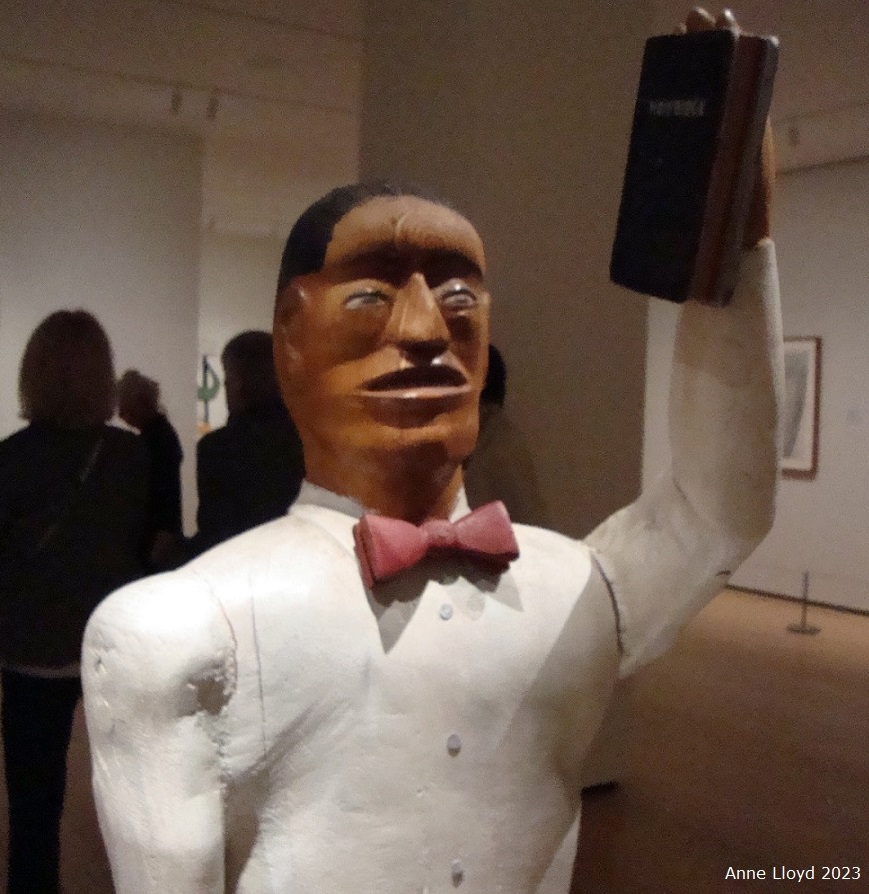
The gallery devoted to religious art is dominated by works of art by two other artists: the nearly life-sized  Preacher and his Wife, carved by S.L. Jones, and Simon Sparrow's Assemblage with Faces. Both are sensational works and, though sharply different in technique, these two masterpieces work together to anchor the entire exhibition. 

Both S.L. Jones and Simon Sparrow were men of deep religious faith, tempered by lives of poverty and toil. Their contrasting approaches to art embody the two essential aspects of religion: the practice of lives of devotion by members of a faith community and the mystical, contemplative experience of God by individual believers. 


Anne Lloyd, Photo (2023) 
Gallery view of the Of God and Country exhibition,
 showing S.L. Jones’ Preacher and His Wife, date unknown

Jones, a sharecropper's son from West Virginia, worked long years for the Chesepeake and Ohio Railroad.  A devoted member of the Primitive Baptist Church, he started carving religious figures to ease the pain in his heart, following the death of his wife. According to the beliefs of the Primitive Baptists, every man and woman can be called to preach the Gospel. There is no need for an ordained clergy as in other denominations.


Anne Lloyd, Photo (2023)
Details of S.L. Jones' Preacher and His Wife


Jones did not aim to carve portraits of specific individuals but rather to evoke the expression of faith on the features of two Christian believers. Their faces radiate the inner light of grace, as they proclaim the word of God. Jones' Preacher and Wife is a brilliant illustration of communal worship, of the famous quote from the Gospel of St. Matthew.

For where there are two or three gathered together in my name, there am I in the midst of them. (Matthew, 18:20)

For Simon Sparrow (1925-2000), the "variety" of religious experience devolved to a personal relationship with God. Sparrow had an amazing life-story. His father was a member of the Yoruba community from West Africa, his mother a Native-American. Details of his childhood are few and conflicting. Sparrow may have been born in Africa, but at some point his family moved to a Cherokee reservation in North Carolina, where he grew-up.


Anne Lloyd, Photo (2023) 
Gallery view of the Of God and Country exhibition,
 showing Simon Sparrow’s Assemblage with Faces.

The spiritual traditions of his ancestors exercised a powerful influence, but Sparrow's approach to art was so unique that it is best to let him speak for himself. Sparrow said that when he began a work of art, he would allow his mind to go blank and let God take over. The process was "sweeter than anything on earth... I feel like I'm climbing."


                                       Anne Lloyd, Photo (2023)                                            Simon Sparrow’s Assemblage with Faces. (Detail), date unknow.

Before letting his mind ascend the "stairway to heaven", Sparrow collected a vast store of found objects, trinkets, shells, small toys and glitter... lot's of glitter. These, Sparrow would place at the service of his God-directed creative power. 

The resulting works are depictions of the numinous, the emergence of the divine presence into the prosaic reality of human life. Sparrow's "assemblages" are as close as an artist can go, I believe, to showing what it would be like to open one's eyes and glimpse heaven. 


                                      Anne Lloyd, Photo (2023)                                       Simon Sparrow’s Assemblage with Faces. (Detail)

Faces and patterns materialize on the mosaic-like surface of Sparrow's art works, seemingly from nowhere. These leave an indelible imprint on the mind of the beholder. But trying to grasp and understand these images is almost impossible, except perhaps by an act of faith. To see, as Simon Sparrow did, one needs to believe.

The final gallery of Of God and Country is, in some ways, the most affecting and perplexing.

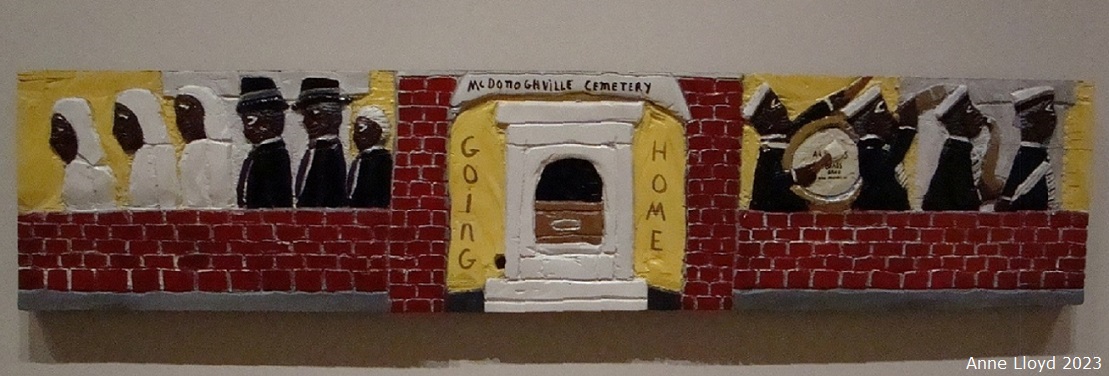
To do justice to the treatment of Death and Mortality really requires an additional review. This will appear shortly in Art Eyewitness.


Anne Lloyd, Photo (2023)
 Herbert Singleton's Going Home: McDonogh Cemetery. Date unknown

No one returns from the "undiscovered country" as Hamlet said so memorably. But judging from the extraordinary works of art in Of God and Country, I would not be surprised if some of the visionary artists in the exhibition had a few sneak previews. 

***

Text, copyright of Ed Voves. Original photography, copyright of Anne Lloyd.

Introductory Image: Anne Lloyd, Photo (2023) William L. Hawkin's American Flag with Cone-Shaped Fireworks ( Detail), 1983. Paint on plywood: 48 x 57 inches (121.9 x 144.8 cm) Collection of Jill and Sheldon Bonovitz, Promised Gift to the Philadelphia Museum of Art.

Anne Lloyd, Photo (2023) William L. Hawkin's Boffo, 20th century. Alkyd house paint on Masonite, fiberboard, alkyd paint mixed with broken starch chunks (possibly dried glue): 44 1/2 x 51 1/2 inches (113 x 130.8 cm) Collection of Jill and Sheldon Bonovitz, Promised Gift to the Philadelphia Museum of Art.

Anne Lloyd, Photo (2023) Sheldon and Jill Bonovitz at the Philadelphia Museum of Art's Of God and Country exhibition.

Anne Lloyd, Photo (2023) Howard Finster’s Angel, #3,2361984. Paint on wood cutout: Collection of Jill and Sheldon Bonovitz. 

Anne Lloyd, Photo (2023) Gallery view of the Philadelphia Museum of Art's Of God and Country exhibition, showing three of Felipe Archuleta’s carved animals, Donkey (1981), Spotted Boar (1981) and Mule (1975). Cottonwood, paint, sisal, sawdust, glue. Collection of Jill and Sheldon Bonovitz, Promised Gift to the Philadelphia Museum of Art. 

Anne Lloyd, Photo (2023) Bill Traylor's House with Two Men, a Turkey, and a Dog, c. 1939-42. Graphite on thin cream card; punched for hanging:Sheet: 22 × 14 1/2 inches (55.9 × 36.8 cm). Collection of Jill and Sheldon Bonovitz, Promised Gift to the Philadelphia Museum of Art. 

Anne Lloyd, Photo (2023) Gallery view of the Philadelphia Museum of Art's Of God and Country exhibition, showing William L. Hawkin's American Flag with Cone-Shaped Fireworks. 

Anne Lloyd, Photo (2023) Leroy Almon’s Uncle Sam, late 20th century. Paint on carved wood. Collection of Jill and Sheldon Bonovitz.

Anne Lloyd, Photo (2023) Josephus Farmer 's Eli Whitney Nemesis of the South, c. 1985. Paint and ink on carved wood. The Jill and Sheldon Bonovitz Collection. 

Anne Lloyd, Photo (2023) Elijah Pierce's Love (Martin Luther King, Jr.). Paint, glitter, and local applications of varnish on carved wood; artist-made frame: 19 x 16 inches (48.3 x 40.6 cm) Collection of Jill and Sheldon Bonovitz, Promised Gift to the Philadelphia Museum of Art. 

Anne Lloyd, Photo (2023) Howard Finster's The Big Push, #1,765, 1980. Paint on plywood; artist-made frame of Douglas fir branded with artist-made metal stamps: Framed: 15 1/4 x 15 inches (38.7 x 38.1 cm) The Jill and Sheldon Bonovitz Collection. 

Anne Lloyd, Photo (2023) Gallery view of the Philadelphia Museum of Art's Of God and Country exhibition, showing S.L. Jones’ Preacher and His Wife

Anne Lloyd, Photo (2023) S.L. Jones’ Preacher and His Wife (Detail), date unknown. Paint on wood with nails; leather belt: Preacher (a): 62 1/2 x 19 x 14 inches (158.8 x 48.3 x 35.6 cm) Wife (b): 54 x 15 x 18 inches (137.2 x 38.1 x 45.7 cm) The Jill and Sheldon Bonovitz Collection. 

Anne Lloyd, Photo (2023) Gallery view of the Philadelphia Museum of Art's Of God and Country exhibition, showing Simon Sparrow’s Assemblage with Faces

Anne Lloyd, Photo (2023) Simon Sparrow’s Assemblage with Faces. (Detail), date unknown. Glitter, paint, and other found objects on wood; artist-made painted wood frame: 56 1/2 inches × 8 feet 11 inches × 3 1/2 inches (143.5 × 271.8 × 8.9 cm. Collection of Jill and Sheldon Bonovitz, Promised Gift to the Philadelphia Museum of Art. 

Anne Lloyd, Photo (2023) Herbert Singleton's Going Home: McDonogh Cemetery. Date unknown. Alkyd industrial paint, including metallic paint, on carved red cedar with yellow pine battens: 12 3/4 x 60 inches (32.4 x 152.4 cm) Collection of Jill and Sheldon Bonovitz.