Showing posts with label Pop Art. Show all posts

Tuesday, July 26, 2022

Art Eyewitness Review: New York: 1962-1964 at the Jewish Museum, New York City


New York: 1962-1964  

Jewish Museum, New York City

July 22, 2022 - January 8, 2023

Reviewed by Ed Voves

Original Photography by Anne Lloyd

One Thousand Days. This was the title of one of the most praised and popular non-fiction books of the 1960's. Written by Arthur Schlesinger Jr., One Thousand Days chronicled President John F. Kennedy's administration, from his inauguration in January 1961 to the fatal Friday in Dallas, November 22, 1963.

The Jewish Museum in New York City has just opened a brilliant and ambitious exhibition surveying the American art scene during a similar span of the early 1960's. The chronology is not an exact fit, but it's close. The years covered by the exhibition extend from 1962 to 1964.

Why these three years? The course of events during this period marked the  abrupt transition from the ironclad ascendancy of Abstract Expressionism to the wide-open, consumer-conscious theater of Pop Art. Social ideals, in keeping with the political goals of President Kennedy's New Frontier and the Civil Rights movement, likewise made their presence felt.


Anne Lloyd, Photo (2022) 
Gallery view of New York:1962-1964 at the Jewish Museum, showing Donald Judd's Untitled,1963

New York: 1962-1964 is a big, colorful art show, currently spread over two floors at the Jewish Museum. The exhibition guides us through these eventful years with major works of art and provocative gallery texts about the role of culture in American society. 

Yet, there is nostalgic touch to New York: 1962-1964 which will appeal to those old enough to remember the Camelot years - and to later generations still affected by its mystique. 


                                       Anne Lloyd, Photo (2022)                                               Gallery view of New York:1962-1964, with a vintage jukebox,        courtesy of New York Jukebox

The exhibit opens by displaying a jukebox, that potent symbol of Sixties pop culture. 


Pick a song. "Love is a Swingin' Thing" by the Shirelles? "Leader of the Pack" by the Shangrilas? The curators of the Jewish Museum selected a soundtrack of "hit tunes" which will have you dancing through the first floor galleries.

Then, on the second floor, the mood changes. A poignant and powerful array of JFK-related memorabilia and works of art awaits. As with the actual events, 59 years ago, the shocking assassination of President Kennedy casts a sense of mourning over the rest of the exhibition.


Anne Lloyd, Photo (2022) 
Walter Cronkite Reporting the Assassination of President Kennedy; Andy Warhol's Jackie Frieze (detail), 1964

A six minute video-loop of Walter Cronkite, grappling with his emotions as he announced the death of President Kennedy, and Andy Warhol's Jackie Frieze are on view. Both are still heart-wrenching after all these years.

At this point, we should ask a further question related to the years, 1962-1964. Why did the Jewish Museum decide to focus on these "thousand days" of art for a major exhibition? The answer can be found in the dynamic role of the Jewish Museum itself during this period.

In March 1962, a much-anticipated display of drawings and paintings by Willem de Kooning opened at the Sidney Janis Gallery. Surprisingly, the show occasioned hostile criticism and poor sales. A few months later, the Janis Gallery tried a different tack with an exhibit highlighting younger artists, entitled New Realists.

The exhibition opened on October 31, 1962, only days after the Cuban Missile crisis. The New York art scene was sharply divided as Pop Art came to town with Andy Warhol's 200 Campbell Soup Cans leading the charge. The New York Times styled New Realists as "mad, mad, wonderfully mad" but "welcome." The "Ab-Ex" establishment, however was infuriated, with Mark Rothko, Robert Motherwell and others severing ties with the Janis Gallery.

Navigating his way through this crossfire of contention, Dr. Alan Solomon (1920-1970) took over the directorship of the Jewish Museum in July 1962. His two-year tenure at the museum anchors the time-line of this exhibition.


Anne Lloyd, Photo (2022) 
Alan Solomon being interviewed at the Venice Biennale, June 27, 1964

An outstanding scholar and curator, Solomon turned the Jewish Museum into a major forum for appreciating modern art. Solomon had a keen insight into the art of his own era and promoted young, innovative artists. He mounted exhibitions of the work of Robert Rauschenberg (1963) and Jasper Johns (1964) at the Jewish Museum. These were watershed events at the time and, decades later, provide the foundation for New York:1962-1964.


Hans Namuth, Photo (1963) 
Gallery view of the Jewish Museum's Robert Rauschenberg exhibit 

Art works by Rauschenberg and Johns figure prominently in the Jewish Museum exhibit. What especially impresses me, however, is the diversity of artists included in the show, not just the big names, and the strikingly off-beat curatorial values. Both were hallmarks of Solomon's methodology at the Jewish Museum.


  Anne Lloyd, Photo (2022) 
Robert Rauschenberg's Talisman, 1958

Solomon had particular regard for Rauschenberg's "combines." These were created from a wide-variety of materials, pieced-together to evoke moods and modes of life, often defying easy comprehension.

Such works, Solomon stated in an influential 1963 essay, were rooted in an "intense passion for direct experience, for unqualified participation in the richness of our immediate world."

There can be no better description or summing-up of the works of art on view in New York: 1962-1964.

A huge, multi-paneled oil painting entitled The Eye of Lightning Billy dominates the first gallery of the exhibition. Painted by an Oklahoma-born artist named Harold Stevenson, it appeared in the New Realists exhibition in October 1962. An impressive, if alarming, work, this depiction of the eye of a Native American cowboy leaves the viewer wondering just who is watching whom.


 Anne Lloyd, Photo (2022) 
Harold Stevenson's The Eye of Lightning Billy, 1962

We are left to question too about the identity of this work. Is The Eye of Lightning Billy a Realist painting?  Is it Pop Art or perhaps Surrealism? All or none of the above?

For Solomon, works like The Eye of Lightning Billy did not fit securely into a narrowly defined artistic canon or "school." And that is exactly what he wanted, art which was drawn from everyday life, “familiar, public, and often disquieting.” 

Solomon referred to the works he promoted at the Jewish Museum as the  "New Art." This was a revival of the title initially used to describe the paintings of Monet, Renoir and Pissarro by the critic Edmund Duranty in 1874, before the originally scornful term, Impressionism, was adapted as a badge of honor. Like his nineteenth century forebearers, Solomon championed art that was experimental and expressive, yet rooted in the "here and the now."


  Anne Lloyd, Photo (2022) 
Louise Nevelson's Sky Cathedral’s Presence I, 1959-1962

That, at least initially, was the backdrop for Louise Nevelson's ominous Sky Cathedral’s Presence I, created over the course of 1959–62. Nevelson watched the destruction of New York City's working class neighborhoods to make way for the "urban renewal" plans of Robert Moses. 

After being evicted from her residence in the Kips Bay neighborhood of New York City, Nevelson responded to Moses' "slum clearance," by collecting  castaway objects, just as Rauschenberg was doing. With these and thick layers of black paint, Nevelson created Sky Cathedral’s Presence I. 


     Anne Lloyd, Photo (2022) 
Louise Nevelson's Sky Cathedral’s Presence I (detail)

Nevelson's art, however, was not merely reactive. Sky Cathedral's Presence I was deeply grounded in spiritual ideals. With this powerful sculpture, and similar works produced over the following years, Nevelson aimed to reach "the in-between places, the dawns and dusk, the objective world, the heavenly spheres, the places between the land and the sea." 

For many people during  the early 1960's, the image of "heavenly spheres" did not have much to do with "in-between places." Rather, they thought in terms of the Project Mercury rockets which launched NASA astronauts like John Glenn into orbit. Except for a fortunate few able to travel to the beaches near Cape Canaveral, watching the Project Mercury lift-offs was done from a reclining armchair positioned in front of a television set. 


        Anne Lloyd, Photo (2022)
 Gallery view of New York:1962-1964, showing period furnishings, including Eames Chair & Ottoman and Magnavox television

The idea of "home entertainment centers" with wide-screen monitors and Dolby Sound was beyond the wildest dreams of all but a few tech-savvy engineers during the 1960's. But to watch a NASA rocket blasting into Outer Space on a TV in your living room was still a big deal. 

The impact of television was felt everywhere in the Sixties' art world. Rauschenberg embraced the televised, black and white drama of a NASA space launch in Glider. 


   Anne Lloyd, Photo (2022) 
Robert Rauschenberg's Glider, 1962

Not surprisingly for a work by Rauschenberg, one really has to search Glider to find the rocket blasting-off, positioned just above a human hand on the left hand side of the canvas.

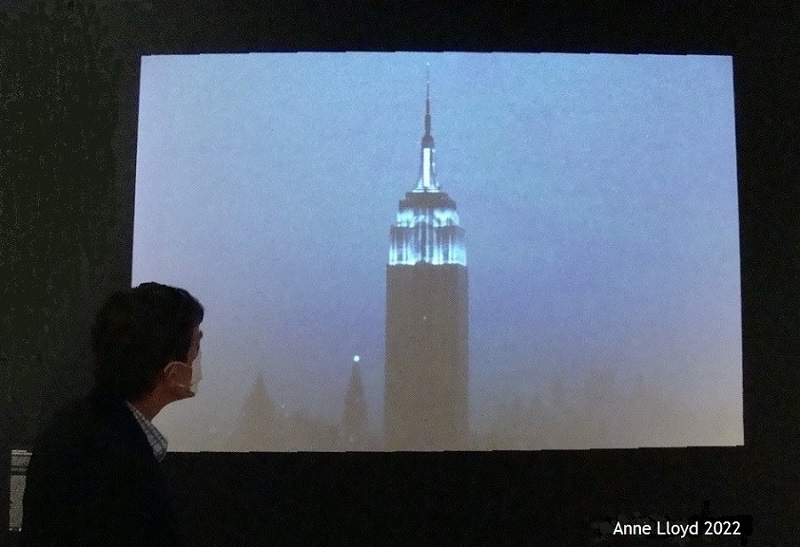
If Rauschenberg engaged with television, Andy Warhol's Empire reacted in direct contrast. In many an American home, the "boob tube" droned relentlessly from morning till midnight. Warhol directed a 16 mm camera to record what everyone was missing while they watched TV - the effect of light, natural and electric, as reflected on and around the spire of skyscraper.


Anne Lloyd, Photo (2022)
 Andy Warhol's Empire, 1964

The skyscraper was, of course, the Empire State Building, making for a dramatic setting. Nothing much happened,however, in the eight-hour filming session, the sun set and the building lights came on. Yet, Warhol and his film-making partners, Jonas Mekas and John Palmer, had captured a moment of astonishing transcendence - "as though the world had been recreated" to quote an appreciative critic. 

Thanks to the curators of New York: 1962-1964, we are able to relive that moment.

Few people have the time or patience to watch an eight-hour film. For most Americans of Warhol's era, it was the appliances and accoutrements of their "Affluent Society" that interested them. The Jewish Museum curators have done a terrific job in evoking the material culture of the early 1960's, clock radios, electric coffee pots, slick magazines and stylish apparel like Evelyn Jablow's Fold-Up Dress for a Portable Society (1964). 


Anne Lloyd, Photo (2022)
 1960's Kitchen appliances: Lloyd’s high fidelity AM/FM tube radio, an Osterizer Beehive blender and General Electric's two-slice toaster

Another dress appeared the same year, 1964, as the Fold-Up: the topless Monokini bathing suit. Designed by Rudi Gernreich, it was intended as a protest against America's puritanical values (according to Gernreich). Whether that was true - or just a clever sales technique - the advertisement and sale of the Monokini led to a storm of controversy. 


Anne Lloyd, Photo (2022) 
            From left: Rudi Gernriech's Monokini, Geoffrey Beene's  Evening Dress & Evelyn Jablow's Fold-Up Dress for a Portable Society 

GIven the sheer number of topics covered in New York, 1962-1964, the Jewish Museum curators wisely avoid detailed commentary on these debates. But the Monokini's inclusion in the exhibition does set the stage for art works by woman artists who very much wanted to protest against the treatment of the female body as an "object" available at your local newstand in "pin-up" magazines. 

Marjorie Strider and Marisol Escobar, in different ways, asserted the right of women to define own identities, free from societal expectations or male desires..


        Anne Lloyd, Photo (2022) 
                     Roy Lichtenstein's Thinking of Him, 1963, at left,                     and Marjorie Strider's Girl with Radish,1963

Strider's Girl with Radish, 1963, appeared in a 1964 exhibit, The First International Girlie Show, along with works by Roy Lichtenstein, Andy Warhol and. Rosilyn Drexler, who is also featured in New York: 1962-1964. "Girlie Show" was one of the first Pop exhibits and many critics regarded Strider's painting - and Pop generally - as a stunt rather than serious art. Strider, however, was not joking with her confrontational reworking of comic book sexuality.

Kristina Parsons, one of the Jewish Museum curators of New York, 1962-1964, comments on Strider's "engagement with the power dynamics of voyeurism." Strider, Parsons notes, "combines a kind of sly humor and a little bit of bite. Strider often features women who are staring deliberately out at the viewer, rejecting the one-directional gaze of an often male viewer consuming a female's image."


Anne Lloyd, Photo (2022)
 Marisol (Marisol Escobar) Self-Portrait, 1961-62

Marisol Escobar, or simply Marisol, joined with Rauschenberg and Nevelson in reusing debris from the "throw-away" society around her as source material for her art. She even somehow found human teeth to use in the mouths of the figures comprising the identities of her Self-Portrait.


Anne Lloyd, Photo (2022)
 Marisol's Self-Portrait (detail), 1961-62

Just who are these enigmatic folks? Only one of the seven faces looks like Marisol herself. Two, maybe three, are male and who the duck-billed creature might be is anyone's guess. Do they represent various facets of Marisol's personality?

Perhaps the best explanation for this remarkable work of art is that Marisol created it to deliberately leave us guessing. While we are scratching our heads in bemusement, Marisol affirms that she - and she alone - defines her own, true, identity.

Artistic statements are, for the most part, personal manifestos. Most of the works on the first floor galleries of New York: 1962-64 are individual responses to events transpiring during those incredible years. But art has a community, collegial "ethic" and the Jewish Museum exhibition does not neglect this aspect of the early 1960's.


Anne Lloyd, Photo (2022)
 Gallery view of New York:1962-1964,
 showing Robert Rauschenberg costumes for Antic Meet

Modern dance played a major role in the New York cultural scene during the 1960's. Although Solomon was not directly involved with dance, Rauschenberg was. He designed costumes for Merce Cunningam's  company, provided sets and choreography for the Judson Dance Theater and even danced himself in one production, on roller skates with a parachute suspended on his shoulders!


  Anne Lloyd, Photo (2022) 
 Isamu Noguchi's Shrine of Aphrodite for the ballet Phaedra

The Jewish Museum exhibits several of Rauschenberg's costumes for Merce Cunningham's Antic Meet. Also on view is the spectacular stage prop, the Shrine of Aphrodite designed by Isamu Noguchi for the controversial 1962 ballet, Phaedra, by Martha Graham.

Artists, acting with a sense of community, found unity in social action, which in turn led many to create powerful works of art supporting the Civil Rights Movement. Most of the artists whose works are on view in New York: 1962-1964, lived and worked in run-down areas of Lower-Manhattan. Labeled the "Loft Generation" they had a natural sympathy with African-Americans battling against segregation and discrimination.


Anne Lloyd, Photo (2022)
 Faith Ringold's American People #4: The Civil Rights Triangle, 1964

The extensive array of art related to the Civil Rights era, on view in New York: 1962-1964, is truly impressive. Paintings by Faith Ringold and Norman Lewis, photos by Bruce Davidson and Roy De Carava, videos of the the "I have a Dream Speech" and an interview with Malcolm X make these galleries a virtual exhibition is its own right.


  Anne Lloyd, Photo (2022)
 Reginald Gammon's Freedom Now! (Detail), 1963

Although not as well known today as Lewis or Ringold, Reginald Gammon was a great artist and a dedicated Civil Rights activist. Born in Philadelphia, Gammon settled in New York city after World War II service in the Navy. His Freedom Now!, a splendid evocation of the spirit of the Civil Rights movement, appeared in a major exhibition at the Christopher Street Gallery in 1965.

Gammon's Freedom Now! embodied the "spirit of the age" of the early 1960's America. This positive, almost unquestioned, belief in ourselves and our ability to overcome our failings and realize our nation's destiny, was real and widespread. And this sense of confidence and "mission" suffered a terrible, if not fatal, wound on November 22, 1963.

As I mentioned earlier in this review, the array of art and artifacts related to President Kennedy's murder and America's prolonged anguish is deeply moving.

It was only after we returned from the Jewish Museum and examined Anne's photos that we noticed a strange effect of light and reflection on one of pictures. In a amazing way, impossible to plan or orchestrate, one image was mirrored in another to create a new image with its own special impact. 


  Anne Lloyd, Photo (2022) 
Cover of LIFE magazine, November 29, 1963

Looking at a photo of the LIFE magazine dedicated to the memory of President Kennedy, we saw reflected the somber face of Walter Cronkite announcing Kennedy's death, joined in a photo montage effect. This left Anne and I shaking our heads in wonderment.  It was a compelling and chilling image all in one. 

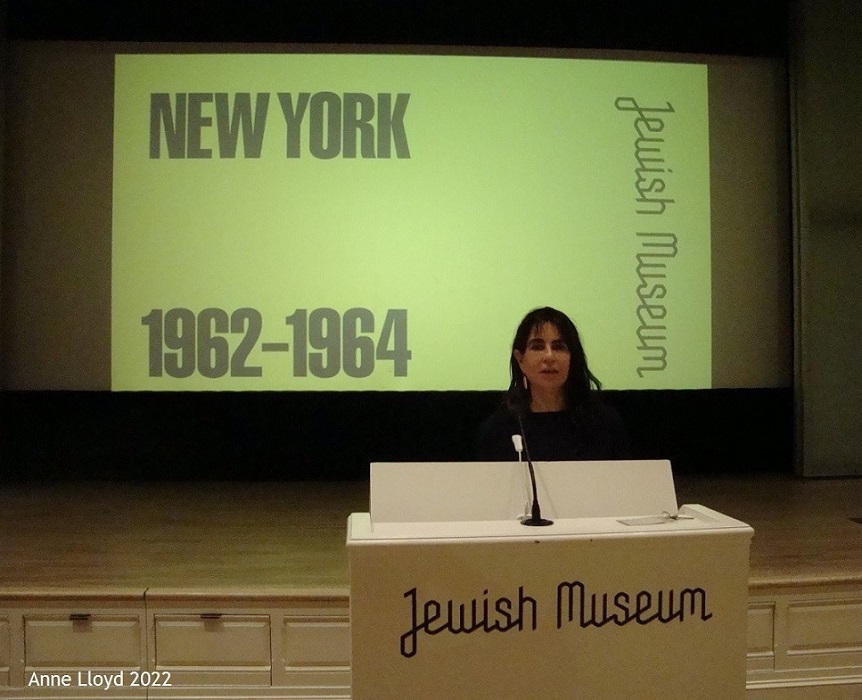
New York: 1962-1964 is a magnificent exhibition. The curators at the Jewish Museum have brought back to life a short-lived era of exceptional achievement. Their task in preparing the exhibition was made vastly more difficult by the death of the great Italian scholar who had planned and organized New York: 1962-1964. Germano Celant, died from Covid-19 before seeing the project to completion. Judging from the emotion in the voice of Claudia Gould, director of the Jewish Museum, as she spoke of Mr. Celant at the press preview, his death was a great loss.


Anne Lloyd, Photo (2022)
 Claudia Gould, Director of the Jewish Museum, July 20, 2022

One can only admire Ms. Gould and the staff of the Jewish Museum, all the more, for completing the preparation of New York: 1962-64 and sharing it with lovers of art.

And what of Dr. Alan Solomon, the guiding mind and directing hand for much of what we see celebrated in New York: 1962-1964? 

Sadly, Alan Solomon too was cut-down in his prime, dying from a heart attack in 1970, aged 49. His death, like JFK's, left a void of unrealized promise, never to be fulfilled.

**
Text: Copyright of Ed Voves, all rights reserved                                                             
Images copyright of Anne Lloyd, all rights reserved.

Additional images, courtesy of the Jewish Museum, NYC. 

Introductory Image: Anne Lloyd, Photo (2022) Marjorie Strider (American, 1931-2014) Girl with Radish, 1963. Acrylic on laminated pine on Masonite panels  Ruth and Theodore Baum Collection.

Anne Lloyd, Photo (2022) Gallery view of New York:1962-1964 with showing Donald Judd's Untitled, 1963. Fabricated, 1988. Cadmium red light oil on wood and purple enamel on aluminum tube. Judd Foundation, New York 

Anne Lloyd, Photo (2022) Gallery view of New York:1962-1964, showing a vintage Jukebox, courtesy of New York Jukebox.

Anne Lloyd, Photo (2022) Walter Cronkite Reporting on the Assassination of President John F. Kennedy, November 22, 1963. CBS Video, black and white, sound, 6 min., 22 sec. CBS News Archives. 

Anne Lloyd, Photo (2022) Andy Warhol's Jackie Frieze (detail) Jackie Frieze, 1964. Silkscreen on linen: Museum of Contemporary Art, Chicago, gift of Beatrice Cummings Mayer 

Anne Lloyd, Photo (2022) Ruggero Orlando interviewing Alan Solomon as part of a newscast covering the Thirty-Second Venice Biennale, June 27, 1964. Broadcast by Rai (Radiotelevisione Italiana) Video, black and white, sound, 3 min., 18 sec.

Hans Namuth, Photo (1963) Robert Rauschenberg at the Jewish Museum. Installation Image. Courtesy of The Jewish Museum, New York.

Anne Lloyd, Photo (2022) Robert Rauschenberg (American, 1925-2008) Talisman, 1958. Combine: oil, paper, printed paper, printed reproductions, wood, glass jar on metal chain, and fabric on canvas. Des Moines Art Center

Anne Lloyd, Photo (2022) Gallery View of New York:1962-1964, showing Harold Stevenson's The Eye of Lightning Billy, 1962. Oil on canvas, 6 joined panels 120  x 180 inches (305 x 47 cm) Collection of the Harold Stevenson Family

Anne Lloyd, Photo (2022)  Louise Nevelson's Sky Cathedral’s Presence I, 1959-1962. Painted wood and found objects: 107-120 1/8 x 21 ½ in. Fine Arts Museums of San Francisco.

Anne Lloyd, Photo (2022) Gallery view of New York:1962-1964, showing period room furnishings, including Eames Chair (Model 670) & Ottoman and Magnavox television.

Anne Lloyd, Photo (2022) Robert Rauschenberg's Glider, 1962. Oil and silkscreen ink on canvas, Menil Foundation, Houston 

Anne Lloyd, Photo (2022) Andy Warhol's Empire, excerpt of reel 1, 1964. 16mm film transferred to digital video, black and white, silent, excerpt 50 min., original 8 hr., 5 min. Andy Warhol Museum, Pittsburgh

Anne Lloyd, Photo (2022) Gallery view of New York:1962-1964, showing period kitchen appliances, including Osterizer Beehive blender, Model 238, General Electric two-slice toaster, Model GE A7T86, and Lloyd’s high fidelity AM/FM tube radio, Model TM-8384.

Anne Lloyd, Photo (2022)  Rudi Gernreich's Monokini, 1964 (Wool knit and elastic, produced by Harmon Knitwear) Kent State University Museum; Geoffrey Beene's Evening Dress, 1964. (Silk) Musée Mode et Dentelle de la Ville de Bruxelles, Belgium; Evelyn Jablow's, Fold-Up Dress for a Portable Society, 1964 (Silk) Cincinnati Art Museum.

Anne Lloyd, Photo (2022) Roy Lichtenstein's Thinking of Him, 1963. (Magna on canvas. Yale University Art Gallery, New Haven, and Marjorie Strider's Girl with Radish.

Anne Lloyd, Photo (2022) Marisol (Marisol Escobar) Self-Portrait, 1961-62. Wood, plaster, marker, paint, graphite, human teeth, gold, and plastic: 43 1/2 x 45 1/4 x 75 5/8 in. (110.5 x 114.9 x 192.1 cm) Museum of Contemporary Art Chicago, Chicago, IL.Gift of Joseph and Jory Shapiro. 

Anne Lloyd, Photo (2022) Gallery view of New York:1962-1964, showing Robert Rauschenberg costumes for Antic Meet. Tattooed tank top, bear or bison fur coat, and parachute dress. Walker Art Center, Minneapolis, Merce Cunningham Dance Company Collection. 

Anne Lloyd, Photo (2022) Gallery view of New York:1962-1964, showing Isamu Noguchi's Shrine of Aphrodite for Martha Graham’s ballet Phaedra. Original, 1962, exhibition copy 2021. Wood, metal, and canvas. Noguchi Museum, New York

Anne Lloyd, Photo (2022) Faith Ringold's American People #4: The Civil Rights Triangle, 1964. Oil on canvas: 36 3/16 x 42 ⅛ inches (92 x 107 cm) Glenstone Museum, Potomac, Maryland.

Anne Lloyd, Photo (2022) Reginald Gammon's Freedom Now! (Detail), 1963. Acrylic on board. National Afro-American Museum and Cultural Center, Wilberforce, Ohio

Anne Lloyd, Photo (2022) Gallery view of New York:1962-1964, showing LIFE magazine, November 29, 1963.  

Anne Lloyd, Photo (2022) Claudia Gould,Director of the Jewish Museum, New York City, July 20, 2022.

Thursday, March 3, 2016

International Pop at the Philadelphia Museum of Art


International Pop


Philadelphia Museum of Art

February 24, 2016 - May 15, 2016


Reviewed by Ed Voves

Pop Art, like most of the cultural innovations of the 1960's, took a lot of people by surprise. In some cases, it came as a  revelation. For others it was a shock. 

The lively and informative exhibition at the Philadelphia Museum of Art, International Pop summons this tumultuous era to life. "I Pop" provides insight into the emergence of Pop at a time when representational art in the West was considered passé. 

To many sophisticated art scholars around 1960, anything approaching realism was considered "illustration." It was acceptable on the covers of magazines. It was not art. 

Pop Art changed that situation  - radically. Abstract Expressionism, the canonized art form of 1950's America, was suddenly dethroned. The flowering of primary colors, figurative depiction and references to mass media in Pop took the world by storm. Many, like the influential art critic, Harold Rosenberg, were not pleased.  

Joe Tilson, LOOK!, 1964

Pop Art, declared Rosenberg, was like "a joke without humor, told over and over again until it begins to sound like a threat..."

Rosenberg's assessment was wide of the mark and yet closer to the truth than he perhaps realized. There was plenty of humor to Pop Art. But the "threat" was real too. It lurked not in the themes and techniques of the practitioners of Pop Art but rather in what they perceived was happening in the world around them.

Examples of the upbeat Pop Art of the early 1960's are well represented in the galleries of International Pop. Roy Lichtenstein's clever parody of Disney cartoon characters, Look Mickey, is a notable work of" populist" Pop. There is also Gerhard Richter's Woman Descending the Staircase, an apparent homage to one of the most celebrated works in the Philadelphia Museum of Art, Marcel Duchamp's Nude Descending a Staircase.

It is easy to focus on these two major works in the spirit of art critic Lawrence Alloway's interpretation of Pop as "mass popular art."  Perhaps it is too easy.


Roy Lichtenstein, Look Mickey, 1961

In Look Mickey, Lichtenstein "recomposed" a scene from a familiar Disney book, Donald Duck: Lost and Found. Lichtenstein's young sons were fans of Disney cartoons. By transforming the Little Golden Book illustrations into a comic-book format, replete with Benday dots, Lichtenstein created an image that would appeal to kids, parents and (hopefully) lovers of modern art. 

In the case of Richter's 1965 "photo painting," the obvious reference to Duchamp's work was further reinforced the following year when he virtually re-staged Duchamp's 1912 work with a sensitive depiction of his wife in the role of Ema, Nude on a Staircase.

Yet, there was a seed of iconoclasm in both these early Pop works which would grow as the Pop movement spread. We need to look closely at both to grasp the implications for Pop Art as an international movement.

Only two years separated Look Mickey from the "blood and thunder" war scenes, Whaam! and Torpedo ...Los! which Lichtenstein based on early-60's DC Comics series, All-American Men of War and Our Fighting Forces. These garish depictions of combat present war as only a twelve year-old boy could applaud. Lichtenstein, a World War II veteran, surely intended subversive social commentary in these 1963 works - but cryptically refrained from providing any overt indicators.


Gerhard Richter, Woman Descending the Staircase, 1965

Richter's relationship to Duchamp is also problematical. In a 1991 interview, Richter declared that Duchamp's Nude Descending a Staircase "rather irritated me. I thought very highly of it, but I could never accept that it had put paid, once and for all, to a certain kind of painting."

That "certain kind of painting" was, of course, representational art. Richter turned the tables on Duchamp and transformed his abstract nude into a realist figure. Both of his re-stagings of the 1912 work, the elegantly dressed version on view in the Philadelphia exhibit and Ema, Nude on a Staircase, are defiant rejections of Duchamp. 

Pop Art was often called NeoDada. Like the World War I era original, Pop/NeoDada turned the world upside down and inside out. What looks like a celebration of the good things of life might well be a cunning, satiric put-down of consumer society gluttony. 


Tom Wesselmann, Still Life #35, 1963

The vast Still Life #35 by Tom Wesselmann (1931-2004) certainly seems to be later-day Dada, skewering the insatiable appetites of the post-World War II era. The rather malevolent glint in the eyes of the Aryan-looking Sunbeam Bread girl is profoundly unsettling.


Anne Lloyd, Detail of Tom Wesselmann's Still Life #35

Tom Wesselmann, however, emphatically rejected such an interpretation of his work and always tried to distance himself from the Pop Art School.

"I used what was around me, so my culture was what I used," Wesselman declared. "But I didn’t use it for cultural reasons, it was not a cultural comment.”

Wesselman's artistic aims were to be upstaged by the impact of his paintings. Many other Pop artists would experience the same surprising reception of their art.

The Philadelphia exhibit is the third and final U.S.venue of International Pop, following displays in Minneapolis and Dallas. Tate Modern in London also presented a version,The World Goes Pop, during 2015. Different works by artists represented in The World Goes Pop appear in the American exhibition such as Oiran, one of the signature series by Japanese artist, Ushio Shinohara (b. 1932).


Ushio Shinohara, Oiran, 1968

According to the standard history of Pop Art, this radical departure started in Britain and the United States during the 1950's as artists grappled with the explosion of product brands and the unprecedented marketing campaigns. Abstract Expressionism's cult of the obscure was left behind for big, bold and bright images of the profusion of goods and services of the post-war boom decades.

Interestingly, a painting on view by the British Pop pioneer, Richard Hamilton, has more elements of abstract theory and design than is generally accepted. Hers is a Lush Situation - the mystifying title comes from a Buick automobile review - distributes car parts over the canvas with almost Cubist precision.


Richard Hamilton, Hers is a Lush Situation, 1958

The revolutionary Brazilian artist, Hélio Oiticica (1937-1980), also embraced Pop after exploring other art forms. He engaged in geometric and non-representational art forms early in his career. During in the 1960's, Oiticica launched ambitious efforts to create art that was evocative of Brazilian life and to break down the barriers between art, as a process of observation, and life as an active struggle to survive. Oiticica aimed to make art and life one and the same.

Pop art seemed ready-made for Oiticica and other Latin American artists. But Pop art to Latin American eyes was compromised by the U.S. counter-insurgency campaign against Communism. 

In the United States and Western Europe, Pop art dealt with social themes, such as the way that life was being packaged into boxes, whether Andy Warhol's Brillo boxes or the "little boxes made of ticky tacky" of the Pete Seeger song. In Latin America, the "boxes" were coffins of martyred victims of political oppression and U.S. intervention.


Hélio Oiticica, Be an Outlaw, Be a Hero, 1967

Unable to oust Castro's regime in Cuba, the United States launched repeated anti-Communist efforts elsewhere in Latin America, sparking anger among political liberals. In 1964, the United States supported a military coup in Oiticica's homeland, Brazil.The following year, U.S. Marines landed in the Dominican Republic, crushing left-wing protests and in 1967, U.S.-trained forces killed the Argentinian Marxist leader, Ernesto "Che" Guevara, who was supporting a revolt in Bolivia. 

Oiticica's Christlike image of a dead rebel was created the same year as "Che" Guevara's death. It vividly illustrates the response of committed activists like the brilliant Brazilian artist for whom a work of art was a political manifesto first and foremost.

The 1960's was a revolutionary decade throughout the world. The curators of "I Pop" at the Philadelphia Museum created a brilliant timeline chart tracing the interrelated relationships of Pop art movements among the various nations and linking these developments in the arts with notable political events.
        
One of the 1960's most significant legacies, however, eluded the grasp of the curators of International Pop. This was the impact of the "Sixties" on the rise of the Feminist Movement of the 1970's.

To give due credit, a conscientious effort was made to include many significant women artists in the International Pop exhibit. Evelyne Axell (Belgian,1935-1972), Pauline Boty (English,1938-1966), Niki de Saint Phalle (French,1930–2002), Marjorie Strider (American, 1934-2014) and Jann Haworth, (American, born 1942) are all represented in the exhibit. Most of the works by these women engaged with feminist themes that were to be major topics during the 1970’s when women asserted control of “Our Bodies, Ourselves.” 

These talented women artists are generally represented by only one piece in the exhibit and this is a major stumbling block. They are less well known than their male counterparts in Pop Art and thus more difficult to appraise on the strength of a single work of art. 

In the case of Pauline Boty, anyone unfamiliar with her work will be left in the dark by the exhibit. Boty, a gifted artist and a charismatic figure in the London art scene, tragically died in 1966 from cancer at age 25. She is represented in the exhibit by a sedate work of collage. This choice gives no indication of the highly charged erotic paintings that Boty created to repudiate the way that women's bodies are treated as objects by the male establishment. 

Boty is an extreme case, but International Pop is generally short on insights into these remarkable women. In an otherwise cohesive exhibit, Axell, Boty and Strider seem to be latecomers to the "swinging 60's" rather than major artists in their own right and forerunners of the art of the 1970's Feminist Movement.

Fortunately, "I Pop" has two other major works of art that help assert the growing role of women in art and modern society. These are Dinner Date, the 1963 sculpture group by Marisol Escobar and Andy Warhols's Sixteen Jackies, created a year later. 


Anne Lloyd, Gallery View of Marisol's Dinner Date, 1963

Marisol (as she was universally known) was born in France in 1930 of Venezuelan parents. She came to New York in the 1950's as a painter. Deeply impressed by pre-Columbian art, she launched a unique and unforgettable sculptural series incorporating either realistic portraits or mask-like representations (sometimes combinations of the two) on blocks of pine or mahogany, with disembodied hands, legs and feet to complete the unsettling effect. 

Dinner Date, which is part of the collection of Yale University's art museum, is positioned close to Still Life #35 by Tom Wesselmann. These two works complement and counteract each other. Marisol's mute, rigid figures are poised to eat "TV dinners," the epitome of the processed foods extolled in Still Life #35.Their faces (which bear a resemblance to Marisol's own features) are gripped in a trance-like state, as frozen as the "TV dinners" they will never consume.

The artificial, emotion-drained world which Marisol evoked in Dinner Date came to an abrupt end on November 22, 1963. 

Andy Warhol's Sixteen Jackies is a testament to the defining moment of the 1960's and the Pop era: the assassination pf President John F. Kennedy. Its significance is even wider.


Anne Lloyd, Gallery View of Andy Warhol's Sixteen Jackies, 1964

Warhol was strangely unmoved by the murder of Kennedy but very much aware of the significance of the event, as it transpired on television. Warhol's famous remark about the endless, repetitive broadcast of events in Dallas and the state funeral was both perceptive on the cultural level and incorrect in the instance of the role of Jacqueline Kennedy. 

“The more you look at the same exact thing," Warhol later declared, "the more the meaning goes away and the better and emptier you feel.”

The ad nauseam stream of media images which is now part of daily life certainly proved Warhol right. In the case of the Kennedy events, however, that did not happen. The "grace under pressure" courage of Jacqueline Kennedy, watched by millions, invested this sad drama with a nobility lasting to this day. One can feel the numinous outpouring of her spirit, even now, standing before Warhol's Sixteen Jackies.


Anne Lloyd, Detail of Andy Warhol's Sixteen Jackies, 1964

If Jacqueline Kennedy transformed a media circus into a moment of everlasting reconciliation, her example also marked a decisive shift in the role of women in the arts. The static place of women in society, so brilliantly skewered by Marisol's Dinner Date, was not going to continue, unquestioned, after Jacqueline Kennedy's strength of character was displayed to such an extraordinary extent.

The International Pop exhibit, now on view in Philadelphia, deftly contradicts Andy Warhol's "fifteen minutes of fame" dictum. Some images and the people they portray take on a life of their own. By virtue of the insight and inspiration they provide, these images become indelible, marked forever in the human mind and soul. 

These images keep on living.  And keep on living. And keep on living.

***
Text: Copyright of Ed Voves, all rights reserved 

Images courtesy of the Philadelphia Museum of Art

Introductory Image:                                                                                                         Anne Lloyd (2016), Gallery View of Marisol's Dinner Date, 1963, and Tom Wesselmann's Still Life #35, 1963.

Joe Tilson (British, born 1928), LOOK!, 1964. unframed 73.5 × 76.75 × 3 inches, oil, acrylic on plywood. Walker Art Center, Minneapolis: Art Center Acquisition Fund, 1966 © Artists Rights Society (ARS), New York / DACS, London

Roy Lichtenstein (American, 1923–1997), Look Mickey, 1961. Oil on Canvas, overall: 121.9 x 175.3 cm (48 x 69 in.) framed: 123.5 x 176.9 x 5.1 cm (48 5/8 x 69 5/8 x 2 in.) National Gallery of Art, Washington, Gift of Roy and Dorothy Lichtenstein in Honor of the 50th Anniversary of the National Gallery of Art. 1991.41.1

Gerhard Richter (German, born 1932), Woman Descending the Staircase, 1965. Oil on canvas, 198 x 128 cm ( 79 X 51 in.)The Art Institute of Chicago; Roy J. and Frances R. Friedman Endowment: Gift of Lannan Foundation) 1997.176 © Gerhard Richter

Tom Wesselmann (American, 1931–2004), Still Life No. 35, 1963, Oil and collage on canvas, 304.80 x 487.68 cm. The Estate of Tom Wesselmann, New York, © Estate of Tom Wesselmann/SODRAC, Montreal/VAGA, New York (2012), Photo: Jeffrey Sturges

Anne Lloyd (2016), Detail of Tom Wesselmann's Still Life #35, 1963.

Ushio Shinohara  (Japanese, born 1932), Oiran, 1968.  Plexiglass and acrylic on canvas, 72 1/4 x 72 1/4 in. 183.5 x 183.5 cm.  Museum of  Contemporary Art Tokyo © Ushio and Noriko Shinohara.

Richard Hamilton (British, 1922–2011), Hers is a Lush Situation, 1958.  (Pallant House Gallery, Chichester, UK, Wilson Gift through the Art Fund, 2006)

Hélio Oiticica (Brazilian, 1937–1980), Be an Outlaw, Be a Hero (Seja Marginal, seja herói), 1967. Screen print on fabric, 41 5/16 × 35 3/8 inches (104.9 × 89.9 cm). 2007-10-1 Purchased with funds contributed by the Committee for Modern and Contemporary Art, 2007, Philadelphia Museum of Art.

Anne Lloyd (2016), Gallery View of Marisol's Dinner Date, 1963. Painted wood, plaster, textiles, oil on canvas, metal fork, leather boots, paint, graphite 139.7 x 135.9 x 111.8 cm (55 x 53 1/2 x 44 in. ) Gift of Susan Morse Hilles 1973.86 Yale University Art Gallery

Anne Lloyd (2016), Gallery View of Andy Warhol's Sixteen Jackies. 1964, unframed 80.375 x 64.375 x inches, acrylic, enamel on Canvas. Walker Art Center, Minneapolis. Art Center Acquisition Fund. 68.2 © Andy Warhol Foundation for the Visual Arts/ARS, New York

Anne Lloyd (2016), Detail of Andy Warhol's Sixteen Jackies, 1964.