Showing posts with label Alan Solomon. Show all posts

Sunday, January 8, 2023

Art Eyewitness Looks at the Art Scene in 2022


Reflections on the Art Scene during 2022

Text by Ed Voves

Original Photography by Anne Lloyd

If it is possible to savor the events of a year like a fine wine, then 2022 was truly a vintage experience for Art Eyewitness. Indeed, the number of outstanding exhibitions was so great, especially during the final quarter of the year, that several reviews are still waiting to be posted.

During 2022, Art Eyewitness covered outstanding exhibitions of the work of Sean Scully, Winslow Homer, John Singer Sargent, Edward Hopper, Winold Reiss, Hans Holbein, Maxfield Parrish, Henri Matisse and Amedeo Modigliani. Just to name a few.


Anne Lloyd, Photo (2022) Gallery view of the Edward Hopper's New York exhibit at the Whitney Museum, New York City

2022 was also a year to celebrate great institutions. December 2022 marked the 100th anniversary of the Barnes Foundation; November was the 20th year since the Neue Galerie opened its welcoming doors to art lovers eager to see beloved works of German and Austrian art like Gustav Klimt's The Woman in Gold. 


                                  Anne Lloyd, Photo (2022)                                      Gallery view of the Barnes Foundation, showing Henri Matisse's The Dance mural, 1932-33.

The Barnes Foundation and the Neue Galerie have provided many memorable "art moments" and Art Eyewitness essays celebrating them will be forthcoming in the new year.

Ironically, the most significant Art Eyewitness encounter with great art during 2022 took place in a train station rather than a museum gallery.

This "learning experience" occurred on November 19th, the Saturday of the Philadelphia Marathon weekend. Oblivious of the scheduled race, my wife, Anne, and I ventured to downtown Philadelphia for an early morning photo shoot. 

To our surprise, all of our return bus connections were cancelled or redirected because of the Marathon. To get home, we had to travel via train from 30th Street Station.


Anne Lloyd, Photo (2022) 
The Pennsylvania Railroad World War II Memorial,
30th Street R.R. Station, Philadelphia, PA

Living in Philadelphia, Anne and I are no strangers to 30th Street Station. In the main concourse of 30th Street is an imposing monument to the employees of the Pennsylvania Railroad company who were killed during World War II. Incredibly, the names of 1,307 men from the "Pennsy" are listed on the bronze plaques at the base of the statue. Think of it, 1,307 human lives lost to war, all workers from just one company!

From atop the base of the Pennsylvania Railroad World War II Memorial, rises The Angel of the Resurrection. This 28-foot bronze sculpture depicts St. Michael the Archangel embracing the soul of a dead soldier or seaman, one of the casualties of the second "War to end all Wars." 

This deeply moving work of art was sculpted by Walker Hancock (1901–1998), long-time instructor at the Pennsylvania Academy of the Fine Arts. Hancock, one of the "Monuments Men" who helped save works of art stolen by the Nazis, created a masterpiece which literally halts one in their tracks - if you take the time to stop and look. 

That's the problem with Hancock's Angel of the Resurrection. The angel looms-up over the vast concourse, its wings folded behind, cradling the soul of the dead G.I. And we - whose freedom was safeguarded by this sacrifice - rush by the statue to hail a taxi or run for a bus.


Anne Lloyd, Photo (2022) 
Side view of Walker Hancock's Angel of the Resurrection

I have stopped, from time-to-time, to admire The Angel of the Resurrection. Mostly, though, I pass the winged guardian in a late afternoon hurry. What was different on that November Saturday was the time of day when we were at 30th Street - a little before noon - and the light conditions. Sunlight was pouring through the South-facing, four-story widows.

The light bathing the two figures set the left side of the statue aglow. The bronze wing, facial features, the robed figure of the angel and the nude torso of the slain warrior were caressed by the southern light, contrasting with the veil of shadows on the opposite side. This incredible contrast, almost conflict, between light and dark, calls to mind a state of war and the ultimate sacrifice of the citizen soldiers whose names appear below.


Anne Lloyd, Photo (2022) 
Detail of Walker Hancock's Angel of the Resurrection

The shock-effect of viewing Walker Hancock's Angel of the Resurrection was made even more profound when we looked at the photos Anne took. Being "in the right place, at the right time" assumed a deeper significance with later reflection. This effect keeps on increasing in the vein of thought and feeling, the more we think and feel about it.

In short, the attention-grabbing sight of The Angel of the Resurrection on a Saturday morning in November 2022 perfectly illustrates the "Art Moment." From the retina of our eye to our brain to our soul, Art becomes part of our lives. 

The year 2022 brought quite a few of these moments, along with the joy of returning to art museums and galleries, enjoying the company of fellow art lovers and observing their evident pleasure.


Anne Lloyd, Photo (2022) Gallery view of the Philadelphia Museum of Art, showing patrons viewing Claude Monet's Japanese Footbridge and the Water Lily Pool, Giverny, 1899

Over and over again, Anne and I encountered large, enthusiastic crowds in the galleries. The long lines of visitors waiting to see the Matisse in the 1930's exhibit at the Philadelphia Museum of Art, during the Christmas-New Year holiday week, was truly a sight to behold.


Anne Lloyd, Photo (2022)
 Interior view of the Philadelphia Museum of Art, Dec. 28, 2022, showing patrons waiting to see the Matisse in the 1930's exhibit

We especially noted large numbers of children and young people in the galleries during 2022. I was particularly touched to see a dad explaining a  painting to a very-young art lover at the Whitney Museum's Edward Hopper’s New York exhibition (October 19, 2022–March 5, 2023). 


Anne Lloyd, Photo (2022) Gallery view of Edward Hopper's New York, showing Hopper's House at Dusk, 1935

Crowded galleries were also a feature of the Met's long-awaited exhibit, The Tudors: Art and Majesty. But the sight of a young woman, deep in thought before a portrait of the much maligned monarch, Queen Mary, is one of the most vivid memories I have of this memorable exhibition.


                                     Ed Voves, Photo (2022)                                    Gallery view of The Tudors: Art and Majesty

In many ways, the Metropolitan Museum of Art set the tone for 2022 with a major exhibition, earlier in the year, Winslow Homer: Crosscurrents. The exhibit later traveled to the National Gallery in London.


Anne Lloyd, Photo (2022)
Gallery view of Winslow Homer: Crosscurrents
at the Metropolitan Museum of Art

Born in Boston, Winslow Homer (1836-1910) first made his mark as an artist for popular magazines like Harper's Weekly shortly before the outbreak of the Civil War. From being a talented recorder of current events, Homer immortalized America's "new birth of freedom."


Anne Lloyd, Photo (2022)
 Winslow Homer's A Sharp-Shooter on Picket Duty (detail), 1863

The drawings Homer made at the battle front and the paintings he produced on his return are some of the most important visual records of the Civil War. The 1861-65 conflict marked Homer for life - even his lyrical paintings of children produced in the years afterward were a reaction to the horror of the war.


Anne Lloyd, Photo (2022)
 Winslow Homer's The Gale, 1883-1893

The aftershock of the Civil War and the difficult realities of life during the Gilded Age infused Homer's oeuvre. His seascapes were beset by storms and shipwrecks, culminating in The Gulf Stream (1899). 


Ed Voves, Photo (2022)
 Winslow Homer's The Gulf Stream, 1899

This painting of the stoical courage of an African-American sailor in the face of calamity anchored the Met's exhibit. There seldom was a time during my two visits to Winslow Homer: Crosscurrents when there was not a throng of fascinated visitors grouped before it.

Adversity is a feature of all great artists' lives, usually at the beginning of their careers, with a "dry" period after some hard-earned success. That was certainly true of Henri Matisse during the late 1920's. While his paintings were earning him a comfortable income, Matisse was increasingly condemned by his fellow Modernists for producing "play safe" works recalling Old Masters like Ingres.


Anne Lloyd, Photo (2022) 
Gallery view of Matisse in the 1930's at the Philadelphia Museum of Art, showing The Chant Fireplace mural (1938)

Matisse in the 1930's at the Philadelphia Museum of Art (October 20, 2022–January 29, 2023) details the great French master's decade-long campaign of reinvention. The curators of the Philadelphia Museum of Art and the two French museums where the exhibition will travel later in 2023 collected a huge array of signature Matisse "Thirties" paintings but also works of sculpture, drawings for limited edition books and set designs for the ballet. 

 Art lovers able to come to Philly for Matisse in the 1930's have the opportunity to see the key work of Matisse's "decisive" decade, which will not be travelling to France. This is the mural, The Dance, created for Dr. Albert Barnes. It's on view - permanently - at the Barnes Foundation, a couple blocks from the Philadelphia Museum of Art.  


Anne Lloyd, Photo (2022) 
Gallery view of the Modigliani Up Close exhibition at the Barnes Foundation, showing Amadeo Modigliani's Head, 1911-12

Also on view at the Barnes is the exhibit, Modigliani Up Close. This examination of Modigliani's brief career did not stress his personal difficulties and private demons - of which he had many. Instead, the curators analyzed Modigliani's technique and his use of blocks of limestone, secured from Parisian building sites, and second-hand canvases to create a new "temple of beauty."

Although Modigliani's brief, tortured life was not used as a morality tale by the Barnes curators, there is one lesson which it is appropriate to mention here. Artists must work with a finite supply of time as well as paint, canvas, clay and stone. "Modi" had very little time to make his mark. The same is often true for art scholars and museum curators. 

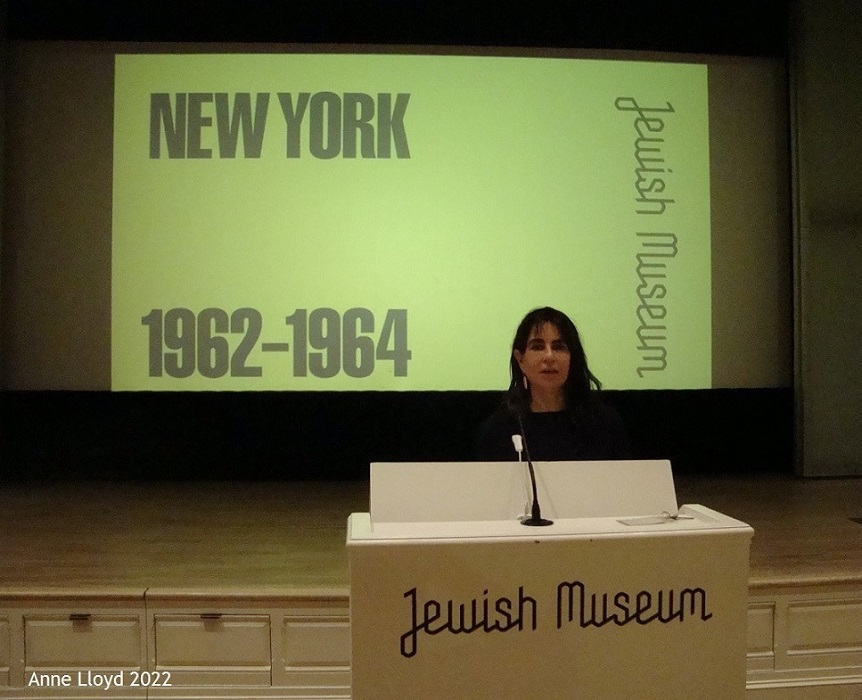
Alan Solomon (1920-1970) had less than three years at the Jewish Museum of New York to propel the rather staid museum into the vanguard of 1960's-style Modernism. The board of directors of the Jewish Museum were often perplexed by the dynamic Solomon's support for up-and-coming artists like Richard Rauschenberg, Roy Lichtenstein and Marjorie Strider. But as shown in the sensational 2022 exhibit, New York, 1962-1964, the effect of Solomon's controversial tenure was transformative. 


Anne Lloyd, Photo (2022) 
Gallery view of New York:1962-1964, showing Roy Lichtenstein's Thinking of Him,1963, & Marjorie Strider's Girl with Radish,1963

New York, 1962-1964 shared a feature with all of the exhibitions mentioned here. At least in part, these phenomenal displays of art were planned and organized during the Covid-19 pandemic years. In the case of New York, 1962-1964, preparing the exhibition was made vastly more difficult by the death of the great Italian scholar leading the project. Germano Celent died from Covid-19 before seeing the project to completion. The 2022 exhibition at the Jewish Museum was a worthy testimonial.

2022 is already in the rear-view mirror and there is much to look forward to as we prepare for 2023. I don't have a crystal ball to predict the future events. But, as the sun comes up on a new year and the hard-working staff of the museum PR departments begin to post notices of coming exhibitions, I can share a few tips on what's in store for the coming year.


Anne Lloyd, Photo (2023)
 Winter Dawn and Prism, January 2023

A host of exhibits are being prepared to honor Picasso, fifty years after his death in 1973. The Guggenheim has one planned, Young Picasso in Paris, May 12, 2023 - August 7, 2023. Georgia O’Keeffe: To See Takes Time will debut at MOMA, April 09, 2023 – August 12, 2023. An exhibition of ancient art, which I am particularly looking forward to, entitled Tree and Serpent, Buddhist Art in Early India, is scheduled to open July 17, 2023 - December 3, 2023 at the Met. 

I have all three of these exhibits marked on my calendar, but I am finding it hard to let go of the fabulous 2022 exhibitions, especially since some still have a few weeks to go and I have reviews to post!

So, let's take a few more moments to reflect on 2022. Let's summon up our memories of great art and great people. Let's not rush by, ignoring The Angel of the Resurrection and other memorials and testimonials to those who have sacrificed so much for our welfare.


Anne Lloyd, Photo (2022) 
 Gallery view of Matisse in the 1930's, showing two versions of Henri Matisse's Window at Tahiti, 1935

I am going to pause and meditate on the miracle of human creativity. I am going to sit down and meditate, like the fellow in the jaunty jacket at the Matisse in the 1930's exhibit (above). 

 "Let Freedom Ring!" That is what the letters spell-out on his colorful jacket. I am going to take some time to think on those words, to remember and to be grateful for the gifts of art and life and liberty. 

***

Text: Copyright of Ed Voves, all rights reserved                                      Images copyright of Anne Lloyd, all rights reserved.

Introductory Image: Anne Lloyd, Photo (2022) Walker Hancock's The Angel of the Resurrection (detail) from the Pennsylvania Railroad World War II Memorial, 30th Street Station, Philadelphia, PA., August 10, 1952. 

Anne Lloyd, Photo (2022) Gallery view of Edward Hopper's New York at the Whitney Museum, showing Edward Hopper's Self-Portrait,1925–30. Oil on canvas: 25 3/8 × 20 3/8 in. (64.5 × 51.8 cm). 

Anne Lloyd, Photo (2022)  Gallery view of the Barnes Foundation, Philadelphia, PA., showing Henri Matisse's The Dance mural, 1932-33.

Anne Lloyd, Photo (2022) The Pennsylvania Railroad World War II Memorial. Walker Hancock's Angel of the Resurrection, sculpted, 1950, and dedicated, August 10, 1952 at 30th Street Station, Philadelphia, PA. Bronze statue: 28 ft (8.53 m.) on 11 ft. (3.35) black granite base. The base has two inscribed dedications and four bronze plaques listing the  1,307 Pennsylvania Railroad employees who were killed in World War II.

Anne Lloyd, Photo (2022) Gallery view of the Philadelphia Museum of Art, showing patrons viewing Claude Monet's Japanese Footbridge and the Water Lily Pool, Giverny, 1899.

Anne Lloyd, Photo (2022) Interior view of the Philadelphia Museum of Art, December 28, 2022, showing patrons waiting to see the Matisse in the 1930's exhibition

Anne Lloyd, Photo (2022) Gallery view of Edward Hopper's New York, showing Hopper's House at Dusk, 1935.

Ed Voves, Photo (2022)  Gallery view of The Tudors: Art and Majesty, showing Patron viewing Hans Eworth's Mary I, 1554. Collection of the Society of Antiquaries, London

Anne Lloyd, Photo (2022) Gallery view of Winslow Homer: Crosscurrents at the Metropolitan Museum of Art

Anne Lloyd, Photo (2022) Winslow Homer's A Sharp-Shooter on Picket Duty (detail), 1863. Oil on canvas: 12 1/4 x 16 1/2 in. Portland (Maine) Museum of Art #1992.41

Anne Lloyd, Photo (2022) Winslow Homer's The Gale, 1883-1893. Oil on canvas: 30 1/4 x 48 5/16 in. (76.8 x 122.7 cm)  Worcester Museum of Art, Museum Purchase. #1916.48

Ed Voves, Photo (2022) Winslow Homer's The Gulf Stream, 1899. Oil on canvas: 28 1/8 x 49 1/8 in. (71.4 x 124.8 cm). The Metropolitan Museum of Art

Anne Lloyd, Photo (2022)  Gallery view of the Matisse in the 1930's exhibition at the Philadelphia Museum of Art, showing The Chant Fireplace mural (1938) painted by Matisse for Nelson Rockefeller.

Anne Lloyd, Photo (2022) Gallery view of the Modigliani Up Close exhibition at the Barnes Foundation, showing Amadeo Modigliani's Head, 1911-12. Limestone: 25 x 6 x 8 1/4 in. ( 63.5 x 15.2 x21 cm.) Guggenheim Museum. #55.1421

Anne Lloyd, Photo (2022) Gallery view of New York:1962-1964, showing Roy Lichtenstein's Thinking of Him, 1963. Collection of Yale University Art Gallery, New Haven, and Marjorie Strider's Girl with Radish,1963. Ruth and Theodore Baum Collection.

Anne Lloyd, Photo (2023) Winter Dawn and Prism, January 2023. 

Anne Lloyd, Photo (2022)  Gallery view of the Matisse in the 1930's exhibition at the Philadelphia Museum of Art, showing two versions of Henri Matisse's Window at Tahiti, 1935.


Tuesday, July 26, 2022

Art Eyewitness Review: New York: 1962-1964 at the Jewish Museum, New York City


New York: 1962-1964  

Jewish Museum, New York City

July 22, 2022 - January 8, 2023

Reviewed by Ed Voves

Original Photography by Anne Lloyd

One Thousand Days. This was the title of one of the most praised and popular non-fiction books of the 1960's. Written by Arthur Schlesinger Jr., One Thousand Days chronicled President John F. Kennedy's administration, from his inauguration in January 1961 to the fatal Friday in Dallas, November 22, 1963.

The Jewish Museum in New York City has just opened a brilliant and ambitious exhibition surveying the American art scene during a similar span of the early 1960's. The chronology is not an exact fit, but it's close. The years covered by the exhibition extend from 1962 to 1964.

Why these three years? The course of events during this period marked the  abrupt transition from the ironclad ascendancy of Abstract Expressionism to the wide-open, consumer-conscious theater of Pop Art. Social ideals, in keeping with the political goals of President Kennedy's New Frontier and the Civil Rights movement, likewise made their presence felt.


Anne Lloyd, Photo (2022) 
Gallery view of New York:1962-1964 at the Jewish Museum, showing Donald Judd's Untitled,1963

New York: 1962-1964 is a big, colorful art show, currently spread over two floors at the Jewish Museum. The exhibition guides us through these eventful years with major works of art and provocative gallery texts about the role of culture in American society. 

Yet, there is nostalgic touch to New York: 1962-1964 which will appeal to those old enough to remember the Camelot years - and to later generations still affected by its mystique. 


                                       Anne Lloyd, Photo (2022)                                               Gallery view of New York:1962-1964, with a vintage jukebox,        courtesy of New York Jukebox

The exhibit opens by displaying a jukebox, that potent symbol of Sixties pop culture. 


Pick a song. "Love is a Swingin' Thing" by the Shirelles? "Leader of the Pack" by the Shangrilas? The curators of the Jewish Museum selected a soundtrack of "hit tunes" which will have you dancing through the first floor galleries.

Then, on the second floor, the mood changes. A poignant and powerful array of JFK-related memorabilia and works of art awaits. As with the actual events, 59 years ago, the shocking assassination of President Kennedy casts a sense of mourning over the rest of the exhibition.


Anne Lloyd, Photo (2022) 
Walter Cronkite Reporting the Assassination of President Kennedy; Andy Warhol's Jackie Frieze (detail), 1964

A six minute video-loop of Walter Cronkite, grappling with his emotions as he announced the death of President Kennedy, and Andy Warhol's Jackie Frieze are on view. Both are still heart-wrenching after all these years.

At this point, we should ask a further question related to the years, 1962-1964. Why did the Jewish Museum decide to focus on these "thousand days" of art for a major exhibition? The answer can be found in the dynamic role of the Jewish Museum itself during this period.

In March 1962, a much-anticipated display of drawings and paintings by Willem de Kooning opened at the Sidney Janis Gallery. Surprisingly, the show occasioned hostile criticism and poor sales. A few months later, the Janis Gallery tried a different tack with an exhibit highlighting younger artists, entitled New Realists.

The exhibition opened on October 31, 1962, only days after the Cuban Missile crisis. The New York art scene was sharply divided as Pop Art came to town with Andy Warhol's 200 Campbell Soup Cans leading the charge. The New York Times styled New Realists as "mad, mad, wonderfully mad" but "welcome." The "Ab-Ex" establishment, however was infuriated, with Mark Rothko, Robert Motherwell and others severing ties with the Janis Gallery.

Navigating his way through this crossfire of contention, Dr. Alan Solomon (1920-1970) took over the directorship of the Jewish Museum in July 1962. His two-year tenure at the museum anchors the time-line of this exhibition.


Anne Lloyd, Photo (2022) 
Alan Solomon being interviewed at the Venice Biennale, June 27, 1964

An outstanding scholar and curator, Solomon turned the Jewish Museum into a major forum for appreciating modern art. Solomon had a keen insight into the art of his own era and promoted young, innovative artists. He mounted exhibitions of the work of Robert Rauschenberg (1963) and Jasper Johns (1964) at the Jewish Museum. These were watershed events at the time and, decades later, provide the foundation for New York:1962-1964.


Hans Namuth, Photo (1963) 
Gallery view of the Jewish Museum's Robert Rauschenberg exhibit 

Art works by Rauschenberg and Johns figure prominently in the Jewish Museum exhibit. What especially impresses me, however, is the diversity of artists included in the show, not just the big names, and the strikingly off-beat curatorial values. Both were hallmarks of Solomon's methodology at the Jewish Museum.


  Anne Lloyd, Photo (2022) 
Robert Rauschenberg's Talisman, 1958

Solomon had particular regard for Rauschenberg's "combines." These were created from a wide-variety of materials, pieced-together to evoke moods and modes of life, often defying easy comprehension.

Such works, Solomon stated in an influential 1963 essay, were rooted in an "intense passion for direct experience, for unqualified participation in the richness of our immediate world."

There can be no better description or summing-up of the works of art on view in New York: 1962-1964.

A huge, multi-paneled oil painting entitled The Eye of Lightning Billy dominates the first gallery of the exhibition. Painted by an Oklahoma-born artist named Harold Stevenson, it appeared in the New Realists exhibition in October 1962. An impressive, if alarming, work, this depiction of the eye of a Native American cowboy leaves the viewer wondering just who is watching whom.


 Anne Lloyd, Photo (2022) 
Harold Stevenson's The Eye of Lightning Billy, 1962

We are left to question too about the identity of this work. Is The Eye of Lightning Billy a Realist painting?  Is it Pop Art or perhaps Surrealism? All or none of the above?

For Solomon, works like The Eye of Lightning Billy did not fit securely into a narrowly defined artistic canon or "school." And that is exactly what he wanted, art which was drawn from everyday life, “familiar, public, and often disquieting.” 

Solomon referred to the works he promoted at the Jewish Museum as the  "New Art." This was a revival of the title initially used to describe the paintings of Monet, Renoir and Pissarro by the critic Edmund Duranty in 1874, before the originally scornful term, Impressionism, was adapted as a badge of honor. Like his nineteenth century forebearers, Solomon championed art that was experimental and expressive, yet rooted in the "here and the now."


  Anne Lloyd, Photo (2022) 
Louise Nevelson's Sky Cathedral’s Presence I, 1959-1962

That, at least initially, was the backdrop for Louise Nevelson's ominous Sky Cathedral’s Presence I, created over the course of 1959–62. Nevelson watched the destruction of New York City's working class neighborhoods to make way for the "urban renewal" plans of Robert Moses. 

After being evicted from her residence in the Kips Bay neighborhood of New York City, Nevelson responded to Moses' "slum clearance," by collecting  castaway objects, just as Rauschenberg was doing. With these and thick layers of black paint, Nevelson created Sky Cathedral’s Presence I. 


     Anne Lloyd, Photo (2022) 
Louise Nevelson's Sky Cathedral’s Presence I (detail)

Nevelson's art, however, was not merely reactive. Sky Cathedral's Presence I was deeply grounded in spiritual ideals. With this powerful sculpture, and similar works produced over the following years, Nevelson aimed to reach "the in-between places, the dawns and dusk, the objective world, the heavenly spheres, the places between the land and the sea." 

For many people during  the early 1960's, the image of "heavenly spheres" did not have much to do with "in-between places." Rather, they thought in terms of the Project Mercury rockets which launched NASA astronauts like John Glenn into orbit. Except for a fortunate few able to travel to the beaches near Cape Canaveral, watching the Project Mercury lift-offs was done from a reclining armchair positioned in front of a television set. 


        Anne Lloyd, Photo (2022)
 Gallery view of New York:1962-1964, showing period furnishings, including Eames Chair & Ottoman and Magnavox television

The idea of "home entertainment centers" with wide-screen monitors and Dolby Sound was beyond the wildest dreams of all but a few tech-savvy engineers during the 1960's. But to watch a NASA rocket blasting into Outer Space on a TV in your living room was still a big deal. 

The impact of television was felt everywhere in the Sixties' art world. Rauschenberg embraced the televised, black and white drama of a NASA space launch in Glider. 


   Anne Lloyd, Photo (2022) 
Robert Rauschenberg's Glider, 1962

Not surprisingly for a work by Rauschenberg, one really has to search Glider to find the rocket blasting-off, positioned just above a human hand on the left hand side of the canvas.

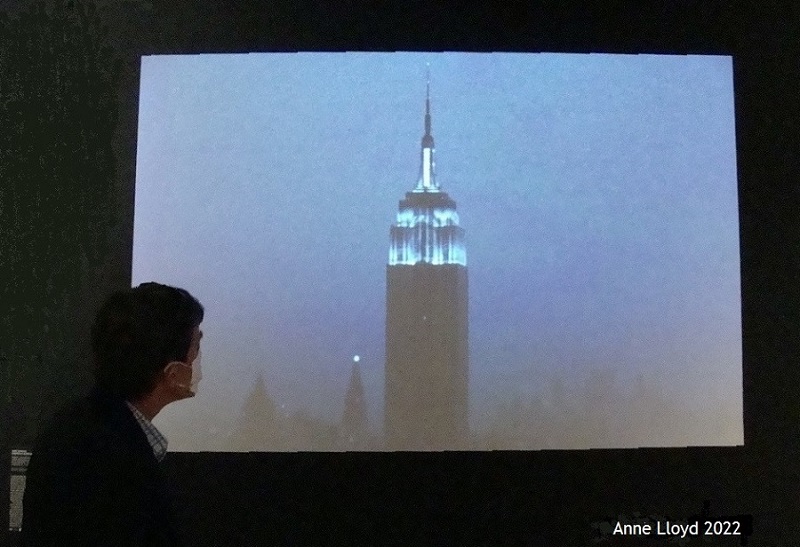
If Rauschenberg engaged with television, Andy Warhol's Empire reacted in direct contrast. In many an American home, the "boob tube" droned relentlessly from morning till midnight. Warhol directed a 16 mm camera to record what everyone was missing while they watched TV - the effect of light, natural and electric, as reflected on and around the spire of skyscraper.


Anne Lloyd, Photo (2022)
 Andy Warhol's Empire, 1964

The skyscraper was, of course, the Empire State Building, making for a dramatic setting. Nothing much happened,however, in the eight-hour filming session, the sun set and the building lights came on. Yet, Warhol and his film-making partners, Jonas Mekas and John Palmer, had captured a moment of astonishing transcendence - "as though the world had been recreated" to quote an appreciative critic. 

Thanks to the curators of New York: 1962-1964, we are able to relive that moment.

Few people have the time or patience to watch an eight-hour film. For most Americans of Warhol's era, it was the appliances and accoutrements of their "Affluent Society" that interested them. The Jewish Museum curators have done a terrific job in evoking the material culture of the early 1960's, clock radios, electric coffee pots, slick magazines and stylish apparel like Evelyn Jablow's Fold-Up Dress for a Portable Society (1964). 


Anne Lloyd, Photo (2022)
 1960's Kitchen appliances: Lloyd’s high fidelity AM/FM tube radio, an Osterizer Beehive blender and General Electric's two-slice toaster

Another dress appeared the same year, 1964, as the Fold-Up: the topless Monokini bathing suit. Designed by Rudi Gernreich, it was intended as a protest against America's puritanical values (according to Gernreich). Whether that was true - or just a clever sales technique - the advertisement and sale of the Monokini led to a storm of controversy. 


Anne Lloyd, Photo (2022) 
            From left: Rudi Gernriech's Monokini, Geoffrey Beene's  Evening Dress & Evelyn Jablow's Fold-Up Dress for a Portable Society 

GIven the sheer number of topics covered in New York, 1962-1964, the Jewish Museum curators wisely avoid detailed commentary on these debates. But the Monokini's inclusion in the exhibition does set the stage for art works by woman artists who very much wanted to protest against the treatment of the female body as an "object" available at your local newstand in "pin-up" magazines. 

Marjorie Strider and Marisol Escobar, in different ways, asserted the right of women to define own identities, free from societal expectations or male desires..


        Anne Lloyd, Photo (2022) 
                     Roy Lichtenstein's Thinking of Him, 1963, at left,                     and Marjorie Strider's Girl with Radish,1963

Strider's Girl with Radish, 1963, appeared in a 1964 exhibit, The First International Girlie Show, along with works by Roy Lichtenstein, Andy Warhol and. Rosilyn Drexler, who is also featured in New York: 1962-1964. "Girlie Show" was one of the first Pop exhibits and many critics regarded Strider's painting - and Pop generally - as a stunt rather than serious art. Strider, however, was not joking with her confrontational reworking of comic book sexuality.

Kristina Parsons, one of the Jewish Museum curators of New York, 1962-1964, comments on Strider's "engagement with the power dynamics of voyeurism." Strider, Parsons notes, "combines a kind of sly humor and a little bit of bite. Strider often features women who are staring deliberately out at the viewer, rejecting the one-directional gaze of an often male viewer consuming a female's image."


Anne Lloyd, Photo (2022)
 Marisol (Marisol Escobar) Self-Portrait, 1961-62

Marisol Escobar, or simply Marisol, joined with Rauschenberg and Nevelson in reusing debris from the "throw-away" society around her as source material for her art. She even somehow found human teeth to use in the mouths of the figures comprising the identities of her Self-Portrait.


Anne Lloyd, Photo (2022)
 Marisol's Self-Portrait (detail), 1961-62

Just who are these enigmatic folks? Only one of the seven faces looks like Marisol herself. Two, maybe three, are male and who the duck-billed creature might be is anyone's guess. Do they represent various facets of Marisol's personality?

Perhaps the best explanation for this remarkable work of art is that Marisol created it to deliberately leave us guessing. While we are scratching our heads in bemusement, Marisol affirms that she - and she alone - defines her own, true, identity.

Artistic statements are, for the most part, personal manifestos. Most of the works on the first floor galleries of New York: 1962-64 are individual responses to events transpiring during those incredible years. But art has a community, collegial "ethic" and the Jewish Museum exhibition does not neglect this aspect of the early 1960's.


Anne Lloyd, Photo (2022)
 Gallery view of New York:1962-1964,
 showing Robert Rauschenberg costumes for Antic Meet

Modern dance played a major role in the New York cultural scene during the 1960's. Although Solomon was not directly involved with dance, Rauschenberg was. He designed costumes for Merce Cunningam's  company, provided sets and choreography for the Judson Dance Theater and even danced himself in one production, on roller skates with a parachute suspended on his shoulders!


  Anne Lloyd, Photo (2022) 
 Isamu Noguchi's Shrine of Aphrodite for the ballet Phaedra

The Jewish Museum exhibits several of Rauschenberg's costumes for Merce Cunningham's Antic Meet. Also on view is the spectacular stage prop, the Shrine of Aphrodite designed by Isamu Noguchi for the controversial 1962 ballet, Phaedra, by Martha Graham.

Artists, acting with a sense of community, found unity in social action, which in turn led many to create powerful works of art supporting the Civil Rights Movement. Most of the artists whose works are on view in New York: 1962-1964, lived and worked in run-down areas of Lower-Manhattan. Labeled the "Loft Generation" they had a natural sympathy with African-Americans battling against segregation and discrimination.


Anne Lloyd, Photo (2022)
 Faith Ringold's American People #4: The Civil Rights Triangle, 1964

The extensive array of art related to the Civil Rights era, on view in New York: 1962-1964, is truly impressive. Paintings by Faith Ringold and Norman Lewis, photos by Bruce Davidson and Roy De Carava, videos of the the "I have a Dream Speech" and an interview with Malcolm X make these galleries a virtual exhibition is its own right.


  Anne Lloyd, Photo (2022)
 Reginald Gammon's Freedom Now! (Detail), 1963

Although not as well known today as Lewis or Ringold, Reginald Gammon was a great artist and a dedicated Civil Rights activist. Born in Philadelphia, Gammon settled in New York city after World War II service in the Navy. His Freedom Now!, a splendid evocation of the spirit of the Civil Rights movement, appeared in a major exhibition at the Christopher Street Gallery in 1965.

Gammon's Freedom Now! embodied the "spirit of the age" of the early 1960's America. This positive, almost unquestioned, belief in ourselves and our ability to overcome our failings and realize our nation's destiny, was real and widespread. And this sense of confidence and "mission" suffered a terrible, if not fatal, wound on November 22, 1963.

As I mentioned earlier in this review, the array of art and artifacts related to President Kennedy's murder and America's prolonged anguish is deeply moving.

It was only after we returned from the Jewish Museum and examined Anne's photos that we noticed a strange effect of light and reflection on one of pictures. In a amazing way, impossible to plan or orchestrate, one image was mirrored in another to create a new image with its own special impact. 


  Anne Lloyd, Photo (2022) 
Cover of LIFE magazine, November 29, 1963

Looking at a photo of the LIFE magazine dedicated to the memory of President Kennedy, we saw reflected the somber face of Walter Cronkite announcing Kennedy's death, joined in a photo montage effect. This left Anne and I shaking our heads in wonderment.  It was a compelling and chilling image all in one. 

New York: 1962-1964 is a magnificent exhibition. The curators at the Jewish Museum have brought back to life a short-lived era of exceptional achievement. Their task in preparing the exhibition was made vastly more difficult by the death of the great Italian scholar who had planned and organized New York: 1962-1964. Germano Celant, died from Covid-19 before seeing the project to completion. Judging from the emotion in the voice of Claudia Gould, director of the Jewish Museum, as she spoke of Mr. Celant at the press preview, his death was a great loss.


Anne Lloyd, Photo (2022)
 Claudia Gould, Director of the Jewish Museum, July 20, 2022

One can only admire Ms. Gould and the staff of the Jewish Museum, all the more, for completing the preparation of New York: 1962-64 and sharing it with lovers of art.

And what of Dr. Alan Solomon, the guiding mind and directing hand for much of what we see celebrated in New York: 1962-1964? 

Sadly, Alan Solomon too was cut-down in his prime, dying from a heart attack in 1970, aged 49. His death, like JFK's, left a void of unrealized promise, never to be fulfilled.

**
Text: Copyright of Ed Voves, all rights reserved                                                             
Images copyright of Anne Lloyd, all rights reserved.

Additional images, courtesy of the Jewish Museum, NYC. 

Introductory Image: Anne Lloyd, Photo (2022) Marjorie Strider (American, 1931-2014) Girl with Radish, 1963. Acrylic on laminated pine on Masonite panels  Ruth and Theodore Baum Collection.

Anne Lloyd, Photo (2022) Gallery view of New York:1962-1964 with showing Donald Judd's Untitled, 1963. Fabricated, 1988. Cadmium red light oil on wood and purple enamel on aluminum tube. Judd Foundation, New York 

Anne Lloyd, Photo (2022) Gallery view of New York:1962-1964, showing a vintage Jukebox, courtesy of New York Jukebox.

Anne Lloyd, Photo (2022) Walter Cronkite Reporting on the Assassination of President John F. Kennedy, November 22, 1963. CBS Video, black and white, sound, 6 min., 22 sec. CBS News Archives. 

Anne Lloyd, Photo (2022) Andy Warhol's Jackie Frieze (detail) Jackie Frieze, 1964. Silkscreen on linen: Museum of Contemporary Art, Chicago, gift of Beatrice Cummings Mayer 

Anne Lloyd, Photo (2022) Ruggero Orlando interviewing Alan Solomon as part of a newscast covering the Thirty-Second Venice Biennale, June 27, 1964. Broadcast by Rai (Radiotelevisione Italiana) Video, black and white, sound, 3 min., 18 sec.

Hans Namuth, Photo (1963) Robert Rauschenberg at the Jewish Museum. Installation Image. Courtesy of The Jewish Museum, New York.

Anne Lloyd, Photo (2022) Robert Rauschenberg (American, 1925-2008) Talisman, 1958. Combine: oil, paper, printed paper, printed reproductions, wood, glass jar on metal chain, and fabric on canvas. Des Moines Art Center

Anne Lloyd, Photo (2022) Gallery View of New York:1962-1964, showing Harold Stevenson's The Eye of Lightning Billy, 1962. Oil on canvas, 6 joined panels 120  x 180 inches (305 x 47 cm) Collection of the Harold Stevenson Family

Anne Lloyd, Photo (2022)  Louise Nevelson's Sky Cathedral’s Presence I, 1959-1962. Painted wood and found objects: 107-120 1/8 x 21 ½ in. Fine Arts Museums of San Francisco.

Anne Lloyd, Photo (2022) Gallery view of New York:1962-1964, showing period room furnishings, including Eames Chair (Model 670) & Ottoman and Magnavox television.

Anne Lloyd, Photo (2022) Robert Rauschenberg's Glider, 1962. Oil and silkscreen ink on canvas, Menil Foundation, Houston 

Anne Lloyd, Photo (2022) Andy Warhol's Empire, excerpt of reel 1, 1964. 16mm film transferred to digital video, black and white, silent, excerpt 50 min., original 8 hr., 5 min. Andy Warhol Museum, Pittsburgh

Anne Lloyd, Photo (2022) Gallery view of New York:1962-1964, showing period kitchen appliances, including Osterizer Beehive blender, Model 238, General Electric two-slice toaster, Model GE A7T86, and Lloyd’s high fidelity AM/FM tube radio, Model TM-8384.

Anne Lloyd, Photo (2022)  Rudi Gernreich's Monokini, 1964 (Wool knit and elastic, produced by Harmon Knitwear) Kent State University Museum; Geoffrey Beene's Evening Dress, 1964. (Silk) Musée Mode et Dentelle de la Ville de Bruxelles, Belgium; Evelyn Jablow's, Fold-Up Dress for a Portable Society, 1964 (Silk) Cincinnati Art Museum.

Anne Lloyd, Photo (2022) Roy Lichtenstein's Thinking of Him, 1963. (Magna on canvas. Yale University Art Gallery, New Haven, and Marjorie Strider's Girl with Radish.

Anne Lloyd, Photo (2022) Marisol (Marisol Escobar) Self-Portrait, 1961-62. Wood, plaster, marker, paint, graphite, human teeth, gold, and plastic: 43 1/2 x 45 1/4 x 75 5/8 in. (110.5 x 114.9 x 192.1 cm) Museum of Contemporary Art Chicago, Chicago, IL.Gift of Joseph and Jory Shapiro. 

Anne Lloyd, Photo (2022) Gallery view of New York:1962-1964, showing Robert Rauschenberg costumes for Antic Meet. Tattooed tank top, bear or bison fur coat, and parachute dress. Walker Art Center, Minneapolis, Merce Cunningham Dance Company Collection. 

Anne Lloyd, Photo (2022) Gallery view of New York:1962-1964, showing Isamu Noguchi's Shrine of Aphrodite for Martha Graham’s ballet Phaedra. Original, 1962, exhibition copy 2021. Wood, metal, and canvas. Noguchi Museum, New York

Anne Lloyd, Photo (2022) Faith Ringold's American People #4: The Civil Rights Triangle, 1964. Oil on canvas: 36 3/16 x 42 ⅛ inches (92 x 107 cm) Glenstone Museum, Potomac, Maryland.

Anne Lloyd, Photo (2022) Reginald Gammon's Freedom Now! (Detail), 1963. Acrylic on board. National Afro-American Museum and Cultural Center, Wilberforce, Ohio

Anne Lloyd, Photo (2022) Gallery view of New York:1962-1964, showing LIFE magazine, November 29, 1963.  

Anne Lloyd, Photo (2022) Claudia Gould,Director of the Jewish Museum, New York City, July 20, 2022.