Tuesday, April 22, 2014

Lost Kingdoms: Hindu-Buddhist Sculpture at the Metropolitan Museum of Art


Lost Kingdoms: Hindu-Buddhist Sculpture of Early Southeast Asia,        
5th to 8th Century

Metropolitan Museum of Art, New York City
April 14, 2014–July 27, 2014

Reviewed by Ed Voves

There are few places in the world as extraordinary as the ancient site of Angkor in Cambodia. Many of the temples and shrines at Angkor are gripped by huge, boa-constrictor-like roots of strangler fig trees. The scene, familiar to readers of National Geographic or Smithsonian Magazine, is truly remarkable. But the cultural roots that led to the founding of Angkor Wat are even more remarkable.

The new exhibition at the Metropolitan Museum of Art, Lost Kingdoms: Hindu-Buddhist Sculpture of Early Southeast Asia, 5th to 8th Century, documents how this flowering of sacred art took place in a corner of the world that was regarded as little more than a stepping stone to China.

Lost Kingdoms: Hindu-Buddhist Sculpture of Early Southeast Asia features 160 sculptures, created in various media including stone, terracotta and bronze. Many of them have never before appeared in the West. Cambodia, Vietnam, Thailand and Malaysia contributed numerous works to the exhibition. Several were lent by the government of Myanmar (the former Burma), the first time that this nation has collaborated in an international art exhibition.


Khin Ba Relic Chamber Cover, Myanmar 

These works of art from first millennium Southeast Asia are - almost without exception - of inexpressible beauty and serenity. Some - like the exquisite terracotta Head of Meditating Buddha from the National Museum, Bangkok - rank as iconic national treasures.


Head of Meditating Buddha 

The wonder is that these works were loaned even to such a prestigious institution as the Metropolitan Museum. To grasp the magnitude of the quality and number of the masterpieces of Asian art on display in Lost Kingdoms, one would have to conceive of an exhibition of Renaissance art featuring the Louvre's version of Leonardo's The Virgin of the Rocks, The Birth of Venus from the Uffizi and Titian's Bacchus and Ariadne from the National Gallery in London.

The standing sandstone Buddha from Thailand, which serves as the exhibition's promotional image, is representative of the exceptional caliber of the works of art in Lost Kingdoms. Lent by the National Museum, Bangkok, this contemplative Buddha dates to the first decades of the seventh century.


Buddha, Thailand

In keeping with the traditional elements of Buddhist iconography, this Buddha is depicted with closed eyes and elongated earlobes, the result of having worn heavy earrings before renouncing the use of jewelry. The polished texture of the statue recalls two of the lakshanas, or distinguishing body features that testify to the Buddha's spiritual nature, namely the smooth and shining skin of the Buddha.

One of the key aspects of Lost Kingdoms is the diversity of the depictions of the Buddha. These differences are due in part to regional or cultural interpretations that could be expected from the wide geographical range of the exhibition. However, some of the variations are of a more primal nature, revealing differing conceptions of the nature of God.

The Buddha from Thailand exudes a feminine character of divinity that is strikingly dissimilar to the virile, broad-shouldered Buddha Offering Protection from the National Museum of Cambodia.


Buddha Offering Protection

Created slightly earlier during the second half of the sixth century, this portrayal of the Buddha manifests the strength and redemptive traits that are also features of several statues of Vishnu on display in the exhibition.

The dramatic title of the exhibition, Lost Kingdoms, is entirely appropriate. For large stretches of time, these beautiful works of art were all but lost to view. Even the great temples and shrines of Southeast Asia had retreated before the spread of new religions and the encroaching rain forest.

Borobudur, on the Indonesian island of Java, is the site of the largest Buddhist temple complex in the world. But after Indonesia's conversion to Islam in the 1300's, this holy shrine, built in the ninth century, became the "stuff of legend." In 1814, the British explorer and founder of Singapore, Sir Thomas Stamford Raffles, was told of its existence by local inhabitants. Likewise, Angkor Wat languished unknown to the outside world until "discovered" by an intrepid French scholar, Henri Mouhot, in 1858.

The arrival of Hinduism and Buddhism in Southeast Asia is even more shrouded in mystery. Wandering Buddhist missionaries and Brahman priests, Hindu merchants and people of noble status brought these great faiths to the lands of Southeast Asia. Angkor, originally a Hindu temple complex, was built by a royal dynasty which came to Cambodia from Java.

The arrival of Hinduism and Buddhism in Southeast Asia was not a matter of passive acceptance. The Khmer Empire of Cambodia, the Champa Kingdom in Central Vietnam, the Pyu city states in Myanmar and the Dvāravatī state in Thailand (which may have been a confederation of independent city states) were vigorous political entities who effectively utilized their position on the trade routes from India to China. But these states did not have sophisticated religious cults to match their political and economic power, making them fertile ground for the great faiths from India.

The earlier animistic cults of Southeast Asia did not give way without resistance. But Hinduism and Buddhism, sometimes in a competitive relationship, could not be denied. The statue of the Hindu goddess, Durga Mahishasuramardini, depicts her standing on the corpse of the Buffalo demon which represents the displaced cults.


                                                                         Durga

This depiction of Durga, from Cambodia, dates from the late seventh to early eighth centuries. Durga, one of the supreme deities in the Hindu pantheon, here radiates a transcendent power combined with beauty that accounts for the appeal of the Hindu gods to the ruling elites of Southeast Asia.

Another of the exhibition's most powerful works of art is devoted to Krishna, the eighth avatar or incarnation of Lord Vishnu. This sculpture is the Krishna Govardhana, from the early seventh century. In 1944, it was discovered in fragments in a cave near the site of the ancient city of Phnom Da in southern Cambodia.


Krishna Govardhana     

According to Hindu mythology, Krishna saved villagers and their cattle from destruction by the vengeful god, Indra, who sent a typhoon to destroy them. Krishna lifted a mountain, Govardhan, and held it aloft over the people and animals to fend-off the storm. This is a frequently depicted incident in Indian art and in some respects is a counterpart to the story of Noah in the Jewish and Christian scriptures, representing the providential power of God.


The Krishna Govardhana from the National Museum of Cambodia, even in its fragmentary condition is remarkably powerful. The expression on Krishna's face recalls the unearthly "archaic smile" of an ancient Greek kouros statue from the sixth century BC. Just as the Greek kouros beamed with an expression of the virtuous character or arete of the hero or god depicted, so too does Krishna as he faces down the vengeful Indra. The smile of Krishna Govardhana radiates his benevolence towards humanity and his confidence in beating back the forces of cosmic disorder and irrational behavior.

Indeed, the overwhelming sensation that one has when beholding these Buddhist and Hindu sculptures is that they represent a key moment in the evolution of the human psyche. Compassion was a rare emotion in the early epochs of humanity. But as you behold these sculptures of meditating Buddhas and beneficent Krishnas, one after the other, the effect is profoundly moving. Here one senses that the spread of Hinduism and Buddhism to Southeast Asia marked the beginning of the globalization of spirituality that, despite theological differences, is uniting the peoples of the Earth.

The concluding gallery is devoted to the Savior Cults of Buddhism. This concept represented a humanization of the religious ideals of Buddhism. It centered on the role of saintly and compassionate beings, the bodhisattvas. Originating in India, the concept of the bodhisattva as an individual seeking enlightenment was widely embraced in Southeast Asia. Regional or national characteristics were grafted on to the original ideal to give it unique manifestations. Bodhisattvas could be male or female, kings or commoners.

Avalokiteshvara is the highest manifestation of the bodhisattva. Dedicated to helping all sentient beings, Avalokiteshvara took a vow to delay his Buddhahood to assist others achieve enlightenment. The stylistic range of the statues depicting this self-sacrificing bodhisattva is very wide indeed, even within the borders of a single country. The exhibit presents two versions of Avalokiteshvara from Thailand that appear to originate from two very different countries or cultures.


Bodhisattva Avalokiteshvara   
                                                                             
 The lean, simply clad Avalokiteshvara, cast in copper alloy, is thought to have been commissioned by an ascetic group, the Sri Canasa, about which very little is known.


Bodhisattva Avalokiteshvara 
                                                                                                       
The second, more elaborate, version was also cast in copper alloy, though it shows traces of gilding. It dates from the late eighth century, only a few decades later. However differently they may appear, both sculptures radiate great spirituality, the power of enlightened dedication to the welfare of all humanity.

It is a sobering thought to realize that the religious values, so powerfully expressed in the sculptures assembled in the Metropolitan exhibit, did not lead to an age of peace and harmony for Southeast Asia. What occurred in Medieval Europe after the adoption of Christianity, happened in these rising kingdoms on the trade routes to China. Kings built vast temples dedicated to Vishnu or Buddha and then marched to war, burning the temples of Vishnu or Buddha built by their rivals.

Nirvana is not of this world. There are moments, though, when transfixed by the beauty and spiritual resonance of this once-in-a-lifetime exhibit, that a state of enlightenment seems not far off.

 
***

Text: Copyright of Ed Voves, all rights reserved

Images Courtesy of Metropolitan Museum of Art, New York City

Introductory Image:

Buddha, Central Thailand, first half of the 7th century Sandstone 67 5/16 × 16 9/16 × 13 in. (171 × 42 × 33 cm) Lent by National Museum, Bangkok (DV6)

Khin Ba Relic Chamber Cover, Sandstone H. 63 3/4 in. (162 cm); W. 55 1/8 in. (140 cm); D. 5 7/8 in. (15 cm); Wt. 1600 lbs. (725.8 kg) Lent by Thiri Khittaya (Śrī Ksetra) Archaeological Museum, Hmawza, Myanmar (1926-27/1/7)

Head of Buddha, Central Thailand, 9th century Terracotta 6 11/16 × 5 7/8 in. (17 × 15 cm) Lent by National Museum, Bangkok (361/2511)

Buddha Offering Protection,
Southern Cambodia, Pre-Angkor period, second half of the 6th century Sandstone with traces of lacquer and gilding Lent by National Museum of Cambodia, Phnom Penh (Ka.1731)

Durga Mahishasuramardini, Southern Cambodia, Pre-Angkor period, late 7th–early 8th century Sandstone 41 3/4 × 16 1/2 × 6 1/4 in. (106 × 41.9 × 15.9 cm) Lent by National Museum of Cambodia, Phnom Penh (Ka.1631) Cat. no. 66
                                                                                                                                                                                                 Krishna Govardhana, Southern Cambodia, Pre-Angkor period, early 7th century Sandstone 47 1/4 × 14 15/16 × 7 7/8 in. (120 × 37.9 × 20 cm) Lent by National Museum of Cambodia, Phnom Penh (Ka.1641)
                                                                                                                                                                                                                                                                                                                                                         Bodhisattva Avalokiteshvara, Northeastern Thailand, second quarter of the 8th century Copper alloy inlaid with silver and glass or obsidian 56 × 22 1/2 in. (142.2 × 57.2 cm) The Metropolitan Museum of Art, Rogers Fund, 1967
                                                                                                                                                                             Bodhisattva Avalokiteshvara, Southern Thailand, late 8th–early 9th century Copper alloy with traces of gilding 30 1/4 in. (76.8 cm) Lent by National Museum, Bangkok (SV24)

Saturday, April 5, 2014

Treasures from Korea at the Philadelphia Museum of Art


Treasures from Korea: Arts and Culture of the Joseon Dynasty, 1392–1910
With Reflections on Landscape Painting, East and West

Reviewed by Ed Voves

The inspiring exhibition currently at the Philadelphia Museum of Art, Treasures from Korea: Arts and Culture of the Joseon Dynasty, 1392–1910, presents works of art from the golden age of a country which sadly has known more of war than peace.
 

During the eighteenth and most of the nineteenth centuries, Korea experienced prosperity and stability rare in its history. The wondrous paintings, ceramics, fabric art and rare books on display in the exhibition are a testament to what the Korean people, ruled by the Joseon Dynasty, were able to achieve when not threatened by foreign invasion or civil war.

Joseon means "Fresh Dawn." But this new beginning for Korea took a long time in coming. The Joseon Dynasty fought nomad attacks from Mongolia early in its history, survived palace coups and defeated a massive invasion by the Japanese warlord, Hideyoshi, during the 1590's. Almost all of the works of art on display date from the 1700's and 1800's.

Treasures from Korea: Arts and Culture of the Joseon Dynasty, 1392–1910, will continue at the Philadelphia Museum of Art until the end of May and then travel to the Los Angeles County Museum of Art and the Museum of Fine Arts, Houston. As a result, a wide audience in the United States will have an opportunity to study the culture of this long-lived Korean dynasty.

The experience of seeing several spectacular landscape screens in the Treasures from Korea exhibit made an especially powerful impression on me. Studying these magnificent evocations of nature revived my interest in the question of how the very different traditions of landscape painting, Asian and European, eventually reached a point of parallel insight, if not outright synthesis.

These Korean landscape screens are monumental in size and astonishing in the artistic skill and verve needed to create them. The late eighteenth century screen, Ten Longevity Symbols, and Sun, Moon, and Five Peaks, an eight-fold screen created during the 1800's, are very colorful. This use of color was a departure from the more muted tones of earlier landscapes, no doubt reflecting the indirect influence of European art via China.


Sun, Moon, and Five Peaks, 19th century

Both Ten Longevity Symbols and Sun, Moon, and Five Peaks are idealized landscapes rather than naturalistic representations of actual topography. This is in keeping with the cultural ideals of Imperial China, dating back to the Tang Dynasty (618-906), which profoundly influenced Korea. Humans, when they appear in Chinese and Korean art, are often depicted as miniature, insignificant beings, dwarfed by the vast scale of nature.

These screen paintings also represent the two paramount ideals of the Joseon Dynasty: the harmony of a well-ordered society based on the teachings of Confucius and the spirit-restoring effects of country living. For the ruling elite of Korea, known as yangban, the natural world represented a refuge from the stress and uncertainties of the political world.


Portrait of Yi Jae (1680-1746)

These scholar-statesmen of the Joseon Dynasty are depicted in several works in the exhibit, particularly Portrait of Yi Jae (1680-1746). This hanging scroll, created with ink and colors on silk, dates to the same period as Ten Longevity Symbols. Yi Jae compiled the essence of the teachings of Confucius into a ready-reference work for public administrators entitled the Easy Manual of the Four Rites.

The Joseon Dynasty took power in 1392 after a long series of civil wars. The Joseon rulers abolished Buddhism as the state religion in order to impose systematic codes of behavior based on Confucianism. Yangban bureaucrats like Yi Jae greatly benefited by the invention of a phonetic Korean alphabet known as hangul by King Sejong, who reigned from 1418–50. For the first time, Korean scholars did not have to depend on Chinese script and could communicate their Confucian laws directly to their people.

Buddhism and the spiritual teachings of Daoism were not expunged from Korean society, however. These religious beliefs and their adherents retreated to the countryside, especially to mountain shrines and temples. In Korea, the countryside, remote from the temptations and dangers of power, was the realm of the spirit.

In Ten Longevity Symbols, you can see how the unknown artist "squared the circle," rendering a landscape that was politically acceptable to the yangban, while extolling spiritual values that could be embraced by all.


Ten Longevity Symbols, 18th century.

Each animal, each tree, the waterfalls and the mountain peaks, even the mushrooms, occupy their proper sphere and represent a unique value in Ten Longevity Symbols. Turtles and evergreen trees symbolize long life; the deer are gentle animals living in harmony. A particularly charming touch is the presence of the white cranes. In Daoist teachings, cranes featured as messengers from Heaven, while in Confucianism they represented the dignity and constancy of scholars. This was a symbol sure to please yangban administrators like Yi Jae.

There were in fact many more symbolical elements in Korean landscape painting, to the degree that almost every animal and plant represented an important spiritual value.

Bamboo branches, which appear as a motif on an exquisite white porcelain vase from the sixteenth century, Korea's National Treasure No. 166, symbolized strength, endurance and adaptability. Bamboo trees bend but do not break even in gale force winds. Such "grace under pressure" earned bamboo trees the nickname of "gentlemen" in Korea, for this was what was expected of the yangban elite. The greatest of Korea's heroes, Admiral Yi Sun-Sin, who defeated the Japanese Samurai during the 1590's war, embodied these traits to perfection.

Peach trees and their succulent fruit likewise symbolized a key facet in Korea's spiritual values: immortality. This belief reached back to the beginnings of Daoism in China, where there was supposedly a mystical peach orchard in the western mountains. Transmitted to Korea, this mythological realm came to figure in one of the greatest of all Korean works of art, the fifteenth century landscape known as Mongyu-dowon-do or Painting of a Journey in a Dream to the Peach Orchard.

Mongyu-dowon-do is not on display in the Treasures from Korea exhibit. But don't blame the curators of the exhibition for this omission. Now in the collection of a Japanese university, the fate of Mongyu-dowon-do reflects the tortured past of Korea.


Dream Journey to the Peach Blossom Land by An Gyeon

Mongyu-dowon-do was painted in 1447 by the gifted artist, An Gyeon, for Prince Anpyeong, (1418-1453), the son of King Sejong, inventor of the Korean alphabet. Prince Anpyeong was a noted scholar of Chinese literature. The painting underlines both China's continuing influence on Korea and the cultural breakthroughs which took place under the Joseon Dynasty.

According to the historical narratives of the period, Prince Anpyeong dreamed of a journey deep into rugged hill country where he eventually discovered a beautiful peach orchard surrounded by mountainous terrain. The peach orchard symbolized refuge from the political infighting at the Joseon court, for Prince Anpyeong was engaged in a struggle for dominance with his brother, Prince Suyang, for control of the throne as King Sejong neared death. The peach trees also represent the survival of Daoism. Daoist spiritual teachings traced their roots back to ancient shamanic beliefs, in a land now ruled according to Confucian secularism.

Prince Anpyeong's vision of a Utopia was never realized - at least not in his abbreviated lifetime. Prince Suyang launched a well-planned coup, executing Anpyeong and numerous other family members, court officials and scholars. The painting by An Gyeon disappeared, later surfacing in Japan. It is believed to have been taken from Korea as part of the war loot seized by Hideyoshi's army in 1592.

If Prince Anpyeong's dream was "a dream deferred," it came close to realization during the eighteenth century. Events like Suyang's bloody purge and Hideyoshi's invasion receded into memory. Landscapes such as Ten Longevity Symbols represented the world that men like Yi Jae wanted to believe was possible - and worked diligently to achieve.

Another amazing screen painting, Scholar’s Accoutrements, is a virtual catalog of the implements of power which the Korean elite used to preserve the traditional culture of their nation. This ten-fold screen was painted in the nineteenth century, just at the moment when the outside world was beginning to intrude into the "golden age" of Joseon Korea.


Scholar’s Accoutrements, 19th century.

These amazing painted screens on display in Treasures from Korea are fascinating and important in their own right. However, there is a wider significance to these works which can only be briefly sketched here.

The Korean view of nature, reflecting the cosmology of East Asia, was very different from what developed in Europe during the 1400s through 1700's. Landscape painting in the West, with only rare exceptions, served as a backdrop to the religious or mythological narratives of European painting from the Renaissance to the era of the French Revolution.

By the end of the nineteenth century, however, the landscape traditions of East and West reflected a meeting of minds. Impressionist painters like Claude Monet often reduced the scale of humans and animals in their paintings in proportion to the expanse of the landscape. Was this the result of Asian influences transforming the European conception of nature?

Chinese art certainly made an impact on Europe during the 1700's. Later, the craze for
Japanese woodblock prints in France helped shape the revolutionary impact of Impressionism. But the momentous shift in the way that the West has come to perceive the natural world occurred independently from what had transpired in China and Korea.


Take a look at the 1818 masterpiece by J.M.W. Turner, Raby Castle, the Seat of the Earl of Darlington, now in the collection of the Walters Museum in Baltimore. Turner painted the country estate of the fox-hunting Lord Darlington very much in the scale and the spirit of the landscapes of China and Korea. Yet, Turner created this breathtaking view of the English countryside decades before landscapes from these Asian countries became widely known in the West.


J.M.W. Turner, Raby Castle, the Seat of the Earl of Darlington

Turner's Raby Castle is a dreamscape like Ten Longevity Symbols. Lord Darlington was as determined to preserve "his" lands as a refuge from the outside world, as were the Korean yangban elite. The very year that Turner exhibited this great work, Lord Darlington used his political clout to prevent a railroad being constructed through his estates that might disturb his fox hunting.

The route of the railroad was diverted so that Lord Darlington could continue his pursuit of England's foxes. On September 27, 1825, the re-configured Stockton and Darlington Railway, the world's first public railway using steam locomotives, was inaugurated.

Turner's Raby Castle evokes a key date in the Industrial Revolution. It shows the natural world as English aristocrats wanted it to remain, at the moment just before it would be transformed forever. So too, An Gyeon's Painting of a Journey in a Dream to the Peach Orchard, shows the idealized world view of Prince Anpyeong shortly before he was murdered by his brother in one of Korea's savage civil wars.

Great works of art cannot stop the march of time. But these Korean landscape masterpieces and Western counterparts like Turner's Raby Castle share a kindred view of the sacredness of the earth. Moreover, these great works have helped shaped an appreciation for Planet Earth as a refuge for all humankind - not just yangban bureaucrats or fox-hunting English "milords."

When we look at Ten Longevity Symbols and Raby Castle, the Seat of the Earl of Darlington, we are witnessing early steps in the "journey in a dream" to the greatest landscape of all time, Earthrise, photographed by the Apollo 8 astronaut, Bill Anders, on December 24, 1968.

William Anders, Earthrise-Apollo 8-Dec. 24, 1968

These Treasures from Korea are treasures indeed - for all humanity, talismans of our dream of Earth.

March 2 - May 26, 2014 at the Philadelphia Museum of Art

June 29 - September 28, 2014 - Los Angeles County Museum of Art

November 2, 2014 - January 11, 2015 - Museum of Fine Arts, Houston

*** 


Text: Copyright of Ed Voves, all rights reserved

Images from Treasures from Korea Exhibit Courtesy of the Philadelphia Museum of Art.

Introductory Image:

Jar with Design of Bamboo and Plum Trees, 16th to 17th century. Porcelain with underglaze iron decoration, 15 3/4 x 14 15/16 inches (40 x 37.9 cm). National Museum of Korea, Seoul. National Treasure No. 166.

Sun, Moon, and Five Peaks, Artist/maker unknown, Joseon Dynasty (1392-1910), 19th century, Eight-fold screen; colors on paper, 82 11/16 × 217 7/16 inches (210 × 552.3 cm), Private Collection

Portrait of Yi Jae (1680-1746), Artist/maker unknown, Joseon Dynasty (1392-1910), Late 18th century, Hanging scroll; ink and colors on silk, 38 1/2 × 22 3/16 inches (97.8 × 56.3 cm), National Museum of Korea, Seoul.

Ten Longevity Symbols, 18th century. Ten-fold screen; colors on paper, 98 7/16 × 231 1/8 inches (250 × 587 cm). Private Collection. PMA Only.
                                                          
Scholar’s Accoutrements, 19th century. Ten-fold screen colors on silk, 78 1/4 x 154 3/4 x 4 3/4 inches (198.8 x 393 x 12 cm), each panel: 77 15/16 x 15 1/2 inches (198 x 39.3 cm). National Museum of Korea, Seoul. PMA Only.

 
Additional Images from Wikipedia Commons - Public Domain.                                          

Courtesy of Tenri University, Nara, Japan; Walters Art Museum, Baltimore, MD; NASA (National Aeronautics and Space Administration), Washington D.C.

Dream Journey to the Peach Blossom Land, slight colours on silk by An Gyeon, 1447; in the Tenri Central Library, Tenri University, Nara, Japan. 38.7 cm × 106.5 cm.

J.M.W. Turner, Raby Castle, the Seat of the Earl of Darlington, oil on canvas, 1817, Accession Number 37.41, 46 7/8 x W: 71 1/8 in. (119 x 180.6 cm). Walters Art Museum, Baltimore MD.

William Anders, Earthrise-Apollo 8-Dec. 24, 1968. Photo ID: 68-HC-870. Image Credit: NASA


Wednesday, March 26, 2014

Art Eyewitness Essay: Old Master Insights - Rubens, Rembrandt and Sir Kenneth Clark


Old Master Insights: Rubens, Rembrandt and Sir Kenneth Clark


By Ed Voves

During the great cultural awakening that took place in seventeenth century Holland, the professional association of artists, the Guild of Saint Luke, admitted amateur members known as liefhebbers. Loosely translated, liefhebber means enthusiast, fan or "lover."

Kunstliefhebbers, or "art lovers," paid membership dues to the guild of Saint Luke. Part dilettante, part groupie, a liefhebber could gain insights into art and into the practical realities of the art world denied to the rest of the Dutch citizenry. Liefhebbers were commercially well-positioned also, on the inside track for purchasing new paintings as they became available. The Dutch were almost always astute businessmen, whether or not they were liefhebbers.

I like to use the term "art lover" in my reviews, as it sounds much better than "museum patron" or "gallery visitor." It is also more accurate. Most people who go to art museums on a regular basis really do love art. They are modern day liefhebbers and I like to think of myself as one too.

I have two extraordinary women to thank for nurturing the art lover in me. My mother, Camille McKee Voves, planted a deep-rooted (if slow to bloom) appreciation of art. My wife, Anne Lloyd, is an accomplished artist. The example of her vision and inspired work ethic, in ceramics and portrait painting, constantly informs my reflections on the visual arts. Thanks to both of them, I have come to realize that the "magic" of art is the result of an uncompromising dedication to depicting the world as the artist sees it.

Sir Kenneth Clark, of Civilization fame, also deserves my "liefhebber" gratitude. If one engages in "name-dropping," why not go with the best?


Portrait of Kenneth Clark

The Tate Gallery in London is preparing an exhibition, opening in May 2014, to explore Kenneth Clark's profound impact on the way that millions of people have come to look upon art and the world. As a writer, scholar and broadcaster, Clark was a worthy successor to the Renaissance humanists he discussed in Civilization way back in 1969.

The final remarks of Civilization, in which Clark reflected upon the promise and perils of the human condition, are among the most moving statements of what it means to be a sensitive, caring person that I know of:

On the whole, I think that knowledge is preferable to ignorance, and I am sure that human sympathy is more valuable than ideology... And I think we should remember that we are part of a great whole, which for convenience sake we call nature. Above all, I believe in the God-given genius of certain individuals, and I value a society that makes their existence possible.
It was a pleasant surprise, recently, to chance upon a book which Kenneth Clark had written back in 1938 while he was the Director of the National Gallery in London. One Hundred Details From the National Gallery was a pioneering correlation of art images and commentary, a liefhebber's delight.

In this wonderful book, republished in a new edition with full color illustrations in 2008, Clark compared aspects of paired paintings from the National Galley collection. His selection of the "details" often highlighted unconventional relationships.

A great student of the way that artists have portrayed the human hand, Clark matched Peter Paul Rubens' Susanna Lunden (1635) with Hans Holbein's Christina of Denmark, Duchess of Milan (1538). Rubens was one of the first great landscape painters, among many other pursuits in his busy life. The "undulating hills and waterfalls" of Susanna Lunden's crossed hands contrasted with the pyramid-shaped form of the hands of Holbein's Duchess Christina as she tightly grips her leather gloves.

Clark wrote that he chose these "details" from the National Gallery's Old Masters "chiefly for their beauty" and because they "have something in common, either of movement and design or of subject and mood."

Clark certainly did not aim at creating controversy through pairing conflicting visions of art. "Great pictures grumble at each other," Clark noted, "insult or even annihilate each other as great men."

I could not resist the challenge of trying out Clark's approach to comparing details of two works of art. I chose two works from the National Gallery of Art in Washington, D.C. These were Rubens' oil on canvas, Deborah Kip, Wife of Sir Balthasar Gerbier, and Her Children (1629/1630) and an etching by Rembrandt, Studies of the Head of Saskia and Others (1636).

Rubens' group portrait and Rembrandt's ensemble of portrait sketches both treat the cycle of life, youth leading to maturity.

In the case of the Rubens' painting, we begin with the baby in the arms of Deborah Kip and follow a succession of her children, each a year or two older, in a circle that leads back to their mother.


Rembrandt van Rijn, Studies of the Head of Saskia and Others (1636)

In Rembrandt's etching, a youthful Saskia is surrounded by a galaxy of portraits of women of various ages, most of whom, if not all, resemble her. This includes an elderly woman who might well have represented in Rembrandt's mind a vision of his young wife in her old age. Saskia, as we know, died in 1642, only few years after this etching was created.

The parallel between these two works, based on the theme of the cycle of life, is only a very loose one. Rembrandt frequently drew or etched works with multiple portrait studies and these may have been intended as nothing more than references for future works, perhaps one with a biblical theme. Clark, in Civilization, observed about Rembrandt's drawings that "one often doesn't know if he is recording an observation or illustrating the scriptures, so much had the two experiences grown together in his mind."

Whatever Rubens or Rembrandt intended with these works, there are comparative "details" in both them that reach out across the centuries and compel our attention. Look closely and you will see two sets of eyes focused directly upon you, one from each picture. The young girl dressed in black, Deborah Kip's daughter, Elizabeth, and "Saskia" wearing the wide-brimmed hat are both intently studying us, with a fixed, deliberate, "knowing" look that is quite unsettling.

 
Elizabeth Gerbier (detail)
Rubens' Deborah Kip, Wife of Sir Balthasar Gerbier, and Her Children
 
In the Rubens' painting, the younger daughter, Susan, is also looking directly at us too, but she is too young to fully comprehend the visual exchange. The black-garbed Elizabeth and Saskia, beneath that extravagant hat, both have taken our measure - and their own. They gaze upon their world without illusion and recognize us as fellow human beings, mortal creatures with strengths and weaknesses, as they were/are.

 
Saskia van Uylenburgh (detail)
Rembrandt, Studies of the Head of Saskia and Others (1636)

Is my reflection merely subjective musing on similar elements of two Old Master pictures? Could I be seeing "eyes" in portraits following me around the room like the ones in creepy, 1940's horror films? Perhaps... not.

My wife, Anne, has noted, that when painting a portrait, she frequently achieves masterly of an eye or a set of eyes early on, during the painting process. A sense of presence or contact is thus achieved, a relationship established between painter and subject that lasts until the picture is finished - and longer.

One eye, Anne observes, frequently is more alert, livelier and more perceptive. Anne calls it the "intense" eye. The other, by contrast, often is a "dull" eye. It is reflective, inwardly focused. The eyes of Rembrandt's Saskia certainly reveal this split focus.


I think that this is true for Ruben's young Elizabeth as well, though more open to interpretation.


One thing is certain about Elizabeth. She has a mature, grown-up countenance far more advanced than we would expect from an adolescent girl. Rubens painted her in this and another other major work while he was visiting London in 1629-30 as the ambassador of the King of Spain and the Spanish government in Belgium. This was the era of the terrible Thirty Years War, a staggering human tragedy which weighed heavily on the mind of Rubens, a peace-loving man, and cast a malign shadow upon the whole population of Europe.

Rubens stayed with Sir Balthasar Gerbier, the father of Elizabeth, during the time he spent in England. As a peace offering from Philip IV of Spain to Charles I of Great Britain, Rubens painted one of his grandiose allegorical works. Minerva Protects Pax from Mars, in the collection of the National Gallery in London, is usually referred to as Peace and War. It is one of the most "Rubenesque" of Rubens' works. It depicts a voluptuous, nude Goddess of Peace being shielded by Minerva or Athena, clad in extravagant armor, from the belligerent "God" of War, Mars.

Peace and War is not much to the modern taste and indeed I held Rubens in low esteem for many years. Fortunately, in 2005, Anne and I saw a great exhibit of drawings and etchings by Rubens at the Metropolitan Museum in New York. The astonishing skill and the inspiring degree of human empathy evident in these works totally changed my appraisal of Rubens.


Peter Paul Rubens, Portrait of George Gerbier (1629/30)

One of the works in the Rubens' exhibit was a sensational portrait of George Gerbier, a preparatory drawing for Peace and War, now preserved in the Albertina Museum in Vienna. George, Elizabeth, and Susan Gerbier (who looks out from this painting with the same innocent, questioning eyes that feature in the National Gallery family portrait) appear in Peace and War, receiving the fruits of peace.

It was Rubens' desire that this allegorical work would indeed promote the fruits of peace. Although Spain and England patched up their differences (both nations were in the process of internal collapse), the Thirty Years War raged on until 1648.

The Gerbier family was among the casualties of this terrible conflict. Rubens painted this family portrait to thank Balthasar Gerbier for his hospitality. Gerbier, a French Huguenot who was the art agent for Charles I, as well as a diplomat, should have followed Rubens' example as a peacemaker.

Instead, Sir Balthasar Gerbier followed a second, clandestine career in keeping with the murderous politics of the time. He was a double-agent, betraying fellow Protestants in Belgium to the Spanish. He then jumped ship and joined the Dutch, convincing them to let him lead a gold-hunting expedition to South America. He dragged his long-suffering wife and family to the coast of Guiana, where the troops promptly mutinied. One of his daughters was killed in the rioting. Gerbier also betrayed King Charles I during the English Civil War and then had the temerity to ask for his position back when Charles II was restored to the throne in 1660. Gerbier was curtly dismissed by Charles II, and died in disgrace a few years later.

Elizabeth Gerbier, the young girl with the soulful eyes painted by Rubens, converted to Roman Catholicism and joined a convent of nuns. This act may have been motivated by disgust at her father's duplicity or by a spiritual yearning to escape the horrors of the time.

It is vital to remember that a great work of art like Rubens' portrait of the Gerbier family can be appreciated without dwelling on a historical "backstory" like this. But it is also important to consider that "life is short and art is long." The events of the Thirty Years War are long gone. Rubens' art and Rembrandt's art remain.

In probing the eyes and the souls of George, Susan and Elizabeth Gerbier and of Saskia van Uylenburgh, Rubens and Rembrandt acted as intermediaries between them and us. And this dialog between generations will be shared by others. It will continue as long as these great paintings last and as long as art lovers, liefhebbers, remember that we humans "are part of a great whole, which for convenience sake we call nature."
***


Text: Copyright of Ed Voves, all rights reserved
Images Courtesy of the National Gallery of Art, Washington D.C., Tate Britain, London (with
www.showonshow.com) and the Albertina Museum, Vienna.

Sir Peter Paul Rubens (and possibly Jacob Jordaens)
Flemish, 1593 - 1678
Deborah Kip, Wife of Sir Balthasar Gerbier, and Her Children, 1629/1630, reworked probably mid 1640s
oil on canvas
overall: 165.8 x 177.8 cm (65 1/4 x 70 in.) framed: 200.34 x 211.14 x 14.61 cm (78 7/8 x 83 1/8 x 5 3/4 in.)
National Gallery of Art, Andrew W. Mellon Fund
1971.18.1


Portrait of Kenneth Clark in Front of Renoir Nude  

Private Collection Courtesy of Tate Britain and Show on Show, www.showonshow.com 

Rembrandt van Rijn
Dutch, 1606 - 1669
Studies of the Head of Saskia and Others, 1636
etching
sheet (trimmed to plate mark): 15.1 x 12.7 cm (5 15/16 x 5 in.)
National Gallery of Art, Rosenwald Collection
1950.1.113
 
  
Peter Paul Rubens
Portrait of George Gerbier, Son of Balthasar Gerbier, 1629/30
Black chalk, red chalk, heightened with white chalk, pen and brown. Small brownish stains on the face, and several brown spots on right edge.
Albertina Museum 8267
                                                                                                                                                                                                                           

Sunday, March 2, 2014

Woodcut Revival at the Morgan Library & Museum


Medium as Muse: Woodcuts and the Modern Book

The Morgan Library & Museum,  New York City


 February 21–May 11, 2014


Reviewed by Ed Voves
 
A picture is no longer worth a thousand words.

We live in a world were a tidal wave of imagery threatens to swamp human consciousness. From Google Images and cell phone photography to the omnipresent screen presence of television, people in the twenty-first century glimpse more pictures in a week than a person in the not too distant past would have seen in a lifetime.

Throughout much of history, images were invested with power and sanctity. That is the true meaning of the word Icon. Now, the digital revolution is threatening the ideal of the uniqueness and spiritual force of images.

A new exhibit at the Morgan Museum and Library shows that similar concerns emerged during the age of the Industrial Revolution. Mechanized printing confronted people with a bewildering, disorienting mass of images. A counter movement arose, based upon the technique of carving pictures on wooden blocks to print illustrations in books or posters. This came to be called the Woodcut Revival.

The Woodcut Revival, as its name suggests, was the second great age of carving pictures and designs that could then be coated with ink to produce multiple copies of an image. The first had taken place during the 1500's when Albrecht Durer used the woodcut technique, originally developed in China nearly a thousand years before, to achieve astonishing levels of artistry. In time, Durer earned much more from the woodcut prints of his pictures than from the sale of individual paintings.

The heyday of the Woodcut Revival took place between 1890 and the outbreak of World War Two. But the artist who sparked this renaissance lived nearly a century before.

This was Thomas Bewick, a copper engraver and woodcutter from Newcastle in the north of England. Bewick (1753-1828) used his metal engraving tool, called a burin, to carve on wood. In doing so, Bewick followed French innovators earlier in the 18th century. These included Jean-Michel Papillon, who produced woodcut images for wallpaper. Bewick turned his attention to book illustrations. His woodcut pictures, which are properly called woodcut engravings, are among the most skillful ever created.

Bewick perfected the technique of cutting against the grain of hard, dense types of wood. This enabled him to create intricate patterns of white and black lines. These "hatchings" made his woodcut illustrations look more like drawings with subtle tones of shading than simple black and white prints.


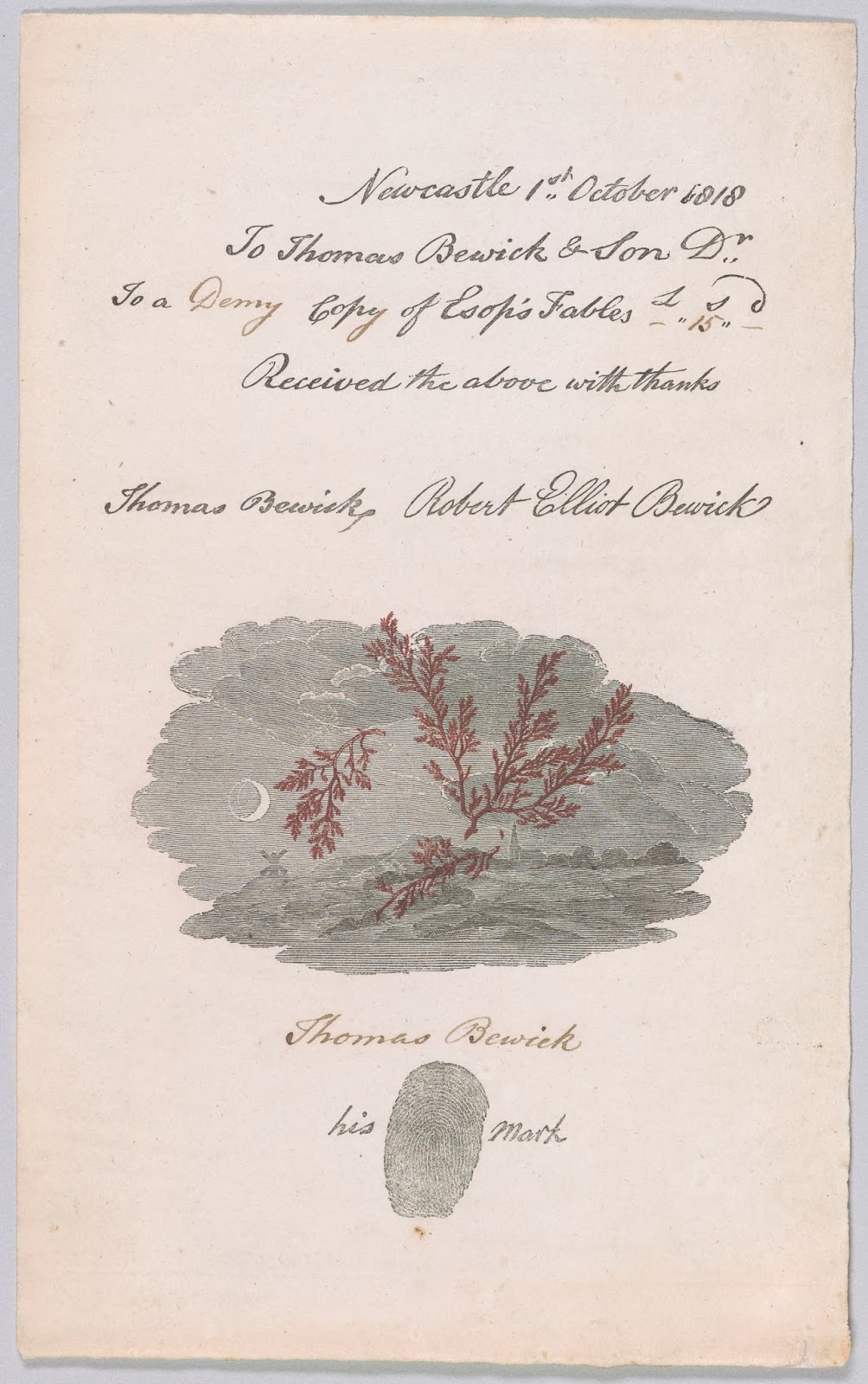
Thomas Bewick, Printed receipt for Fables of Aesop, 1818
  
Bewick was so successful with this technique that he began to issue copies of his woodcut-illustrated books with a thumbprint receipt to prove that the work was indisputably his. This example dates from 1818 for an edition of The Fables of Aesop.

 
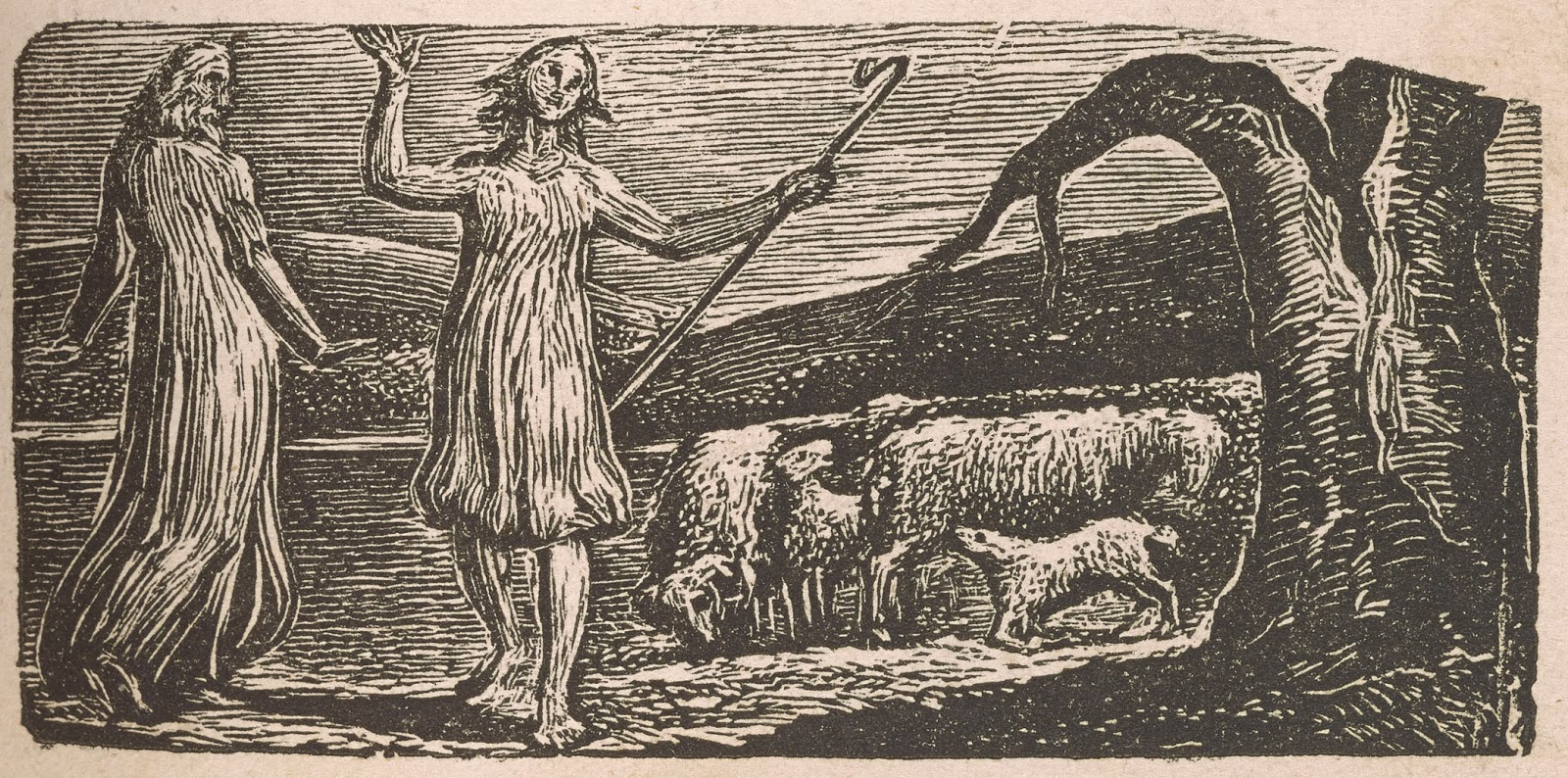
William Blake, The Pastorals of Virgil, 1821

By the end of his life, Bewick's method of "against the grain" engraving was emulated by many woodcut illustrators in Britain and Europe. But others, like the visionary poet and artist, William Blake, preferred the earlier style of Durer's era. This "primitive" style of woodcut carving became associated with counter-cultural and left-wing political movements. This is important to note because woodcut illustrations were often featured in expensive, limited-edition books favored by wealthy collectors.

During the nineteenth century, woodcuts appeared in two competing roles: the woodcut as talisman of the art of the common man or as aesthetic masterpiece affordable only in elite circles. Medium as Muse, as the Morgan Library exhibit is called. reveals that these two basic categories of woodcuts covered a very wide variety of illustrations. Over ninety woodcut prints, books illustrated with woodcuts, drawings and tools used to create woodcuts are on display in this much-needed exhibit at the Morgan Library. All are from the Morgan's collection.

Emile Bernard, the artist who mounted the first retrospective of the work of Vincent van Gogh, is a key figure in the duality of the Woodcut Revival. Bernard (1868 -1941) was a great admirer of Japanese woodcuts and of the popular prints made in the city of Épinal in northeast France. Yet he chose to illustrate with woodcuts one of the most controversial and "decadent" literary works of the era, Les fleurs du mal by Charles Baudelaire.


Émile Bernard, Les fleurs du mal, 1916

 
It took another Englishman, William Morris, to launch the Woodcut Revival in earnest. Morris (1834-1896) was one of the leaders of the Arts and Crafts movement. He had the private wealth to underwrite the operations of his design studio, which specialized in wallpaper, textiles and other furnishings for homes and churches. In January 1891, Morris founded the Kelmscott Press to produce limited editions of classic or inspirational works. The production of these books incorporated all the traditional, artisan techniques that Morris struggled to preserve in an age of increasing automation.


The Works of Geoffrey Chaucer
Designed by William Morris, 1896

Morris and his long-time colleague and friend, Edward Burne-Jones, worked together on a lavishly illustrated edition of the works of Geoffrey Chaucer. Five years of planning, two years to produce, 438 copies in total, the Kelmscott Chaucer was illustrated with eighty-seven woodcuts by Burne-Jones. These are among the last art works in the Pre-Raphaelite tradition. Morris died in October 1896, as his edition of Chaucer came clanking from the hand press. Burne-Jones died less than two years later, in June 1898. It was the end of an era - and the beginning of another.

The Kelmscott Press gained widespread fame for its stunning, handcrafted books. Lucien Pissarro (1863-1944), son of the Impressionist Camille Pissarro and a notable artist himself, established the Eragny Press with the help of his wife, Esther. Pissarro was a great admirer of Japanese prints like his friend, Vincent van Gogh, and he incorporated color woodcut engravings in many of his works. But Pissarro lacked the independent wealth of Morris and he suffered a stroke which limited the number of publishing projects that he could undertake. Never-the-less, the Eragny Press woodcuts made a deep impression on book collectors on the European continent.

The Kelmscott Chaucer and the Eragny Press books were feasts for the eye but not intended for reading. Morris described his edition of Chaucer as "essentially a work of art." But the sheer number of woodcut illustrations in these beautiful books enabled viewers to construct a visual narrative without grappling with the dense, crowded typography.


Félix Vallotton, Le dejeuner en plein air (or, Cinq heures), 1900

Picking up on this, the Swiss-born artist, Felix Vallotton (1865- 1925), produced several series of woodcuts without accompanying text. These presented episodes or scenes whose meanings were easy to grasp. Vallotton's woodcuts totally dispensed with hatchings and simulated gray tones. His woodcuts were small universes of black and white.

Frans Masereel (1889–1972), born in Belgium but active in France, created "wordless novels" with woodcuts unsupported by text. His masterpiece was Mon livre d'heures or Passionate Journey, the story of a twentieth century everyman first published in 1919. A popular Chinese edition appeared in 1933.

Masereel was a hard-working, prolific artist, a painter as well as woodcut specialist. Only a year after Passionate Journey, he published L'Idée or The Idea. In this symbolical work, a naked woman representing free-thinking ideals, is hunted down by the Capitalist "powers that be."


Frans Masereel, Die Idee: 83 Holzschnitte, 1927

A 1932 animated film, L'Idée, inspired by Masereel's wordless novel, was made by Berthold Bartosch, a Hungarian filmmaker, and can be seen at the Morgan exhibit.

Masereel made a lasting impact with his wordless novels, his influence extending to Art Spiegelman's controversial Holocaust graphic novel, Maus, completed in 1991. But it is inconceivable to consider the role of woodcuts in twentieth century American art without studying the career of Lynd Ward.

Lynd Ward (1905-1985) is represented in the Morgan exhibition by a short film documenting his carving technique. Ward was fortunate that woodcuts enjoyed a vogue in advertising circles during the 1930's and 1940's. He was at the peak of his energy and talent, both of which were epic in scope. Ward produced woodcut engravings for such corporate giants as U.S. Cast Iron Pipe & Foundry. Ward's woodcuts gave a populist appeal to the marketing strategy of a company which produced seventy-percent of the metal pipes in the United States.


Lynd Ward, Wild Pilgrimage: A Novel in Woodcuts, 1932

While Ward "paid the bills" with ads for U.S. Cast Iron Pipe & Foundry, he created "wordless novels" which were anything but supportive of the corporate economy. Ward's tales of workers struggling to find their identity in Depression-era America were passionate, almost anarchistic, in tone. Ward's Wild Pilgrimage also probed the psychological state of his protagonist, shifting to reddish brown color to denote a shift from reality to the embattled hero's inner world.

Ward's Wild Pilgrimage shows an obvious debt to the wordless novels of Masereel. Ward had closely studied Masereel’s work while a student in Leipzig during the 1920's. The effect of silent film on the woodcut revival ought to be considered too. But it is fascinating to consider this connection from the reverse angle - the influence of the wordless novel with its woodcut engravings on modern film.

Wordless novels plot the course of narratives exactly as storyboards are used in the motion picture industry. Webb Smith, an animator for the Walt Disney Studio, is credited with pioneering storyboards to plot the sequential development of Disney cartoons such as The Three Little Pigs in 1933. It was not long before feature films were using the technique of plotting, scene by scene, the development of the narrative with storyboards. David O. Selznick hired William Cameron Menzies, who had studied at the Art Students League of New York, to storyboard Gone with the Wind. Alfred Hitchcock was legendary for the use of storyboards in his films of the 1940's and 1950's.


Typee: Wood-Engravings by Robert Gibbings, Penguin Illustrated Classics, 1938

Woodcut engravings, either directly or at second-hand, contributed to some of the most dynamic media of the twentieth century. The Morgan exhibition displays several of the early Penguin Press paperback books which were illustrated with woodcut engravings. It was a long way from the Kelmscott Chaucer, but Morris would certainly have approved.

Woodcuts retain an arcane, time-honored appeal. This is inevitable, no doubt, given the Janus-like nature of the Woodcut Revival. The signature illustration of the Morgan exhibit, Vanessa Bell's woodcut for the story, Monday or Tuesday, by her sister Virginia Woolf, is a case in point. Bell's woodcut appeared in an edition printed on the hand-operated printing press of the Hogarth Press, owned by Virginia Woolf and her husband, Leonard.

But the Morgan exhibit shows that the incredible diversity of woodcut illustration absolutely defies easy categorization. The exhibit is very aptly named, Medium as Muse. There is an almost magical power at work in woodcuts. The act of carving these wondrous illustrations insures the unique, indelible individuality of the artists who create them - and fosters that of the art lovers who behold them.

 *** 

 
Text: Copyright of Ed Voves, all rights reserved

Images Courtesy of Morgan Library and Museum, New York City

Introductory Image:
Vanessa Bell (1879-1961)
Monday or Tuesday
By Virginia Woolf (1882-1941)
Richmond: The Hogarth Press, 1921
Bequest of Gordon N. Ray, 1987
The Morgan Library & Museum
© Estate of Vanessa Bell, courtesy Henrietta Garnett
Photograph: Graham S. Haber

Thomas Bewick (1753-1828)
Printed receipt, signed Newcastle 1st October 1818
From a subscriber’s copy of Bewick’s Fables of Aesop
Gift of Dr. Charles Ryskamp, 1981
The Morgan Library & Museum
Photograph: Graham S. Haber

William Blake (1757-1827)
The Pastorals of Virgil
London: F.C. & J. Rivingtons et al., 1821
Bequest of Gordon N. Ray, 1987
The Morgan Library & Museum
Photograph: Graham S. Haber

Émile Bernard (1868-1941)
Les fleurs du mal
By Charles Baudelaire (1821-1867)
Paris: Ambroise Vollard, 1916
Bequest of Gordon N. Ray, 1987
The Morgan Library & Museum
Photograph: Graham S. Haber

The Works of Geoffrey Chaucer
Designed by William Morris (1834-1896)
Wood engravings after Edward Coley Burne-Jones (1833-
1898)
Hammersmith: The Kelmscott Press, 8 May 1896
Purchased by J. P. Morgan, Jr., ca. 1921
The Morgan Library & Museum
Photograph: Graham S. Haber

Félix Vallotton (1865-1925)
Le dejeuner en plein air (or, Cinq heures), 1900
Preparatory drawing for wood engraving
Pen and black ink, over black chalk, on wove paper
Thaw Collection
The Morgan Library & Museum
Photography: Graham S. Haber

Frans Masereel (1889-1972)
Die Idee: 83 Holzschnitte
Munich: Kurt Wolff, 1927
Purchased on the Gordon N. Ray Fund, 2012
The Morgan Library & Museum
© 2014 Artists Rights Society (ARS), New York / VG Bild-
Kunst, Bonn
Photography: Graham S. Haber

Lynd Ward (1905-1985)
Wild Pilgrimage: A Novel in Woodcuts
New York: Harrison Smith & Robert Haas, 1932
Collection of Robert Dance
© Estate of Lynd Ward
Photography: Graham S. Haber
Herman Melville (1819-1891)

Typee: Wood-Engravings by Robert Gibbings (1889-1959)
Penguin Illustrated Classics
Harmondsworth: Penguin Books Ltd., 1938
Bequest of Gordon N. Ray, 1987
The Morgan Library & Museum
Photography: Graham S. Haber
© 2014 Artists Rights Society (ARS), New York / ADAGP, Paris