Wednesday, March 18, 2015

The Plains Indians, Artists of Earth and Sky at the Metropolitan Museum of Art


The Plains Indians, Artists of Earth and Sky

March 9 - May 10, 2015
Metropolitan Museum of Art, New York City

Reviewed by Ed Voves

The Plains Indians, Artists of Earth and Sky, now on view at the Metropolitan Museum of Art, is a religious experience as well as an art exhibit. Like last year's tour de force at the Met, Lost Kingdoms: Hindu-Buddhist Sculpture of Early Southeast Asia, the boundaries between art and spirituality are almost totally erased by this powerful display of Native American creativity.

The Plains Indians, Artists of Earth and Sky presents stunning examples of Native American art from the early 1700's to the twenty-first century. These singular works show how Native American art is infused by an acute sensitivity to the guiding influence of the Great Spirit or Wakan Tanka, in the language of the Lakota Sioux.

At the heart of Native American spirituality lies the vision quest. Almost all the Native  American peoples practiced some form of a "right of passage" through which an individual gains insight into the spiritual realm. This could be achieved by undergoing a solitary journey into the wilderness or taking part in a ceremonial ordeal marked by extreme physical privation or suffering.

The Lakota Sioux call their version of this sacred, sacrificial rite the Wi wanyang wacipi or "sun gazing dance."  The resulting vision or communion with Wakan Tanka brings wisdom that will enrich the life of the Sun Dancer and of his family and community.

There are a number of powerful works of art directly related to the theme of vision quest in The Plains Indians, Artists of Earth and Sky. Several decorated shirts like the one worn by the great Lakota chief, Red Cloud, are on display. These are badges of special status, conferred on the wearer in recognition of his spiritual enlightenment or prowess in hunting or warfare.


 Man’s Shirt, 1865

Only members of the Lakota elite group known as the Wicasasyatampi or "praiseworthy men" were honored with such beautiful garments. These "shirt wearers" were selected by the seven leading chiefs of the Lakota for their valor and wisdom. The shirt is ornamented with beadwork symbolizing the stars and the sun. The fringe of locks of hair were gifts from friends, though scalps of fallen enemies were sometimes used.

Red Cloud's shirt was especially elegant in design. Other honorific shirts were more roughly stitched together from the tanned hides of buffalo or antelope to "preserve the identity and some of the animals' spiritual power..."

The cult of courage and vision quest wisdom was universally esteemed among the tribes of the Great Plains. Magnificent garments like Red Cloud's shirt were presented in expectation of future deeds as well as past achievements. The companion volume to the exhibit notes that the burden of leadership was something that Native Americans felt all too keenly:

Many men declined to make use of their rights to such a prestigious shirt, as they were afraid of ridicule if they did not live up to the expectations of great courage and generosity that came with such an honor.

The great warriors, "Patriot Chiefs" as the noted historian Alvin Josephy called them, suffered a high casualty rate in the frontier wars with the U.S. Army - and afterward. Crazy Horse, "bravest of the brave" Lakota, was brutally bayoneted to death shortly after surrendering to the U.S. military in 1877. In 1890, Sitting Bull - who had had a visionary dream shortly before the Battle of the Little Big Horn - was shot and killed by members of a police unit recruited from other Native Americans.

This tragic legacy is exemplified by the "ledger" drawing made by a young Kiowa named Wohaw, who was imprisoned in Fort Marion, Florida, from 1875 to 1878.  Ledger art, made on common stationary, is a primary record of Native American history.

Wohaw fought under the leadership of White Horse, a Kiowa chief who was also sent to Fort Marion for leading raids on settlements and cattle ranches in Texas. The Kiowas, along with many other incarcerated Native Americans, illustrated tribal history to occupy their time. In an unexpected turn-of-events, Indian ledger art became popular with White collectors, among the first wave of tourists to Florida. Wohaw and his fellow prisoners began selling their art to raise funds to support families now living on U.S. Government reservations, two dollars a drawing.


Wohaw, A Man Receiving Power from Two Spirit Animals, 1877
Wohaw's drawing shows a warrior, stripped to his loin cloth, offering gift pipes to guides from the Spirit world. They appear in the shape of a buffalo and a longhorn bull, both powerful animals on the Southern Plains, where the Kiowa and their Comanche allies had been the dominant tribes since the introduction of the horse in the early 1700's. The two spirit animals breathe their "medicine" onto the young warrior while the moon, sun and a comet appear in the sky overhead.

At the young mans' feet are representations of an Indian tipi and a ranch house.  Wohaw's drawing shows the Kiowa warrior poised between two worlds, the nomadic, buffalo hunting past and the "white man's way." But the Great Spirit has insured the survival of Wohaw and his people.

The presence of the gift pipes in Wohaw’s drawing hearkens to the first work of art displayed in the Metropolitan exhibit. This is a human effigy pipe, dating from 100 B.C. to 100 A.D. Created during the extraordinary “Mound Builder” epoch, this carved stone pipe from the Ohio River valley testifies to the ancient roots of Native American culture. Essential rites such as peace offerings of tobacco pipes transcended vast stretches of time and space long before the arrival of European intruders.


Human Effigy Pipe, 100 B.C. – A.D. 100

Many of the famous tribes of the Great Plains, the Lakota Sioux and the Cheyenne for instance, originally lived in a woodland environment like the ancient Mound Builders.  The Lakota and the Cheyenne migrated from the Great Lakes region on to the Great Plains during the early 1700’s, thanks to the mobility conferred by another newcomer, the horse.

Horses galloped on to the Great Plains as a result of the 1680 overthrow of the Spanish colony of New Mexico by the Pueblo people. Horses brought by the Spanish escaped or were seized by the Pueblos. By trade, capture or the spread of wild pony herds, the horse moved onto the Southern Plains and then northward. The nomadic, buffalo-hunting culture of the Plains tribes took hold of the vast region’s economy – and the world’s imagination.

The original inhabitants of the Great Plains had hunted buffalo on foot, a dangerous and exhausting endeavor. These tribes, the Mandan, Arikara and Pawnees were primarily agricultural societies, living along the Missouri and Platte Rivers. They too seized the opportunity of enhanced hunting thanks to the horse. But arriving around the same time were other exports from Europe – guns, trade beads, iron axes and knives and small pox.

The diseases unknowingly introduced by the Europeans hit the Mandan and Arikara villages with devastating effect. The more nomadic tribes were initially spared, so that the Lakota were able to gain dominance over the Northern Plains. Warfare to control the buffalo hunting grounds became an endemic feature of life on the Great Plains during the 1700’s and early 1800’s.

Native American art and artifacts from the Great Plains during the 1700’s are rare items in U.S. museum collections. By a fortunate turn of events, a significant number of precious examples of Plains Indian art were sent back to Europe by the early explorers.

French missionaries and traders were particularly attentive to documenting their travels through the Great Plains with souvenir artifacts. Many of these are now in the collection of the Musée du quai Branly, the great anthropological museum in Paris. It was the Musée du quai Branly which originally proposed the idea for this great exhibition, collaborating with the Nelson Atkins Museum in Kansas City, Missouri, and the Metropolitan Museum of Art.

Among the most outstanding art works from the Musée du quai Branly are several tanned leather buffalo hides or "robes" which Native American artists utilized to paint their masterpieces. The Robe with Mythic Bird, dating 1700 to1740, is the greatest of these, though it raises a number of interpretive questions. Artifacts decorated with abstract designs were usually created by Native American women, so this outstanding piece may have been the work of a woman artist.


The Grand Robe, c. 1800 – 1830

Pictograph paintings of warriors locked in combat were an important theme of Plains Indian art. Male artists were almost always the creators of these works. Like European naval and military painters of the same period, details of guns, weapons and warlike regalia were always scrupulously depicted. Though hardly inspiring in the same way as The Robe with Mythic Bird, the battle painting shown here vividly illustrates the "arms race" that accompanied the arrival of the horse on the Great Plains during the 1700's.

During the late eighteenth century, it must have seemed that the hard-riding, buffalo hunting lifestyle of the Plains tribes would endure forever. Objects of everyday use, like Cheyenne pouch or parfleche envelope, for carrying dried food, were designed and decorated with great artistry.


Parfleche Envelope, c. 1865

The "golden age" of the Plains Indians was destined to be brief. In 1803, the United States purchased Louisiana from France. This real estate deal brought the windfall of the Great Plains region under the jurisdiction of the U.S. Government. Nobody in Paris or Washington consulted the Native American tribes who actually lived on the Great Plains. The downfall of the Plains tribes, symbolized by the 1890 massacre at Wounded Knee, South Dakota, was sealed by an act of geopolitical duplicity against which they struggled for nearly a century with tragic, unavailing courage.

There are a number of artifacts which illustrate the eventual loss of Native American independence. Ledger art, like Wohaw's drawing, is an important part of this part of the exhibition. So too are battle shields made from buffalo hide. Tough enough to deflect an arrow, shields like this one made by an Arikara warrior around 1850 offered no protection against the bullets of a Sharps Rifle.


Arikara Shield, c. 1850

One of the most beautiful art works on view in the Metropolitan exhibit cannot be displayed here. This is woman's dress from the Arapaho tribe, made from tanned hide and painted red with cosmic symbols such as the Thunderbird, magpie and the turtle who supports the earth on its shell.

This dress was used in the Ghost Dance religious revival of 1890 and is truly a sacred object, worthy of reverence by people of all religious beliefs and convictions. I spent several moments of reflection standing in the presence of this Ghost Dance dress and was deeply moved.


Woman’s Dress, c. 1865
Some idea of the power of the Ghost Dance dress can be gained by studying a Lakota woman's dress from 1865 and contrasting it with the modern-day version worn by the note Native American dancer and political activist, Jodi Archambault Gillette We can see Gillette's dress as an evolution from the simplicity and strength of the earlier Lakota dress, incorporating symbols and motifs of all the Native American peoples of the Great Plains.

Jodi Gillette, Woman’s Dress and Accessories, 2005

The concluding galleries of The Plains Indians, Artists of Earth and Sky display many other modern works of art like Gillette’s dress. These works are examples of a living tradition, which grows in strength, confounding earlier expectations that American Indians could only survive through assimilation.


Oscar Howe, Calling on Wakan Tanka, 1962

The powerful  1962 painting, Calling on Wakan Tanka, by Oscar Howe testifies to the unconquerable spirit of Native American artists. Howe (1915-1983), a member of the Yanktoni Dakota tribe, worked as an artist in the Depression-era Works Progress Administration. Howe rebelled against the stereotypes and expectations assigned to Native Americans. He embraced elements of Modernism, combining motifs from Christianity and Native American culture, to show that the Wi wanyang wacipi , the "sun gazing dance, " is part of the global vision of humankind.

***
Text: Copyright of Ed Voves, all rights reserved

Introductory Image:                                                                                                                                    
Robe with Mythic Bird, c. 1700 – 1740, Eastern Plains artist, probably Illinois, Mid-Mississippi River basin. Native tanned leather, pigment, 42 3/8 x 47 7/8 in. (107.7 x 121.4 cm) , Musée du quai Branly, Paris. Photo: Musée du quai Branly/Thierry Ollivier, Michel Urtado
Man’s Shirt, 1865, Oglala Lakota (Teton Sioux) artists, South Dakota. Native tanned leather, pigment, human hair, horsehair, glass beads, porcupine quills, 58 x 42 ½ in. (147.3 x 108 cm), Buffalo Bill Center of the West, Cody, Wyoming. Collection Adolf Spohr, gift of Larry Sheerin, Photo: Buffalo Bill Center of the West
Wohaw (Kiowa, 1855-1924), A Man Receiving Power from Two Spirit Animals, Paper, colored pencil and crayon, 8 ¼ x 11 3/8 in. (21 x 28.9 cm), 1877. St. Louis (Missouri), Missouri History Museum. Photo: Missouri History Museum, Saint Louis                                                                   

Human Effigy Pipe, 100 B.C. – A.D. 100, Adena or Hopewell artist, Adena Mound, Ross County, Ohio. Pipestone, 7 7/8 in. (20 cm). Ohio Historical Society, Columbus, Ohio. Photo: Ohio Historical Society
The Grand Robe, c. 1800 – 1830, Central Plains artists. Native tanned leather, pigment, porcupine quills, 58 3/8 x 88 ¼ in. (148.3 x 224.2 cm), Musée du quai Branly, Paris, gift of Chaplain-Duparc. Photo: Peabody Museum of Archeology and Ethnology, Harvard University
Saddle Blanket, c. 1840, Lakota (Teton Sioux) artist, North or South Dakota. Native tanned leather, glass beads, wool cloth, 64x 26 1/2 in. (162.6 x 67.3 cm), State Historical Museum of Iowa, Des Moines. Photo: The State Historical Museum of Iowa/Joshua Ferdinand
 Parfleche Envelope, c. 1865, Southern Cheyenne artist, Colorado. Buffalo rawhide, pigment, native tanned leather, 29 x 16 1/2 in. (73.7 x 41.9 cm),The Field Museum of Natural History,Chicago. 67468
Shield, c. 1850, Arikara artist, North Dakota. Buffalo rawhide, native tanned leather, pigment
Diameter: 20 in. (50.8 cm), The Nelson-Atkins Museum of Art, Kansas City (Missouri), Purchase: the Donald D. Jones Fund for American Indian Art. Photo: The Nelson-Atkins Museum of Art/Jamison Miller
Woman’s Dress, c. 1865, Lakota (Teton Sioux) artist, probably South Dakota. Native tanned leather, glass beads, tin cones, 61 ½ x 53 ¾ in. (156.2 x 136.5 cm), Smithsonian Institution, National Museum of the American Indian. Photo: National Museum of the American Indian, Smithsonian Institution/photo by NMAI photo services
Jodi Gillette (Hunkpapa Lakota, 1959-), Woman’s Dress and Accessories, Native tanned and commercial leather, glass and metal beads, cotton cloth, silk, dentalium shell, metal cones, horsehair, plastic, hair pipes, brass bells, porcupine quills, brass tacks, brass and metal studs, silver cones, 54 × 60 in. (137.2 × 152.4 cm), 2005. Courtesy of Jodi Gillette, U.S.A. Photo: Joshua Ferdinand

Oscar Howe (Yanktonai Dakota, 1915-1983), Calling on Wakan Tanka, Paper, 22 3/8 x 31 ¼ in. (56.8 x 79.4 cm), 1962. The University of South Dakota, Vermillion, donation from the artist Photo: The University of South Dakota/John Lamberton


Tuesday, March 10, 2015

The Artist's Garden at the Pennsylvania Academy of the Fine Arts


The Artist's Garden: 
American Impressionism and The Garden Movement, 1887—1920

The Pennsylvania Academy of the Fine Arts (PAFA)
February 13, 2015 - May 24, 2015

Reviewed by Ed Voves

The Artist's Garden: American Impressionism and The Garden Movement, 1887—1920, takes a fresh look at the landscape tradition from the standpoint of our own backyard. The new exhibition at the Pennsylvania Academy of Art presents dazzling art and vintage "green thumb" gardening books from the late-Victorian era through the end of the First World War.


Cecilia Beaux, Landscape with Farm Building, Concarneau, France, 1888


The PAFA exhibit is certainly a feast for the eyes. It is an expansive exhibition with art work by virtually every American artist of the period, including Cecilia Beaux (1855- 1942) and William Merritt Chase (1849-1916). 


Bessie Potter Vonnoh (1872-1955), Water Lilies Fountain, 1913


The ideals of beauty and innocence from the years before the First World War are evoked by two exquisite garden statues by Harriet Whitney Frishmuth  (1880-1980) and Bessie Potter Vonnoh (1872-1955).

An additional feature of the PAFA display is a companion exhibit, Gardens on Paper. Along with rare prints, this exhibit presents an array of early color photographs, discovered in the Pennsylvania Academy’s archives.  These Autochromes, the earliest method of color photography, show the garden of artist Thomas Shields Clarke at his home in Lenox, Massachusetts.  I hope to do a separate post on these incredible images.


Thomas Shields Clarke,  Photographic Autochrome, ca. 1910


The Artist's Garden is not just an occasion for displaying paintings of verdant fields or striking works of stained glass.  There is a subtext to the exhibition, the lurking presence of daunting social problems besetting American culture at the turn of the twentieth century.

American Impressionism began when young artists from the U.S. traveled to France to study and paint with Claude Monet at his idyllic retreat, Giverny. The Americans produced works of beauty that matched some of the best work done by the great Impressionist master and his colleagues, Renoir, Sisley, Pissarro. 

John Leslie Breck (1860-1899) was one of the first American painters - with the obvious exception of Mary Cassatt - to embrace Impressionism. There is no sign of humanity in his landscape, Garden in Giverny, just dense masses of flowers, seemingly untended, and an empty path. But there is such a powerful sense of being in this work that one senses the presence of the natural world in a direct, almost personal manner.


John Leslie Breck, Garden at Giverny, between 1887-91

Many of the American Impressionists followed in Breck’s footsteps, painting works of nature with little sign of human mediation. Color, itself, in the dazzling garden and flowering field, was an invitation to the Impressionist style as the artist Charles Curran noted in a 1909 article discussing the work of his colleague, Willard Metcalf.

In looking at such a gorgeous mass of flowers in nature the eye would be so filled with the richness and profusion of forms that the precise form of no one particular flower would be noticed. It would detract greatly from the charm of such a picture if each flower were sharply drawn in detail…

Impressionism then was suited to the vision of American painters who embraced it so readily. The world of art, however, had already moved on by the time that they began painting en plein air in France. The joint Impressionist exhibitions in Paris ceased after 1886. Symbolism, with its powerful explorations of the human psyche, was gaining in notoriety. The brilliant landscapes painted by the American Impressionists could thus be seen as the final flourish of an avant-garde art movement that was soon to be overshadowed by more radical artistic oeuvres.

American Impressionism and the Garden Movement can be interpreted in another light, however. They were vigorous responses to the changing circumstances of life in the United States following the Civil War. These post-war decades were dubbed the "Gilded Age" by Mark Twain. But "Iron Age" is a more accurate title.

As the U.S. economy surged past Great Britain and Germany, the environmental and social costs of breakneck industrialism could not be disregarded for long. The vast slag heaps of the coal industry and the polluted rivers threatened the image of America the Beautiful. The shocking disparity between the standard of living of the "Social Register" few and that of the impoverished “Masses” threatened the ideals of America the Just.

Nostalgia, combined with concern for the future, nurtured the Colonial Garden Movement. Beginning with displays at the Centennial Exhibition held in Philadelphia in 1876, theories about the "simplicity" of life during the eighteenth century exerted a widespread appeal. From the design of gardens and the emphasis on planting native or vintage flowers to the decoration of summer homes, a popular, romantic image of Early America took hold, countering the crass, "shoddy" reality of the late 1800's.

As the PAFA exhibit details, the Garden Movement was influenced by the cultural background of Philadelphia and the New Hope art colony in nearby Bucks County. Philadelphia was a city with a deep-rooted "club" tradition reaching back to Benjamin Franklin's Junto. In 1913, the Garden Club of America was founded in Philadelphia. The city was also the home of the Burpee Seed Company, founded in 1876. The world's largest mail order seed company, Burpee’s Seeds enabled a new generation of plant and flower enthusiasts to swell the Garden Movement.

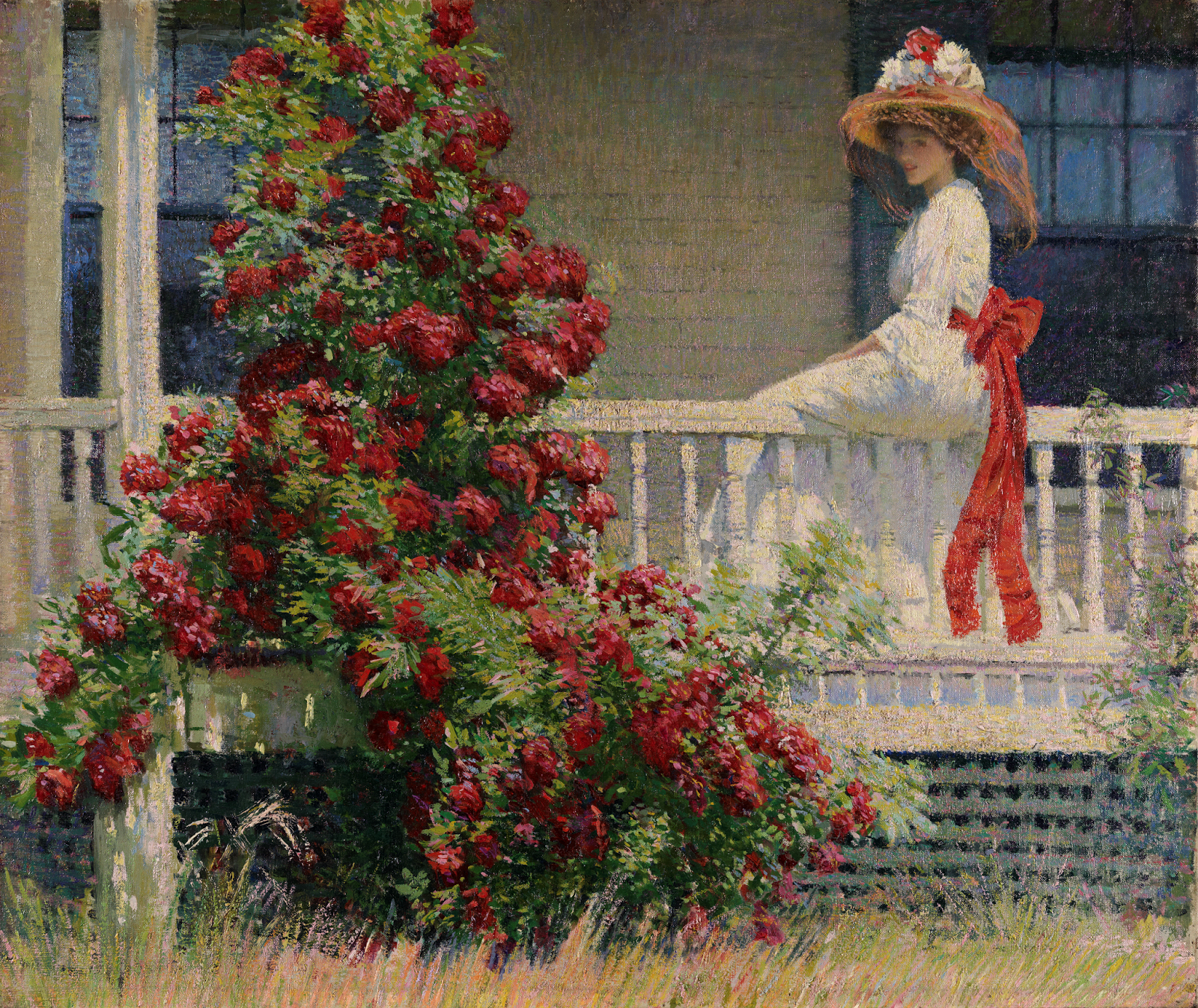
All these disparate factors combined to promote the Garden Movement as an ideal for America. Philip Leslie Hale's 1908 painting, The Crimson Rambler captured the mood to perfection. The vibrant young woman in the picture sits astride the porch fence, poised for growth and movement, just as the climbing rose bush - a variety only introduced in the U.S. during the 1890's - soars upward.

Hale (1865–1931) was a New Englander, a descendant of the Revolutionary War hero, Nathan Hale. If Philadelphia provided inspiration for the Garden Movement, many of the leading American Impressionist painters were from New England. 

Of these, Frederick Childe Hassam (1859-1935) was the most commanding figure. Prodigiously talented and prolific in the number and variety of his paintings, Hassam was also a contradictory figure. Self-taught, he was a consummate professional. Hassam loved the quietude of New England seacoast refuges like Appledore Island, Maine, where he befriended the poet and gardener, Celia Thaxter. Yet he never tired of observing people in the supercharged atmosphere of the big cities.

"Humanity in motion,” Hassam declared, “is a continual study to me.” 

Hassam's art was not without  points of contradiction, too, and the influence of the Garden Movement, perhaps surprisingly, brought them to the surface.


Childe Hassam,The Goldfish Window, 1916

In The Gold Fish Window, 1916, Hassam painted a work of great beauty. Every detail of the scene, natural or man-made, is bathed in golden, luminous light. Yet there is total absence of the spontaneity and mobility that Hassam professed to find intriguing.

The Gold Fish Window is a disturbing picture. Its unsettling effect is compounded by the fact that Hassam painted many variations on the theme of a solitary young woman, meditating or melancholy. Like the goldfish swimming in their light-drenched bowl, the young woman is seemingly a hostage of her environment. The window frames, the bordering curtains, the polished table act as barriers to her interaction with the outside world. Even the garden, sun-dappled and flower strewn, is less of a sanctuary than a prison cell.

The young woman in The Gold Fish Window may be compared to the protagonists of Johannes Vermeer's works. Vermeer’s young women occupy a serene moment in time. Yet they are all absorbed in a task, making lace, reading or playing music. Hassam's young woman, by contrast, clutches a flower to her breast in an almost funereal gesture.

The Gold Fish Window was painted in 1916 while the Women's Suffrage Movement vigorously campaigned for the rights of women in the United States. You would never know it from The Gold Fish Window that Hassam had declared that a true artist is "one who paints the life he sees about him, and so makes a record of his own epoch.”

As we can see in the array of paintings in the PAFA exhibit, other painters of the era also placed pensive young women in their works. In 1918, Daniel Garber (1880–1958), the leader of the second generation of the New Hope Impressionists, countered this view of passive femininity. Garber’s The Orchard Window is a brilliant evocation of a young woman in harmony with nature and society.


Daniel Garber, The Orchard Window, 1918

By the 1920’s, however, American Impressionists like Garber were unable to maintain their place in the front ranks of Modernism. For all the revolutionary technique that Hassam, Garber and others brought to their work, American Impressionism was increasingly perceived as the art of the past. 


These reflections deal with only one of the themes of PAFA exhibit, the Lady in the Garden.  The Artist's Garden is wide-ranging and extremely perceptive in its presentation of vital developments in American life and culture. Additional themes treat the Urban Garden, Leisure and Labor in the American Garden and the Garden in Winter. 

The idea of including winter scenes in the exhibit, the Garden at Rest, is particularly significant because it shows the sensitivity of these American artists to the cycles of nature, to the fundamental structure and the regenerative power of the natural world.

Of all the American Impressionists, none made a better case for the importance of the natural world than John Henry Twachtman (1853-1902). Born in Ohio, but a New Englander by choice, Twachtman infused the subtle tonalities of James McNeill Whistler into his seasonal landscapes, especially those depicting winter.

"I can see now how necessary it is to live always in the country—at all seasons of the year. We must have snow and lots of it. Never is nature more lovely than when it is snowing," Twachtman wrote, ". . . . That feeling of quiet and all nature is hushed to silence."


Abbott Handerson Thayer,  Blue Jays in Winter, c. 1905-09

Abbott Handerson Thayer's Blue Jays in Winter is another testament to the rediscovery of the natural environment. Thayer (1849-1921), more famous for his paintings of angels and childhood innocence, produced this remarkable work for his book, Concealing Coloration in the Animal Kingdom. 

Thayer's ideas on animal camouflage were disputed by no less a figure than Theodore Roosevelt. But the important point is that Thayer - and the rest of the American Impressionists - focused on nature as a living entity, a vital component of our daily lives.
Ultimately, the role of the artist as a vital interpreter of nature is the essential theme of this thoughtful exhibit. The Artist's Garden: American Impressionism and The Garden Movement, 1887—1920 will be on display at PAFA, February 13, 2015 - May 24, 2015. Following its presentation at PAFA, this wonderful exhibition will be shown at a number of other U.S. museums during 2015-2016.

And of course, the natural wonders depicted by Breck, Hassam, Garber, Twachtman and the other American Impressionists are also on view each time you look out the window on to your own garden or green space nearby.

***

Text: Copyright of Ed Voves, all rights reserved 
Images Courtesy of the  Pennsylvania Academy of the Fine Arts, Philadelphia.

Introductory Image                                                                                                           Philip Leslie Hale (1865–1931), The Crimson Rambler, ca. 1908 Oil on canvas 25 1/4 x 30 3/16 in. Pennsylvania Academy of the Fine Arts, Joseph E. Temple Fund, 1909.12 

Cecilia Beaux (1855-1942), Landscape with Farm Building, Concarneau, France, 1888, Oil on canvas, 11 1/16 x 14 3/16 in. Pennsylvania Academy of the Fine Arts, Philadelphia, Gift of Henry Sandwith Drinker, 1950.17.31

Thomas Shields Clarke, Series of approximately 100 photographic autochromes, ca. 1910 PAFA Archives 

Bessie Potter Vonnoh (1872-1955), Water Lilies Fountain, 1913, Bronze, 28 ¾ x 15 ¼ x 7 ¼ in. Conner Rosenkranz, LLC Photo: Mark Ostrander, courtesy of Conner Rosenkranz, New York

John Leslie Breck (1860-1899), Garden at Giverny (In Monet’s Garden), between 1887-91 Oil on canvas, 18 x 21 7/8 in. Terra Foundation for American Art, Daniel J. Terra Collection, 1999.18. Photo: © Terra Foundation for American Art, Chicago 

Childe Hassam (1859-1935),The Goldfish Window, 1916, Oil on canvas, 34 3/8 x 50 5/8 in. Currier Museum of Art, Manchester, NH, Museum Purchase: Currier Funds, 1937.2

Daniel Garber (1880-1958), The Orchard Window, 1918, Oil on canvas, 56 7/16 x 52 ¼ in. Philadelphia Museum of Art, PA, Centennial gift of the family of Daniel Garber, 1976-216-1

Abbott Handerson Thayer (1849-1921), Blue Jays in Winter, study for book, Concealing Coloration in the Animal Kingdom, c. 1905-09, Oil on canvas, 22 1/8 x 18 1/8 in. Smithsonian American Art Museum, Washington, DC, Gift of the heirs of Abbott Handerson Thayer 1950.2.12/Art Resource, NY

Wednesday, February 18, 2015

From Ancient to Modern: Archaeology and Aesthetics at ISAW


From Ancient to Modern: Archaeology and Aesthetics Institute for the Study of the Ancient World


February 12, 2015 to June 7, 2015

Reviewed by Ed Voves

When visiting art exhibitions, one should always expect the unexpected. Unfamiliar masterpieces and unconventional exhibit presentations can transform our vision of humanity. 

Exhibitions ought to challenge our long-term assumptions about art, make us comprehend the inner dynamics of works of art, as well as their surface attributes. In fact there should be a little box at the end of each exhibit where we can dispose of our preconceptions like the ID tags that we discard when leaving museums.

The Institute for the Study of the Ancient World (ISAW) in New York City does not provide a little box for ID tags, as its exhibits are free. Preconceptions don’t last very long in its galleries. Old, threadbare ideas are the only form of ancient history you will not find here.

From Ancient to Modern: Archaeology and Aesthetics is the latest exhibition at the ISAW. Fifty art works from ancient Mesopotamia are integrated with vintage photos and documents from two major archaeological expeditions during the 1920's and 1930's. These artifacts are expertly displayed in a way that recalls the 2011 ISAW exhibit Edge of Empires, which detailed the excavation of the Roman city in Syria, Dura-Europos, during the inter-war years.


Standing Male Worshiper, ca. 2900–2600 B.C.

The major innovation of From Ancient to Modern: Archaeology and Aesthetics is the inclusion of several masterpieces of modern art.  This is a first for ISAW and not as surprising as it might initially seem. These works, created by Henry Moore, Alberto Giacometti and Willem de Kooning were all influenced by the objects unearthed at the celebrated "digs" in Iraq during the period between the two world wars. 


Henry Moore, Half Figure II, 1929

The curators of From Ancient to Modern took the even bolder step of widening the scope of the exhibit to include art by contemporary artists. These works by Jananne al-Ani and Michael Rakowitz underscore the human tragedy of recent wars in Iraq and the tragic looting of the National Museum of Iraq in 2003.

With this deeply moving exhibition, Jennifer Chi, ISAW’s Director of Exhibitions, and Professor Pedro Azara, of the Polytechnic University of Catalonia, have powerfully asserted a visionary role for art in articulating the values of human society.

All this in two moderately-sized galleries at 15 E. 84th Street in NYC!

History begins at Sumer in Mesopotamia, as the famous book by Samuel Noah Kramer declared. But archaeological ventures to Mesopotamia got a late start, at least in comparison with expeditions to Egypt. The reasons for this are complex. But the discovery of the treasure-filled tomb of Tutankhamun in November 1922, which sparked world-wide Egyptomania, spurred two major efforts to uncover the buried past of Mesopotamia.


Leonard Woolley Waxing a Skeleton for Removal, Ur, ca. 1929-1930


The first of these was a joint British Museum/University of Pennsylvania partnership which focused on the site of Ur in southern Iraq. Ur of the Chaldees was the birthplace of the Biblical patriarch, Abraham. The great British archaeologist, Leonard Woolley, led a series of "campaigns" to Ur starting in 1922 and lasting until 1934. 

The second mission to Mesopotamia was the Iraq Expedition of the Oriental Institute of the University of Chicago. From 1930 to 1937, a distinguished Dutch archaeologist, Henri Frankfort, brought a well-organized team of scholars to the Diyala River valley. A tributary flowing from the north into the Tigris River, the Diyala River had previously been thought to be too far from the main centers of early Sumerian civilization along the Euphrates River to yield much of interest. The methodical Frankfort disproved such speculations with history-changing finds on a very big scale.

The military terminology of archaeology this period is not coincidental. As the superb companion volume to the ISAW exhibit makes clear, Woolley's excavations had the direct support of the British Army and Colonial Office which dominated Iraq in the years following World War I. Frankfort's "campaigns" in the more remote Diyala region benefited too from the prestige and power of Western colonialism.

The ISAW exhibit is subtitled Archaeology and Aesthetics. As well as being an accomplished archeologist with recent fieldwork (done under dangerous circumstances) in Iraq, Professor Azara is a noted authority on aesthetics. The way that human beings perceive art and then conceptualize it in terms of personal experience or societal influences is of vast significance.

Such aesthetic concerns are often ignored or treated as rarefied, elitist ideals. The ISAW exhibit proves that prejudice towards deep thinking about art is totally wide of the mark. Aesthetics, as the companion volume notes, is a vital mode of critical thinking. Aesthetics enables us to judge and to transform objects and images "with meaning, into windows to the world or to ourselves."

Aesthetics, from time to time, need a little help from the Publicity Department. The discoveries at Ur were a notable example of this interaction.

The ISAW exhibit deals with the savvy manipulation of the media culture of the 1920's and 1930's by Leonard Woolley and his fashion-conscious wife, Katherine. Woolley's PR efforts were rewarded by the discovery in 1927 of the glittering diadem of Queen Puabi and a mass of other jewels and golden accoutrements, dating from 2500 to 2300 BC, at Ur. It was an archaeological coup to rival the treasure of Tutankhamun. 


Puabi's headdress and cloak, ca. 2500–2300 B.C.

Woolley left no publicity venue untapped. From color photography supplements in the Sunday newspapers of the era to travelling exhibits of the Ur treasures, Woolley kept the Mesopotamian discoveries before the public eye. I was particularly struck by the catalog of a special display, Exhibits from the Royal Tombs of Ur of the Chaldees, held in 1934 at the Strawbridge and Clothier department store in Philadelphia! 


Female Worshipper, ca. 2700-2500 B.C.

The enjoyable and fascinating array of ancient art works and publicity documents related to Ur in the ISAW exhibit naturally command our interest. But Henri Frankfort's discoveries at the Diyala River excavations were hugely significant as well. These statues or votive images were initially characterized in some quarters as "idols." Many questions were raised whether these unsettling objects were art works at all. 

I am planning a separate post on Art Eyewitness to review the companion volume to From Ancient to Modern and will discuss this theme in more detail. For now, it is enough to note that Henry Moore and Willem de Kooning were moved by these ancient sculptures to create new art works of their own.


Cover of catalogue, Ancient to Modern: Archaeology and Aesthetics

It is in the second of the ISAW galleries that I wish to linger for there the contemporary works by Michael Rakowitz and Jananne al-Ani are presented. Rakowitz's family is of Iraqi-Jewish heritage and al-Ani was born in Kirkuk, Iraq. Both of these artists now live and work in the West, but the history of Iraq, ancient and modern, is woven into their work with the thread of memory.

Rakowitz recreated objects looted from the National Museum of Iraq in Baghdad in 2003. Troops from the U.S. and coalition forces were posted nearby but failed or were not ordered to intervene to stop the vandalism. Rakowitz used cheap disposable materials from recycled milk cartoons and cigarette packs to recreate these lost art works in order to emphasize how a nation’s culture can be treated as "disposable."

Given the recent adulation for the "Monuments Men," who saved thousands of art works from the Nazis, the looting of the National Museum of Iraq is inexplicable. The failure of Allied troops to protect the cultural heritage of Iraq raises troubling questions about the level of Western commitment to the people of Iraq and other Middle Eastern nations. The team that Woolley led to Ur during the 1920's brought some of the most precious art works of Mesopotamia to the collections of the British Museum and to the University of Pennsylvania Museum. But the ancient art that was excavated and placed in the National Museum of Iraq in Baghdad was shrugged-off in 2003.

Whatever the reason for this appalling blunder, Rakowitz's installation does not let the Western powers off the hook of collective responsibility.  Jananne al-Ani, with her photographic and multi-media work, likewise presents challenging, critical images relating to Iraq’s agony. 


Jananne al-Ani, Untitled, May 1991 [Gulf War Work]


Untitled May 1991 [Gulf War Work] is on display at the ISAW. It is a deceptively simple piece, with a grid of twenty images arranged on a wall in the manner of a family photo gallery. One of the rows indeed shows photos of al-Ani's family. The top row shows images of treasures from the National Museum of Iraq and a depiction of Queen Puabi wearing her fabled golden diadem. There is a row of portraits of Iraqi women with haunted or grief-stricken eyes. Any of these women could be a latter-day Puabi, fit to wear her golden diadem.

These photographs are followed in the bottom row by images of war.

Jananne al-Ani's Untitled May 1991 is the kind of art work that I referred to at the beginning of this review. It is the unexpected work that forces you to question your preconceptions. It struck me with particular force.

During the Gulf War years, I worked as a news research librarian for the Philadelphia Inquirer and the Philadelphia Daily News. One of my tasks was to retrieve and index the stream of Associated Press photos as they were digitally transmitted. Particularly during the 2003 Gulf War "campaign," marked as it was by the prolonged bombardment of Baghdad, I was sickened by many of the incoming images. The AP pictures of dead and mangled civilians, particularly children, were horrific. Very few of these were selected to appear in Western newspapers.


Jananne al-Ani's Untitled May 1991 brought the memories of these terrifying pictures flooding back to me. The “disposable” sculptures of Michael Rakowitz reinforced the effect.  I was not prepared for art work like this at the ISAW exhibit. I'm still looking for a box big enough to discard my preconceptions.


***
Text: Copyright of Ed Voves, all rights reserved 

Images Courtesy of the Institute for the Study of the Ancient World, New York City.

Introductory Image

Detail of Puabi’s headdress, apple clusters with large bales, ca. 2500–2300 B.C., Ur, Gold, Lapis Lazuli, Bitumen, L. 88 cm,  Joint Expedition of the British Museum and of the Museum of the University of  Pennsylvania, 8th season, 1929-1930. University of Pennsylvania Museum of Archeology and Anthropology (B16684.1) © Bruce White

Standing Male Worshiper, ca. 2900–2600 B.C., Early Dynastic I-II period of Mesopotamia, Eshnunna (modern Tell Asmar). Gypsum alabaster, shell, black limestone, bitumen, 11 5/8 x 5 1/8 x 3 7/8 in. (29.5 x 12.9 x 10 cm)  The Metropolitan Museum of Art, Fletcher Fund, 1940(40.156)  Image: © The Metropolitan Museum of Art, New York 

Henry Moore, Half Figure II. Cast concrete, H. 39.4 cm, W. 23 cm; D. 17 cm, 1929. The Robert and Lisa Sainsbury Collection, SCVA: UEA 79 © Robert and Lisa Sainsbury Collection, Sainsbury Centre for Visual Arts, University of East Anglia, UK

Leonard Woolley Waxing a Skeleton for Removal, Ur,  Photograph,  ca. 1929-1930 Courtesy of the University of Pennsylvania Museum of Archaeology and Anthropology (191485) © Courtesy of Penn Museum

Puabi's headdress and cloak, ca. 2500–2300 B.C., Ur, Tomb PG 800, Gold, Lapis Lazuli, Carnelian and various stones,  (Hair Ring), B17709 (Wreath), B16693 (Decorative Comb), B17710 (Wreath), B17711 (Wreath), B17711A (Hair Ribbon), B17712A, B (Earrings), 98-9-9A, B (Hair Rings), B17708 (Frontlet), B16694 (Necklace), 83-7-1.1–83-7-1.89 (Cloak). Joint Expedition of the British Museum and of the Museum of the University of  Pennsylvania, 6th season, 1927-1928.University of Pennsylvania Museum of Archeology and Anthropology © Bruce White

Female Worshipper, ca. 2700-2500 B.C., Tell Asmar, Khafajah,(Sin Temple IX) Iraq, Gypsum, shell, H, 36.1 cm, W, 13.5 cm,D. 7.1 cm, Oriental Institute Museum, Chicago, 1930-1937  (A12412)  Image © Oriental Institute Museum, Chicago

Cover of the exhibit catalogue, Ancient to Modern: Archaeology and Aesthetics, published by Princeton University Press. Cover illustration by Michael Rakowitz from his installation   The Invisible Enemy Should Not Exist” (Recovered, Missing, Stolen) (2003) 

Jananne al-Ani, Untitled, May 1991 [Gulf War Work]. Silver gelatin prints on paper, 20 units: H. 20 cm; W. 20 cm (each), 1991. Courtesy of the artist. IWM: ART 16417 © Courtesy of Jananne al-Ani Estate and the Imperial War Museums

Thursday, February 12, 2015

Pennsylvania German Fraktur at the Philadelphia Museum of Art


Drawn with Spirit: 
Pennsylvania German Fraktur from the Joan and Victor Johnson Collection

February 1–April 26, 2015
Philadelphia Museum of Art, Perelman Building

Reviewed by Ed Voves

This Valentine's Day, the best place to look for hearts and flowers is the Philadelphia Museum of Art.  There you will see wonderful examples of the American folk art genre known as fraktur

The Philadelphia Museum of Art is hosting an amazing exhibition, Drawn with Spirit: Pennsylvania German Fraktur from the Joan and Victor Johnson Collection.

One of the objects on display really stands out in terms of the Valentine's Day theme. This is an example of scherenschnitte, the Pennsylvania German - "Pennsylvania Dutch" - word for scissors-created "cutwork." The amount of skill, patience and affection that went into the creation of this love note over two and a half centuries ago totally dissolves the arbitrary boundaries between art or craft.

That is true of almost of the works on view in Drawn with Spirit. The exhibition presents the collection of a husband-wife team, Joan and Victor Johnson, who, for nearly a half-century, amassed a jaw-dropping array of fraktur. Folk art it is, but it's great art as well.

Fraktur refers to a form of lettering, "broken" or fractured, first developed during the 1500's. This distinctive calligraphy was embellished  with water color depictions of daily life and visionary spirituality.

Fraktur was most prevalent in southern Germany and parts of central Europe such as Moravia in the Czech Republic which then had a significant number of German-speaking citizens. These regions, devastated by the Thirty Years War (1618-1648), sent a stream of immigrants  during the 1700's to the refuge of William Penn's Quaker colony, Pennsylvania.

This work of "Valentine" fraktur is dated May 22,1754, a little late in the year for a formal Valentine's Day greeting. It is instead a liebesbrief or love letter, shared by a courting couple as they explored the path to marriage.

The ornate calligraphy of fraktur was often surrounded by a thick growth of flowers and vines, bewildering flocks of birds and animals and fantastical creatures, partly human and part-bird or part-fish.

The androgynous angels circling the border of this liebesbrief are pretty ominous-looking. They certainly aren't Victorian cupids. Nor do they have a “come hither” gleam in their eyes.

Fraktur long retained the cultural ambiance of the German-speaking world of the seventeenth century. The small Pietist religious groups which came to Pennsylvania established communities like the Ephrata Cloister that were located away from the mainstream of English-speaking culture. The distinctive nature of fraktur artworks, many of which served as personal or family documents, helped their owners preserve their Germanic identity.

These Pietist groups - Mennonites, the Moravian Brethren, the Schwenkfelders – had many unique features to their religious devotions, some of which did not fit comfortably within the framework of major Christian denominations. One of these involved letters reputedly written by God himself – in German, with fraktur decoration – and sent to earth for the instruction of the faithful. These were known as “letters from heaven” or Himmelsbrief.

A much more common use of fraktur was for creating birth and baptismal certificates. Known as Geburts und Taufschein, these documents were required by the governments of the German states and the Holy Roman Empire to identify new-born children. The English colonies, especially in the frontier country, were much more slipshod with record keeping. But the Pennsylvania Germans maintained this Old World tradition in their new surroundings.


Birth and Baptismal Certificate for Anna Maria Oberle, 1798

A particularly good example of this form of fraktur in the Johnson Collection is the Birth and Baptismal Certificate for Anna Maria Oberle. Created around 1798, the certificate is believed to have been the work of Johannes Ernst Spangenberg, (c. 1755 ‑ 1814).

In this document, the September 19, 1798 birth of Anna Maria Oberle in Northhampton County, Pennsylvania, is duly noted. Spangenberg depicted well-dressed couples, accompanied by musicians and leaping dogs, celebrating the event. In a particularly evocative touch, he portrayed a man and woman, perhaps baby Anna Maria's parents, relaxing in chairs decorated with human faces.

The festivities at the bottom of the certificate appear under a blessing invoked for Anna  Maria's future welfare. This charming expression rhymes in the original German:

Gott geb ihr Gluck und segen  Gesundheit allerwegen                                                       ihr schutz woll Jesus seyn, und Jesum zum Trost allein

(God give her happiness and blessing; good health at all times                                           Her protection shall be Jesus and Jesus her comfort alone)

A particularly interesting feature of this blessing is that it was used a decade earlier in another birth and baptismal certificate that was almost certainly the work of Johannes Spangenberg. The Metropolitan Museum of Art has this fraktur work in its collection. It documents the birth of Cathrina Seiffert, July 10, 1789, also in Northampton County, Pennsylvania.


Birth and Baptismal Certificate of Cathrina Seiffert (detail), 1789, Metropolitan Museum

Note how the Gluck und segen blessings are placed within heart motif designs in the Metropolitan Museum piece. Fraktur artists like Spangenberg may have utilized standard blessings and iconography. But one of the most significant features of fraktur was its emphasis on the individuality of the person being celebrated.

Fraktur continued to be created up until the era of World War II, by which time museums and private collectors began to acquire it for their collections. During the nineteenth century, the distinctive Germanic "old world" traits of fraktur gradually gave way to include some American themes. However, there was never a chance of mistaking the Pennsylvania German origins of the fraktur artists.

The Johnson collection, which has been generously pledged to the Philadelphia Museum of Art, contains several works by the Sussel‑Washington Artist. A particular motif of this anonymous creator involved equestrian portraits of colonial gentlemen and ladies. They are sometimes identified with "Genneral Waschington" and his wife. One suspects that nobody, then or since, ever thought that Martha Washington ever looked like the red-cheeked rider below. 


Drawing of Woman on Horseback, c. 1775

I don't think many people ever confused the Sussel-Washington artist's depiction of a doe-eyed, humpbacked quadruped (below) with a real camel, either. There was a circus troop traveling about the newly independent United States and the Sussel-Washington artist may have seen or heard about the camel that appeared in the show. 


Drawing of a Camel, c. 1775.

The Sussel-Washington artist chose to make the outward reality of life in America conform to the inner vision which he (or she) shared with other fraktur artists. This is not just a matter of personal preference or an early version of "my way." Instead, beneath the surface of this cheerful creature, there is a very powerful life-force at work.

"Out of Many - One" is the political motto of the United States. It is not the cultural maxim for American society. Diversity, not uniformity, has been the hallmark of art in the United States. 

The Pennsylvania German artists who developed fraktur over the course of two centuries can thus be recognized as pioneers of a multi-ethnic society where art can be created from many points of view and be appreciated and cherished by all.

***
Text: Copyright of Ed Voves, all rights reserved 

Images Courtesy of the Philadelphia Museum Art and the Metropolitan Museum of Art, New York City.

Introductory Image                                                                                                         Cutwork Valentine, May 22, 1754. Artist/maker unknown, American, Pennsylvania German?. Watercolor and ink on laid paper, Diameter: 12 1/2 inches (31.8 cm). Promised gift of Joan and Victor Johnson.

Birth and Baptismal Certificate for Anna Maria Oberle (born September 19, 1798), c. 1798. Attributed to Johannes Ernst Spangenberg, American, c. 1755 ‑ 1814. Watercolor and ink on laid paper, 13 1/8 × 16 1/4 inches (33.3 × 41.3 cm). Promised gift of Joan and Victor Johnson.

Birth and Baptismal Certificate of Cathrina Seiffert (detail), 1789. Likely created by Johannes Ernst Spangenberg, American, c. 1755 ‑ 1814. Ink and watercolor on paper,  17 x 13 1/2 in. (43.2 x 34.3 cm). The Metropolitan Museum of Art,  Gift of Mrs. Robert W. de Forest, 1933 (34.100.62) Image: © The Metropolitan Museum of Art, New York 

Drawing of Woman on Horseback, c. 1775. Attributed to the Sussel‑Washington Artist, American, active 1760 ‑ 1785. Watercolor and ink on laid paper, 8 × 6 3/8 inches (20.3 × 16.2 cm). Promised gift of Joan and Victor Johnson

Drawing of a Camel, c. 1775. Attributed to the Sussel‑Washington Artist, American, active 1760 ‑ 1785. Watercolor and ink on laid paper, 4 1/4 × 3 1/2 inches (10.8 × 8.9 cm). Promised gift of Joan and Victor Johnson

Sunday, February 1, 2015

Art Eyewitness Close-up: The Fall of Icarus by Henri Matisse

The Fall of Icarus by Henri Matisse 


By Ed Voves

The Fall of Icarus by Henri Matisse (1869-1954) is an example of the paper cut-outs or gouaches découpés that figured so prominently during the last decade of Matisse's life. I have selected this wonderful work of art for the first of a new series of short, focused essays in Art Eyewitness. 

I also hope to encourage art lovers to make their way to the Museum of Modern Art in New York to see the exhibit Henri Matisse: The Cut-Outs before it closes on February 10. It is truly a "once-in-a-lifetime" exhibition.

The Fall of Icarus was not the first time that Matisse created cut-outs. Earlier, he made cut-outs to help him prepare the composition of the mural The Dance which he painted for Dr. Albert Barnes during the early 1930's. But when Matisse took a pair of scissors in hand and created The Fall of Icarus in 1943, the very idea of planning any large-scale works in the future must have seemed very problematic.

As years go, 1943 was a terrible one. Although it was apparent that Hitler was not going to conquer the world, it was not clear if he could be stopped from destroying it - starting with France. 

Matisse, who had barely survived cancer surgery in 1941, was confined to a wheelchair, no longer able to stand before an easel. But just as an illness in 1890 had occasioned his first bed-ridden efforts to paint pictures, so his precarious medical condition in 1943 led him to launch into the new venture of gouaches découpés.


Matisse in front of gouache-painted papers.

Apart from the brilliant color of The Fall of Icarus, the first thing that impresses me is how utterly different Matisse's handling of the subject was from the versions of earlier artists. This is true whether one compares it to Bruegel's ironic scene, where the farmhands fail to notice Icarus drowning in the sea, or more melodramatic versions from the Baroque era replete with melting wax, shredding feathers and a doomed youth plunging earthward.                                                                                                                                                           
Matisse's Icarus looks like he has been shot and is reeling backward. There is a famous - and terrifying - photograph of a French soldier being struck by a bullet in the 1916 battle of Verdun. Was Matisse thinking of this photo from the first "war to end all wars" or contemporary scenes from the second?

According to Hilary Spurling, Matisse's biographer, the writer Louis Aragon saw the work soon after it was created. He noted that Matisse said that the splashes of yellow surrounding Icarus "- suns  or stars if you want to be mythological - were exploding shells in 1943."

The Fall of Icarus, however, has a resonance far beyond the war years. By thrusting Icarus in our faces, Matisse banished mythology from the work and made the scene part of our "here and now" reality. Icarus expires before our eyes and Matisse won't let us turn away. 

This is a scene of reckoning. Matisse requires our verdict. Do we value glory like Icarus or survival? 

Matisse chose survival. But it was not a case of picking flight over fight. Matisse refused offers of refuge in America during the dark days of 1940. Though initially safe in the unoccupied south of France, the situation had changed by 1943. Matisse created The Fall of Icarus while German troops were stationed in the very building that he lived in. The cut-out was an act of defiance, an artist's statement on the coming fall of the Third Reich.

Once peace returned, The Fall of Icarus also marked the beginning of a new phase in Matisse's career. In 1945, a lithograph of the work was used as an illustration in the fine art magazine Verve and two years later a similar version appeared as plate VIII in Jazz, the stunning, limited edition book that Matisse created for his publisher, Tériade.

The Fall of Icarus has lost none of its emotion-shaping power.


The Fall of Icarus (detail)

How moving it was to stand before The Fall of Icarus at the MOMA exhibition. How poignant is the sight of the very pins inserted by Matisse to hold the pieces of painted paper together to create this masterpiece. How life affirming - ironically - is this depiction of the dying fall of Icarus.

As power-mad despots tore civilization apart in 1943, Henri Matisse took hold of a pair of scissors, a sheaf of colored papers, a handful of pins and started to put the world of beauty back together again.

***
Text: Copyright of Ed Voves, all rights reserved

Images Courtesy of the Museum of Modern Art, New York City.
Introductory image:                                                                                                                                                        
Henri Matisse (French, 1869-1954). The Fall of Icarus (La Chute d’Icare), 1943. Gouache on paper, cut and pasted, and pins. 13 2/4 x 10 5/8” (35 x 27 cm). Private collection. © 2015 Succession H. Matisse / Artists Rights Society (ARS), New York

Matisse in front of gouache-painted papers, Hôtel Régina, Nice. Photo: Lydia Delectorskaya. © 2014 Succession H. Matisse