Tuesday, October 16, 2018

Fabulous Fashion: From Dior’s New Look to Now at the Philadelphia Museum of Art


Fabulous Fashion: From Dior’s New Look to Now


Philadelphia Museum of Art
October 16, 2018–March 3, 2019

Reviewed by Ed Voves

If you ask art lovers about the term haute couture, most would likely resort to a list of familiar adjectives to set the visual tone of their reply. Stylish, elegant, classy, exquisite, sensual, hip, sassy, glamorous, etc., etc. Describing "fashion" is easier than achieving a satisfactory definition. 

All of the above "superlatives" are applicable to to the Philadelphia Museum of Art's just-opened exhibition. Fabulous Fashion: From Dior’s New Look to Now is a superb exhibit, a feast for eye and mind. 


Ed Voves, Photo (2018)  View of the entrance to the Fabulous Fashion: From Dior’s New Look to Now exhibit at the Philadelphia Museum of Art

There is an element of irony to the term haute couture, certainly relating to its second word. To American ears at least, couture denotes Old World sophistication. The basic meaning is quite mundane, a very "work-a-day" French word.

Couture means sewing.  

To be exact, a French haute couture garment is a unique, hand-fitted dress. However, the incredible amount of work involved in a high fashion "ready made" garment makes the distinction less meaningful than one would think. 

High fashion sewing, in either form, entails a great deal of meticulous work: creating patterns, handling fabrics, cutting, stitching, fitting and all the other delicate tasks involved in turning a fashion designer's concepts into reality. It is this "sewing" which makes these dresses "works" of art. 

In the case of the New Look of 1947, Christian Dior and his dedicated staff helped reawaken a sense of beauty in a war-ravaged world. Other designers, stressing femininity and romanticism, followed suit. Fashion tastes have certainly changed since then and the Sexual Revolution has challenged some of our conceptions of beauty. Yet, when we look to the models coming down the runways, we still expect to see beautiful people and beautiful clothing and our expectations are usually met.


Ed Voves, Photo (2018) Kristina Haugland, curator of Fabulous Fashion

Kristina Haugland is the Le Vine Associate Curator of Costume and Textiles at the Philadelphia Museum of Art. She organized Fabulous Fashion along thematic lines, much as a fashion house does when a new collection is introduced. Wisely, she begins with a comparison of two signature House of Dior ensembles.

The New Look began in 1947 with a striking two-piece dress (below, right) designed by Christian Dior. The trim waste and full skirt emphasized traditional feminine attributes. Made from pale pink silk and satin (which looks burnished gold in the exhibit), Dior's dress proclaimed that the wartime shortages of rich materials were a phenomenon of the past. 


Ed Voves, Photo (2018) Fall/Winter Suit,1998, designed by John Galliano (left)
 Two-Piece Dress, Spring 1948, designed by Christian Dior  

According to the insightful exhibition text, Dior's New Look dress "redefined high fashion’s feminine ideal. To emphasize his new shape, the shirt has diagonal shoulder seams and stiffened tails that tuck in, while the skirt has a stiff lining and bands of topstitching." 

By comparison, the House of Dior Fall/Winter ensemble from 1998 stressed modern urban living, combining jaunty flair with a sense of luxury. A "ready-to-wear" outfit, it was created  from a wide range of materials, including dyed wool to resemble a fur collar. A lot of effort and skill went into this process, undercutting any negative comparisons about using "faux" versus organic components.


Ed Voves, Photo (2018) Tina Leser's Sea Fan Fantasy Evening Dress,1947

A surprising number of twentieth century fashion designers worked or were born in Philadelphia. Their creations are featured prominently in the exhibition. I was particularly impressed by the artistry of Tina Leser's hand-painted "underwater" design of large sea fans on a billowing blue blouse and skirt. 


Ed Voves, Photo (2018) Detail of Tina Leser's Sea Fan Fantasy Evening Dress,1947

Made the same year as Dior's "New Look" dress, Leser's Sea Fan Fantasy shows how trends in fashion respond to wide-spread feelings or emotions, in this case a yearning for adventure and romance after the austerity and regimentation of the war years. 


              Ed Voves, Photo (2018) Gallery View of Fabulous Fashion exhibit                  Ralph Rucci's 2001 Stingray Swan evening dress is at center

The full, flowing skirt continues to have a long life, outlasting the "conventional" 1950's by many years. Another Philadelphia-born designer, Ralph Rucci designed the Stingray Swan evening dress for the Chado 2001 spring/summer collection. Shown in striking midnight blue at center, this dress covers everything that the "mini" skirt left bare. Yet, it is one of the sexiest evening gowns of the Fabulous Fashion show.

Another sensational dress demonstrates that an eye for color and integrity of design can work with a short skirt or a long one. In 1952, Ellsworth Kelly utilized the hard-edged color blocks that had figured in his breakthrough painting the previous year, Colors for a Large Wall. The 1952 work was a set of panels made from brightly dyed cotton.

When he had completed his fabric art creation, Kelly had leftover material. With the help of designer, Anne Weber, he juxtaposed leftover strips of color on a simple, yet elegant sleeveless dress that reached down to the calves. Kelly declared his intention of of "getting color off the wall and having it walk around the room.” 


Ed Voves, Photo (2018) Gallery view showing Brazilian designer, Francisco Costa's reinterpretation of a 1952 dress based on artwork by Ellsworth Kelly

The original dress based on Kelly's design has not survived. In 2013, Brazilian designer, Francisco Costa, reinterpreted the Fifties' classic with a much shorter hem. The result is dazzling in its simplicity, making it one of the most remarkable works on view in Fabulous Fashion.

The 1950's has an undeserved reputation as a "gray decade." Over and over again, when you look at the dates of the works in the exhibition, many of the most colorful and innovative dresses are "Fifties" creations. I was very impressed by a sensual, body-hugging evening dress designed by another Philadelphia-born fashion artist. James Galanos created this sparkling tartan gown in 1957 from beads and sequins meticulously sewn on sheer silk crepe. There is not a hint of being "dated" with this truly classic evening dress.


Ed Voves, Photo (2018) Evening Dress,1957, designed by James Galanos

Kristina Haugland's thematic approach gives a powerful assist to art lovers like myself who are not especially knowledgeable about fashion. It also promotes a "dialog" among like-minded designers and their dresses. 


Ed Voves, Photo (2018)  Fashion designs (left to right) by:
 Norman Norell, Todd Oldham, Geoffrey Beene and Hubert de Givenchy

The array of "metallic" dresses actually works better as a group than would have been the case had each been singled-out for attention. Here four gifted designers - Norman Norell, Todd Oldham, Geoffrey Beene and Hubert de Givenchy - used unorthodox materials like metallized plastic sequins and rhinestones on silk to create fashion "statements" which are also beautiful, wearable dresses.

The Fabulous Fashion exhibition is anchored by a multi-tiered stage which brilliantly evokes the setting of fashion shows. Haugland and the exhibition set designers further enhance the "star quality" of the exhibit by the masterful synchronization of lights. 


Ed Voves, Photo (2018) Gallery views the lighting effects of the multi-tiered fashion display of the Fabulous Fashion exhibit at the Philadelphia Museum of Art

In the alternating glow of gold and blue light, we see these dresses in terms of daylight and evening shadow. Even more important, we are enabled to see these fashion creations as the designers envisioned them as they worked out the details of color and form on their drawing boards. Before there was a New Look there was an image in the mind's eye of Christian Dior, as for all great artists.


Ed Voves, Photo (2018) "Photo-op" at Fabulous Fashion: From Dior’s New Look to Now

The inspiration which empowers the world of fashion, the "haute" of haute couture, is brilliantly explored in this wonderful exhibition at the Philadelphia Museum of Art.

The Philadelphia Museum of Art is one of the few American museums with a major costume and textile department. As a result, Haugland and her colleagues were able to mount this major reappraisal of twentieth century fashion exclusively with dresses, hats and accessories from their own museum's extensive collection. Not one item was loaned from another institution.

You don't have to be a fashionista to crave further exhibitions like Fabulous Fashion: From Dior’s New Look to Now. And you don't have to be a prophet to make a prediction that we will be seeing many more such shows come down the "runway" at the Philadelphia Museum of Art.

***
Text and photos: Copyright of Ed Voves, all rights reserved                                                                                           
Introductory Image:
Gallery view of Fabulous Fashion: From Dior’s New Look to Now at the Philadelphia Museum of Art. Photo shows the "Color and Pattern" section of exhibition.
                                                                                                                   
Ed Voves, Photo (2018) Gallery view of Fabulous Fashion: From Dior’s New Look to Now at the Philadelphia Museum of Art. Digital film projection of fashion shows dating to the period covered by the exhibition.
                                                                                         
Ed Voves, Photo (2018) Kristina Haugland, curator of Fabulous Fashion: From Dior’s New Look to Now at the Philadelphia Museum of Art.


Ed Voves, Photo (2018) Fall/Winter Suit,1998, designed by John Galliano (left);

Two-Piece Dress, Spring 1948, designed by Christian Dior.

Ed Voves, Photo (2018)  Tina Leser's Sea Fan Fantasy Evening Dress, 1947, from the collection of the Philadelphia Museum of Art.

Ed Voves, Photo (2018) Gallery View of Fabulous Fashion exhibit. Ralph Rucci's 2001 Stingray Swan evening dress is at center

Ed Voves, Photo (2018) Gallery View showing Brazilian designer Francisco Costa's reinterpretation of a 1952 dress, based on an artwork of Ellsworth Kelly. Dress was made by Calvin Klein Collection. Cotton/nylon/spandex double weave. Gift of the artist to the Philadelphia Museum of Art, 2015-5-1.

Ed Voves, Photo (2018) Evening Dress, 1957, designed by James Galanos (American, 1924–2016). Beads and sequins on sheer silk crepe. Philadelphia Museum of Art,  Gift of the designer, 1957-103-1

Ed Voves, Photo (2018) Gallery View of the Philadelphia Museum of Art exhibit, Fabulous Fashion: From Dior’s New Look to Now. On view, left to right, are dresses designed by:  Norman Norell, Evening Dress, ca. 1967–70; Todd Oldham, “Mirror” Evening Dress, Fall 1992; Geoffrey Beene, “Mercury” Evening Dress, Fall/Winter 1994–95; Hubert de Givenchy, Evening Dress, Fall 1982.

Ed Voves, Photo (2018) Gallery views the lighting effects of the multi-tiered fashion display of the Fabulous Fashion exhibit at the Philadelphia Museum of Art


Ed Voves, Photo (2018) "Photo-op" at Philadelphia Museum of Art's Fabulous Fashion: From Dior’s New Look to Now exhibition.

Monday, October 8, 2018

Armenia! at the Metropolitan Museum of Art


Armenia!


The Metropolitan Museum of Art
September 22, 2018 - January 13, 2019

Reviewed by Ed Voves

"My kingdom is not of this world," Jesus of Nazareth declared to Pontius Pilate. Ignoring this truthful testimony, the Roman procurator "washed his hands" and sent Jesus to his death. 

The same scenario applies to the first Christian nation, an "other-worldly" state which has suffered murderous persecution and exile during its long, tortured existence.

That nation is Armenia.

The Metropolitan Museum of Art has just opened a spectacular exhibition showcasing Armenian art over the course of a thousand and more years, beginning in 301 AD. That year, the Armenian king, Tiridates III adopted Christianity as the state religion for his ancient country. 

The vast span of time covered by the Met's exhibit witnessed endless wars and invasions, heart-rending suffering and incredible fortitude. The cast of would-be conquerors changed over the centuries but the result was always the same: the survival and triumph of Armenian national identity.                                                                                                                 
  
Ed Voves Photo (2018), Gallery view of Armenia! at the Metropolitan Museum of Art
                                                                                         
It is absolutely essential, before examining the wondrous Met exhibition, to emphasize that the resilient Armenian nation differs from what is normally considered a "nation." The French scholar, Jean Michel Thierry, wrote in his massive 1987 study of Armenian art that it is "impossible to define Armenia as a state, for it has seldom been one in the full sense of the word, that is to say it has rarely enjoyed autonomous political and social structures.”

Armenian art should not be considered as art made within well-defined borders. Armenian identity likewise transcends the limitations that define what other peoples regard as normal. Thierry concluded: 

If it is difficult to define Armenia as a country, a state or a race, the Armenians are nonetheless a very specific people, independent from all others. Armenians are supportive of one another, and have a strong sense of solidarity. They thus form a nation united by these very feelings, which emanate from their own two cultural bases: language and religion.

These two foundations of Armenian identity are exemplified by the impressive number of illuminated manuscripts on display in the Metropolitan exhibition and by the astonishing carved monuments known as khachkars (cross stones), most of which were created during the late Middle Ages.


Sargis Pidzak, Bible of Yerevan, 1338


The precious, hand-written bibles and chronicles on display in Armenia! are testaments to an unbroken chain of heritage and religion. The Armenian language is one of the most ancient in the world, a survivor of the Thracian language group which was brought to Central Asia when the ancestors of the Armenians migrated there around 1200 BC. This was the ancient "Dark Age" during which the Bronze Age empires bordering on the Mediterranean Sea collapsed and new political entities arose. The city states of Greece originated during this time of "overturning." So too did Armenia.

The Bible of Yerevan, created  in 1338, is a superb example of the sacred books of the Armenians. It was made for the Cathololicos or leader of the Armenian Church, Hakob II. A very significant - and charming -  feature of this Bible is the portrait of the artist and scribe, Sargis. He appears in the lower left-hand corner of the page, busily working away. This may explain his "nickname" of Pidzak, which means bee.

The above pages of the Bible of Yerevan show the Gospel of St. Matthew. If the language of the Armenians survives from remote antiquity, their alphabet is a more recent creation. The Armenian alphabet was developed about 405 AD by the Christian church leader, Mesrop Mashtots.

A century before, Armenia had embraced Christianity in 301 AD and the need for a vernacular translation of the Bible was paramount. Without an Armenian alphabet, Armenia risked being engulfed by the Greek culture of the Roman Empire. Armenia faced a comparable Persian threat from the east. It was a land-locked version of "between the devil and the deep-blue sea." 

Sacred scripture, Christian religious doctrines, the lives of Armenia's saintly heroes, moral precepts and folk wisdom - all were written in the Armenian alphabet and copied into stunningly beautiful manuscripts. And when movable print enabled the publication of books in massive print runs, the Armenians were quick to embrace the new technology. 


Book of Friday (Urbat'agirk'), the first printed book in Armenian, 1512

The first printed volume in the Armenian language was a religious work called the Book of Friday or Urbat'agirk'. It was published in Venice in 1512, a hugely significant point. 

The Ottoman Turkish overlords of Armenia had banned the printing press in 1485 to thwart dissent among their subjects. That decision cost the Turks dearly. Though still a formidable military force for the next century, the Turks doomed their empire by stifling scientific inquiry and technological innovation. The Armenians, through their business contacts in Italy, survived and thrived by using the printing press.

Over a thousand years before, the Armenians, beset by danger on all sides, had embraced Christianity in similar fashion. They did so both from sincere, religious belief and from an instinctive awareness of threats to their existence. That is still true today. No greater testament to the faith-based endurance of Armenia exists than the awesome khachkar.


Ed Voves, Photo (2018) Khachkar (Stone Cross), 12th century, Northern Armenia

This stunning work of art and faith stands six feet high, taller than the average height of a man during the thirteenth century. At the very top corners, are two pairs of birds who symbolize the risen dead. At the foot of the cross are the symbols of the four gospel writers: the ox at the very bottom for St. Luke, the lion for St. Mark, the eagle for St. John and the face of a man for St. Matthew.  


 Ed Voves, Photo (2018) Khachkar from Northern Armenia (detail)

The man's face may also  have been intended for "double duty." In Christian imagery, a skull is often shown at the foot of the cross, based on the belief that the site of Jesus' execution was the burial place of Adam. In this way, the khachkar is doing "double duty" as a memorial to a Christian believer and as a symbol of the power of Holy Scripture.

Thousands of khachkars were sculpted over the centuries, beginning around 800 AD. Most were original works of devotion, rearing-up over the rugged countryside of Armenia. For the most part, khachkars were commissioned by individual patrons to express their desire for the salvation of their souls and of their loved ones, living and dead. 


Cruciform Khachkar, made in Sevan, Eastern Armenia, 1448

Some khatchers, from the Lake Van region, reused ancient stele monuments from the predecessors of the Armenians, the Urartu kingdom. Most khachkars are inscribed rectangles of stone, but there are rare examples like the one shown above that were carved in a cruciform shape.

Looking at the khachkars in the Armenia! exhibition taps into primal emotions. Khachkars, without exaggeration, are some of the most impressive works of human faith and creativity in the world.

Sadly, khachkars are also objects of desecration. Hundreds have been destroyed or damaged, casualties in a deliberate campaign of cultural destruction aimed at removing all trace of Armenian civilization.


Khachkar (damaged), 13th–14th century, made in Eastern Armenia

Fortunately, the Metropolitan Museum of Art has played a key role in promoting awareness of the beauty and importance of the imperiled art of Central Asia, the Middle East and other war-torn areas. Armenia! follows in the footsteps of some of the most landmark exhibitions of modern times: The Glory of Byzantium (1997), Byzantium: Faith and Power (2004), Byzantium and Islam (2012).  

A common thread - indeed a crucial point - of all these exhibitions has been the role of Dr. Helen C. Evans of the Metropolitan staff. She was the curator of each of the Byzantine exhibits as well as Armenia! The "before and after" effect of the earlier ones dealing with the art and culture of the Eastern Roman or Byzantine Empire has been remarkable.


Dr.Helen C. Evans (center), with members of the clergy of the Eastern Diocese of the Armenian Church of America, at the preview of Armenia! 

Before the Met's Byzantium exhibits, many art text books often glossed over Byzantine art - but no longer. Hopefully, Dr. Evans' tremendous efforts on behalf of Armenian art will have the same beneficial result.

Dr. Evans has assembled over 140 masterpieces for the Armenia! exhibition. Like its Byzantium predecessors, the sheer number, variety and antiquity of these works leaves the gallery visitor stunned by the magnitude of this curatorial achievement.

Many of the works of art on display have never traveled from Armenia or from the communities of Armenians living in Iran and Europe. I hope in a future review to focus on some of the more unusual pieces in the exhibition. For now, I will highlight three artifacts from the exhibit, including a carved door, dating to the fifteenth century that is little short of miraculous.

The first of these signature works need a bit of explaining. One is a tapestry showing Chinese dragons. What seems an unusual piece to include in this exhibit is indeed one of the key works of Armenia! at The Met.


Silk tapestry from China, 11th–12th century

During the long period covered by the exhibition, Armenian merchants played a crucial role as "middle-men" on the Silk Road trade. So important were the Armenians in the east-west commerce during the Middle Ages, that the otherwise ferocious Mongol khans utilized their talents and, for the most part, allowed them to keep their heads on their shoulders. 

The silk treasured in Europe was principally used to create garments of western design for the nobility and merchant class. But this tapestry, dated to the eleventh or twelfth centuries, is worthy of note because it shows a direct influence on Armenian art.


Gospel Book of Archbishop John, made in Sis, Lesser Armenia, 1289

 An illuminated manuscript, the Gospel Book of Archbishop John, created around 1289 AD, shows a Chinese dragon on the hem of the vestments of a very high-ranking Armenian clergyman. Archbishop John was the half-brother of the Armenian king, Hetum I. The dragon robe which he wears was likely a gift from the Mongols. It takes considerable attention to spot the dragon on the archbishop's robes but it's worth the extra effort. 

In the case of the carved wooden door from the Church of the Holy Apostles at the Monastery of Sevan, an entire review seems in order for just this one, wondrous work of art! 


Ed Voves, Photo (2018) 
Carved Door from the Church of the Holy Apostles, Eastern Armenia, 1486

I kept returning to look and study this astonishing door while at the Armenia! exhibit. Comparison with the "Gates of Paradise" of the Baptistry of Florence seems entirely appropriate. Created slightly later than the Renaissance masterpiece of Lorenzo Ghiberti (1425-1452), the door was carved from walnut wood in 1486. An inscription at the bottom mentions the artists, Abraham and Grigoris. 

While the "Gates of Paradise" depict historical scenes from the Old Testament, the Sevan doors are dedicated to the heaven-oriented spirituality of the New Testament. 


Carved Door from the Church of the Holy Apostles (detail)
Courtesy of the Metropolitan Museum of Art

Here we see the risen Christ attended by the symbolical creatures of the four gospel writers. Below this scene, Christ's disciples are shown, receiving the Holy Spirit on Pentecost. Stylistic elements from khachkars and illuminated manuscripts are clearly identifiable.

The Sevan Monastery doors are the total embodiment of the Armenian view of the cosmos. For all of their mercantile acumen and survival skills, the ultimate goal of life in Armenian civilization is the resurrection of the immortal soul and union with God. 


Carved Door from the Church of the Holy Apostles (detail)

The works of art on view in Armenia! testify to this "other-worldly" world view. Armenians, past and present, well know the importance of keeping the eye of faith focused on the life of the world to come.

***
Text: Copyright of Ed Voves, all rights reserved                                                                                           
Images courtesy of the Metropolitan Museum of Art and Ed Voves

Introductory Image:
Altar Frontal, 1741. Made in Isfahan, Iran. Embroidered textiles. Gold thread, silver thread, and silk thread on silk: 26 9/16 × 38 3/8 in. (67.5 × 97.5 cm) Mother See of Holy Etchmiadzin, Armenia (626)

Ed Voves, Photo (2018) Gallery view of the Armenia! exhibition at the Metropolitan Museum of Art.

Sargis Pidzak (Armenian, active 14th century) Bible of Yerevan, 1338. Manuscript and illuminations. Ink, tempera, and gold on parchment: 546 folios. 9 3/16 × 6 5/16 in. (23.4 × 16 cm) Weight: 5.4 lb. (2430g) “Matenadaran” Mesrop Mashtots‘ Institute-Museum of Ancient Manuscripts, Yerevan, Armenia (ms 2627)

Book of Friday (Urbat'agirk'), 1512. Printed book, published in Venice. Ink on paper,124 pages: 6 1/4 × 4 3/4 in. (15.8 × 12.1 cm) Armenian Mekhitarist Congregation, Library of San Lazzaro Abbey, Venice, Italy (2225)
  
Ed Voves, Photo (2018) Khachkar (Stone Cross), 12th century. Made in Lori-Berd, Armenia. Basalt: 72 x 38 3/4 x 9 in. (182.9 x 98.4 x 22.9 cm). Weight: 2000lb. (907.2kg). Special loan of the History Museum of Armenia

Ed Voves, Photo (2018) Khachkar (Stone Cross) from Lori-Berd, Armenia (Detail). 


Cruciform Khachkar, 1448. Made in Lake Sevan. Tufa stone: 52 3/8 × 31 1/2 × 11 13/16 in. Weight: 563.1 lb. (255.4 kg) History Museum of Armenia, Yerevan (1658)

Khachkar (damaged), 13th–14th century. Made in Eastern Armenia. Tuff: 50 3/8 × 27 3/16 × 7 1/16 in. Weight  392.6 lb. (178.1 kg) Mother See of Holy Etchmiadzin, Armenia (N 4-Q)

Ed Voves, Photo (2018) Dr. Helen Evans, curator of Armenia! at the Metropolitan Museum of Art, with members of the clergy of the Eastern Diocese of the Armenian Church of America.

Tapestry with Dragons and Flowers, 11th–12th century. Made in China. Silk tapestry: 21 x 13 in. (53.3 x 33 cm) Metropolitan Museum of Art.  Fletcher Fund, 1987  Accession Number:1987.275 Image: © The Metropolitan Museum of Art, New York

Gospel Book of the Archbishop John, 1289. Made in Sis, Lesser Armenia. Manuscript and Illuminations. Ink, tempera, and gold on parchment; 353 folios. 10 3/16 × 7 11/16 in. (25.8 × 19.5 cm) Weight: 6.2 lb. (2805g) “Matenadaran” Mesrop Mashtots‘ Institute-Museum of Ancient Manuscripts, Yerevan, Armenia (ms 197)

Ed Voves, Photo (2018) Carved Door, 1486. Made in Sevan, Armenia. Walnut wood: 72 13/16 × 38 9/16 × 7 7/8 in. Weight: 335.8 lb. (152.3 kg) History Museum of Armenia, Yerevan (86)


Carved Door, made in Sevan, Armenia. (Detail views, courtesy of the Metropolitan Museum of Art and Ed Voves, 2018).


Sunday, September 30, 2018

Between Worlds: The Art of Bill Traylor at the Smithsonian American Art Museum


Between Worlds: The Art of Bill Traylor  

Smithsonian American Art Museum 


September 28, 2018 - March 17, 2019

By Ed Voves


This brilliant retrospective of the work by the African-American artist, Bill Traylor is aptly named "Between Worlds."

William "Bill" Traylor was born during the last years of the world of slavery and died in 1949 just before the Civil Rights movement began. Traylor's vision was also "other-worldly," combining  elements of African spiritual traditions, evangelical Christianity and personal experience.

A splendid array of Traylor's art is on view at the Smithsonian American Art Museum. This is certainly the most inclusive exhibition of Traylor's drawings and paintings, dealing with all of his major themes. There is so much to see here and so much to try and figure out.


Bill Traylor, Untitled (Radio), ca. 1940-1942

Traylor's art defies ready-made labels and aesthetic categorization. Born into slavery in 1853 (or 1854), Traylor created a uniquely, powerful style all of his own. Drawing and painting on scrap paper or cast-off pieces of cardboard (as in the work above), he created a vast body of work, of which approximately 1,500 pieces survive. There is nothing "primitive" about Traylor's art, though he was entirely self-trained. Although there are surreal elements in his paintings and drawings, Traylor was not a Surrealist.

The greatest insight into Bill Traylor comes from a revealing answer he made to an inquisitive question about the source of his art:

"It just come to me."

Traylor divulged little else. Beyond a handful of obvious points - the resilience of  the African-American community, the impact of suffering and violence - much of what Traylor depicted eludes easy explanation. Why should it have been otherwise? During the Jim Crow years, the very act of making art by African Americans could be perceived as dangerous self-assertion.


Ed Voves Photo (2018), Gallery view of Between Worlds: the Art of Bill Traylor

As I walked through the exhibition, it occurred to me that Traylor's art works are best explained by the questions they raise rather than the answers we formulate. But to raise these questions, we need to provide the context for Traylor's art-making


After a life spent as a sharecropper, Traylor moved to Montgomery, Alabama in 1928 to look for work. A year later, his son, Will, was killed by two white policemen in Birmingham, allegedly for attempting a night-time robbery. The official verdict was “justifiable homicide.” 

These watershed events would certainly have created a breakdown of Traylor's familiar world and a shattering crisis of faith in the future, at least for his son. Traylor was illiterate and therefore could not grapple with his feelings by writing a memoir. He could express himself with drawings and paintings. At some point in the early-1930's, he began doing exactly that. 


Bill Traylor, Black Smith Shop, 1939–40

The most significant "question" to be raised about Traylor's art is whether he was engaged in merely documenting his life story or something more primal. Was Traylor aiming to illustrate the cosmic world view of African American people at a pivotal moment in their history?

The two aims are not contradictory. Traylor could supply a narrative of his own struggles, in a codified manner to evade white lynch law. Sitting at his daily place in front of a blacksmith shop in Montgomery, Alabama, Traylor recorded the world as it passed by him on Monroe Street and offered a subtle critique of society. 


Bill Traylor, Self-Portrait, 1939–40

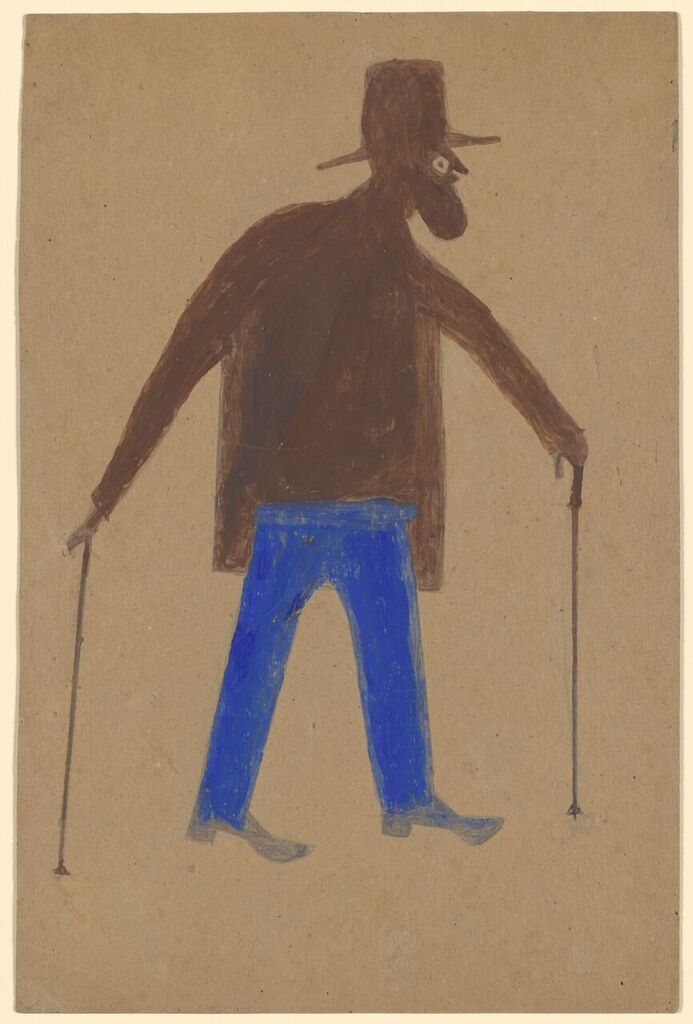
There is no doubt that Traylor included himself in the drama or human comedy that he sketched and painted. We see a frequent figure in these works, a fellow wearing a tall crowned hat and sometimes leaning on walking canes or crutches. That is Bill Traylor portraying himself.

The evidence of his more cryptic works, however, leads one to conclude that Traylor aimed to do much more than chronicle his life and times. Bill Traylor's "eyes were watching God" and doing so from a vantage point that stretched back to Africa. 


Bill Traylor, Leg Forms with Bird, ca. 1939-40

Let's consider Traylor's enigmatic Leg Forms with Bird.

Here we see two well-shod legs. Traylor was a shoe-repairman late in life and valued well-made boots and fashionable clothes. Yet here, the legs are moving in opposite directions and sprouting roots or trees. In the middle is a small bird at repose. Does this bird recall the sacred Sankofa from Ghana in West Africa? The Sankofa symbolized the act of looking to the past in order to search for knowledge useful for future life. 

Denied proper education and health care, African Americans carefully preserved traditional African folk remedies and wisdom literature, called by various names, conjure or hoodoo. These traditions fused with evangelical Christianity to create a support system and world view for African Americans independent of mainstream American life. Leg Forms with Bird testifies to this great truth.
 

Bill Traylor, Man with Yoke, ca.1939–40 

We can see in many of Traylor's works fascinating examples of the way that African spirituality negotiated its way into the consciousness of America. In Man with a Yoke, Traylor depicted a man wrestling with his conscience. It was a familiar theme, often seen in cartoons and advertisements. Traylor may have been influenced by these angel/devil on the shoulder pictures. A far more potent factor was a spiritual concept that had survived the terrible journey from Africa aboard the slave ships.

From West Africa came the potent ideal of the "little me within the big me." The "little me" was the immortal soul, tried and tested by adversity, able to "trabel" in ecstatic vision experiences to the gates of hell and back. What seems like a "good angel, naughty devil" caricature is in fact a powerful expression of the journey of the soul.

The more that one studies the art of Bill Traylor, the greater is the realization that he was not an "outsider" artist as he is often described. Traylor was firmly "inside" the African American cultural tradition. He was also a major spiritual figure and much of his art needs to be interpreted from a religious perspective.


Ed Voves Photo (2018), Bill Traylor's Black Jesus, ca. ca.1939–42

Traylor's profoundly moving Black Jesus is one one of the highlights of Between Worlds.  Given the heart-piercing power of this work, it defies the need for commentary. If any of Traylor's works speak plainly and without ambiguity, Black Jesus is it.

When it comes to the many works featuring animals and birds, interpretation is needed. In the case of the bird in Leg Forms with Bird, an educated guess can be made. This is true of Traylor's Rabbit, as well. Rabbits and hares figure prominently in West African folklore, as trickster figures. Small and vulnerable, the rabbit survives by his cunning and speed. He outwits the predator, living to have the last laugh.


Bill Traylor, Rabbit, ca. 1940-1942

The hare/rabbit trickster reappears in African American folk tales as the clever Br'er Rabbit, who "outfoxes" Br'er Fox. Interestingly, Native Americans of the southern states such as the Cherokee feature a trickster rabbit in their stories as well. Traylor's Rabbit, scrambling for its life, has a long - and distinguished - pedigree.


Bill Traylor, Figures and Construction with Cat, ca. 1939–40 

Other works, such as Figures and Construction with Cat, speak from a level of spirituality beyond our comprehension. Here a cat with a "thousand-yard stare" looks beyond a scene of mayhem, folly and cruelty. The cat sits in what appears to be a coffin, while behind him a crucifix is being "constructed." Perhaps in the fullness of time, Traylor's meaning will be discerned, but I am not the person to try.

"Food for thought" is plentiful in Between Worlds at the Smithsonian American Art Museum. Curator Leslie Umberger has spent over five years on this exhibition of Traylor's art. Wisely organized on a thematic plan, the abundant examples of Traylor's works she has selected are easier to grasp, even if the meaning of many is still elusive. 


Ed Voves Photo (2018), Gallery view of Between Worlds: the Art of Bill Traylor

Two standout features of the exhibition deserve to highlighted. Umberger, during her exhaustive research, found a short color film of Montgomery, Alabama, dated to 1940-41. A movie screen prominently displays this film, enabling us to see the very people and buildings that Traylor saw and sketched. Sadly, there is not a glimpse of the artist himself, but he is there in "spirit."  

No artist lives and works in a vacuum. Traylor was befriended by a young white artist named Charles Shannon, who supplied him with art supplies and collected his works. With a group of other progressive artists, Shannon organized an exhibit at the New South Gallery in Montgomery during 1940. A commemorative booklet with hand-lithographed prints was made for the exhibition and a rare surviving copy is on view in the Beyond Worlds galleries.


Ed Voves Photo (2018), Booklet from Bill Traylor's Exhibit at the New South Gallery

As you behold this singular work of art, the residual power of Traylor's amazing personality is very evident. Conjure, the special magic of African-American spirituality, is on view in that display case, along with the booklet. There is no need of further commentary here, just as I mentioned with Black Jesus.

Just look, just listen in the silence. The meaning of Traylor's art will soon be apparent. It will - to quote Traylor - "just come" to you.   

***
Text: Copyright of Ed Voves, all rights reserved 

Introductory Image:  
Bill Traylor (American, 1853/54–1949) House, ca. 1941. Watercolor and graphite on cardboard: 22 1/4 × 14 1/8 inches. Montgomery Museum of Fine Arts, Montgomery, Alabama, Gift of Charles and Eugenia Shannon, 1982.4.29

Bill Traylor  (American, 1853/54–1949)  Untitled (Radio), ca. 1940-1942. Opaque watercolor and pencil on printed advertising paperboard: 32 1/2 × 24 1/2 in. (82.6 × 62.2 cm) Smithsonian American Art Museum. Museum purchase through the Luisita L. and Franz H. Denghausen Endowment.Object Number 2016.14.4

Ed Voves, Photo (2018) Gallery view of Between Worlds: the Art of Bill Traylor, exhibition at the Smithsonian American Art Museum. Photo shows Bill Traylor's Man and Large Dog, ca. 1939-1942.

Bill Traylor (American 1853/54–1949) Black Smith Shop, ca. 1939–40. Pencil on cardboard:13 3/8 x 26 1/4 in. (34 x 66.7 cm) Metropolitan Museum of Art. Gift of Eugenia and Charles Shannon, 1995. Accession Number:1995.399  Image: © The Metropolitan Museum of Art, New York

Bill Traylor (American, 1853/54–1949) Self-Portrait,  ca. 1939–40.  Gouache and pencil on cardboard:  17 1/4 × 11 3/8 inches. Courtesy of The Metropolitan Museum of Art, Promised Gift of Charles E. and Eugenia C. Shannon. © The Metropolitan Museum of Art, New York

Bill Traylor (American, 1853/54–1949) Leg Forms with Bird, ca. 1939-1940. Charcoal on cardboard: 13 × 7 1/2 inches. Private Collection.

Ed Voves, Photo (2018) Bill Traylor's Black Jesus, ca. 1939–40. Gouache and pencil on cardboard: 13 3/4 inches × 10 inches. Courtesy of The Metropolitan Museum of Art, Promised Gift of Charles E. and Eugenia C. Shannon

Bill Traylor (American, 1853/54–1949) Rabbit, ca. 1940-1942. Watercolor and graphite on cardboard: 8 3/8 × 11 1/8 inches. Montgomery Museum of Fine Arts, Montgomery, Alabama, Gift of Charles and Eugenia Shannon, 1982.4.10.

Bill Traylor (American, 1853/54–1949) Figures and Construction with Cat: ca. 1939–40    gouache and pencil on cardboard:   13 7/8 × 9 1/8 inches. Courtesy of The Metropolitan Museum of Art, Promised Gift of Charles E. and Eugenia C. Shannon. © The Metropolitan Museum of Art, New York   

Ed Voves, Photo (2018) Gallery view of Between Worlds: the Art of Bill Traylor, exhibition at the Smithsonian American Art Museum.     

Ed Voves, Photo (2018) Booklet from Bill Traylor's Exhibit at the New South Gallery, Montgomery, Alabama, 1940. On view in the  Between Worlds: the Art of Bill Traylor exhibition at the Smithsonian American Art Museum.